Looking for imodules (Encompass) alternatives available for advancement and alumni relations teams? We've picked out some of the popular options that you can consider.
Almabase
Updated:
July 16, 2026

Summary
With the dust settling from Anthology’s major corporate restructuring, your team might find themselves faced with the opportunity to re-evaluate what’s working and what isn’t. This is especially true if events sit at the absolute center of how you engage alumni and drive giving.
In this blog, we’ll walk through the top alternatives for your team with events in mind, what to look for in a modern system, and what a smooth transition away from Encompass (iModules) looked like in practice. Let’s dive in.
While most platforms will look similar on paper, you can look at how their features come together, especially around events.
Here's what to evaluate:
The CRM is where data comes together, and when someone registers for an event, makes a gift, or updates their information, you don't want that data sitting in a spreadsheet waiting to be imported later. With Encompass (iModules), event data reaches your CRM through manual exports or scheduled batch syncs, which means your team could be looking at outdated information. During a giving day, reunion, or fundraising gala, that delay can make it much harder to understand what's happening in real time and respond while engagement is at its peak. Your data should feed into your CRM in real time, giving your team an ideal, reliable view of what’s happening in your event.
TrueSync keeps Blackbaud Raiser’s Edge NXT and Almabase in sync in real time, so gift and event data never sits in a queue waiting for a manual export.
Because Encompass (iModules) was built on a legacy architecture, its event features can feel disconnected from the rest of the platform. In practice, that often means advancement teams have to step outside the system to handle things like ticketing, check-ins, or attendee management. Instead of running everything in one place, staff end up juggling multiple tools, switching between them during busy events, and piecing together attendee data afterwards. Your event platform should support the entire event lifecycle in one place, so your team spends less time wrestling with the technology and more time creating great alumni experiences.
Planning a multi-day event like Homecoming or Reunion Weekend with Encompass (iModules) can become more complicated than it needs to be.
Things like creating individual sessions, setting capacity limits, or building different itineraries for guests often require manual workarounds because the registration forms aren't flexible enough to handle them easily.
Ideally, you should be able to build a single master event and organize sessions, tracks, and attendee schedules underneath it with just a few clicks.
Making a quick text edit, updating a logo, or adding a last-minute question to an Encompass (iModules) page can mean waiting on IT or burning a customer support ticket. Advancement teams rarely have dedicated web developers. The coordinators who run your campaigns should be able to create, brand, and modify pages confidently on their own, ideally with minimal to no coding required.
Before we get into the details, here’s a summary of the top 5 Encompass (iModules) alternatives and all they have to offer:
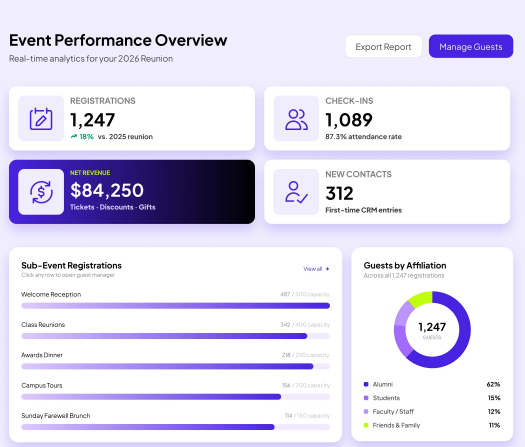
Almabase is a good fit if your team runs events year-round. Instead of piecing together separate tools for registration, ticketing, communications, and CRM updates, everything lives in one place. Event attendance and constituent information sync automatically with Raiser's Edge NXT, while giving data flows over in clean, organized batches. That means your team always has an up-to-date view of who's registering, attending, and giving, without spending hours cleaning up spreadsheets after every event.
Key strengths:
After nearly a decade on iModules, the team at New England College found themselves spending more time managing technology than engaging alumni. Everyday tasks involved manual data entry, spreadsheet clean-up, and workflows that felt far more complicated than they needed to be.
Switching to Almabase gave them a much simpler way to work. Anna Twombly, Director of Annual Giving and Alumni Relations, said the migration was far smoother than expected, and her team quickly became self-sufficient. They could launch giving days, manage event registrations, and update pages themselves instead of waiting on technical support. For a lean advancement team, that meant less time wrestling with software and more time focused on building meaningful relationships with alumni. Check out the full conversation below! 👇
What it's not great at: Almabase does not include prospect research or wealth screening tools. If complex management for major gifts research is a priority, you'd need to layer in a separate platform.
Pricing: Custom pricing based on institution size and needs.
Cvent is one of the most well-known event management platforms on the market. If your institution is coordinating admissions fairs, conferences, athletic events, and campus-wide programmes from one central system, Cvent makes a lot of sense.
Key strengths:
What it's not great at: Cvent is designed as a general event management platform, and not specifically for advancement. That means alumni engagement features like community directories, mentorship programmes, giving pages, and donor-focused workflows aren't part of the core experience.
Universities looking for a single platform to manage large, institution-wide event programmes across multiple departments will find Cvents to be a natural fit.
If your advancement office mainly runs reunions, regional events, giving days, and alumni programming, you may find Cvent more complex than you need.
Pricing: Custom quote, with the median at $19,500 a year.
Eventbrite is one of the easiest ways to publish and sell tickets for an event. It's familiar, simple to use, and great for taking a registration page live quickly. If you're hosting an event where ticket sales are the priority, it's hard to beat for convenience.
Key strengths:
What it's not great at: Eventbrite was built for event ticketing, not advancement. It doesn't recognize alumni or donor records or support fundraising workflows like pledges and auctions. Because it doesn't natively sync with advancement CRMs, your team will likely end up exporting attendee lists and matching records manually after every event.
Smaller advancement teams or alumni clubs running simple, standalone events where collecting registrations is more important than tracking long-term constituent engagement will find this to be a good fit.
Pricing: Free for free events. For paid events, Eventbrite charges per-ticket fees. Verified nonprofits can receive discounts on some marketing plans, but those discounts don't apply to ticketing fees.
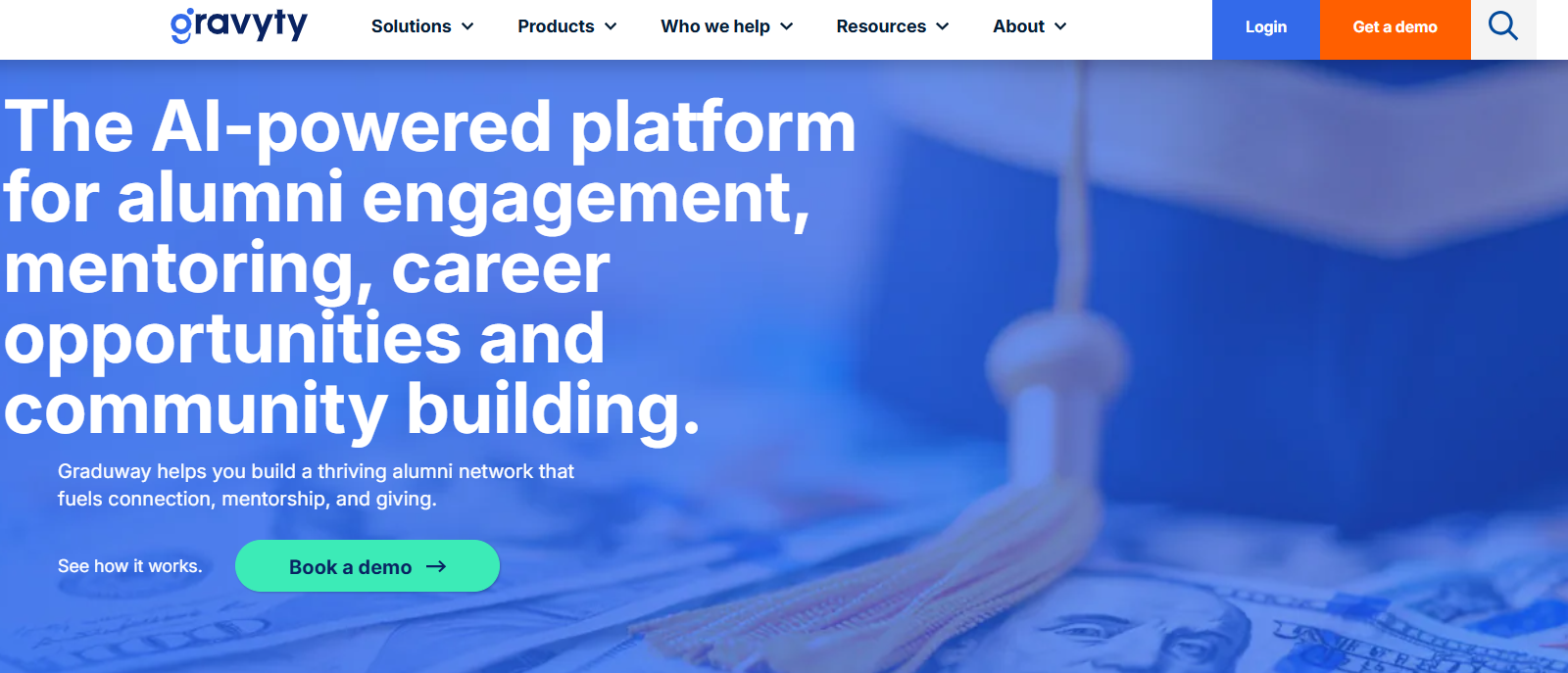
Gravyty takes a different approach: instead of offering one place to manage everything, it brings together a suite of products focused on fundraising, donor engagement, alumni networking, and AI-assisted outreach. If your biggest priority is growing digital giving and helping gift officers work more efficiently, it's a compelling option.
Key strengths:
What it's not great at: Gravyty isn't designed as a single, unified event management platform. Basic event registrations are available through Graduway, but the event functionality is relatively lightweight. Data also syncs back to CRMs like Blackbaud or Salesforce through scheduled updates rather than continuously in real time.
This option would be good for advancement teams that prioritize digital fundraising, AI-assisted major gift work, and donor stewardship over complex event management, and are comfortable working across multiple products instead of one integrated platform.
Pricing: Custom pricing based on your institution's size and requirements.
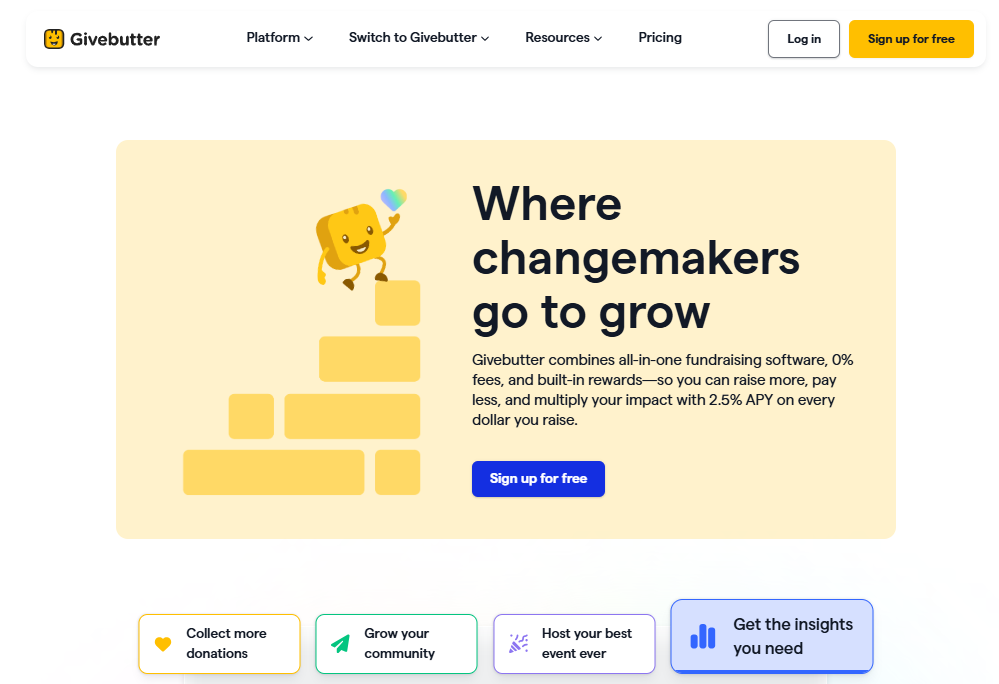
Givebutter is a highly popular, modern fundraising platform that bundles peer-to-peer campaigns, event ticketing, and auction tools into an incredibly user-friendly dashboard.
Key Strengths:
What it's not great at:
It is not built for higher education. It lacks alumni portals, directories, or mentorship matching. More importantly, it features no native, two-way advancement CRM integrations (like a direct Raiser’s Edge NXT sync). Because it is designed for simple, single-form events, running complex university milestone schedules like a multi-day Homecoming or Reunion Weekend will quickly outgrow its functional limits.
Givebutter is a great fit for individual campus departments, student organizations, or smaller advancement shops running straightforward, standalone peer-to-peer campaigns and auctions on a tight budget.
Pricing: Core tools are free if donor tips are left on. Disabling tips triggers a flat 3% platform fee (plus standard credit card processing). Upgrading to Givebutter Plus for advanced automations uses contact-based pricing, starting at $29/month for under 250 contacts and scaling upward as your alumni list grows.
Many university advancement teams already rely on Blackbaud Raiser's Edge NXT to manage donor relationships and fundraising. It's excellent at tracking constituent history, gifts, and engagement over time, but it isn't designed to run events on its own.
Things like event registration, attendee management, and on-site check-ins require a dedicated event platform. If you want that event data to flow into RE NXT without manual imports, you'll need a platform with a purpose-built integration, such as Almabase's TrueSync or Cvent's connector. For institutions already invested in the Blackbaud ecosystem, it's often the easiest way to modernise event management while keeping the same CRM at the centre of operations.
Ellucian is designed for institutions that want advancement data closely connected to the rest of the university ecosystem, from student records to finance and ERP systems. It serves as a powerful back-end system for managing constituent and fundraising data, but it isn't built to power the day-to-day event experience.
Features like branded registration pages, flexible event forms, and on-site check-in usually require a separate event platform. As a result, many advancement teams use Ellucian alongside a dedicated events solution that handles the public-facing side of registrations while keeping the underlying data connected.
Salesforce is flexible and works well as the central CRM for institutions with complex data needs. Institutions piece it together using offerings like Salesforce Education Cloud and Salesforce Nonprofit Cloud, depending on whether the priority is student lifecycle data or donor and fundraising management.
But when it comes to running events, its native capabilities are fairly limited. Most teams rely on dedicated event platforms like Almabase or Cvent to handle registrations, event websites, and attendee management. Those integrations then feed event data back into Salesforce, allowing institutions to keep the CRM as their single source of truth without asking it to do everything on its own.
Whichever CRM you use to hold your donor data, the event layer you place on top of it is what determines how much overhead your team can expect in terms of data reconciliation.
At the end of the day, it is up to you and your team’s unique needs that will determine your platform of choice for 2026 and beyond. But we hope we’ve been able to give you a good starting point to find the right fit for you.
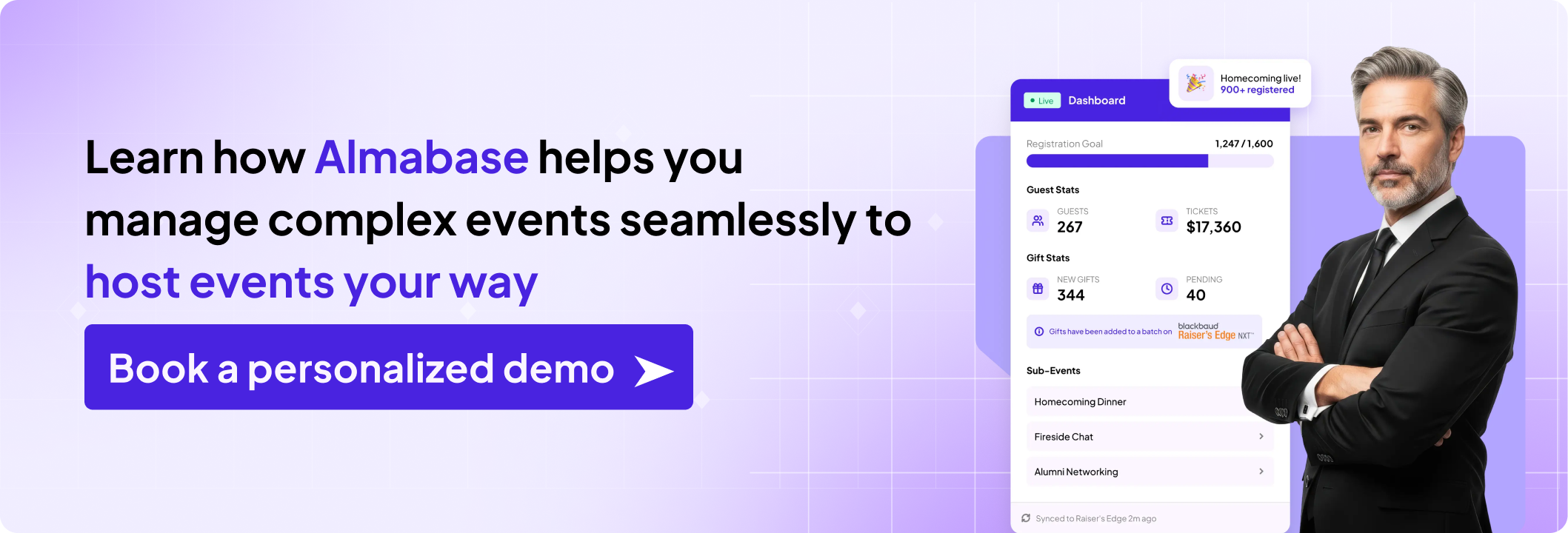
If you’d like to learn more about Almabase and how we help institutions and organizations for advancement needs, feel free to book a personalized demo call with us below! ⬇️
Almabase provides dedicated personnel for your onboarding and training as you or your team gets used to Almabase. We also provide readily available live chat, email, and on-call support in case you run into any hiccups.
Almabase also supports K-12 schools and healthcare foundations managing donor and alumni communities.
Almabase comes with its own set of reporting and analytics tools for giving, engagement, and donor pipeline data.
Yes. Almabase supports multi-day and multi-session events natively, including separate registration and check-in for each session under one parent event, so reunions, homecoming weekends, and multi-track galas don't require a spreadsheet workaround or a second tool.
Subscribe
See how modern advancement teams bring alumni engagement and fundraising together.
Plan faster. Execute better
Explore free templates designed for alumni and fundraising teams.
.png)

.avif)
Almabase
What started in 2012 as a small social media campaign has grown into a global giving phenomenon that now inspires millions across 90+ countries to support the causes they love, all in just 24 hours. This brings us to the point of this blog. The fundraising platform you choose to build your Giving Tuesday events and fundraisers on can make or break your annual experience drastically.
We’ve curated a handful of platforms designed for education-focused teams to do more with less, so you can spend time building relationships, not battling technology.
Here’s a closer look at some platforms that can help your institution raise more and engage better for this year’s Giving Tuesday and beyond. Let’s get started:

Almabase often comes up first when education teams want a platform that balances rich tools with actual ease. It is purpose-built for advancement, blending fundraising, alumni engagement, and events into one modular platform. It shines when teams want depth, data, and scalability with the support of a dedicated team. Here’s how it stacks up-
Advancement teams that want a long-term, comprehensive platform to integrate fundraising with a strategic alumni engagement and community-building effort.
Almabase offers pricing based on your needs and the size of your alumni and donor base that you want to engage with. You can book a personalized demo and get a quote here.

Givebutter is known for its modern, donor-friendly design and transparent pricing. It combines crowdfunding, peer-to-peer fundraising, and event ticketing in one platform. Here’s how it stacks up –
Schools, nonprofits, and small teams wanting an easy-to-launch Giving Tuesday campaign platform with built-in social tools and no upfront software cost.
It operates on a 100% transparent tip-or-fee model, meaning it's free to use with a voluntary tipping system. Organizations can choose to cover the platform fee themselves or let donors cover it with an optional tip.

Donorbox is a platform known for its focus on providing a secure, reliable, and conversion-optimized donation experience through its simple, yet powerful, features. It is designed for nonprofits of all sizes, including schools and universities with diverse fundraising needs.
Mid-sized to large schools and universities that need a reliable, cost-effective, and conversion-optimized tool to run a Giving Tuesday campaign, especially for direct online appeals and recurring giving.
Donorbox offers a free standard plan, a pro plan at $150/month, and a premium plan with custom pricing.

Givecampus is a fundraising platform for educational institutions, empowering fundraisers at every stage of the fundraising lifecycle. Its core value proposition is its deep understanding of and specialization in the unique needs of schools and universities, from online giving days to volunteer management.
Key Features
Large, established colleges and universities with a strategic focus on alumni engagement and a dedicated advancement team that can leverage its enterprise-grade features for a high-impact Giving Tuesday.
GIveCampus has three platform plans: Essentials, Professional and Enterprise. On top of this, your price will vary depending on the modules you need.

Bonterra, formerly a suite of tools including EveryAction, is a comprehensive, enterprise-grade solution that has garnered a reputation as a robust fundraising platform for larger nonprofit organizations with complex needs. It aims to provide a single, unified solution for fundraising and donor engagement.
Large universities and institutions that need a long-term, comprehensive CRM and fundraising solution, and for whom Giving Tuesday is a part of a larger, integrated annual giving strategy.
Tailored to the organization's unique needs, with pricing based on size, complexity, and features.

Onecause is a fundraising platform with a particular focus on events, auctions and peer-to-peer campaigns. It is designed to help organizations streamline the guest experience and run successful events.
Educational institutions with a Giving Tuesday strategy built around a live or virtual event, auction, or other high-energy initiative.
Onecause has different pricing plans based on which features you need to use between fundraising and text-to-give, auction and events, and peer-to-peer fundraising.
Maybe you just need a simple crowdfunding platform this year to complement an event you are already planning with another tool, or you just want to use an easy-to-set-up fundraising page with names that have become synonymous with raising money for causes. If that’s what you’re looking for, here are some of the popular ones to choose from:
…and more depending on your institution’s geographic location.
Not every platform is built with education teams in mind, and choosing wrong can cost you both time and momentum. With so many options, the right fit depends on what your team actually needs, not just flashy features. So, while deciding, keep these factors in mind:
Want a deeper breakdown of these essentials? Take a look at our guide on giving day platform features every institution should consider.
The right Giving Tuesday platform should lighten your team’s load while helping you hit ambitious goals. The platforms we’ve covered are built with education teams in mind; it’s just a matter of matching your goals, team size, and budget to the right solution. Once done, you’ll set yourself up for more than just a one-day win.

6 Great Giving Tuesday Platforms for Schools & Universities (2026)
Lorem ipsum dolor sit amet, consectetur adipiscing elit. Suspendisse varius enim in eros elementum tristique. Duis cursus, mi quis viverra ornare, eros dolor interdum nulla, ut commodo diam libero vitae erat. Aenean faucibus nibh et justo cursus id rutrum lorem imperdiet. Nunc ut sem vitae risus tristique posuere.

Sharada Koti
August 26, 2025
12 minutes
Giving Days are one of the most important fundraising events today for institutions and nonprofits alike. According to EAB, 12.7% of private institution alumni and 19.8% of public institution alumni make their first gift on a giving day. In turn, powerful Giving Day platforms have cropped up to help teams get the most out of these events.
With so many excellent giving platforms available today, we’d like to zoom out and let you know which features you should consider essential and how you can make the most of your eventual choice. Let’s get started:
A good giving platform should ideally be:
Test your dashboards, giving pages, forms, and all other touchpoints to make sure all the people involved in your Giving Day have a smooth and memorable experience across all devices.
For social media, your team should be looking for features such as:
💡 Consider which social media your donors and supporters are most active in. You’ll want a platform that integrates to the same level of depth on those specific platforms.
Giving Days, due to the nature of being a focused fundraiser within a short window, will naturally need a platform that can handle many transactions at the same time. You will have bursts of transactions, such as when the campaign launches and after a successful promotion. A good Giving Day platform also needs to incorporate SSL/PCI-compliant payment processing as well as any other compliance requirements depending on the national or state laws applicable to your fundraiser.
You need to be able to engage donors and potential donors before, during, and after your Giving Day. Automated and personalized engagement through email, text, and social media may be crucial, especially if communicating with a larger pool of donors.
💡 Depending on your overall engagement strategy, you may want a fundraising platform that has a few donor engagement features on top or a dedicated engagement platform that works in tandem with your fundraising tool.
With a relatively short burst of high activity, you should be looking for platforms that support:
💡 Keep the above features as well as your needs in mind as different might CRMs interact with different tools in varying capacities.
Engaging and enabling donations from mobile device users are no longer something novel. Today, you’ll want a giving platform that not only engages mobile users but also optimizes their experience so that they don’t end up with an inferior experience.
Some platforms provide an app-based approach, while others go for mobile-optimized browser experiences.
💡Surveys and donor device metrics should help you get a sense of how much of a priority mobile features are for you as well as which method your donors prefer.
The cornerstone of any modern-day Giving Day campaign is a well-designed, customizable fundraising page that captures your organization's unique brand and mission. Customization is especially important for peer-to-peer fundraisers, where you’ll want to find the right mix between flexible templates and recognizable branding.
If you are regularly hosting Giving Day fundraisers, chances are that you have a long-term fundraising plan. This is where you’ll want a giving platform that is viable for both long-term and short-term fundraising efforts. Depending on your needs, look for platforms that include:
to make sure that your Giving Days produce an effective ripple effect.
It’s easy to get lost in all the fancy and innovative features that fundraising platforms offer today. Instead of trying to use a feature simply for the sake of trying something new, keep your mission and the people involved at the heart of your Giving Day campaign by enabling your storytelling and vision through the features available.
Whether it’s connected to an existing CRM or comes with its own, you will most likely get a good amount of data about your supporters, donors, and prospects throughout your campaign. Make detailed segments to optimize your outreach and communication efforts and enrich these segments after your campaign to make your engagement better with each fundraiser.
Always test your forms, pages, and communication efforts on mobile devices to check how they would feel for a donor trying to donate. Your CTAs might be a couple of scrolls away and on the side of your giving page when it’s front and center on other devices.
Your recent first-time donor might just be your next superstar supporter. Make sure your donors feel good about their contribution by keeping them informed on goals reached throughout the day. Keep them looped in on how the funds are being used and inform them about future initiatives coming up.
Giving Days are so integral to your long-term fundraising plan that you might feel like the choice of platform might make or break your strategy entirely. However, a lot of work goes into making these platforms work optimally for a specific institution or organization.
If you’re looking for a platform that syncs effortlessly with CRMs with a team committed to ensuring your giving day success, get in touch with us, and we’d be glad to show you how we can help. 🫡

Giving Day Platforms: Essential Software Features
Lorem ipsum dolor sit amet, consectetur adipiscing elit. Suspendisse varius enim in eros elementum tristique. Duis cursus, mi quis viverra ornare, eros dolor interdum nulla, ut commodo diam libero vitae erat. Aenean faucibus nibh et justo cursus id rutrum lorem imperdiet. Nunc ut sem vitae risus tristique posuere.
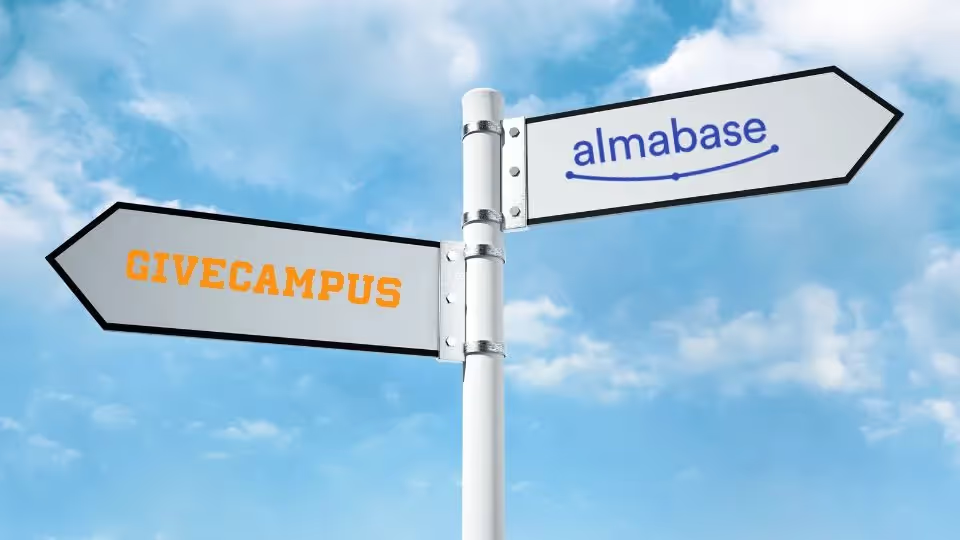
If you’ve looked at fundraising and alumni engagement platforms for educational institutions, you’ve probably seen Almabase and GiveCampus get mentioned frequently.
With two great options, it might seem a difficult choice at first. However, depending on your needs for a peer-to-peer fundraising platform, an all-around digital engagement solution, or other needs, your choice can vary greatly. With this blog, we’d like to provide a buyer’s guide to help you make an informed choice to see what each platform does well and which of the two might fit your team better. Let’s get started:
Almabase is a SaaS platform designed to empower alumni teams across schools, colleges, and universities. It integrates with existing CRM systems to enhance digital engagement, event management, and online giving campaigns. Almabase is effective for small teams looking to amplify their impact without expanding resources.
GiveCampus is a fundraising platform specifically built for educational institutions. It streamlines the fundraising lifecycle by identifying, engaging, soliciting, and stewarding donors. GiveCampus is known for its user-friendly interface and robust volunteer management features.
1. Integration and Efficiency: Almabase seamlessly integrates into most educational institution CRM systems, especially those based on Raiser’s Edge NXT thanks to a long-standing partnership, which ensures:
2. Digital Engagement Tools: Almabase offers advanced digital engagement tools that help institutions build lifelong relationships with alumni through a comprehensive alumni directory, personalized emails, text communication, etc. to reach out to alumni more effectively.
3. Excellent Customer Support: Almabase offers both email and chat-based support that can be reached at any time, with a focus on quick response and resolution time.
1. User-Friendly Interface: GiveCampus is praised for its intuitive design, making it easy for both fundraisers and donors to use. It simplifies the donation process, leading to higher conversion rates.
2. Volunteer Management: GiveCampus offers a robust volunteer management system that empowers volunteers to track their outreach efforts effectively. This feature is great for successful peer-to-peer fundraising campaigns.
3. Extensive support for mobile payment: GiveCampus supports most popular mobile/digital wallets and a large number of cryptocurrencies, allowing more flexibility for donors.
If you are an educational institution that already has a digital engagement platform and only needs a fundraising module, both solutions will provide with you a robust fundraising and event solution. However, if you are looking for all-around alumni engagement on top of fundraising, Almabase might suit your needs better.
If your institution already uses a CRM like Raiser’s Edge NXT, Almabase might be more suitable due to its seamless integration capabilities. While GiveCampus also has several amazing integrations, it incurs additional charges for third-party integrations.
If volunteer management and peer-to-peer fundraising are key priorities, GiveCampus offers more robust features in this area.
Almabase supports several payment platforms and is a great choice due to its integration with Blackbaud Merchant Services (BBMS). However, if you are looking to support as many platforms as possible including cryptocurrency, GiveCampus does give you more choices.
Both platforms have slightly different pricing structures. Almabase’s pricing primarily depends on the size of your institution, the number of records, and how many modules you need. On the other hand, GiveCampus has different plans depending on the number of features you need, and may also charge fees for exceeding goals on top of integration charges. You should ideally consider both options to get a quote that fits your needs and your budget.
If yours or a related nonprofit wants to make use of either option, it is certainly possible. However, Almabase has more experience working with nonprofits while GiveCampus exclusively caters to educational institutions.
What we advise when picking any platform is that you consider the budget, skillset, and time available to your team above all else (even if that means you choose a platform that’s not ours). What works really well for a similarly sized school might not work for you due to nuanced aspects like state regulations, donor experiences, extra fee scaling, etc.
Once everything seems aligned, make sure to pursue a demo or free trial (ideally one that’s personalized for your needs) to confirm. That being said, we hope you are able to make a decision you, your team, and your alumni are comfortable with.

Almabase vs GiveCampus: What is the right tool for you?
Lorem ipsum dolor sit amet, consectetur adipiscing elit. Suspendisse varius enim in eros elementum tristique. Duis cursus, mi quis viverra ornare, eros dolor interdum nulla, ut commodo diam libero vitae erat. Aenean faucibus nibh et justo cursus id rutrum lorem imperdiet. Nunc ut sem vitae risus tristique posuere.
%201.svg)
%201.svg)
%204.svg)



.svg)