The right alumni management software can make or break your alumni engagement strategy. Find all you need to know about choosing the right product for your team in this blog.

Anwesha Kiran
Published:
January 20, 2026
Updated:
May 11, 2026
.avif)
Summary
• Start your software search by clarifying your specific alumni engagement goals first: Before diving into features, figure out if your main priority is boosting event attendance, improving data quality, or growing giving; this focus helps you avoid overbuying and finds a platform truly aligned with your challenges.
• Look for a system that centralizes all your alumni data and activities, not just a few: Scattered spreadsheets and separate tools make it tough to know who's truly engaged, so a unified platform that connects communications, events, and giving is key to overcoming data silos.
• Prioritize platforms that make targeted communication and personalized outreach easy for your small team: It's crucial for fundraising campaigns and general alumni engagement to be able to confidently segment your audience and send relevant messages without needing heavy IT support.
• Community features like groups and mentoring programs are game-changers for sustained engagement beyond events or appeals: They give alumni a reason to connect with each other, showing the value your institution offers even when you're not actively fundraising.
• Ensure your new software integrates seamlessly with your existing CRM and SIS to prevent new data silos from popping up: Good integrations mean your alumni engagement efforts actually inform your overall advancement strategy, reducing manual work and improving data confidence.
• When evaluating, ask vendors how their platform helps you track and act on engagement data, not just report it: You need clear insights into who's active and who's drifting, so you can allocate your team's precious effort where it counts most for donor participation and engagement.
• Don't overlook implementation support, pricing structure, and ongoing vendor commitment during your decision-making process: These long-term factors often determine whether your new alumni management software becomes a strategic asset or a costly headache down the road.
Choosing the right alumni management software is a crucial decision for any advancement team. Even with changing alumni expectations, data across too many systems, teams are expected to drive engagement, events, and giving, all without adding more tools. This article is for teams that want clarity on what to look for, what actually matters, and how to avoid buying a platform that looks good in a demo but underperforms in practice.
In the sections that follow, we break down what modern alumni platforms are designed to do, how today’s alumni engagement software and alumni management systems differ from generic CRMs, and which capabilities directly support long-term relationships.
.avif)
An alumni management software is a centralized platform that helps institutions manage alumni data, communication, events, and giving in one place. It is built specifically for alumni teams. Most platforms in this category combine directories, messaging, events, online giving, and reporting so teams can run engagement programs without stitching together multiple systems.
The key difference is in how the software is used day to day. Alumni can update their profiles, register for events, join groups, or donate through a single experience, while teams can see how individuals interact across those activities over time. This makes it easier to understand who is engaged, who is drifting away, and where to focus outreach, which is why many institutions rely on alumni management software for ongoing alumni relationship management, rather than treating engagement and giving as separate efforts.
At the buying stage, the value of alumni management software is not about having more features. It is about whether those features reduce friction for your team and create consistent engagement for alumni. Most institutions already have email tools, event tools, donation pages, and spreadsheets. The real question is whether bringing these together in a single system actually improves outcomes for advancement.
At the buying stage, the value of alumni management software comes less from feature breadth and more about whether those features measurably improve engagement and giving. That matters because industry benchmarks show just how limited alumni participation typically is. Reports show that only 19-20% of alumni engage with their institution in any form, including communications, events, volunteering, or giving.
Keeping this in mind, the real benefit of an alumni platform is its ability to help teams identify areas that need support, focus effort where it counts, and reduce friction across engagement workflows.
Here’s a closer look at the core capabilities buyers expect from modern platforms and why they matter when you are comparing vendors side by side.
For most advancement teams, the alumni database is where trust is won or lost. Alumni management software replaces scattered spreadsheets and partial records with a single directory that alumni can interact with directly. Self-service profile updates, searchable records, and enrichment through integrations mean teams spend less time chasing correct information.
The practical benefit here is the ability to segment audiences confidently and act on that segmentation without second-guessing whether the list is accurate. Teams evaluating platforms should pay close attention to how easy it is to maintain data quality over time, not just how records look on day one. With engagement concentrated among a small subset of alumni, the role of alumni software is to help teams identify, deepen, and sustain those relationships without spreading effort too thin.
Most platforms promise multi-channel communication. What buyers quickly discover is that ease of use matters more than channel count. Alumni management software typically includes email campaigns, newsletters, automation workflows, and templates that are built for small teams managing ongoing outreach.
There is also a clear link between digital engagement and giving. A 2024 alumni trends survey found that 93% of alumni who donate are active on their institution’s alumni portal, highlighting how ongoing digital interaction supports philanthropic behavior.
The real value shows up in consistency. When communication tools are integrated with alumni data and activity, teams can move away from one-off blasts and toward regular, targeted messaging that reflects alumni interests and past engagement. This is often where generic CRMs fall short, requiring heavy configuration to achieve the same result.
The advancement outcome here is simple but critical: teams can confidently target alumni by location, interests, or past involvement, reducing wasted outreach and increasing relevance in both engagement and fundraising campaigns.
One of the clearest differentiators between alumni platforms and traditional advancement tools is the presence of community features. Groups, chapters, discussion spaces, and peer-to-peer interaction give alumni a reason to return even when there is no event or appeal running.
From a buyer’s perspective, this matters because engagement that happens between campaigns is easier to sustain. Institutions that rely only on email and events often see activity spike and drop. Community features help smooth that curve by keeping alumni connected to each other, not just to the institution.
Events are a major driver of alumni interaction, but they are often managed in isolation. Alumni management software brings event pages, registration, payments, check-in, and follow-ups into the same system as alumni records. Access to event management that feeds engagement data back into strategy is the real game-changer.
The benefit here is smoother logistics and visibility. Attendance, repeat participation, and post-event behavior become part of the engagement picture, making it easier to understand which events justify continued investment and which do not.
Most alumni platforms include online giving features such as campaign pages, giving days, recurring donations, and payment integrations. What buyers should look for is how tightly these tools connect to engagement history. Online giving tools are most effective when they are part of a broader engagement picture. Alumni management software links donations to communication history, event attendance, and other forms of involvement.
When giving activity is viewed alongside event participation, volunteering, or mentoring, teams gain a clearer sense of donor journeys. This reduces reliance on guesswork and makes it easier to time appeals based on demonstrated involvement rather than assumptions.
Career support and mentoring are often underestimated during evaluation because they do not immediately drive revenue. In practice, they are powerful engagement drivers, especially for younger alumni. This benefit is indirect but strategically important: perceived alumni value. For early-career alumni, relevance matters more than solicitation. Nearly half of alumni value career and networking opportunities as a primary reason to stay connected, which explains why institutions investing here often see steadier engagement over time.
Platforms that support job boards, mentoring programs, and alumni-student matching help institutions demonstrate value beyond fundraising. For many buyers, these features act as a long-term investment, strengthening relationships early and supporting future giving rather than forcing it.
No alumni platform exists in isolation. Integrations determine whether alumni data informs advancement strategy or sits in a parallel system. Advancement CRMs, student information systems, and finance tools still play a role. Strong alumni management software integrates cleanly with systems like Salesforce or Blackbaud to reduce duplication and manual reconciliation.
For buyers, this is often a deciding factor. Poor integrations create shadow processes and erode confidence in reporting. Good integrations make the alumni platform feel like part of the institutional ecosystem rather than another tool to manage.
Most platforms offer dashboards for email performance, event attendance, and giving. The difference lies in how actionable that data is. Buyers should look for reporting that helps answer real questions: who is engaged, who is slipping away, and where effort is paying off. Your dashboards should give you insights to support decisions.
Dashboards and engagement scoring support smarter allocation of effort, helping teams focus outreach where it is most likely to convert and clearly explain impact to leadership.
For advancement teams, security and compliance rarely influence engagement strategy until something goes wrong. Alumni management software handles personal data, communication preferences, and often payment information, which means gaps in permissions or consent tracking quickly turn into operational and reputational risks.
Platforms that support GDPR and CCPA requirements, granular permission controls, and clear opt-in and opt-out management make it easier for teams to engage alumni without second-guessing whether outreach is compliant. The practical outcome is reduced exposure for the institution and fewer internal blockers around campaigns, events, and giving. When compliance is built into day-to-day workflows, teams can move faster and engage more confidently at scale. As alumni become more conscious of data usage, transparency here increasingly influences willingness to participate, not just legal standing for advancement teams and institutions.
Once you shortlist a few platforms, the challenge is figuring out which system will actually work for your institution, your team size, and your advancement goals. Many platforms look similar on the surface. The differences show up after implementation.
Let us look at how advancement teams can evaluate alumni engagement software in practice:
Before comparing features or pricing, teams need internal alignment on what success looks like. Common goals include increasing participation, improving alumni data quality, expanding mentoring programs, or growing giving over time. The mistake many institutions make is trying to optimize for all of these at once.
At this stage, buyers should be honest about priorities. A platform that excels at community building may not be the best fit if your primary need is fundraising integration and event management. Clear goals help narrow options quickly and prevent overbuying. This is especially important if you are considering a product that is within an ecosystem of related modules.
When reviewing platforms, it is important to look beyond how vendors present their tools or how many features a platform has. Use a checklist to align with your team’s strategies and needs to best decide which software is your perfect match.
Tip: intentionally frame your checklist and evaluation criteria around operational impact to avoid getting caught in the details of feature depth.
Demos often highlight best-case workflows. Buyers should use this time to surface constraints and trade-offs. A few questions consistently separate strong platforms from polished presentations:
💡 Pay attention to the features that vendors emphasize but also keep an ear out for how they explain limitations. This transparency (or lack thereof) is often more revealing than feature lists.
Beyond features and demos, long-term fit often comes down to factors that are harder to spot early but expensive to fix later. Buyers who skip this layer tend to revisit the decision within a few years.
Even strong platforms struggle if onboarding is rushed or under-resourced. Institutions should look closely at how vendors handle data migration, training, and rollout. Think about the trade-offs: a shorter implementation timeline is not always better if it sacrifices adoption. Ask what successful launches typically look like and what internal effort is expected from your team.
Alumni management software is often priced based on alumni count, feature tiers, or modules. Buyers should confirm what is included upfront and what requires add-ons later. Costs tied to integrations, advanced reporting, or support can change the total investment significantly over time.
Some platforms evolve rapidly, while others remain static after core features are built. Ask yourself how product decisions are made and how often and to what extent customer feedback shapes the roadmap. This is especially important for institutions planning multi-year engagement strategies over short-term fixes.
Post-launch support matters more than pre-sales responsiveness. Clarify what support channels are available, response times, and whether customer success is proactive or reactive. This is especially relevant to advancement teams with limited technical capacity.
Almabase supports alumni engagement by helping advancement teams connect participation, communication, and giving in one place. For institutions evaluating alumni management software, this matters because engagement only becomes useful when teams can see which alumni are active, how they are engaging, and where to focus next.
The platform brings alumni profiles, communications, events, mentoring, and online giving into a single system. Engagement across these activities is tied back to individual alumni records, giving teams a clearer picture of involvement over time.
Where teams tend to see value is in how easily engagement data can be centralized without increasing operational overhead. Check out the top alumni management software for a broader comparison of tools and positioning.
Almabase also supports engagement across the alumni lifecycle. Institutions can onboard recent graduates, run mentoring and career programs, manage regional or virtual events, and maintain ongoing communication from the same platform. This approach helps alumni experience engagement as a continuous relationship rather than a series of disconnected touchpoints. Read more for a closer look at how institutions design these engagement journeys.
At Almabase, fundraising is embedded within the broader engagement experience. Online giving tools connect directly to communication and participation history, giving advancement teams better context when planning appeals and follow-ups. This alignment between engagement and giving is reflected in Almabase being recognized as the #1 donor management software by G2 Crowd, based on verified user reviews.
Overall, Almabase supports alumni engagement by giving institutions clearer visibility into participation, stronger coordination between alumni relations and advancement teams, and a more direct link between engagement activity and advancement outcomes.
Choosing alumni management software is less about finding a platform with the most features and more about finding one that fits how your institution actually works. At this stage, the most useful next step is to map your current engagement goals to your operational reality. That means understanding where alumni data lives today, how engagement is tracked, and which outcomes matter most to advancement leadership.
As you evaluate options, focus on how clearly each platform connects engagement activity to participation and giving, how easily teams can work together, and how much effort is required to maintain clean, usable data over time.
For institutions looking to centralise alumni engagement while keeping advancement outcomes in focus, Almabase offers a platform built around visibility, coordination, and scale. Exploring how it supports real engagement workflows can help determine whether it aligns with your needs.
At its best, alumni management software gives institutions clarity. Clarity on who is engaged, how relationships are evolving, and where to focus effort next. That clarity is what turns engagement into long-term impact.
Want to see for yourself how Almabase helps with alumni engagement and management? Book a personalized demo with us and we’d love to chat!
Subscribe
See how modern advancement teams bring alumni engagement and fundraising together.
Plan faster. Execute better
Explore free templates designed for alumni and fundraising teams.
.png)

.avif)
Anwesha Kiran
Alumni are among the most valuable assets of any educational institution. They provide mentorship, offer career opportunities, donate generously, and serve as brand ambassadors. But maintaining meaningful relationships with a growing alumni base is no small feat. That’s why alumni management software such as Almabase have become essential, enabling advancement teams to streamline engagement, personalize outreach, and elevate alumni experiences.
Almabase is a leading alumni management software trusted by advancement teams at top institutions. Almabase stands out by helping institutions manage all aspects of alumni relations from one unified platform.
Almabase is built to meet the practical, day-to-day needs of advancement teams:
💡 Check out how Almabase helped Thomas Aquinas College alumni community grow 3x in just 3 months by setting up an online directory.
💡 Check out how we worked with Concordia College to level up their alumni communication and engage 10k+ alumni monthly.

💡 Check out how Alumni Association, SMLLU successfully raised $1.15 million in a single giving day with Almabase.
Almabase’s interface is built with two things in mind:
Almabase emphasizes the need for alumni software to integrate with existing technology ecosystems of educational institutions, particularly CRM systems and social platforms. This focus ensures data flows efficiently and remains consistent across tools.
Almabase distinguishes itself with stellar customer support as seen through their customer reviews in review websites like Capterra and G2:

Almabase offers pricing based on the size of your contactable alumni base, making it accessible for institutions of all sizes. For RE NXT users, the Blackbaud partnership also enables savings on payment processing if they use BBMS. With no hidden costs and flexible plans, Almabase delivers high value for the investment.
It centralizes alumni and donor data in one place, reducing duplicates and manual work. You also get more targeted campaigns because engagement and giving history are synced for better segmentation.
Any institution or nonprofit with a growing alumni base that runs events, communities, or fundraising should consider it. It’s especially useful once spreadsheets and email lists are no longer enough to manage outreach.
Yes, platforms like Almabase and many others are built to integrate with popular CRMs like Salesforce or Blackbaud rather than replace them. Engagement data (events, communities, mentoring) syncs back to your main CRM and fundraising systems.
It brings profiles, communications, events, and mentoring into one hub, making it easier to stay in touch over time. Automation and analytics help you send more relevant messages and keep alumni active at different life stages.
Managing alumni relationships at scale requires more than spreadsheets and disconnected tools. Almabase brings together alumni data, engagement, events, and giving into a single, user-friendly platform that advancement professionals can rely on. From automation and integration to ongoing support, it’s a solution built for modern alumni engagement.
To see how Almabase can help your institution strengthen alumni relationships and increase fundraising outcomes, book a free, personalized demo at a time that works best for you 🔽


What makes Almabase a good alumni management software?
Lorem ipsum dolor sit amet, consectetur adipiscing elit. Suspendisse varius enim in eros elementum tristique. Duis cursus, mi quis viverra ornare, eros dolor interdum nulla, ut commodo diam libero vitae erat. Aenean faucibus nibh et justo cursus id rutrum lorem imperdiet. Nunc ut sem vitae risus tristique posuere.
In any competent fundraising environment today, a donor management software is often the backbone of this process, allowing organizations to streamline operations, personalize communications, and ultimately, increase donor retention.
Donation management tools allow teams to facilitate the development of more sincere connections with supporters. Finding the best donation management software for your company is therefore essential. In this comprehensive guide, we’ll explore the top 10 donor management software solutions that can help your institution or nonprofit thrive.
Donor Management Software (DMS) is a system that helps advancement teams keep track of supporters, their giving history, the events they attend, and the interactions your staff has with them. In a university setting, it becomes a place where alumni records, donor information, volunteer roles, and engagement activities live together, rather than being scattered across different tools.
Higher-ed data is complicated, as alumni stay connected for decades and often play several roles over time. Advancement-focused systems are built to handle that mix. They support features such as multi-decade records, college- or department-level designations, pledge schedules, soft credits, and others, which matter when teams across campus rely on the same information.
Most general CRMs aren’t designed for this kind of long-term, multi-role engagement. They usually fall short when you need to run reunion participation reports, manage major-gift portfolios, or connect across schools and student programs. That gap is why many institutions eventually look for software made specifically for advancement; it fits the realities of alumni relationships and the way higher-ed fundraising actually works.
Advancement work runs on long-term relationships, not short campaign cycles. Alumni stay connected for decades, and their roles shift as their lives do. That kind of relationship needs a system that understands how higher-ed engagement actually works.
Here are the areas where generic tools usually fall short:
Here’s a look at the donor management platforms most advancement teams should be considering in 2026, and what each one brings to the table-

Almabase is built for institutions that want to modernize alumni engagement with a platform that feels intuitive for staff and alumni alike. It brings events, online giving pages, class-year groups, directories, and engagement tools into one ecosystem, giving advancement teams a clearer picture of how alumni stay connected over time.
Works best for:
Institutions that want a single place to run alumni engagement, manage event workflows, track participation, and gather updated alumni data without adding more manual processes. It works especially well for teams that want to deepen engagement across different alumni segments, recent grads, reunion clusters, volunteers, and mentors while keeping donor data organized and current.
Pros
Cons
Price range: Custom / quote-based. Not published as a fixed package; cost depends on alumni/constituent volume and modules selected.
Works best for:
Smaller advancement teams or institutions establishing foundational fundraising practices and wanting a straightforward donor database with minimal training requirements.
Pros
Cons
Price range: Entry plans typically start around US $125/month for small databases. The cost scales up as the contact count and features increase.

Works best for:
Mid-sized and large advancement teams managing major gift pipelines, multiple gift types, stewardship programs, and unit-based fundraising. Institutions that need detailed reporting and coordinated advancement operations benefit most from its capabilities.
Pros
Cons
Price range: Quote-based; licensing and cost vary depending on database size, modules chosen, and institution complexity (no publicly advertised “starting plan”).

Works best for:
Institutions that want to strengthen annual giving performance with more consistent, automated, and targeted outreach. It works well for teams that don’t have the capacity to manually manage segmented campaigns but still want communication that feels personal and intentional.
Pros
Cons
Price range: Billing starts at $486. Custom / quote-based. Public pricing isn’t available, so institutions need to request a tailored quote.

Works best for:
Institutions that want a strong mentorship and networking platform to support career services, young alumni engagement, and community-building initiatives. It’s valuable for campuses prioritizing alumni-to-student support and long-term professional pathways.
Pros
Cons
Price range: Custom / quote-based. Like many alumni-engagement platforms, the cost depends on required modules, the number of alumni, and integration needs.
Works best for
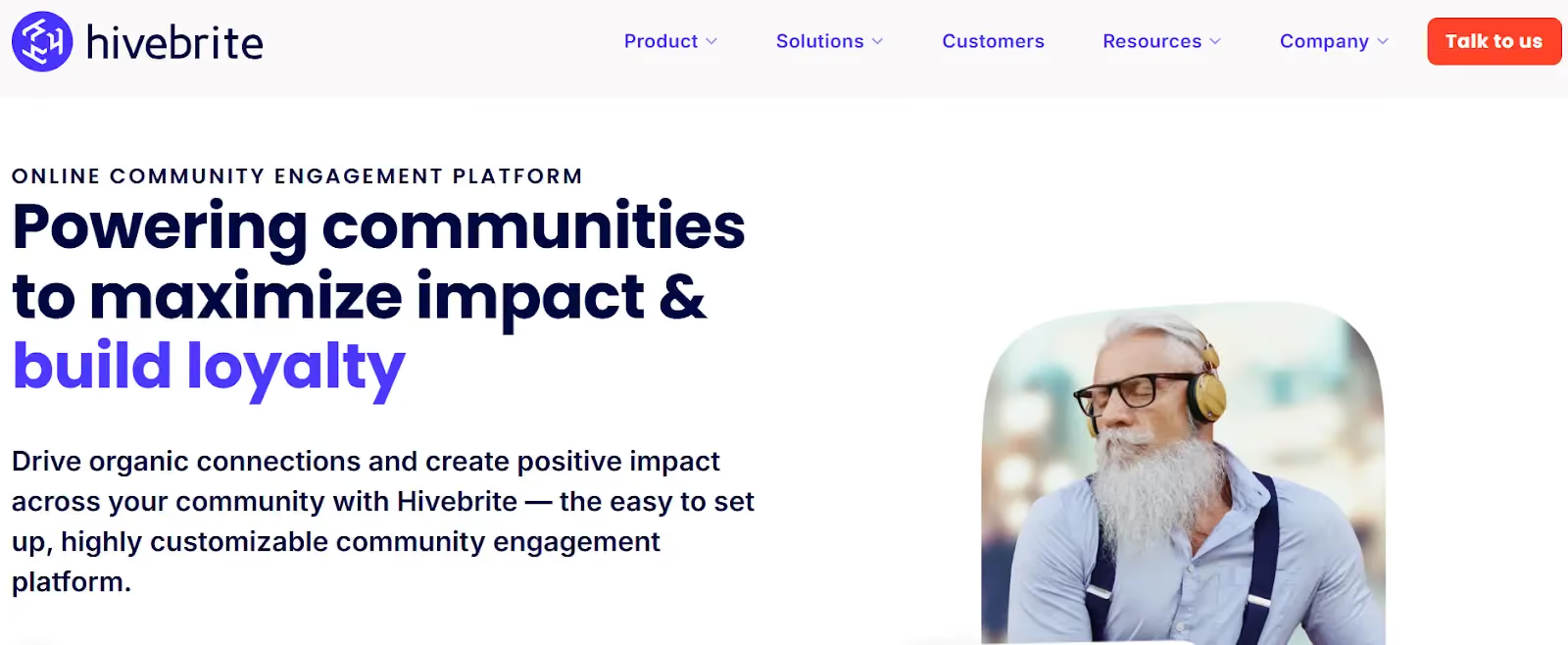
Institutions that want a highly customizable online community with strong social features, group structures, and networking tools. It supports advancement, alumni relations, and career services teams that want a modern, branded digital hub.
Pros
Cons
Price range: Custom / quote-based. Final pricing depends on institution size, customization level, and modules activated.
Works best for
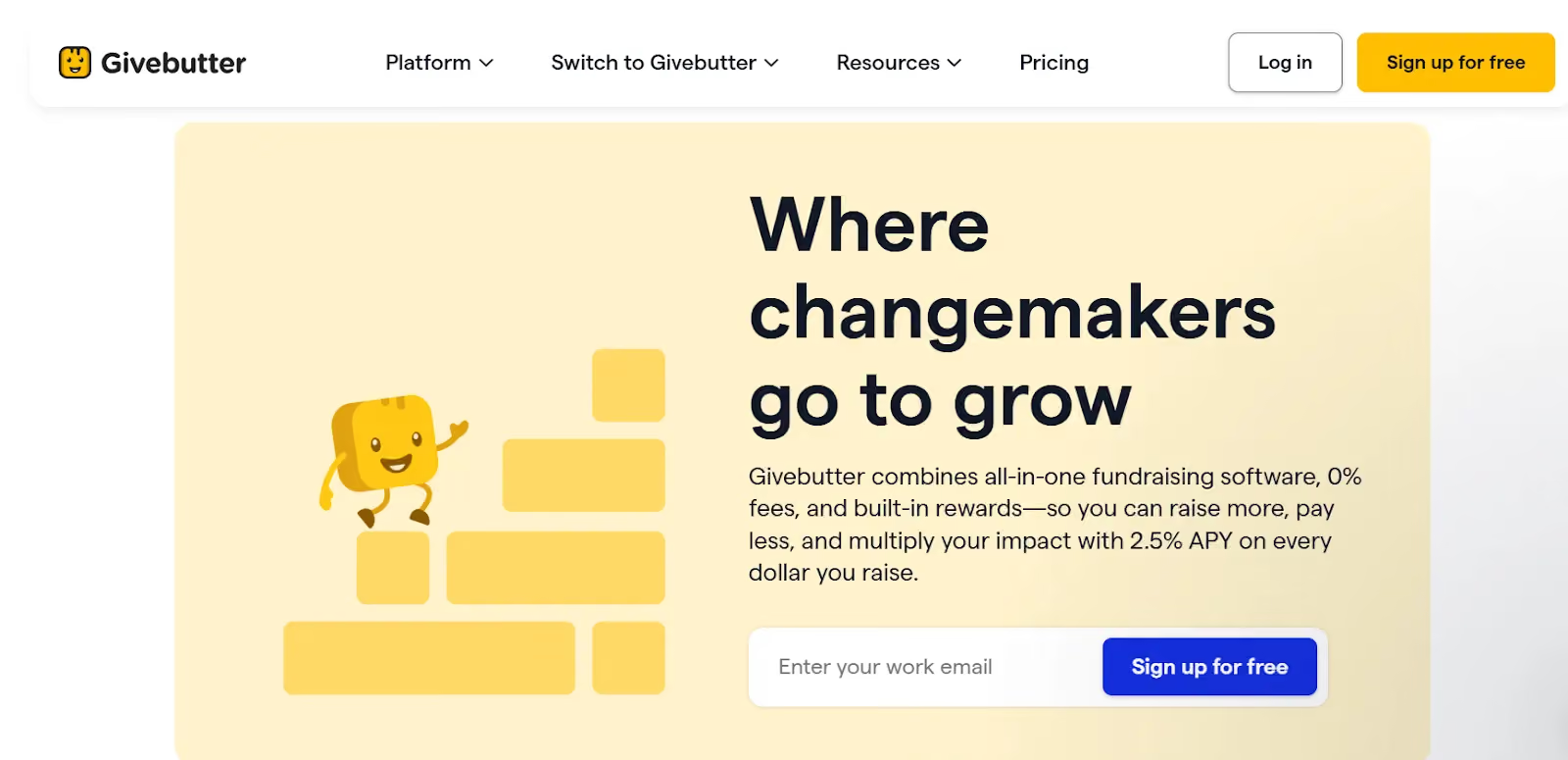
Small to mid-sized institutions or alumni groups that need an easy-to-launch giving experience for campaigns, events, and peer fundraising, especially teams that want low friction for donors and fast setup.
Pros
Cons
Price range: Free tier / standard plan widely promoted; paid/plus features and service options are quoted per account or use case.
Works best for
Organizations and small-to-mid advancement teams that want an all-in-one CRM with growing automation and event/volunteer features a middle ground between entry CRMs and enterprise systems.
Pros
Cons
Price range: Public starting tiers cited around US$99/month (Essentials) up to the $400s for higher tiers; exact cost depends on features and contact volume.

Works best for
Small advancement teams that want a user-friendly CRM with built-in automation and donor insight tools, and who prefer minimal external tool stitching.
Pros
Cons
Price range: entry pricing starts from roughly US$99/month for small contact bands, with step-ups as contact counts increase.

Works best for
Mid-sized advancement teams that want a modern fundraising platform with tight marketing automation and a focus on donor experience teams that want donor journeys and responsive communications built into the CRM.
Pros
Cons
Price range: Public and partner-site references show entry plans and per-contact pricing; typical starting points in market scans land in the low hundreds per month, with higher tiers for expanded contact counts and features.
Choosing a donor management system starts with getting clear about where your team struggles today and what actually moves your advancement work forward. A good evaluation process makes those gaps visible to you, and here’s a practical way to approach it-
Advancement work often ends up spread across too many systems, giving here, events there, engagement somewhere in between. Almabase pulls those pieces into one workflow, which is why Thomas Aquinas College found it easier to steady their digital outreach once everything lived in the same place.
A lot of the lift comes from TrueSync, the native RE NXT integration that keeps profiles, gifts, and event activity aligned without connectors. Illinois Tech leaned on this when they wanted their CRM to reflect real alumni behavior, not a version of it that needed constant cleanup.
With the data stitched together, segmentation becomes less of a project and more of a natural part of the work—class years, programs, regions, affinities, volunteer roles. It’s the kind of setup that makes targeted outreach feel less like a campaign and more like a conversation.
On the fundraising side, teams get a donor pipeline view that surfaces who’s warming up or re-engaging. It’s simple enough to use every day, and the Engagement Tile in RE NXT keeps that context right where fundraisers already spend their time.
Campaigns get the benefit of custom giving pages shaped around each audience. Loma Linda University used that flexibility during a campaign that eventually crossed $1.5M, helped by pages that matched how different groups preferred to give.
Altogether, Almabase gives advancement teams a cleaner path forward. When all these pieces sit inside one rhythm, advancement work feels less like managing systems and more like guiding relationships, which is the part of the job that matters most.
Advancement teams are operating in a very different landscape than they were even a few years ago. The systems we choose either add weight to that reality or make the work lighter.
The thread running through all the platforms you explored is simple: the right system should help people work smarter, not harder. It should reduce the friction around data, make segmentation feel natural, support fundraising strategy, and give teams a clearer sense of who’s ready for a conversation or a nudge.
As you evaluate donor management software, the real test isn’t the feature list. It’s whether the tool helps your team build relationships with more intention and less administrative drag.
Thinking about how a modern DMS could fit into your institution's needs? Let’s talk through how Almabase can make the most difference for your team.

Top Donor Management Software for Advancement Teams (2026)
Lorem ipsum dolor sit amet, consectetur adipiscing elit. Suspendisse varius enim in eros elementum tristique. Duis cursus, mi quis viverra ornare, eros dolor interdum nulla, ut commodo diam libero vitae erat. Aenean faucibus nibh et justo cursus id rutrum lorem imperdiet. Nunc ut sem vitae risus tristique posuere.

Sharada Koti
December 12, 2025
12 minutes
Alumni are among your institution's most valuable assets. They provide mentorship, career opportunities, financial support, and serve as natural, authentic brand ambassadors for your school. This, of course, depends on the extent to which they feel connected to their alma mater once they’ve graduated. But nurturing relationships is a complex undertaking, and especially so at scale. Keeping alumni engaged across multiple touchpoints like events, communications, giving, and career networking remains a persistent (as well as rewarding) challenge for advancement teams. The right alumni management software solves this by bringing engagement activity, fundraising, and community into a single system.
Choosing the right alumni management system cuts through the fragmentation that typically forces teams to stitch together multiple disconnected tools, and makes it easier to track which initiatives drive outcomes.
With so many options available, this blog compares the ten best platforms that could help you get there, based on your specific requirements.

Almabase brings alumni engagement and fundraising into the same workflow, connecting the activities between constituents and institutions. The platform builds interactions such as alumni events, email campaigns, or giving days into a shared engagement history rather than treating them as standalone features, giving your team a complete picture of constituents’ journeys.
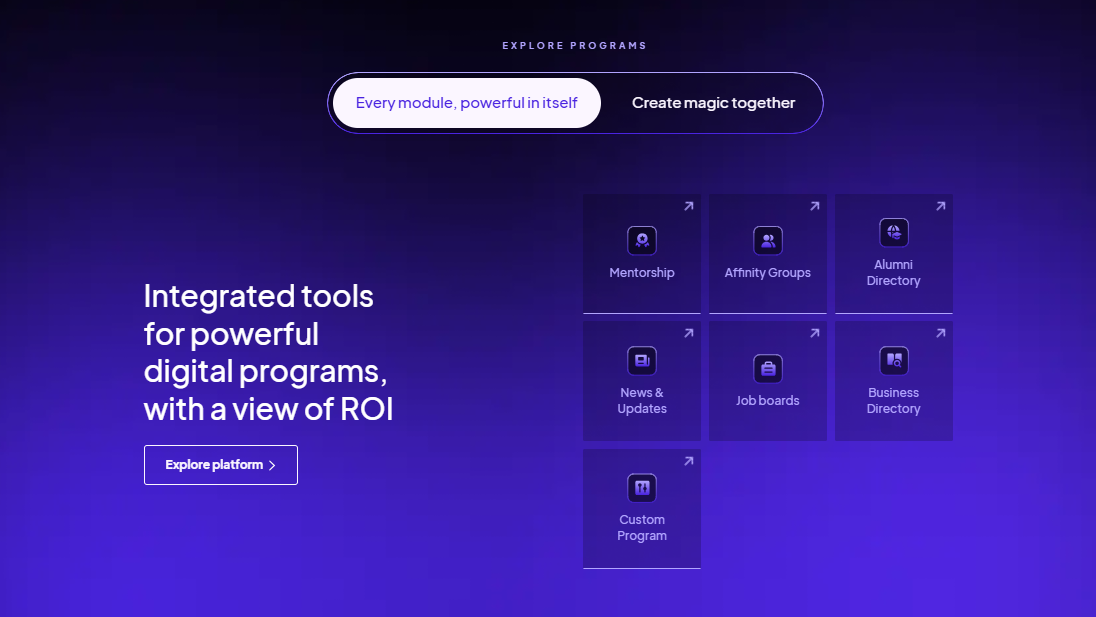
Almabase’s engagement tools connect with your CRM seamlessly. Its TrueSync integration with Raiser’s Edge NXT supports two-way, real-time data sync, so information can move between Almabase and RE NXT without the recurring exports, imports, and manual updates that can come with managing separate systems.
The platform also brings alumni-facing programs such as directories, mentorship, job boards, events, and email campaigns into the same environment. This means fewer disconnected tools and less work trying to piece together engagement data afterward for institutions running several of these programs at the same time.
That makes it relevant for teams of all sizes running all types of events: reunions, regional events, giving days, donor events, and ongoing alumni communications.
All of these features make Almabase particularly suited to advancement teams that want engagement activity and fundraising data to work together. It's also a natural fit for institutions already working in Raiser’s Edge NXT and looking to connect their alumni-facing activities more closely to their advancement database.
Pricing: Custom pricing based on institution size, requirements and alumni count.
EverTrue is a fundraising intelligence and donor engagement platform built to help advancement teams find better prospects, understand their constituents, and give fundraisers more context for their outreach. EverTrue sits alongside your CRM and enriches constituent records with engagement, career, social, and wealth information.
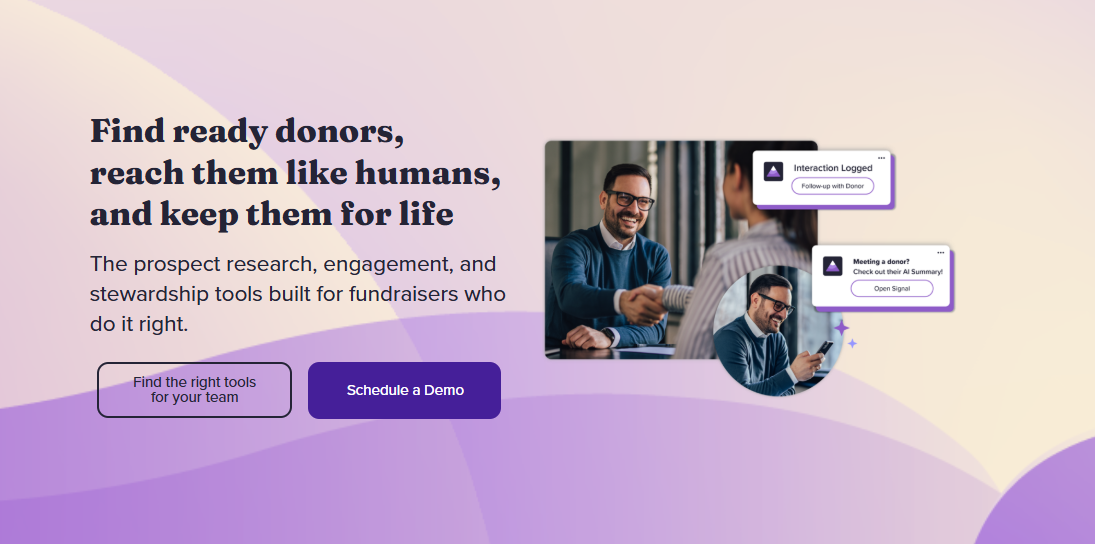
EverTrue brings a lot of external intelligence into constituent records. TrueView profiles can combine your existing CRM data with career changes, social media activity, donor interests, wealth indicators, and other signals, giving fundraisers a more current picture of the people they're trying to engage. The platform also supports prospect discovery, segmentation, mapping, and alerts to help teams identify people who may be worth a closer look.
It's a good fit when you already have a CRM you want to keep and need additional intelligence to help fundraisers identify prospects, prioritize portfolios, plan visits, and personalize outreach. However, it's less suited to institutions looking for a single platform to run their broader alumni engagement program.
Pricing: Custom pricing based on the EverTrue products and capabilities an institution selects. Estimates place the starting quote at about $5000 a year.
360Alumni brings together an alumni directory, networking, events, fundraising, mentoring, job boards, and email marketing in a single branded environment. Its focus is less on advancement operations and more on giving alumni a place to find each other, build connections, and participate in their alumni community.
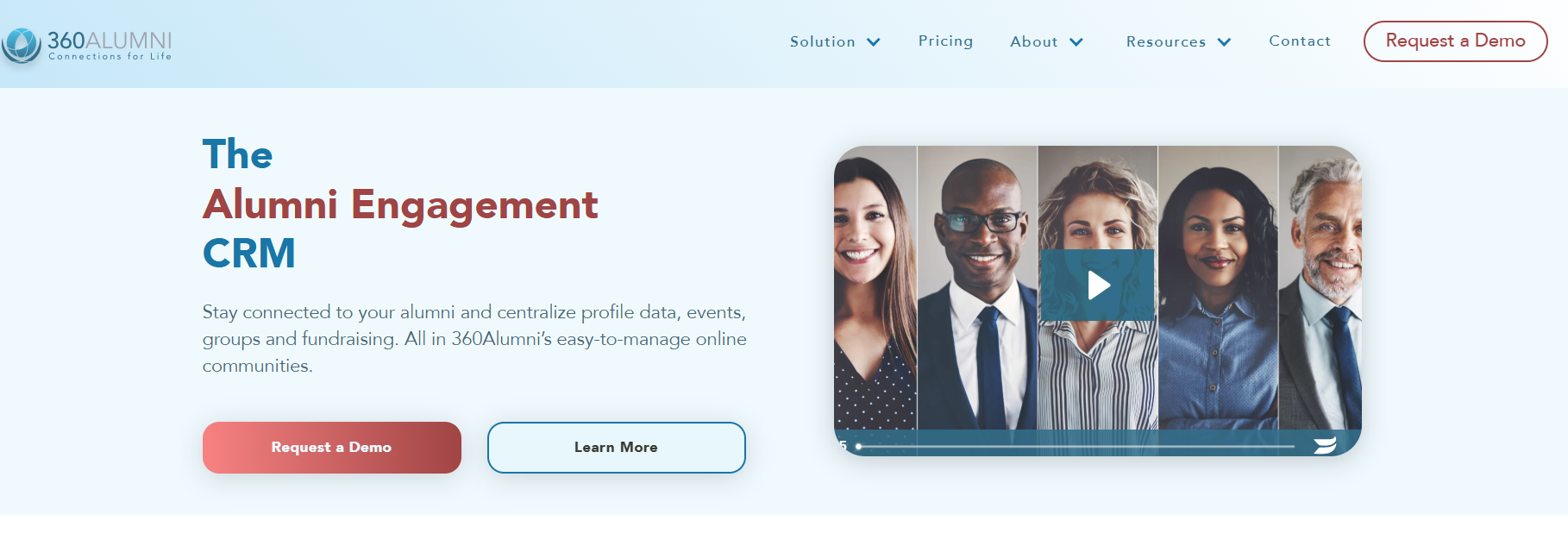
360Alumni stands out as being a more alumni-facing platform. It puts its interactive alumni directory and map at the center and makes it easy for users to search for other alumni by a range of metrics: location, profession, interests, and other criteria.
360Alumni is well suited for schools where an alumni directory, career networking, mentoring, and geographically based connections are all important parts of the engagement strategy.
Pricing: Custom pricing based on record count, with an initial setup cost and annual subscription. 360Alumni also charges a 3% credit-card processing fee plus a plan-dependent service charge on event ticket sales, donations, and membership payments.
Graduway is built around the idea of an alumni community as an active digital space, giving alumni a place to connect with each other as well as stay connected to their institution.
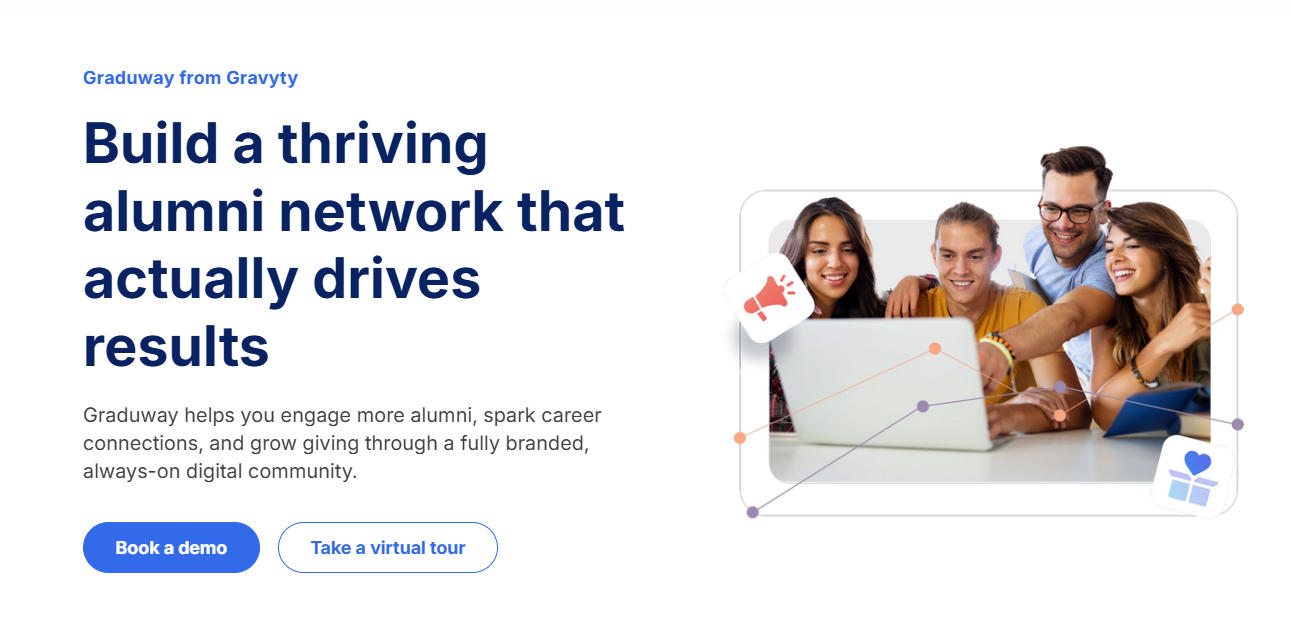
What sets Gravyty apart is alumni-to-alumni engagement. Alumni can connect with peers, participate in mentoring programs, join communities, and build professional relationships through the platform.
Graduway is particularly suited to institutions where community building, networking, and mentoring are central to the alumni engagement strategy. It's especially relevant for institutions with geographically dispersed alumni or large professional networks, where mentoring, career connections, affinity groups, and peer networking offer a major push to stay engaged throughout the year.
Pricing: Custom pricing based on the institution's requirements and alumni community size.
HiveBrite is a community platform designed for organizations that want more control over how their online communities look, work, and evolve. For higher education, it can bring alumni networking, groups, events, mentoring, career opportunities, and other engagement programs into a branded community environment.
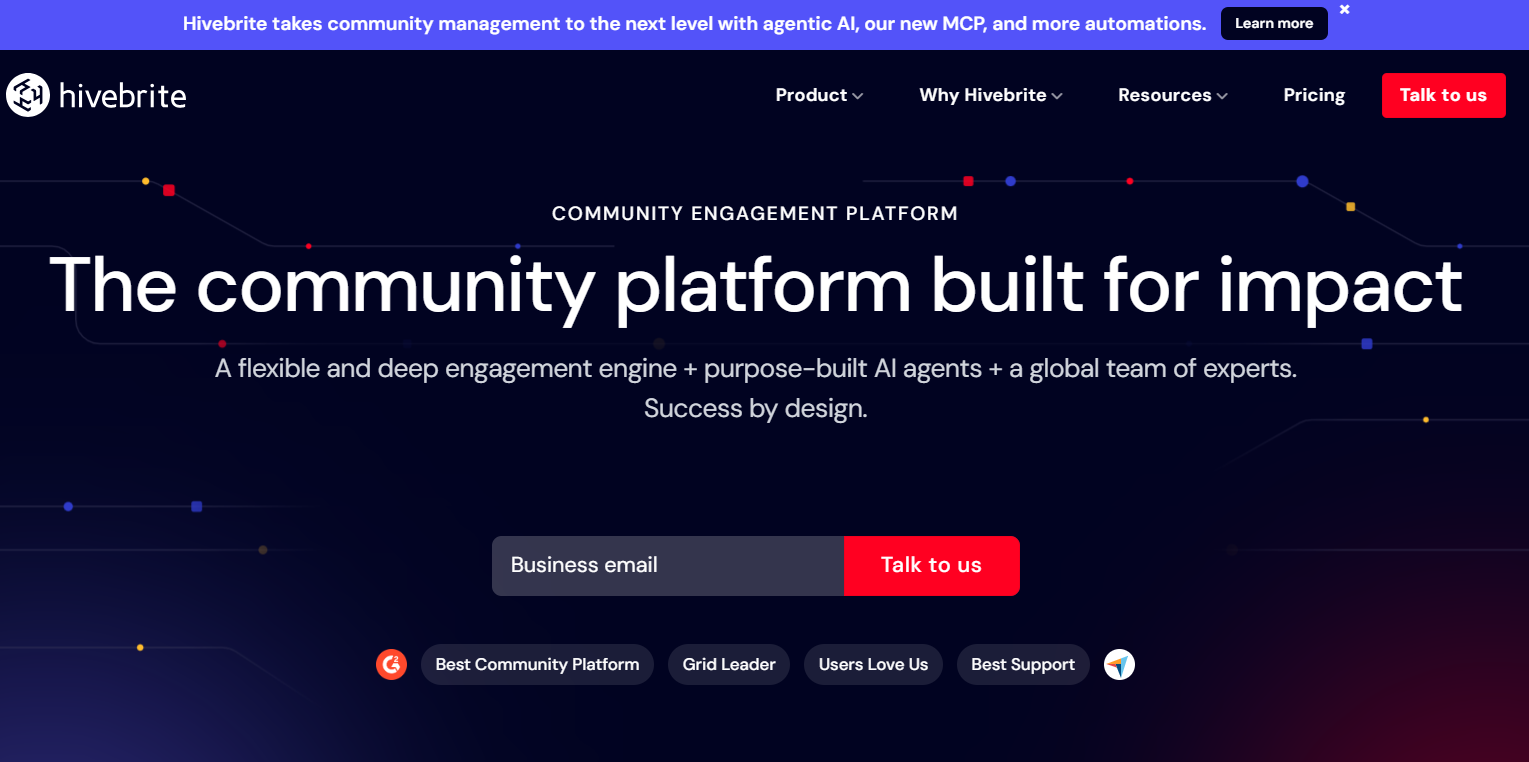
HiveBrite offers a good level of customization: institutions can shape member journeys, create different community spaces and permissions, customize the platform's design, and tailor experiences for different audiences.
The platform also supports events, groups, discussions, mentoring, career networking, and other community activities. Its multilingual capabilities and support for international communities make it relevant for institutions managing alumni networks across multiple countries and regions.
HiveBrite is particularly suited to larger institutions that want to build a highly tailored alumni community and have the resources to support implementation and ongoing administration.
Pricing: HiveBrite offers tiered and custom pricing starting at $895/month depending on the size and requirements of the community.
PeopleGrove is an alumni engagement platform built around helping institutions create stronger connections between students and alumni.
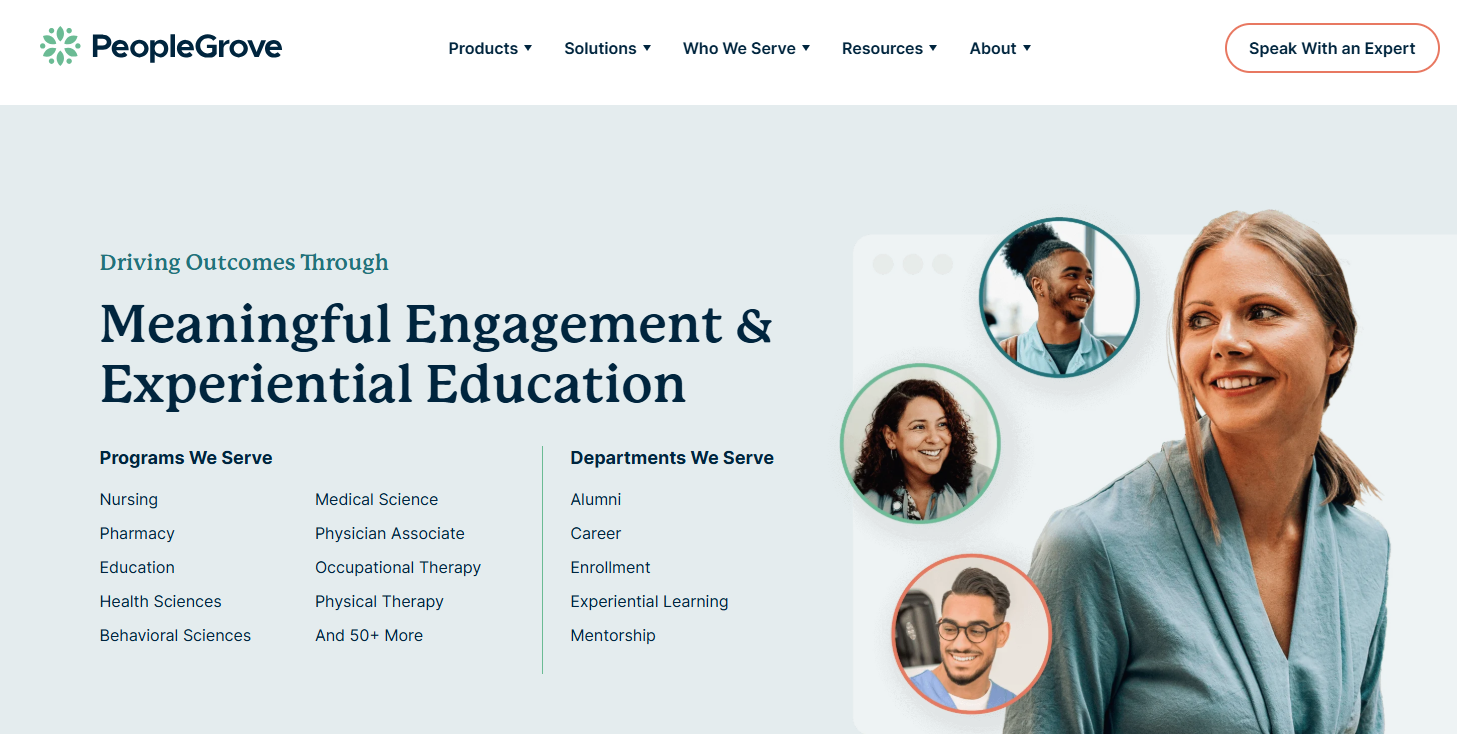
PeopleGrove particularly excels at structured program management. Teams can set up mentoring programs, match participants based on skills, interests, and goals, establish milestones, and track participation and outcomes. Rather than simply giving alumni a directory and letting them find one another, the platform gives institutions tools to actively shape how those connections happen.
The platform also enriches profiles with professional information from LinkedIn, helping you maintain more current information about where alumni work and what they do without relying entirely on manual profile updates. This information is useful when building targeted programs or helping users find relevant connections.
Pricing: Custom pricing offered based on the institution's requirements.
Encoura Encompass is a constituent engagement platform for higher education that brings website management, email marketing, event management, online giving, membership, and other alumni-facing functions into one system.
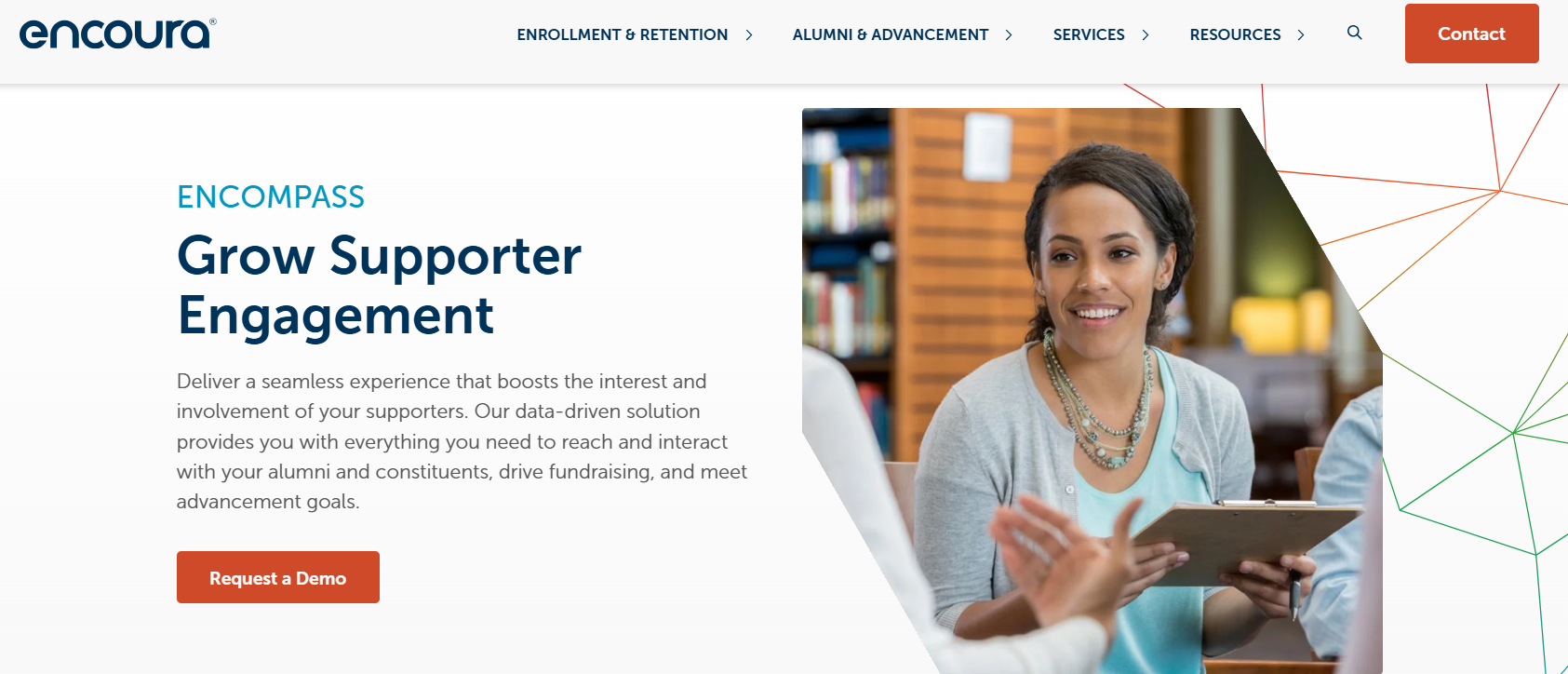
One of Encompass's biggest strengths is its breadth of constituent-facing functionality. Instead of using separate systems for an alumni website, communications, events, giving, and membership management, institutions can manage these activities through one connected platform. This breadth is particularly useful for institutions already working within the Anthology ecosystem.
For institutions evaluating it, the recent ownership transition is an important part of the conversation: Encoura acquired the service in 2026, so teams should evaluate the current product roadmap, support model, and integration plans alongside the platform's existing functionality.
Pricing: Estimate currently place pricing starting at $7,500 per year, but the platform does not publicly disclose its prices.
ToucanTech is an alumni and community platform that brings together an alumni database, website and portal, email marketing, events, fundraising, memberships, and career networking. Built specifically for schools and educational institutions, it aims to give teams a broad set of alumni engagement tools without requiring extensive technical configuration.
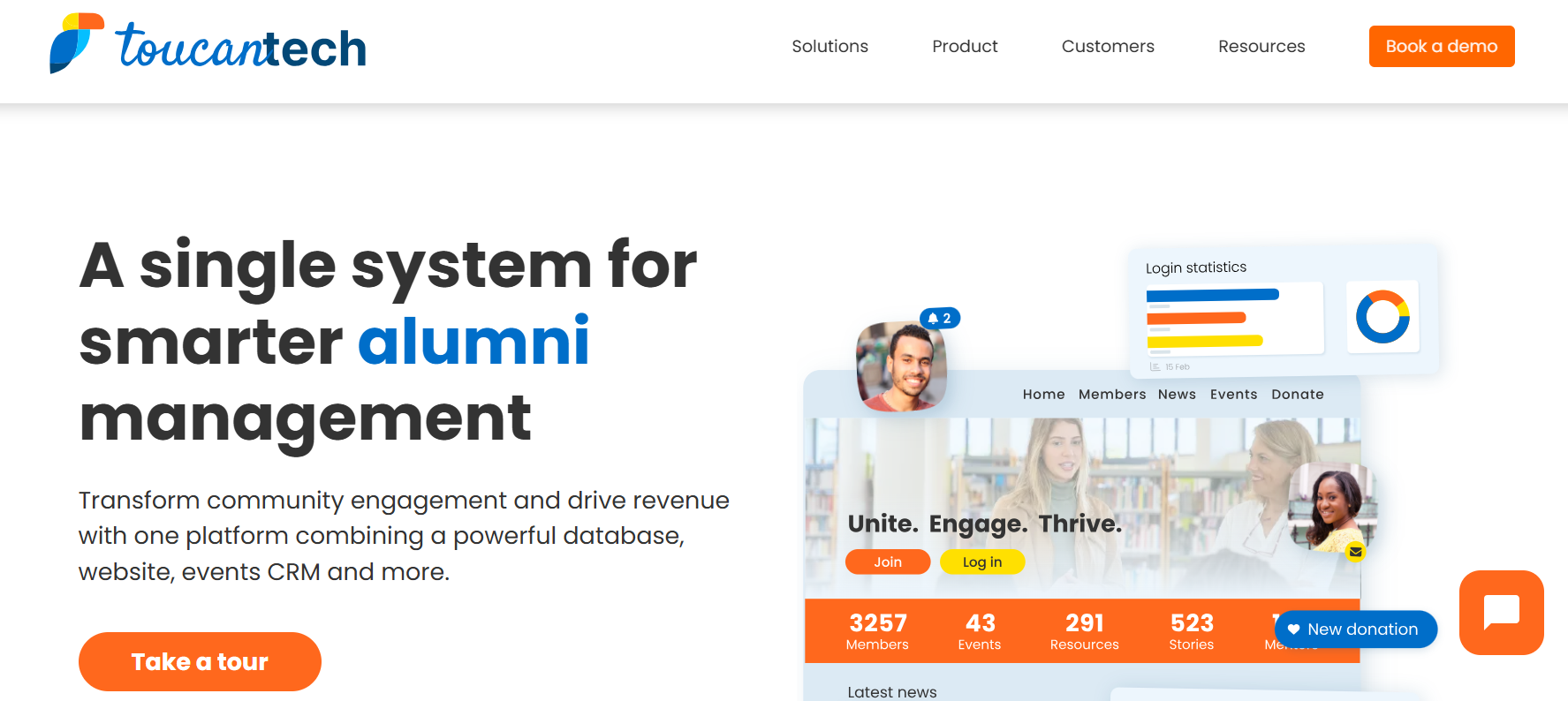
ToucanTech champions ease of use as one of its core principles. Users frequently highlight its intuitive interface and customer support. The platform also keeps common alumni activities connected. Event registrations, donations, communications, memberships, and constituent information can be managed within the same system, giving teams one place to work from rather than stitching together several point solutions.
It's a useful option for teams replacing a legacy alumni system, building a program with a relatively small staff, or looking to consolidate several alumni-facing tools into one platform.
Pricing: ToucanTech's core plan has a flat rate of $8,000 per year.
WildApricot is a membership management platform used by associations, nonprofits, and community organizations.
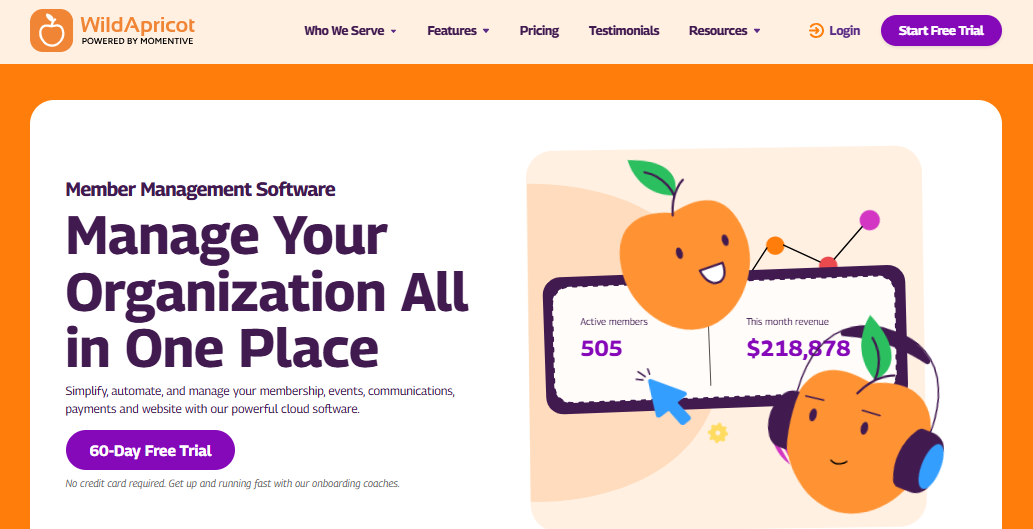
The platform sets itself apart with its straightforward pricing and setup. Unlike many enterprise alumni platforms that require a sales conversation before you can estimate costs, WildApricot publishes its plans based on the number of contacts you manage. It also offers a 60-day free trial, making it easier for smaller organizations to test the platform before committing.
The platform is also designed to be managed without extensive technical expertise. Teams can build a member-facing website, maintain a directory, create events, collect payments, and send communications from the same system.
WildApricot is a good fit for small alumni associations and organizations with simpler membership and event needs, such as maintaining a member directory, managing memberships, organizing events, sending communications, and collecting payments.
It may become less suitable as an institution's needs expand into larger and more specialized alumni engagement or advancement workflows.
Pricing: Plans are based on contact volume, starting at $63/month for 100 contacts and increasing with database size. WildApricot also offers a 60-day free trial.
GiveCampus is built around fundraising, alumni engagement, events, volunteer management, and frontline fundraising. As an engagement layer that sits on top of your CRM, it brings together constituent, gift, event, volunteer, and frontline fundraising data.
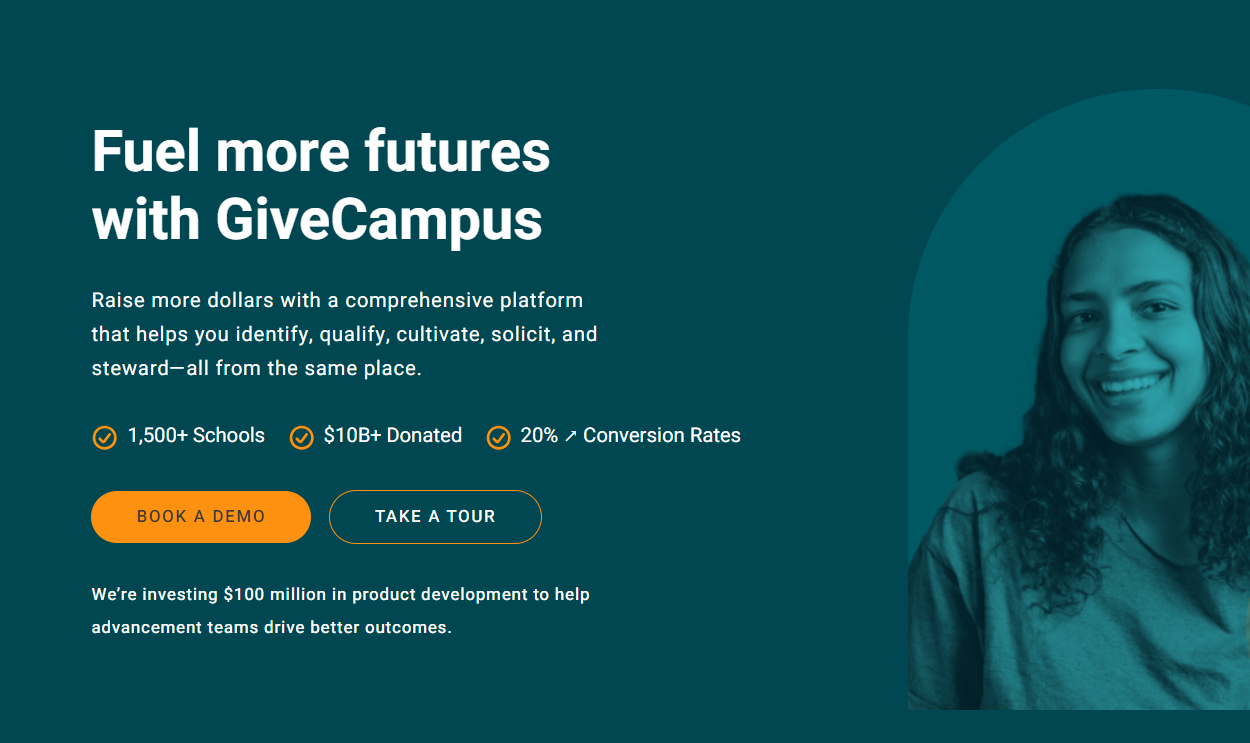
This is particularly useful for advancement teams that want events and alumni engagement to feed directly into fundraising workflows. GiveCampus also supports email and text outreach, volunteer management, and fundraising campaigns within the same ecosystem.
It's a strong fit for institutions running a lot of giving campaigns, reunions, alumni events, volunteer programs, and donor outreach from the same advancement operation.
It's less of a traditional alumni-community platform built primarily around directories, mentoring, or social networking.
Pricing: Custom pricing offered based on the institution and products selected.
There’s no single alumni management platform that will be the right fit for every institution. Think on the question of what you need the platform to do, and you’ll be able to approach the decision with much clarity.
If fundraising and advancement are at the center of your alumni strategy, look for a platform that can connect engagement activity with your CRM and give your advancement team useful donor context. Almabase and GiveCampus are worth a closer look here, while EverTrue makes more sense for teams that need deeper prospect and donor intelligence.
If your priority is building an active alumni community, Graduway and HiveBrite take a more community-first approach, with tools for networking, groups, mentoring, and member interaction.
For institutions where alumni-to-student connections, mentoring, and career engagement are a major part of the strategy, PeopleGrove is built around those programs rather than treating them as an add-on. And if you're looking for something simpler to get up and running, ToucanTech offers a broader set of alumni tools, but with less emphasis on extensive customization.
Before you start booking demos, definitely get clear on what your institution actually needs from an alumni management platform and what you can realistically expect from your budget, team, and existing tech stack. That’s exactly what we cover in our Alumni Management Software Buying Guide. It walks through the key features to evaluate, questions to ask vendors, implementation considerations, and how to compare platforms against your institution’s specific needs.
If you’re unsure what to prioritize, flipping through the guide before comparing vendors might help!
Choosing alumni management software is a big decision, especially when your team will be relying on it for everything from everyday alumni communications to major events and fundraising campaigns. Take the time to see how each platform handles your actual workflows, what implementation involves, and how well it works with the systems you already use.
Almabase is worth exploring if bringing alumni engagement and fundraising closer together is a priority. It brings events, communications, giving, and alumni data into one platform, with CRM integrations to reduce manual work for your team. 🤗
You can read more about what makes Almabase a good alumni management software and how it supports different alumni programs.
Ultimately, the goal is to find the platform your team can comfortably use, your alumni will want to engage with, and your institution can continue to rely on as its programs grow.
Request a demo today to see how Almabase can help your institution nurture deeper relationships with your alumni. 💜

An institution can get by with spreadsheets and basic CRM functions, but a dedicated alumni management software makes a huge difference when you need to map engagement, personalize communications, giving, and complex events. So while not always necessary, it becomes almost essential as an institution scales its alumni management efforts.
There’s no single best option for every institution. The right platform depends on your goals, existing technology, budget, and whether you need deeper capabilities or customizations. Ultimately it’s about finding the right fit for your requirements.
Pricing varies widely depending on the platform, number of alumni, and features you need. Some platforms offer tiered pricing, while others use custom pricing based on the institution’s requirements.
Free tools can work for institutions with smaller alumni programs or straightforward needs, but they often come with limits on features, users, data, or customization. If your programs are growing, paid software may offer more room to scale.
You might find the terms being used interchangeably, but an alumni platform usually focuses on the alumni-facing experience, while alumni management software could also include the operational side, including data management, events, communications, and fundraising.

Best Alumni Management Software in 2026: 10 Platforms Compared
Lorem ipsum dolor sit amet, consectetur adipiscing elit. Suspendisse varius enim in eros elementum tristique. Duis cursus, mi quis viverra ornare, eros dolor interdum nulla, ut commodo diam libero vitae erat. Aenean faucibus nibh et justo cursus id rutrum lorem imperdiet. Nunc ut sem vitae risus tristique posuere.
Anwesha Kiran
April 20, 2026
12 minutes
%201.svg)
%201.svg)
%204.svg)


.svg)