Alumni networks provide their universities with consistent funding. Discover how to create one or activate your current network to earn the support you need.

Jamie Pugh
Published:
February 11, 2026

Discover AI Summary
• Give your donor database a refresh: Many schools overlook potential major donors; a modern prospect research approach using analytics can help you spot hidden gems and tailor your fundraising asks effectively.
• Boost alumni engagement with affinity groups: Creating groups based on shared interests or professions keeps alumni connected to your school and each other, turning passive supporters into active participants.
• Diversify your donation options: Don't limit gifts to just cash; equip your university to accept assets like stock, planned gifts, or even cryptocurrency to unlock new fundraising potential from various alumni.
• Showcase impact to inspire giving: Beyond annual reports, use focused impact reports, student success stories, and campus tours to vividly demonstrate how alumni gifts directly make a difference for current students.
• Spark urgency with an alumni giving day: Plan a special giving event on a meaningful date, complete with incentives and a celebratory event, to rally alumni support and meet fundraising goals quickly.
Experienced university fundraising professionals know that alumni and their families are some of their most valuable donors. However, if your school is still building its alumni network, it can be challenging to know where to start.
Fortunately, universities can access an extensive range of management platforms, specialized consultants, and free educational resources. In this guide, we’ll explore five proven strategies for building a network of alumni donors.
The more connected alumni are to your school, the more likely they are to contribute to your programs. Invite alumni to continue being a part of your school’s community by creating an affinity group.
Alumni organizations like affinity groups offer a variety of activities and perks. These organizations offer networking opportunities for alumni who work in the same industry or have the same interests, such as an affinity group for real estate. These organizations provide alumni with a connection to your school that they’re actively incentivized to use throughout their entire career.
Additionally, consider creating a unique legacy society for your planned donors. This honors their decision to give, helps them feel connected to your school, and demonstrates your appreciation for their future gifts. Graham-Pelton’s university fundraising guide outlines the steps for starting a legacy society:
There’s a high probability that your school is overlooking several alumni who have the potential to become major donors. With rare exceptions, nearly all major donors start their engagement with a nonprofit as a normal donor. This means your school needs to continuously assess its donor database for major giving candidates.
If it’s been some time since your school last conducted prospect research or you are using outdated information, now is the time to update your process. A few modern prospect research strategies include:
This approach will continue to help you steward major donors long-term. For example, this research process enables you to uncover giving candidates’ unique interests and values, leading to more productive donation conversations.
If your university only accepts cash donations, you are limiting your fundraising potential. Your alumni have a range of assets, and your university should be equipped to accept all of these unique types of donations.
Set your university’s donation processing system up to accept the following types of gifts:
Some of these gifts require software to accept, while others may require consulting a lawyer. For example, some nonprofit donation software automatically converts gifts of stock and cryptocurrency into cash, whereas several types of planned gifts require a contractual agreement between your school and the donor.
Alumni give to your school because of the positive experiences they had as a student. For many of them, creating an equal or even better school life for future students is a core motivation for giving.
Retain and acquire more alumni donors by demonstrating that your school is putting their gifts to good use. A few ways you can do this include:
In addition to showcasing impact after a donor gives, provide alumni with examples of their potential impact to inspire them to give. For example, you might promote an upcoming initiative, explain your fundraising goal, and emphasize how that specific alumnus’ gift can make a difference.
Additionally, thank you students from current students can be especially impactful. Gather a few students who were directly affected by donations to have them write personalized thank-you letters that share their stories and express their gratitude.
If your university needs to raise funds quickly, an alumni giving day can add a sense of urgency to your fundraising efforts and bring in new donors. To maximize donations on this day, try these strategies:
After your alumni giving day, report back to all donors to thank them for their gifts and let them know how you will use their generous donations.
A network of alumni donors can power your university’s fundraising long-term. Expand your donation strategies and create new opportunities for alumni connections to tap into this valuable audience.
Table of Contents
Subscribe
See how modern advancement teams bring alumni engagement and fundraising together.
According to higher education giving insights from EverTrue, the number of donors decreased by 8.2% in Q1 2024 compared to Q1 2023. Meanwhile, the total dollar amount donated increased by 60% on average, with a median growth of 18%. This shift underscores a critical challenge (and opportunity) for advancement teams: fewer donors are giving more, meaning institutions must focus on deeper engagement and stronger relationships with supporters.
In this guide, we’ll discuss actionable university fundraising tips to help your institution build meaningful, lasting relationships. From using segmented communication strategies to digital tools like texting and early student engagement, we’ll explain what works and why. Let’s begin.
University donors don’t all have the same preferences or interests, so your outreach shouldn’t treat them as a monolith. By tailoring your donor engagement efforts to your audience’s unique needs, interests, and preferences, you can design outreach materials that resonate with them.
Your organization’s constituent relationship management (CRM) platform will come in handy in this process. Whether you use Slate, Salesforce Education Cloud, Ellucian CRM Advance, or a different CRM tool, you should be able to manage donor segmentation directly within your donor database.
Use donor data and behavioral insights to segment donors by:
This allows you to personalize messages and target content effectively. For example, a young alumni donor might respond well to a digital networking event invite, while a seasoned donor might be more interested in legacy giving updates.
Alumni are among the most essential donors for university fundraising because of their powerful personal connections to your institution. The most successful alumni engagement strategies start before commencement. Building affinity early fosters long-term loyalty and stronger giving potential among new grads.
Consider the following tactics to keep students engaged with your institution:
These efforts show students that your university cares about their ongoing success, even after they get their diplomas. As a result, students will hold more goodwill for your institution, increasing the likelihood of consistent, meaningful support.
90% of donors prefer experiential recognition to physical acknowledgment materials like letters or gifts. This makes fundraising events an especially valuable engagement tool as a social touchpoint and a meaningful way to recognize and celebrate supporters.
High-impact events don’t have to be large or elaborate, but they must be personal and memorable. Whether in person or virtual, the goal is to build community and reinforce connection to your institution through shared experiences.
To improve your fundraising events:
Well-designed events can spark new engagement, rekindle dormant relationships, and create lasting memories that keep donors connected for years to come.

Your donor community is diverse, not just in background, but also in how they prefer to communicate. To meet them where they are, use a mix of digital and traditional methods such as:
Texting, in particular, offers high engagement rates. It enables fast, two-way communication and is ideal for event reminders or campaign updates. Busy contributors can read concise messages from your organization and click on links to your event registration forms or donation pages instantly.
Major donors receive a lot of attention in university fundraising because of their ability to contribute transformational gifts. However, mid-level donors represent a valuable bridge between casual supporters and your highest-tier donors.
These donors are typically more consistent in their giving, have a demonstrated affinity for your institution, and are often receptive to deeper engagement if you approach them intentionally.
Use these tips to engage mid-level donors:
With strategic cultivation, your mid-level donors may even decide to become planned or legacy donors in the future. According to a Sea Change Strategies report, 31% of mid-level donors have made a bequest to the organization they support, and another 23% say they plan to make one later. This data highlights the value of intentionally building lasting relationships with mid-level supporters.
In university fundraising, personalized cultivation is essential for strengthening lifelong ties and converting engagement into sustained giving. From milestone celebrations to targeted giving appeals, personalized outreach helps donors feel connected to your school and its evolving mission.
Use tools like predictive analytics, donor personas, and engagement tracking to:
BWF’s guide to university fundraising recommends going beyond simple emails to create personalized gratitude videos for donors. According to the guide, these videos can “capture donors’ attention and show them that your organization values their involvement.” Ask current students or professors to volunteer to speak in these videos, making them even more personal and meaningful.
Effective university fundraising requires your school to meet donors where they are and build mutually beneficial relationships with them. With the tips in this guide, your advancement team can build enduring donor relationships that drive both connection and giving.

6 Audience Engagement Tips for Better University Fundraising
Explore top university fundraising tips to build lasting connections with your donors and boost giving through personalized, data-driven strategies.
Lorem ipsum dolor sit amet, consectetur adipiscing elit. Suspendisse varius enim in eros elementum tristique. Duis cursus, mi quis viverra ornare, eros dolor interdum nulla, ut commodo diam libero vitae erat. Aenean faucibus nibh et justo cursus id rutrum lorem imperdiet. Nunc ut sem vitae risus tristique posuere.

June 20, 2025
12 minutes

Fundraising is a necessity for any school to support its educational activities.
It seems you can never fundraise too much or accept too many donations, but you don’t want to bore your supporters with the same fundraisers year after year. Is your school tired of the same old fundraisers and looking for new ideas that are guaranteed to work?
Your search ends here! Follow these 7 proven fundraising ideas for schools to raise money for your students:
1. Walkathon
2. Partner with a local restaurant chain
3. Multicultural fair
4. Car wash
5. Coffee Drive
6. Trivia Night
7. Envelope Fundraiser
Want something focused specifically on fundraising for private schools? Look to DonorSearch’s 5 Steps to A+ Private & Independent School Fundraising.
Read on to boost your mentoring skills and learn about these school fundraising ideas!


Typically annual, a walkathon event is a long-distance walk meant to fundraise for a cause.
Walkathons are usually encouraging and successful events because they support:
1. Health: All participants walk around your designated course, encouraging a healthy habit.
2. Community: Usually hosted on a public field or in a public park, walkathons are open to the public for the most exposure and therefore, evoke a sense of community and develop relationships as they bring people together.
3. Accessibility: Participants will be at different levels athletically, and that’s fine. Some will be participating to challenge themselves, and some will just be participating for fun. The more the merrier.
4. Affordability: Walkathons are fairly inexpensive fundraising events.
Pledges are placed on participants and how far they’re able to walk the day of the event. For example, if Sabrina pledges $5 for every mile Alex walks and Alex walks 7 miles, you’ve raised $35 for your school.
There’s a list of things to do when organizing your walkathon event.
1. Determine a location. You’ll need to decide if you want a course that gets you from Point A to Point B or a circular course that starts and ends at Point A, a straight course or a circuit course, respectively.
2. Pick a date and rain date. Make sure you pick a date in a warmer season, but not a hot one. Try May instead of August. And select a rain date, just in case!
3. Recruit sponsors. Approach previous gala sponsors to see if they’d like to run tents or water stations.
4. Promote your event. You can look into merchandise providers to customize your own t-shirts and water bottles. Promote your event through flyers and word-of-mouth, as well.
For a more extensive description on organizing a walkathon, check out Booster’s walkathon guide.

There are plenty of restaurants that partner with schools and educational clubs to help create awareness and raise money. These restaurants will have school fundraising nights, during which a portion of the sales from the night are donated to the school.
Everyone has to eat. The partnership between restaurants and your school converts a daily task into a charity event.
All you have to do is:
1. Pick a participating restaurant. Many fast food places like Chick-fil-a or Moe’s Southwest Grill have fundraising programs. Just contact your local restaurant for more information. Be sure to check with your local small-business restaurants, too! Many of their owners’ kids have gone through your school system and will be open to help you fundraise.
2. Promote the night. Send out email blasts, create flyers, even make t-shirts, if you’d like. Your fundraiser’s success will depend on your dedication to promotion.
Turn your community’s next good meal into a successful fundraising idea by partnering with a restaurant!
A multicultural fair allows students to showcase their heritage and learn about their peers’ heritage.
Students get a chance to perform cultural demonstrations and sell their culture’s products and food. On top of being a great fundraising opportunity and satisfying the mentor in you, it’s educational and a fun way to immerse the students in different cultures.
There’s a bit of planning that goes into organizing this fair:
1. Pick a location. This fair will be easiest if you have an accessible field if weather permits. If it doesn’t, try a gymnasium.
2. Set a date. If it’s outside, choose a rain date, too.
3. Recruit students to participate. Start a discussion and sign-up sheet to see which students would like to hold a booth at the fair. Ask which foods they’ll be making and selling and which cultural performances they’d like to display.
4. Promote! Post flyers. You might try to schedule the fair during lunch periods to reach the most students and/or during the evening to reach parents, too.
No matter what, make sure your students will have fun during the event–they need to be excited enough to sell and excited enough to learn.

Your school can put together a group of students to organize a car wash. Besides being a quick and simple fundraising idea, it gets your students outside (and away from tablets, phones, and the tv).
A car wash is an easy fundraiser to set up. Plus, everyone needs the pollen rinsed off their cars in the spring so who can pass up just $5 for a car wash?
There are just a few basic planning steps before you hold your car wash:
1. Pick a location. The school’s parking lot is probably your safest bet, just make sure it’s close to a hose!
2. Gather the materials. You need minimal supplies for this event. Invest in some soap, sponges, towels for drying, buckets, and of course, make sure you have a hose!
3. Promote and Advertise. Charge $5 per car and spread the word. You can advertise the day off by having students holding signs at the closest busy road.
Now that you have everything to start, pick a sunny day and hold your fundraiser.

With 83% of American adults drinking coffee, a coffee drive is bound to be a successful fundraiser. Partnering with a fair trade roaster can let you sell both packaged coffee beans and hot cups of joe.
Your students can sell beans to their peers, family, and others, while your school sells cups of coffee during lunch periods. Local coffee shops may partner with you and sell your school coffee at a discounted rate.
You’ll need to find a wholesaler to work with. Do your research and decide which blends at what prices work for your school’s community. Once you’ve found a supplier, all that’s left to do is promote and sell!
Get the word out and recruit students to sell.
Depending on how you want to organize sales, you can have students directly sell the product or keep a sales and orders sheet, like how girl scouts sell cookies.
Be sure to plan out your fundraiser and promote your coffee drive!

A trivia night will spark a friendly sense of competition among your students. You can have students register as teams or individuals.
Again, this fundraiser brings your students together to form a community. It works because who doesn’t love a little bit of rivalry and healthy competition?
Pick a location to host your trivia night. Your school’s gymnasium is a great option, but you can always try to partner with a local restaurant for space.
Make sure you have a plan for advertising and promoting your event to draw a crowd! Charge a small admission fee to trivia teams who want to compete. Plan out how your trivia game will start and finish. You don’t want an unorganized game.
Your trivia night can easily be an exciting and successful fundraiser as long as you plan ahead and organize.

An envelope fundraiser is a super inexpensive and simple way for your school to raise some extra dough. You’ll need 100 envelopes numbered 1 through 100, which you can easily find in your school’s office. Then, supporters who pass by the envelopes will choose one and donate that amount. For example, if Sally picks up envelope 13, she’ll give $13.
Easy, easy, easy. A fundraiser can’t get much more simple than this one. Plus, the envelope fundraiser doesn’t pressure supporters to give!
Get a pack of 100 envelopes and number them. From there, you can pin them to a corkboard in your school’s lobby or front office so students, parents, and others will see it and can make their donations.
All you need is 100 envelopes and a place to hang them and with the generosity of your supporters, you can accept donations.
Just remember to spread the word about your envelope fundraiser so people know where and when they can give because you’re relying directly on individual supporters’ donations.
Throughout your fundraising event, whichever idea you decide to go with, you can build a relationship with your students, like a mentor should. Don’t put too much pressure on them to sell and raise money, but instead encourage them to have fun with the fundraiser.
Still, want more ideas? Check out this list of fundraising ideas for schools and education.

Adam Weinger is the President of Double the Donation, the leading provider of tools to nonprofits to help them raise more money from corporate matching gift and volunteer grant programs. Connect with Adam via email or on LinkedIn.

7 Proven School Fundraising Ideas
Fundraising is a necessity for any school to support its educational activities. It seems you can never fundraiser too much or accept too many donations, but you don’t want to bore your supporters with the same fundraisers year after year. Is your school tired of the same old fundraisers and looking for new ideas that are guaranteed to work?
Lorem ipsum dolor sit amet, consectetur adipiscing elit. Suspendisse varius enim in eros elementum tristique. Duis cursus, mi quis viverra ornare, eros dolor interdum nulla, ut commodo diam libero vitae erat. Aenean faucibus nibh et justo cursus id rutrum lorem imperdiet. Nunc ut sem vitae risus tristique posuere.
Texting has quietly become one of the most effective ways to reach donors. In this blog, you’ll see real examples of fundraising texts, understand what makes them effective, see sample fundraising text message templates that work and learn simple ways to use them in your next campaign.
Text messages have an open rate of about 98%, while email averages only 20–28%. Even better, nine out of ten texts are read within three minutes of landing on someone’s phone.
SMS also drives faster action. The average response time for a text is 90 seconds, while emails take 90 minutes on average. For time-sensitive campaigns like Giving Tuesday, Fundraising Galas or end-of-year appeals, that speed matters.
SMS also outperforms email when it comes to conversions. Depending on the campaign, texts convert between 21–30%, while email responses stay closer to 2–3%. On Giving Tuesday, organizations that used texting saw 84% higher conversion rates than those that relied only on email.
For institutions using RE NXT or similar CRMs, text messaging can work alongside your existing donor segmentation. You can reach people based on giving history, event participation, or engagement level, through the channel they’re most likely to open.
💡Learn how to use text messaging for donor engagement and fundraising
These examples work well for ongoing or all-year fundraising campaigns when you want to make a simple, heartfelt ask.
Hi [Name], it’s [Organization]. We’re $5,000 away from our goal for [specific program]. Can you chip in $25 today? [Link]
Hi [Name], your gift can make a real difference for [specific cause]. Every contribution helps us keep [impact statement, such as “meals on the table for families in need”]. Donate here: [Link]
Quick question, [Name]. Would you consider giving $50 to help [specific outcome]? Every bit of support brings us closer to our goal. [Link]
Hi [Name]. We’re reaching out to our most engaged supporters first. Can you make an early gift of [amount] to [campaign name]? [Link]
[Name], we have a shortfall in funding for [program]. Your gift of any amount today will help us close the gap. Give here: [Link]
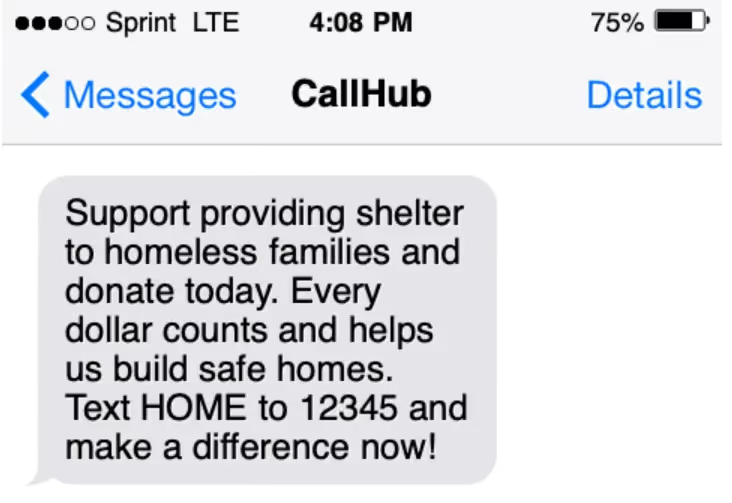
Urgency can be one of the strongest motivators for giving. When your donors know there’s a deadline or a goal within reach, they’re more likely to take action right away. Short, time-bound messages like these can help you make the most of that window of attention.
Hi [Name], we have 48 hours left to reach our goal. We’re still $3,000 short. Can you give $25 right now? [Link]
Only 6 hours remain! We need 50 more donors to unlock our challenge grant. Be one of them: [Link]
Deadline tonight at midnight. Your gift will be matched dollar for dollar, but only if you give before [time]. [Link]
[Name], we're 80% to our goal with just 12 hours left. Can you help us finish strong? [Link]
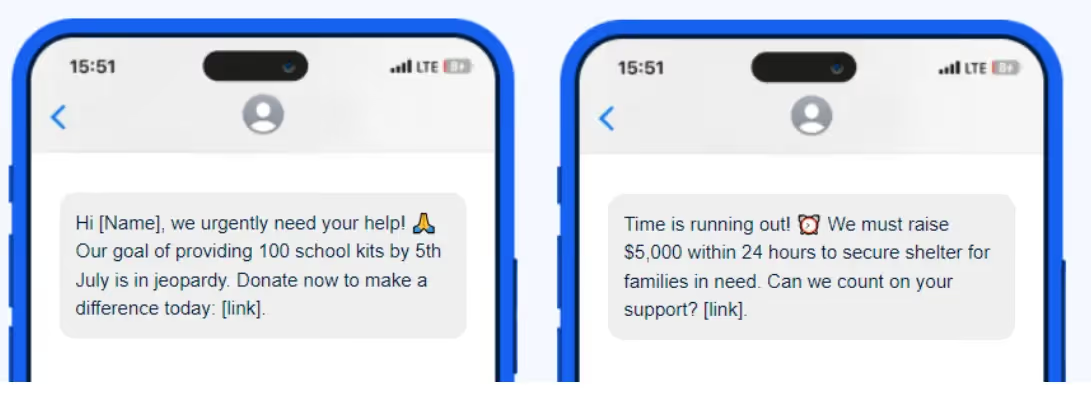
Events give you a chance to bring donors together, celebrate milestones, and raise additional support. A well-timed text can boost attendance and remind supporters why their presence, and their gifts, matter.
Hi [Name], join us for [event name] on [date]. Your participation helps raise funds for [cause or program]. Save your spot: [Link]
Only 20 seats left for [event name] this [day]. Every ticket supports [specific goal or program]. Register now before they’re gone: [Link]
[Name], [event name] happens tomorrow at [time]! Your attendance helps us reach our fundraising goal for [cause]. Here’s a key detail before you arrive: [Key detail]. See you there!
Last call for [event name]! Doors open in two hours. Join us and help make a difference for [cause]. RSVP now: [Link]
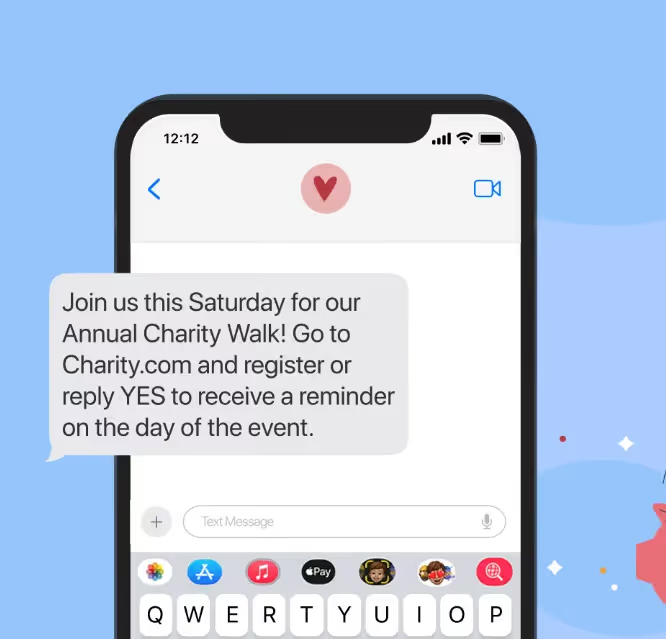
Few messages spark action faster than one that says, “Your gift counts twice.” Matching gift campaigns work because donors can immediately see the bigger impact of their support. A short, clear text that highlights the multiplier effect often drives quick responses.
Great news, [Name]! Every gift made today will be matched two to one. Your $50 turns into $150 for [cause or program]. Give now: [Link]
[Name], a generous supporter is matching all donations up to $10,000. This is your chance to double your impact for [specific cause]. Donate here: [Link]
Your employer might match your gift to [Organization]. Check your eligibility and make your donation go twice as far: [Link]
[Name], we still have $5,000 left in matching funds, but only until [time]. Give today and see your contribution doubled instantly: [Link]
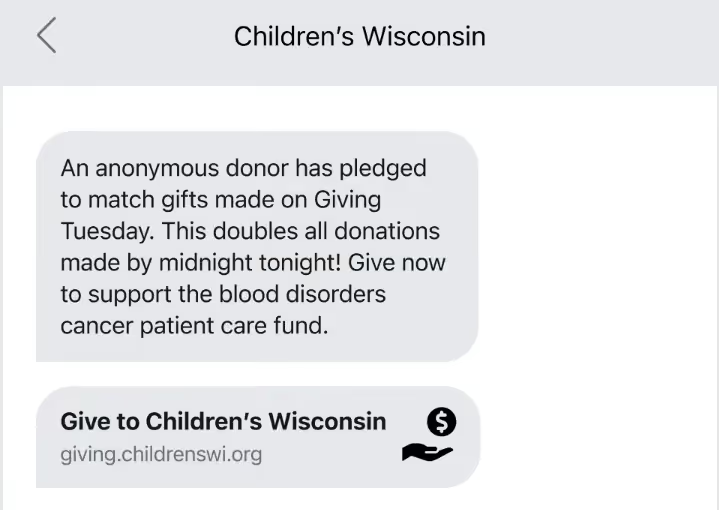
Giving Tuesday has become one of the biggest global movements in philanthropy. In 2024 alone, supporters contributed more than $3.6 billion, and text messaging played a huge part in that momentum. The immediacy of SMS helps organizations reach donors throughout the day, keeping the energy and generosity flowing.
Here are a few text ideas you can adapt for your next Giving Tuesday campaign.
It’s Giving Tuesday! Join [number] supporters who’ve already given today. Your gift of any amount makes a difference: [Link]
[Name], all Giving Tuesday donations are being matched. Your $25 becomes $50, and your $100 becomes $200. Give before midnight: [Link]
We’re halfway through Giving Tuesday and $8,000 short of our goal. Can you help us close the gap? [Link]
Only four hours left on Giving Tuesday! We need 75 more donors to reach our target. Be one of them: [Link]
[Name], thank you for considering a Giving Tuesday gift. Here’s what your donation supports: [specific outcome]. Give here: [Link]
Once the campaign ends, send a brief thank-you message the next day. A quick note of gratitude keeps the connection warm and helps donors feel part of the success they made possible.
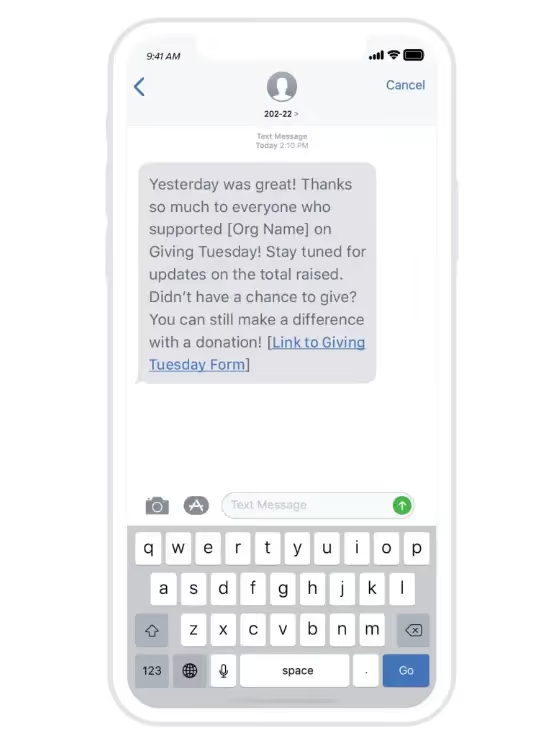
Your past donors are those who already believe in your mission. They just need a reminder of the difference they’ve made. Re-engagement texts work best when they sound personal, share a quick update, and show donors how their earlier support still creates impact.
Hi [Name], we haven't heard from you in a while, but we'd love to have you back. Here's what we've been up to: [Brief update]. Interested in getting involved again? [Link]
[Name], you gave to [campaign name] last year and it made a real difference. We're running a similar campaign now. Would you consider giving again? [Link]
We miss you, [Name]! Your last gift helped [specific outcome]. We're working on [new project] and would love your support: [Link]
[Name], your support in [year] helped us [achievement]. This year, we're trying to [new goal]. Will you help us again? [Link]
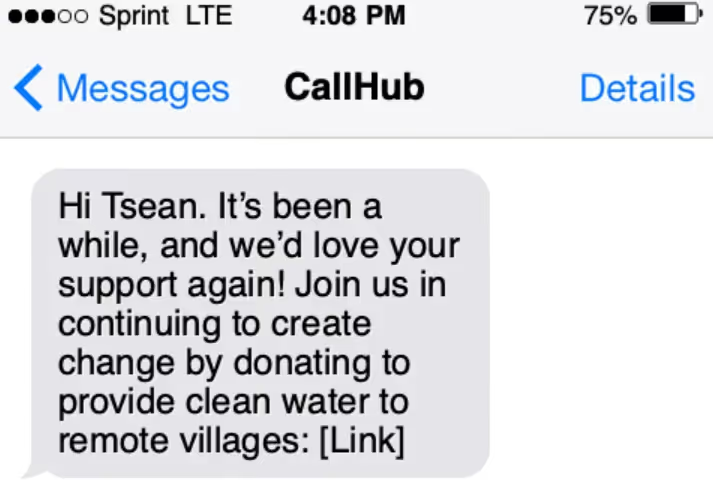
Gratitude matters. Donors who feel seen and appreciated are far more likely to stay connected and give again. Send one of these right after someone gives:
Thank you, [Name]! Your gift of [amount] just came through. You're making [specific impact]. We're grateful.
[Name], your donation means [specific outcome, e.g., '3 students will get scholarships']. Thank you for believing in our mission.
We got your gift of [amount], [Name]. Thank you! Here's your receipt: [Link]. Your support makes our work possible.
[Name], you just became donor #[number] in our campaign! Thank you for joining [number] others who are making this possible.
Your gift is already at work, [Name]. Thank you! Watch for updates on what we accomplish together.
Text messaging works best when it's part of an integrated strategy. Here's how advancement teams can automate their fundraising sms campaigns:
The result is a text messaging program that runs efficiently without eating up your team's time on manual tasks.
Text messaging can deliver results that other channels struggle to match, but only when you have the right tools and strategy in place.
Almabase helps advancement teams run text campaigns that convert, with built-in segmentation, personalization, and automated workflows that save time while raising more.
Request a demo to see how Almabase can power your next text messaging campaign.

Fundraising Text Message Examples
We've collected a whole bunch of fundraising text message templates for you to use for your upcoming giving days, events, and fundraisers.
Lorem ipsum dolor sit amet, consectetur adipiscing elit. Suspendisse varius enim in eros elementum tristique. Duis cursus, mi quis viverra ornare, eros dolor interdum nulla, ut commodo diam libero vitae erat. Aenean faucibus nibh et justo cursus id rutrum lorem imperdiet. Nunc ut sem vitae risus tristique posuere.

November 24, 2025
12 minutes

.svg)

.avif)
.webp)