Almabase is thrilled to announce our collaboration with Louis Diez, founder of the Donor Participation Project (DPP), to host Friday Research Findings, a monthly LinkedIn Live series. Join us on the last Friday of every month to elevate your fundraising strategies.
.webp)
We are thrilled to announce our collaboration with Louis Diez, founder of the Donor Participation Project (DPP), to host Friday Research Findings, a monthly LinkedIn Live series.
Every last Friday of the month, Louis will be hosting insightful discussions with fundraisers, advancement professionals, and industry experts. Think about it as a casual conversation between two friends who share an unwavering passion for fundraising and advancement.
Each session will delve into research discoveries, best practices, actionable insights, and real-life scenarios, all designed to enhance your strategic approaches. Whether you're a seasoned fundraising professional or a newcomer to the field, the Friday Research Findings series guarantees valuable takeaways for everyone.
For those not yet familiar with Louis, he is a seasoned authority in annual fund development and digital fundraising, bringing a wealth of experience to the table. His tenure as the former Executive Director of Annual Giving at Muhlenberg College, coupled with his contributions to esteemed organizations such as the Baltimore Symphony Orchestra and Johns Hopkins SAIS, underscore his remarkable journey in fundraising.
The Donor Participation Project, Louis Diez's brainchild, is an initiative that convenes fundraising professionals who share two critical concerns:
The members meet for monthly meetings that take the form of Lunch Analysis sessions—a blend of a book club, scholarly discussions, brainstorming, and mutual support. Each session focuses on a specific topic related to donor participation.
Join us on the last Friday of every month to elevate your fundraising strategies. 🚀
In addition to the valuable insights you'll gain from the session, you'll also receive exclusive resources from Almabase and access to the resource library curated by DPP.
Curious about this month's speaker and the topic? Watch out this space for more details!

Louis Diez, a seasoned expert in annual fund development and digital fundraising, brings a wealth of experience to the table. His roles as the former Executive Director of Annual Giving at Muhlenberg College, along with his contributions to organizations like the Baltimore Symphony Orchestra and Johns Hopkins SAIS, underscore his remarkable journey in fundraising.
With an impressive academic background, including an MBA from CUNEF, a Ph.D. in Business Administration from Universidad Rey Juan Carlos, and an MM in Music Performance from the University of TN, Louis embodies a diverse perspective that enriches every discussion.
Table of Contents
Subscribe
See how modern advancement teams bring alumni engagement and fundraising together.
After over a decade of front-line fundraising for worthy causes, I'm starting a new chapter as VP, Community at Almabase and Host of the Donor Participation Project
My first real job in this industry began almost exactly ten years ago, when I networked my way into the alumni office of my alma mater, the University of Tennessee-Knoxville as an administrative assistant with an MBA and a Ph.D. The passion for the backend of fundraising has remained with me ever since. How do things get done in fundraising offices? What processes help—or hinder—our success? Will looking at things differently help? Or are we “building on the shoulders of giants” and shouldn’t change what isn’t broken?
However, my passion for the space started much before that.
Armed with a stack of resumes, the Internet, and a place to stay in NYC, I ran my first direct response campaign to find myself an internship. As I think of the outcome now, the results were life-changing and yet the ROI at the time didn’t feel so great: maybe an early fundraising lesson?
I landed two internships at Lincoln Center for the Performing Arts and a similarly prestigious boutique consulting firm: AEA. Lincoln Center’s CEO at the time was known for his fundraising prowess. Reynold Levy would tell his employees that the only reason he would ever interrupt their meetings was if a trustee was calling. As I progressed into more strategic roles, planned successful fundraising campaigns, and managed talented teams these early lessons stayed with me.
Fast-forward ten years, and here I am with Almabase and as the founder of the fastest-growing professional organization in philanthropy (joindpp.org).
To those who aren’t familiar with Almabase or what we do – we are a team of 40-something innovators on a mission that’s very dear to me: making quality education accessible to everyone.
This is what brought me to this organization. Their heart is in helping nonprofits, mainly in higher education, improve in the area of biggest opportunity in our industry. How do you make it easy to run highly engaged communities? How do you connect engagement to giving behaviors? What do annual giving, alumni affairs, and communication professionals need to do a better job? Yes, they have an incredibly user-friendly software but their true superpower is in caring about the right things.
When Kalyan flew in to meet at my neighborhood coffee store, he had an interesting idea to run by me: powerful communities are poised to rule the non-profit sector, but the problem right now is in setting up these communities.
That’s where I came into the picture. With my experience building thriving communities like the Donor Participation Project, I could see where Kalyan was headed with this vision, and naturally, I wanted in.
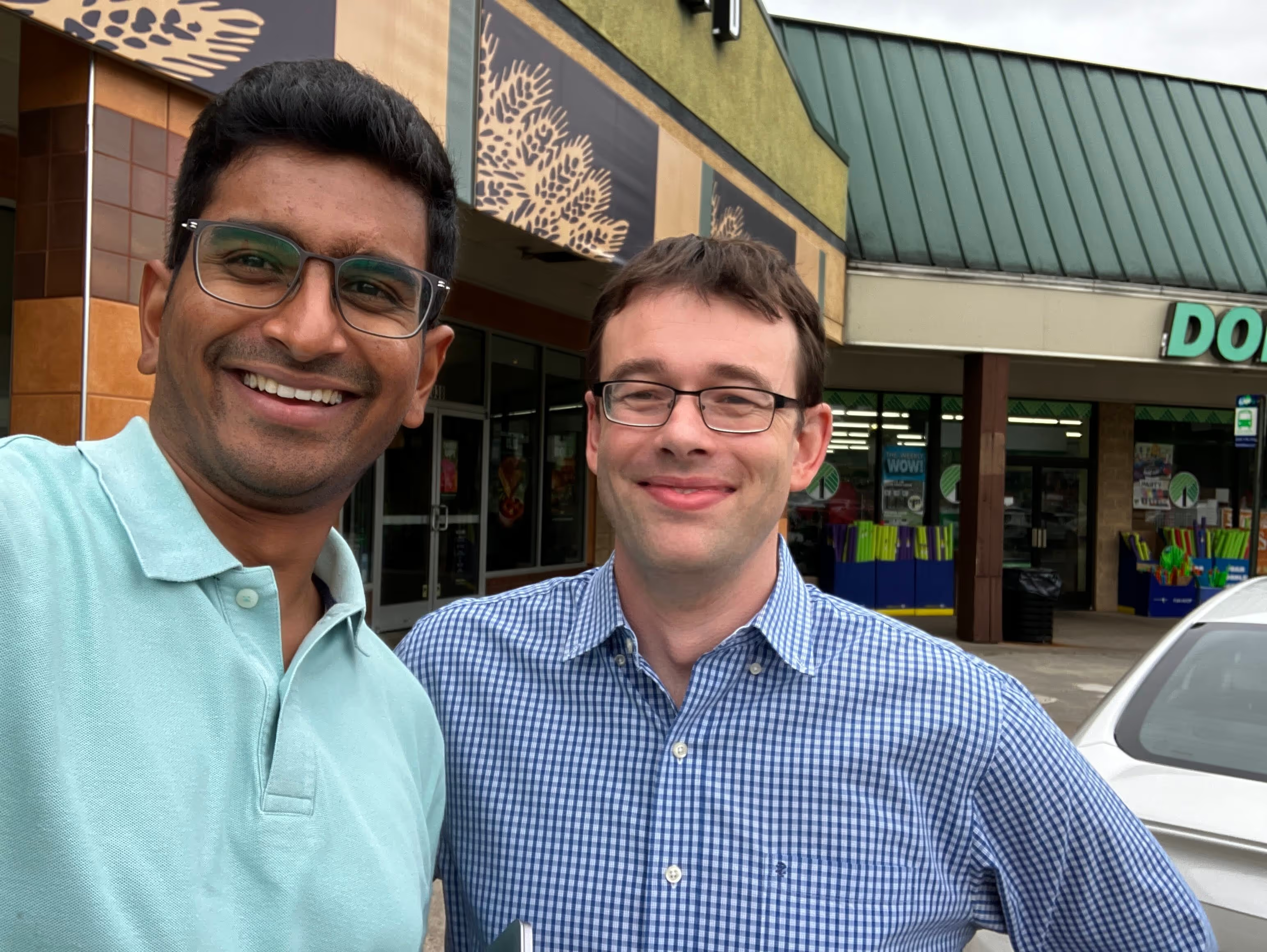
However, having an interesting problem to work on is only half the reason I chose to join Almabase. The other half, the one that resonates with me on a personal level, is about their values.
With student debt being a growing challenge, it's only natural for alumni to be the bridge that makes education accessible to all.
"If I were to create a platform to support our community-building and fundraising work, it would be Almabase."
Almabase is making a huge bet on communities being one of the central drivers of success for nonprofits in the next few years, and I’m thrilled to get a front-row seat on the ride.
Almabase lives and swears by alumni-centricity – the idea of building value-driven relationships with your alumni network. Incidentally, creating and sharing value is what makes a community strong and purposeful for all its members. Clearly, there are common threads between the two.
The way I see it, if institutions want to get better at alumni centricity, they need to leverage the power of strong alumni networks. That’s how I come into the picture – I’ve had my fair share of experience building communities that work. That’s why I’ll be working with Almabase’s vast network of institutions in helping them shape these communities.
It’s a big bet, but powerful alumni communities lead to higher donations raised with lower costs, which can empower the next generation of students with quality education. Everyone’s a winner, and I’m thrilled to see how this shapes up.
So there you have it – the not-so-brief recap of the events over these last few weeks. What are your predictions for the future of this space?

Louis Diez is an expert in annual fund development, digital fundraising, and engagement strategies. He's the founder and host of the Donor Participation Project and VP, Community at Almabase.

Louis Diez, Community & Fundraising Expert, joins Almabase as VP, Community
Veteran fundraiser Louis Diez, Founder of the Donor Participation Project, recently joined Almabase as VP, Community. Read on to learn more about his journey so far, and the future of communities in alumni relations.
Lorem ipsum dolor sit amet, consectetur adipiscing elit. Suspendisse varius enim in eros elementum tristique. Duis cursus, mi quis viverra ornare, eros dolor interdum nulla, ut commodo diam libero vitae erat. Aenean faucibus nibh et justo cursus id rutrum lorem imperdiet. Nunc ut sem vitae risus tristique posuere.
Your university likely often brainstorms new fundraising ideas to engage alumni, from Giving Tuesdays to tele-a-thons. However, one of the most effective ways to earn alumni support is to demonstrate your appreciation before pitching for a donation.
According to NPO Info’s charitable giving statistics report, alumni are an important donor group for higher education institutions, contributing approximately 26% of all gifts to colleges and universities.
Theoretically, your university should see a regular increase in alumni giving year after year as each class graduates and enters the workforce.
However, universities will only be able to set themselves up for this growing support if they take the proper steps to retain their alumni donors. To help your university improve your alumni donor appreciation strategy and increase fundraising, this article will explore how to:
When reaching out to current and potential alumni donors, keep in mind that just because an alumni isn’t able to give now, doesn’t mean they won’t be able to in the future. Keeping these relationships strong long-term can be well worth the effort.
Each of your alumni had a unique experience at your university, making life-long connections with professors, faculty, and fellow students. Show them that they are still an important part of this community by reaching out to them with personalized messages.
Basic personalization includes doing small things like addressing your alumni by name. But you can go a step further and create messages that will truly capture their attention by:
Personalized messages strengthen your donation requests and show your alumni that your university acknowledges and appreciates their support. Additionally, be sure to reach out to alumni volunteers to thank them for their efforts. This will help secure their support long-term, and may even lead to future donations as volunteers can often turn into donors.
Chances are that you or someone (or many people) you know still have school spirit for their alma mater, even decades later. You can help your alumni continue to represent their school years after graduation with custom merchandise with your university’s name and logo.
Of course, your university likely already has an on-campus store where visiting alumni can pick up merchandise. However, you can give them more options by creating an online storefront or even sending merchandise in the mail as a thank-you for donating.
When it comes to creating custom merchandise, you can stick to old classic designs or mix things up to create apparel that plays with your university’s branding in a unique way to make items that are stylish and maybe a bit out of the box, but still unquestionably represent your university. For example, try playing with the color and even the overall style of items to create something eye-catching.
You can also create merchandise lines exclusively for alumni who donate or volunteer. This can make alumni feel not just appreciated, but that they are members of an exclusive group powering their school’s success.
Although with time, your alumni will move on with new friends, coworkers, and raising families, many of them will likely enjoy reconnecting with old college friends and professors, revisiting campus, and reliving the time spent at their alma mater. Alumni events provide the opportunity for them to do just that and are an impactful way to show that their alma mater still considers them to be a valuable member.
You can gather your alumni together to show your appreciation and garner support with events like:
To host an alumni event, use your alumni management tools to identify alumni you would like to invite, create personalized invitations, and track how your event turned out. After each event, follow up with alumni to thank them for attending and create a communication stream to strengthen your relationship and encourage them to make a contribution in the future.
Your alumni will have a connection to your school forever, and you can transform those feelings into lasting support with the right appreciation strategies. Show donors that their contributions matter by reaching out to them with custom messages, providing them with custom merchandise, and bringing them back to your university with numerous events. Good luck!

3 Alumni Donor Appreciation Ideas to Inspire Lasting Support
To help your university improve your alumni appreciation strategy and increase fundraising, send personalized messages, custom merchandise, and host alumni events.
Lorem ipsum dolor sit amet, consectetur adipiscing elit. Suspendisse varius enim in eros elementum tristique. Duis cursus, mi quis viverra ornare, eros dolor interdum nulla, ut commodo diam libero vitae erat. Aenean faucibus nibh et justo cursus id rutrum lorem imperdiet. Nunc ut sem vitae risus tristique posuere.
The institution of higher education relies on funding from alumni to maintain the level of excellence it’s worked so hard to establish. When students graduate and go out into the working world, they’re putting the skills and knowledge that they built while in school to use. On an average, higher education graduates earn around twice as much in their lifetime than individuals with only a high school diploma or GED.
This means that your alumni are also the best people to reach out to for fundraising at your institution. Not only do they have a special connection with their alma mater, but as they grow in their respective careers and gain financial stability, they can contribute better to your cause — hence, it’s imperative to keep your alumni in the loop. Your alumni leverage the education they received from your institution. By donating to your school, they can give back to help others do the same.
What does this mean for your organization? It’s your job to help alumni see the benefit of contributing to your school and to develop relationships with them over time. We've curated 4 alumni fundraising strategies that are evergreen and will help you reap alumni fundraising success. However, keep in mind that some other details, such as trends in higher education fundraising, may change depending on the external circumstances in which you’re operating. Keep the latest alumni engagement trends in mind, but don’t forget the importance of lasting strategies as well. Let’s dive in!
Not all alumni are equal. This doesn’t mean you should completely ignore some of them, because they’re all important. However, you should approach them differently depending on who they are and their role in your organization.
For instance, you wouldn’t go to an average recent graduate and ask for a major donation of $1 million. Similarly, you wouldn’t go to a major donor and ask for $25. Instead, segment the supporters within your database. If you don’t yet have a database you like or are looking for a new option, Bloomerang’s donor database guide provides the following steps to find the perfect solution for any organization:
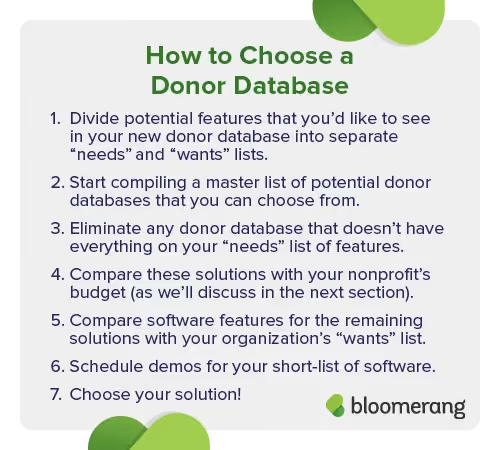
When you have an alumni engagement/fundraising software/platform that empowers the effective organization of alumni data, create segments based on the alumni’s giving recency, frequency, type, amount, reason, and interest. Let’s consider how different types of donors might show these items differently:
Understanding segments in your alumni database will help you reach out to alumni with messages most meaningful to their engagement with your school. This lays the foundation for an impactful relationship.
Higher education institutions generally rely heavily on major giving from alumni. By leveraging prospect research, your institution can identify these valuable alumni and determine who will be most likely to give in substantial quantities to your school.
Prospect research will help you identify both wealth and philanthropic indicators to make this possible. Here’s a breakdown of the difference:
This information is publicly available, so you could take a DIY approach to find it. However, it’s much simpler to use a prospect research database to learn more about prospective donors. Then, you can search your alumni database to find the perfect match for your next mid-tier or major donation.
Average new alumni might not have the capacity to donate back to the school in large sums just yet. However, they may still feel a very strong connection to your school, having just graduated. Therefore, you should get them involved as soon as possible.
Ask new graduates to reach out on your behalf to get their friends, family, and connections involved with your institution. You may ask them to:
Even if your alumni don’t have the capacity to give or don’t want to give yet, that doesn’t mean they can’t get involved! Encourage all of your alumni to get involved with your institution and to start giving back by reaching out on your behalf.
It’s rare that an alumna will turn around to give $10,000 to your school out of the blue. Typically, large donations that exceed thousands or even millions are those that come from someone your institution has developed a relationship with.
Focusing on donor relationships will help keep your alumni coming back again and again, increasing your retention rate and helping you fundraise more. Higher donor retention lowers the cost of acquisition. Plus, alumni will tend to give in greater quantities over time as their capacity increases and their connections to the institution continue to grow.
To build these relationships, your organization should:
Relationships build the foundation for all healthy and sustainable fundraising. By focusing on relationships rather than money, you show your alumni that you care about them, not just their wallets.

Your alumni are thankful for the time they spent learning at your school and developing skills that helped them make it in the world beyond. This connection to your school is special and strong. Therefore, take the steps necessary to build relationships with these important donors and reach out to them using the strategies in this guide for more successful alumni fundraising.
Alumni donate to an institution and cause that they feel a personal connection with. Alumni donations involve require keeping them engaged, providing a smooth donation process, hosting events that resonate with them, and forming a community of like-minded donors.
Even the most generous alumni may miss out on an upcoming cause due to a busy schedule. Meaningful and personalized engagement not only keeps alumni in the loop with what's happening but also allows you to widen your reach for upcoming events and fundraisers.
Today, alumni engagement is a mix of online and offline engagement methods. You try to promote in-person interactions but also keep track of your email, social media, and alumni community interactions to keep your alumni base interested and informed.
Fundraisers allow institutions to tap into the social goodwill of their alumni to achieve initiatives and events that they might have otherwise not had the funding or reach to accomplish. By maintaining this bond, fundraising also doubles as a crucial engagement channel between an institution and an alumni.
An alumni association provides alumni with access to career , mentorship, and networking opportunities while keeping them in touch with their fellow alumni. The institution in turn gains a central point of contact for their alumni outreach and communication needs through the association.

4 Awesome Alumni Fundraising Strategies
Check out these four strategies to amplify your alumni engagement and improve your fundraising efforts.
Lorem ipsum dolor sit amet, consectetur adipiscing elit. Suspendisse varius enim in eros elementum tristique. Duis cursus, mi quis viverra ornare, eros dolor interdum nulla, ut commodo diam libero vitae erat. Aenean faucibus nibh et justo cursus id rutrum lorem imperdiet. Nunc ut sem vitae risus tristique posuere.

September 30, 2021
12 minutes

.svg)

.avif)
.webp)