Are you securing corporate matching gifts for charitable donations made to your university? Get started or up your efforts with these effective practices.

Adam Weinger
Updated:
April 1, 2026
Is your university making the most of matching gift fundraising opportunities? Unfortunately, the answer is probably not. The truth is that matching gifts are a significantly underutilized form of funding for all sorts of schools, universities, and institutions. That means that to maximize your school’s revenue, the way you view and promote matching gifts to donors could likely use a revamp.
Matching gifts have the potential to fuel any organization’s fundraising efforts and help you secure the most revenue possible. Ready to drastically improve your matching gift marketing strategies and bring in more corporate dollars? Check out these five best practices if you’re looking to up your matching gift marketing strategies to encourage corporate giving participation among your university donors.
.png)
Many alumni enjoy supporting the schools that helped pave the way for their success. Effective fundraising campaigns can be an excellent means for engaging these former students long after they leave your campus. And taking things a step further is matching gifts.
According to statistics from Double the Donation, more than 18 million individuals are employed by companies with matching gift programs. More than likely, a good amount of your school’s alumni are among those people.
However, the vast majority of match-eligible donors are unaware of the programs offered by their employers — which often puts it on the organization to market these opportunities effectively. If you’re looking to promote matching gifts, consider the following powerful marketing and outreach avenues to use:
While it’s certainly a good idea to inform all sorts of people about the wide availability of matching gifts, taking an alumni-centered approach can be a great way to focus on these types of generous supporters and target your efforts accordingly.
Many donors use your university’s website to learn more about how to get involved and where to give as well as additional opportunities for support. As such, it’s important that you provide ample information about matching gifts on your site.
We suggest crafting a dedicated matching gifts web page with the following tips in mind:
Then, direct supporters to this informative resource by linking to it in your matching gift emails, school-wide newsletters, social media posts, and other fundraising materials.
Whether you’re looking to plan for a dedicated giving day or other fundraising occasion or simply optimize your long-term strategy, corporate matching gifts are a great way to go. When you integrate matching gift fundraising into your existing donation process, it allows donors to determine their own eligibility for a matching gift without ever having to leave your donation page.
Here’s how it typically works:
1. A donor fills out your school’s online donation form.
2. The donor is provided with a simple company search widget embedded in the page.
3. The donor fills in their employer’s name and submits the donation.
4. The donor is provided with guidelines for their employer’s matching gift program on the confirmation screen.
Supporters are usually at the peak of their engagement while completing your online donation form, so it makes sense that you’d want to incorporate matching gifts at this time. Plus, research shows that 1 in 3 donors report that they’d likely make a larger gift if they know it will be matched by their employer, which makes it an impactful strategy for increasing donation sizes as well.
When it comes to matching gift fundraising for universities, one of the best things you can do to set your team up for success is to keep a detailed record of companies with especially generous matching gift programs. Then, you can compare this information against the companies that your alumni are working for to get a better idea of your existing match-eligible prospects.
After all, a significant part of effectively leveraging matching gifts depends on having and using the right data to drive your fundraising strategies. For matching gifts, donor employers are the most important metric there is.
Following up with supporters after they’ve made their gifts is one of the best ways to take your donor relations to the next level and maximize the number of donors who request corporate matches. We recommend segmenting donors by their likely eligibility for a match (based on information collected during the donation process) to ensure your messaging is as tailored and relevant as possible. Consider these examples:
Luckily, if you’d like to streamline this process and save time and resources for your school, you can automate the follow-up process from beginning to end. All you have to do is invest in a matching gift automation tool, and the software will do the rest!
Failing to promote matching gifts to supporters is essentially throwing away free donations. When you take a strategic approach to marketing, however, you allow your generous donors to make an even larger impact on your school, establish corporate partnerships with businesses in your network, and secure additional revenue for your university’s needs.
Just remember to inform alumni and other supporters of these exceptional giving opportunities, promote matching gifts through your school website and donation page and follow up with donors to drive match requests to make the best of your fundraising efforts.
Subscribe
See how modern advancement teams bring alumni engagement and fundraising together.
Plan faster. Execute better
Explore free templates designed for alumni and fundraising teams.
.png)

.avif)
Adam Weinger
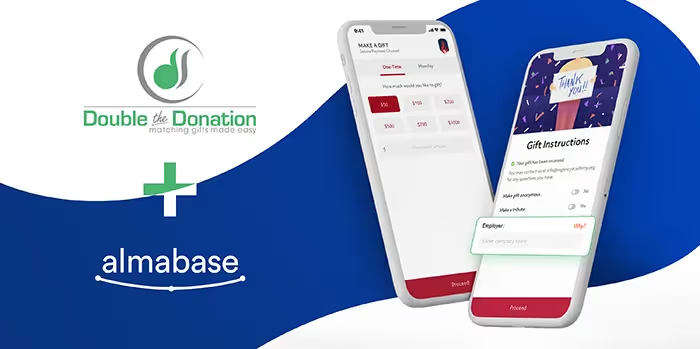
San Francisco, CA (2nd October, 2019) — Alumni engagement and online giving expert Almabase has launched a new partnership with Double the Donation, the leading provider of matching gift and volunteer grant solutions to nonprofits and educational institutions. This features a new integration between Almabase online giving pages and 360MatchPro by Double the Donation.
Trusted by hundreds of Higher Ed & K12 institutions, Almabase is transforming the world of alumni fundraising. With the ability to integrate with various gift processing systems, Almabase provides a one-stop solution for achieving fundraising goals, acquiring new donors, and enhancing the online giving experience for donors.
The 360MatchPro platform actively identifies donors who are eligible for employer matching gift programs, provides their company’s specific matching gift next steps, and then follows up with them automatically to drive additional revenue to nonprofits. The integration with Almabase automatically adds an employer field onto online giving forms, jumpstarting the matching gift process.
“The schools fundraising through Almabase are all in a unique position to take advantage of employer matching gift programs,” said Kalyan Varma, Co-founder and CEO of Almabase. “Integrating with 360MatchPro allows those schools to automate their matching gift opportunity identification and outreach. This is a huge value-add for schools without adding time-intensive administrative efforts.”
Setup of the integration is easy and only needs to be completed once. After setup is complete, schools have the capability to customize the matching gift follow-up that donors receive.
“Lack of donor awareness is the main contributing factor to schools falling short of their matching gift fundraising potential,” said Adam Weinger, President of Double the Donation. “Using 360MatchPro, schools start to close the $4-7 billion gap in matching gifts left on the table each year.”
360MatchPro identifies more matching gift opportunities than schools could do so manually, then actively and automatically follows up with them to drive a higher percentage of matches to completion than possible with manual outreach. Connecting 360MatchPro to Almabase giving forms ensures that no matching gift opportunity goes unclaimed.
Learn more about Double the Donation at https://doublethedonation.com/ or schedule a private demo of 360MatchPro at https://www.360matchpro.com/demo-request/.
Learn how Almabase transforms online giving: https://www.almabase.com/.
Almabase and Double the Donation Announce Integration with 360MatchPro Matching Gift Platform
Lorem ipsum dolor sit amet, consectetur adipiscing elit. Suspendisse varius enim in eros elementum tristique. Duis cursus, mi quis viverra ornare, eros dolor interdum nulla, ut commodo diam libero vitae erat. Aenean faucibus nibh et justo cursus id rutrum lorem imperdiet. Nunc ut sem vitae risus tristique posuere.
As another year approaches its end and the holiday spirit hangs high in the air, how prepared are you to leverage this holiday season to double the impact of your donations?
Gift matching programs are a great way to drive revenue for your institution - they allow your donors to increase their donation amounts through employer benefits instead of their own wallets. Despite this, there is an estimated $4 to $7 billion in matching gifts that go unclaimed each year. Academic institutions could really benefit from that cash - so why aren’t they taking advantage of it?
Well, many organizations and donors alike are not very familiar with matching gift programs. In fact, 78% of match eligible donors don’t know anything about their gift matching programs. That means they are certainly not taking the extra step of submitting matching gift requests. So the most important thing to know about gift matching is that not enough donors know about gift matching programs.
Once you know that it is an awareness gap and not a motivation gap that stands in the way of matching gift revenue, it becomes easier to educate your donors and encourage them to drive their matching gift requests to completion.
This holiday season, leverage these 3 matching gift strategies to fuel your institution's fundraising efforts and upgrade your alumni programming.
As mentioned above, the main reason that your organization does not reach its potential in matching gifts is because donors are not aware that they are eligible for gift matching programs. As a nonprofit organization, it is your job to educate these donors because it can result in a lot of extra cash for your mission.
One of the best places to educate your donors is on your donation confirmation screen. Many matching gift requests are time sensitive, so it is important to educate your donors quickly, and the easiest way to do that is, of course, directly after their donation has been made.
Educating your donors on the confirmation screen also allows you to target them while they are still in the giving mindset. The donor obviously feels connected and committed to your organization, so they will welcome additional ways to increase their initial contribution.
To do this, simply add a couple of sentences about gift matching on your confirmation page. You can even use tools like 360MatchPro by Double the Donation to allow donors to search for the name of their employer and then read more about their own specific gift matching program.

By placing matching gift information directly onto your confirmation pages, you can target donors quickly and efficiently while they are still feeling connected to your organization. This increases the chances that they will learn more about employer gift matching and then pursue a matching gift request.
After your donor learns more about gift matching, you still want to ensure that they take action and submit their matching gift request. That is why our next must-know strategy also involves direct donor communication. This time, however, it entails using automated emails to follow up with donors after the donation process.
Email messages are a great way to provide additional gift matching information that might not fit on your confirmation page. It also provides a second chance for your donor to submit their gift matching request. There are many automated email stream options that allow you to send matching gift emails to donors after the donation process.
If you use gift matching software like 360MatchPro, you can even automate these messages to contain gift matching information that is specific to your donor’s employer.

These messages contain specific guidelines based on the information that your donor entered on the confirmation page.This can include employer match amounts, eligibility and a link to submit a gift matching request. This makes it easy for the donor to learn more about gift matching and take the final step of driving their gift to completion.
Automated emails that contain general matching gift information are especially important because even if your donor did not enter their employer into the gift matching tool you’re using, they might still be eligible for a matching gift. They might have simply neglected to read the confirmation page or they did not think that matching gift programs applied to them, which could be based on the awareness gap that we discussed before.
Most nonprofits choose to customize this email so that it matches their brand’s unique voice. Automated email outreach is a lucrative strategy that encourages donors to complete gift matching requests. It is a great way to further educate donors and help them secure extra funding for your organization.
The gift matching process produces valuable insights about your donors. This can include where they work, their matching gift eligibility and their response to automated outreach. It is important to keep track of this data so that you can better develop your ongoing fundraising strategies.
That is why the final need-to-know strategy involves tracking donor insights. By tracking the information that is produced from matching gift strategies, you can tailor future outreach and ensure that you are creating an effective matching gift approach.
360MatchPro can actually track all of these insights for you using its automated technology. While you could manually record all of this data, the 360MatchPro dashboard stores it for you in one, easy-to-navigate space.

Using this information, you could thank your donors for their matching gift request, or you could automate follow up emails to donors who did not open your first message. For example, if you have a donor named Jenny from the Home Depot who submits a matching gift request, you could wait to receive the gift, then send Jenny a personalized message that thanks her for her request and explains how it helped your organization. You could then track Jenny’s future contribution habits to see how this positively affected her donor behavior. Keeping track of this information is vital to maintaining a lucrative gift matching strategy.
The fundraising strategies don’t stop there! While you just learned about the most important matching gift strategies for the year-end holiday season, there are certainly more tools to explore. For example, if you are interested in learning more about which companies have the best matching gift programs, check out this page. This list details the most impressive matching gift programs, and it can help you target the most profitable matching gift employees.
You can also check out Double the Donation’s educational blog to discover more matching gift resources. Happy fundraising!

Adam Weinger is the President of Double the Donation, the leading provider of matching gift tools to nonprofit organizations and educational institutions. Adam created Double the Donation in order to help nonprofits increase their annual revenue through corporate matching gift and volunteer grant programs.

Everything You Need to Know About Matching Gifts to Fuel Your Fundraising Efforts This Holiday Season
Lorem ipsum dolor sit amet, consectetur adipiscing elit. Suspendisse varius enim in eros elementum tristique. Duis cursus, mi quis viverra ornare, eros dolor interdum nulla, ut commodo diam libero vitae erat. Aenean faucibus nibh et justo cursus id rutrum lorem imperdiet. Nunc ut sem vitae risus tristique posuere.
As a fundraising professional, you understand the importance of building relationships with your valuable donors. They’re the ones who provide the funding that make it possible to provide new opportunities for students and alumni. Therefore, building relationships with them secures support both now and in the future for these fundraising programs to continue taking place.

Considering the disruptions that everyone experienced (and continues experiencing) during the COVID-19 pandemic and how the industry has evolved since then, your relationships with many donors might appear to be volatile or different. When everyone changed up their strategies to incorporate the latest trends in engagement, some strategic aspects undoubtedly fell through the cracks.
We recommend taking your approach back to the basics of engagement and donor relationships this coming year. Revisit some tried-and-true ideas that have been proven time and time again to bolster relationships with your supporters. After all, these are the strategies that are most often forgotten when we embrace new methods and change up our approach to relationships.
The tips we’re covering in this article are ones that you may have seen before. However, they’re immensely important to maintain throughout the hubbub and chaos of the year. Without further ado, let’s dive deeper into these important and timeless strategies to help take your donor relationships to the next level.

For students, alumni, and donors, it’s painfully obvious when you send out emails or other communications that do not employ segmentation or other personalization strategies. Everything from a “To whom it may concern” introduction to the lack of personal details in the message makes it clear that you sent the same message to everyone on your email list.
Generic, impersonalized outreach is the easiest to ignore and causes the downfall of many marketing programs. See how institutions such as Gann Academy increased alumni email open rates by personalizing their email campaigns.
When it comes to your donors, you should include the same personalization strategies for outreach.
The easiest way to start making the most of personalization is to use the same approach as Gann Academy: start with your email campaigns. Use the information in your donor database to fill in some gaps and to show your supporters that the message you’re sending is customized just for them. You can do this by:
- Using the donor’s preferred name in the introduction.
- Including details about the supporters’ engagement history.
- Approaching specific segments of donors with targeted messages.
- Sending messages relevant to the interests of the donor.
When you have access to an effective donor database, a lot of this information can be automated to save you time and energy in sending these highly targeted messages. This effective donor database buyer’s guide explains that automation features, when used correctly, can make personalization more effective and efficient.
Your database can be used to auto-populate details into message templates and ensure you reach the right audience segments in your communications to enhance donor engagement.

Building relationships is impossible if it’s a one-sided effort. Your institution needs to not only work to communicate and show your donors that you care, you need to invite them to engage back with you by providing ample opportunities.
Since COVID-19, engaging opportunities look a little different than they have in the past. To create engaging opportunities amidst of a pandemic, many institutions had to adhere to social distancing guidelines by coming up with new virtual event ideas.
We’ve come up with a list of our favorite virtual fundraising ideas that any educational institution, nonprofit, or other organization can make use of. While you can find the full list here, we’ll highlight some of the options below:
- Online Gala - This is a great opportunity to encourage your major donors to get dressed up and network with one another using virtual conferencing software.
- TED Talk Events - Encourage your donors while enforcing your emphasis on education by providing TED Talk-style events to spread knowledge about certain topics.
- Online Classes - Provide online class opportunities for donors as well as students. These may not be full-fledged courses, but mini opportunities to sharpen skills.
- Annual Giving Days - Giving days encourage a great number of people (especially alumni) to give on a very specific day, similar to #GivingTuesday.
- Matching Gift Drives - This is a great way to encourage more donations and maximize impact. Promote corporate giving opportunities and remind supporters to check their eligibility for matched gifts.
When your donors get involved with all of the opportunities you offer, they strengthen their ties to your institution. This makes it all the more likely that they’ll continue supporting you in your upcoming fundraising events.

A phone call is an often overlooked relationship-building strategy because it can be somewhat time-consuming. However, it’s a valuable tool and makes a huge difference, especially when it comes to new donors.
For instance, consider the new donor cultivation timeline below. It shows that a thank-you call within 48 hours of a donation can dramatically improve your donor retention rates. Plus, it’s the first step to begin a strong relationship with your donors. This is because you establish a personal connection with the donor while showing your appreciation for their contribution.

Phone calls are a great way to start a relationship with donors on the right foot. However, don’t forget to employ the strategy with your seasoned donors as well! Call them to maintain regular contact and to express your gratitude for their continued support in your fundraising initiatives.

You’ll notice that on the cultivation timeline from the previous section that the step after a “thank you phone call” is sending a “signed thank you letter.” While email is likely your primary method of communication with the donors, the power of a physical letter of appreciation should not be underestimated, especially when it’s hand-written.
Handwritten notes are a classic way to show your donors that you will truly take the time out of your day for them. They want to feel like a priority for your organization, which is what a hand-written note should communicate.
When you write these notes, there are specific elements that you should make sure to include, such as:
- The preferred name of the donor. Just like in email communications, you should make sure to refer to the specific donor as you hand-write letters (be sure to double-check your spelling, too!)
- The activity they participated in. If your donor has just contributed funds, be sure to thank them for the specified amount. If they attended an event, thank them for their involvement and participation.
- The president’s signature. Letters are generally better received when they come from the top office of your institution. Therefore, you should make sure the president of your institution’s signature is on each and every one of them.
Just like phone calls, hand-written letters tend to be important strategies as you cultivate relationships with your new donors. However, don’t forget about the strategy for your veteran donors!
Be sure both phone calls and hand-written letters are a part of both your cultivation and stewardship strategies to strengthen donor relations.
.avif)
Don’t we all love stories? Your donors want to hear your inspiring story. They want to hear the reason behind all the great work that you do and the support that you provide to your community. Sharing these stories with your donors is a great way to show them what it is that their contributions support.
One of the current trends in the higher education space is the use of images to communicate these types of narratives. This trend is important to keep in mind because there are so many different platforms on which you’ll be telling stories. For instance, consider the following examples:
- Email - Whether it’s an email to a certain segment of your audience or a regular newsletter sent to many, include an image of an individual who attended your institution along with their story. This adds a face to the name and a personal touch to show the impact of donations.
- Social media - Platforms like Instagram and Facebook are made for visual storytelling. Be sure to use an image that tugs at the heartstrings to gain the attention of your audience, then caption it with details about the story itself. If it’s a longer story, be sure to provide a link to where donors can read the rest of it.
- Blog posts - Blogs are the perfect way to write long stories about individuals or about the progress of your institution. Showing images, faces, and specific names makes them even more powerful.
They say a picture is worth a thousand words. And it’s true! Be sure to leverage both text and image when you tell the story of your institution’s successes.

In the last section, we mentioned briefly that stories are a method of showing impact. Communicating impact is critical for donor engagement and continued support down the line. Think about it. If you give to an organization, you’re not contributing money for the sake of spending it. That would be silly! Rather, you’re donating to help accomplish a mission.
Communicating the progress of this mission and the impact of specific donations is a great way to give your donors the warm and fuzzy feeling in the pit of their stomachs that was probably what drove them to contribute in the first place. You’re reinforcing the positive aspect of donating.
Check out this nonprofit annual report guide that conveys the story of The Johnsons and how their impact was communicated to all contributors in an end-of-year report.

Notice some key aspects of this example:
- It shows a picture of The Johnsons
- The text uses a statistic showing the impact their contributions made
- The text is framed to put all of the emphasis on the Johnsons rather than on the efforts of the organization
These aspects are some of the most important things to remember when you communicate the impact of specific donors. Generally, on annual reports such as this, it’s your major donors that you’ll highlight. However, you can still use these strategies in emails, letters, phone calls, and other methods of communication to show any supporter that they’ve made a difference.
Building donor relationships is an incredibly important part of the fundraising strategy at your institution. Therefore, even as you explore all of the new and exciting ways to communicate and engage with them, don’t forget about the basics. Form a strong foundation for your donor relationships by using these tried-and-true strategies. Then, continue to cultivate and build these relationships to watch your fundraising soar!


Co-Founder and current Chief Relationship Officer at Bloomerang
He has served this sector for 33 years and is considered the most well-known senior statesman whose advice is sought constantly.
Prior to Bloomerang, he was the CEO and Co-Founder of eTapestry for 11 years, which at the time was the leading SaaS technology company serving the charity sector. Jay and his team grew the company to more than 10,000 nonprofit clients, charting a decade of record growth.
He is a graduate of Butler University with a B.S. in Business Administration. Over the years, he has given more than 2,500 speeches around the world for the charity sector and is often the voice of new technology for fundraisers.

6 Ways to Take Your Donor Relationships to the Next Level
Lorem ipsum dolor sit amet, consectetur adipiscing elit. Suspendisse varius enim in eros elementum tristique. Duis cursus, mi quis viverra ornare, eros dolor interdum nulla, ut commodo diam libero vitae erat. Aenean faucibus nibh et justo cursus id rutrum lorem imperdiet. Nunc ut sem vitae risus tristique posuere.
The institution of higher education relies on funding from alumni to maintain the level of excellence it’s worked so hard to establish. When students graduate and go out into the working world, they’re putting the skills and knowledge that they built while in school to use. On an average, higher education graduates earn around twice as much in their lifetime than individuals with only a high school diploma or GED.
This means that your alumni are also the best people to reach out to for fundraising at your institution. Not only do they have a special connection with their alma mater, but as they grow in their respective careers and gain financial stability, they can contribute better to your cause — hence, it’s imperative to keep your alumni in the loop. Your alumni leverage the education they received from your institution. By donating to your school, they can give back to help others do the same.
What does this mean for your organization? It’s your job to help alumni see the benefit of contributing to your school and to develop relationships with them over time. We've curated 4 alumni fundraising strategies that are evergreen and will help you reap alumni fundraising success. However, keep in mind that some other details, such as trends in higher education fundraising, may change depending on the external circumstances in which you’re operating. Keep the latest alumni engagement trends in mind, but don’t forget the importance of lasting strategies as well. Let’s dive in!
Not all alumni are equal. This doesn’t mean you should completely ignore some of them, because they’re all important. However, you should approach them differently depending on who they are and their role in your organization.
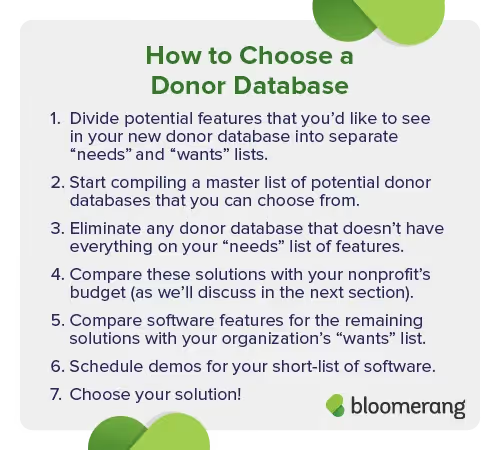
For instance, you wouldn’t go to an average recent graduate and ask for a major donation of $1 million. Similarly, you wouldn’t go to a major donor and ask for $25. Instead, segment the supporters within your database. If you don’t yet have a database you like or are looking for a new option, Bloomerang’s donor database guide provides the following steps to find the perfect solution for any organization:
When you have an alumni engagement/fundraising software/platform that empowers the effective organization of alumni data, create segments based on the alumni’s giving recency, frequency, type, amount, reason, and interest. Let’s consider how different types of donors might show these items differently:
Understanding segments in your alumni database will help you reach out to alumni with messages most meaningful to their engagement with your school. This lays the foundation for an impactful relationship.
Higher education institutions generally rely heavily on major giving from alumni. By leveraging prospect research, your institution can identify these valuable alumni and determine who will be most likely to give in substantial quantities to your school.
Prospect research will help you identify both wealth and philanthropic indicators to make this possible. Here’s a breakdown of the difference:
This information is publicly available, so you could take a DIY approach to find it. However, it’s much simpler to use a prospect research database to learn more about prospective donors. Then, you can search your alumni database to find the perfect match for your next mid-tier or major donation.
Average new alumni might not have the capacity to donate back to the school in large sums just yet. However, they may still feel a very strong connection to your school, having just graduated. Therefore, you should get them involved as soon as possible.
Ask new graduates to reach out on your behalf to get their friends, family, and connections involved with your institution. You may ask them to:
Even if your alumni don’t have the capacity to give or don’t want to give yet, that doesn’t mean they can’t get involved! Encourage all of your alumni to get involved with your institution and to start giving back by reaching out on your behalf.
It’s rare that an alumna will turn around to give $10,000 to your school out of the blue. Typically, large donations that exceed thousands or even millions are those that come from someone your institution has developed a relationship with.
Focusing on donor relationships will help keep your alumni coming back again and again, increasing your retention rate and helping you fundraise more. Higher donor retention lowers the cost of acquisition. Plus, alumni will tend to give in greater quantities over time as their capacity increases and their connections to the institution continue to grow.
To build these relationships, your organization should:
Relationships build the foundation for all healthy and sustainable fundraising. By focusing on relationships rather than money, you show your alumni that you care about them, not just their wallets.
Your alumni are thankful for the time they spent learning at your school and developing skills that helped them make it in the world beyond. This connection to your school is special and strong. Therefore, take the steps necessary to build relationships with these important donors and reach out to them using the strategies in this guide for more successful alumni fundraising.
Alumni donate to an institution and cause that they feel a personal connection with. Alumni donations involve require keeping them engaged, providing a smooth donation process, hosting events that resonate with them, and forming a community of like-minded donors.
Even the most generous alumni may miss out on an upcoming cause due to a busy schedule. Meaningful and personalized engagement not only keeps alumni in the loop with what's happening but also allows you to widen your reach for upcoming events and fundraisers.
Today, alumni engagement is a mix of online and offline engagement methods. You try to promote in-person interactions but also keep track of your email, social media, and alumni community interactions to keep your alumni base interested and informed.
Fundraisers allow institutions to tap into the social goodwill of their alumni to achieve initiatives and events that they might have otherwise not had the funding or reach to accomplish. By maintaining this bond, fundraising also doubles as a crucial engagement channel between an institution and an alumni.
An alumni association provides alumni with access to career , mentorship, and networking opportunities while keeping them in touch with their fellow alumni. The institution in turn gains a central point of contact for their alumni outreach and communication needs through the association.

4 Awesome Alumni Fundraising Strategies
Lorem ipsum dolor sit amet, consectetur adipiscing elit. Suspendisse varius enim in eros elementum tristique. Duis cursus, mi quis viverra ornare, eros dolor interdum nulla, ut commodo diam libero vitae erat. Aenean faucibus nibh et justo cursus id rutrum lorem imperdiet. Nunc ut sem vitae risus tristique posuere.

Jay Love
September 30, 2021
12 minutes
%201.svg)
%201.svg)
%204.svg)


.svg)