To be a successful higher education fundraiser, you’ll need to keep your donors in mind. In this guide, you’ll learn how to plan a fundraiser donors will love.

Most of your higher education donor prospects, whether they're first-time supporters or long-term donors, already have an affinity for your college or university. They might root for your sports team, champion academic research on campus, or want to pave the way for continued high-quality academics.
While many supporters are emotionally invested in your institution, they may still hesitate to support your fundraising initiatives. They may ignore your Giving Tuesday email appeals, scroll past your social media posts promoting your recurring giving program, or think, “My alma mater always does the same old thing during Homecoming Week” when they receive an invitation to your annual benefit.
So, in order to really grab your donors’ attention, you should plan fundraisers that they’ll be excited to participate in. Of course, there’s no need to throw out the current strategies that are working for your organization, like your graduation day email stream that always boosts your progress toward your annual fundraising goal or the Parents’ Week dinner that sells out every year. But you can fine-tune your strategies so that you always plan fundraisers your donors will love!
.jpeg)
We’ll help you get started by covering three tips:
As you set out to improve your fundraising efforts, consider working with a fundraising consultant. These professionals bring to the table a third-party perspective and years of experience, helping to improve your fundraising strategy in ways you may not have seen. And their work goes beyond identifying problems—a consultant can help you brainstorm and implement positive changes to your strategy, setting your organization up for sustainable success and growth.
Let’s dive into our three tips!
To plan a fundraiser that will resonate with your audience, you need to get to know your supporters and their preferences.
The first place to look for this information is your organization’s CRM. Review the donor profiles saved in your CRM to identify trends in your audience’s demographics and preferences. For example, you might notice that most of your donors fall within the age range of 45-60. You might use this information to create a more targeted social media marketing plan for your next campaign, leaning into Facebook over a platform that younger generations prefer, like TikTok.
Another source of information is donors themselves! Try surveying your donors to find out what they want to see in a fundraising campaign. For instance, you might ask your donors, “Where did you hear about our fundraising campaigns?” or “Which of the events listed below are you most likely to attend?” Show your audience that you care about their opinions while gathering ideas. This will help build and maintain stronger relationships with your support.
Leveraging your CRM and surveying your audience of supporters will empower you to step into your community members’ shoes and see your fundraising efforts from their perspective. This way, you can easily plan campaigns and events that they will be excited to participate in!
Having the right fundraising tools on your side will help you set up a campaign that is quick, easy, and hassle-free. And convenience will be a major deciding factor in how your supporters feel about your campaign!
Here are some fundraising tools for your next campaign, as well as how they can be used to streamline the process for everyone involved:
With each of these fundraising tools, one of your main priorities should be to brand the tool to your organization. Even if you’re using an external platform, having your institution’s brand elements present on a fundraising page or other donation tool is imperative. Doing so can reinforce for your supporters exactly why they’re giving and can help establish professionalism and credibility with your audience.
One of the best things about fundraising for a college or university is the tight-knit community that your organization gets to interact with each and every day. So, why not level up your next fundraiser by having your campaign culminate in a fun event, where people who love your school can gather together and mingle?
There are hundreds of options out there for fun end-of-campaign events. Here are a few of our favorites:
Events like these can bring your community closer and help your supporters create lasting memories that they associate with your institution. To make your event a success, make sure to start planning early. You’ll need to secure venues, arrange catering, and recruit volunteers to make sure everything runs smoothly on the big day!
By using these tips, you can polish your college or university’s approach to fundraising and plan campaigns that your donors will love. As you do, remember to focus on building lasting relationships with your supporters. Show them that you appreciate and value them, and that you’re working to make sure your efforts resonate with them and what they love about your school. Good luck!
Subscribe
See how modern advancement teams bring alumni engagement and fundraising together.
Plan faster. Execute better
Explore free templates designed for alumni and fundraising teams.
.png)

.avif)
Picture this: You’re the director of fundraising and development at a well-known higher education institution. You’ve recently had a ton of money coming in to support your larger-scale initiatives. A private grant-giving foundation is providing your team with the money required to open a high-tech computer lab, and a major donor is funding the building of a new wing at the school.
But what about your other day-to-day operations? You need funds to keep your institution above water, continue paying staff salaries, and invest in behind-the-scenes technology that allows your university to continue running smoothly. Oftentimes, major gifts and grant funding don’t cover those needs.
And that’s where your annual fundraising strategy comes in! In this guide, we’ll explore four powerful tips for boosting this particular type of fundraising. As you begin planning your upcoming campaign, be sure to:
.png)
All sorts of mission-driven organizations rely on annual fundraising to help manage their in-between needs—and when it comes to university and other education-based institutions, your alumni are likely to be your biggest supporters!
Are you ready to uncover how you can position your school for the greatest annual fundraising success going into 2022? Let’s get started.
Fundraising organizations have learned a lot about effective fundraising strategies (and the way that they’re always changing) from the highs and lows of 2021. And before that, 2020. Going in 2022, reviewing efforts and results from previous years can give you a head start toward success.
To get started, take a look at where your fundraising flourished in the past year, as well as where you see room for improvement. If you notice that your efforts in the corporate giving arena could use some extra work, for example, consider prioritizing corporate fundraising in the upcoming year.
Here are some other key performance indicators (or KPIs) you might look at:
As you craft your newest annual fundraising strategy, make sure to prioritize the avenues that have historically been your most profitable while also giving extra care to channels that may be lagging behind.
A significant element of successful fundraising involves setting fundraising goals beforehand. Otherwise, how will you determine “success” in the first place?
You’ll want to choose lofty objectives that inspire donors and fundraisers alike while ensuring you don’t aim too high that it can seem unrealistic or like a “lost cause.” To find the perfect medium between the two, the best and most effective goals often follow the SMART framework.
As you craft your upcoming objectives, make sure they are:
Here’s an example of a SMART goal for an upcoming campaign - “To collect $10,000,000 in individual contributions to fund university operations by 12/31/2022.”
To contrast, a poorly crafted goal might look like this - “To raise a lot of money in the next few months.”
The former sample is much clearer and will ultimately result in greater success, while the latter is subjective and vague. When your annual fundraising objectives incorporate each element listed above, you can ensure your team is positioned for success.
The more fundraising strategies and tools develop, the more comprehensive your campaigns are expected to be. As a result, organizations are encouraged to integrate multiple channels to spread the word about their annual fundraising efforts far and wide.
The particular avenues you choose to leverage for your annual campaign can vary depending on your donors’ preferences and your team’s strong points. However, they will likely incorporate a combination of the following:
Several years ago, you may have been able to reach your goals solely through phone and in-person solicitation efforts. Now, it’s essential that you take a multichannel approach—both to meet donors where they already are and to stand out from other organizations seeking your audiences’ attention.
Did you know that more than 26 million people work for companies with corporate matching gift programs? It’s likely that many of these individuals are your alumni, donors, and other key supporters.
Before you can expect a solid flow of corporate matches coming in, however, you’ll need to enact specific matching gift marketing strategies to raise awareness of this powerful opportunity. Because although 26+ million individuals are eligible for company matches, more than 78% of this group is completely unaware.
To incorporate corporate matching gifts into your annual fundraising strategy, consider these best practices:
For you, matching gifts mean that your school has the potential to collect two donations for the cost of soliciting one. And for your donors, they get to know their contributions went twice as far.
You can’t do the big things (like your overall mission impact) without being able to fund the little things as well. An effective annual fundraising strategy allows your team to collect the dollars you need to bankroll every part of your school’s operations—from the most glamorous of tasks to the most mundane.
Luckily, integrating these best practices into your strategy will allow you to raise more funding for your institution and better situate your team for ongoing success. Good luck!

4 Tips for Your Annual Fundraising Strategy
Lorem ipsum dolor sit amet, consectetur adipiscing elit. Suspendisse varius enim in eros elementum tristique. Duis cursus, mi quis viverra ornare, eros dolor interdum nulla, ut commodo diam libero vitae erat. Aenean faucibus nibh et justo cursus id rutrum lorem imperdiet. Nunc ut sem vitae risus tristique posuere.

Adam Weinger
December 30, 2021
12 minutes
Back in 2020, advancement teams across the country had to shift to rethink their programming to find unique ways of engaging alumni and donors. Fundraising professionals have since leveraged virtual platforms to engage donors through more accessible programs and events. With the fall spirit of giving upon us, now's the right time to start thinking about ways to boost donations at your Fall Giving Day 2024.
Giving Day is a powerful online fundraising campaign conducted for 24 hours with the purpose of raising money and finding new donors. Giving Days provide alumni with the ideal opportunity to serve their alma mater by helping the institution in a time of need.
As the pandemic continues, it's evident that Giving Day 2026 will be unlike any of the previous traditional Giving Days. With advancement teams shifting their focus to raising money online at their fall Giving Day and upcoming Giving Tuesday, here are 5 innovative strategies to help them get started.
It's always a best practice to start promoting your Giving Day as early as possible and build-up to the day of the event. While you can't invite your alumni to campus to let them know about your fall Giving Day, countdown posts on social media are a great way to spread the word.
Instead of merely creating posters or event notifications at intervals like, say, 15, 10, and 5 days before the Giving Day, think of ways to incentivize donors to participate. For instance, along with every countdown post, you can also share testimonials of past donors on social media. Seeing a friend believe in your institution’s cause can be a strong motivator for more alumni to donate.
Including photos and videos of how your institution has utilized funds raised at past fundraising events is another great way to motivate potential donors. Scranton Preparatory School's fundraising campaign is an excellent example of how they leveraged countdowns to their benefit.

As the pandemic forces us to be confined to our homes, now more than ever, is the perfect time for your institution to invest greatly in building and growing an online community that your constituents can benefit from.
While an online community is great for driving engagement, not all potential donors will react the same way to your fundraising asks. For instance, an alum who's been working as an investment banker for 10 years might be more receptive to your fundraising ask this Giving Day than a young alum who's just graduated college and is still reeling under the pressure of repaying his student loan.
Personalizing your fundraising asks, therefore, plays a crucial role in building a unique connection with each constituent and paving the way for lasting relationships. Check out Archbishop Riordan High School's campaign that encouraged alumni to contribute towards improving their school campus.
Use dynamic segmentation to segregate your constituents based on class year, location, donation history, interests, etc. and personalize your emails right from the first message to the final thank you.

While promoting your Giving Day via in-person events does not look likely this fall, an increasing number of advancement teams are contemplating virtual events.
In the past couple of years, the industry has seen a ton of successful virtual events being implemented by institutions, big and small. Many have seen a steady rise in participation at virtual events because they're easily accessible irrespective of location or time. Virtual events, therefore, can help you tap into a wider network of donors and be a valuable addition to your marketing plan for Giving Day 2026.
As an added tip, you can use virtual event management software to engage alumni and drive participation at your fall Giving Day 2026.

As online engagement becomes pivotal for a successful Giving Day campaign in 2026, it is equally important to make the best use of the channels at your disposal.
Social media is the ideal place to meet and connect with new people, with platforms like LinkedIn and Facebook enabling you to explore potential donors. Calvert Hall College's picture slideshow on Facebook went viral to help them boost their fundraising campaign.
While you may already be connected with some of your donors on shared groups, use the network of your existing supporters to influence new donors. In addition to social media, emails and personal one-on-one calls are popular channels employed by most institutions for fundraising asks. If you are worried that alumni might ignore your email requests, here are some tips for you.
While driving more donors online may be your priority, also ensure that the online giving experience is smooth and flexible.

Now that you have done your bit to promote the campaign, how can you leverage your supporters to maximize the impact? Your donors are the ones who can carry your fundraising campaign forward by spreading the word through their networks.
You can find ways to make social sharing easy for donors and create more incentives for them to influence others in their network. For example, encourage your supporters to broadcast and share their contributions on social media. Offer them a customized template and prompt them to share this message on social media right after they've completed a gift.
You can also create a filter for Instagram or Facebook that donors can apply to their profile photos. Seeing their peers support their alma mater's cause can act as a strong driving factor for other constituents to contribute to the same cause. Here are other ways to build stronger online communities in today's times.
Gamification techniques like leaderboards, challenges, and tributes are some additional great ways for invoking a healthy sense of competition amongst various constituent groups and amplifying the impact of gifts at your Giving Day. Need more information on how to run crowdfunding campaigns? Learn more here.
Planning a Giving Day has never been an easy task, but, with the pandemic leaving a majority of institutions around the world with a severe financial crisis, Giving Day 2026 is a big opportunity.

5 Fundraising Tips for Fall Giving Day in 2026
Lorem ipsum dolor sit amet, consectetur adipiscing elit. Suspendisse varius enim in eros elementum tristique. Duis cursus, mi quis viverra ornare, eros dolor interdum nulla, ut commodo diam libero vitae erat. Aenean faucibus nibh et justo cursus id rutrum lorem imperdiet. Nunc ut sem vitae risus tristique posuere.
As part of the higher education sector, your university likely depends on social campaigns like peer-to-peer fundraising and crowdfunding to fund its projects and initiatives. While these campaigns have the potential for a wide reach, they require effective promotion to maximize alumni support.
How can you retain alumni support long after they receive their diplomas? Let’s explore the top marketing practices your university should employ when planning your outreach strategy.
Your alumni may be eager to support your university, but many are unaware of the opportunities available to help them maximize their contributions—namely, matching gifts.
Matching gifts are a type of corporate social responsibility initiative wherein businesses match donations made by their employees. Double the Donation defines corporate social responsibility as “a company’s efforts to improve society” in a multitude of ways, from directly donating to supporting employee giving. Matching gifts combine both of these efforts and represent a major revenue opportunity for universities.
Identify match-eligible alumni by looking into your existing donor base. Specifically, take a look at your alumni and major donors who represent your largest match opportunities. Then, secure matching gifts from alumni by promoting the opportunity to match-eligible individuals through:
As you solicit matched gifts, maintain an open line of communication with major employers who offer matches. Periodically review their policies and ask them to notify you if any changes are made to their matching gift program. Both universities and donors should stay on top of employers’ match guidelines to avoid missing out on matching gift revenue.
Communication is the foundation of a successful fundraising campaign. While some approaches are more effective than others, the best results come from incorporating multiple channels—especially for larger donor bases.
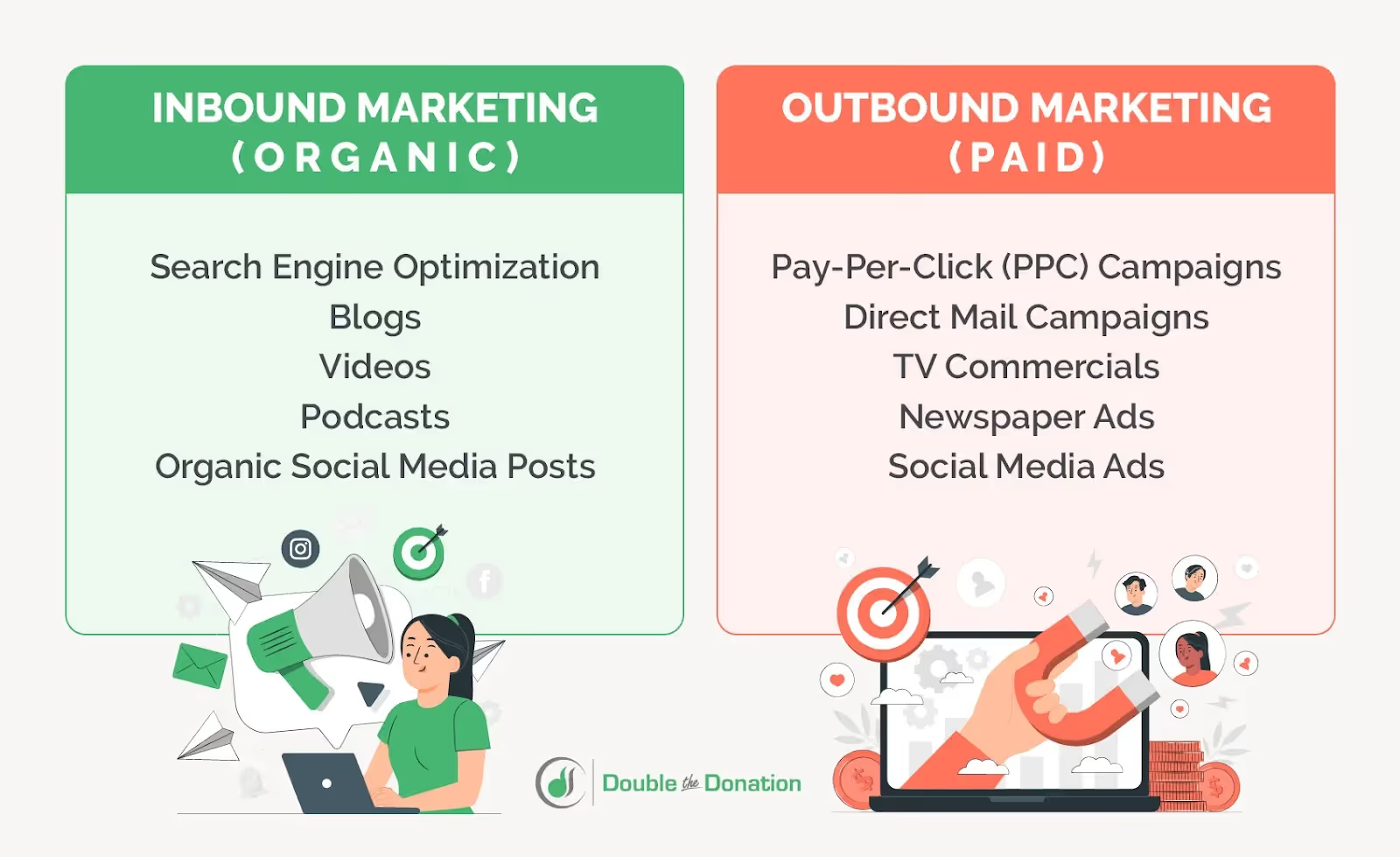
There are two types of marketing your university can leverage, and each type has a plethora of channels you can use to spread the word about your campaigns:
Remember, communication is a two-way street. You won’t just want to send messages to alumni, but to stay in touch with them over time. Ensure that alumni and any volunteer fundraisers feel free to voice their feedback or concerns.

Effective communication is about more than just an open line of communication—it’s about powerful storytelling, too. Stories encourage alumni to form stronger connections with your university’s mission, students, and impact.
As part of your marketing approach, implement the following storytelling strategies into your content:
Storytelling and powerful imagery compel users to share content with their networks, so it’s crucial that you make your storytelling components shareable. For example, you might place a “Share” button next to the content on your alumni website that makes it easy for viewers to repost an article or video to their social media channels.
In all your digital marketing materials, make it easy for viewers to take action by directing them to your donation page. Make the most of clear calls to action, prominent buttons, and QR codes across all the channels you use. To ensure shareability, use an effective social campaigning platform and the right social media platforms.
Additionally, when alumni land on your fundraising page, they should be able to take action easily. Check to ensure your donation form can be quickly completed and doesn’t require any unnecessary steps. With a compelling marketing strategy and simple form, your university can seamlessly convert alumni into dedicated supporters.
Now that you know the best marketing practices, share this information with your fundraising team, and plan your best campaign yet! Then, as donations start to roll in, be sure to show your appreciation for donors’ support and continue to engage them by offering additional involvement opportunities. The more active your donors are in your university’s activities, the more likely they’ll be to continue their support.

Adam Weinger is the President of Double the Donation, the leading provider of tools to nonprofits to help them raise more money from corporate matching gift and volunteer grant programs.
Double the Donation's robust solution, 360MatchPro, provides nonprofits with automated tools to identify match-eligible donors, drive matches to completion, and gain actionable insights. 360MatchPro integrates directly into donation forms, CRMs, social fundraising software, and other nonprofit technology solutions to capture employment information and follow up appropriately with donors about matching gifts.

4 Marketing Strategies University Fundraisers Need to Know
Lorem ipsum dolor sit amet, consectetur adipiscing elit. Suspendisse varius enim in eros elementum tristique. Duis cursus, mi quis viverra ornare, eros dolor interdum nulla, ut commodo diam libero vitae erat. Aenean faucibus nibh et justo cursus id rutrum lorem imperdiet. Nunc ut sem vitae risus tristique posuere.

Fundraising is a necessity for any school to support its educational activities.
It seems you can never fundraise too much or accept too many donations, but you don’t want to bore your supporters with the same fundraisers year after year. Is your school tired of the same old fundraisers and looking for new ideas that are guaranteed to work?
Your search ends here! Follow these 7 proven fundraising ideas for schools to raise money for your students:
1. Walkathon
2. Partner with a local restaurant chain
3. Multicultural fair
4. Car wash
5. Coffee Drive
6. Trivia Night
7. Envelope Fundraiser
Want something focused specifically on fundraising for private schools? Look to DonorSearch’s 5 Steps to A+ Private & Independent School Fundraising.
Read on to boost your mentoring skills and learn about these school fundraising ideas!


Typically annual, a walkathon event is a long-distance walk meant to fundraise for a cause.
Walkathons are usually encouraging and successful events because they support:
1. Health: All participants walk around your designated course, encouraging a healthy habit.
2. Community: Usually hosted on a public field or in a public park, walkathons are open to the public for the most exposure and therefore, evoke a sense of community and develop relationships as they bring people together.
3. Accessibility: Participants will be at different levels athletically, and that’s fine. Some will be participating to challenge themselves, and some will just be participating for fun. The more the merrier.
4. Affordability: Walkathons are fairly inexpensive fundraising events.
Pledges are placed on participants and how far they’re able to walk the day of the event. For example, if Sabrina pledges $5 for every mile Alex walks and Alex walks 7 miles, you’ve raised $35 for your school.
There’s a list of things to do when organizing your walkathon event.
1. Determine a location. You’ll need to decide if you want a course that gets you from Point A to Point B or a circular course that starts and ends at Point A, a straight course or a circuit course, respectively.
2. Pick a date and rain date. Make sure you pick a date in a warmer season, but not a hot one. Try May instead of August. And select a rain date, just in case!
3. Recruit sponsors. Approach previous gala sponsors to see if they’d like to run tents or water stations.
4. Promote your event. You can look into merchandise providers to customize your own t-shirts and water bottles. Promote your event through flyers and word-of-mouth, as well.
For a more extensive description on organizing a walkathon, check out Booster’s walkathon guide.

There are plenty of restaurants that partner with schools and educational clubs to help create awareness and raise money. These restaurants will have school fundraising nights, during which a portion of the sales from the night are donated to the school.
Everyone has to eat. The partnership between restaurants and your school converts a daily task into a charity event.
All you have to do is:
1. Pick a participating restaurant. Many fast food places like Chick-fil-a or Moe’s Southwest Grill have fundraising programs. Just contact your local restaurant for more information. Be sure to check with your local small-business restaurants, too! Many of their owners’ kids have gone through your school system and will be open to help you fundraise.
2. Promote the night. Send out email blasts, create flyers, even make t-shirts, if you’d like. Your fundraiser’s success will depend on your dedication to promotion.
Turn your community’s next good meal into a successful fundraising idea by partnering with a restaurant!

A multicultural fair allows students to showcase their heritage and learn about their peers’ heritage.
Students get a chance to perform cultural demonstrations and sell their culture’s products and food. On top of being a great fundraising opportunity and satisfying the mentor in you, it’s educational and a fun way to immerse the students in different cultures.
There’s a bit of planning that goes into organizing this fair:
1. Pick a location. This fair will be easiest if you have an accessible field if weather permits. If it doesn’t, try a gymnasium.
2. Set a date. If it’s outside, choose a rain date, too.
3. Recruit students to participate. Start a discussion and sign-up sheet to see which students would like to hold a booth at the fair. Ask which foods they’ll be making and selling and which cultural performances they’d like to display.
4. Promote! Post flyers. You might try to schedule the fair during lunch periods to reach the most students and/or during the evening to reach parents, too.
No matter what, make sure your students will have fun during the event–they need to be excited enough to sell and excited enough to learn.

Your school can put together a group of students to organize a car wash. Besides being a quick and simple fundraising idea, it gets your students outside (and away from tablets, phones, and the tv).
A car wash is an easy fundraiser to set up. Plus, everyone needs the pollen rinsed off their cars in the spring so who can pass up just $5 for a car wash?
There are just a few basic planning steps before you hold your car wash:
1. Pick a location. The school’s parking lot is probably your safest bet, just make sure it’s close to a hose!
2. Gather the materials. You need minimal supplies for this event. Invest in some soap, sponges, towels for drying, buckets, and of course, make sure you have a hose!
3. Promote and Advertise. Charge $5 per car and spread the word. You can advertise the day off by having students holding signs at the closest busy road.
Now that you have everything to start, pick a sunny day and hold your fundraiser.

With 83% of American adults drinking coffee, a coffee drive is bound to be a successful fundraiser. Partnering with a fair trade roaster can let you sell both packaged coffee beans and hot cups of joe.
Your students can sell beans to their peers, family, and others, while your school sells cups of coffee during lunch periods. Local coffee shops may partner with you and sell your school coffee at a discounted rate.
You’ll need to find a wholesaler to work with. Do your research and decide which blends at what prices work for your school’s community. Once you’ve found a supplier, all that’s left to do is promote and sell!
Get the word out and recruit students to sell.
Depending on how you want to organize sales, you can have students directly sell the product or keep a sales and orders sheet, like how girl scouts sell cookies.
Be sure to plan out your fundraiser and promote your coffee drive!

A trivia night will spark a friendly sense of competition among your students. You can have students register as teams or individuals.
Again, this fundraiser brings your students together to form a community. It works because who doesn’t love a little bit of rivalry and healthy competition?
Pick a location to host your trivia night. Your school’s gymnasium is a great option, but you can always try to partner with a local restaurant for space.
Make sure you have a plan for advertising and promoting your event to draw a crowd! Charge a small admission fee to trivia teams who want to compete. Plan out how your trivia game will start and finish. You don’t want an unorganized game.
Your trivia night can easily be an exciting and successful fundraiser as long as you plan ahead and organize.

An envelope fundraiser is a super inexpensive and simple way for your school to raise some extra dough. You’ll need 100 envelopes numbered 1 through 100, which you can easily find in your school’s office. Then, supporters who pass by the envelopes will choose one and donate that amount. For example, if Sally picks up envelope 13, she’ll give $13.
Easy, easy, easy. A fundraiser can’t get much more simple than this one. Plus, the envelope fundraiser doesn’t pressure supporters to give!
Get a pack of 100 envelopes and number them. From there, you can pin them to a corkboard in your school’s lobby or front office so students, parents, and others will see it and can make their donations.
All you need is 100 envelopes and a place to hang them and with the generosity of your supporters, you can accept donations.
Just remember to spread the word about your envelope fundraiser so people know where and when they can give because you’re relying directly on individual supporters’ donations.
Throughout your fundraising event, whichever idea you decide to go with, you can build a relationship with your students, like a mentor should. Don’t put too much pressure on them to sell and raise money, but instead encourage them to have fun with the fundraiser.
Still, want more ideas? Check out this list of fundraising ideas for schools and education.

Adam Weinger is the President of Double the Donation, the leading provider of tools to nonprofits to help them raise more money from corporate matching gift and volunteer grant programs. Connect with Adam via email or on LinkedIn.

7 Proven School Fundraising Ideas
Lorem ipsum dolor sit amet, consectetur adipiscing elit. Suspendisse varius enim in eros elementum tristique. Duis cursus, mi quis viverra ornare, eros dolor interdum nulla, ut commodo diam libero vitae erat. Aenean faucibus nibh et justo cursus id rutrum lorem imperdiet. Nunc ut sem vitae risus tristique posuere.
%201.svg)
%201.svg)
%204.svg)




.svg)