Taking a look at AI in advancement in the context of donor trust and building connections.

Anwesha Kiran
Published:
July 31, 2026

AI has arrived in advancement faster than the field has had time to make space for it. It’s influencing advancement ways both large and small, showing up everywhere from internal operations to donor engagement.
Institutions are experimenting, donors are forming opinions, and best practices are still taking shape. The most relevant question emerging seems to be how institutions can make use of this technology without weakening the very relationships they’re meant to nurture. As institutions try to find these answers, recent research offers an early look at what's changing, what's holding steady, and what donors are asking for.
Most institutions are still in an experimental phase with AI. Some teams have found workflows where it clearly helps. Others are still figuring out where it fits or whether it fits at all. That's the backdrop advancement teams are operating in, regardless of whether their institution has a formal AI policy in place yet.
Fundraising staff, for the most part, have already moved past that experimental stage individually. Almost two-thirds of nonprofits and foundations already report using AI in their work, according to a 2025 Center for Effective Philanthropy survey.
Governance hasn't kept pace with that adoption: a 2026 report found 47% of nonprofits have no AI policy at all.
This gap between individual use and institutional guidance shows up clearly in how nonprofits handle disclosure. Only 15% of nonprofits disclose their use of generative AI tools, even though a majority of donors say they want to know when AI is involved. Blackbaud's donor research puts a number on that expectation: 76% of donors want to know when and how an organization is using AI. What their research also found is that transparency, not AI use itself, is what protects donor trust.
The data above points to a stance that isn’t necessarily for or against AI: donors are simply asking to be told when it's in use. This reframes the ethical question for advancement, taking it from adoption itself to how openly that adoption happens.
A 2024 study led by Nathan Chappell and Cherian Koshy, surveying more than 1,000 donors, found that younger donors (ages 18-44) show more openness to AI-driven innovations, while donors 60 and older expressed a stronger preference for maintaining traditional human interaction.
This split is particularly relevant to advancement, since most alumni bases span every one of these generations at once. A single approach to AI use will land differently depending on who's receiving it, which is all the more reason disclosure and consent need to be built into institutions’ AI strategy from the start.
Most of the AI conversation in higher ed treats advancement like any other back-office function: a place to automate reporting, speed up admin work, save staff time. But advancement carries a distinct responsibility on top of that. It's the function that manages an institution's most valuable, hard-earned asset: trust with the people who choose to care about it.
That's what makes the stakes in advancement multi-dimensional, and harder to get right than in most other back-office use cases.
A predictive model flagging alumni at risk of lapsing is a promising, emerging use of AI in this space. Applied without care to how that flag gets acted on, the same model can turn a relationship into a transaction.
The main driver for adoption right now seems to be time saved. Teams are using AI to handle the repetitive parts of the job, drafting, data cleanup, first-pass research, so staff time goes toward the relationship work that really does require a human. Cost plays a role too. Advancement teams are on the leaner side, relative to the scope of their work, and AI gets pitched internally as a way to do more without adding headcount.
On the barrier side, sensitive data handling is the concern that comes up most. Advancement holds some really sensitive data an institution has: giving history, wealth indicators, family relationships, or personal details shared over years of stewardship. That sensitivity raises the bar for what responsible AI use means in advancement specifically, and it shows up clearly in the numbers. Data privacy and security are the top adoption barrier in higher ed, cited by 61% of individuals and 56% of institutions.

Data privacy and security concerns aren’t the only reservation teams have with AI adoption. The same survey found newer concerns emerging too: environmental impact now shows up among the top three barriers for more than 1 in 5 respondents, and concern about AI-related role elimination nearly doubled year over year, from 7% to 14%. Training hasn't kept pace with any of this. Concerns around training will likely continue to shape reluctance around embracing AI.
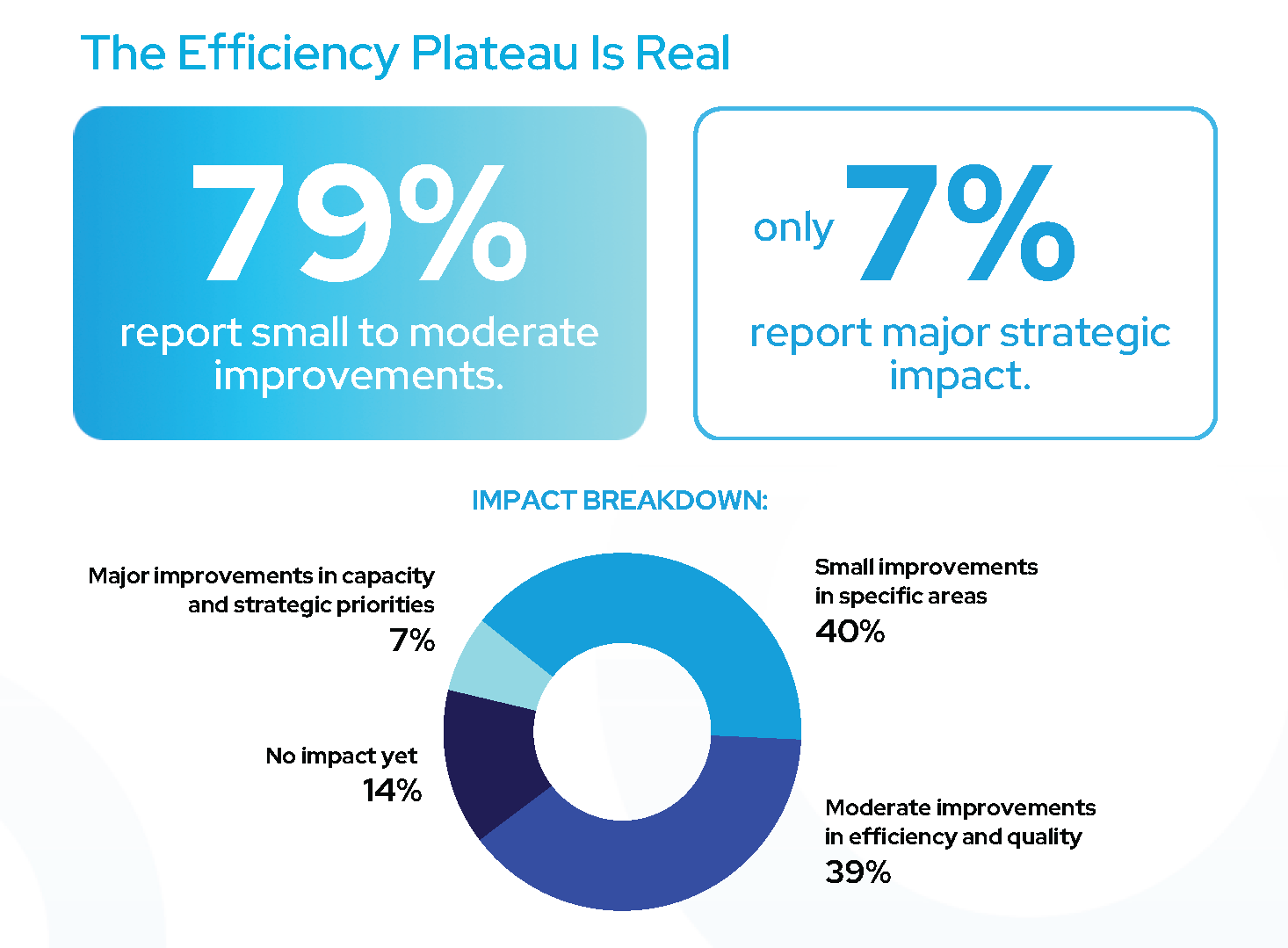
Put together, this paints a picture of willingness to adopt but also one of uneven adoption. Nonprofit-wide, 92% of organizations report using AI in some capacity, with a disconnect: only 7% agree that it’s made any significant impact.
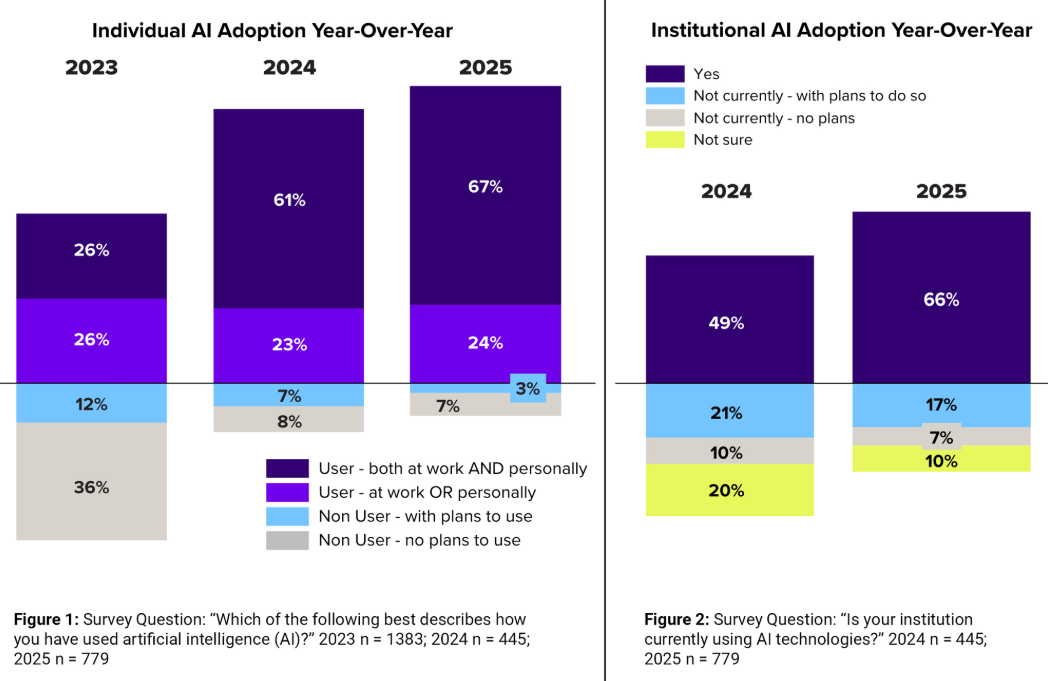
Advancement specifically is tracking a bit ahead of that nonprofit-wide baseline. Ellucian's third annual higher ed AI survey placed alumni relations and advancement among the field's Emerging Adopters, at roughly 59 to 60% momentum.
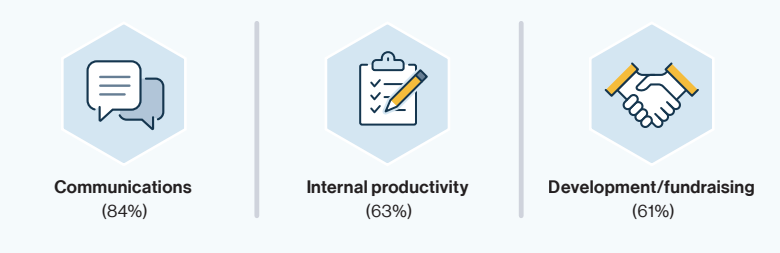
Within fundraising, AI shows up across:
Leaders credit AI adoption specifically in operational improvement and personalized engagement specifically, with only about 30% agreeing that there has been any direct impact on revenue.
The nuance remains that advancement teams are using AI to free up time for the parts of the job that actually move donors: the relationships. In this revelation lies the congruence between what donors expect and what advancement teams are trying to achieve.
Advancement is working through AI adoption for the first time alongside every other part of the institution with no established playbook to follow. The leaders shaping this work right now are figuring out what responsible use looks like as they go. These are the open questions the field is sitting with and working through.
Alumni giving participation has been declining for years. It's easy to assume the answer is better tools: smarter segmentation, more personalized outreach, sharper messaging. But the 2026 National Alumni Survey suggests the problem is something else entirely.

Younger alumni aren't giving less, they just give elsewhere rather than strictly to their alma mater.
With motivations shifting, the strongest predictor of giving has very little to do with their age and their capacity to give. It's whether they feel connected to their alma mater. Alumni who feel very connected are 24 times more likely to donate than those who feel disconnected.
More than convincing younger alumni to give, we should think along the lines of "How do we help more of them feel like they still belong?" Because the generosity is already there! It’s just a matter of establishing the connection, or rekindling it, rather.
If connection is the real problem, AI can help institutions:
The actual relationship-building work remains a deeply human function.
AI can widen the aperture on who gets noticed and when, but it can't replace the judgment and warmth that make an alumnus feel like an individual rather than a segment.
For many advancement professionals, AI brings a lingering concern: where does this eventually lead; is it just another tool, or does it change the role itself?
So far, AI adoption has been more practical rather than existential:
Toeing the line between assistance and substitution is a sensitive task, but one we believe teams are very much capable of doing. Some of these decisions will vary by institutional requirements. But the consensus is that AI works best in a supporting role while the relationships themselves must stay distinctly human.
For institutions still figuring out their AI strategy, there's no need for a sweeping rollout. Most teams are better served starting internal use cases (research, reporting, drafting, data analysis) and expanding as they get comfortable.
But as AI moves closer to donor-facing work, transparency matters most. Chappell and Koshy's study found 93% of donors rate transparency about AI use as "very important" or "somewhat important," which leaves little room for disclosure to be optional.
Clear disclosure and real consent should be one of the main concerns in policy and cannot be treated as an afterthought. Across the research, one pattern holds: AI adoption is moving fast, donor confidence is catching up more slowly, and trust and transparency are what close that gap.
As for the decline in alumni giving, it isn't really about generosity at all. It's about connection and that's where AI can do the most good: helping teams uncover more relevant stories, personalize outreach, and catch signs of drift before alumni disengage entirely. The relationship itself still belongs to the people doing the work. Few advancement professionals, and even fewer donors, want to hand that part to a machine.
Watching this play out at CASE Summit this year, one thing stood out: the conversation centered on using AI well without losing the human touch.
That tracks with the data. AI adoption is already underway, even if unevenly and without formal policies at many institutions. Donors have made clear that transparency matters more than AI's mere presence. And the core challenge advancement teams are solving: helping alumni feel connected enough to stay engaged and give, is still fundamentally a human one.
AI can spot patterns, reduce admin work, and make personalization easier at scale. It creates more space for relationship-building, but it can't do the building itself.
The tools will keep improving, and institutional policies will catch up. What won't change are the pillars advancement has always depended on: trust, real connection, and people who know how to build both.
Table of Contents
Subscribe
See how modern advancement teams bring alumni engagement and fundraising together.
Strong donor retention strategies are becoming essential as institutions prepare for another year of unpredictable fundraising behavior. Leaders across the sector are noticing sharper swings in donor loyalty and gift frequency, and many are rethinking how they engage supporters in a landscape shaped by rapid shifts in expectations.
At the same time, organizations are experimenting with donor acquisition strategies that reflect how people now discover, evaluate, and choose the causes they want to support. New donor audiences bring different motivations, attention patterns, and communication preferences, and advancement teams are realizing that older playbooks are no longer enough to sustain growth.
This article walks you through the changes shaping 2026 and what teams can do to build acquisition and retention plans that work.
Recent findings show that nearly seventy percent of nonprofits identify donor acquisition and retention as their top challenges - pressures that are increasingly mirrored across educational institutions, alumni networks, and member-based organizations.
While donations are dropping, there's also a growing disconnect between what donors want and what institutions are delivering. Today's donors want quick responses, clear communication, and seamless experiences, just like they get from Amazon or their banking app. Many institutions are struggling to keep pace with these expectations.
Generational shifts are adding to this pressure. Younger donors respond to immediacy and values alignment, while older donors still carry much of the giving power but prefer steady, relationship-focused outreach. These realities make it harder to build a consistent experience for supporters.
Education institutions feel the weight of these changes in very specific ways. Many are navigating declining alumni participation, shifting enrollment patterns, and tighter advancement teams that must do more with less. In this environment, acquisition and retention depend on teams having a clear understanding of which donors support them, why they give, and how those motivations evolve across different moments.
The takeaway is simple: strategies that carried institutions through the last decade will not be enough in 2026. Advancement and development teams need smarter segmentation, stronger personalization, more thoughtful automation, and integrated data workflows that remove unnecessary administrative work.

Many organizations are seeing a sharp increase in episodic donors. These are supporters who give during election cycles, crisis moments, or highly publicized events. (Tip: Many companies roll out special workplace giving programs during these time periods, too!) Their motivations often revolve around urgency rather than a long-term relationship with the institution.
The challenge is that once the moment passes, the emotional trigger disappears. Episodic donors rarely self-identify as long-term supporters, which leads to a steep drop-off in future engagement.
In 2026, this segment will require:
• mission-centered storytelling
• consistent stewardship beyond the initial gift
• automated follow-ups that keep the donor connected to impact.
These steps help move episodic donors from reactive giving to more intentional, recurring support.
Giving motivations can vary significantly across generations. While Boomers prioritize loyalty and tangible legacy, Gen X donors appreciate clarity and practical outcomes. On the other hand, Millennials look for values alignment and evidence of change. Gen Z leans toward authenticity, peer influence, and causes with clear moral grounding. Not to mention, both Gen Z and Millennials are increasingly likely to work for companies with workplace giving programs, which can grow their chances of getting involved.
Communication preferences also differ:
• Boomers respond well to phone calls, mailed updates, and personal touchpoints.
• Gen X tends to read emails and appreciates concise follow-ups.
• Millennials engage through social storytelling and mission-driven content.
• Gen Z prefers short-form video, mobile-first communication, and quick transparency.
To reach each group effectively, teams need adaptable acquisition and retention plans. A single message cannot serve a multigenerational donor base. Personalized content and varied channel strategies will be essential.
Supporters in 2026 will not wait for delayed thank-you notes or quarterly updates. Donors are now accustomed to the immediacy of digital experiences, from online retail to financial apps.
A timely, personalized acknowledgment is no longer a nice-to-have. It is an expectation.
Organizations that want to maintain loyalty must invest in:
Strong donor journeys help supporters understand how their contribution matters and build a sense of partnership throughout the year.
The sector is moving toward wider adoption of data-driven tools. Predictive scoring, segment-based automation, and donor pipeline visibility are now part of everyday planning for many institutions managing donor and alumni relationships. These tools allow teams to identify who is likely to give, who may lapse, and which donors need more personal attention.
Automation in this context is not a replacement for human connection. Instead, it removes repetitive tasks so staff can focus on meaningful interactions.
With stronger data intelligence, teams can personalize outreach, improve retention, and allocate limited resources more strategically.
Corporate philanthropy has entered a new era of record-breaking growth. According to the recent Giving USA report, total corporate giving reached $44.4 billion, a year-over-year increase of more than 9%. This growth signals that even in unpredictable economic climates, businesses are doubling down on social impact.
In 2026, corporate giving trends show companies moving away from top-down annual grants and toward year-round, employee-led initiatives. These include:
For advancement teams, this trend represents a massive opportunity. As companies become more generous, often matching gifts at higher ratios or lowering minimum donation requirements, the institutions that proactively help donors navigate these corporate benefits will be the ones that see the highest ROI in 2026 and beyond.
A strong 2026 strategy starts with a clear look at how donors have behaved over the last five years. Patterns in first-time donor retention, gift frequency, and year-over-year participation can reveal where engagement is strong and where attention is slipping.
Many institutions are already noticing declines in donor counts even when revenue grows.
Pay attention to which channels bring in the most consistent supporters. Email may drive volume, while events or direct mail might produce higher-value relationships.
The goal here is to gather data and to read it and uncover the shifts that will shape your acquisition and retention plan for 2026.
Segmentation is one of the clearest levers for improving both acquisition and retention. Different groups give for different reasons, and treating them as one audience leads to missed opportunities.
At minimum, your segments should include:
Each group requires a different message, tone, and cadence. This type of segmentation helps institutions invest effort where it matters most and make each supporter feel understood.
In 2026, single-channel communication will not be enough. Donors interact with organizations through email, SMS, social media, direct mail, and event experiences. A multi-channel approach increases the number of meaningful touchpoints without overwhelming your audience.
Storytelling plays a central role here. Donors want to understand how their gift fits into the broader mission. They want updates that show real progress, not general statements. Maintaining relevance across channels helps reinforce the emotional connection.
Here are three donor journey examples you can build:
New donor journey
- Send an immediate thank-you that clearly acknowledges the donor and their reason for giving.
- Follow up within the first week with a short impact story that shows how their contribution is already making a difference.
- Make a thoughtful follow-up ask that reflects the donor’s initial interest or motivation.
Event attendee journey
- Thank attendees soon after the event while the experience is still fresh.
- Share photos, highlights, or a brief recap to help them relive the moment and feel connected to the community.
- Introduce a giving prompt tied directly to the themes or outcomes of the event.
- Continue with stewardship updates that show how contributions are supporting the mission.
Matching gift donor journey
- Send a reminder immediately after an eligible gift is made, providing a direct link to the donor’s company-specific matching gift portal.
- Deliver an update once the corporate match has been verified or received, showing exactly how the combined total is moving the needle.
- Follow up on unclaimed matchinges at the end of the calendar year to drive requests before many companies’ deadlines close.
- Send an annual impact summary, reminding donors of their matched total and encouraging them to leverage their company’s benefits again the following year.
Lapsed donor journey
- Reach out with a warm “we miss you” message that acknowledges the past relationship without pressure.
- Share a meaningful update that highlights recent impact and progress since their last gift.
- Invite them to re-engage through an event, campaign, or low-barrier opportunity to reconnect.
Consistency strengthens retention. Sporadic campaigns cannot build the same sense of coherence and connection as throughout-the-year communication. Give your cause a story that donors can connect with year-around.
Learn how event participation triggers donor journeys automatically using Almabase Events.
Stewardship remains one of the strongest predictors of donor retention. According to donor loyalty surveys, personalized thank-yous and clear impact updates significantly increase a donor’s likelihood of giving again.
Stewardship remains one of the strongest predictors of donor retention. Research shows that personalized thank-yous and clear impact updates significantly increase a donor's likelihood of giving again. Findings suggest that timely acknowledgements are directly tied to higher lifetime giving, emphasising that donors should receive prompt confirmation of their gifts (ideally within 48 hours) and appreciate knowing the concrete impact of their contributions.
Strong stewardship includes:
The national donor retention average still hovers around 45 percent, based on industry-wide studies. Schools and mission-driven organizations that invest in consistent stewardship often achieve 55 to 60 percent retention or higher. These extra touches make donors feel seen and valued, which strengthens long-term loyalty.
Donors increasingly expect a smooth and intuitive giving process. This includes mobile-friendly donation pages, support for digital wallets, streamlined forms, and saved payment options.
Research from Blackbaud Institute shows that over 28 percent of online donations now come through mobile devices, highlighting how critical ease of use has become. Reference: Blackbaud Institute Index.
Additional friction reducers include:
Reducing friction in giving directly improves donor retention. It makes the act of giving feel effortless, which encourages supporters to return.
Technology should serve as an enabler of donor relationships. Clean data, reliable CRM integration, and unified systems help teams avoid errors and eliminate duplicate work. With proper infrastructure, organizations gain better visibility into donor behavior and can react to trends more quickly.
Automation also helps teams operate more efficiently. Many institutions today plan to expand their use of AI tools for donor engagement, reporting, and segmentation. This shift reflects a desire to scale personalized outreach without hiring significantly larger teams.
Predictive AI, too, is becoming an important tool for teams that want to make smarter decisions about where to invest their time. By analyzing patterns in donor behavior, such as giving history, demographics, event attendance, and past engagement, predictive models can highlight which supporters are most likely to give again and which new or lapsed donors are worth prioritizing.
Beyond behavioral patterns, smart technology now plays a critical role in identifying employment data: an often untapped goldmine for fundraising growth. By integrating tools that automatically verify a supporter’s workplace information, advancement teams can move beyond guessing and start strategically identifying who is eligible for corporate perks.
Investing in data intelligence allows teams to identify warm leads, detect at-risk donors earlier, and plan stewardship cycles with more accuracy.
A strategy only works if teams monitor its performance. Setting monthly or quarterly KPIs ensures that priorities stay aligned and progress remains visible. Each KPI should connect directly to acquisition or retention outcomes.
Key metrics to track include:
These metrics matter because they reveal where teams should invest time, where communication might be falling short, and which donor groups are strengthening or weakening. Tracking KPIs consistently allows institutions to adjust their strategy before problems escalate.
To capitalize on the $44.4 billion corporate giving landscape, organizations must move beyond a passive "wait and see" approach. Integrating workplace giving into your nonprofit’s daily operations turns a standard gift into a high-impact partnership.
Here’s how you can operationalize these programs to drive both acquisition and retention.
Workplace giving is a powerful tool for acquisition because it appeals to a donor's sense of efficiency. Use your marketing channels to target employees at local or major corporations known for generous matching (e.g., "Calling all Apple employees! Did you know your gift can be tripled for our cause?").
By highlighting that their contribution goes further with a matching gift, you create a compelling value proposition that attracts new, first-time supporters who want to maximize their impact.
The biggest hurdle to workplace giving is the administrative gap. Many donors intend to submit a match request, but forget once they leave your site. To drive retention, you must make the process instantaneous. Use technology that enables matching gift auto-submission or provides a direct, one-click link to the donor’s submission portal. The easier you make it for them to get involved, the more likely you are to secure that second (corporate) check.
Volunteer grants (or "Dollars for Doers") are a goldmine for volunteer retention. Many supporters who lack the disposable income to give cash are happy to donate their time. When you inform a volunteer that their 20 hours of service could trigger a $500 corporate grant from their employer, you validate their effort and provide them with a way to give financially. This transforms a volunteer into a donor without requiring them to open their own wallet, deepening their loyalty to your mission.
Acquisition is expensive, but recurring giving is the "holy grail" of retention. Therefore, encourage your supporters to look into payroll giving programs. Because these donations are deducted automatically and often pre-tax, they have a much lower pain point for the donor than a large one-time gift. This creates a predictable, recurring revenue stream for your organization that is much less likely to lapse than other repeating gifts.
Retention isn't just about thanking the individual; it's about acknowledging the ecosystem that made the gift possible. When a match comes through, send a personalized update to the donor: "Thanks to you and your team at [Company], we were able to fund two scholarships instead of one." This reinforces their professional identity and encourages them to spread the word among their colleagues, potentially opening doors for broader corporate partnerships.
You can also reach out to the company itself and thank them for their workplace giving contributions, though this step is largely considered unnecessary.
Advancement teams today juggle a lot. They are expected to run events, stay active on multiple channels, thank donors quickly, and keep data clean, often with small teams and limited time. Almabase helps by bringing all of this work together in one place so teams can focus on people instead of processes. Here's how:
Want to see Almabase in action? Request a demo.

Donor Acquisition and Retention Strategies for 2026
Donor acquisition and retention are two vital sides of the fundraising coin. Learn how you can ensure sustainable fundraising success for your team in 2026.
Lorem ipsum dolor sit amet, consectetur adipiscing elit. Suspendisse varius enim in eros elementum tristique. Duis cursus, mi quis viverra ornare, eros dolor interdum nulla, ut commodo diam libero vitae erat. Aenean faucibus nibh et justo cursus id rutrum lorem imperdiet. Nunc ut sem vitae risus tristique posuere.
December 18, 2025
12 minutes
Do you remember the first time you volunteered? I do.
It was for an NGO where I volunteered to teach kids at a school that was running low on staff. I remember walking into that classroom for the very first time, taking my first-ever class, and feeling a sense of connection I had never felt before. It genuinely felt like I had made a difference. And as I continued over the years, giving back to that organization financially became the easiest decision I ever made. Not because anyone asked me the right way, but because I had seen the work firsthand. I believed in it. I was part of it.
Through that experience, I also built something I hadn't expected: lasting friendships and a network of people who were equally passionate about making a difference. When that organization makes an ask today, I don't think twice.
That's a personal story. But when you extrapolate it, volunteering is a life-changing experience for many. No matter the form it takes. From participating in a small fundraiser to serving on an advisory committee, volunteering quietly paves the way to some of your most loyal and generous donors.And most institutions are leaving this pathway almost entirely untapped.
This isn't based on feeling alone. The 2026 National Alumni Survey, led by Howard Heevner and Sarah Kleeberger and co-sponsored by Almabase, surveyed over 82,000 alumni across 31 colleges and universities. The findings on volunteering are striking.
Alumni who recently volunteered with their alma mater are, simply put, a different category of donor.

The connection isn't coincidental. Volunteering builds the exact conditions that make giving feel natural: emotional investment, awareness of impact, and a sense of belonging. Alumni who volunteer don't give because they're asked well. They give because they care deeply, and they care deeply because they showed up first.
💡RISD’s “Life after RISD” initiative, for example, created flexible ways for alumni to mentor students, participate in career conversations, and support networking communities. [Learn More]
The honest answer is that most volunteer programs were designed for a different era. Traditional offerings like alumni events, leadership committees, and reunion committees were built around older models of engagement that assumed alumni had the time, proximity, and interest to commit to open-ended roles.
Today's alumni, particularly younger ones, don't see themselves in those formats. They want flexibility. They want to contribute a skill, not fill a seat. And critically, they want to see the impact of what they do. Not months later in an annual report, but in a way that feels immediate and personal.
When those conditions aren't met, volunteering quietly falls off the list. And with it, so does the pathway to giving.
The shift doesn't require a program overhaul. It requires rethinking what "volunteering" means and who it's designed for. Here's where to start:
Short, virtual, time-bound engagements like a one-hour career conversation, a Giving Day ambassador role, or a single mentoring session lower the barrier dramatically for younger alumni and first-time volunteers who aren't ready to commit to standing roles.
💡Pacific Northwest University, featured in CASE Insights on Giving Day 2026, expanded Giving Day participation beyond donations by introducing opportunities like mentorship, admissions support, and preceptor roles, reinforcing the idea that engagement often comes before giving [Read More]
Career advising, project-based consulting, and issue-focused advocacy align closely with how many alumni want to contribute today. Findings from the 2026 National Alumni Survey suggest that alumni interests vary across communities and lived experiences, with some gravitating toward career-focused engagement and others toward service-oriented involvement. Offering multiple pathways allows institutions to meet alumni where they are.
After every volunteer interaction, close the loop. Share what happened as a result. Connect their contribution to a student outcome, a program milestone, or a real story. Volunteers who see their impact are far more likely to return and to give.
Once an alumnus has volunteered and seen the work, the transition to giving should feel like a natural next step, not a separate ask. Design the journey intentionally, from first engagement to first gift.
💡Institutions like Concordia College have focused on creating more continuous and accessible alumni engagement experiences through digital communities, events, and ongoing participation opportunities. The result is a stronger sense of connection over time, where fundraising becomes part of an existing relationship rather than a one-time campaign ask. [Read more]
Timely, personalized acknowledgment matters more than formal recognition programs. Peer shoutouts, digital acknowledgment tied to specific impact, and authentic storytelling go further than plaques and event mentions.
The 2026 National Alumni Survey makes one thing clear: alumni haven't disengaged from generosity. They've simply redirected it toward causes and organizations that make them feel connected, informed, and like they genuinely matter.
Volunteering is the fastest, most human way to create that feeling.
Your best future donors may not be donors yet. But there's a good chance they're willing to show up, if you give them the right reason to.
👉 Explore the full 2026 National Alumni Survey findings on how volunteering shapes donor behavior.
How Alumni Volunteers Become Donors
Learn how alumni volunteering drives alumni giving, strengthens engagement, and builds long-term donor relationships according to the 2026 National Alumni Survey.
Lorem ipsum dolor sit amet, consectetur adipiscing elit. Suspendisse varius enim in eros elementum tristique. Duis cursus, mi quis viverra ornare, eros dolor interdum nulla, ut commodo diam libero vitae erat. Aenean faucibus nibh et justo cursus id rutrum lorem imperdiet. Nunc ut sem vitae risus tristique posuere.

May 19, 2026
12 minutes
As a fundraising professional, you understand the importance of building relationships with your valuable donors. They’re the ones who provide the funding that make it possible to provide new opportunities for students and alumni. Therefore, building relationships with them secures support both now and in the future for these fundraising programs to continue taking place.

Considering the disruptions that everyone experienced (and continues experiencing) during the COVID-19 pandemic and how the industry has evolved since then, your relationships with many donors might appear to be volatile or different. When everyone changed up their strategies to incorporate the latest trends in engagement, some strategic aspects undoubtedly fell through the cracks.
We recommend taking your approach back to the basics of engagement and donor relationships this coming year. Revisit some tried-and-true ideas that have been proven time and time again to bolster relationships with your supporters. After all, these are the strategies that are most often forgotten when we embrace new methods and change up our approach to relationships.
The tips we’re covering in this article are ones that you may have seen before. However, they’re immensely important to maintain throughout the hubbub and chaos of the year. Without further ado, let’s dive deeper into these important and timeless strategies to help take your donor relationships to the next level.

For students, alumni, and donors, it’s painfully obvious when you send out emails or other communications that do not employ segmentation or other personalization strategies. Everything from a “To whom it may concern” introduction to the lack of personal details in the message makes it clear that you sent the same message to everyone on your email list.
Generic, impersonalized outreach is the easiest to ignore and causes the downfall of many marketing programs. See how institutions such as Gann Academy increased alumni email open rates by personalizing their email campaigns.
When it comes to your donors, you should include the same personalization strategies for outreach.
The easiest way to start making the most of personalization is to use the same approach as Gann Academy: start with your email campaigns. Use the information in your donor database to fill in some gaps and to show your supporters that the message you’re sending is customized just for them. You can do this by:
- Using the donor’s preferred name in the introduction.
- Including details about the supporters’ engagement history.
- Approaching specific segments of donors with targeted messages.
- Sending messages relevant to the interests of the donor.
When you have access to an effective donor database, a lot of this information can be automated to save you time and energy in sending these highly targeted messages. This effective donor database buyer’s guide explains that automation features, when used correctly, can make personalization more effective and efficient.
Your database can be used to auto-populate details into message templates and ensure you reach the right audience segments in your communications to enhance donor engagement.

Building relationships is impossible if it’s a one-sided effort. Your institution needs to not only work to communicate and show your donors that you care, you need to invite them to engage back with you by providing ample opportunities.
Since COVID-19, engaging opportunities look a little different than they have in the past. To create engaging opportunities amidst of a pandemic, many institutions had to adhere to social distancing guidelines by coming up with new virtual event ideas.
We’ve come up with a list of our favorite virtual fundraising ideas that any educational institution, nonprofit, or other organization can make use of. While you can find the full list here, we’ll highlight some of the options below:
- Online Gala - This is a great opportunity to encourage your major donors to get dressed up and network with one another using virtual conferencing software.
- TED Talk Events - Encourage your donors while enforcing your emphasis on education by providing TED Talk-style events to spread knowledge about certain topics.
- Online Classes - Provide online class opportunities for donors as well as students. These may not be full-fledged courses, but mini opportunities to sharpen skills.
- Annual Giving Days - Giving days encourage a great number of people (especially alumni) to give on a very specific day, similar to #GivingTuesday.
- Matching Gift Drives - This is a great way to encourage more donations and maximize impact. Promote corporate giving opportunities and remind supporters to check their eligibility for matched gifts.
When your donors get involved with all of the opportunities you offer, they strengthen their ties to your institution. This makes it all the more likely that they’ll continue supporting you in your upcoming fundraising events.

A phone call is an often overlooked relationship-building strategy because it can be somewhat time-consuming. However, it’s a valuable tool and makes a huge difference, especially when it comes to new donors.
For instance, consider the new donor cultivation timeline below. It shows that a thank-you call within 48 hours of a donation can dramatically improve your donor retention rates. Plus, it’s the first step to begin a strong relationship with your donors. This is because you establish a personal connection with the donor while showing your appreciation for their contribution.

Phone calls are a great way to start a relationship with donors on the right foot. However, don’t forget to employ the strategy with your seasoned donors as well! Call them to maintain regular contact and to express your gratitude for their continued support in your fundraising initiatives.

You’ll notice that on the cultivation timeline from the previous section that the step after a “thank you phone call” is sending a “signed thank you letter.” While email is likely your primary method of communication with the donors, the power of a physical letter of appreciation should not be underestimated, especially when it’s hand-written.
Handwritten notes are a classic way to show your donors that you will truly take the time out of your day for them. They want to feel like a priority for your organization, which is what a hand-written note should communicate.
When you write these notes, there are specific elements that you should make sure to include, such as:
- The preferred name of the donor. Just like in email communications, you should make sure to refer to the specific donor as you hand-write letters (be sure to double-check your spelling, too!)
- The activity they participated in. If your donor has just contributed funds, be sure to thank them for the specified amount. If they attended an event, thank them for their involvement and participation.
- The president’s signature. Letters are generally better received when they come from the top office of your institution. Therefore, you should make sure the president of your institution’s signature is on each and every one of them.
Just like phone calls, hand-written letters tend to be important strategies as you cultivate relationships with your new donors. However, don’t forget about the strategy for your veteran donors!
Be sure both phone calls and hand-written letters are a part of both your cultivation and stewardship strategies to strengthen donor relations.
.avif)
Don’t we all love stories? Your donors want to hear your inspiring story. They want to hear the reason behind all the great work that you do and the support that you provide to your community. Sharing these stories with your donors is a great way to show them what it is that their contributions support.
One of the current trends in the higher education space is the use of images to communicate these types of narratives. This trend is important to keep in mind because there are so many different platforms on which you’ll be telling stories. For instance, consider the following examples:
- Email - Whether it’s an email to a certain segment of your audience or a regular newsletter sent to many, include an image of an individual who attended your institution along with their story. This adds a face to the name and a personal touch to show the impact of donations.
- Social media - Platforms like Instagram and Facebook are made for visual storytelling. Be sure to use an image that tugs at the heartstrings to gain the attention of your audience, then caption it with details about the story itself. If it’s a longer story, be sure to provide a link to where donors can read the rest of it.
- Blog posts - Blogs are the perfect way to write long stories about individuals or about the progress of your institution. Showing images, faces, and specific names makes them even more powerful.
They say a picture is worth a thousand words. And it’s true! Be sure to leverage both text and image when you tell the story of your institution’s successes.

In the last section, we mentioned briefly that stories are a method of showing impact. Communicating impact is critical for donor engagement and continued support down the line. Think about it. If you give to an organization, you’re not contributing money for the sake of spending it. That would be silly! Rather, you’re donating to help accomplish a mission.
Communicating the progress of this mission and the impact of specific donations is a great way to give your donors the warm and fuzzy feeling in the pit of their stomachs that was probably what drove them to contribute in the first place. You’re reinforcing the positive aspect of donating.
Check out this nonprofit annual report guide that conveys the story of The Johnsons and how their impact was communicated to all contributors in an end-of-year report.

Notice some key aspects of this example:
- It shows a picture of The Johnsons
- The text uses a statistic showing the impact their contributions made
- The text is framed to put all of the emphasis on the Johnsons rather than on the efforts of the organization
These aspects are some of the most important things to remember when you communicate the impact of specific donors. Generally, on annual reports such as this, it’s your major donors that you’ll highlight. However, you can still use these strategies in emails, letters, phone calls, and other methods of communication to show any supporter that they’ve made a difference.
Building donor relationships is an incredibly important part of the fundraising strategy at your institution. Therefore, even as you explore all of the new and exciting ways to communicate and engage with them, don’t forget about the basics. Form a strong foundation for your donor relationships by using these tried-and-true strategies. Then, continue to cultivate and build these relationships to watch your fundraising soar!


Co-Founder and current Chief Relationship Officer at Bloomerang
He has served this sector for 33 years and is considered the most well-known senior statesman whose advice is sought constantly.
Prior to Bloomerang, he was the CEO and Co-Founder of eTapestry for 11 years, which at the time was the leading SaaS technology company serving the charity sector. Jay and his team grew the company to more than 10,000 nonprofit clients, charting a decade of record growth.
He is a graduate of Butler University with a B.S. in Business Administration. Over the years, he has given more than 2,500 speeches around the world for the charity sector and is often the voice of new technology for fundraisers.

6 Ways to Take Your Donor Relationships to the Next Level
Donor relationships are necessary to maximize fundraising and support retention rates. Check out these six expert tips to take relationship-building further.
Lorem ipsum dolor sit amet, consectetur adipiscing elit. Suspendisse varius enim in eros elementum tristique. Duis cursus, mi quis viverra ornare, eros dolor interdum nulla, ut commodo diam libero vitae erat. Aenean faucibus nibh et justo cursus id rutrum lorem imperdiet. Nunc ut sem vitae risus tristique posuere.

.svg)

.avif)
.webp)