Use these alumni engagement best practices to improve events, giving, volunteerism, mentorship, and scalable alumni relationship management.
Almabase
Updated:
August 7, 2026

The best alumni engagement practices are really about one thing: giving alumni a meaningful reason to stay connected after they leave campus.
Most teams nowadays are well aware that one-off emails or event invites are not enough. Long-term engagement could come from mentoring, volunteering, or simply hearing from the institution in a way that feels relevant The challenge is making these efforts consistent without adding more manual work for already busy advancement teams.
In this blog, we want to walk through practical alumni engagement best practices and strategies that help institutions meet the needs of modern alumni.
Alumni engagement today (and for a good while now) scales well when alumni see a clear reason to stay involved. Now more than ever, they need to hear from the institution in ways that feel personal, relevant, and substantial. They need digital experiences that are easy to access as well as opportunities that match their interests, life stage, and capacity to contribute.
For advancement teams, this means alumni engagement has to be treated as a long-term relationship strategy. CASE’s 2024 alumni engagement found that across a three-year cohort, the average share of alumni engaged in at least one way stayed between 19% and 20%, which shows how much intentional work is needed to move participation.
Fundraising, of course, is part of that relationship, but it should never be the only reason to reach out.
That leaves us with the strongest alumni engagement programs today being built around:
With these pieces in play and fine-tuned to your audience’s needs, institutions are more likely to improve event participation, alumni giving, volunteerism, mentorship activity, and long-term donor loyalty.
An alumni-centric engagement strategy starts with what alumni value. This means being in tune with and reacting to what your alumni actually want, and helps teams create programs that feel relevant across different life stages and levels of involvement.
Strong alumni-centric planning usually asks:
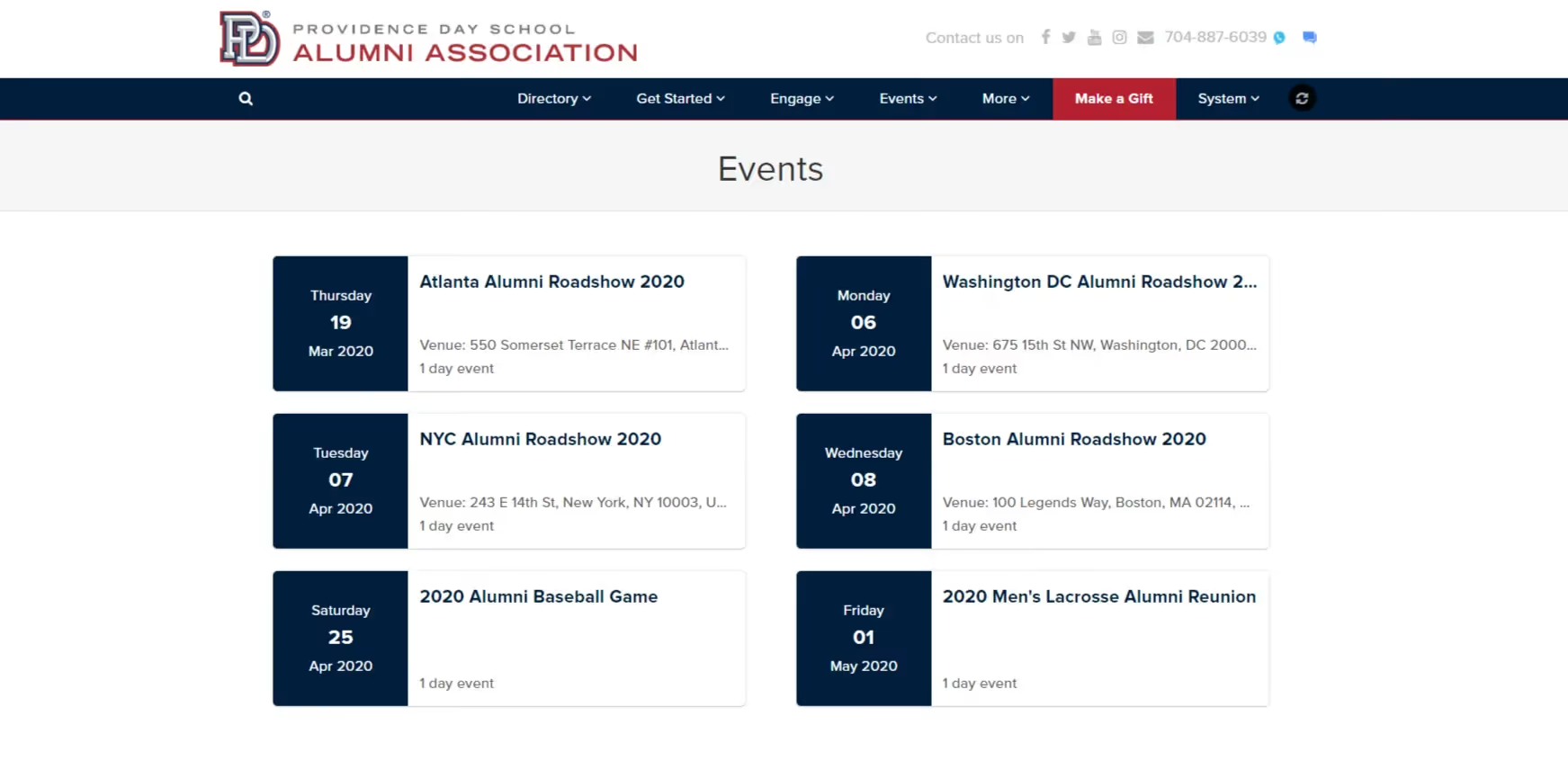
Providence Day School used this approach by creating targeted events for different alumni groups instead of relying on broad outreach alone. With Almabase, the school ran 92 events in under two years. Homecoming participation grew by nearly 400% in one year, and alumni donor participation rose from 4% to 20%.
Also read → How institutions can approach alumni-centric advancement in 2026: A detailed guide
Segmentation is essential for any engagement program and while a category like graduation year is a useful starting point, today’s need for personalized communications means that your segmentation ideally should be much more granular. Good segmentation today looks at behavior, context, and motivation so that teams can segment by:
This makes communication more relevant because each group receives outreach that matches their connection to the institution. It also helps teams identify alumni who may be ready for deeper involvement.
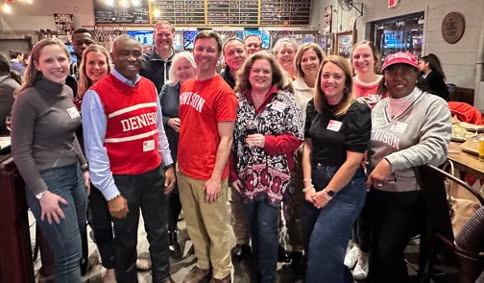
Denison University’s 2024-2027 alumni plan sets goals across class years, affinity groups, regions, and underrepresented alumni groups. That structure gives the team more ways to shape programming and outreach around real alumni communities, rather than treating the full alumni base as one audience.
Digital touchpoints give alumni easier ways to participate when they cannot come to campus or attend a scheduled event. It also keeps the relationship active between major programs and events.
This can include:
Alumni should be able to find peers, explore opportunities, update their information, and join programs without waiting for the next email.
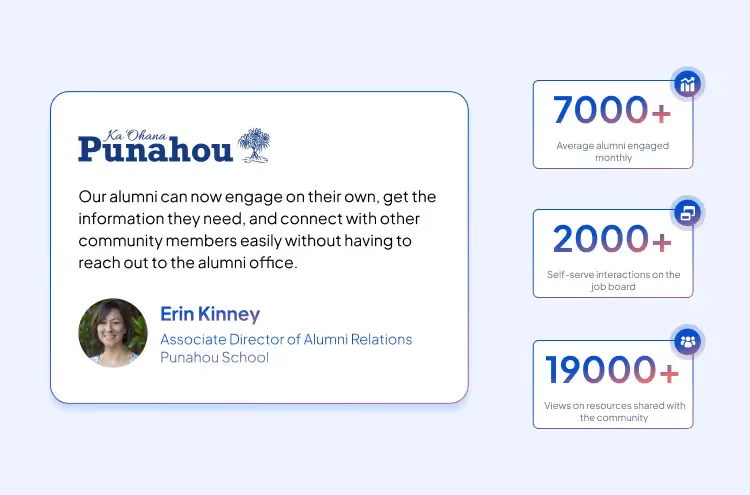
Punahou for instance, used Almabase to build a dedicated digital alumni community where alumni could discover peers and network independently. The school also created self-serve digital programs, which helped keep more than 7,000 alumni engaged each month.
Career-focused programs give alumni an accessible and practical reason to engage beyond nostalgia.
They usually include:
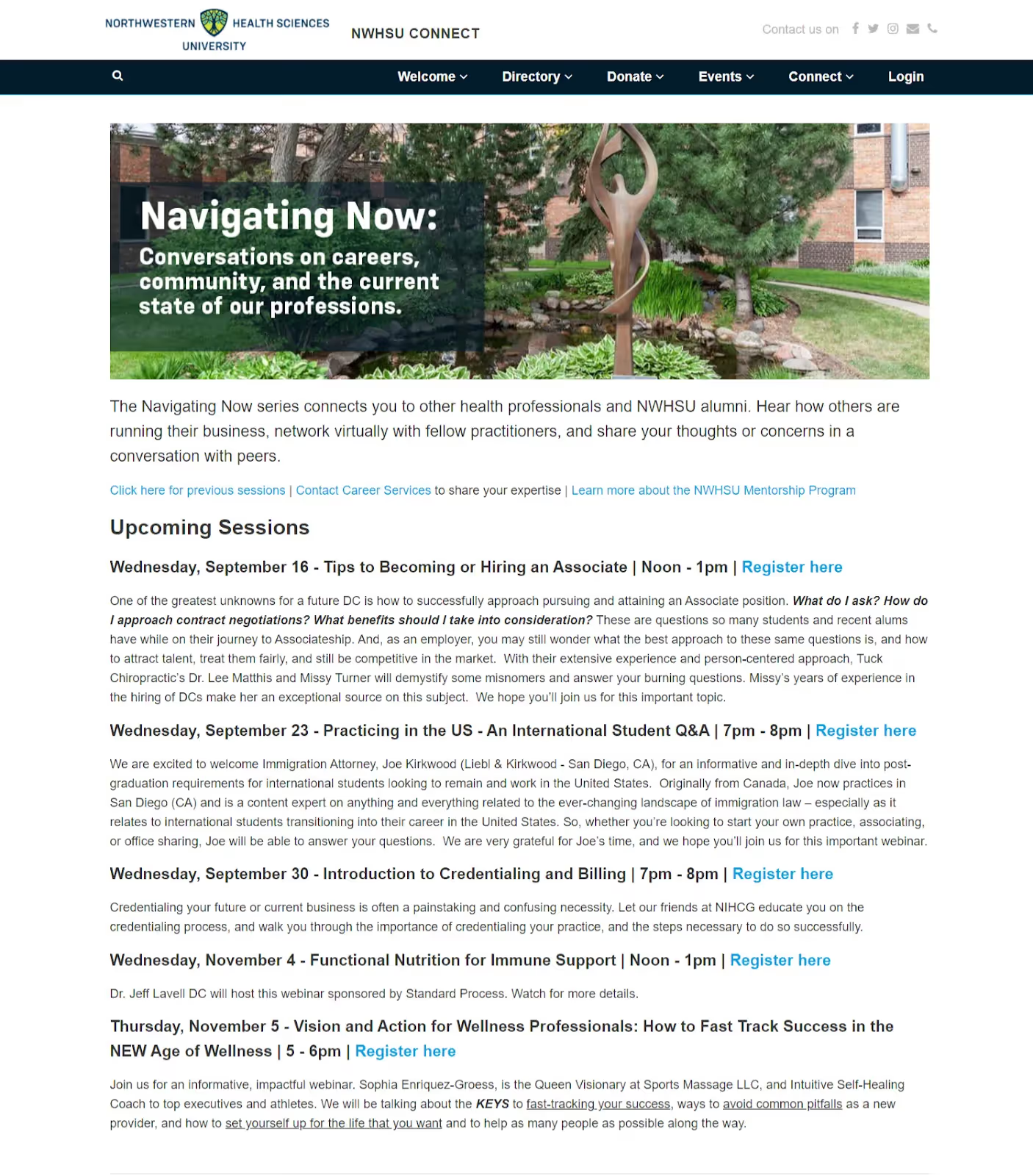
Northwestern Health Sciences University used Almabase to support this through job updates, classifieds, virtual career programs, community events, and a mentor program connecting students with alumni or professional mentors. This helped the university keep alumni involved through practical career value, which contributed to 1,000 event registrations over two years.
Events remain one of the most effective alumni engagement strategies when they are designed around connection instead of attendance alone.
Homecoming and reunions help alumni reconnect with campus. Regional gatherings make engagement easier for alumni who live farther away. Networking events create professional value. Hybrid events allow more people to participate, especially when travel is not realistic.
To make the most of event participation, the strongest event programs usually include a clear next step. That could be joining a group, volunteering, updating a profile, or attending another program.
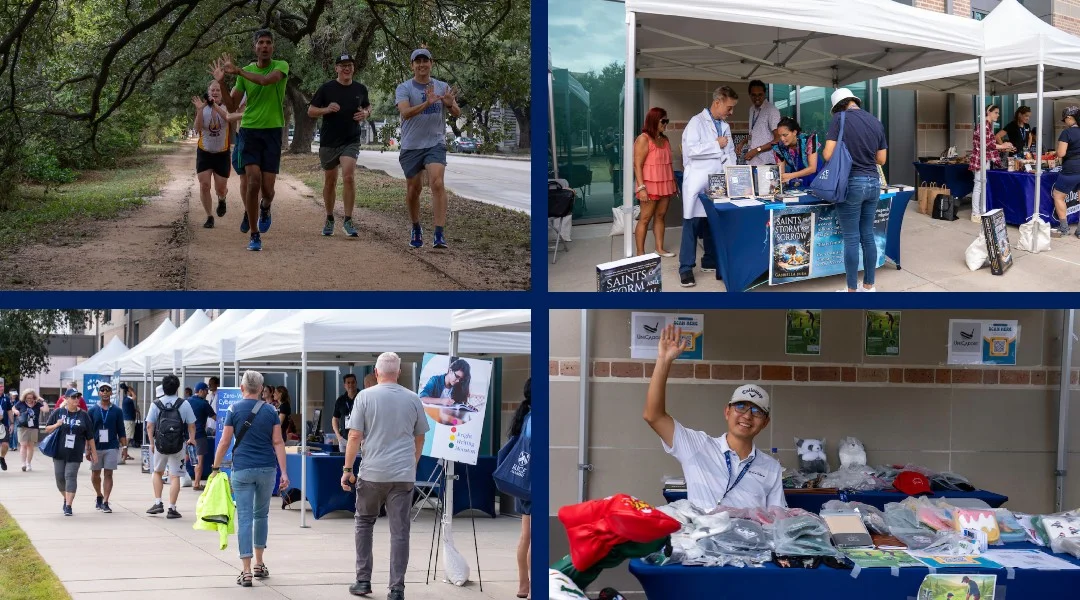
Rice University’s Alumni Weekend 2024 brought alumni back into campus life through reunion activity, fellowship, football, and shared community moments. The event also connected alumni with students, faculty, and staff. That mix matters because it turns an event into a broader community experience instead of a single-day gathering.
Personalized alumni communication starts with knowing who alumni are and how they engage. It also requires a steady communication rhythm that does not depend on manual effort every time.
Teams can improve personalization through:
This helps alumni receive messages that match their interests and past activity. It also helps teams avoid sending the same broad message to every graduate.
Deloitte Digital’s personalization research found that brands delivering standout personalized value reported 50% higher engagement. For alumni teams, the takeaway is simple: personalization should make each message feel more useful, not just more targeted.
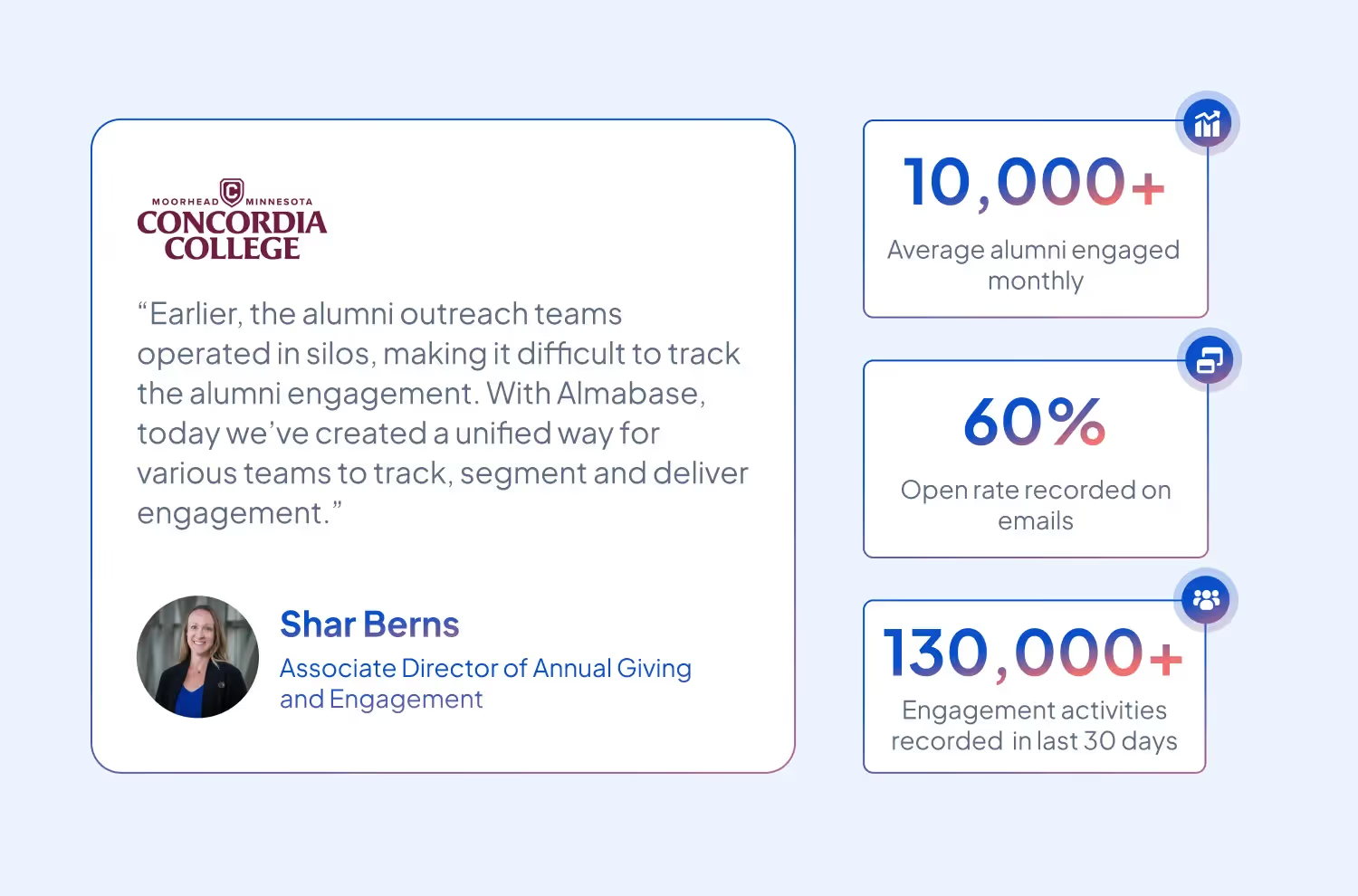
Concordia College moved away from fragmented email tools and brought alumni communication into a more connected system. The team deployed Almabase for segmented outreach, shared stronger alumni stories, and used engagement data to shape future campaigns. That helped them engage 10,000+ alumni monthly, reach a 60% email open rate, and record 130,000+ engagement activities in 30 days.
Affinity groups help alumni reconnect through shared identity, location, experience, or interest. This is often easier than asking alumni to engage with the institution as one broad audience. Strong community models can include:
These groups create smaller spaces where alumni can participate more naturally. They also help institutions build alumni community engagement beyond large annual events.
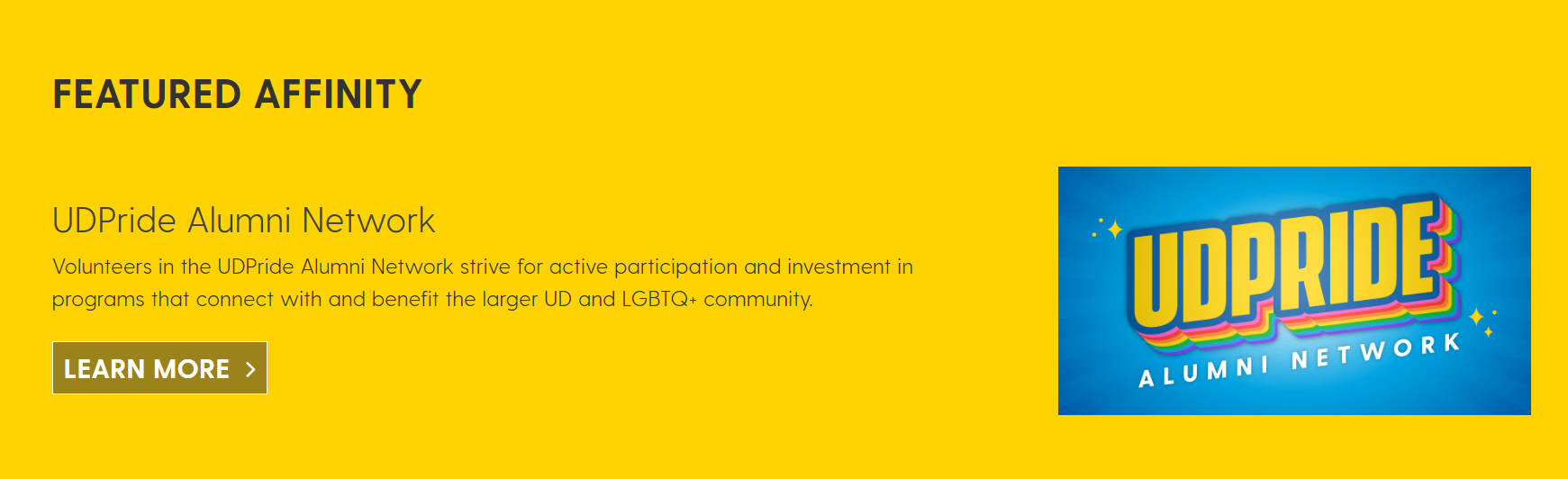
The University of Delaware’s UDPride Alumni Network shows how this can work. In its second year, the network welcomed new members and hosted a Drag Show during Alumni Weekend. That kind of programming gives alumni a clear community to join, not just an event to attend.
Alumni are more likely to give when they already feel connected to the people, programs, and communities their support affects. This is why giving should sit within the larger engagement journey.
Giving days, peer-to-peer fundraising, volunteer-led fundraising, and engagement-to-donation pathways work best when alumni have already had meaningful touchpoints with the institution. The goal is to make giving feel like a natural next step.
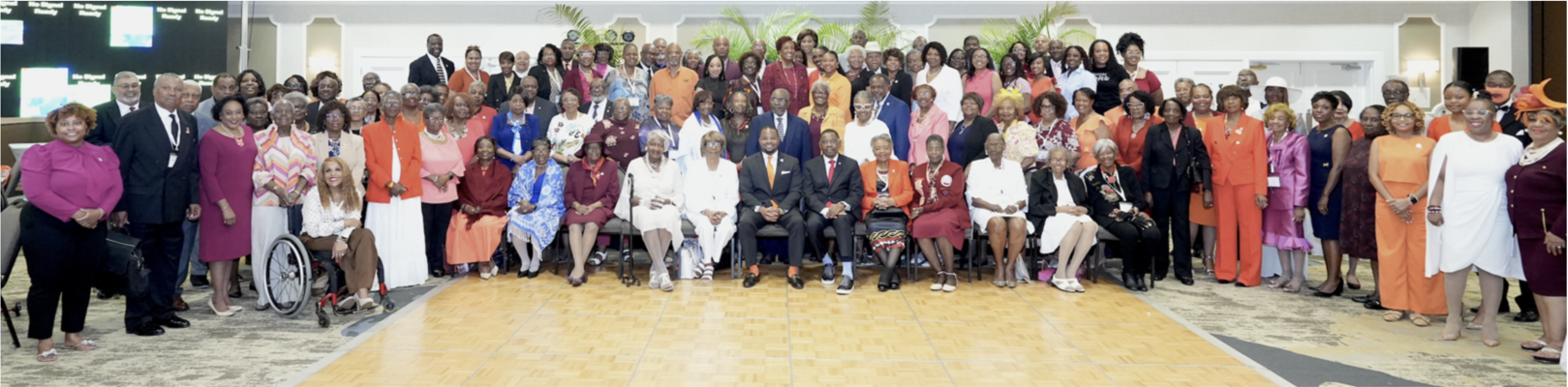
Claflin University connected alumni fundraising to broad participation across reunion classes, young alumni, alumni chapters, and multiple generations. In FY 2024-2025, alumni contributed $1,006,088 and helped the university exceed its $1 million alumni fundraising goal.
Volunteer roles give alumni a way to contribute time, experience, and influence even when they may not be ready to make a gift. This is crucial today where alumni and donors want to feel connected to a cause and its impact before they give.
These roles can include:
They help bring others into the community, support students, and extend the reach of small advancement teams.
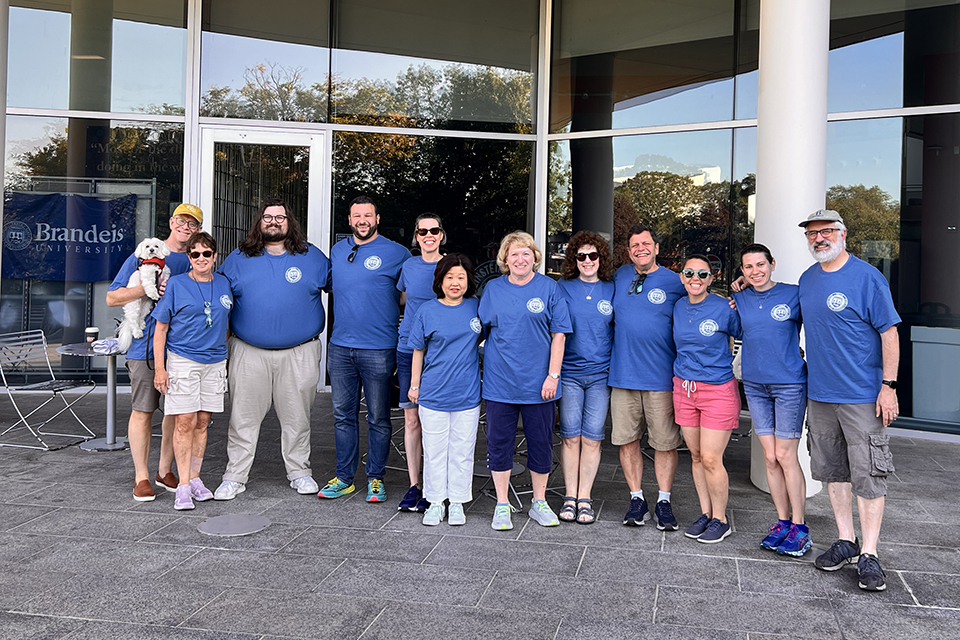
Brandeis University’s Alumni Ambassador Program gives alumni clear ways to strengthen the community, build professional connections, promote university initiatives, amplify campus news, and connect with students. The role turns alumni advocacy into structured participation.
Stories help alumni visualize their impact in the institution’s community. They also give teams a way to keep engagement active between events, campaigns, and formal programs.
Common storytelling initiatives include:
A thoughtful spotlight can recognize career growth, personal impact, service, resilience, or the way an alum supports others.

Sacred Heart’s November 2024 alumni story featured two alumni sharing personal experiences of hope and resilience. The story focused on what they had lived through and how their experiences could help others facing similar moments.
Alumni engagement data should show more than donations. Giving matters, but it is only one part of the relationship. Your teams should also track:
These metrics help teams understand who is active, what programs are working, and where follow-up should happen next. They also help demonstrate engagement ROI to leadership with clearer evidence.
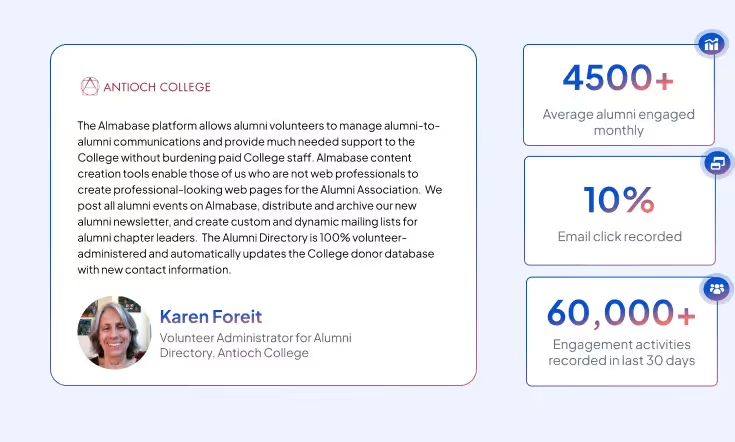
Antioch College used Almabase to improve community engagement and streamline volunteer management. The college recorded 60,000+ engagement activities in the last month, reached a 10% email click rate, and engaged 4,500+ alumni on average each month.
Sustainable alumni engagement depends on consistent relationship-building, personalized outreach, useful community experiences, and the right infrastructure to keep everything connected. Almabase helps colleges and universities bring these pieces together through an integrated alumni relations platform built for
-teams that need to scale without adding more manual work.
Institutions can use Almabase to:
This helps teams understand how alumni participate over time and use that insight to improve future outreach. It also keeps engagement activity from sitting in disconnected tools.
For institutions building a stronger online alumni community, Almabase makes it easier to strengthen relationships, improve participation, and support advancement outcomes through one connected system.
Request a demo to see how Almabase can support your alumni engagement strategy or watch an interactive tour below!
Alumni engagement best practices are strategies institutions use to build meaningful, long-term alumni relationships. They usually include personalized communication, community-building, events, networking, mentorship, and clear engagement measurement.
Universities improve alumni engagement by making outreach more relevant and participation easier. This often includes personalized communication, career-focused programs, alumni communities, events, mentorship opportunities, and consistent multi-channel communication.
The best alumni engagement strategies are the ones that create value before asking for deeper involvement. These include segmentation, alumni-centric engagement, networking programs, affinity groups, giving day participation, and volunteer programs.
You can measure alumni engagement by tracking participation across different touchpoints. Useful metrics include event attendance, volunteer involvement, email engagement, community participation, mentorship activity, and giving participation.
Alumni engagement helps institutions build stronger relationships that support fundraising, advocacy, mentorship, student success, and community-building. It also creates a stronger foundation for long-term donor relationships because alumni stay connected before they are asked to give.
Subscribe
See how modern advancement teams bring alumni engagement and fundraising together.
Plan faster. Execute better
Explore free templates designed for alumni and fundraising teams.
.png)

.avif)
Almabase
%201.svg)
%201.svg)
%204.svg)


.svg)