Alumni have unique, personal ties to your school motivating them to give. Tap into this group and maximize their loyal support for your school and its students.

As trends in the economy, philanthropic efforts, and donor behavior continue to change, it’s critically important that schools steward alumni donors and recognize the essential role they play in fundraising campaigns.
Finding what messages your alumni connect to allows you to tailor your campaigns and strategies to their interests and preferences. In this guide, we’ll expand on the following ways that your school can use what you know about its alumni to motivate and maximize their support:
.png)
Just as you should choose fundraising ideas that align with donors’ giving motivations and behaviors, you should do the same with your alumni communications. Let’s get started!
Communicating with alumni is the only way your school can make an impact on them and inspire long-term support. To avoid having your communications fall by the wayside, it’s key to make them feel genuine and personal. Make your communications feel warm and engaging with quick fixes such as greeting alumni by name at the beginning of every communication.
Next, explore your alumni database and experiment with strategies like:
Additionally, make sure your website is updated, easy to navigate, and has content designed to resonate with your alumni. For example, you might feature testimonials from donors about why they chose to donate to their alma mater, a page that breaks down how alumni giving has impacted your school, and a list of ways they can support your institution.
Many corporations offer matching gift programs to their employees as a part of their corporate social responsibility (CSR) efforts. In these programs, companies match the donations their employees make to eligible organizations, usually including nonprofits, schools and universities, and other charitable organizations.
When promoting matching gifts to alumni, keep these things in mind:
You can also use your alumni database to improve matching gift program participation rates. If you know where alumni work, you can learn whether or not their employers have matching gift programs. Then, send targeted messages and reminders to those donors.
To get alumni involved in your fundraising efforts, you’ll need to cultivate a vested interest in your school’s success. Building a community of dedicated alumni and showing them the impact fundraising has on your operations will help them understand the importance their support holds.
Consider engaging your alumni with events, activities, and initiatives such as:
.png)
These strategies go beyond a simple email or letter, encouraging alumni to take an active role in your school’s success. Take note of the alumni who participate in these activities—they are likely to be your most dedicated, loyal supporters.
As your school would with any other donor, you should strive to provide a positive giving experience to alumni in order to motivate them to give again in the future. Make sure to accept a wide variety of payment options to make giving convenient. Always acknowledge and thank donors’ generosity through genuine thank-you messages to steward alumni who are driven to support their alma mater.
Table of Contents
Subscribe
See how modern advancement teams bring alumni engagement and fundraising together.
The institution of higher education relies on funding from alumni to maintain the level of excellence it’s worked so hard to establish. When students graduate and go out into the working world, they’re putting the skills and knowledge that they built while in school to use. On an average, higher education graduates earn around twice as much in their lifetime than individuals with only a high school diploma or GED.
This means that your alumni are also the best people to reach out to for fundraising at your institution. Not only do they have a special connection with their alma mater, but as they grow in their respective careers and gain financial stability, they can contribute better to your cause — hence, it’s imperative to keep your alumni in the loop. Your alumni leverage the education they received from your institution. By donating to your school, they can give back to help others do the same.

What does this mean for your organization? It’s your job to help alumni see the benefit of contributing to your school and to develop relationships with them over time. We've curated 4 alumni fundraising strategies that are evergreen and will help you reap alumni fundraising success. However, keep in mind that some other details, such as trends in higher education fundraising, may change depending on the external circumstances in which you’re operating. Keep the latest alumni engagement trends in mind, but don’t forget the importance of lasting strategies as well. Let’s dive in!
Not all alumni are equal. This doesn’t mean you should completely ignore some of them, because they’re all important. However, you should approach them differently depending on who they are and their role in your organization.
For instance, you wouldn’t go to an average recent graduate and ask for a major donation of $1 million. Similarly, you wouldn’t go to a major donor and ask for $25. Instead, segment the supporters within your database. If you don’t yet have a database you like or are looking for a new option, Bloomerang’s donor database guide provides the following steps to find the perfect solution for any organization:
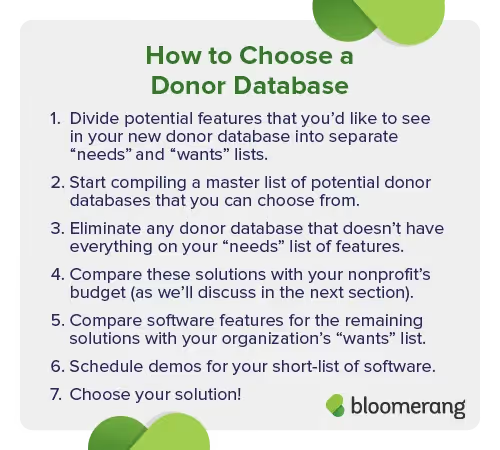
When you have an alumni engagement/fundraising software/platform that empowers the effective organization of alumni data, create segments based on the alumni’s giving recency, frequency, type, amount, reason, and interest. Let’s consider how different types of donors might show these items differently:
Understanding segments in your alumni database will help you reach out to alumni with messages most meaningful to their engagement with your school. This lays the foundation for an impactful relationship.
Higher education institutions generally rely heavily on major giving from alumni. By leveraging prospect research, your institution can identify these valuable alumni and determine who will be most likely to give in substantial quantities to your school.
Prospect research will help you identify both wealth and philanthropic indicators to make this possible. Here’s a breakdown of the difference:
This information is publicly available, so you could take a DIY approach to find it. However, it’s much simpler to use a prospect research database to learn more about prospective donors. Then, you can search your alumni database to find the perfect match for your next mid-tier or major donation.
Average new alumni might not have the capacity to donate back to the school in large sums just yet. However, they may still feel a very strong connection to your school, having just graduated. Therefore, you should get them involved as soon as possible.
Ask new graduates to reach out on your behalf to get their friends, family, and connections involved with your institution. You may ask them to:
Even if your alumni don’t have the capacity to give or don’t want to give yet, that doesn’t mean they can’t get involved! Encourage all of your alumni to get involved with your institution and to start giving back by reaching out on your behalf.
It’s rare that an alumna will turn around to give $10,000 to your school out of the blue. Typically, large donations that exceed thousands or even millions are those that come from someone your institution has developed a relationship with.
Focusing on donor relationships will help keep your alumni coming back again and again, increasing your retention rate and helping you fundraise more. Higher donor retention lowers the cost of acquisition. Plus, alumni will tend to give in greater quantities over time as their capacity increases and their connections to the institution continue to grow.
To build these relationships, your organization should:
Relationships build the foundation for all healthy and sustainable fundraising. By focusing on relationships rather than money, you show your alumni that you care about them, not just their wallets.

Your alumni are thankful for the time they spent learning at your school and developing skills that helped them make it in the world beyond. This connection to your school is special and strong. Therefore, take the steps necessary to build relationships with these important donors and reach out to them using the strategies in this guide for more successful alumni fundraising.
Alumni donate to an institution and cause that they feel a personal connection with. Alumni donations involve require keeping them engaged, providing a smooth donation process, hosting events that resonate with them, and forming a community of like-minded donors.
Even the most generous alumni may miss out on an upcoming cause due to a busy schedule. Meaningful and personalized engagement not only keeps alumni in the loop with what's happening but also allows you to widen your reach for upcoming events and fundraisers.
Today, alumni engagement is a mix of online and offline engagement methods. You try to promote in-person interactions but also keep track of your email, social media, and alumni community interactions to keep your alumni base interested and informed.
Fundraisers allow institutions to tap into the social goodwill of their alumni to achieve initiatives and events that they might have otherwise not had the funding or reach to accomplish. By maintaining this bond, fundraising also doubles as a crucial engagement channel between an institution and an alumni.
An alumni association provides alumni with access to career , mentorship, and networking opportunities while keeping them in touch with their fellow alumni. The institution in turn gains a central point of contact for their alumni outreach and communication needs through the association.

4 Awesome Alumni Fundraising Strategies
Check out these four strategies to amplify your alumni engagement and improve your fundraising efforts.
Lorem ipsum dolor sit amet, consectetur adipiscing elit. Suspendisse varius enim in eros elementum tristique. Duis cursus, mi quis viverra ornare, eros dolor interdum nulla, ut commodo diam libero vitae erat. Aenean faucibus nibh et justo cursus id rutrum lorem imperdiet. Nunc ut sem vitae risus tristique posuere.

September 30, 2021
12 minutes
Most of your higher education donor prospects, whether they're first-time supporters or long-term donors, already have an affinity for your college or university. They might root for your sports team, champion academic research on campus, or want to pave the way for continued high-quality academics.
While many supporters are emotionally invested in your institution, they may still hesitate to support your fundraising initiatives. They may ignore your Giving Tuesday email appeals, scroll past your social media posts promoting your recurring giving program, or think, “My alma mater always does the same old thing during Homecoming Week” when they receive an invitation to your annual benefit.
So, in order to really grab your donors’ attention, you should plan fundraisers that they’ll be excited to participate in. Of course, there’s no need to throw out the current strategies that are working for your organization, like your graduation day email stream that always boosts your progress toward your annual fundraising goal or the Parents’ Week dinner that sells out every year. But you can fine-tune your strategies so that you always plan fundraisers your donors will love!
.jpeg)
We’ll help you get started by covering three tips:
As you set out to improve your fundraising efforts, consider working with a fundraising consultant. These professionals bring to the table a third-party perspective and years of experience, helping to improve your fundraising strategy in ways you may not have seen. And their work goes beyond identifying problems—a consultant can help you brainstorm and implement positive changes to your strategy, setting your organization up for sustainable success and growth.
Let’s dive into our three tips!
To plan a fundraiser that will resonate with your audience, you need to get to know your supporters and their preferences.
The first place to look for this information is your organization’s CRM. Review the donor profiles saved in your CRM to identify trends in your audience’s demographics and preferences. For example, you might notice that most of your donors fall within the age range of 45-60. You might use this information to create a more targeted social media marketing plan for your next campaign, leaning into Facebook over a platform that younger generations prefer, like TikTok.
Another source of information is donors themselves! Try surveying your donors to find out what they want to see in a fundraising campaign. For instance, you might ask your donors, “Where did you hear about our fundraising campaigns?” or “Which of the events listed below are you most likely to attend?” Show your audience that you care about their opinions while gathering ideas. This will help build and maintain stronger relationships with your support.
Leveraging your CRM and surveying your audience of supporters will empower you to step into your community members’ shoes and see your fundraising efforts from their perspective. This way, you can easily plan campaigns and events that they will be excited to participate in!
Having the right fundraising tools on your side will help you set up a campaign that is quick, easy, and hassle-free. And convenience will be a major deciding factor in how your supporters feel about your campaign!
Here are some fundraising tools for your next campaign, as well as how they can be used to streamline the process for everyone involved:
With each of these fundraising tools, one of your main priorities should be to brand the tool to your organization. Even if you’re using an external platform, having your institution’s brand elements present on a fundraising page or other donation tool is imperative. Doing so can reinforce for your supporters exactly why they’re giving and can help establish professionalism and credibility with your audience.
One of the best things about fundraising for a college or university is the tight-knit community that your organization gets to interact with each and every day. So, why not level up your next fundraiser by having your campaign culminate in a fun event, where people who love your school can gather together and mingle?
There are hundreds of options out there for fun end-of-campaign events. Here are a few of our favorites:
Events like these can bring your community closer and help your supporters create lasting memories that they associate with your institution. To make your event a success, make sure to start planning early. You’ll need to secure venues, arrange catering, and recruit volunteers to make sure everything runs smoothly on the big day!
By using these tips, you can polish your college or university’s approach to fundraising and plan campaigns that your donors will love. As you do, remember to focus on building lasting relationships with your supporters. Show them that you appreciate and value them, and that you’re working to make sure your efforts resonate with them and what they love about your school. Good luck!

Plan a Fundraiser Donors Will Love: 3 Tips
To be a successful higher education fundraiser, you’ll need to keep your donors in mind. In this guide, you’ll learn how to plan a fundraiser donors will love.
Lorem ipsum dolor sit amet, consectetur adipiscing elit. Suspendisse varius enim in eros elementum tristique. Duis cursus, mi quis viverra ornare, eros dolor interdum nulla, ut commodo diam libero vitae erat. Aenean faucibus nibh et justo cursus id rutrum lorem imperdiet. Nunc ut sem vitae risus tristique posuere.
Picture this: You’re the director of fundraising and development at a well-known higher education institution. You’ve recently had a ton of money coming in to support your larger-scale initiatives. A private grant-giving foundation is providing your team with the money required to open a high-tech computer lab, and a major donor is funding the building of a new wing at the school.
But what about your other day-to-day operations? You need funds to keep your institution above water, continue paying staff salaries, and invest in behind-the-scenes technology that allows your university to continue running smoothly. Oftentimes, major gifts and grant funding don’t cover those needs.
And that’s where your annual fundraising strategy comes in! In this guide, we’ll explore four powerful tips for boosting this particular type of fundraising. As you begin planning your upcoming campaign, be sure to:
All sorts of mission-driven organizations rely on annual fundraising to help manage their in-between needs—and when it comes to university and other education-based institutions, your alumni are likely to be your biggest supporters!
Are you ready to uncover how you can position your school for the greatest annual fundraising success going into 2022? Let’s get started.
Fundraising organizations have learned a lot about effective fundraising strategies (and the way that they’re always changing) from the highs and lows of 2021. And before that, 2020. Going in 2022, reviewing efforts and results from previous years can give you a head start toward success.
To get started, take a look at where your fundraising flourished in the past year, as well as where you see room for improvement. If you notice that your efforts in the corporate giving arena could use some extra work, for example, consider prioritizing corporate fundraising in the upcoming year.
Here are some other key performance indicators (or KPIs) you might look at:
As you craft your newest annual fundraising strategy, make sure to prioritize the avenues that have historically been your most profitable while also giving extra care to channels that may be lagging behind.
A significant element of successful fundraising involves setting fundraising goals beforehand. Otherwise, how will you determine “success” in the first place?
You’ll want to choose lofty objectives that inspire donors and fundraisers alike while ensuring you don’t aim too high that it can seem unrealistic or like a “lost cause.” To find the perfect medium between the two, the best and most effective goals often follow the SMART framework.
As you craft your upcoming objectives, make sure they are:
Here’s an example of a SMART goal for an upcoming campaign - “To collect $10,000,000 in individual contributions to fund university operations by 12/31/2022.”
To contrast, a poorly crafted goal might look like this - “To raise a lot of money in the next few months.”
The former sample is much clearer and will ultimately result in greater success, while the latter is subjective and vague. When your annual fundraising objectives incorporate each element listed above, you can ensure your team is positioned for success.
The more fundraising strategies and tools develop, the more comprehensive your campaigns are expected to be. As a result, organizations are encouraged to integrate multiple channels to spread the word about their annual fundraising efforts far and wide.
The particular avenues you choose to leverage for your annual campaign can vary depending on your donors’ preferences and your team’s strong points. However, they will likely incorporate a combination of the following:
Several years ago, you may have been able to reach your goals solely through phone and in-person solicitation efforts. Now, it’s essential that you take a multichannel approach—both to meet donors where they already are and to stand out from other organizations seeking your audiences’ attention.
Did you know that more than 26 million people work for companies with corporate matching gift programs? It’s likely that many of these individuals are your alumni, donors, and other key supporters.
Before you can expect a solid flow of corporate matches coming in, however, you’ll need to enact specific matching gift marketing strategies to raise awareness of this powerful opportunity. Because although 26+ million individuals are eligible for company matches, more than 78% of this group is completely unaware.
To incorporate corporate matching gifts into your annual fundraising strategy, consider these best practices:
For you, matching gifts mean that your school has the potential to collect two donations for the cost of soliciting one. And for your donors, they get to know their contributions went twice as far.
You can’t do the big things (like your overall mission impact) without being able to fund the little things as well. An effective annual fundraising strategy allows your team to collect the dollars you need to bankroll every part of your school’s operations—from the most glamorous of tasks to the most mundane.
Luckily, integrating these best practices into your strategy will allow you to raise more funding for your institution and better situate your team for ongoing success. Good luck!

4 Tips for Your Annual Fundraising Strategy
Effective annual fundraising is critical for universities and other donation-driven institutions. Explore four easy tips to set your school up for success.
Lorem ipsum dolor sit amet, consectetur adipiscing elit. Suspendisse varius enim in eros elementum tristique. Duis cursus, mi quis viverra ornare, eros dolor interdum nulla, ut commodo diam libero vitae erat. Aenean faucibus nibh et justo cursus id rutrum lorem imperdiet. Nunc ut sem vitae risus tristique posuere.

December 30, 2021
12 minutes

.svg)

.avif)
.webp)