Managing alumni engagement with multiple systems can slow teams down! Here’s how Cornell College simplified workflows and built a more connected alumni experience.

Chetana More
Published:
June 18, 2026
Discover AI Summary
• Don't mistake functional systems for efficient systems: Emails sending and events running doesn't necessarily mean your operations are optimized. Hidden inefficiencies across disconnected tools can quietly consume staff capacity and limit what teams can accomplish.
• Create a single source of truth for alumni engagement activities: When giving, events, communications, and community data live in separate systems, collaboration becomes harder and manual work increases. Unified platforms help teams stay aligned and move faster.
• Reduce administrative work to increase engagement capacity: Every hour spent syncing data, managing workarounds, or navigating multiple systems is an hour not spent building relationships with alumni. Simplification creates more time for high-value engagement.
• Design alumni experiences that are seamless behind the scenes: Donors and alumni may never see your internal processes, but they feel the impact of them. Streamlined registrations, giving experiences, and self-service tools make engagement easier and more rewarding.
• Prioritize technology that removes friction, not just adds features: The most impactful investments are often the ones that simplify workflows, reduce handoffs, and help teams focus on the work that matters most.
With a lean advancement team and an alumni community that genuinely cares about staying connected, Cornell has always found ways to make meaningful relationships work. So when Taylor Petersen and Naomi Winder sat down to look honestly at how their team was spending its time, the question wasn't whether their alumni were engaged. The question was whether their systems were keeping up with them.
At the time, that meant managing alumni engagement across Blackbaud NetCommunity and several other tools. While everything worked, the team saw an opportunity to simplify workflows, reduce manual effort, and create a more connected experience for both staff and alumni.
So we sat down with them to talk about how they moved from disconnected systems to a more unified, easier-to-manage alumni experience. What stood out wasn't just the tools they used. It was how they simplified the way their team actually works.
.avif)
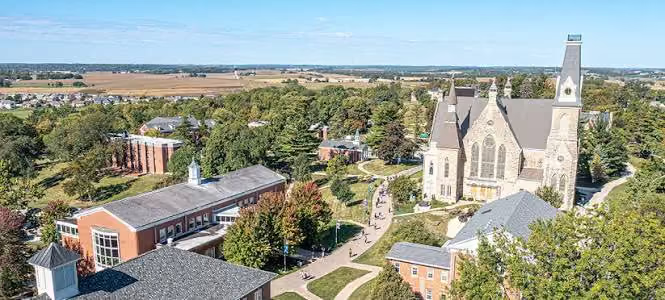
Cornell College, located in Mount Vernon, Iowa, is a small liberal arts institution with a distinctive academic model.
Instead of juggling multiple classes, students focus on one course at a time in 18-day blocks, creating a highly immersive experience and strong, lasting connections. That sense of connection carries into their alumni community.
Today, Cornell supports a network of 15,000–17,000 alumni. But the team managing that?
Which means every decision about how they spend their time is intentional. When you're managing events, campaigns, and communications all at once, the way you work matters just as much as the work itself.
.avif)
Earlier, Cornell was working with multiple systems across giving, events, email, and alumni data. And to be fair, everything functioned.
Pages could be built. Emails could be sent. Events could run. But behind the scenes, it looked like this:
None of these challenges were deal-breakers on their own. But over time, they added up, making everyday tasks more complicated than they needed to be and creating extra work behind the scenes. And more importantly, it pulled time away from what the team actually wanted to focus on, engaging their alumni.
Instead of asking, “What more do we need?”, the team asked a simpler question:
What would this look like if it were easier to manage?
That led to a shift toward consolidation. By moving to Almabase, Cornell brought giving, events, email, forms, and community management into one platform, all seamlessly connected to Raiser’s Edge NXT through a deep, reliable integration.
Instead of spending time moving data between systems or managing manual syncs, the team could work from a single source of truth, with information flowing smoothly across campaigns, events, and donor engagement activities.
This reduced the need to move between systems and minimized manual processes.
More importantly, it created a shared environment where the team could collaborate more effectively, working on different parts of the same campaign without stepping on each other’s toes.
The result was fewer handoffs, fewer workarounds, and fewer moments where someone had to stop and figure something out.
%20(1).webp)
This is where the shift becomes visible, not in theory, but in day-to-day work.
Giving Day became easier to run and more engaging to participate in.Instead of a single static page, the team could:
Each improvement may seem incremental on its own, but together they created a more engaging experience for donors and a smoother process for the team running the campaign.
Events like Homecoming and reunions no longer required constant back-and-forth.
Bringing event management into the same ecosystem reduced the amount of coordination required behind the scenes and made it easier to keep information aligned across teams.
Even routine tasks became easier. With a more self-serve alumni experience:
Which meant less manual work for the team, and more accurate, up-to-date data.
This is where everything comes together.
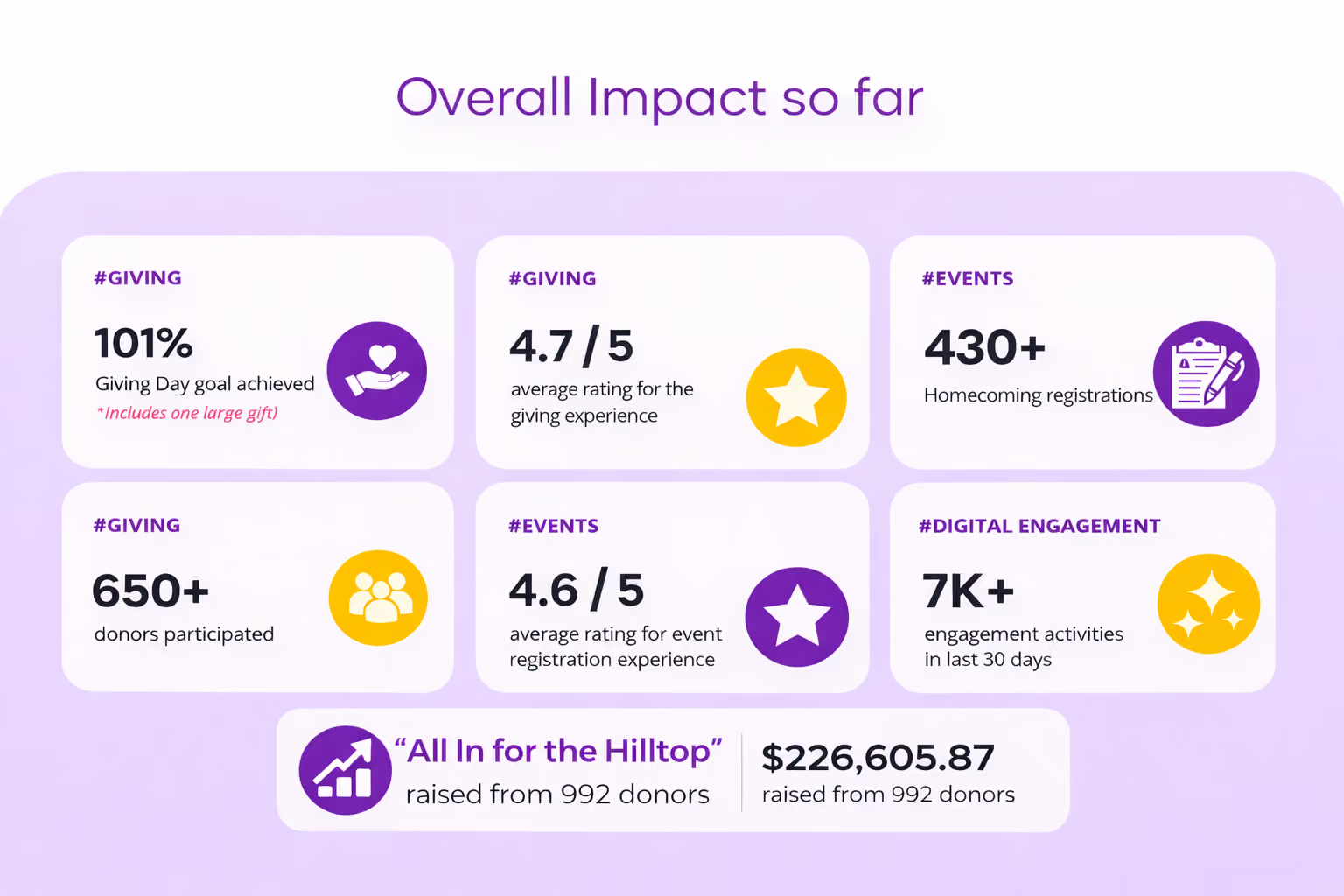
For a team of this size, those results speak to more than campaign performance. They reflect the impact of having systems that support the work rather than compete for attention, giving the team more capacity to focus on alumni relationships and engagement.
One of the themes that came up repeatedly during the conversation was focus. By bringing key pieces of the alumni experience into one place, Cornell created a workflow that is easier for staff to manage and easier for alumni to engage with.
The result is a stronger foundation for everything the team is already doing from events and giving to ongoing alumni engagement without requiring additional complexity behind the scenes.
If you'd like to see how the team approached this transition and hear their experience firsthand, you can watch the full conversation here.
Table of Contents
Subscribe
See how modern advancement teams bring alumni engagement and fundraising together.

.svg)

.avif)
.webp)