Compare 10 Hivebrite alternatives for alumni, membership & community management. Find specialized solutions for education, creators & enterprises

Summary
• Considering a new alumni platform? If your educational institution relies on an existing CRM, a purpose-built solution like Almabase can seamlessly integrate your alumni data, truly enhancing fundraising and engagement without replacing your database.
• Many advancement teams find generic community platforms overwhelming or lacking in education-specific features; this post highlights alternatives designed to tackle unique challenges like event management and donor participation.
• Discover platforms that simplify operations by offering market-leading event tools with badge generation, or provide 24/7 priority support during crucial times like giving days and homecoming.
• Whether your team is lean or focused on maximizing fundraising ROI, this guide explores options that bring transparent pricing, deep CRM integrations, or AI-powered donor intelligence to the table.
• Learn how specialized tools can foster stronger alumni engagement through sophisticated mentorship programs, or even help you create custom branded pages without needing any technical coding skills.
• The full post offers a comprehensive look at both education-specific and broader community platforms, helping you find the perfect fit to avoid complexity and align with your institution's specific needs and budget.
Hivebrite has established itself as a significant player in the community management space, offering organizations an all-in-one platform that brings together member directories, event management, communication tools, mentoring programs, job boards, and more.
But as your community evolves and your specific needs become clearer, you might find that a platform designed to serve everyone from corporations to universities to professional associations doesn't quite hit the mark for your particular use case. Organizations often discover that Hivebrite's extensive feature set requires significant time investment to learn and configure properly, particularly for smaller teams without dedicated technical resources. The platform's flexibility can be limited for organizations that need specific customizations.
That's where this guide comes in. Whether you're looking to:
We'll explore specialized alternatives that excel in these specific areas. Some organizations might use these tools alongside Hivebrite to enhance particular functions, while others might find that a more focused solution better serves their needs entirely.
Hivebrite is an all-in-one, cloud-based community management and engagement platform designed to help organizations build, manage, and grow private, branded online communities. Founded in 2015 and serving over 900 customers in more than 50 countries, it provides a comprehensive suite of tools for various sectors including educational institutions, nonprofits, corporations, and professional associations. Its key features include:
When organizations use Hivebrite, all these components work together in an integrated fashion: a member who registers for an event automatically appears in the attendee list, their participation is tracked in analytics, they can be added to relevant groups, and targeted for specific communications based on their engagement. This integration reduces the need for multiple disconnected tools.
However, as a horizontal platform designed to serve all industries—from corporate alumni networks to professional associations to educational institutions—Hivebrite's broad approach can present challenges. The extensive feature set that makes Hivebrite powerful for large enterprises with dedicated staff can feel overwhelming for institutions without technical resources. Additionally, customization options are often restricted based on tier levels, limiting flexibility for organizations with specific needs.
That's why exploring alternatives that excel in particular use cases can help you find the perfect fit for your community's unique needs. In this guide, we've organized alternatives into two distinct categories: Alumni Engagement & Management platforms (designed specifically for educational institutions and advancement teams) and Generic Community Engagement & Management platforms (suitable for a broader range of organizations)
After thoroughly researching Hivebrite and analyzing user feedback, we identified that organizations often seek alternatives when they need:
Each platform on this list excels in at least one of these areas, providing specialized solutions that might better match your organization's specific requirements, technical capabilities, or budget constraints.
To help you navigate these options more effectively, we've organized our alternatives into two distinct categories:
Alumni Engagement & Management Platforms (1-6): These platforms are purpose-built for educational institutions—K-12 schools, colleges, and universities—with features tailored for advancement teams, alumni relations, fundraising, and student/alumni mentorship. If you're in the education sector looking for a Hivebrite alternative, start here.
Generic Community Engagement & Management Platforms (7-10): These platforms serve a broader range of organizations, from creators and SaaS companies to enterprises and technical communities. They excel at general community building, customer engagement, forum discussions, and CRM integration across various industries.
❗DISCLAIMER: We aren't covering every single community platform in the market. Our focus is on highlighting the best alternatives that address specific limitations or use cases where organizations might need something different from Hivebrite's all-in-one approach.
The following six platforms are specifically designed for educational institutions seeking specialized tools for alumni engagement, advancement operations, and fundraising. Unlike Hivebrite's all-industry approach, these solutions understand the unique workflows of K-12 schools, colleges, and universities.
Almabase is a comprehensive alumni management software purpose-built for educational institutions such as K-12 schools, colleges, and universities. Unlike generic community platforms that try to serve all industries, Almabase is an education-specific platform that works as an integrated solution on top of your existing CRM, enhancing your current database of record without replacing it. This specialized advancement platform provides tools designed specifically for how educational institutions engage alumni and drive fundraising. Its key features include:
Take a quick product tour →
Almabase serves over 500 institutions and maintains a 95% customer retention rate, demonstrating its value for advancement teams that need their community platform to work in harmony with their existing CRM infrastructure. The platform's consistently high support ratings reflect its customer-first philosophy as a bootstrapped organization.
While Hivebrite offers a comprehensive platform that attempts to serve various sectors from corporations to associations to educational institutions, Almabase excels as a dedicated alumni engagement system built exclusively for educational advancement. Where Hivebrite's all-industry approach can require extensive configuration and may include irrelevant features while missing education-specific capabilities, Almabase delivers exactly what advancement teams need.
Almabase is architected specifically for educational institutions, not adapted from a generic platform. Every feature—from event management to fundraising to communications—is designed with advancement workflows in mind. The platform includes comprehensive event management capabilities that are market-leading for education, with features like badge generation and distribution, complete attendee management, and seamless data flow to your CRM.
Unlike Hivebrite, which requires significant time investment to learn and configure for educational use cases, Almabase provides pre-built templates and workflows designed specifically for advancement teams. The platform's modularity and ease of use mean you can create custom branded pages without any coding knowledge and publish them directly on your institutional website through Almabase's CDN infrastructure—eliminating the need for separate technical resources.
Almabase's TrueSync technology provides bidirectional synchronization with Blackbaud advancement CRMs (Raiser's Edge NXT and Blackbaud CRM)—the deepest integration available in the market. The platform also offers native integrations with Salesforce and connections to other CRMs like Ellucian.
This integration extends beyond simple data sync. Almabase includes comprehensive finance management capabilities designed for educational advancement, enabling proper gift processing, donor transaction management, and financial tracking. When gifts are processed through Almabase giving pages, they are batched and pushed to your CRM with proper gift coding, soft credits, and constituent matching—significantly reducing manual data entry.
While Hivebrite users often report struggling with setup complexity and needing dedicated technical staff, Almabase provides 24/7 customer support with a customer-first philosophy that has earned consistently high ratings. The support team offers priority assistance during critical institutional periods like giving days and homecoming events—exactly when advancement teams need immediate help.
The platform is specifically designed for advancement teams who may not have extensive technical resources. Pre-built templates for common workflows, automated data enrichment that finds updated alumni information, and drag-and-drop builders eliminate the steep learning curve that many experience with horizontal platforms.
🏅 NOTE: We also evaluated platforms like Graduway and 360Alumni for educational institutions. Graduway offers strong AI-powered fundraising through its Gravyty merger and integrates with existing CRMs. 360Alumni provides good value for smaller schools and offers integrations with Raiser's Edge NXT and Salesforce. Almabase combines comprehensive advancement features with deep CRM integration through TrueSync, making it a strong choice for institutions that want to enhance their existing database infrastructure with a purpose-built solution.
Almabase uses customized pricing based on your institution's size and needs:
Choose Almabase if:
Ready to see how Almabase can transform your advancement operations while working seamlessly with your existing CRM? Schedule a personalized demo and discover why 500+ institutions trust Almabase for their alumni engagement and fundraising.
Graduway is an alumni engagement platform that has evolved into a comprehensive fundraising ecosystem through its merger with Gravyty and the addition of Gratavid and the Advance giving platform. Built with the philosophy that alumni engagement should directly translate into philanthropic support, it serves larger educational institutions and advancement offices that want to operationalize their alumni network as a pipeline for fundraising campaigns. Its key features include:
Graduway distinguishes itself through three key advantages:
🏅 NOTE: We considered 360Alumni and PeopleGrove as alternatives. While 360Alumni offers strong networking capabilities and transparent pricing, and PeopleGrove excels at career services, Graduway's comprehensive fundraising ecosystem through the Gravyty partnership makes it a strong choice for institutions prioritizing philanthropic outcomes from alumni engagement.
Choose Graduway if:
Wild Apricot is a cloud-based membership management platform providing organizations with unified tools for websites, member databases, events, and payments without requiring technical expertise. Originally launched in 2006 and serving organizations ranging from small groups to those with up to 50,000 members, it's designed for associations and small nonprofits that need robust functionality at predictable costs. Its key features include:
Wild Apricot excels in three critical areas:
🏅 NOTE: We evaluated Memberful and MemberPress as alternatives. While Memberful excels at lightweight membership integration for existing websites and MemberPress works well for WordPress sites, Wild Apricot provides a complete standalone solution with website building, membership management, and payments at transparent pricing.
Choose Wild Apricot if:
ToucanTech is an all-in-one community platform consolidating website building, CRM, email communications, event management, and payment processing into a single system. Specifically designed for schools and nonprofits, it reduces the need for multiple vendors and complex integrations, though it does connect with payment processors and accounting software. Its key capabilities include:
ToucanTech differentiates itself through three key advantages:
🏅 NOTE: We evaluated Hivebrite's integrated modules and other school-focused platforms. While Hivebrite offers more customization and modular flexibility, ToucanTech's pre-integrated approach reduces configuration complexity, making it well-suited for schools wanting operational simplicity over extensive customization options.
Choose ToucanTech if:
PeopleGrove is a comprehensive student success platform that reframes mentorship and career development by unifying initiatives across the entire learner lifecycle. Rather than treating mentorship as a standalone feature, PeopleGrove integrates AI-powered matching, career exploration, experiential learning management, and community engagement into a single Career Access Platform. Its key capabilities include:
PeopleGrove excels through specialized career development features:
🏅 NOTE: We evaluated Stack Overflow for Teams for technical mentorship and various LMS platforms with career modules. PeopleGrove combines mentorship, experiential learning, and measurable career outcomes in ways that many general community or learning platforms do not.
Contact PeopleGrove for specific pricing based on your institution's size.
Choose PeopleGrove if:
360Alumni is a community-first platform designed for educational institutions and nonprofits seeking streamlined, affordable alumni management without enterprise complexity. Launched in 2013, it offers comprehensive engagement and fundraising tools within a single environment, with every feature included at every price tier regardless of record count. Its key capabilities include:
360Alumni differentiates itself through focused simplicity:
🏅 NOTE: We evaluated Graduway for advanced analytics and considered general association platforms. While Graduway offers strong features for larger enterprises and association platforms serve multiple industries, 360Alumni offers a straightforward solution specifically for K-12 and small colleges prioritizing rapid deployment with transparent pricing.
Choose 360Alumni if:
The following four platforms serve organizations beyond the education sector, including creators, SaaS companies, enterprises, and technical communities. If you're looking for Hivebrite alternatives for customer communities, creator monetization, enterprise CRM integration, or discussion forums, these options may better fit your needs.
Mighty Networks is an all-in-one community platform purpose-built for creators and entrepreneurs who want to build, monetize, and scale branded communities without extensive development. Unlike enterprise-focused platforms, Mighty Networks prioritizes the creator economy with integrated courses, memberships, and events in a single ecosystem. Its key capabilities include:
Mighty Networks excels for individual creators and small teams:
🏅 NOTE: We evaluated Circle for flexible community architecture and Kajabi for sales funnels. While Circle offers good customization and Kajabi excels at marketing, Mighty Networks provides a cohesive all-in-one experience for creators wanting community and monetization without external integrations.
Note: Branded mobile apps are only available with the Mighty Pro tier.
Choose Mighty Networks if:
Bettermode is a community platform architected as "infrastructure for communities," designed to be embedded directly into existing products and websites rather than functioning as a standalone destination. This makes it ideal for SaaS companies and digital product teams that view community as integral to their product ecosystem. Its key capabilities include:
Bettermode excels at embedded community experiences:
🏅 NOTE: We evaluated Hivebrite's customization and Circle for creator communities. While both offer strong features for their target markets, Bettermode combines no-code customization with embeddability and developer flexibility for teams building branded customer communities native to their product ecosystem.
Choose Bettermode if:
Salesforce Experience Cloud (formerly Community Cloud) is a digital experience platform enabling organizations to create branded portals natively integrated with Salesforce CRM. Rather than treating community as a separate system requiring integration, Experience Cloud operates as an extension of your Salesforce platform with data flow across Sales, Service, and Marketing Clouds. Its key capabilities include:
Experience Cloud provides CRM-native capabilities:
🏅 NOTE: We evaluated standalone community platforms with Salesforce connectors and considered Microsoft Viva Engage for Office 365 organizations. While these provide integration capabilities, Experience Cloud's native CRM architecture significantly reduces synchronization complexity for organizations already invested in Salesforce.
Choose Salesforce Experience Cloud if:
Discourse is a 100% open-source discussion platform designed for building forums focused on "civilized discussion." Founded by Stack Overflow co-founder Jeff Atwood, it concentrates on creating structured, searchable conversations rather than broad community management. Its key capabilities include:
Discourse excels at structured knowledge creation:
🏅 NOTE: We evaluated Stack Overflow for Teams for Q&A and phpBB for mature open-source options. While Stack Overflow excels at technical Q&A and phpBB offers forum basics, Discourse provides a modern discussion platform combining forums with real-time chat while maintaining complete data ownership.
Self-Hosted (Free)
Choose Discourse if:
While Hivebrite excels as a comprehensive all-in-one community platform, organizations with specific requirements often benefit from more specialized solutions. The platform's broad, all-industry approach can present challenges: many users find the initial learning curve steep, customization options are restricted by tier levels, smaller organizations often feel overwhelmed by the complexity, and the interface and mobile experience don't always meet modern expectations. Based on our research, here are the best alternatives organized by category:
Remember, you don't have to choose between Hivebrite and these alternatives exclusively. Many institutions and organizations successfully combine platforms to address different aspects of their community needs. Consider your specific requirements, technical capabilities, and growth trajectory when selecting the solution that best fits your organization.
Ready to enhance your alumni engagement? Discover how Almabase's education-specific platform can transform your advancement operations with market-leading event management, no-code custom page creation, and 24/7 priority support.
Schedule your personalized demo and join 500+ institutions already achieving results with integrated alumni engagement and fundraising.
Subscribe
See how modern advancement teams bring alumni engagement and fundraising together.
Plan faster. Execute better
Explore free templates designed for alumni and fundraising teams.
.png)

.avif)
If you're exploring Graduway alternatives, you're likely in the middle of evaluating what your advancement team truly needs from an alumni engagement platform in 2026. Maybe you're looking for tighter CRM integration, a more tailored user experience, or modular functionality that aligns better with your internal workflows.
This blog is designed to help you identify the best-fit solutions. We’ve researched five leading platforms that advancement professionals are turning to—each offering a slightly different approach to engagement, community management, and fundraising. Whether you’re focused on alumni networking, giving days, mentorship programs, or branded experiences, these alternatives are worth your time.
Not every platform will meet every institution’s needs. That’s why the best Graduway alternatives are flexible, powerful, and deeply connected to the daily operations of advancement teams. Here's what to look for:
Each of these platforms offers a unique value proposition. Here's a deep dive into why they stand out in 2026:

Almabase is an all-in-one alumni engagement and fundraising platform purpose-built for educational institutions. It’s known for its tight integrations, intuitive interface, and ability to run giving, events, email, and community features from a single platform.
Almabase is designed around the real workflows of advancement teams. It integrates directly with Blackbaud Raiser’s Edge NXT, enabling bidirectional sync of contacts, activities, and gifts. Teams can automate email cadences, launch giving day microsites, run peer-to-peer campaigns, and manage alumni directories—all without code.
Advancement teams at higher-ed and K-12 schools as well as small to mid-sized nonprofits that want to focus on alumni engagement, events, and fundraising.
Modular pricing based on features and alumni database size. Book a demo here.

Anthology offers a wide range of solutions for institutions to engage, raise funds, and host events within their platform ecosystem. Some tools such as their Anthology Encompass and Anthology Raise will be of interest to advancement teams.
Anthology comes with its own CRM to complement its ecosystem as it covers both students and alumni as well as a few complementary tools to help advancement tasks such as marketing.
Institutions or nonprofits that are used to the Anthology environment or preferred the previous iteration of iModules
No publicly available pricing sheet. You can book a demo and ask for a quote here.

EverTrue is an alumni engagement and fundraising platform designed for educational institutions and nonprofits. It stands out for its deep integration with social media, advanced segmentation, and real-time analytics, enabling advancement teams to connect with donors and alumni in highly personalized ways.
EverTrue’s unique TrueView profiles aggregate up-to-date career, giving, and engagement data—including Facebook interactions—into a single dashboard. Teams can segment audiences with 80+ filters, automate outreach, manage events, and identify new ambassadors or volunteers using actionable engagement insights. Its mobile-friendly interface and seamless integrations with popular tools (like Eventbrite and Emma) help advancement teams save time and boost participation.
Teams who want to engage alumni active on Facebook and mainly prioritize fundraising
EverTrue’s pricing is not publicly available. You can request a demo to get a quote here.

ToucanTech is a CRM-driven engagement platform designed for schools, colleges, and nonprofits. It combines fundraising, alumni engagement, and communication into a single interface.
ToucanTech is praised for its ease of use and built-in CRM, which removes the need to integrate with a third-party system. It's particularly popular among K–12 independent schools and smaller colleges that want an all-in-one system without heavy tech lift.
Advancement offices that want a branded alumni website with an in-built back-end CRM.
ToucanTech’s pricing is not publicly available. You can request a demo to get a quote here.

Hivebrite is a powerful community management platform used across education, enterprise, and nonprofit sectors. It offers robust customizability and scalability for complex engagement needs.
Hivebrite excels at creating branded online communities for alumni, offering tools for networking, groups, forums, events, mentorship programs, and content sharing.
Large universities or Advancement teams that need deep customization, API access, and enterprise-level security for complex engagement structures.
Hivebrite offers three pricing plans: “Connect”, “Scale” and "Enterprise" with each tier having custom pricing. You can find out more here
The platforms above offer different strengths. What you ultimately choose as an alternative to Graduway will depend on:
Ultimately, integrated platforms that offer a variety of tools are meant to be long-term partnerships and you’ll want to make sure you land on the right platform for your institution and your team.
If you’re considering Almabase, we’d love to sit down with you and show you how we can help. We’re always open for a personalized demo or conversation! ⤵️


5 Graduway Alternatives Advancement Teams Love in 2026
Lorem ipsum dolor sit amet, consectetur adipiscing elit. Suspendisse varius enim in eros elementum tristique. Duis cursus, mi quis viverra ornare, eros dolor interdum nulla, ut commodo diam libero vitae erat. Aenean faucibus nibh et justo cursus id rutrum lorem imperdiet. Nunc ut sem vitae risus tristique posuere.

Anwesha Kiran
May 29, 2025
12 minutes
With the dust settling from Anthology’s major corporate restructuring, your team might find themselves faced with the opportunity to re-evaluate what’s working and what isn’t. This is especially true if events sit at the absolute center of how you engage alumni and drive giving.
In this blog, we’ll walk through the top alternatives for your team with events in mind, what to look for in a modern system, and what a smooth transition away from Encompass (iModules) looked like in practice. Let’s dive in.
While most platforms will look similar on paper, you can look at how their features come together, especially around events.
Here's what to evaluate:
The CRM is where data comes together, and when someone registers for an event, makes a gift, or updates their information, you don't want that data sitting in a spreadsheet waiting to be imported later. With Encompass (iModules), event data reaches your CRM through manual exports or scheduled batch syncs, which means your team could be looking at outdated information. During a giving day, reunion, or fundraising gala, that delay can make it much harder to understand what's happening in real time and respond while engagement is at its peak. Your data should feed into your CRM in real time, giving your team an ideal, reliable view of what’s happening in your event.
TrueSync keeps Blackbaud Raiser’s Edge NXT and Almabase in sync in real time, so gift and event data never sits in a queue waiting for a manual export.
Because Encompass (iModules) was built on a legacy architecture, its event features can feel disconnected from the rest of the platform. In practice, that often means advancement teams have to step outside the system to handle things like ticketing, check-ins, or attendee management. Instead of running everything in one place, staff end up juggling multiple tools, switching between them during busy events, and piecing together attendee data afterwards. Your event platform should support the entire event lifecycle in one place, so your team spends less time wrestling with the technology and more time creating great alumni experiences.
Planning a multi-day event like Homecoming or Reunion Weekend with Encompass (iModules) can become more complicated than it needs to be.
Things like creating individual sessions, setting capacity limits, or building different itineraries for guests often require manual workarounds because the registration forms aren't flexible enough to handle them easily.
Ideally, you should be able to build a single master event and organize sessions, tracks, and attendee schedules underneath it with just a few clicks.
Making a quick text edit, updating a logo, or adding a last-minute question to an Encompass (iModules) page can mean waiting on IT or burning a customer support ticket. Advancement teams rarely have dedicated web developers. The coordinators who run your campaigns should be able to create, brand, and modify pages confidently on their own, ideally with minimal to no coding required.
Before we get into the details, here’s a summary of the top 5 Encompass (iModules) alternatives and all they have to offer:
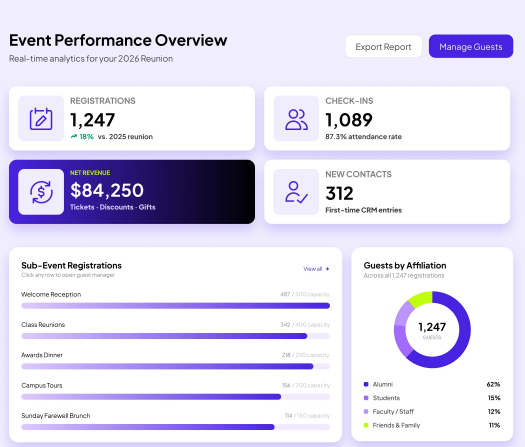
Almabase is a good fit if your team runs events year-round. Instead of piecing together separate tools for registration, ticketing, communications, and CRM updates, everything lives in one place. Event attendance and constituent information sync automatically with Raiser's Edge NXT, while giving data flows over in clean, organized batches. That means your team always has an up-to-date view of who's registering, attending, and giving, without spending hours cleaning up spreadsheets after every event.
Key strengths:
After nearly a decade on iModules, the team at New England College found themselves spending more time managing technology than engaging alumni. Everyday tasks involved manual data entry, spreadsheet clean-up, and workflows that felt far more complicated than they needed to be.
Switching to Almabase gave them a much simpler way to work. Anna Twombly, Director of Annual Giving and Alumni Relations, said the migration was far smoother than expected, and her team quickly became self-sufficient. They could launch giving days, manage event registrations, and update pages themselves instead of waiting on technical support. For a lean advancement team, that meant less time wrestling with software and more time focused on building meaningful relationships with alumni. Check out the full conversation below! 👇
What it's not great at: Almabase does not include prospect research or wealth screening tools. If complex management for major gifts research is a priority, you'd need to layer in a separate platform.
Pricing: Custom pricing based on institution size and needs.
Cvent is one of the most well-known event management platforms on the market. If your institution is coordinating admissions fairs, conferences, athletic events, and campus-wide programmes from one central system, Cvent makes a lot of sense.
Key strengths:
What it's not great at: Cvent is designed as a general event management platform, and not specifically for advancement. That means alumni engagement features like community directories, mentorship programmes, giving pages, and donor-focused workflows aren't part of the core experience.
Universities looking for a single platform to manage large, institution-wide event programmes across multiple departments will find Cvents to be a natural fit.
If your advancement office mainly runs reunions, regional events, giving days, and alumni programming, you may find Cvent more complex than you need.
Pricing: Custom quote, with the median at $19,500 a year.
Eventbrite is one of the easiest ways to publish and sell tickets for an event. It's familiar, simple to use, and great for taking a registration page live quickly. If you're hosting an event where ticket sales are the priority, it's hard to beat for convenience.
Key strengths:
What it's not great at: Eventbrite was built for event ticketing, not advancement. It doesn't recognize alumni or donor records or support fundraising workflows like pledges and auctions. Because it doesn't natively sync with advancement CRMs, your team will likely end up exporting attendee lists and matching records manually after every event.
Smaller advancement teams or alumni clubs running simple, standalone events where collecting registrations is more important than tracking long-term constituent engagement will find this to be a good fit.
Pricing: Free for free events. For paid events, Eventbrite charges per-ticket fees. Verified nonprofits can receive discounts on some marketing plans, but those discounts don't apply to ticketing fees.
Gravyty takes a different approach: instead of offering one place to manage everything, it brings together a suite of products focused on fundraising, donor engagement, alumni networking, and AI-assisted outreach. If your biggest priority is growing digital giving and helping gift officers work more efficiently, it's a compelling option.
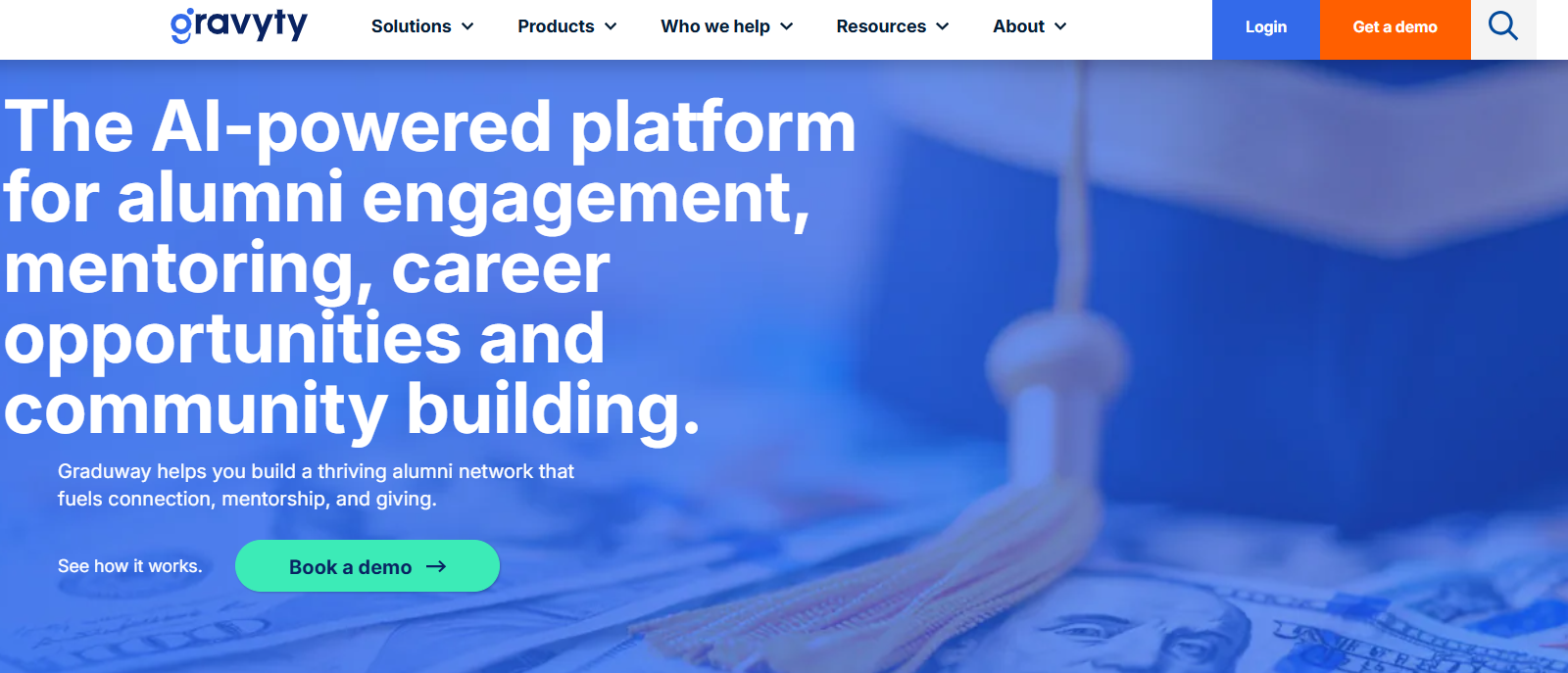
Key strengths:
What it's not great at: Gravyty isn't designed as a single, unified event management platform. Basic event registrations are available through Graduway, but the event functionality is relatively lightweight. Data also syncs back to CRMs like Blackbaud or Salesforce through scheduled updates rather than continuously in real time.
This option would be good for advancement teams that prioritize digital fundraising, AI-assisted major gift work, and donor stewardship over complex event management, and are comfortable working across multiple products instead of one integrated platform.
Pricing: Custom pricing based on your institution's size and requirements.
Givebutter is a highly popular, modern fundraising platform that bundles peer-to-peer campaigns, event ticketing, and auction tools into an incredibly user-friendly dashboard.
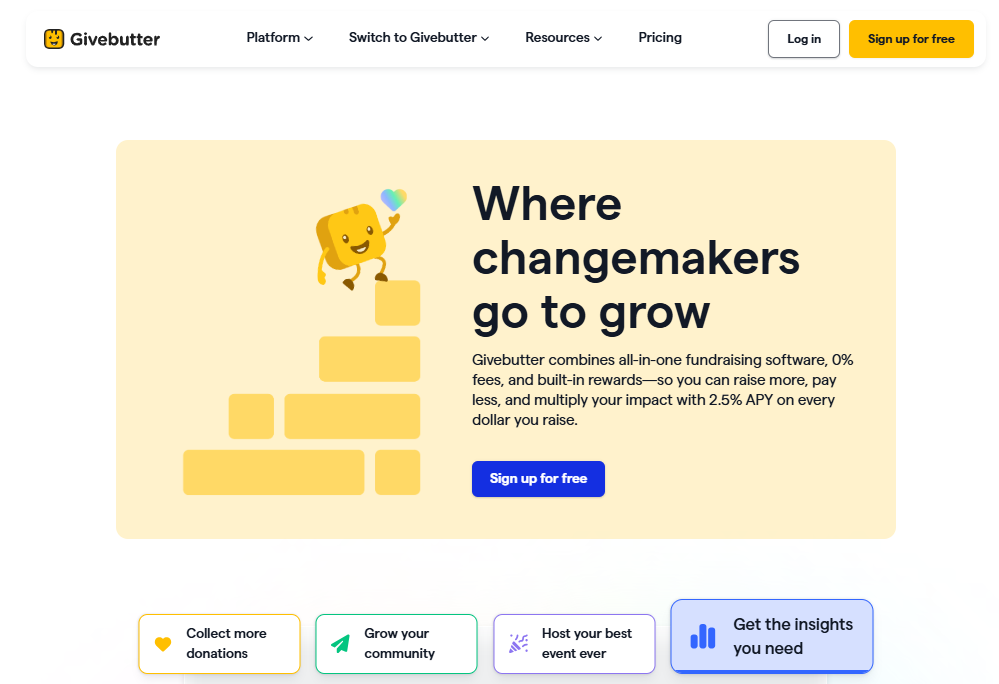
Key Strengths:
What it's not great at:
It is not built for higher education. It lacks alumni portals, directories, or mentorship matching. More importantly, it features no native, two-way advancement CRM integrations (like a direct Raiser’s Edge NXT sync). Because it is designed for simple, single-form events, running complex university milestone schedules like a multi-day Homecoming or Reunion Weekend will quickly outgrow its functional limits.
Givebutter is a great fit for individual campus departments, student organizations, or smaller advancement shops running straightforward, standalone peer-to-peer campaigns and auctions on a tight budget.
Pricing: Core tools are free if donor tips are left on. Disabling tips triggers a flat 3% platform fee (plus standard credit card processing). Upgrading to Givebutter Plus for advanced automations uses contact-based pricing, starting at $29/month for under 250 contacts and scaling upward as your alumni list grows.
Many university advancement teams already rely on Blackbaud Raiser's Edge NXT to manage donor relationships and fundraising. It's excellent at tracking constituent history, gifts, and engagement over time, but it isn't designed to run events on its own.
Things like event registration, attendee management, and on-site check-ins require a dedicated event platform. If you want that event data to flow into RE NXT without manual imports, you'll need a platform with a purpose-built integration, such as Almabase's TrueSync or Cvent's connector. For institutions already invested in the Blackbaud ecosystem, it's often the easiest way to modernise event management while keeping the same CRM at the centre of operations.
Ellucian is designed for institutions that want advancement data closely connected to the rest of the university ecosystem, from student records to finance and ERP systems. It serves as a powerful back-end system for managing constituent and fundraising data, but it isn't built to power the day-to-day event experience.
Features like branded registration pages, flexible event forms, and on-site check-in usually require a separate event platform. As a result, many advancement teams use Ellucian alongside a dedicated events solution that handles the public-facing side of registrations while keeping the underlying data connected.
Salesforce is flexible and works well as the central CRM for institutions with complex data needs. Institutions piece it together using offerings like Salesforce Education Cloud and Salesforce Nonprofit Cloud, depending on whether the priority is student lifecycle data or donor and fundraising management.
But when it comes to running events, its native capabilities are fairly limited. Most teams rely on dedicated event platforms like Almabase or Cvent to handle registrations, event websites, and attendee management. Those integrations then feed event data back into Salesforce, allowing institutions to keep the CRM as their single source of truth without asking it to do everything on its own.
Whichever CRM you use to hold your donor data, the event layer you place on top of it is what determines how much overhead your team can expect in terms of data reconciliation.
At the end of the day, it is up to you and your team’s unique needs that will determine your platform of choice for 2026 and beyond. But we hope we’ve been able to give you a good starting point to find the right fit for you.
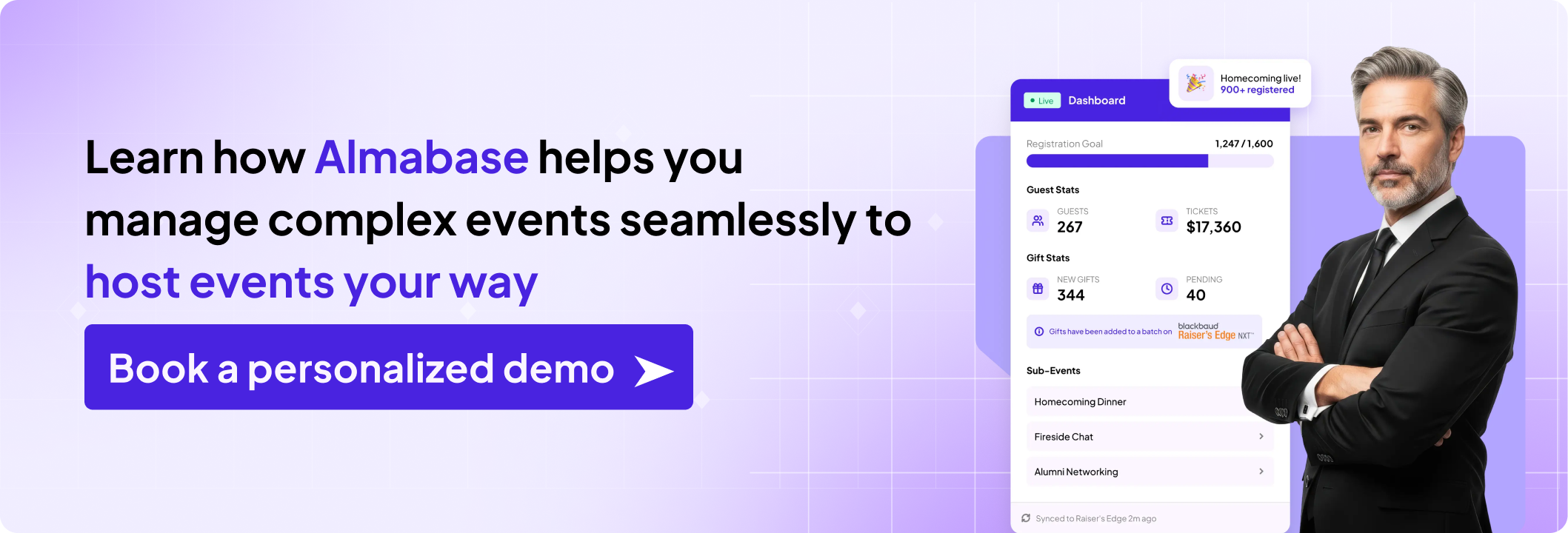
If you’d like to learn more about Almabase and how we help institutions and organizations for advancement needs, feel free to book a personalized demo call with us below! ⬇️
Almabase provides dedicated personnel for your onboarding and training as you or your team gets used to Almabase. We also provide readily available live chat, email, and on-call support in case you run into any hiccups.
Almabase also supports K-12 schools and healthcare foundations managing donor and alumni communities.
Almabase comes with its own set of reporting and analytics tools for giving, engagement, and donor pipeline data.
Yes. Almabase supports multi-day and multi-session events natively, including separate registration and check-in for each session under one parent event, so reunions, homecoming weekends, and multi-track galas don't require a spreadsheet workaround or a second tool.

Best iModules Alternatives for Events-Forward Advancement Teams (2026)
Lorem ipsum dolor sit amet, consectetur adipiscing elit. Suspendisse varius enim in eros elementum tristique. Duis cursus, mi quis viverra ornare, eros dolor interdum nulla, ut commodo diam libero vitae erat. Aenean faucibus nibh et justo cursus id rutrum lorem imperdiet. Nunc ut sem vitae risus tristique posuere.
Almabase
November 21, 2025
12 minutes
Every thriving community begins with participation. For schools, higher ed institutions, and nonprofits, that might look like an alum mentoring a student, a parent joining a virtual town hall, or donors rallying behind a cause. Small contributions like these build on each other, shaping the volunteerism, advocacy, and momentum that sustain your mission.
When you have a community that spans multiple time zones and busy schedules, the real challenge is to design experiences that truly feel inclusive. Getting people involved can feel like an uphill battle, but it doesn’t have to. A few thoughtful adjustments to your approach can unlock more consistent and meaningful engagement.
With that in mind, we’ve compiled over 20+ ideas to simplify and enhance engagement in 2026. These are practical ways to boost participation, turn involvement into long-term support, and keep the energy in your community moving.
Looking for a roadmap tailored to your needs? Discover how Almabase helps communities run events, engagement, and giving on one platform.
An online community that has consistent and meaningful interaction can unlock advantages that traditional channels often can’t for advancement teams. These interactions leave behind clear signals of interest, making it easier to understand alumni priorities and build stronger connections. They also remove barriers of distance and time, creating opportunities to involve graduates who might otherwise remain out of reach.
Here are 25 ideas, each to transform your online community into an essential resource for your alumni-
Your alumni community becomes stronger when it helps members grow in their careers. By positioning your network as a space for guidance, connections, and learning, you create lasting value.
Offer flexible formats that connect alumni at different stages of their careers. Structured programs can match mentors and mentees through data-driven pairings, while flash mentoring events provide quick, focused conversations without long-term commitment. Together, they make it easy for alumni to give and receive guidance in ways that fit their schedules.
Create spaces where alumni learn directly from one another. Small roundtables can dive into industry trends, while themed panels highlight career pivots and personal journeys. Both formats give members access to insider knowledge and relatable stories, making the community a go-to place for real-world insights.
Build a digital library that alumni can access anytime. This could include resume guides, salary negotiation tips, or recorded lectures from faculty and industry experts. Keeping this content exclusive adds clear, practical value to being part of your network.
Host short, focused workshops led by alumni or faculty on topics like leadership, data storytelling, or personal branding. These sessions offer hands-on learning and help members pick up new tools they can apply right away.
Centralize job and internship postings within your platform. Alumni can share openings from their organizations, giving others a direct path to opportunities while reinforcing the idea that the network actively supports their professional growth.
Some of the strongest connections happen when alumni drive momentum themselves. Your role is to create the space and tools for those peer-to-peer bonds to thrive.
Create a searchable hub where alumni can list and discover businesses owned by fellow graduates. Beyond visibility, it encourages alumni to support each other’s ventures, fostering a “buy alumni” culture. Featuring rotating spotlights like a “Business of the Month” which adds recognition and keeps the directory lively.
Empower passionate alumni to take on leadership roles. Ambassadors can organize meetups in their city, welcome new graduates, or rally volunteers for campaigns. Equip them with a toolkit of templates, brand resources, and event ideas so they feel supported while extending your reach.
Instead of every appeal coming from the institution, let alumni take the lead. With personal fundraising pages, they can champion causes that matter to them. Whether that’s a scholarship fund or a student club initiative. This grassroots approach creates deeper ownership and often draws in gifts from networks you might never reach directly.
Offer short-term opportunities for alumni to collaborate. For example, a three-month committee to plan a cultural showcase, designing a mentorship toolkit, curating alumni stories, mentoring a student for an hour, reviewing portfolios, or providing professional feedback. These projects appeal to busy professionals who can’t commit year-round but are eager to contribute in bursts of time and expertise.
Invite alumni to host informal webinars or live Q&As on topics they’re passionate about, from launching a startup to balancing career and family. These sessions position alumni as thought leaders, while providing practical, real-world learning for the community.
Stories are at the heart of engagement. Sharing authentic experiences and milestones reminds alumni of their shared identity and the impact they continue to make.
Celebrate alumni achievements while highlighting their long-term paths. This could feature recent success stories, career transitions, or reflections from former student leaders and creatives. Combining recognition with narrative, these stories inspire peers, show the value of an education from your institution, and reinforce community pride.
Reconnect alumni with professors through live "Ask Me Anything" events. These sessions provide a casual, engaging way for graduates to ask questions, hear about current research from their favourite faculty and feel connected to the evolving campus life.
Showcase the accomplishments of current students to bridge generations. Highlight scholarship recipients, award-winning teams, or innovative projects. Seeing the tangible results of their support strengthens alumni pride and encourages ongoing involvement.
Offer alumni the chance to run your social media channels for a day. They can share personal stories, career experiences, or campus memories, giving peers an authentic look into their lives and perspectives. This fresh, unfiltered content keeps engagement lively and relatable.
Launch campaigns around themes like “Alumni Making a Difference” or “Campus Then & Now.” Curate photos, videos, and short written reflections to weave a narrative across channels. Themed campaigns provide structure while still allowing many alumni to participate and share their stories.
Creating memorable, accessible experiences keeps alumni connected to each other and the institution. The right events spark engagement, foster nostalgia, and make participation easy across geographies.
Broadcast homecoming, lectures, or student showcases so alumni can join from anywhere. Interactive features like live chat, polls, or Q&A sessions make virtual attendees feel part of the action, not just observers. These events give alumni who can’t travel a chance to celebrate milestones and stay connected to campus life.
Engage alumni through curated groups that meet online regularly around shared hobbies or interests like hiking, photography, cooking, or book discussions. Inviting a graduate to lead sessions or spotlighting alumni contributions adds a personal touch. Over time, these groups create smaller, dedicated communities within your network, encouraging repeat engagement and fostering meaningful conversations around shared passions.
Host friendly, competitive events focused on university history, campus traditions, or milestone decades. Trivia nights encourage alumni to reminisce, spark laughter, and connect across generations. They’re low-pressure, fun events that make it easy for alumni from anywhere in the world to join and interact, often sparking follow-up conversations long after the event ends.
Organize short, informal meetups with specific themes or for select groups (e.g., young alumni in tech, regional chapters, or parents of current students). These casual settings encourage alumni to talk, exchange ideas, and meet new people without committing to a full-scale event. They’re perfect for building local or niche communities while keeping energy high and logistics simple.
Bring together alumni from different decades to share personal stories and lessons learned. These small-group conversations help newer alumni see the long-term impact of their education, while older graduates reconnect with the evolving culture of the institution. Cross-generational exchanges build a sense of legacy and continuity, strengthening bonds across the entire alumni network.
This section focuses on innovative ways to involve alumni that go beyond traditional events or giving, making participation fun, purposeful, and mutually beneficial.
Pair younger alumni with seasoned professionals to share insights on emerging technologies, industry trends, or modern work practices. This two-way exchange benefits both groups: younger alumni gain guidance, while senior alumni stay updated and connected to the latest developments.
Use interactive social media features to spark participation with fun, university-related questions. Polls or quizzes about campus history, student life, or alumni trivia keep the community active and encourage sharing, creating low-effort but high-value engagement.
Make it easy for recent graduates to join the alumni community with a simple, compelling online form. Feature it on your website and in welcome emails, giving newcomers a clear first step to participate in programs, discussions, and events tailored to their interests.
Turn updating alumni contact information into a friendly competition. Offer a prize for the class or affinity group that verifies the most profiles. This gamified approach keeps data accurate while making the process engaging and rewarding.
Organize short, themed challenges that alumni can participate in over a day or week like submitting a campus memory, sharing a professional tip, or posting a photo from their graduation year. These bite-sized activities drive engagement, create shareable content, and make alumni feel involved.
Creating lasting connections goes beyond hosting events or sending newsletters. Here’s what to keep in mind to make every initiative count:
A comprehensive and customizable alumni and donor engagement platform like Almabase makes it simple to put these strategies into motion. From branded directories and seamless onboarding to virtual events and mentoring programs, everything lives in one place. Built-in analytics show in real time which initiatives are driving participation, connections, and impact, so you know where to double down.
For community managers and advancement teams, the day-to-day tasks like messaging members, segmenting groups, or surfacing the right opportunities take just a few clicks. With our Re: NXT integration, all engagement data flows directly into your advancement CRM, so nothing gets lost between platforms. Features like Next-Gen Directories, Event Management, and Affinity Groups go beyond the basics, making it effortless for alumni to connect, RSVP, and engage on their own terms. With an all-in-one platform powering your strategy, advancement teams can focus less on logistics and more on creating meaningful engagement.
Hopefully, this blog gave you a chance to step back and appreciate one of the cornerstones of advancement and alumni relations. Even the most experienced teams benefit from revisiting why these events exist in the first place; it’s a chance to approach your next one with fresh ideas and renewed perspective. Because when done well, they remind graduates why they belong, spark pride in your institution, and create new ways for alumni to support one another.
If you’re looking for a partner to help plan your next alumni event and make it a success, we’d love to chat. Whether it’s brainstorming, planning, or running the event, you can start a conversation or request a personalized demo, and we’ll help you bring your vision to life.

20+ Online Community Engagement Ideas for 2026
Lorem ipsum dolor sit amet, consectetur adipiscing elit. Suspendisse varius enim in eros elementum tristique. Duis cursus, mi quis viverra ornare, eros dolor interdum nulla, ut commodo diam libero vitae erat. Aenean faucibus nibh et justo cursus id rutrum lorem imperdiet. Nunc ut sem vitae risus tristique posuere.

Sharada Koti
September 30, 2025
12 minutes
%201.svg)
%201.svg)
%204.svg)



.svg)