Even after they graduate, your alumni play a major role in your school’s success. Here’s how to engage them and get donations with your alumni webpage.

As an alumni outreach specialist, it’s up to you to meet your alumni where they are—online. Your school likely already has a website where its entire community, from prospective students to faculty, can come together to learn more about the school's offerings and important updates. All of your stakeholders (prospective students, current students, family, faculty, and alumni) visit the website to learn more about the school and see its updates.
Do you want the same success for your alumni website? Your answer is likely, “Of course!”
However, it’s certainly possible that your alumni site doesn’t get as much traction from your target demographic as you need to sustain growth. However, maintaining a wealth of online resources and tools for your alumni association is important to keep them interested in their alma mater and, eventually, give back to it.

Here are some tips to spruce up your alumni website and infuse school spirit into your alumni culture.
Web design is perhaps the most important contributor to engaging visitors with your site. Conversion rates suffer with longer load times and confusing web design elements. Luckily, there are many ways for your nonprofit to improve usability and offer a user-friendly website experience.
If you’re creating your alumni website for the first time, make sure you use a nonprofit website builder. These platforms remove the guesswork and streamline the website design process.
From there, optimize your alumni website with intuitive navigation, fast load times, and accessibility for people of all abilities. This will ensure that when alumni arrive on your website, they’ll be inclined to stay and explore your educational resources, sign up for an event, or complete another desired action.
When your alumni visit your website, they need to find something meaningful, relevant, and valuable to them, not just information about your alumni association or annual fund. In fact, strong alumni networks are a major reason why students choose to attend your school in the first place. The best way to strengthen your alumni network is to create an online community for them to find and connect with each other. Alumni can use this network to access information about:
You can also use your website as a trove of resources for your alumni. For example, you can include content such as member directories, blogs, and calendars to keep your alumni in the loop about everything your organization is doing. These resources will attract alumni from around the world to your website and keep them involved with your school.
According to Cornershop Creative, there are numerous search engine optimization (SEO) practices you can use to make your alumni website more visible on search engines like Google. Industry-standard best practices have to be understood and included in your alumni website’s content. Research ways you can optimize your SEO strategy to get in front of your target audience. Here are some tips to get you started:
Incorporating these elements into your website will increase the likelihood of your page ranking higher on the results page, leading to more organic traffic to your site and engagement from your alumni audience.
There’s no question that mobile browsing is the new normal for surfing the web. Your alumni website should accommodate this huge traffic source by making your website mobile-friendly. Here are some suggestions for doing so:
Optimizing your website for mobile browsing is well worth the time and effort! Young alumni in particular comprise a huge portion of mobile browsers, so this is a great way to engage them.
Once alumni click on your site, you should provide them with reasons to revisit it again and again. While part of this is including worthwhile resources like the ones listed above, you can also encourage revisits with low-commitment subscription tools, like an email newsletter sign-up. This way, even your most passive alumni can get involved at their convenience.
You can also leverage your social media presence to get your members to return to your site. By integrating your website content into your social media posts and bios, you’ll encourage alumni not only to follow you there but also to click through and explore your site. Plus, they can see new fellow alumni interacting with your social content, thus opening up more opportunities for connection within your network.
The pandemic has ushered in a new era of digital opportunity. Your website can become a hotspot for alumni involvement and appreciation through virtual or hybrid events. So, you should clear some space on your calendar for new events popularized through the uptick in virtual offerings:

Virtual and hybrid events have numerous benefits. Not only will these events promote participation and increase member retention due to their flexibility, but it’s also a great way to increase organic traffic, which will help your site’s performance on Google.
Your alumni all have something in common: their connection to your school. As an alumni outreach specialist, it’s your responsibility to leverage this commonality, bringing them together and making their experience as beneficial as possible.
Work with your team to analyze ways you can improve your current website and implement these tips to see growth in your alumni involvement. Good luck!
Table of Contents
Subscribe
See how modern advancement teams bring alumni engagement and fundraising together.
Having observed over a hundred schools successfully bring attention to their alumni events and reunions via social media, we have sufficient evidence that it is one of the most powerful mediums to promote your alumni reunion successfully. A little creativity and event marketing can go a long way in making sure that the maximum amount of alumni notice and engage with your upcoming reunions.
With that being said, here are 7 tested approaches to promote alumni reunions on social media:
Sharing photos and videos of previous years reunions on your social media page is one of the best ways to attract attention to your alumni reunion event. While alumni may love hearing about wonderful stories about your previous reunions, these stories become all the more engaging when they hear it from their friends or peers. Encouraging alumni to share their own experiences from previous years reunions, has proven to be highly rewarding for reunion success.
If a large amount of your alumni base is still in touch with your faculty or staff, asking faculty members to share updates about upcoming reunions or their experiences at past year reunions is a best practice you should follow.
Another way to encourage alumni engagement and participation is by creating opportunities for alumni to take some action on your post. Here’s an example: create a simple graphic post with the tagline - “Just three days to go!! Tag 3 people you are looking forward to meeting at the reunion.”
Here’s how William Peace University drew the attention of its alumni and got them talking about their upcoming reunion.

It's generally a good idea to see which alumni event ideas are gaining traction. Take for example the widely popular 10-Year Challenge on Facebook where you can request alumni to simply post two photos, side-by-side, taken at least ten years apart. Alternatively, you can use photos from yearbooks and current profiles of alumni to create ‘10-year challenge’ posts. However, in the case of this approach, consent needs to be established before using an alum’s personal photos.
Instead of promoting your alumni event the traditional way, capture the attention of your alumni by constantly staying in their social media feed and reminding them of the wonderful memories they’ve had over their time spent at their school. Here’s how McCarthy Alumni Association gets this right.

Create a campaign asking alumni to respond to “What's something you loved about your Class of 10 Yr Reunion?”. Share the positive feedback you receive from the campaign and from past year reunions on your social media pages, tagging those alumni who’ve provided feedback, thus ensuring a wider reach for your campaign.
Pick images of 3-5 alumni, combine them to create a collage with question marks on top of each image, and then post it as a challenge for alumni to guess the names of the people mentioned in the post. To make it more interesting, provide hints. For example, if one of the names to be guessed is "Sarah", you can drop the letters ‘S’, ‘R’, and ‘H’ as a clue. Such campaigns not only get you visibility but also encourage your alumni to take action by responding to the challenge you’ve thrown at them.
To effectively promote alumni reunions, institutions today have a good variety of social media platforms, each offering distinct advantages for outreach and engagement.
When it comes to promoting your alumni reunions, there’s no limit to all that you can do. Here’s a list of techniques for increasing alumni participation to your reunions that have brought success to over a hundred institutions.

7 Tested Ideas To Promote Alumni Reunions On Social Media
Discover 7 proven strategies to boost engagement and attendance at your alumni reunions using social media. Learn how to create buzz, use countdown timers, etc.
Lorem ipsum dolor sit amet, consectetur adipiscing elit. Suspendisse varius enim in eros elementum tristique. Duis cursus, mi quis viverra ornare, eros dolor interdum nulla, ut commodo diam libero vitae erat. Aenean faucibus nibh et justo cursus id rutrum lorem imperdiet. Nunc ut sem vitae risus tristique posuere.
Having an updated alumni database is a massive asset to any alumni program. Unfortunately, very few schools actually have a database that is seamless and functional enough. While we all understand the herculean task of tracking thousands of our graduates across the decades, we cannot ignore how pivotal a role it plays in our alumni engagement strategies.
Having observed hundreds of institutions around the globe take up various approaches with respect to updating their alumni databases, we’ve compiled for you the best techniques that are typically employed by schools and their relative benefits.

Address Finder Services look up publicly available information on individuals and matches them against your database. Typically these services are charged on a success fee model - so if they help you find new data then you pay for it, otherwise, you don’t. Some of these services are integrated into your database, and some are independent. A few popular service providers are — LexisNexis, AlumniFinder, and Raiser’s Edge Address Finder.
1. Affordable for low-volume data appends: For organizations that work with low volumes of data, Address Finder Services can be affordable but the costs are high if you have a large alumni base.
Quick results: Address Finder Services eliminate the need to manually collect data, thereby saving time and resources.
1. No user consent: Since you are not asking your alumni for this information, they are not giving you explicit consent to use their information to communicate with them. The recommended practice here is to get consent from your alumni once you get new contact information, but this is a separate effort you’ll have to take up.
2. Incomplete Data: Since these services compile data based on publicly available information, more often than not, you may find yourself dealing with incomplete information as it is likely for people to limit their personal data online.
3. Inaccurate Data: As these services extract data from various public sources, you might often come across outdated alumni data. While some of the data may be accurate, it is highly likely that all of it isn’t.
4. No ongoing updates: In order to keep your alumni database updated, you will have to run this service regularly.
This is an easy option and almost every school includes a form on their website requesting alumni to update their information using that form. Within the alumni page of your website, this is a key section. However, the challenge that every school reports is that very few alumni actually fill it. Think about it — what is the motivation for alumni to go to your website regularly and fill out a long form to update their information?
1. Data accuracy: Since your alumni are providing this information voluntarily, it would be accurate at least for then.
2. Easy to setup: Setting up a form on your website that captures information from your website visitors or in this case - alumni, doesn’t take much time or effort.
3. User consent: Unlike address finder services, forms collect information from only those who are willing to provide their information, thereby establishing user consent.
1. Low volume: Without an incentive in place, very few alumni actually fill out the form.
2. Manual efforts: While setting up a form may be easy, the challenge lies in entering the data collected by these forms into your database.
3. No ongoing updates: Most updates are not captured on time. For example: if an alum finds a new job and moves from Boston to San Francisco, how likely are they to immediately update you via the form?
LinkedIn is a great source of information, some schools turn to the social media platform to capture relevant alumni information. LinkedIn has an alumni tool that you can use to find your alumni who have indicated an education at your school on their profile. You can either have a staff member use their personal LinkedIn account and browse through alumni or create a separate account using your school’s name only for this purpose. The major problem here is that beyond a point LinkedIn will detect that you are browsing through too many profiles and will block you.
1. Data Accuracy: LinkedIn being a professional networking platform, alumni are much more likely to keep their profiles updated here.
2. Beneficial for smaller institutions: For smaller organizations, with a smaller alumni base, capturing alumni data via LinkedIn is feasible.
1. Limitations by LinkedIn: Since LinkedIn only allows a fixed number of searches, upon exceeding that limit, you will be either blocked or asked to shift to a paid account.
2. No user consent: Similar to address finder services, the data collection process is discrete and user consent is not involved.
3. Expensive & time-consuming: You would need to appoint designated people to solely do this job which can make this process rather time-consuming and expensive.
4. High risk of error: Where there’s manual extraction of data involved, there is always a high risk of error.
Events are wonderful opportunities to re-engage alumni and offer a chance to gather relevant information from event attendees. The data collected from these event registrations is highly accurate since it’s provided by your own alumni who are actively engaging with you.
1. Data accuracy : Since the source of this information is your alumni, there’s no doubting its credibility.
2. User consent : Since the information collected via events is provided by your own alumni, user consent is established.
1. Low volume : If your institution doesn’t see a lot of alumni participation at events, you might not be able to capture enough information to update your alumni database.
2. Manual effort : While alumni information collected from events can be highly useful, this information needs to be manually entered into your database, thereby increasing the risk of errors and time taken.

4 ways to update your alumni database
Looking to update your school's, college's or university's alumni database? Find the top 5 ways to update your alumni database and engage with more alumni.
Lorem ipsum dolor sit amet, consectetur adipiscing elit. Suspendisse varius enim in eros elementum tristique. Duis cursus, mi quis viverra ornare, eros dolor interdum nulla, ut commodo diam libero vitae erat. Aenean faucibus nibh et justo cursus id rutrum lorem imperdiet. Nunc ut sem vitae risus tristique posuere.

August 26, 2019
12 minutes
Cultivating a strong alumni community is important for universities. Graduates tend to think fondly of their alma mater, and having a dedicated alumni section on your website offers an opportunity to stay connected with university activities. Your alumni website is also a great resource for connecting with potential alumni donors and showing appreciation for their ongoing support.
Nowadays, most alumni outreach takes place over online platforms. Your alumni network likely spans across the country and even worldwide, and the internet is one place where everyone can easily stay connected with your institution.
Plus, 93% of online experiences begin with using a search engine. That’s why your university’s website must be optimized for search engine performance as well as engaging alumni digitally. In this guide, we’ll review top tips for engaging your alumni using your website:
.avif)
Most top college websites include a link to their alumni website in the top navigation bar. This means it’s important to optimize your alumni information on your overall website and on the alumni website itself. Keep this in mind as we explore each tip. Let’s dive in!
You probably have a wide range of alumni who interact with your university, and you should take the opportunity to determine who they are and what they want out of your website. Remember that many alumni are potential donors, so learning more about them is crucial.
Review these metrics in your Google Analytics to learn more about your website visitors:
By examining your Google Analytics, you can learn more about how your university’s website can better serve its visitors by determining the most and least effective elements on it. Ultimately, when you get to know your user audience and alumni visitors better, you can design your site in a way that encourages them to engage with your content.
Streamlined, user-friendly design can go a long way toward inspiring alumni to explore your site. An enhanced user experience (UX) allows them to quickly find the information they need and discover all the opportunities for engaging with your institution. Plus, streamlined UX helps your website perform better in search engine result rankings.
Here are some tried-and-tested UX design tips for your website:
Your alumni website doesn’t need complex design elements or flashy graphics to be effective. A minimalistic design with a focus on accessibility will allow alumni to navigate your website easily and connect with your programs and opportunities faster. These updates are easy to make when your university is using a top content management system like Drupal or Wordpress. Both CMS platforms offer features like accessibility tips and a mobile editor to ensure an optimized user experience.
By implementing strategic calls-to-action (CTAs), you can help alumni easily find the information they’re looking for on your website. CTAs are typically buttons or menu links on your site that direct visitors to different pages. You can use CTAs to direct users to donate, register for mentorship opportunities, read recent news articles, or sign up for your newsletter.
Your CTAs should:
Here are some websites with examples of effective alumni engagement CTAs:
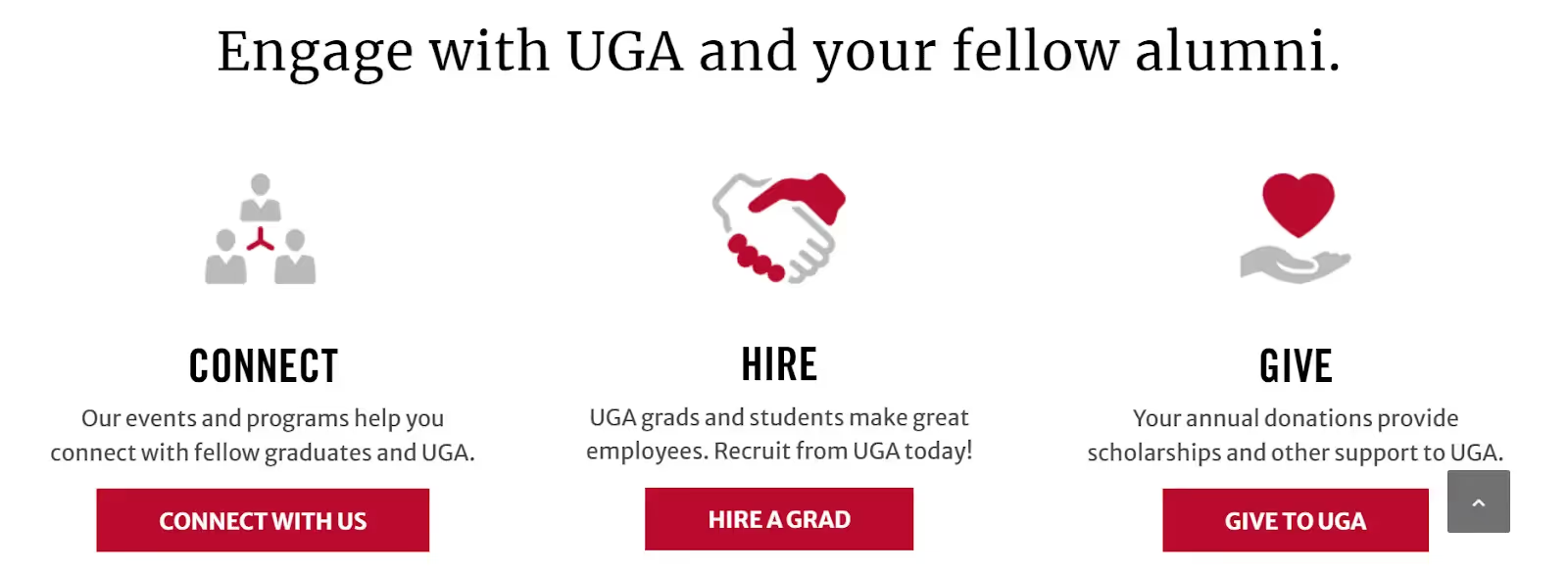
The University of Georgia’s alumni website includes multiple CTA buttons that pop against the background and include clear instructions for different actions that visitors may want to explore.
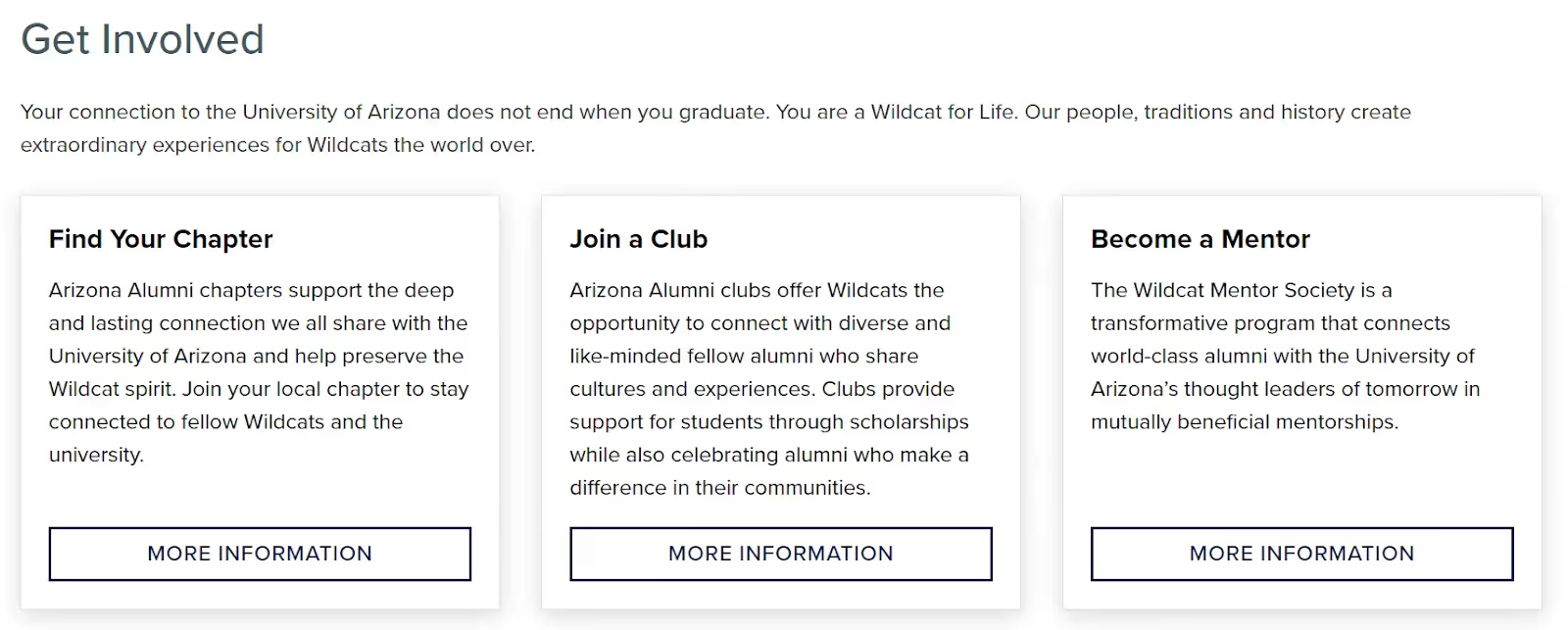
The University of Arizona’s alumni website features multiple CTAs under the “Get Involved” section that point alumni to different groups they might be interested in joining.
Georgetown University’s alumni website incorporates quick link CTAs near the top of the page, making it easier for visitors to navigate to what they’re looking for.

For more inspiration, take a look at Kanopi’s list of best college websites to see how other institutions incorporate unique, engaging CTA design and language.
Clear CTAs make it easy for visitors to figure out how to engage with your institution. Whether you want to recruit alumni to help plan a fundraiser or volunteer for your mentorship programs, making sure that alumni have an easy time navigating your site encourages their continued involvement.
Ultimately, to make your website as engaging as possible for alumni, you must put their interests at the heart of your content. Consider embracing the concept of alumni centricity— the process of building relationships with alumni that aren’t just based on loyalty to their alma mater, but also on the value that your program brings to their lives.
You can build even longer-lasting relationships by orienting your website content around the value that alumni involvement in your opportunities and programs will bring to the lives of former students. Here are a few benefits you can offer:
By striking a balance between donation requests and offering other opportunities such as mentorship programs, homecoming events, and networking opportunities, you can provide just as much value to your alumni as they provide to your university.
As you adjust your website content to appeal to alumni, be sure to continuously assess your data to determine what’s working and what needs improvement. This allows you to keep up with the evolving needs of your alumni base and avoid having to conduct major website overhauls. When your website is optimized, promote it through email newsletters and social media updates to drive more traffic. This allows you to engage alumni effectively, even if they’re located across the country or globe.

4 Tips to Use Your University Website to Engage Alumni
Your university website is a powerful tool to stay in touch with alumni. Incorporate these four tips to build long-lasting alumni relationships online
Lorem ipsum dolor sit amet, consectetur adipiscing elit. Suspendisse varius enim in eros elementum tristique. Duis cursus, mi quis viverra ornare, eros dolor interdum nulla, ut commodo diam libero vitae erat. Aenean faucibus nibh et justo cursus id rutrum lorem imperdiet. Nunc ut sem vitae risus tristique posuere.

.svg)

.avif)
.webp)