Whether you are just starting out or looking to change your approach, let’s help you make your decision between a single modular tool or a set of handy tools.

Whether you are just starting to modernize your alumni program or are looking to change your approach, a persistent (but healthy) question to have in your strategizing process is what to choose between a single highly integrated and modular platform or a bunch of best-in-class tools that each do a specific function well.
There are a lot of things to consider and the answer will not be the same for every institution. Today, we would like to help you make that decision by going over each approach and letting you know what you need to consider before making a decision.
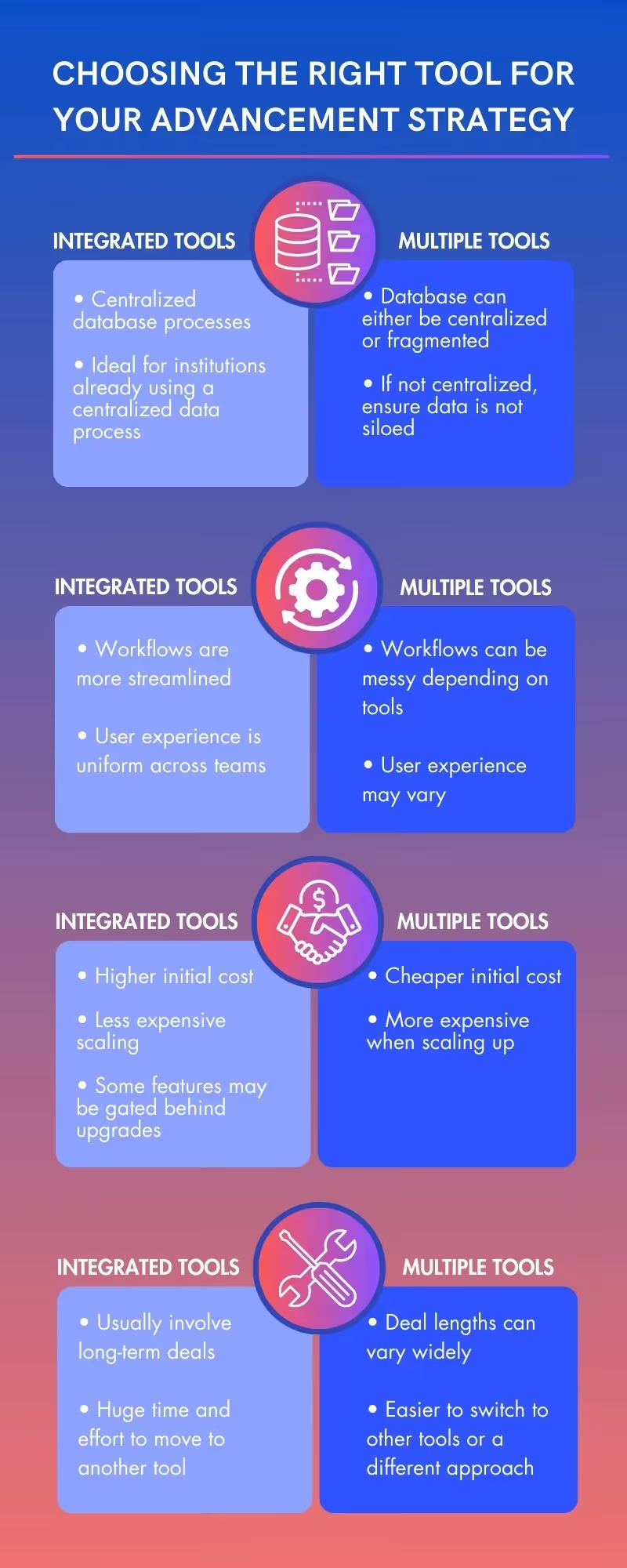
A well-integrated tool is often the choice of many, and for good reason. As an institution, you want to have an efficient but simple data management process, and a single integrated tool for fundraising and alumni engagement works great as it makes it easy to centralize your data management process. This approach naturally leads to more streamlined workflows and similar user experiences across your whole team as you all work on various parts within the same platform.
Depending on how well you use the various features of these tools, they can also be relatively inexpensive to implement. On the flip side, if you are after only a certain feature, that same feature may not be as personalized for you as a specialized tool. Depending on the platform and the features you need, they might also have a steep learning curve. Finally, these integrated tools usually involve a long-term relationship with their customer institutions, where they improve each other over time. Depending on your need, this can be just what you need or a dealbreaker, as it is slightly more difficult to switch to another tool after having everything set up.
On the other hand, many institutions also opt to utilize multiple tools that each serve a specialized feature. This provides them the opportunity to choose the best tool for each needed feature. It allows them to flexibly scale their selections depending on their budget or team size. It’s also a more comfortable option for institutions that are just starting out and don’t have the expertise or experience to work with an all-encompassing tool just yet.
However, this approach can be expensive if you need a lot of features and have a lot of alumni. It also requires staff to manage multiple systems and integrations from different sources, which may all have unique quirks. Data management needs to be closely monitored, as data inconsistency between any of the employed tools is a real possibility. If you choose to go with multiple tools, it is crucial to eliminate data silos. If you do choose to use multiple tools, it’s important that your tools talk to each other and data flows seamlessly.
Now that we’ve had a brief look at the pros and cons of each approach, it’s time to go over some of the things you need to consider so that whichever approach you choose will fit your institution perfectly:
➼ Institution size: For mid-sized sized institutions (5000 annual students and above) that may have a diverse alumni population, an integrated approach would fit their needs better. Meanwhile, institutions that have smaller alumni populations and databases may prefer to start with a small set of specialized tools and see how it aligns with their goals down the line.
➼ Budget: With less administration and vendor management required from the institution, integrated tools can usually be more cost-efficient in the long run. Integrated tools also have the distinct advantage of all their features feeding into a centralized database, which reduces operational costs for both sides. However, some of these integrated platforms may incur upgrade or extra feature fees and be more expensive to move on from. We highly recommend you do your research on these factors and align them with your budget.
➼ Staff volume and expertise: Consider how much staff will be needed for each approach and how much expertise will be needed. An integrated tool will be easier to manage as everyone works on the same tool, and communication channels with vendors are more streamlined. However, if you are a small team with little experience with these tools and are not looking to hire more soon, sticking to one or two specialized tools might be better. Do also consider any platforms your staff members might have experience with or have heard of. Finally, keep your data flows in mind. Even if your staff would prefer multiple specialized tools, check how the data can possibly be centralized between them and if so, how it can be optimized for scale.
➼ Alumni engagement goals: It really should go without saying, but your alumni engagement goals should always be the main factor when deciding which way to go. Consider your past engagement metrics, where you’d like to see improvements, which events and initiatives you are planning to integrate to make that happen, and finally, which approach or tool will be able to not just accomplish that goal but make it scalable in the future.
➼ Data capabilities of the team: Do consider your staff’s capabilities to manage alumni data. If you have a small team but are using a variety of tools, will the team be able to integrate data from multiple sources? In that case, will switching to an integrated tool to streamline your data integration process be better? How is your database set up in the first place, and will it be time-consuming to have it work with the tool you want? If you are choosing to adopt multiple best-in-class tools, will you have issues with data silos? These are just a few questions regarding database management and integration that you should consider.
➼ Scalability: Consider how many staff members, alumni, donors, and donations you may need to manage a few years from now and how you want to scale up to that level. The first step is to consider the tools you are currently using and how scalable they are. Next, consider alternative tools available that match your future goals and whether they can be aligned with your staff, existing programs, and budget to hone down on which tool you want to scale with. Who knows, maybe the tool you already have fits the bill, or you might just find the perfect alternative to take you to the next level!
Hopefully, we’ve given you plenty of food for thought to help you decide your strategy moving forward. We know that these are difficult but crucial questions that are necessary to answer. That’s why we are ending this blog with some actionable questions to consider if you are currently undecided on which approach is better. They are:
Table of Contents
Subscribe
See how modern advancement teams bring alumni engagement and fundraising together.
Blackbaud’s Raiser’s Edge NXT is a popular CRM used by numerous institutions across the country. However, when institutions use RE NXT along with an alumni engagement tool like Almabase, things can get messy when you want data to be uniformly synced across both systems. That’s where our industry-leading integration with Raiser’s Edge NXT comes in.
Because let’s face it - nobody likes working with data first thing every morning when it involves a lot of tedious back-and-forth between multiple systems. We believe this integration is crucial in setting your Advancement team up for success, and this blog post will show you how.
If you're interested in the technical nitty-gritty of the integration, we've got a blog post that you might be interested in.
Here are four ways Almabase’s integration with RE NXT can set your team up for success.
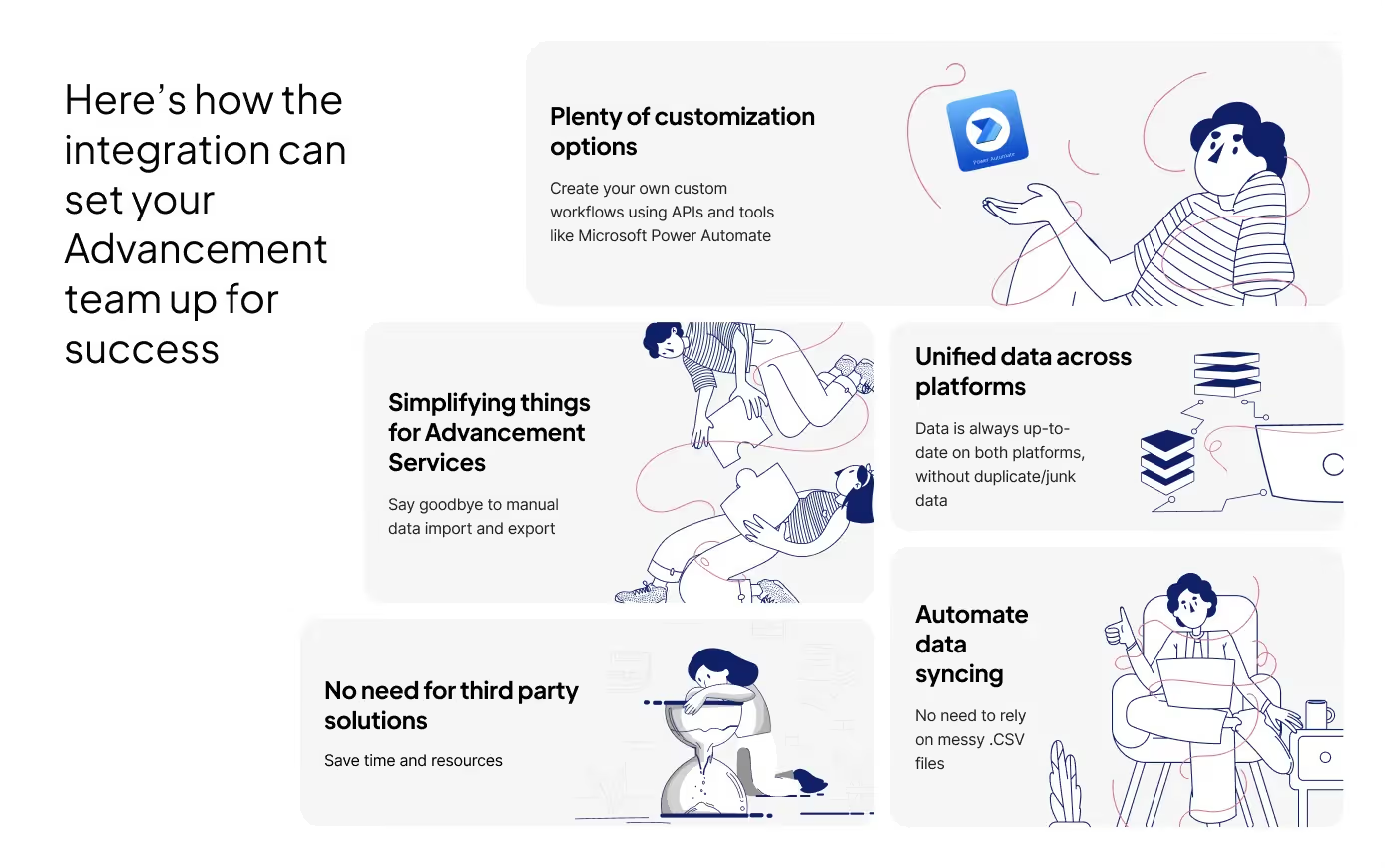
Almabase’s RE NXT integration works from the get-go, and you won’t have to invest additional resources in third-party integrations. While some of these integrations can be super expensive, others that are cost-effective aren’t very reliable. Your team won’t have to rely on multiple tools (one of these being Importacular) to get data flowing between the two systems. Whether you want a simple integration to work right off the bat, or you want something more customizable to be more flexible with your needs, our integration offers it all.
Picture this – you have a thriving alumni community that is creating hundreds and thousands of engagement touchpoints on your platform. Imagine if every event registration or profile update had to be MANUALLY synced with RE NXT by your Advancement Services team.

That would be a dystopia we wouldn’t like to think about. With our integration, you get to choose how and when your data flows between Almabase and RE NXT, with zero human intervention. Furthermore, the data you import will automatically rid itself of duplicate entries and junk data. This smooth integration means your Advancement Services team can say goodbye to messy .CSV imports/exports all day long.
At this point, you might wonder whether it’s worth maintaining data on multiple platforms if each of them were to store different data. Fortunately, this isn’t the case. Almabase’s integration with RE NXT ensures that the data you see on both platforms will always be in sync with each other. This means you won’t have to worry about making sure the data is uniform across the systems. The integration also has provisions in place to ensure there are no duplicates or junk data on either of your systems, which can take a massive load off your IT team’s shoulders.
Besides, Almabase is so much more than an online community for your constituents, or a CRM for your team. With powerful alumni-centric engagement tools, Almabase empowers your team to unlock higher participation and donations. That’s why many institutions prefer to use Almabase in tandem with RE NXT.
When it comes to integrations, we don’t believe in a one-size-fits-all approach. Every institution will have unique guidelines in place to handle data. That’s why our integration allows you to create custom workflows to dictate when, and how, data flows between Almabase and RE NXT. The customization is limitless and can be tweaked to fit your needs. If you’re feeling particularly experimental, you can tinker around with APIs to build your workflow, or you can use Microsoft Power Automate for that tailor-made fit that works best with your processes.
So there you have it – an overview of how Almabase’s best-in-class integration with Raiser’s Edge NXT can set your Advancement team up for success. While we tried to cover the most obvious advantages of the integration for your team, there’s still a lot we couldn’t fit into a blog post.
If you have any specific queries about the integration, or you want to see it in action, you can always get in touch with one of our Alumni Success Specialists. We have a feeling you’re going to like what you see!
.avif)

How Almabase’s integration with Raiser’s Edge NXT can set your Advancement team up for success
From improving the efficiency of your team to optimizing your workflows and processes, find out how the integration can set your team up for success.
Lorem ipsum dolor sit amet, consectetur adipiscing elit. Suspendisse varius enim in eros elementum tristique. Duis cursus, mi quis viverra ornare, eros dolor interdum nulla, ut commodo diam libero vitae erat. Aenean faucibus nibh et justo cursus id rutrum lorem imperdiet. Nunc ut sem vitae risus tristique posuere.
Voluntary Alumni Engagement in Support of Education (VAESE) recently released The Alumni Relations Benchmarking Study, a treasure trove of insightful statistics and findings. Here are some key takeaways from the study:
• While the average number of full-time employees (FTEs) in alumni relations has increased slightly since 2016, many institutions report feeling understaffed.
• Real budgets have decreased when adjusted for inflation, with general budgets effectively decreasing by 16% from 2016 to 2024.
• Staffing constraints are identified as a major roadblock to increasing alumni engagement.
💡 To tackle staffing and budget challenges, consider leveraging automation and strategic volunteer programs to supplement your team. Implementing a robust tool with automation capabilities can streamline routine tasks, freeing up staff for high-impact activities.
• The primary goal for most institutions (65%) is increasing the number of alumni who engage.
• However, the lack of compelling, relevant value for alumni is cited as the biggest roadblock to increasing engagement (22%).
• Post-COVID-19, institutions have focused more on digital communication (73%) and personalized engagement (57%), but only 16% have added new, compelling benefits to attract alumni.
💡 Relevance is key; alumni engage more when they see clear, personal value. Develop unique, personalized benefits and programs that resonate with their current interests.
Use AI and automation tools to segment alumni based on factors like graduation year, field of study, behavior, intent signals, and past involvement to create targeted campaigns.
Tailoring messages based on alumni interests and interactions can make outreach efforts more meaningful and effective.

• There's a significant trend away from dues-paying membership models, with 80% of institutions now using non-dues-paying models in 2024, up from 69% in 2016.
• The number of active dues-paying members has declined dramatically, decreasing 98% since 2016.
💡 Create a non-dues membership model that offers exclusive access to events, content, and networking opportunities.
• Email engagement metrics show challenges, with average open rates at 25.8% and click rates at 12.7%.
• The frequency of gift solicitations to new graduates has decreased from an average of 3.92 in 2016 to 2.90 in 2024.
💡 Let’s face it, we get flooded with hundreds of emails every day. So, how can you make your email stand out?
Segment your email lists and send personalized, relevant messages with crisp, actionable content.
Use compelling subject lines to grab attention, ensure your emails are mobile-friendly, and include clear calls to action. Additionally, track engagement metrics to continuously refine and improve your email strategy.
• 40% of respondents occasionally use AI in their work, while 23% are interested in learning more about it.
• However, there's a notable resistance to AI adoption among some professionals.
💡 AI is no longer a buzzword; it has become an essential part of our work lives. While some may be skeptical, it is an incredibly valuable resource, especially for teams constrained by resources. AI can act as your sidekick for everyday tasks, enhancing efficiency and effectiveness. For instance, you could use it for donor prospecting, personalized communication, predictive analytics, automated reporting, etc.
Need help with prompts? Check this out.
• The highest level of concern among alumni relations professionals is not having enough staff to complete necessary tasks.
• Budget cuts and lack of alumni engagement are also significant stressors.
💡 Alleviate professional stress by prioritizing high-impact activities and leveraging project management software to better organize and delegate tasks.
• There's a critical need for institutions to improve their value proposition to alumni, as many report investing little to nothing in alumni benefits.
• Only 9% of institutions invest significantly in benefits and services to motivate alumni engagement.
💡 Conduct surveys to understand alumni needs and invest in benefits that provide real value, such as career services, mentorship, networking opportunities, exclusive events, and lifelong learning opportunities. Understand which life stage they’re at and build initiatives around it.
Here are 12 alumni-centric ideas to inspire you.
These are some of our handpicked insights from the study. We highly recommend that you check it out for yourself as it provides a huge variety of interesting insights that you can use in your advancement strategizing process.
The Voluntary Alumni Engagement in Support of Education (VAESE) survey is an annual study assessing alumni engagement practices and trends across educational institutions. Conducted by a coalition of alumni relations and advancement professionals, it provides insights on communication, event participation, volunteerism, and giving. VAESE helps institutions enhance alumni outreach and support programs, and their studies are available for free.
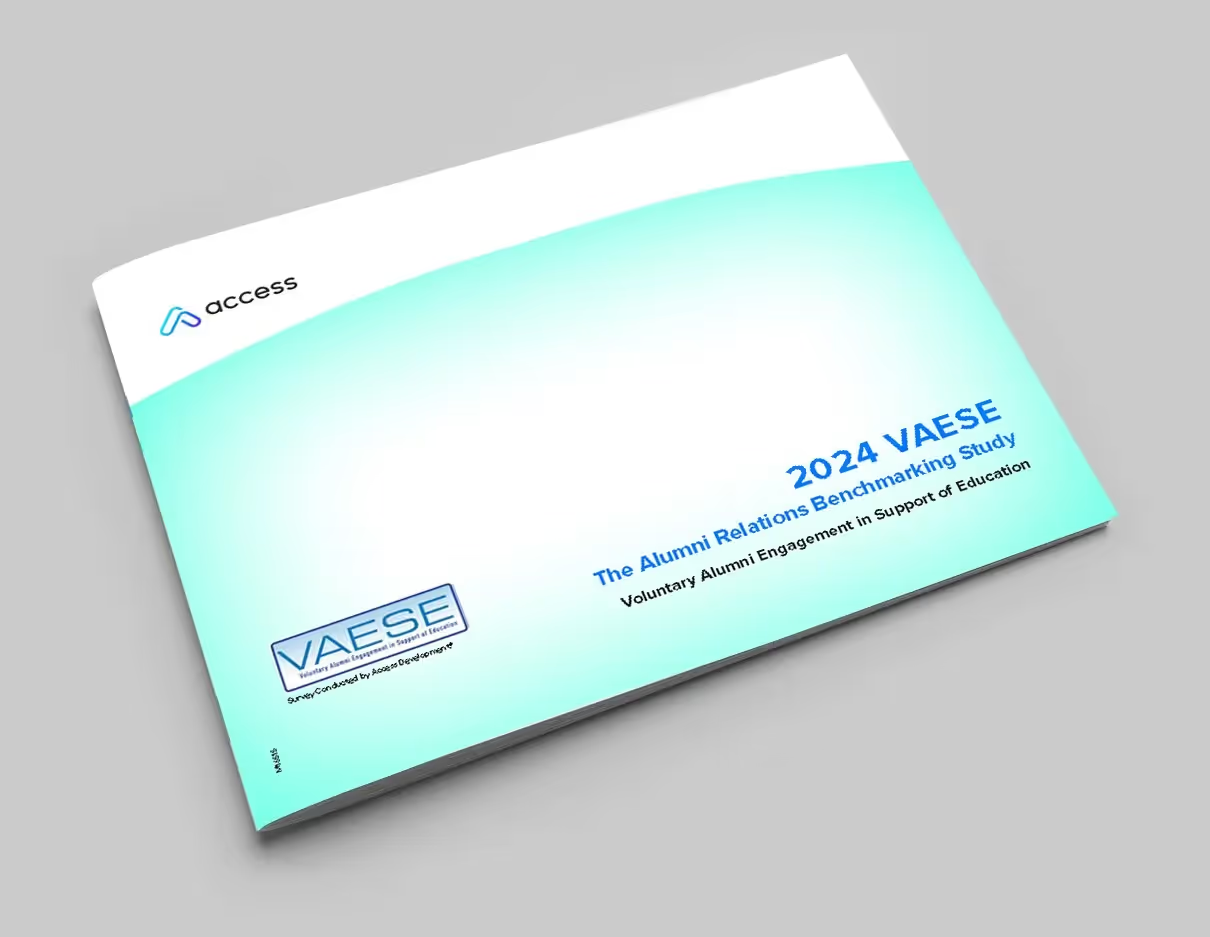
What the Latest VAESE Benchmark Study Means for Your Advancement Strategy
Here are our handpicked takeaways from the recently released 'The Alumni Relations Benchmarking Study' by VAESE for all your Advancement strategy needs.
Lorem ipsum dolor sit amet, consectetur adipiscing elit. Suspendisse varius enim in eros elementum tristique. Duis cursus, mi quis viverra ornare, eros dolor interdum nulla, ut commodo diam libero vitae erat. Aenean faucibus nibh et justo cursus id rutrum lorem imperdiet. Nunc ut sem vitae risus tristique posuere.
K-12 schools and higher ed institutions, public and private alike, rely on smart fundraising strategies to generate the revenue needed to maintain and grow their operations. But planning and carrying out fundraising initiatives without the donor data to inform them can feel like a shot in the dark.
By harnessing the power of data analytics, however, educational institutions can unlock new avenues of support and establish personalized fundraising tactics that resonate with supporters on a deeper level.
In this blog post, we delve into the world of data-driven fundraising and explore what schools of all shapes and sizes need to know.
.jpeg)
A data-informed fundraising approach empowers school fundraisers to build and strengthen donor relationships in a rapidly changing landscape. Today, tailored engagement efforts are seeing particularly high levels of success, with personalized initiatives resonating deeply with organizations’ support networks.
In fact, according to industry research, personalized emails see open rates over 82% higher than generic emails, while segmented campaigns produce up to 760% revenue growth!
Each contact in your CRM is a different person who has their own unique set of behaviors, preferences, and history with your school. For example, Sarah (a recent college grad and devoted alumnus who has recently begun donating to the college's scholarship fund) and John (a retired faculty member who actively participates in campus events and has supported the annual fund campaign for the past twenty years) should not be engaged with in the same way.
Instead, the insights gleaned from personal interactions, surveys and forms, and third-party resources—powered by smart technology—can guide your efforts with individualized engagement recommendations and more.
In this guide, we’ll explore several critical donor data points and how each one can inform your school’s efforts. These include:
The more you know, the better you can tailor your strategy for each person supporting your cause. By establishing donor-centric fundraising practices, you can create a positive giving experience that fosters long-term engagement that goes beyond any single transaction.
Demographic data is some of the most basic information you can collect about a donor. And it’s the foundation of a successfully personalized strategy.
Key demographic points to look out for include a supporter’s name (full name and preferred name or nickname, if applicable), contact information (phone number, email address, social media handles, etc.), address and geographic location, age or D.O.B., and more.
How to get this data point: Ask for these details on your online donation pages. While you’ll want to limit the number of required form fields to the must-haves (typically name and email), the rest can be optional requests. Tons of donors are willing to provide additional information when asked!
Understanding a donor or prospect’s affiliation with your school can be the key to pulling off an effectively tailored strategy. After all, it’s likely one of the primary motivations behind an individual’s giving.
For example, you’d likely take a different approach to alumni engagement than you would for a current student, faculty member, or unrelated donor. Each group has its own unique set of defining characteristics, and acknowledging a supporter’s relationship with your school can establish a more personalized giving experience.
How to get this data point: This is another piece of information you can ask for in your donation form. Consider implementing an optional drop-down field that encourages donors to mark their status as a student, alumnus, family member, friend, faculty/staff, or other.
A donor’s past giving patterns can be one of the largest indicators of future behavior. By tracking how your supporters are involved with your school, you can take key steps to encourage further support. For example, you’ll be able to better understand giving motivations, predict engagement trends, and even uncover major donor opportunities.
Keep in mind that engagement history should go beyond traditional donations—and encompass all instances of giving, volunteering, peer-to-peer fundraising, attending events, matching gifts, and more.
How to get this data point: This information should be quick and easy to locate in your donor database. To ensure you have a thorough understanding of each individual’s engagement with your institution, regularly updating your CRM is a must.
If you send donation appeals using a channel that a donor doesn’t care for, your outreach is more likely to be discarded without consideration. On the other hand, if you use an individual’s favorite means of communication, you can expect a significantly greater response.
Thus, tracking and analyzing donor communication preferences can go a long way—not only in securing more gifts for your school, but also in reducing costs invested in non-responsive channels.
How to get this data point: Take a look at your recent interactions with a donor. Do they tend to be more responsive over email compared to direct mail? Do they favor phone calls or text messages? Your past campaign conversion rates can provide a ton of useful details. Alternatively, consider sending a donor survey that asks respondents to share their preferred communication channels to get straight to the point!
Knowing where your donors work is one of the most impactful data points you can have. Not only does employment data allow your team to uncover existing workplace giving opportunities (i.e., matching gifts, volunteer grants, annual giving stipends, and more) within your support network, but it can also inform your broader corporate partnership strategy, provide wealth insights, and allow for increasingly personalized outreach.
While the employing company is the most important aspect, it also helps to have additional insights such as their job title, rank, and part-time versus full-time status. Many companies even match donations made by their retirees—so don’t count them out, either!
How to get this data point: Employment information is another data point that can be collected directly within the online giving experience. But our #1 recommendation is to integrate your fundraising platform with an innovative matching gift tool—like Double the Donation’s partnership with Almabase!
Leveraging a solution like this empowers your school to collect employment data from donors as they reach the confirmation screen. Plus, it allows you to screen contact information for corporate email addresses and trigger automated post-donation outreach—each of which provides your team with employer insights.
Asking for too much from your donors can lead to extra “no’s,” while asking for too little often leaves available dollars on the table. Thus, having a basic understanding of an individual’s wealth level and capacity to give can help your development team tailor gift requests with optimal donation suggestions that resonate with the prospect.
This information can also help uncover major donation opportunities that already exist in your network—you just might not know it yet!
How to get this data point: Conduct a wealth screening of the donors, prospects, and alumni in your database to identify those with the ability to contribute substantial gifts. Take a look at common wealth markers like stock ownership, real estate holdings, past giving, and previously uncovered employment details to estimate an individual’s capacity to give.
Beyond a donor’s financial giving abilities, another key tenet of prospect research includes looking into the person’s affinity to give. In other words—do they take a natural liking to your cause?
If an individual has an existing relationship with your school (i.e., student, alumnus, faculty member, family, etc.), that connection often does produce an affinity to support your efforts. However, you’d want to note that a chemistry student would likely be more inclined to donate to an expansion of the college’s science wing rather than a scholarship fund for incoming art classes.
How to get this data point: Make a note in your donor database after each meeting with a major donor or prospect. If they mention any particular interests, jot it down to have on record going forward. If an individual is an alumnus of your institution, their major or field of study can provide some insight into their personal and professional interests.
.png)
As the educational fundraising landscape continues to evolve, data-driven fundraising becomes increasingly essential to unlocking untapped potential.
The invaluable insights gleaned from supporter data can empower your institution to make the most of available resources, identify and engage effectively with high-value prospects, and enhance donor retention—from first-time donors to life-long supporters.
Make sure your development team has the tools and the strategies in place to collect, store, and analyze the data available to you. Don’t let that resource go to waste!
Data-Driven Fundraising for K12 and Higher Ed: What to Know
Discover the power of data-driven fundraising for K-12 and higher education institutions. Learn essential tips to boost your fundraising results here.
Lorem ipsum dolor sit amet, consectetur adipiscing elit. Suspendisse varius enim in eros elementum tristique. Duis cursus, mi quis viverra ornare, eros dolor interdum nulla, ut commodo diam libero vitae erat. Aenean faucibus nibh et justo cursus id rutrum lorem imperdiet. Nunc ut sem vitae risus tristique posuere.

October 10, 2023
12 minutes

.svg)

.avif)
.webp)