Compare Raiser’s Edge NXT vs Salesforce to find the best CRM for alumni engagement, fundraising, and advancement team efficiency.

Discover AI Summary
With 88% of US institutions using some type of CRM solution, two choices in particular, Raiser’s Edge NXT (also referred to as RE NXT) and Salesforce, have emerged as the time-tested options for institutions and nonprofits not looking to build a custom CRM system from scratch.
In this blog, we’ll compare RE NXT vs. Salesforce and dissect where they each excel, where they fall behind, and which option you should consider.
With Blackbaud having over 30 years of experience in the field, they have developed an understanding of what goes into making a CRM focused on engaging alumni and raising funds. In 2015, Blackbaud introduced Raiser’s Edge NXT, a modernized, cloud-based version of Raiser’s Edge (also called Raiser’s Edge 7). Built specifically for donor management and fundraising, it has thrived as one of the most popular CRM choices for advancement teams and nonprofits over the years.
Blackbaud maintains both versions at the moment but currently focuses on updating RE NXT to replace the legacy Raiser’s Edge CRM eventually.
💡Advancement teams often extend the power of Raiser’s Edge NXT with Almabase, enabling powerful alumni engagement, streamlined events, and the best two-way sync with RE NXT in the industry — eliminating manual pulls or connectors.
Salesforce itself probably needs no introduction. Being a big player in the global CRM market, it is no surprise that they eventually moved into advancement needs as well. Their Education Cloud and Nonprofit Success Pack (NPSP), in particular, are what advancement teams look to as the other major offering to consider beyond Raiser’s Edge NXT.
Depending on your needs, Salesforce may provide you with simple donor management software or an all-around student and alumni management ecosystem.
Now that you have a general refresher on these two CRM choices, let’s break down the key differences between them.
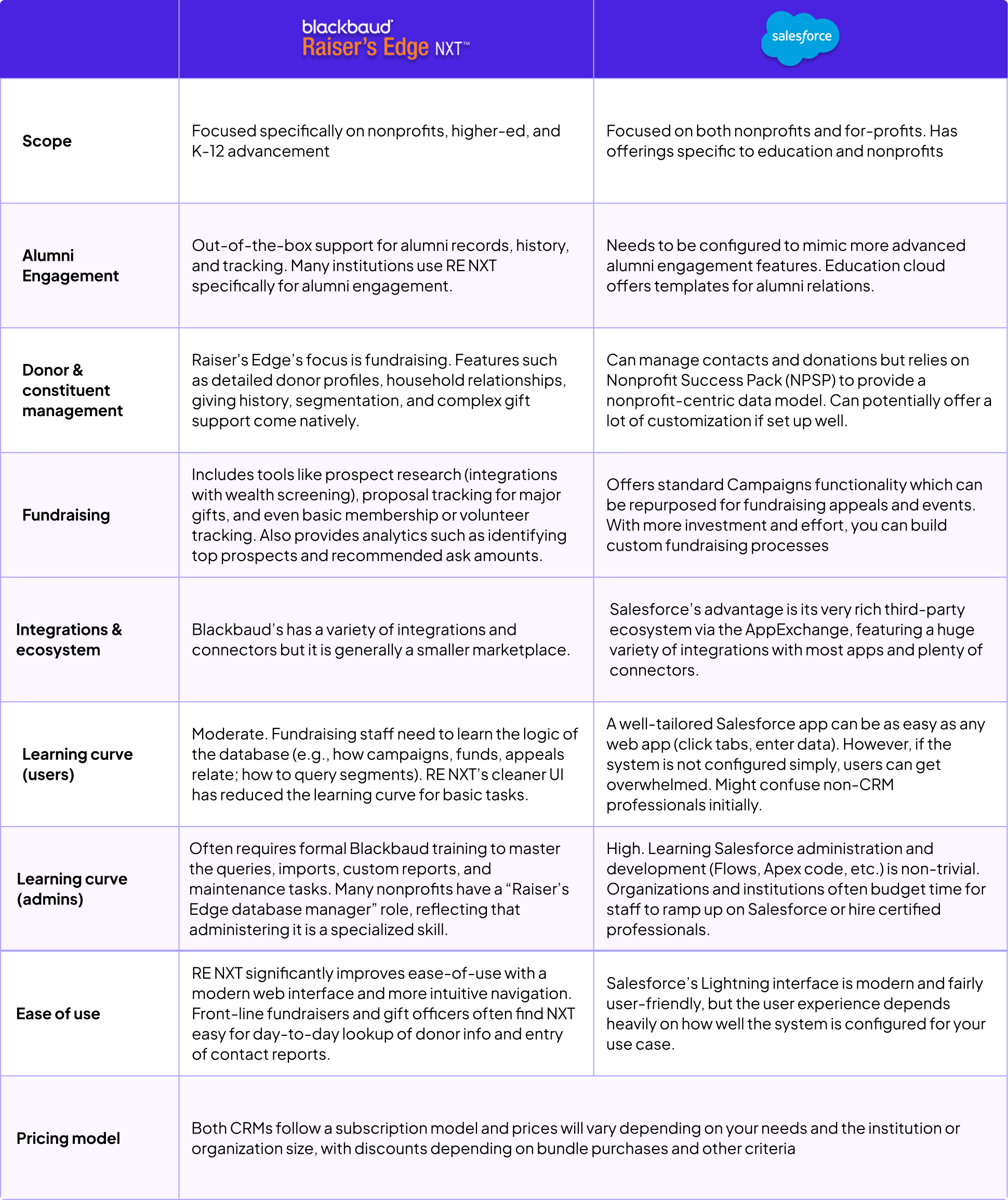
RE NXT is undeniably a strong choice for institutions and nonprofits whose main goal is to manage constituents and raise funds without having to think about too many integrations. Blackbaud’s long-term experience in their specific niche means that teams can have incredibly deep processes and granular data for advancement needs.
On the other hand, Blackbaud’s more focused approach does mean that for-profits and teams looking for deep integrations with a wide variety of multi-industry tools may find Raiser’s Edge lacking in certain areas.
💡See how Almabase’s Raiser’s Edge NXT integration helped The Master’s Seminary automate its process and get 37% of its database updated in 45 days.
→ Learn more
Salesforce’s strengths lie in its ecosystem and the extensive customization it offers. If you have the time and resources to allocate to setting everything up properly and training staff, Salesforce can fulfill your advancement needs and your institution’s other needs, such as admissions, recruitment, student success, etc., pretty well.
On the flipside, Salesforce requires a lot of investment to bring out its true potential as integrations add up, and more people need to be assigned for maintenance.
The two choices essentially boil down to whether you are looking for a CRM specialized for advancement and fundraising or an all-in-one CRM that you can spend some time with to build your preferred CRM environment.
While both options offer great CRM functionality, Raiser’s Edge NXT, in our opinion, slightly edges it out as the go-to for teams focused solely on fundraising, constituent management, and engagement. When paired with a platform like Almabase, institutions unlock a new level of functionality for all their engagement, fundraising, and event management needs.
Regardless of which choice seems better for you at this point, it will require a huge chunk of your time and effort to migrate to any CRM, as well as investment and training to find all the integrations you need and get your staff up to speed with the respective environments.
Table of Contents
Subscribe
See how modern advancement teams bring alumni engagement and fundraising together.
The year 2020 served as a warning that anyone can be the victim of a data breach. More than 120 non-profit organisations learnt that their data was at risk after a breach in Blackbaud's platforms by a ransomware attack. Millions of donors, customers, and staffers were affected, and the incident became the most impacting data breach of 2020.
The ransomware fiasco necessitates reiterating the principal duty of educational institutions to secure the data of their trusting constituents.
Advancement leaders are custodians of data of thousands of alumni and donors, and securing their data must be their highest priority. A lapse in security can have a damaging effect on advancement, as years of relationship-building can be undone by one moment of vulnerability. It is, therefore, the responsibility of institutions to reaffirm their seriousness towards security by adapting secure systems to solidify their constituent's trust in them.

Today, passwords are also a threat to our security. Traditional password authentication is susceptible to threats such as data breaches and phishing. According to a report conducted in 2020, 63% changed their passwords due to a security breach.
In addition to external risks, our heedless habits with managing and sharing passwords increase their risk of exposure.
Our habits with passwords coupled with the looming risk of attacks prove that passwords are no longer a safe way of authentication.
.avif)
At Almabase, we have taken proactive measures to secure the data of its customers and their constituents.
We have integrated with Auth0 to upgrade our login mechanism to become completely password-less. By replacing passwords with single-use codes, this mechanism immunes itself from threats.
This partnership with Auth0 moreover aims to improve the experience of members. Single-use codes will help even the most infrequent users log in without the need to remember their passwords. The platform now also supports SSO (Single-sign-on) via Facebook, Linkedin, and Google, in addition to allowing members to log in using any of the multiple emails listed on their records.
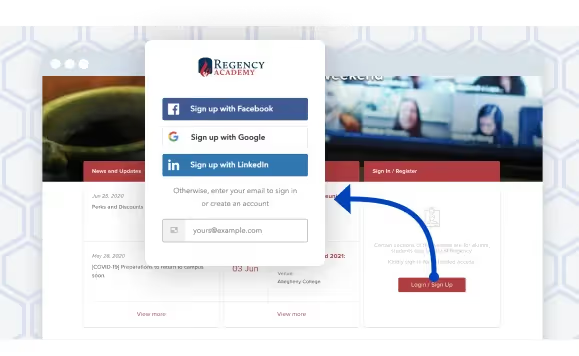
On top of improving the login experience and making it robust, the platform now also supports moderation of access to content and resources to segments of users based on criteria admins set.
With these upgrades, millions of alumni across hundreds of institutions will access their data securely online. We hope that institutions take data security seriously across all their systems, allowing for this relationship to build on greater trust.

How Securing Alumni Data Is Pivotal To Building Trust
We're bringing world-class identity management to your community with the Autho integration. With Autho comes a new login experience and new ways for your community members to log in.
Lorem ipsum dolor sit amet, consectetur adipiscing elit. Suspendisse varius enim in eros elementum tristique. Duis cursus, mi quis viverra ornare, eros dolor interdum nulla, ut commodo diam libero vitae erat. Aenean faucibus nibh et justo cursus id rutrum lorem imperdiet. Nunc ut sem vitae risus tristique posuere.
K-12 schools and higher ed institutions, public and private alike, rely on smart fundraising strategies to generate the revenue needed to maintain and grow their operations. But planning and carrying out fundraising initiatives without the donor data to inform them can feel like a shot in the dark.
By harnessing the power of data analytics, however, educational institutions can unlock new avenues of support and establish personalized fundraising tactics that resonate with supporters on a deeper level.
In this blog post, we delve into the world of data-driven fundraising and explore what schools of all shapes and sizes need to know.
.jpeg)
A data-informed fundraising approach empowers school fundraisers to build and strengthen donor relationships in a rapidly changing landscape. Today, tailored engagement efforts are seeing particularly high levels of success, with personalized initiatives resonating deeply with organizations’ support networks.
In fact, according to industry research, personalized emails see open rates over 82% higher than generic emails, while segmented campaigns produce up to 760% revenue growth!
Each contact in your CRM is a different person who has their own unique set of behaviors, preferences, and history with your school. For example, Sarah (a recent college grad and devoted alumnus who has recently begun donating to the college's scholarship fund) and John (a retired faculty member who actively participates in campus events and has supported the annual fund campaign for the past twenty years) should not be engaged with in the same way.
Instead, the insights gleaned from personal interactions, surveys and forms, and third-party resources—powered by smart technology—can guide your efforts with individualized engagement recommendations and more.
In this guide, we’ll explore several critical donor data points and how each one can inform your school’s efforts. These include:
The more you know, the better you can tailor your strategy for each person supporting your cause. By establishing donor-centric fundraising practices, you can create a positive giving experience that fosters long-term engagement that goes beyond any single transaction.
Demographic data is some of the most basic information you can collect about a donor. And it’s the foundation of a successfully personalized strategy.
Key demographic points to look out for include a supporter’s name (full name and preferred name or nickname, if applicable), contact information (phone number, email address, social media handles, etc.), address and geographic location, age or D.O.B., and more.
How to get this data point: Ask for these details on your online donation pages. While you’ll want to limit the number of required form fields to the must-haves (typically name and email), the rest can be optional requests. Tons of donors are willing to provide additional information when asked!
Understanding a donor or prospect’s affiliation with your school can be the key to pulling off an effectively tailored strategy. After all, it’s likely one of the primary motivations behind an individual’s giving.
For example, you’d likely take a different approach to alumni engagement than you would for a current student, faculty member, or unrelated donor. Each group has its own unique set of defining characteristics, and acknowledging a supporter’s relationship with your school can establish a more personalized giving experience.
How to get this data point: This is another piece of information you can ask for in your donation form. Consider implementing an optional drop-down field that encourages donors to mark their status as a student, alumnus, family member, friend, faculty/staff, or other.
A donor’s past giving patterns can be one of the largest indicators of future behavior. By tracking how your supporters are involved with your school, you can take key steps to encourage further support. For example, you’ll be able to better understand giving motivations, predict engagement trends, and even uncover major donor opportunities.
Keep in mind that engagement history should go beyond traditional donations—and encompass all instances of giving, volunteering, peer-to-peer fundraising, attending events, matching gifts, and more.
How to get this data point: This information should be quick and easy to locate in your donor database. To ensure you have a thorough understanding of each individual’s engagement with your institution, regularly updating your CRM is a must.
If you send donation appeals using a channel that a donor doesn’t care for, your outreach is more likely to be discarded without consideration. On the other hand, if you use an individual’s favorite means of communication, you can expect a significantly greater response.
Thus, tracking and analyzing donor communication preferences can go a long way—not only in securing more gifts for your school, but also in reducing costs invested in non-responsive channels.
How to get this data point: Take a look at your recent interactions with a donor. Do they tend to be more responsive over email compared to direct mail? Do they favor phone calls or text messages? Your past campaign conversion rates can provide a ton of useful details. Alternatively, consider sending a donor survey that asks respondents to share their preferred communication channels to get straight to the point!
Knowing where your donors work is one of the most impactful data points you can have. Not only does employment data allow your team to uncover existing workplace giving opportunities (i.e., matching gifts, volunteer grants, annual giving stipends, and more) within your support network, but it can also inform your broader corporate partnership strategy, provide wealth insights, and allow for increasingly personalized outreach.
While the employing company is the most important aspect, it also helps to have additional insights such as their job title, rank, and part-time versus full-time status. Many companies even match donations made by their retirees—so don’t count them out, either!
How to get this data point: Employment information is another data point that can be collected directly within the online giving experience. But our #1 recommendation is to integrate your fundraising platform with an innovative matching gift tool—like Double the Donation’s partnership with Almabase!
Leveraging a solution like this empowers your school to collect employment data from donors as they reach the confirmation screen. Plus, it allows you to screen contact information for corporate email addresses and trigger automated post-donation outreach—each of which provides your team with employer insights.
Asking for too much from your donors can lead to extra “no’s,” while asking for too little often leaves available dollars on the table. Thus, having a basic understanding of an individual’s wealth level and capacity to give can help your development team tailor gift requests with optimal donation suggestions that resonate with the prospect.
This information can also help uncover major donation opportunities that already exist in your network—you just might not know it yet!
How to get this data point: Conduct a wealth screening of the donors, prospects, and alumni in your database to identify those with the ability to contribute substantial gifts. Take a look at common wealth markers like stock ownership, real estate holdings, past giving, and previously uncovered employment details to estimate an individual’s capacity to give.
Beyond a donor’s financial giving abilities, another key tenet of prospect research includes looking into the person’s affinity to give. In other words—do they take a natural liking to your cause?
If an individual has an existing relationship with your school (i.e., student, alumnus, faculty member, family, etc.), that connection often does produce an affinity to support your efforts. However, you’d want to note that a chemistry student would likely be more inclined to donate to an expansion of the college’s science wing rather than a scholarship fund for incoming art classes.
How to get this data point: Make a note in your donor database after each meeting with a major donor or prospect. If they mention any particular interests, jot it down to have on record going forward. If an individual is an alumnus of your institution, their major or field of study can provide some insight into their personal and professional interests.
.png)
As the educational fundraising landscape continues to evolve, data-driven fundraising becomes increasingly essential to unlocking untapped potential.
The invaluable insights gleaned from supporter data can empower your institution to make the most of available resources, identify and engage effectively with high-value prospects, and enhance donor retention—from first-time donors to life-long supporters.
Make sure your development team has the tools and the strategies in place to collect, store, and analyze the data available to you. Don’t let that resource go to waste!
Data-Driven Fundraising for K12 and Higher Ed: What to Know
Discover the power of data-driven fundraising for K-12 and higher education institutions. Learn essential tips to boost your fundraising results here.
Lorem ipsum dolor sit amet, consectetur adipiscing elit. Suspendisse varius enim in eros elementum tristique. Duis cursus, mi quis viverra ornare, eros dolor interdum nulla, ut commodo diam libero vitae erat. Aenean faucibus nibh et justo cursus id rutrum lorem imperdiet. Nunc ut sem vitae risus tristique posuere.

October 10, 2023
12 minutes
The past decade has seen data become a focal point across all industries, and that is no different for alumni relations and advancement services today. Your institution might already have a well-built CRM system that ensures you have up-to-date information on your alumni and events. In this blog, we’ll take a look at how data today can not just contribute but drive a successful fundraising campaign.
Your data is only as useful as your overall strategy. Before you can have a truly data-driven fundraising campaign, you need to make sure your institution has the right parts:
To maximize the effectiveness of your fundraising campaigns, you need to collect a variety of data that provides insights into your alumni's behaviors, preferences, and giving potential. Here are some of the commonly collected types of data for fundraisers:
• Demographic Data: This includes basic information such as age, gender, location, and graduation year. Demographic data helps you segment your audience and tailor your messaging to specific groups.
• Engagement Data: Track how alumni interact with your institution. This could include event attendance, email open rates, social media interactions, and website visits. Engagement data helps you identify highly active alumni who may be more likely to donate.

• Giving History: Understanding an alum's past donation behavior is critical. This includes the frequency, amount, and timing of their donations.
• Interest and Affinity Data: Collect information on what causes or programs your alumni care about. This can be gathered through surveys, social media, or past donations. Interest data allows you to create targeted campaigns that resonate with specific donor interests.
• Real-Time Insights: Real-time data refers to information that is available immediately, as events occur. This can include monitoring web traffic, social media interactions, or live updates from email campaigns. The advantage of real-time data is that it allows you to respond quickly to donor actions. For instance, if an alum shows interest in a particular fundraising campaign by clicking a link in an email, you can follow up with personalized content or a phone call shortly thereafter.
• Intent Data or Intent Signals: Intent data provides insights into the likelihood of a donor making a future gift based on their current behavior. This data is collected from various touchpoints, including website visits, content downloads, and email interactions. For example, if a donor frequently visits your scholarship donation page, this could indicate a strong intent to give toward that cause. With this knowledge, you can prioritize outreach to these high-intent donors, increasing your chances of securing a donation.
Once you've collected the data you’ll need, the next step is implementation. Here’s how to effectively put your data to work:
• Segmentation: Use your database to segment alumni into groups based on giving history, demographics, and engagement. Tailor your messaging to resonate with each group’s interests.
• Donor Journey Mapping: Map out the typical donor journey for each segment. Understand the touchpoints and interactions that lead to increased giving. Use this information to optimize the donor experience.
• Personalization: Craft personalized communication strategies. Address alumni by name and reference their past interactions with the institution to create a more engaging experience.
• Targeted Campaigns: Develop specific campaigns for different segments. For example, create a campaign focused on younger alumni that highlights the impact of their contributions on current students.
• Predictive Modeling: If you have the resources for it, you can also use predictive analytics to identify potential major donors and forecast future giving trends. This allows you to focus your resources on the most promising prospects and plan your campaigns more strategically.
Data visualization is essential for making complex data more accessible and actionable. By presenting data in visual formats like charts, graphs, and dashboards, you can quickly identify trends, patterns, and outliers.
Effective data visualization will benefit your staff at all stages of any fundraiser. For example, instead of donations received over the past 5 years, your staff may benefit from being able to view donations received from fundraisers in the summer season specifically. This is just an example and what you need and how you can implement it may vary wildly depending on your CRM.
It would be a shame to have all the parts you need only for it to not work as intended. Once you have the data you need and know how you would like to use them, it is time to ensure that your approach is optimized for efficiency. Here are some things to always keep in mind at every stage of your fundraiser:
• Are you using the right kind of tool for your institution?
• Do you need any additional tools or feature upgrades for your fundraiser?
• Is your data centralized? If not, can you get centralized reports from your tools?
• Are your tools/features communicating with each other well?
The key takeaway is that you need to have the right tools and a data strategy to tie it all together. If you are using multiple tools that do not communicate well with each other, you will be wasting time and efficiency when the same set of tools or features could have given you a perfect overview of all your campaigns with just a little bit more planning.

Maximizing Donations with Data-Driven Fundraising Campaigns
What goes into a truly data-driven fundraiser? What kind of data do you need to collect? How can you use that data effectively? All this and more in our blog.
Lorem ipsum dolor sit amet, consectetur adipiscing elit. Suspendisse varius enim in eros elementum tristique. Duis cursus, mi quis viverra ornare, eros dolor interdum nulla, ut commodo diam libero vitae erat. Aenean faucibus nibh et justo cursus id rutrum lorem imperdiet. Nunc ut sem vitae risus tristique posuere.

.svg)

.avif)
.webp)