What goes into a truly data-driven fundraiser? What kind of data do you need to collect? How can you use that data effectively? All this and more in our blog.

The past decade has seen data become a focal point across all industries, and that is no different for alumni relations and advancement services today. Your institution might already have a well-built CRM system that ensures you have up-to-date information on your alumni and events. In this blog, we’ll take a look at how data today can not just contribute but drive a successful fundraising campaign.
Your data is only as useful as your overall strategy. Before you can have a truly data-driven fundraising campaign, you need to make sure your institution has the right parts:
To maximize the effectiveness of your fundraising campaigns, you need to collect a variety of data that provides insights into your alumni's behaviors, preferences, and giving potential. Here are some of the commonly collected types of data for fundraisers:
• Demographic Data: This includes basic information such as age, gender, location, and graduation year. Demographic data helps you segment your audience and tailor your messaging to specific groups.
• Engagement Data: Track how alumni interact with your institution. This could include event attendance, email open rates, social media interactions, and website visits. Engagement data helps you identify highly active alumni who may be more likely to donate.

• Giving History: Understanding an alum's past donation behavior is critical. This includes the frequency, amount, and timing of their donations.
• Interest and Affinity Data: Collect information on what causes or programs your alumni care about. This can be gathered through surveys, social media, or past donations. Interest data allows you to create targeted campaigns that resonate with specific donor interests.
• Real-Time Insights: Real-time data refers to information that is available immediately, as events occur. This can include monitoring web traffic, social media interactions, or live updates from email campaigns. The advantage of real-time data is that it allows you to respond quickly to donor actions. For instance, if an alum shows interest in a particular fundraising campaign by clicking a link in an email, you can follow up with personalized content or a phone call shortly thereafter.
• Intent Data or Intent Signals: Intent data provides insights into the likelihood of a donor making a future gift based on their current behavior. This data is collected from various touchpoints, including website visits, content downloads, and email interactions. For example, if a donor frequently visits your scholarship donation page, this could indicate a strong intent to give toward that cause. With this knowledge, you can prioritize outreach to these high-intent donors, increasing your chances of securing a donation.
Once you've collected the data you’ll need, the next step is implementation. Here’s how to effectively put your data to work:
• Segmentation: Use your database to segment alumni into groups based on giving history, demographics, and engagement. Tailor your messaging to resonate with each group’s interests.
• Donor Journey Mapping: Map out the typical donor journey for each segment. Understand the touchpoints and interactions that lead to increased giving. Use this information to optimize the donor experience.
• Personalization: Craft personalized communication strategies. Address alumni by name and reference their past interactions with the institution to create a more engaging experience.
• Targeted Campaigns: Develop specific campaigns for different segments. For example, create a campaign focused on younger alumni that highlights the impact of their contributions on current students.
• Predictive Modeling: If you have the resources for it, you can also use predictive analytics to identify potential major donors and forecast future giving trends. This allows you to focus your resources on the most promising prospects and plan your campaigns more strategically.
Data visualization is essential for making complex data more accessible and actionable. By presenting data in visual formats like charts, graphs, and dashboards, you can quickly identify trends, patterns, and outliers.
Effective data visualization will benefit your staff at all stages of any fundraiser. For example, instead of donations received over the past 5 years, your staff may benefit from being able to view donations received from fundraisers in the summer season specifically. This is just an example and what you need and how you can implement it may vary wildly depending on your CRM.
It would be a shame to have all the parts you need only for it to not work as intended. Once you have the data you need and know how you would like to use them, it is time to ensure that your approach is optimized for efficiency. Here are some things to always keep in mind at every stage of your fundraiser:
• Are you using the right kind of tool for your institution?
• Do you need any additional tools or feature upgrades for your fundraiser?
• Is your data centralized? If not, can you get centralized reports from your tools?
• Are your tools/features communicating with each other well?
The key takeaway is that you need to have the right tools and a data strategy to tie it all together. If you are using multiple tools that do not communicate well with each other, you will be wasting time and efficiency when the same set of tools or features could have given you a perfect overview of all your campaigns with just a little bit more planning.
Subscribe
See how modern advancement teams bring alumni engagement and fundraising together.
Plan faster. Execute better
Explore free templates designed for alumni and fundraising teams.
.png)

.avif)
With year-end giving season over and the chaos of the new semester settling down, the early months of the new year are the perfect time to revisit your university’s fundraising strategy and hone in on ways to raise more this year.
A great place to start is by analyzing how you’re currently using your database for fundraising. Your university’s constituent relationship management (CRM) system is a powerful tool for fundraising, so if you’re not leveraging it effectively, you’re missing out on valuable opportunities to build lasting donor relationships. In this article, we’ll discuss four ways you can leverage your database to improve this year’s fundraising results.
Before we dive in, make sure you’re up to speed on the latest data hygiene best practices. Keeping your constituent data clean and up-to-date is crucial for gaining the accurate insights you need to get results. Now, let’s explore what your database can do for you.
According to Redpath Consulting Group, one of the biggest benefits of using a comprehensive CRM for your university is that it houses all of your data in one place, showing you the full picture of each student, alumnus, and donor. This holistic view of donors helps you:
When you use the information in your database to get a better understanding of each donor, you’ll be better equipped to reach out to them in ways that resonate with their interests. For instance, one recent graduate’s profile in your database could provide you with the following information:
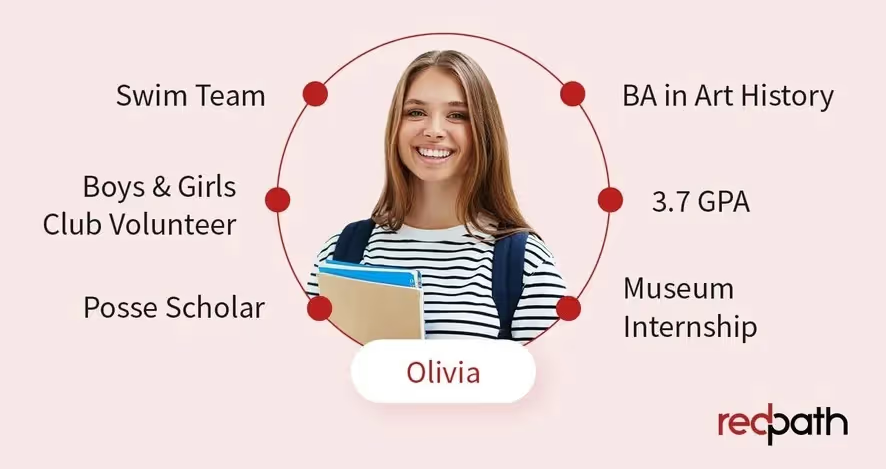
Knowing that Olivia was a frequent volunteer with an art history degree might prompt you to invite her to a volunteering event or ask her to donate to the art department’s scholarship fund.
All of this information helps you better understand donors’ interests and preferences, which you can use to build stronger relationships and more successfully solicit donations.
Once you have a holistic picture of your donors, you can greatly increase the personalization of your communications. Donors and alumni are much more likely to engage with messages tailored to their unique interests. Plus, when donors feel like you understand and appreciate them as individuals, they’re more likely to value your university’s community and continue giving long-term.
To boost personalization, create a variety of highly specific donor segments within your database. For example, you might create segments like:
Then, send personalized emails, mailers, and appeals that align with each segment’s interests. You might ask the group of alumni in the tech industry to give to your capital campaign funding a new computer science department building, while you promote an upcoming fundraising auction to the segment of alumni who frequently attend events.
Beyond segments of donors, your database can also help you personalize outreach to individual donors. Pull data from your CRM like past donation amounts, graduation years, and specific campaigns they supported, and mention them in your appeals for an added personal touch.
Whether you leverage features within your CRM or invest in an integrated marketing automation tool, automation can make a major difference in your fundraising team’s efficiency and success. By automatically updating your database, auto-filling emails with personal details, and triggering email streams based on certain criteria, these features cut down on manual tasks and improve the accuracy of your data.
For instance, say you want to create a process to engage first-time donors. If your CRM integrates with your university’s online donation platform, new donors will be automatically added to your database. When they are, you could leverage marketing automation to trigger a series of personalized welcome emails. This might look like:
Automated email series like this one will help you foster relationships with donors from the moment they decide to give to your university—all without lifting a finger.
Finally, your database’s reporting features can help you identify successes and challenges and improve your fundraising with data. In particular, monitoring the following metrics can help you understand how successful and cost-effective your fundraising strategies are:
With this information, you can investigate further to determine the cause of any major dips or increases and use your findings to adjust your fundraising strategies accordingly. For example, if you discover that a significant number of donors lapsed during an economic downturn, you might adjust your appeals to ask for smaller donations and emphasize the effects of the economy on students’ abilities to attend their dream school.
If you need help formulating strategies based on your fundraising data, consider partnering with a higher ed technology consultant. These experts can help you leverage your CRM more effectively and even customize it to fit your university’s unique needs. With the right tools and strategies in your toolbox, you’ll be able to boost your fundraising results in no time.

Caitlin leads the brand, creative and overall go-to-market strategy for Redpath. Offering over 10 years of experience in omni-channel and B2B marketing, she has a history of successfully implementing marketing plans and leveraging campaign analytics to drive revenue. She has a passion in communications and is skilled in empowering cross-functional teams to promote positive company culture and attain collective goals.
Caitlin has a Bachelors in Sociology from the University of Wisconsin-Madison and a Masters of Business Administration from the University of St. Thomas. When Caitlin is not at work, you can find her reading a good book, sipping on some chai tea, or enjoying activities with her family such as going on walks, boating, and traveling.
Using Your Database to Boost University Fundraising Results
Lorem ipsum dolor sit amet, consectetur adipiscing elit. Suspendisse varius enim in eros elementum tristique. Duis cursus, mi quis viverra ornare, eros dolor interdum nulla, ut commodo diam libero vitae erat. Aenean faucibus nibh et justo cursus id rutrum lorem imperdiet. Nunc ut sem vitae risus tristique posuere.
K-12 schools and higher ed institutions, public and private alike, rely on smart fundraising strategies to generate the revenue needed to maintain and grow their operations. But planning and carrying out fundraising initiatives without the donor data to inform them can feel like a shot in the dark.
By harnessing the power of data analytics, however, educational institutions can unlock new avenues of support and establish personalized fundraising tactics that resonate with supporters on a deeper level.
In this blog post, we delve into the world of data-driven fundraising and explore what schools of all shapes and sizes need to know.
.jpeg)
A data-informed fundraising approach empowers school fundraisers to build and strengthen donor relationships in a rapidly changing landscape. Today, tailored engagement efforts are seeing particularly high levels of success, with personalized initiatives resonating deeply with organizations’ support networks.
In fact, according to industry research, personalized emails see open rates over 82% higher than generic emails, while segmented campaigns produce up to 760% revenue growth!
Each contact in your CRM is a different person who has their own unique set of behaviors, preferences, and history with your school. For example, Sarah (a recent college grad and devoted alumnus who has recently begun donating to the college's scholarship fund) and John (a retired faculty member who actively participates in campus events and has supported the annual fund campaign for the past twenty years) should not be engaged with in the same way.
Instead, the insights gleaned from personal interactions, surveys and forms, and third-party resources—powered by smart technology—can guide your efforts with individualized engagement recommendations and more.
In this guide, we’ll explore several critical donor data points and how each one can inform your school’s efforts. These include:
The more you know, the better you can tailor your strategy for each person supporting your cause. By establishing donor-centric fundraising practices, you can create a positive giving experience that fosters long-term engagement that goes beyond any single transaction.
Demographic data is some of the most basic information you can collect about a donor. And it’s the foundation of a successfully personalized strategy.
Key demographic points to look out for include a supporter’s name (full name and preferred name or nickname, if applicable), contact information (phone number, email address, social media handles, etc.), address and geographic location, age or D.O.B., and more.
How to get this data point: Ask for these details on your online donation pages. While you’ll want to limit the number of required form fields to the must-haves (typically name and email), the rest can be optional requests. Tons of donors are willing to provide additional information when asked!
Understanding a donor or prospect’s affiliation with your school can be the key to pulling off an effectively tailored strategy. After all, it’s likely one of the primary motivations behind an individual’s giving.
For example, you’d likely take a different approach to alumni engagement than you would for a current student, faculty member, or unrelated donor. Each group has its own unique set of defining characteristics, and acknowledging a supporter’s relationship with your school can establish a more personalized giving experience.
How to get this data point: This is another piece of information you can ask for in your donation form. Consider implementing an optional drop-down field that encourages donors to mark their status as a student, alumnus, family member, friend, faculty/staff, or other.
A donor’s past giving patterns can be one of the largest indicators of future behavior. By tracking how your supporters are involved with your school, you can take key steps to encourage further support. For example, you’ll be able to better understand giving motivations, predict engagement trends, and even uncover major donor opportunities.
Keep in mind that engagement history should go beyond traditional donations—and encompass all instances of giving, volunteering, peer-to-peer fundraising, attending events, matching gifts, and more.
How to get this data point: This information should be quick and easy to locate in your donor database. To ensure you have a thorough understanding of each individual’s engagement with your institution, regularly updating your CRM is a must.
If you send donation appeals using a channel that a donor doesn’t care for, your outreach is more likely to be discarded without consideration. On the other hand, if you use an individual’s favorite means of communication, you can expect a significantly greater response.
Thus, tracking and analyzing donor communication preferences can go a long way—not only in securing more gifts for your school, but also in reducing costs invested in non-responsive channels.
How to get this data point: Take a look at your recent interactions with a donor. Do they tend to be more responsive over email compared to direct mail? Do they favor phone calls or text messages? Your past campaign conversion rates can provide a ton of useful details. Alternatively, consider sending a donor survey that asks respondents to share their preferred communication channels to get straight to the point!
Knowing where your donors work is one of the most impactful data points you can have. Not only does employment data allow your team to uncover existing workplace giving opportunities (i.e., matching gifts, volunteer grants, annual giving stipends, and more) within your support network, but it can also inform your broader corporate partnership strategy, provide wealth insights, and allow for increasingly personalized outreach.
While the employing company is the most important aspect, it also helps to have additional insights such as their job title, rank, and part-time versus full-time status. Many companies even match donations made by their retirees—so don’t count them out, either!
How to get this data point: Employment information is another data point that can be collected directly within the online giving experience. But our #1 recommendation is to integrate your fundraising platform with an innovative matching gift tool—like Double the Donation’s partnership with Almabase!
Leveraging a solution like this empowers your school to collect employment data from donors as they reach the confirmation screen. Plus, it allows you to screen contact information for corporate email addresses and trigger automated post-donation outreach—each of which provides your team with employer insights.
Asking for too much from your donors can lead to extra “no’s,” while asking for too little often leaves available dollars on the table. Thus, having a basic understanding of an individual’s wealth level and capacity to give can help your development team tailor gift requests with optimal donation suggestions that resonate with the prospect.
This information can also help uncover major donation opportunities that already exist in your network—you just might not know it yet!
How to get this data point: Conduct a wealth screening of the donors, prospects, and alumni in your database to identify those with the ability to contribute substantial gifts. Take a look at common wealth markers like stock ownership, real estate holdings, past giving, and previously uncovered employment details to estimate an individual’s capacity to give.
Beyond a donor’s financial giving abilities, another key tenet of prospect research includes looking into the person’s affinity to give. In other words—do they take a natural liking to your cause?
If an individual has an existing relationship with your school (i.e., student, alumnus, faculty member, family, etc.), that connection often does produce an affinity to support your efforts. However, you’d want to note that a chemistry student would likely be more inclined to donate to an expansion of the college’s science wing rather than a scholarship fund for incoming art classes.
How to get this data point: Make a note in your donor database after each meeting with a major donor or prospect. If they mention any particular interests, jot it down to have on record going forward. If an individual is an alumnus of your institution, their major or field of study can provide some insight into their personal and professional interests.
.png)
As the educational fundraising landscape continues to evolve, data-driven fundraising becomes increasingly essential to unlocking untapped potential.
The invaluable insights gleaned from supporter data can empower your institution to make the most of available resources, identify and engage effectively with high-value prospects, and enhance donor retention—from first-time donors to life-long supporters.
Make sure your development team has the tools and the strategies in place to collect, store, and analyze the data available to you. Don’t let that resource go to waste!
Data-Driven Fundraising for K12 and Higher Ed: What to Know
Lorem ipsum dolor sit amet, consectetur adipiscing elit. Suspendisse varius enim in eros elementum tristique. Duis cursus, mi quis viverra ornare, eros dolor interdum nulla, ut commodo diam libero vitae erat. Aenean faucibus nibh et justo cursus id rutrum lorem imperdiet. Nunc ut sem vitae risus tristique posuere.

Adam Weinger
October 10, 2023
12 minutes
We’ve come a long way from relying on large registry books to sprawling Excel sheets, and now to databases. An alumni database is a robust, interactive system to record alumni information as the data can be accessed, represented, and used to fuel powerful digital initiatives. That last bit is important because having a well-oiled database is only as effective as how you use it. In today’s blog, we’ll go over some ways in which you can maximize the potential of your institution’s database for higher fundraising success:
Any good giving campaign today needs to know for sure what kind of alumni they want or can reach out to. This is where having a well-built database comes in handy. Having detailed records of past donations is a great way to guide your fundraising strategy. A regularly updated database can take your planning further to an even higher level through details such as stock ownership, business affiliations, political donations, real estate value, etc. to help you find the perfect prospects for your giving campaign.
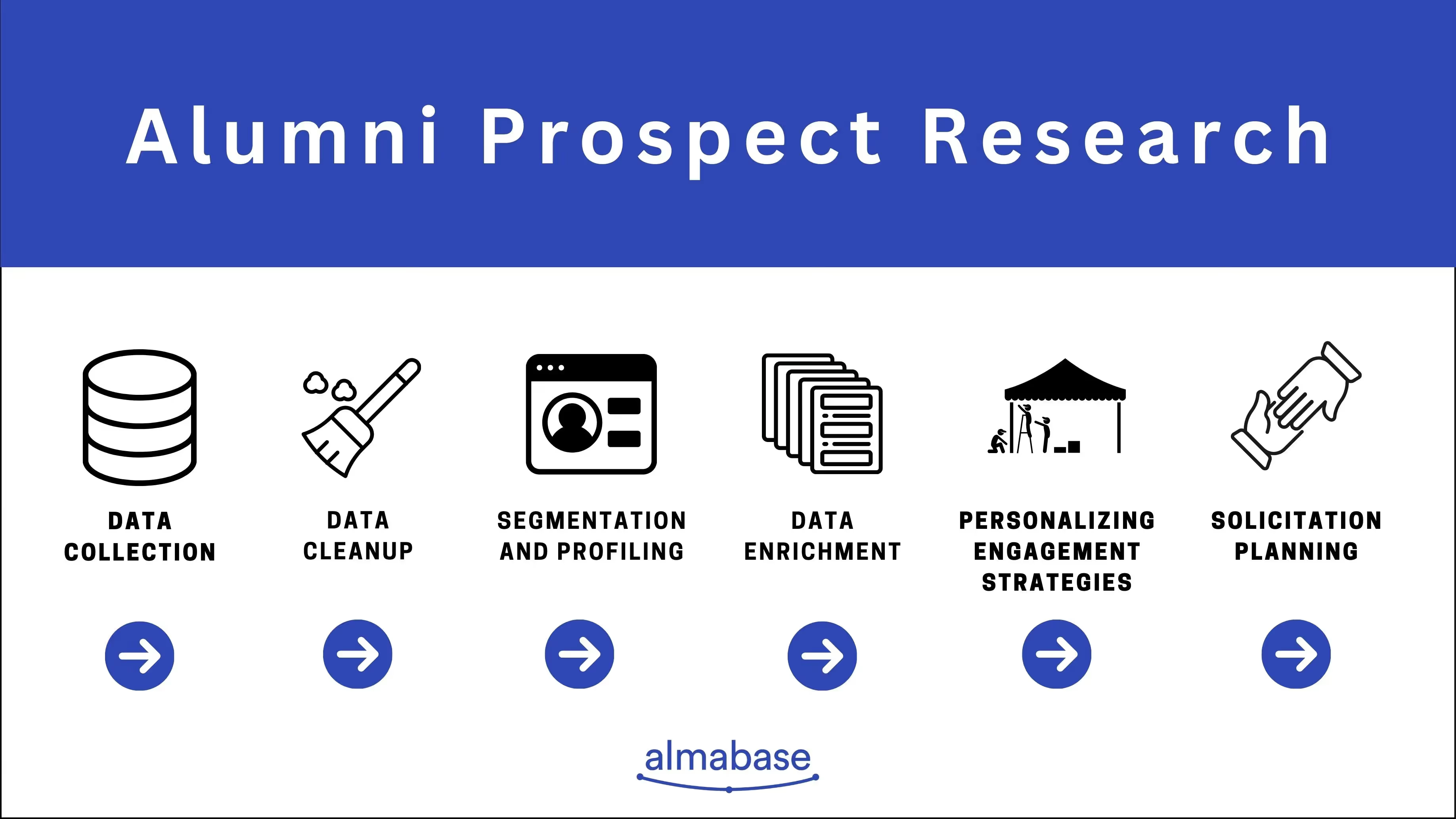
Modern alumni database tools are capable of automated and customizable segmentation. This can help you create more targeted giving campaigns. Take the following common segmentations for example:
You can already start to imagine a more targeted experience based on the above examples. However, it is important to remember that you’ll need to ensure that your database is updated regularly for all your segmentation needs.
CRM (Customer Relationship Management) systems enhance the usability of your data, enabling you to take advantage of powerful automation features that do the menial tasks such as personalizing emails based on donor segments, sending surveys, requesting feedback, etc. in a system that continuously updates with each alumni interaction.
Matching gifts have emerged as a great way to attract donors, amounting to 2 to 3 Billion USD of donations annually. Donors can be sure that their donations are being multiplied without any additional cost from themselves. A customizable database should allow you to segment prospective donors who have employers that provide matching gift opportunities, allowing you to create targeted communication strategies for them. On the flip side, it will be crucial to ensure your database is up to date to ensure that any career changes from your alumni are accounted for.
Donor retention is crucial and making sure your donors feel appreciated is a huge part of it. A well-built database will be able to categorize donors based on gift size, location, physical presence, etc. to allow you to send gifts, emails, and other forms of appreciation in a more personalized way. This will be especially helpful for multi-channel giving campaigns where you may want to thank donors in different channels while making sure nothing feels generic.
It is crucial to look back at your most recent giving campaign (or even group a few recent ones) and see where you can improve. While you may have noticed a lot of verbal feedback, it is also important to consult your data. Any decent database will work well with tools that can visualize reports for you to easily see what you got right and where you can do better. It should also allow you to compare it with past giving campaigns.
While AI/ML technologies are very much still finding their feet in advancement, it is important to understand the potential they hold, and whether that suits you. Even for simple implementations such as a chatbot to answer potential donor questions, you want to make sure it provides the right information, and that depends entirely on the data you are able to train it on. A comprehensive, well-structured database is the foundation of any technological implementation today.

How to Leverage Your Alumni Database to Drive Fundraising Success
Lorem ipsum dolor sit amet, consectetur adipiscing elit. Suspendisse varius enim in eros elementum tristique. Duis cursus, mi quis viverra ornare, eros dolor interdum nulla, ut commodo diam libero vitae erat. Aenean faucibus nibh et justo cursus id rutrum lorem imperdiet. Nunc ut sem vitae risus tristique posuere.
%201.svg)
%201.svg)
%204.svg)


.svg)