Practical resources to help alumni relations, fundraising, and advancement teams work smarter.

Alumni relations professionals understand the challenges of continuous engagement. You send a thoughtful newsletter, but the open rates plateau. You know your graduates care about their alma mater, but their inboxes are overflowing. When it comes to corporate matching gifts, relying solely on email often means leaving revenue on the table. Many of your alumni work for companies that would gladly double their donations, but they are simply unaware that the programs exist.
To fix this, you must diversify your approach. You need a multi-channel strategy that weaves awareness of matching gifts into the daily lives of your alumni network. By utilizing the right fundraising software and implementing some creative tactics, you can market matching gifts through channels that actually capture attention.
In this guide, we will cover some of our top-suggested strategies:
Ready to get started? Let's look at how you can broaden your reach and secure more matched dollars for your school without sending another generic email.
Social media is where your alumni go to network, share life updates, and stay in touch with classmates. It is the perfect environment to remind them about corporate matching gifts. Each platform has a unique vibe, so you should adjust your message to fit the audience on each channel.
LinkedIn is ideal for career-centric content. Since matching gifts are a corporate benefit, this platform is a natural fit. You can post about the top-matching-gift employers among your alumni. For instance, share a graphic celebrating that "50 alumni from Google matched their gifts this year!" This appeals to professional pride and prompts others at similar companies to check their eligibility.
On Facebook and Instagram, visuals drive engagement. Share graphics that clearly show the impact of a matched gift. A side-by-side image comparing "One Book" versus "Two Books" illustrates the power of doubling a donation.
You can also use "Stories" to run polls asking, "Did you know your employer might match your gift?" This interactive approach educates donors while boosting engagement rates.
Did You Know? According to Double the Donation's matching gift statistics, an estimated $4 to $7 billion in matching gift funds goes unclaimed every year. Using social media to spread the word can help your institution capture its share of that funding.
Text messages boast incredibly high open rates compared to email. Most people read a text within just a few minutes of receiving it, making SMS a strong choice for urgent appeals or quick follow-ups regarding matching gift opportunities.
When sending a fundraising text, brevity is key. You do not have room for long paragraphs. Get straight to the point. A text might read, "Thanks for your gift, [Name]! Check if your company will double it here:" followed by a direct link to your matching gift search tool.
The best time to send a text is immediately after a donation is made. If you wait days or weeks, the donor's excitement may fade. By catching them in the moment, however, you increase the likelihood that they will take the extra minute to submit a match request to their employer.
While digital marketing is popular, direct mail still has value, particularly for matching gifts. For example, a physical postcard has a longer lifespan than a digital message. It sits on a desk or a fridge, serving as a tangible reminder. The trick is to connect that physical piece of mail back to your digital fundraising tools for the best results.
Bridge the gap between paper and screen by adding a QR code to your mailers that links directly to your institution’s matching gift webpage.
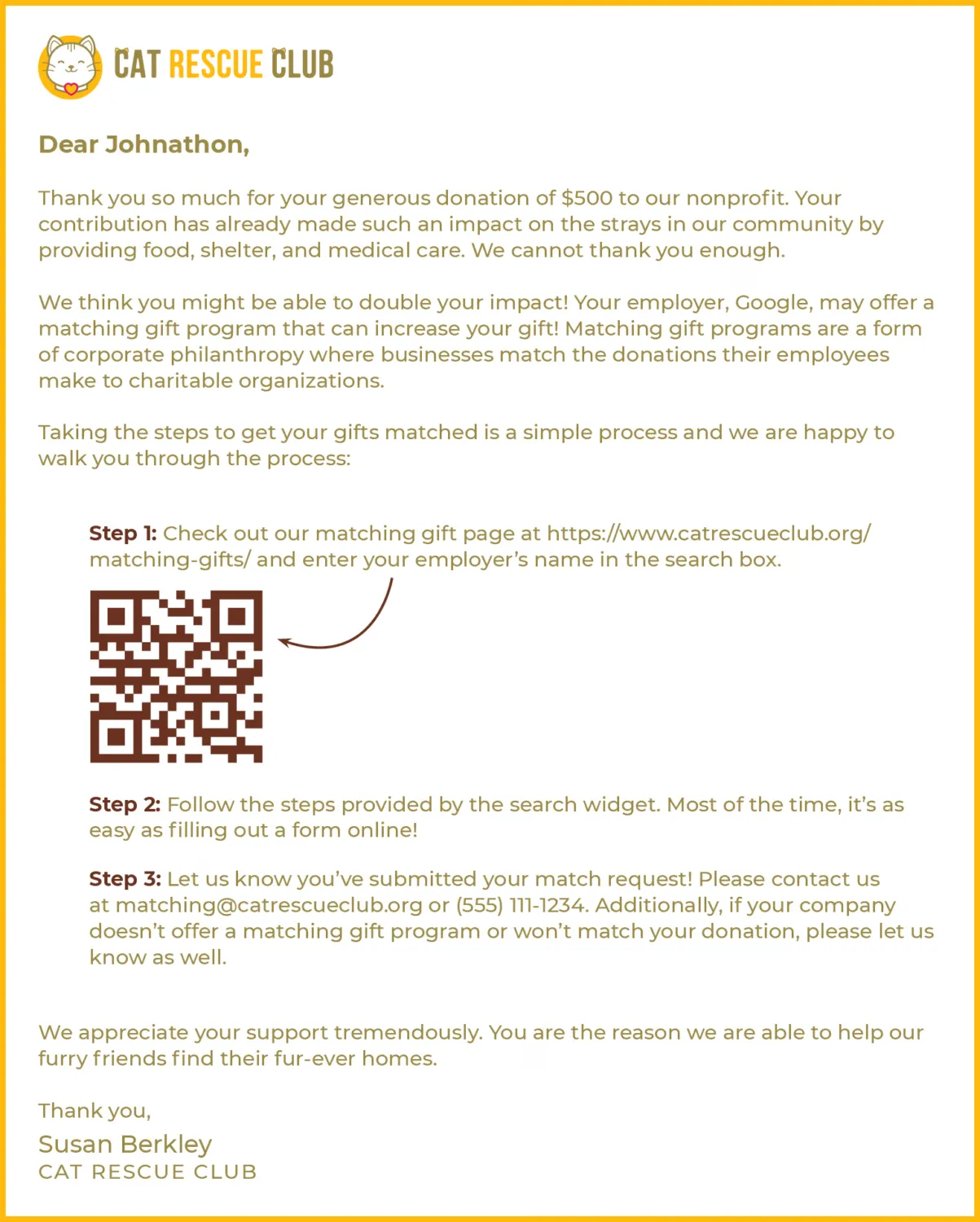
Place a scannable code on your donation reply cards or thank-you notes. Label it clearly with a call to action like, "Scan here to see if your company matches gifts."
Try including a small insert in your appeal packages that focuses solely on matching gifts. It does not need to be complicated. A simple card listing the top matching employers in your alumni network is very effective. If an alumnus sees their company listed, they will instantly know they are eligible to give more without re-opening their wallet.
February is widely recognized within the fundraising sphere as Matching Gift Month. Dedicating a specific time of year to matching gifts lets you run a focused campaign that educates your entire alumni base at once.
Build a campaign that encourages alumni to submit their match requests before the end of the month. You can set a goal, such as "100 Matched Gifts in 30 Days." This creates a shared sense of purpose. Throughout the month, share progress updates to keep the momentum going.
Use this month to answer common questions related to corporate matching. You might release a short video series or a set of infographics explaining how easy the process is. After all, many donors assume matching gifts require complex paperwork or other time-consuming steps. Use this dedicated month to show them that with modern fundraising software, it often takes just a few clicks.
Get inspired! Learn about the engaging Matching Gift Month campaign from Lehigh University here.
Alumni events are built on connection. Whether it is a homecoming tailgate or a regional mixer, you have a captive audience ready to engage. These in-person interactions are excellent opportunities to mention matching gifts in a natural way.
If you have a check-in table, set up a tablet with your matching gift search tool ready to go. As alumni arrive or make a donation, ask, "Do you know if your company matches gifts?" If they are unsure, offer to look it up right then and there. This personal assistance removes barriers for the donor.
Include matching gift messaging on printed programs, table tents, event tickets, or even post-event outreach. A short blurb like "Double your impact; ask us how!" can spark intense interest. You can also ask speakers to mention how matching gifts helped fund the event or a specific scholarship during their opening remarks.
Your website is the central hub for all fundraising activities. However, matching gift details are often buried on hard-to-find pages. To drive results, you must make this information prominent and accessible to all.
Add a "Matching Gifts" link to your main navigation menu or website footer, ideally as visible as your primary "Donate" button. This ensures that any visitor curious about workplace giving can find answers without too much digging.
The most critical part of your site is the donation form (and/or gift confirmation screen). This is the page donors see during or immediately after giving. At this moment, they are largely engaged and feeling generous. Capitalize on this by embedding a matching gift database directly within the donation process.
Here’s an example from Duke School:
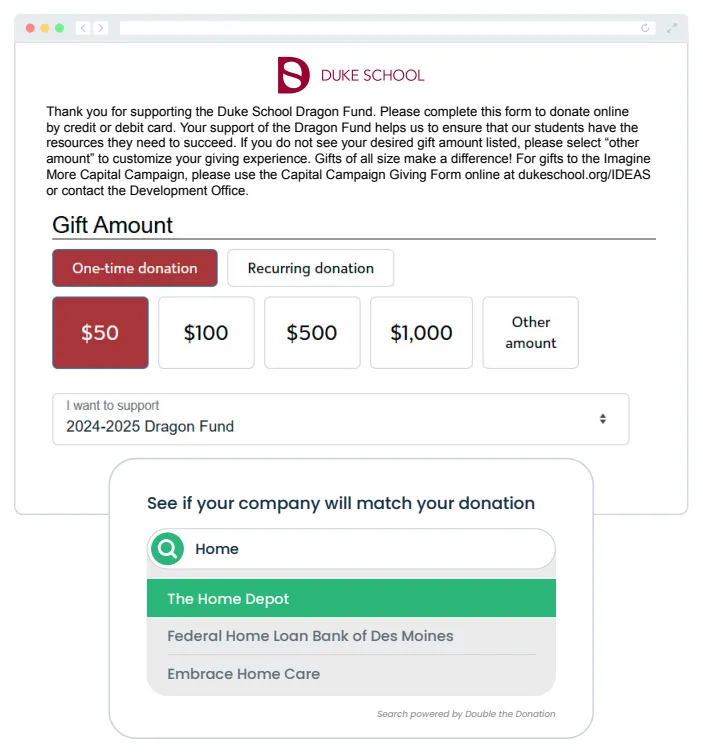
Using an integrated fundraising tool here (like Almabase and Double the Donation) allows donors to check their eligibility and access the correct forms instantly, right when motivation is highest.
Proactively marketing matching gifts to alumni requires thinking beyond the standard newsletter. While email is a useful tool, it should not be your only promotional method. By implementing the tips highlighted above, you create a robust ecosystem that constantly reminds donors of their potential impact.
The goal is to simplify the process for your alumni. When you remove obstacles and remind them of their corporate match eligibility, you unlock a significant revenue stream. Pick one of these new channels to test this quarter, and you’ll see your engagement and funding grow.

Beyond the Email: 6 Ways to Market Matching Gifts to Alumni
Explore six creative strategies to market matching gifts to alumni beyond email. Use social media, direct mail, and Matching Gift Month to boost revenue.
Fundraising
Strong alumni engagement is one that can create relationships that actually last. Institutions need to show how engagement translates into real participation, better retention, and long-term giving. Just tracking activity numbers doesn't cut it anymore. And as alumni populations become more diverse and scattered across the globe, the playbook must evolve to keep up.
Alumni want communication that matters to them: flexible ways to stay involved, experiences that actually match their interests and where they are in life. Generic outreach and jam-packed event calendars deliver spotty results at best. That's why institutions are going back to the drawing board, looking for fresh approaches and building strategies they can actually measure and adjust as they go.
This blog breaks down what modern alumni engagement looks like, why the old methods might fall short, and how you can build a strategy that scales.
Alumni engagement could get mixed up with outreach, but they're not the same thing. Sending emails, promoting events, posting updates are just activities. Real engagement shows up in how alumni actually respond, participate, and stick around over time. The distinction matters because you can blast out communications all day long without building a single meaningful relationship.
These days, engagement comes down to relevance and consistency. Alumni expect you to meet them where they are now, not where they were when they graduated. A recent grad trying to figure out their career path needs something completely different from a mid-career professional who wants to mentor someone, or a senior alumnus thinking about their legacy. When you ignore these shifts, people don't usually make a big exit. They subtly slip away.
Another important shift is how alumni define involvement. Many are open to contributing time, expertise, or advocacy long before they are ready to give financially. Modern engagement recognizes these signals as meaningful indicators of affinity instead of treating fundraising as the first or only goal.
In this context, alumni engagement becomes an ongoing system rather than a series of touchpoints. It connects communication, participation, and insight into a continuous loop that informs what comes next. Institutions that approach engagement this way gain a clearer picture of who their alumni are, what they care about, and how relationships evolve after graduation.
If you’re exploring how institutions are rethinking alumni engagement, you may also find our blog on modern-day alumni engagement and fundraising useful.
A lot of traditional alumni engagement strategies fall short, and it's not because teams aren't trying hard enough. The real problem is that systems underneath were never built for how alumni actually engage today. Tools, data, and workflows have all evolved separately, leaving advancement teams with a patchwork view of their alumni and no clear way to act on what they're seeing.
One common issue is siloed data. Event attendance may live in one system, email engagement in another, and giving history somewhere else entirely. Without a shared view, it becomes difficult to understand patterns or tailor outreach in meaningful ways. Engagement decisions end up driven by habit over evidence.
Another challenge is one-size-fits-all communication. Alumni are frequently grouped into broad segments based on graduation year or geography. These categories miss what actually drives participation, such as career interests, past involvement, or preferred ways of contributing. The result is outreach that comes across as generic and is easily ignored.
Traditional approaches also rely heavily on a narrow set of channels. Email and in-person events remain important, but over-reliance on them creates engagement that is episodic rather than continuous. When engagement spikes only around reunions or campaigns, momentum is hard to sustain.
Finally, many institutions lack clear ways to measure engagement itself. Without defined metrics or feedback loops, teams are left reacting to declining participation instead of proactively shaping stronger alumni relationships over time.
Up next, we’ll look at the core elements that define a modern alumni engagement strategy and how they address these gaps directly.
A modern alumni engagement strategy is not built on isolated tactics. It rests on a small set of foundational elements that work together. When one pillar is weak, engagement tends to feel inconsistent or hard to sustain. But with all five in place, institutions can expect to gain clarity, scale, and momentum.
Engagement starts with knowing who your alumni are. Many institutions hold fragments of alumni data across multiple systems, which makes it difficult to understand behavior or track engagement over time. A unified data foundation brings profiles, interactions, and history into one view.
This matters because engagement decisions improve when teams can see patterns. For example, alumni who attend events, mentor students, or update their profiles often show higher long-term affinity. Without connected data, these signals remain invisible and underused.
Gone are the days when personalization meant adding a first name to an email. Modern engagement uses behavioral and interest-based signals to shape how alumni are invited to participate. What someone clicks, attends, or volunteers for should influence what they see next.
Institutions that move in this direction often see stronger participation because outreach aligns with alumni intent. Industry research frequently shows that relevance drives response, while generic messaging suppresses it. This shift allows teams to personalize without creating manual work for every segment.
Events still play a role, but they no longer carry engagement on their own. Modern strategies create ways for alumni to participate year-round through communities, mentoring, volunteering, directories, and peer interaction.
These touchpoints keep alumni connected even when they cannot attend in person. They also generate continuous engagement data, which helps institutions understand what resonates across different alumni groups.
Engagement becomes strategic when it can be measured and connected to outcomes. Participation trends, repeat involvement, and progression toward giving readiness provide a clearer picture than isolated activity counts.
Many institutions now track engagement as a leading indicator rather than looking at donation behavior alone. This approach supports smarter planning and better alignment between alumni relations and advancement teams.
Teams today are expected to do more with limited resources. Automation supports consistent engagement by triggering timely outreach, updates, and follow-ups based on alumni behavior. AI further helps by identifying patterns and recommending next actions.
Want to see how institutions put these pillars into practice? Check out this blog on how advancement teams can start by learning from peers who have modernized their alumni engagement strategy and turn engagement into sustainable fundraising.
A modern alumni engagement strategy becomes effective only when it is translated into a clear, repeatable plan. This plan should guide day-to-day decisions, not sit separately from execution. Each step below builds on the previous one, moving from clarity to action to continuous improvement.
Begin with a clear-eyed review of your existing engagement ecosystem. This includes tools, channels, data sources, and internal workflows. List every way alumni can currently engage, such as events, emails, mentoring, volunteering, communities, and giving, and note which systems capture those interactions.
This step is critical because many institutions significantly overestimate engagement. CASE research shows that fewer than 20% of alumni are meaningfully engaged in a given year when engagement is measured across participation, volunteering, and philanthropy.
Once activities are mapped, look for gaps. Identify where engagement data is fragmented, where follow-up depends on manual effort, and where teams lack visibility into alumni behavior. The goal is not to evaluate performance yet, but to understand what can and cannot currently be measured or scaled.
Define what your engagement is meant to achieve. When can it be considered a success? Modern engagement goals focus on outcomes such as participation depth, retention, pipeline to giving, and long-term relationship strength. They are not framed around volume alone.
Effective goals answer questions like how often alumni should engage, what progression looks like over time, and how engagement supports broader institutional priorities. This clarity helps teams move away from reactive planning and toward intentional design.
Goals should also be shared across alumni relations and advancement teams. When engagement is positioned as a contributor to long-term fundraising and advocacy, it becomes easier to align priorities and measure success consistently.
Modern engagement strategies nowadays reflect lifecycle stages, moving from students to young alumni, mid-career alumni, and senior alumni. Each stage should offer relevant opportunities, whether that is career support, mentoring, volunteering, networking, or leadership involvement. Journeys work best when they guide alumni forward instead of repeatedly inviting them to the same activities year after year.
Designing journeys also helps institutions anticipate needs rather than reacting after engagement declines. It creates continuity and makes engagement feel purposeful rather than sporadic.
Technology should play a supporting role to lift your strategy. At this stage, institutions should focus on capabilities rather than vendors. Key considerations include CRM integration, automation, reporting, community features, and the ability to scale without increasing manual workload.
The right platform enables consistent engagement, captures behavior across channels, and provides visibility into participation and readiness over time. Without these capabilities, even well-designed journeys become difficult to sustain.
Measurement turns engagement into a growth system. Instead of tracking isolated activities, focus on participation trends, repeat involvement, and progression across engagement types.
Institutions that consistently review engagement data and adjust accordingly perform better over time. Measurement only works when paired with iteration. Regular review cycles help teams identify what is resonating, where alumni disengage, and which experiences strengthen relationships. Check out this list of donor KPIs you can track for valuable engagement data
Alumni Engagement Ideas That Work in Modern Institutions
Building a strategy is one thing, but what really pays off is bringing it to life with ideas that actually resonate with alumni. Below are engagement ideas grounded in real examples from actual institutions and industry best practices.
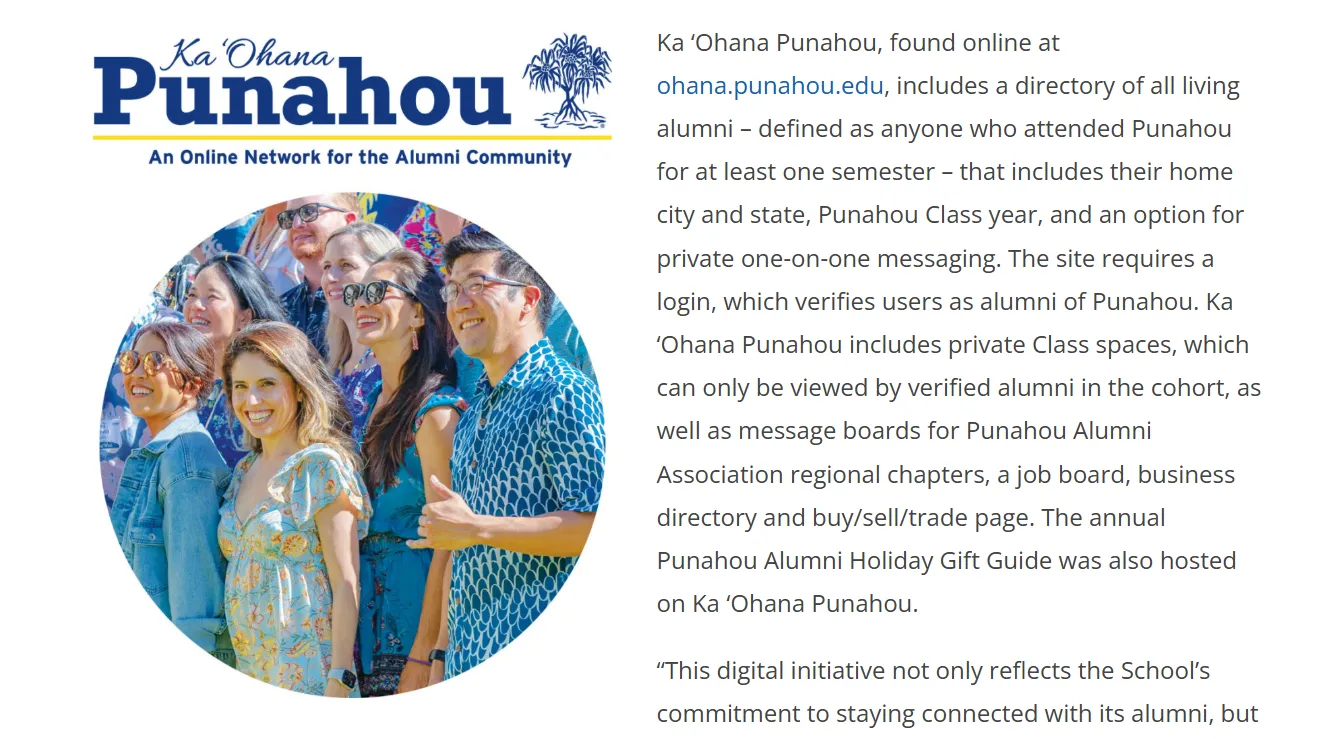
Punahou School in Hawaii created an integrated digital alumni platform called Ka ‘Ohana Punahou that goes beyond email newsletters. The portal includes an alumni directory, private class spaces, message boards for regional chapters, job boards, business listings, and more. Since its launch, about 7,000 alumni visit the platform monthly and roughly 70% of contactable alumni have engaged with it. This is a community hub that keeps alumni connected and interacting year-round.
What you can do:
This turns one-way communication into an always-on engagement hub.
Connecting alumni with current students through structured mentorship programs fosters meaningful relationships while enhancing career opportunities for students. These programs also provide alumni with a tangible way to give back beyond financial contributions.
William & Mary redesigned its alumni engagement by building the One Network. As part of this, the university rebranded traditional mentorship into a more accessible “career connections” program enabling alumni to mentor students and recent grads in professional development. Using this targeted platform helped the institution better match alumni capabilities with student needs and boosted engagement across career networking and event participation.
What you can do:
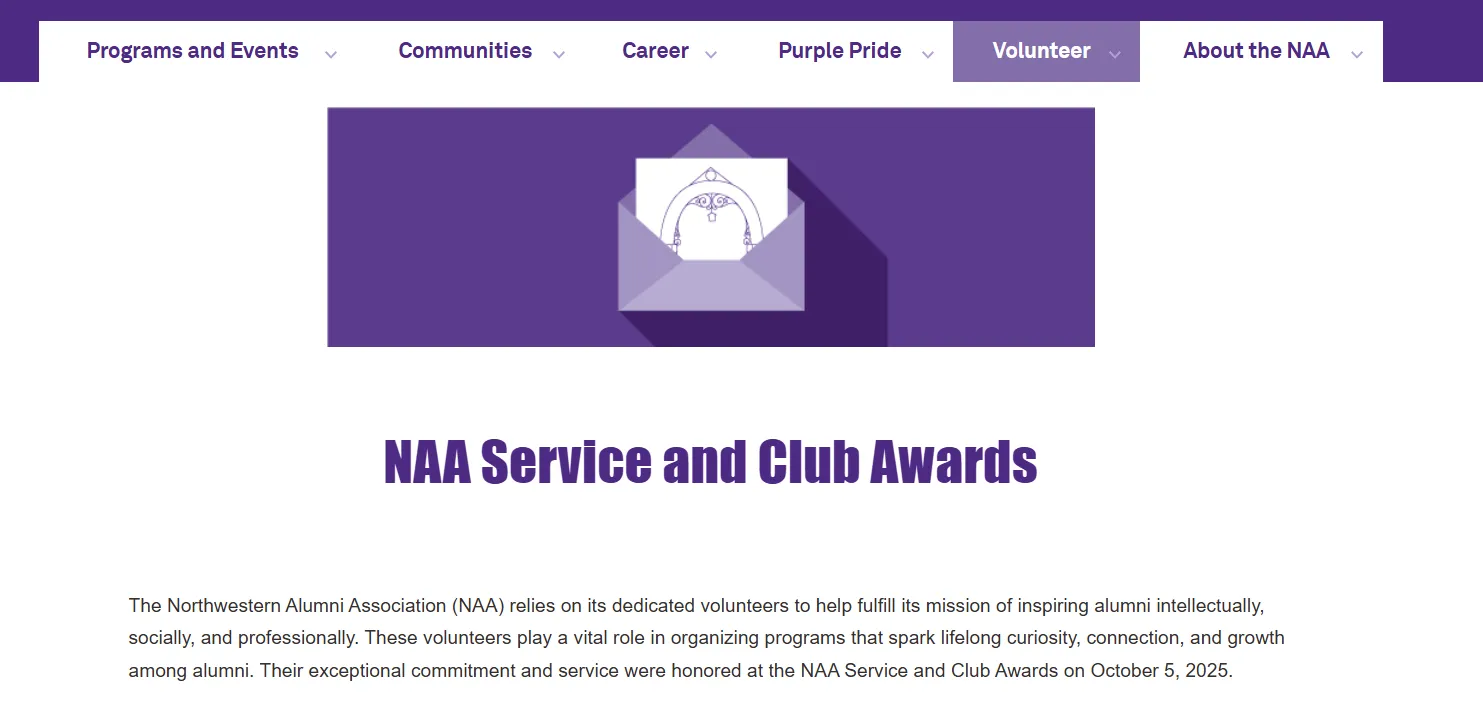
Northwestern University’s Alumni Association offers a variety of awards recognizing alumni achievements from career success to volunteer leadership and community involvement. These awards celebrate clubs, individuals, and volunteer contributions, making recognition a central driver of engagement and community pride.
How to turn this into action
This type of recognition reinforces alumni identity and gives alumni a reason to stay connected beyond transactional interactions.
Events remain one of the most powerful ways to bring alumni back into active engagement but the ones that truly work are purposeful, memorable, and tailored to alumni interests or milestones.
Johns Hopkins hosts an annual Alumni Weekend that goes far beyond a simple reunion. The multi‑day program includes signature events like interactive department showcases, alumni dinners, a traditional Crab Cake Lunch, social mixers, and even big‑game tailgates. It’s designed to appeal to diverse alumni interests from intellectual curiosity to social celebration, and draws alumni back to campus not just once, but year after year.
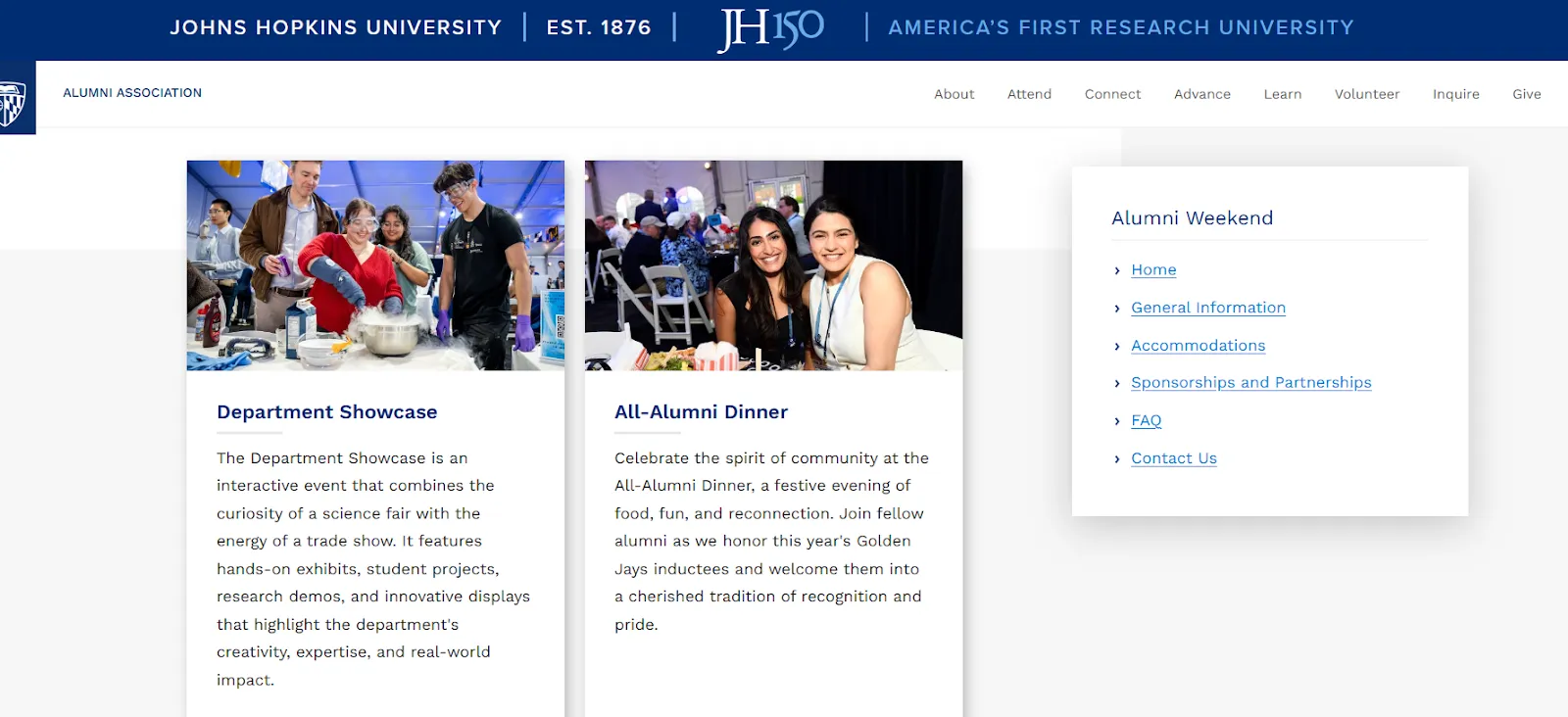
See the full list of signature Alumni Events here.
Effective alumni are more than simple gatherings. They offer:
What you can do to make events that drive engagement
These examples show that effective alumni engagement goes beyond newsletters and occasional reunions. Institutions meet alumni where they are and engagement becomes ongoing and mutually beneficial.
Alumni engagement works best when it is treated as a system that grows over time. When alumni stay involved through mentoring, volunteering, events, or community participation, they are more likely to remain connected to the institution’s mission. That connection fuels fundraising, strengthens advocacy, and supports retention across generations of graduates.
Modern alumni engagement strategies reflect this long-term view. They are robust, well-rounded and intentional about how relationships are built and maintained, and they rely on data to guide decisions rather than assumptions. Instead of asking how many activities were run, successful teams focus on whether alumni are returning, deepening their involvement, and moving along a meaningful engagement journey.
Technology plays a critical role in making this sustainable. Without the ability to capture engagement signals, personalize experiences, and measure outcomes, even well-designed strategies lose momentum. Institutions that invest in the right foundations are better positioned to scale engagement efforts, adapt as alumni needs change, and build durable relationships that extend well beyond individual campaigns.
Building a modern alumni engagement requires a platform that brings data, engagement, and outcomes together in a way that supports everyday work. Almabase is designed specifically for institutions to support the core pillars of modern alumni engagement.
By unifying alumni data, engagement activities, and insights in one place, Almabase helps teams move from disconnected tools to manual processes. This creates the clarity and consistency needed to execute engagement strategies at scale.
With Almabase, institutions can centralize alumni profiles and engagement data to create a single, reliable source of truth. Teams can personalize outreach and engagement journeys based on alumni interests and behavior rather than one-size-fits-all approaches. Always-on engagement is supported through online communities, events, mentoring, and directories that keep alumni connected throughout the year.
Almabase also enables teams to track engagement alongside fundraising readiness and participation metrics, making it easier to understand how relationships evolve over time. Automation and AI-powered workflows reduce manual effort, allowing teams to focus on strategy, relationship building, and continuous improvement.
For institutions looking to modernize alumni engagement without adding operational overheads, Almabase provides the foundation needed to scale engagement efforts, improve visibility, and build stronger, long-term alumni relationships. See for yourself by booking a personalized demo today.

How to Build a Modern Alumni Engagement Strategy That Drives Real Results
Let's break down what modern engagement looks like in 2026. We'll cover what alumni expect, what's not working, and how to modernize your engagement.
Alumni Engagement
Alumni programs are a tricky problem for universities and schools. They are the vehicle for any alumni engagement idea, but they also require a lot of effort and the returns can oftentimes feel lackluster.
These days, an alumni engagement plan needs to be much more than the odd event attendance and a newsletter subscription. To create consistent engagement, attract giving, and bring alumni attendance, modern teams need to create different alumni programs that meet alumni at their needs.
This blog will help you plan (or tweak) your alumni programs to better engage your institution’s alumni.
Alumni programs are relationship-building initiatives aimed at former students and employees. For universities and schools, alumni programs involve creating communities, events, and opportunities to build and nurture relationships with their alma mater.
For example: A mentorship event may be part of a larger annual mentoring program, and that same program may involve a campaign to increase alumni participation as mentors.
We’ve already mentioned how the best alumni programs meet specific alumni needs. With that in mind, these are the most commonly observed alumni programs in schools and universities:
These programs focus on emotional connection and two‑way communication. They typically include reunions, homecoming events, local chapters, virtual meetups, and online communities or portals where alumni can connect with peers and the institution.
Career programs help alumni grow professionally while also creating opportunities for current students. Commonly seen through alumni‑exclusive job boards, networking nights, career fairs, continuing education offerings, and structured mentorship programs that pair alumni with students or younger alumni.
Participation programs exist to get alumni to “do something” regularly: attend events, mentor, volunteer, fill surveys, or contribute content. Examples include ambassador programs, class agent schemes, volunteer committees, event‑host programs, and alumni‑led panels or webinars.
These programs turn goodwill into financial and non‑financial contributions. They include annual funds, crowdfunding campaigns, reunion giving, recurring giving clubs, and campaigns tied to specific projects like scholarships, labs, or community initiatives.
Philanthropy culture programs build a long‑term mindset of generosity starting with students and young alumni. Typical elements include senior class gifts, “thank‑a‑donor” days, giving‑day participation challenges, and events where students meet donors and see funded projects.
First, decide what your alumni program is for. This is where you outline your objectives, both short term and long.
Then, there is the alumni you are building for. Which segments of alumni is it for? Do you have the tools to engage them effectively? Which kind of program would they be most interested in?
Your alumni will inevitably ask, “What is in it for us?” Whether it’s nostalgia, professional growth, or social status, your program must solve a problem or fulfill a desire. While a select few may engage and even give regardless, the vast majority of your alumni will lose interest if they don’t see any value in staying in touch.
Determine if you have the internal bandwidth and the right software (like an alumni CRM or directory) to manage communication, registrations, and data tracking. You can either opt for an integrated platform that supports various programs, or employ a set of specialized tools. It is crucial that you keep your team’s experience and budget in mind at this step.
You want as much visibility as possible when a new program is launched. Consider existing channels and where suitable alumni are most active as key priorities. Also promote your program through LinkedIn, Instagram, your alumni portal, and peer-to-peer outreach to ensure maximum visibility.
After the launch, gather feedback through surveys and data through engagement metrics to refine the program for the next iteration. The best alumni programs evolve as they attract more and more interest over time.
Successful alumni programs provide clear value for their alumni. The most beloved institutions focus on what their alumni actually need, whether it’s networking, learning, giving, or just a sense of belonging. What the institution wants should feel secondary in comparison.
The best alumni programs today:
The key to any successful program is that it must be mutually beneficial for both alumni and their alma mater.
Your team should track both engagement indicators and outcome metrics and combine them with alumni feedback to measure success.
Before moving on, let’s take a look at some common pitfalls to avoid when setting up your alumni program:
Modern advancement teams require a platform that can help them beyond a simple alumni program launch. Almabase helps your institution get the most out of your programs through detailed analytics, seamless communication tools, alumni directories, and dedicated tools for event management and fundraising.
Almabase also understands the importance of data (and the hassle it brings) and makes it easy to sync data to popular CRMs like Raiser’s Edge NXT and Blackbaud CRM, saving you time and effort.
All these come together to help your institution connect with your alumni, nurture relationships, and promote giving in a way that fits your own unique culture as well as the needs of your team.
If you’re interested in seeing how Almabase empowers alumni programs for schools and universities today, book a personalized demo and let’s discuss how we can help!
How to build an alumni program: A complete guide for schools and universities in 2026
Everything you need to know about building an alumni program for your school or university in 2026. Engage alumni, build communities, and promote giving.
Alumni Engagement
Over several decades, alumni networks all over the world have supported institutions, bringing in perspective and support from beyond the campus. As institutions adapt to a modern alumni landscape, the alumni experience has started to play a more visible role in shaping decisions, relationships, and long-term goals.
Drawing from what we’ve seen across institutions, we’ve pulled together practical ways to build an alumni network that goes beyond traditional approaches. In this blog, we will reflect on how to build a strong alumni network that builds, nurtures, and makes the most out of your institution’s relationship with your alumni.
An alumni network is the community an institution builds with its former students after they graduate. It brings alumni together through shared experiences, interests, and professional paths, while keeping a connection to the institution beyond graduation.
Alumni relationships don’t end at graduation, and in many ways, that’s when they start to matter most. A strong network can mean access to career opportunities, mentorships, peers, and continued learning beyond formal education. It gives them a sense of connection that continues as their lives and careers evolve.
That same engagement also matters on the institutional side. They influence admissions decisions, strengthen brand advocacy, and often show up as donors, volunteers, and mentors in meaningful ways. Online alumni networks make this easier to sustain by extending traditional chapters and reunions, allowing institutions to stay connected with alumni across locations, time zones, and life stages.
Understanding why alumni networks matter is one thing. Building one that works is another. Let’s go through the steps that help institutions build an alumni network that stays active, relevant, and useful-
Start by listening to the people that will make up your network. You can use short surveys, quick conversations, or simple polls through email, LinkedIn, or small alumni meetups. You don’t need deep research to have a starting point but it should be enough to let you know which affinity groups and regional groups might need attention, or which programs they would look forward to the most.
Your alumni’s needs change as their lives and careers evolve. Use an alumni management system or CRM to segment them by career stage, geography, interests, affinities, etc. This groundwork makes it easier to create focused groups and relevant content inside your community later down the line, giving a personalized touch to your communications.
Clear goals keep an alumni network from turning into a set of disconnected activities. From the alumni side, value often shows up in practical ways, such as access to people in similar fields, guidance during career transitions, or opportunities to stay connected with familiar communities. Institutions, on the other hand, look for outcomes that strengthen long-term relationships, whether that means deeper engagement, more consistent participation, or stronger links between alumni and current students. With these in mind, you should be able to make out the general goals involved with setting up your alumni network.
Once you have your goals, it’s time to make sure you track the right metrics to see your progress. Focus on a small set of signals that show alumni are returning, participating, and contributing in meaningful ways. This could include patterns of repeat engagement, ongoing conversations beyond single events, or connections that lead to mentoring, referrals, or collaboration. Keeping metrics focused makes it easier to understand what’s working and adjust before engagement starts to drop.
Most alumni networks start with what’s already available. Email lists, spreadsheets, a LinkedIn group, or a chat group that someone from the alumni office set up years ago. This patchwork works for a while, then it quickly becomes chaotic when you want to really mobilize it. Data lives in too many places, events are hard to organize, and engagement becomes guesswork.
A dedicated alumni engagement platform simplifies this. It gives alumni one place to find people, attend events, share updates, and give back. For your team, it replaces juggling tools with a single system that’s easier to manage and measure. Take a look at how the Rhode Island School of Design approached alumni engagement. After moving away from multiple disconnected tools to a single platform, the team reduced manual work significantly and ran dozens of events more efficiently, without the hassle, frustration and loss of time.
Not every feature matters at one stage for every team. But there are a few essentials that consistently support long-term engagement.
Together, these features reduce manual work and create a more consistent experience for alumni.
Almabase brings these capabilities together in a single platform built for higher education. Institutions can manage alumni directories, community groups, events, communication, and giving without relying on disconnected tools.
Because it integrates directly with institutional CRMs and tracks engagement across activities, Almabase makes it easier to understand what alumni care about and scale programs without adding complexity.
Alumni should be able to find their way around the community without thinking too much. The less your alumni have to learn about your platform, the better.
At a minimum, most communities need a clear home feed, an alumni directory, groups, events, and a space for giving or causes. When these sections are easy to spot, the community feels like a product of genuine care and invites participation.
Most alumni connect through smaller circles, not the entire network at once. Regional groups, academic programs, athletics, and interest-based or identity-based communities give alumni spaces that feel relevant. These sub-communities keep engagement active by making participation feel personal and manageable instead of broad and impersonal
Don’t launch to everyone on day one. Start with a handful of alumni who already care. Class reps, chapter leads, alumni volunteers, or people who regularly engage with the institution.
Bring them in early. Let them set up profiles, post a few updates, and activate initial groups. When the larger alumni base joins, they should walk into something that already feels alive.
When you’re ready to go public, your email, social posts, and website banners should answer one simple question: “why should I join?”
Jobs, mentorships, reunions, and familiar faces are some common things that draw alumni in. Pick a few strong reasons and then make the first action obvious. It should be as simple as joining the community, completing your profile, and easily finding what drew you in as an alumni.
This is where the login experience matters. Make onboarding effortless. Use easy login and single sign-on so alumni can access the community without creating new passwords. Once they’re in, relevant group suggestions based on graduation year, location, or interests help them settle in quickly.
Platforms like Almabase support easy login and single sign-on, so alumni don’t have to create new passwords or struggle with access. For example, when SUNY New Paltz simplified access and registration with Almabase, alumni consistently rated the event registration experience 4.6 out of 5, and the team ran 21 events in just 10 months without crashing registrations or manual bottlenecks. This smoother login and registration experience helped the community gain early traction and kept alumni coming back.
You don’t need many programs to keep a network active. A few well-run ones are enough. Mentoring tends to work especially well, whether it’s alumni supporting students or peers helping each other through career moves. Themed event series also help create rhythm, like occasional industry panels, regional meetups, or short webinars that alumni can join without much planning.
Giving moments can fit in here too, particularly when they involve alumni ambassadors or small challenges that feel collective rather than transactional.
Content doesn’t have to be frequent to be effective. Alumni stories, short career spotlights, or behind-the-scenes updates often do more than long announcements. Interactive formats like casual AMAs usually spark more responses than polished posts.
Practical content matters as well. Career tips, networking advice, or ways to support current students tend to get revisited and shared over time.
Some engagement is best handled in the background. Automated nudges for new sign-ups, alumni who haven’t returned recently, or highly active members help maintain momentum without constant manual effort.
With Almabase’s TrueSync integration, institutions can run engagement workflows knowing the underlying data is reliable. With accurate, real-time data syncing through TrueSync, your community software has the right information to automate communication like welcome emails, reminders, and personalized suggestions without manual updates. This helps your automation feel relevant and reduces administrative overhead while improving alumni experiences.
Strong alumni networks don’t rely entirely on central teams. They grow when alumni are trusted to take ownership. Give group leaders the ability to create events within their groups, post updates, and welcome new members.
This shifts the community from staff-led to shared, while keeping engagement closer to where alumni already feel connected.
Autonomy works best with a light structure. Simple playbooks, email templates, and ready-to-use event descriptions help alumni leaders act without hesitation or guesswork.
Recognition closes the loop. Highlighting active volunteers in the community or acknowledging them during key events reinforces participation and signals that leadership is valued.
Look beyond sign-ups to see how alumni are participating. Profile completion, repeat visits, and month-to-month activity offer a clearer picture than raw member counts. Event attendance, group participation, and responses to messages also signal whether engagement is sticking. If your network includes mentoring, careers, or giving, activity in those areas often reflects a deeper commitment.
Focus less on one-off wins and more on patterns over time. Notice which groups stay active without constant nudging, which programs see repeat participation, and where conversations continue after events. These signals show what alumni truly value.
Use these insights to make small, ongoing adjustments. Strengthen what’s working, pause initiatives that require effort without results, and test new formats before scaling. Alumni networks stay relevant through steady iteration, not one-time success.
A few common missteps can quietly slow things down or limit engagement over time. Let’s take a look at the mistakes institutions often make and how to avoid them.
The first 90 days are about setting direction and building early momentum, not doing everything at once. If you’re looking for practical ways to turn alumni engagement into long-term value, this blog on how to leverage alumni networks offers useful context before you plan your first 90 days.
At this stage, it also helps to understand what a modern alumni relations solution looks like and how it supports community building, engagement, and coordination at scale.
Building an alumni network is a long but worthy process. What matters most is staying intentional and being willing to evolve. With the right structure and tools in place, you can move from scattered outreach to a connected alumni network that continues to grow long after graduation.
Whether you are looking to build a new alumni network or revamp an existing one, Almabase is designed to help you transition from setup to sustained engagement in one place. You can explore the product through a personalized demo to see how it fits your alumni network goals.
Guide to Building a Strong Alumni Network in 2026
Discover how institutions build strong alumni networks in 2026 using the right strategy, alumni engagement platforms, and data-driven programs
Alumni Engagement
We've all been there. A donor is excited about your mission, they're on your checkout page, they want to help... but the timing just isn't right. Maybe it's the week before a big payment is due. Maybe they're waiting on a bonus. Maybe they just need a little more time.
Until now, you had two choices: lose that moment of connection entirely, or manually chase down pledges through spreadsheets and follow-up emails. Neither option is ideal.
Today, that changes.
We're excited to roll out a feature that lets you capture donor intent in the moment, even when they can't pay immediately. With "Pledge for later," your supporters can commit to a future gift right on your checkout page, and you can track every step of that commitment without lifting a finger.
Think of it as meeting donors where they are: ready to commit, just not ready to pay today.
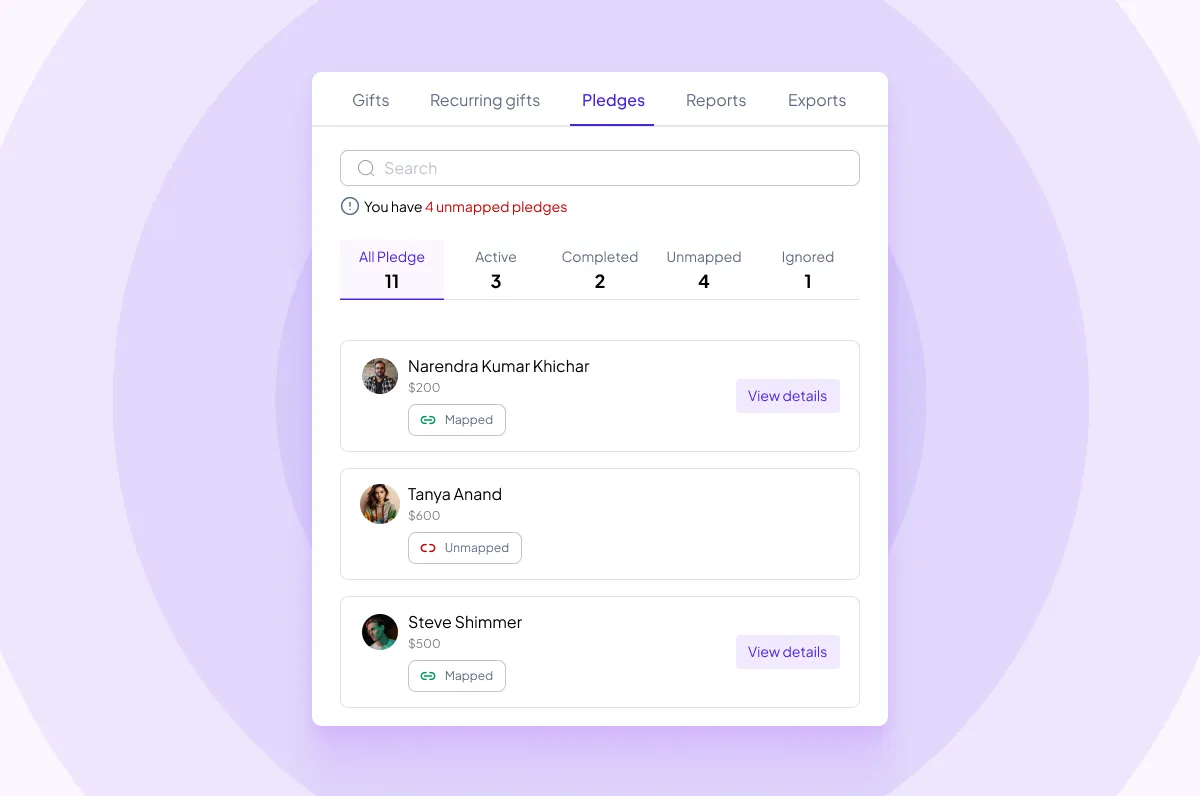
Here's what you can do now that you couldn't before:
Donors see a simple "Pledge for later" option alongside one-time and recurring gifts. They choose their amount, pick a start date (at least 10 days out), and set up their payment schedule, whether that's a single future payment or monthly installments.
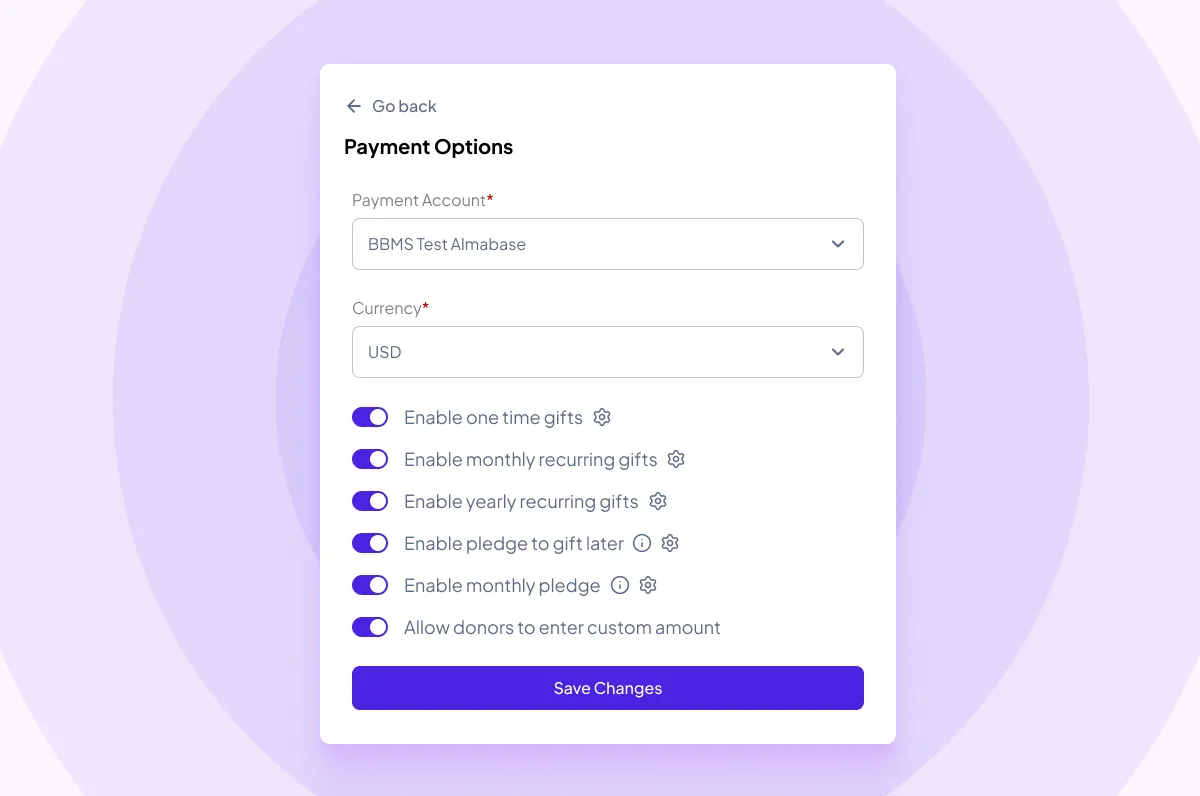
Donors add their payment card while pledging, but nothing gets charged by Almabase. Instead, the card is securely tokenized and passed to Blackbaud Merchant Services (BBMS) and Raiser's Edge NXT (RENXT), which handle all the actual charging. Your donor makes one commitment, and the system takes care of the rest.
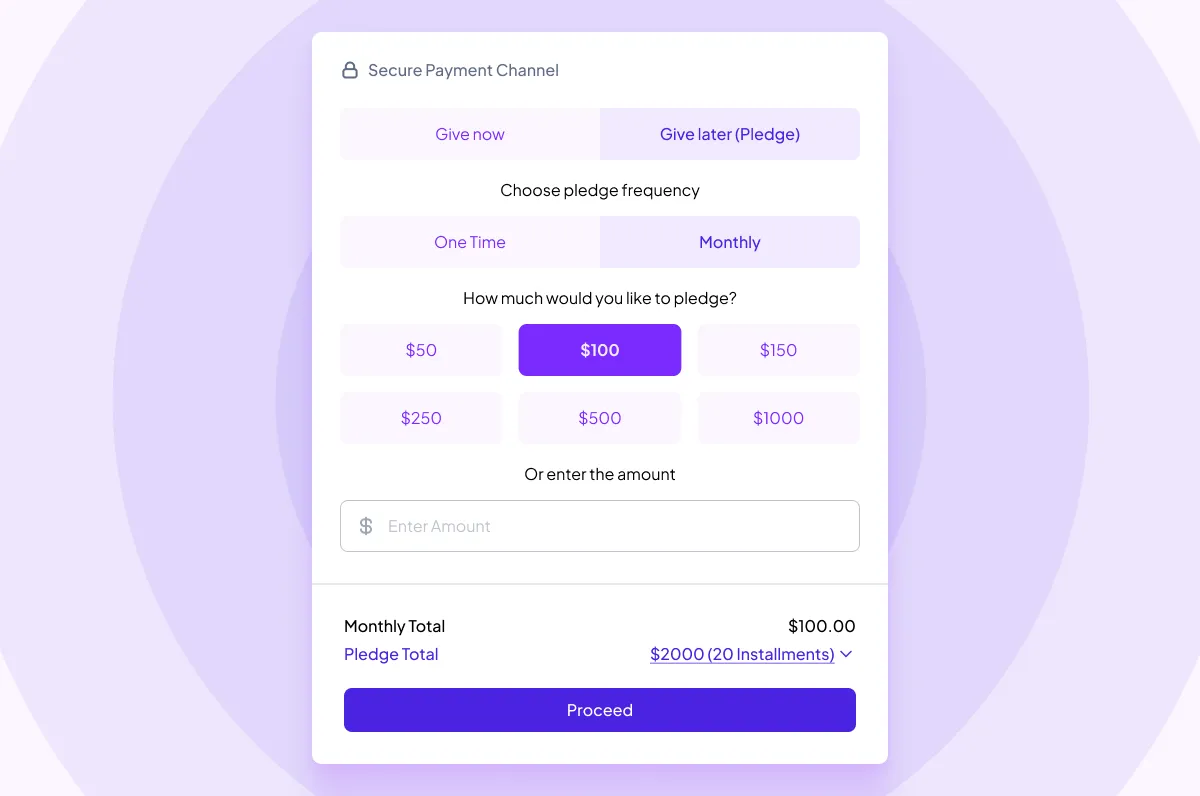
Let the system do the follow-up
Each checkout page now includes a "Pledges" tab with full visibility into status, balance, and installment schedules. Paid, Failed, Overdue, all mirrored from RENXT every single day, automatically.
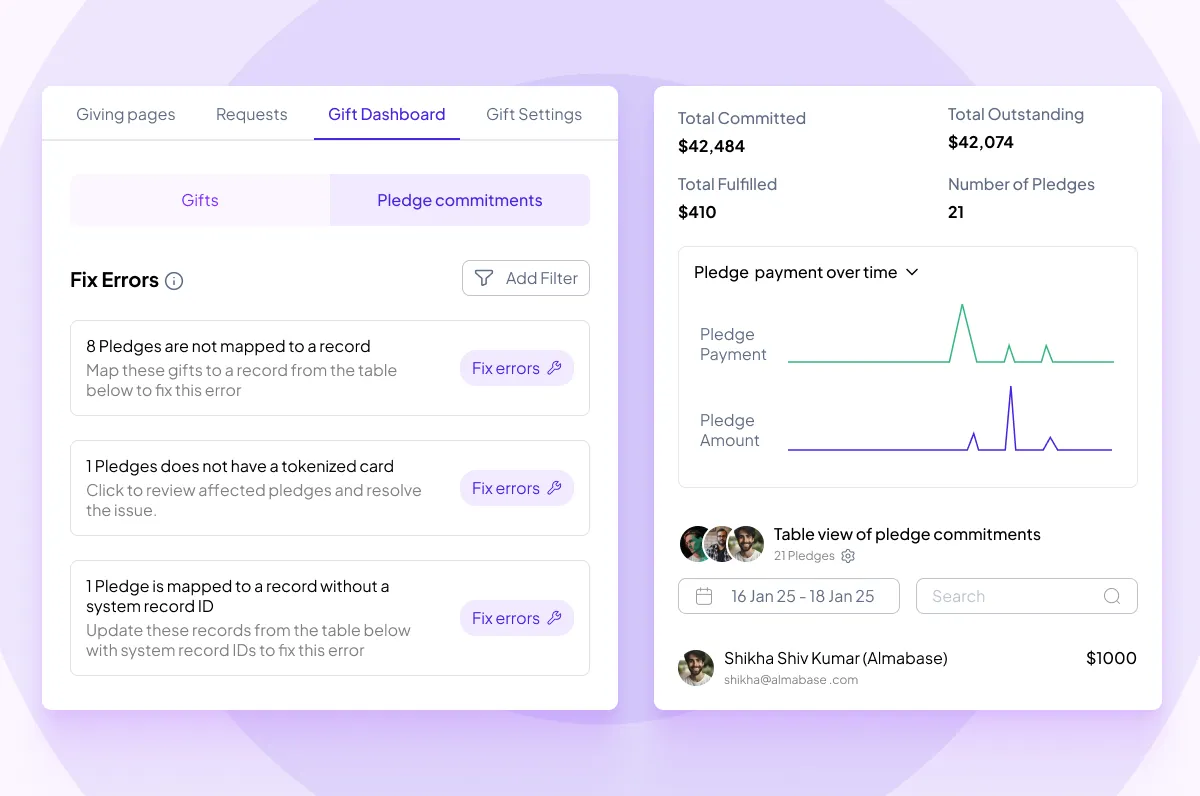
One important safeguard: pledge payments won't execute until they're synced to RENXT. If the first installment date arrives and the pledge hasn't synced, it's automatically cancelled. This keeps your data clean and prevents any surprises.
You stop losing people who want to give
When someone says "I really want to support this, just not this week", you don't have to let them walk away anymore. You've got a real answer for them.
Your follow-up basically runs itself
Remember those pledge tracking spreadsheets? The reminder emails you had to manually send? Yeah, you can retire those. RENXT handles the charges, Almabase keeps your dashboard current, and you get your evenings back.
You can actually plan ahead
There's a huge difference between "Sarah might give us $500" and "Sarah pledged $500 starting March 1st." That difference shows up in your forecasting, your board reports, and how you talk to major donors.
Everyone has less stress
Donors get a straightforward way to follow through. Your team gets reliable data. Nobody's chasing anybody down for forgotten promises.
Just create a new Checkout Page and you'll see the "Pledge for later" option. One heads up: your BBMS needs to have CSC set to "None," but don't worry. We'll let you know if you need to change that.
(Quick note: This is for BBMS users right now.)
Introducing Pledges on Checkout: Let Donors Commit Now, Pay Later
Introducing Pledge for Later. Let donors commit to future gifts on your checkout page, even when they can't pay today. Automate tracking, reduce follow-ups, and never lose a warm lead. Learn more
Product

.svg)