Want better fundraising results? Segment your alumni! Discover simple ways to tailor your messaging by graduation year, engagement level, location, and more. Learn how to make your outreach more personal and effective with easy-to-use strategies.
Before we get into the HOW, let’s look at the WHY.
Blanket messaging no longer works in today’s era of personalized communication. Alumni want to feel that their connection with their alma mater is meaningful and tailored to them. By segmenting alumni, you can
Now, let’s explore the various ways to segment alumni and how this can supercharge your fundraising efforts.
One of the simplest ways to segment alumni is by their graduation year or class year. This allows you to tailor communications to different generations of alumni, addressing their unique concerns and perspectives.
Why it works: Alumni from different eras have distinct experiences with the institution and likely have different capacities and interests when it comes to giving. Younger alumni may need more nurturing before becoming donors, while older alumni might be more financially stable and ready to make significant contributions.
How to use it: Create targeted messages for specific generations. For example, for recent graduates, focus on career support or networking opportunities. For older alumni, focus on legacy giving, reunion events, or updates on how the institution has grown since their time there.
Not all alumni have the same level of connection with your institution. Some may be actively involved, attending events, volunteering, or giving regularly, while others may have limited or no engagement since graduation. Segmenting alumni by their level of involvement allows you to prioritize your efforts where they’ll have the most impact.
Why it works: Engaged alumni are more likely to contribute financially because they already have a strong connection to your institution. By identifying those who are less engaged, you can also develop strategies to re-engage them and turn them into potential donors.
How to use it: Break alumni into tiers such as highly engaged, moderately engaged, and inactive. For highly engaged alumni, you can focus on major giving campaigns or leadership opportunities. For less engaged alumni, offer opportunities to reconnect, such as attending events, joining regional chapters, or participating in mentorship programs.
Where alumni live plays a significant role in their ability to attend events, contribute to local initiatives, or participate in fundraising campaigns. By segmenting alumni based on location, you can create region-specific appeals and engagement opportunities.
Why it works: Alumni are more likely to participate in activities and donate to causes that are locally relevant to them. Whether it’s hosting a local event or showcasing the impact of alumni contributions in their community, geography-based segmentation can create a more personal connection.
How to use it: Identify geographic clusters of alumni and tailor your communications accordingly. For example, alumni living in major cities might be invited to regional events or gatherings, while alumni living abroad might receive updates on international initiatives or virtual engagement opportunities.
Another effective way to segment alumni is by their career or professional interests. Understanding what alumni do professionally helps you tailor your fundraising efforts to appeal to their passions, industries, or expertise.
Why it works: Alumni are more likely to give if they feel that their contribution will make an impact on the areas they care most about. For instance, if you know that a segment of alumni works in healthcare, you can appeal to them by highlighting fundraising campaigns that support health-related programs or research.
How to use it: Use career data to identify key segments such as healthcare professionals, entrepreneurs, educators, or tech industry leaders. You can then personalize your outreach with relevant projects, opportunities, or networking events that align with the alumni’s professional interests.
Alumni who have donated in the past are valuable prospects for future campaigns. Segmenting alumni based on their giving history allows you to tailor your messaging to past donors differently from non-donors.
Why it works: Past donors are more likely to give again, especially if they’ve had a positive experience with your institution. By acknowledging their previous contributions and showing the impact of their donations, you can increase the likelihood of repeat giving.
How to use it: Create segments for first-time donors, repeat donors, and non-donors. For first-time donors, send personalized thank-you messages and show how their gift made a difference. For repeat donors, offer opportunities to increase their impact through matching gift programs or major giving. For non-donors, consider sharing stories of how alumni support has driven significant change at the institution.
Alumni who were involved in specific activities, clubs, or academic programs often maintain a strong connection to those areas post-graduation. By segmenting alumni based on their affinities and interests, you can tap into their passion for a particular cause or community within the institution.
Why it works: Alumni are more likely to contribute to areas that hold personal significance, such as the athletic program they were part of, the student organization they led, or the academic department that shaped their career path.
How to use it: Leverage affinity data to create targeted campaigns for athletics, arts, specific academic programs, or other affinity groups. For example, if an alumnus was involved in the music program, consider asking for their support in funding scholarships or facilities for the arts.
💡 Discover how American University fosters stronger connections through alumni affinity groups and networks [Read more]
Another powerful segmentation method is to assess the wealth or giving capacity of your alumni. Understanding their financial ability can help you tailor your asks and ensure you’re approaching alumni with appropriate, respectful appeals.
Why it works: Tailoring your ask to someone’s giving capacity ensures that you’re not asking for too much or too little, increasing the chances of a positive response.
How to use it: For those with higher capacity, focus on major gifts, planned giving, or naming opportunities. For alumni with lower capacity, emphasize smaller, recurring gifts that add up over time or suggest other ways they can contribute, such as volunteering.
Alumni at different stages in their lives may have different priorities, capacities, and interests when it comes to giving. By segmenting alumni based on their life stages, such as young professionals, mid-career professionals, retirees, or parents of current students, you can create more relatable and appealing messages.
Why it works: Alumni in different life stages have different motivations. A young alum may be interested in networking or career support, while a retiree may be more focused on leaving a legacy or giving back to future generations of students.
How to use it: Tailor your campaigns to life stages. For young alumni, emphasize career support or paying it forward. For mid-career professionals, focus on networking opportunities or targeted programs. For older alumni, highlight legacy giving or opportunities to make a lasting impact through scholarships or endowments.
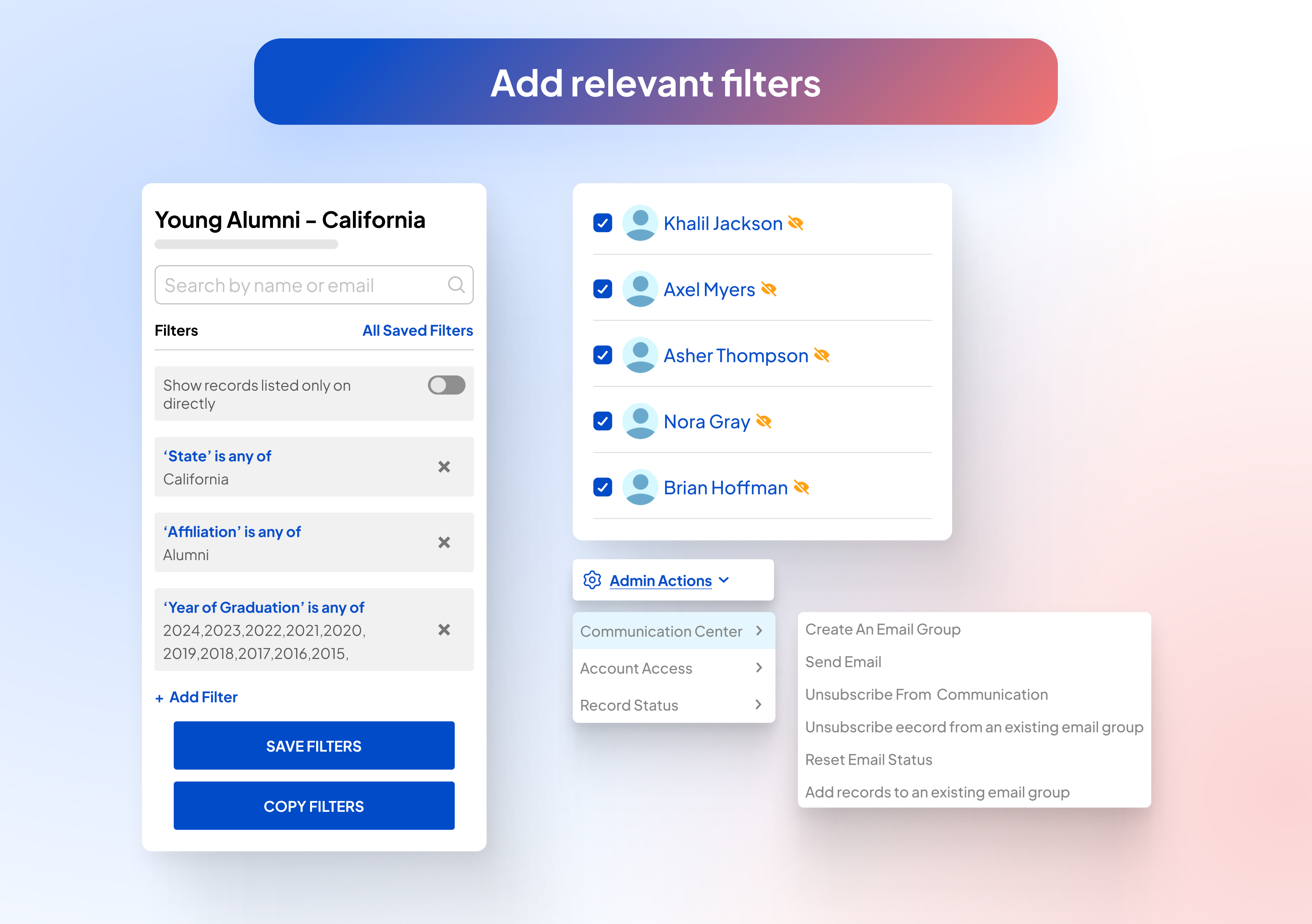
Manually creating these segments can be time-consuming and increase the workload. That’s why it’s crucial to have the right tech stack that automates these filters, allowing you to effortlessly create highly segmented lists and tailor your initiatives, requests, and communications.
Here’s how you can easily create and use segmented lists on Almabase:
For example, if you want to host a young alumni meetup for those living near California and invite them, here’s how you can do it using Almabase:
Table of Contents
Subscribe
See how modern advancement teams bring alumni engagement and fundraising together.
Plan faster. Execute better
Explore free templates designed for alumni and fundraising teams.
Gen Z is the generation born between 1997 and 2012. As current high school students, college students, and young alumni, Gen Z is the prime audience for your university’s digital content. But is your higher education website meeting their needs effectively?
The top college websites are user-friendly, accessible, mobile-compatible, and unique. They offer the authenticity that students and young alumni need to feel strongly connected to their alma mater. If your website isn’t clearing that bar, it could be time for a Gen Z-focused reset.
A Gen Z-friendly website is especially important as more Gen Z members become young alumni. Gen Z's philanthropic engagement has increased by 22% since 2021, making your young alumni a key audience for your university's fundraising efforts.
Below, we’ve created a self-assessment tool with questions to help you determine whether your website is meeting the needs of your Gen Z audience, organized by key website features. Use these guiding questions and tips to help you determine your website’s current state and growth path.
Morning Consult’s Most Trusted Universities report found that, among the four generations surveyed (including Millennials, Gen Z, and Baby Boomers), Gen Z is the least likely to trust higher education institutions. As your digital home, your higher education website is among your strongest tools for building trust with Gen Z students and alumni.
Gen Z craves social proof in the form of unfiltered reality rather than curated experiences. Your website should appeal to that preference by:
These content strategies ensure your digital presence reflects and prioritizes student voices.
Young alumni donors want to see the immediate, tangible impact their contributions will have before deciding to give or engage with your alumni giving program. To meet Gen Z's demand for authenticity, impact stories should focus on individual stories rather than general institutional updates.
For example, avoid generic, nebulous fundraising requests like “Please give to our annual fund.” Instead, send an email asking young alumni to “Help first-generation student Sarah fund essential cancer research to complete her senior thesis.” The second option pulls potential Gen Z donors directly into the story of a real student on your campus who needs help.
Your higher education website must be fully mobile-optimized, as a Harmony Healthcare IT survey found that Gen Z spends an average of 6 hours and 27 minutes on their phones every day.
A seamless, mobile-optimized giving experience is an essential step toward making alumni giving more convenient and less intimidating for Gen Z.
Your website should look good on any device, whether visitors are using a laptop, an Android device, or an iPhone. Keep these elements in mind when optimizing your website for mobile devices:
Your institution can further enhance engagement by creating mobile-friendly online forums or Facebook groups to foster a sense of community among young alumni.
Digital wallets such as Apple Pay, Google Pay, and PayPal are now the third most popular way donors give to nonprofits, surpassing traditional methods like checks.
If your donation checkout process requires entering a 16-digit credit card number and a billing address, Gen Z members won’t take the time to complete their transactions. Integrate one-touch payment options via digital wallets to reduce friction and increase young alumni giving.
An EAB survey found that nearly half of high school students now use AI tools such as ChatGPT and Gemini during their college search, a sharp increase from 26 percent in spring 2025. If your website is invisible to AI search tools, it’s invisible to potential applicants.
GEO is the term for optimizing a website to appear in generative AI search engines for specific queries. Users tend to interact with AI-powered search tools much more conversationally than with traditional search platforms, because they can ask multi-part questions and receive personalized answers.
To ensure your website appears for highly-targeted searches, Kanopi Studios’ guide to AI for higher education recommends providing “specific information on your website that highlights your unique credentials and offerings.”
For example, if your coastal university wants to increase traffic from potential applicants looking for schools by the beach, you could include keywords such as “universities with the best ocean views” and “colleges 30 minutes from the beach” on your student life page.
The National Alumni Survey discovered that only 14% of alumni believe their institution has a good understanding of their current career or life stage. Increase alumni engagement and retention by creating secure portals where they can log in and see personalized gated content, such as a custom alumni or student dashboard that displays relevant information, deadlines, and upcoming events.
Potential and current students, as well as young alumni, want to feel included in your university’s community. They want real-time, transparent information to help them navigate your application process, student life, or the post-grad experience.
Higher education website design and development isn’t just about how your website looks. Gen Z wants to find answers and information about the questions and causes they care most about, such as:
Don’t make website visitors hunt for this information. Use your main navigation menu to share links to essential resources, including your campus security details, environmental sustainability reports, and DEI policies.
The National Alumni Survey found that the vast majority of alumni (86 percent) are very satisfied or satisfied with their student experience, but just 50 percent feel very satisfied or satisfied with their alumni experience. This stark contrast highlights a critical gap that higher education websites can easily address by improving event discoverability.
Though considered a digital-native generation, Gen Z alumni actually crave community. They rank networking opportunities, career support, and sporting events as the three most valuable services offered by their alma mater, demonstrating a clear desire for engagement. By spotlighting relevant event opportunities, your website can help them find their alumni niche.
Make it easy for Gen Z website visitors to find opportunities to connect, such as fundraising events, sporting events, networking meetups, and giving days, on your online calendar. Ensure your calendar offers all the need-to-know information for each event, including how to register, date, time, location, and any associated costs. Additionally, to fully support their desire for community and career development, offer clear information about local alumni groups to join, virtual career prep panels and webinars, and mentorship opportunities with current students.
So, how did you do? If you answered yes most of the time, congratulations; your website is probably in pretty good shape for engaging Gen Z. If you had a few more nos than you’d like, don’t panic. Start by addressing your site’s infrastructure, ensuring it's mobile-friendly and optimized for AI search. Then, build on your approach by layering in the personalization, community-building, and authenticity that Gen Z is looking for. As a result, you’ll be able to build a website that engages your core audience and helps them feel at home with your university.

Is Your Higher Ed Website Meeting Gen Z’s Expectations?
Audit your higher ed website with this self-assessment. Get tips for digital fundraising, mobile UX, and AI discoverability to engage Gen Z students and alumni.
Alumni Engagement
Picture the basket nobody glances at twice - shrink-wrapped, full of gift cards to popular stores and individually wrapped chocolates. It’s sitting next to a hand-packed wooden crate with a local chef's sauce, a pottery mug from a neighborhood studio, and a card that reads "Saturday Morning Trek in Our City." Both probably cost the same to assemble, but only one of them starts a bidding war.

Research shows that experience-based and thoughtfully curated auction items raise 20 to 30 percent more than generic physical goods. This guide is for fundraisers putting those baskets together, whether for a school event, nonprofit gala, alumni weekend, or a community fundraiser. Below, you'll find 18 silent auction basket ideas, each with sourcing suggestions and best-fit audiences.
Baskets are easy to assemble: local businesses say yes, item prices are flexible, and a good theme easily travels from a school event to a nonprofit gala. Community-sourced items consistently out-earn generic catalog items, because a "Spa Day at [local wellness center]" carries weight a generic "$50 massage voucher" won’t. Local sourcing also gives you the flexibility to tailor baskets to different audiences, such as parents, alumni, donors, teachers, and local supporters.
There are maybe ten seconds before someone at the bidding table moves on. In that window, three things do the most work.
A bidder scans the table looking for something that catches their eye. The faster your basket answers "who is this for and what does it feel like to receive it," the better. BidBeacon recommends including a few items that clearly fit your theme, plus one standout piece that's valuable enough to drive competitive bidding.
Experience-based items raise 20 to 30 percent more than physical goods because winning one feels like getting access to an experience rather than collecting another mug for your crowded kitchen shelf. A cooking class, a fitness studio pass, a photographer session: these become the centerpieces that give the whole basket its pazazz.
The opening bid sets expectations in both directions - too low, and the basket reads as low-value; too high, and it doesn't get an early bid to anchor against. LuxGive recommends starting at 30 to 50 percent of fair market value, which tends to invite that first bid and let competitive psychology take over from there.
The audience here usually falls into a few predictable groups: parents who want a special memory from the year for their kids, community members drawn to anything that helps the school, and grandparents who will outbid everyone for something their grandchild's class made together.

Principle for a day - the experience basket. This basket offers something that doesn't exist outside your school: a certificate for the winning child to shadow the principal for a day, make morning announcements, and choose a reward for their class. That specificity is what drives the bid; you can’t buy this at Staples.
What to include:
Best for: Elementary school fundraisers. For parent bidders who want to give their child a story to tell from the school year.
Pro tip: The experience basket can be adapted for any staff role - librarian, PE coach, cafeteria supervisor, and you've got a whole new basket

Every student in a class contributes to a collaborative piece of art: a painted canvas, a mosaic tile, a hand-stamped painting. The winning bidder takes home something that exists nowhere else on earth. The backstory of this project is the whole pitch.
What to include:
Best for: K-8 schools; parent and community bidders; particularly impactful at schools with arts programs.

For middle and high school fundraisers, the baskets that do well usually connect to the specific stage of school life the kids are in. This one speaks to the parent who is already quietly thinking about what the next few years will look like.
What to include:
Best for: Middle and high school audiences, particularly strong with parents of juniors and seniors.

A great option for K-8 audiences where the bidding energy comes from parents who want to buy something that’s genuinely interesting for their kids and also directly useful for their school curriculum. The subscription box shows ongoing value, which makes the basket feel worth more than the individual items inside.
What to include:
Best for: K-8 fundraisers and STEM-oriented parent communities.
Pro tip: Reach out to STEM subscription companies directly and share your school’s 501(c)(3) information. Many do have donation or education-support programs that respond faster than general customer-service enquiries.

Before the event, survey your faculty. Ask what they'd actually want, not what a planning committee assumes teachers want. Build the basket from the real answers, and mention the source in the basket description at the event with a bit of humor. That extra effort and the funny detail give the basket an edge that a generic “teacher appreciation” basket doesn’t have.
What to include:
Best for: The Whole school community; families who want to give something meaningful back to their child's teachers; best at beginning-of-year and end-of-year events.

For parents of young kids, planning a birthday party is a yearly stress test. This basket takes away at least some of that stress, if not all. Any parent who’s been through it will recognize exactly what it offers.
What to include:
Best for: Elementary school audiences with young families; best at back-to-school and spring semester fundraisers.
Pro tip: If your parent community includes someone who does event planning or parties, ask them to donate a coupon. It adds real value and puts their name in front of an audience that will likely need their services soon.
These audiences have typically attended many of these events. They’ve seen all the standard basket types, and they’re not likely to get excited about anything that feels like a placeholder. The ideas below are specific - in theme or in how they’re put together. They will feel fresh in a room full of experienced donors.

A single dinner gift card is appreciated. Twelve of them - one per month, to a rotating set of well-regarded local restaurants is something people will actively try to win.
What to include:
Best for: Couples, young professionals, busy parents who'd genuinely use a monthly reason to get out; strong at galas and alumni events.
Pro tip: Approach the restaurants together, framing the "Year of Date Nights" as a package. Restaurants are more generous when they know they're featured alongside other well-regarded local spots. They're part of a curated package and not just donating free dinners.

Cooking classes with a local chef consistently land among the higher-bidding items at nonprofit events. Mainly because they're hard to arrange on your own. Winning this will feel more like an invitation than a purchase.
What to include:
Best for: Foodie donors, couples, professional communities; strong at spring and fall galas.

The version of this basket that wins bids goes well beyond a standard spa basket. The difference comes down to specificity and quality. For example, a membership to a local studio instead of a generic coupon, high-end skincare instead of a department store brand. Basically, items that come together around an idea of what it really means to relax and restore yourself.
What to include:
Best for: Professional donor communities; women's organizations; health-focused nonprofits; best at spring galas.
Pro tip: Approach the fitness studio as an event wellness partner and not just as a basket donor. Studios are often actively looking for community partnerships.

Every item in this basket comes from a local artisan or small producer, which means every item comes with a story. At a gala full of experienced donors who have bid on baskets after baskets of mass-produced items, something handmade and artisanal will hit the spot.
What to include:
Best for: Community-centered nonprofits; arts organizations; for any event/community with a "buy local" ethos.
Pro tip: Source the whole basket at a single local artisan/farmers market. You build multiple donor relationships in one trip, and "every item in this basket was made in our community" becomes its own selling point at the table.

The version of this that actually draws bids makes the weekend feel fully formed and ready to go. Clear, specific details give bidders an immediate sense of the experience, so they can picture themselves already there and relaxing.
What to include:
Best for: Professional donors; couples and singles alike; best at galas and alumni events where attendees are busy professionals who need a break but won't take one unless it's handed to them.
Pro tip: Boutique hotels are significantly more open to donation partnerships than chains. Community visibility is a genuine advantage for them in a way that it isn't for national brands. You can make that part of your pitch.

Pet owners are a loyal and enthusiastic group at auctions, but they’re often underrepresented at the bid table. A well-made pet basket can quickly become one of the most talked-about items in the room and spark the kind of competitive bidding that draws a crowd.
What to include:
Best for: Community nonprofits; animal rescue organizations; any event where a meaningful portion of the room might own pets.
These ideas don't belong to one event type. With light adjustments, they move from elementary school auctions to nonprofit galas to alumni events.

Seasonal relevance creates a different kind of urgency at the bid table, the sense that this basket is specifically for right now.
What to include:
A fall version can have:
A spring version can have:
Best for: Any event timed to a season; works for family audiences and professional donors alike.

This basket appeals to professionals who travel often - a group that shows up in strong numbers at galas, alumni events, and tends to bid on things they’ll actually use. The right mix of items makes frequent travel feel easier while still feeling a bit indulgent.
What to include:
Best for: Big galas, alumni events; Events with a strong base of frequent travelers.
Pro tip: An airport lounge day pass is a relatively low-cost addition that feels genuinely valuable to anyone who spends a lot of time in airports.

This basket works across age groups. It brings together everything needed for a relaxed, social evening, and the specific game choices help the basket feel thoughtful rather than generic.
What to include:
Best for: Family audiences at school events; younger professional donors at nonprofit galas; mixed-age events.

This buzz about this basket starts before the event. Poll your community through a parent newsletter, email list, or social media and ask what they’d most like to see in a silent auction basket. Then build it using the top responses and name it something like “The One You Asked For.” The process creates a sense of involvement early on, and the people who voted feel a stronger pull to bid on it.
What to include:
Best for: Schools with active parent associations; nonprofits with strong email lists; any community with high pre-event engagement.
Pro tip: Share the poll results in your event communications before the auction. It keeps the basket part of an ongoing conversation and builds anticipation.

This basket highlights the best of the neighborhood. Include gift cards to six or eight local spots - a pet-friendly coffee shop, a family-owned restaurant, an independent bookstore, a new age yoga studio, a farmers market vendor - along with a simple map showing where each one is and a short note about why it’s worth knowing.
This basket tends to hold people’s attention at the table longer; more time at the table often means more competitive bidding.
What to include:
Best for: Community organizations; place-based nonprofits; any event with a strong geographic anchor.

This basket is built for a very specific moment: when someone is sick, worn out, and just wants to feel taken care of. The more thoughtful and well-chosen the items, the more it feels like real relief rather than a generic comfort bundle. The basket name and item list together should answer one question: after what kind of week would someone really be thankful for having this basket around?
What to include:
Best for: Broad audiences - works well with families, professionals, and mixed-age donor groups; best at any event at the start of a new season/the flu season.
Pro tip: Add a simple “doctor’s note” style card with light humor. It makes the basket feel more personal and will make the winner chuckle through their blocked nose when they finally use it.
A silent auction does not start when the doors open. It starts when the first invitation hits someone's inbox, and it does not end when the winning bid is logged. What happens in the weeks before and the days after determines whether that night builds into something or stays a one-time event. Almabase is built for that full journey.
Almabase centralizes registration and ticketing in one place, so your team doesn’t have to juggle multiple systems in the days leading up to the event. Make it easy for your attendees, donors, parents, alumni, and supporters to register for your fundraising event by using a platform that integrates everything.
Send targeted reminders, invitations, and updates to the right audience segments before and after the event. Almabase helps you tailor communication for returning attendees, first-time supporters, and everyone in between.
The supporters who show up for a silent auction are exactly the people worth staying in touch with. Almabase gives teams the tools to keep that conversation going after the event closes - through community features, engagement tools, and communications.
Create a smoother path from participation to giving. Almabase connects event attendance, donation pages, and gift tracking, so supporters can move naturally from showing up to making a gift without switching platforms. Learn more here.
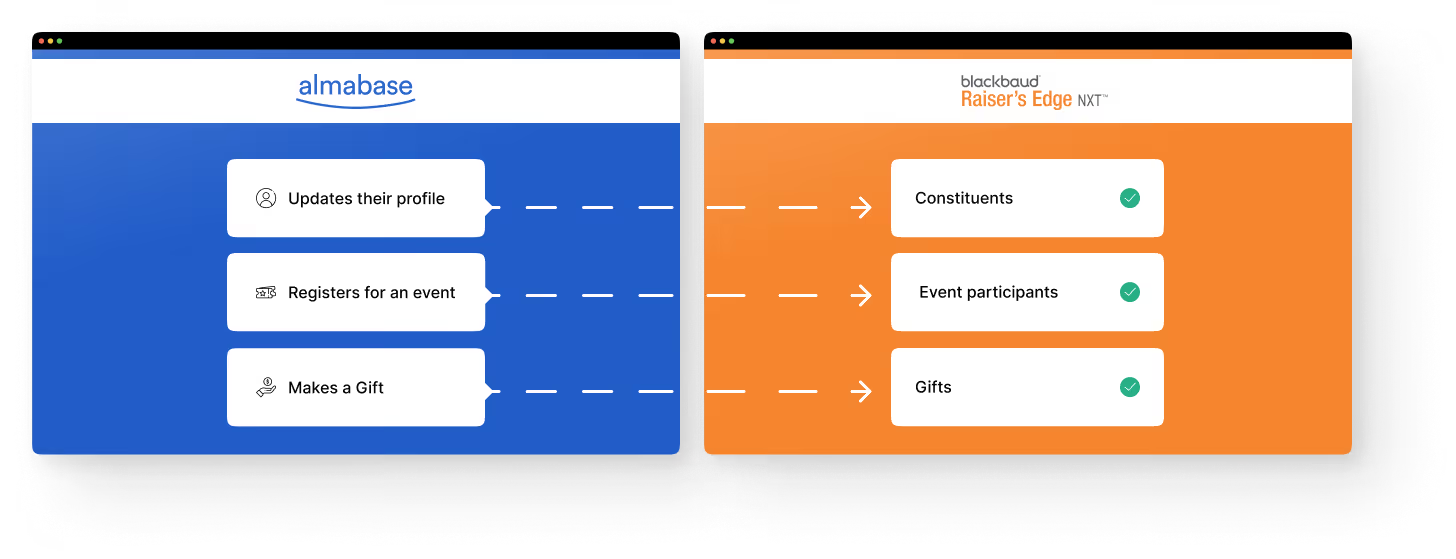
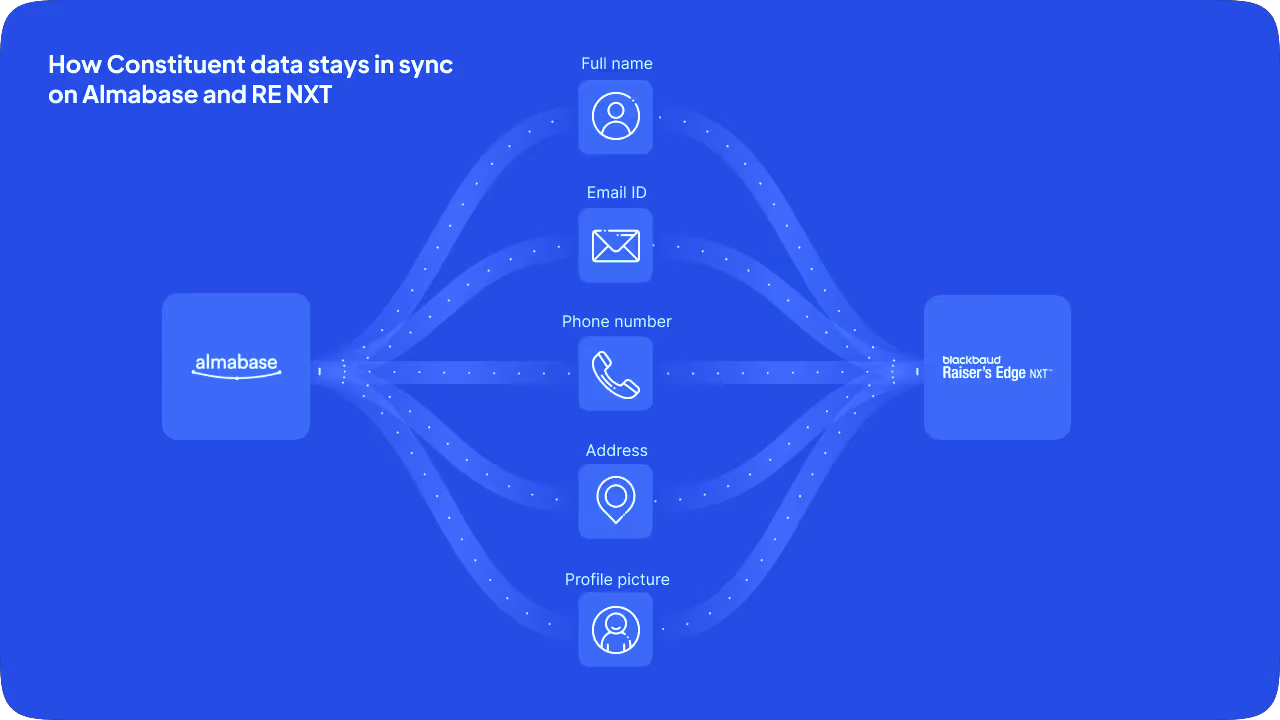
Capture the engagement data your team needs to strengthen future campaigns, donor outreach, and event planning. Almabase syncs this information to your CRM in real time, helping you build on each event rather than starting over.
If your school or nonprofit wants to run smoother, more effective fundraising events, especially if you're managing multiple events a year across disconnected tools, it’s worth exploring a more integrated approach. Almabase can help create a more organized, engaging experience for your community. Book a personalized demo to learn more!
.avif)
18 Silent Auction basket Ideas for Schools and Nonprofits
Discover 18 silent auction basket ideas that raise 20-30% more for schools and nonprofits. Themes, sourcing tips, and pricing advice to spark bidding wars.
Fundraising
Fundraising success doesn’t solely depend on your donors. Setting a fundraising goal can help advancement teams target alumni better, make the best use of available resources, and provide much needed structure while raising money.
With giving making up around 10% of an institution’s educational and general expenditures, a reliable, scalable strategy ensures you’re getting the most out of your campaigns.
This guide explores goal-setting and strategies on how to promote a fundraiser, with valuable fundraising tips thrown in.
It is possible to set nuanced goals based on data using various tools. That being said, you should choose the right areas of focus and aim for ambitious, yet realistic numbers. Here’s how you approach setting an effective fundraising goal:
It’s so much easier for alumni to donate when they relate to a particular cause, as opposed to participating in generic campaigns with no visibility into where the money goes.
Your campaign can be tied to a variety of initiatives associated with infrastructure, scholarships, research programs, sports development, fostering communities, or even charity activities.
For example:
Study both financial and engagement data from campaigns across the previous couple of years. This helps you set realistic expectations, while identifying areas for improvement.
There’s a lot of engagement metrics that cater to measuring different outcomes, but in a fundraising context, you should ideally focus on:
While reviewing financials, make sure to include the following:
More often than not, there’s a disparity between the expectations of advancement teams and the leadership. This approach helps bridge that gap, making sure everyone is aligned on the goals.
Leadership sets a goal based on the needs of the institution, while working teams also do the same from the ground up after reviewing prospect and pipeline data. The final figure is a compromise between the two.
Example: Your institution needs $200,000 in order to finance a new sports facility, and that is leadership’s goal. The fundraising team reviews previous data and arrives at $150,000 as a more realistic goal. After negotiating with each other, the final target is decided to be $178,000.
While it’s great to have a practical number backed by data, stretch goals can encourage teams to connect with more prospects and provide a quality experience. They can also be tied to new initiatives that haven’t been tested before – say, hosting a fundraising marathon for the first time.
Stretch goals can incentivize experimentation with purpose. You can try different types of events and see what works best for you, without being overly reliant on them.
You’ll want to monitor both activity and numbers, so set the key performance indicators accordingly. Breaking down the overall goal into multiple smaller goals for the teams involved and the different alumni segments participating makes it easier to track progress and achieve the final figure.
KPIs can change according to an institution’s working structure and needs, but including the following essentials would be helpful:
It can be easy to let qualitative metrics slip by and focus purely on financial goals. But a successful fundraising event doesn’t just rake in donations, it manages to retain previous donors, bring in new ones, and recover lost donors.
Have goals centered around participation rate, event engagement, geographic diversity, donor motivations, retention, and communication styles.
These may not be straightforward, but are very much influential in ensuring active and prolonged fundraising contributions.
The examples outlined below have one thing in common – they all fit into the SMART framework:
This framework ensures relevancy, and can help with prioritizing important goals.
Major gifts typically constitute the majority of the money received during a fundraising campaign. Decide on the number of major donors and the money you aim to raise from them.
This goal works well as it encourages interaction with donors who directly influence campaign success.
Pointers and tips:
Donors aren’t going to continue contributing without good reason. One-time contributions are nice, but it’s always easier to retain donors than acquiring new ones. Recurring donors are a steady, reliable source of gifts over a longer period of time.
This goal makes sure the emphasis isn’t purely on first-timers but also on developing and maintaining relationships with existing donors.
Pointers and tips:
It’s not the only metric that matters, but total financial contributions is the most influential factor in determining campaign success. An overall fundraising goal is a must for every campaign.
If you’re raising for multiple causes, have sub-goals for each one. This will help you divide effort and resources based on what is being expected.
Pointers and tips:
While large donations are valuable, widespread participation signals a strong, engaged community. This goal focuses on increasing the number of alumni who contribute, regardless of gift size.
A high participation rate signals good outreach and promotion, and a lack of the same can help you tweak marketing and communications for better engagement in upcoming campaigns.
Pointers and tips:
Loyal donors and recurring donations ensure stability, but a steady influx of new donors in every fundraising campaign is necessary for it to be sustainable. Expanding your donor base not only reduces over-reliance on existing contributors but also builds a pipeline for long-term giving.
This goal is all about converting non-donors (younger alumni and recent graduates, typically) into first time contributors.
Pointers and tips:
Corporate sponsorships are a steady, reliable source of revenue. Additionally, they increase visibility and awareness significantly, rallying more donors to your cause.
You should be hunting for sponsorship opportunities throughout the year, but this goal helps you evaluate the good ones that align with not only financial goals, but also institutional values.
Pointers and tips:
Digital channels make it easier to reach donors without the constraints of location, logistics, or event timelines. This goal focuses on driving a defined portion of your total funds through online platforms like your website, email campaigns, and social media.
It helps you build a repeatable system for fundraising instead of relying heavily on one-off events or offline efforts.
Pointers and tips:
Fundraising doesn’t start with an ask. It starts with consistent communication and visibility. This goal focuses on how often and how well you engage with your donors outside of active campaigns.
It ensures that your organization stays top of mind, making future fundraising efforts more effective.
Pointers and tips:
Instead of focusing broadly on repeat donations, this goal is about building and growing a structured recurring giving program. That means getting donors to opt into a system, not just give again occasionally.
A well-defined program gives you better visibility into future income and reduces the uncertainty that comes with one-time campaigns.
Pointers and tips:
A good promotion campaign utilizes multiple channels, personalized messaging, and consistent touchpoints over a period of time anywhere between a few weeks to a couple of months.
Here, we explore strategies that can boost campaign visibility and engagement, and show you how to fundraise more effectively across channels.
A simple, descriptive title is the best way to get the core message of your campaign across. It should also indicate what cause you’re raising money for. A good title is concise, straightforward, and memorable. A few good examples are ‘Break the barrier - make education affordable’ (if you’re raising money for a scholarship), ‘Help us launch a library’ (if you’re, well, launching a library).
The campaign message should highlight your cause and should be easy to sympathize with. What you’re raising money for, how donations will help, and how you’re planning to use the money – including all of these makes it easier for the donors to understand your need and support the institution.
Add a personal touch if possible, and use an honest, warm tone throughout.
Use your institution’s website to highlight upcoming fundraising events. Creating a separate landing page is a great way to share details. Include the campaign title, message, and even your targets to give donors a goal to work with.
Make registration easy. A simple workflow gathering only the necessary details is enough. A long registration process drives prospects away more often than not. Integrate digital giving by setting up suggested donations, and include a custom option that can be used.
For large-scale outreach, email marketing remains one of the best tools. You’ll be using it for three things – sharing upcoming events, sending ticket/donation links, and sharing reminders for the event. Emails are also used for stewardship programs post-event.
Create segmented campaigns based on graduation year, program, giving patterns, or geography, and personalize messaging accordingly. Generic emails feel low-effort and make it harder to relate to your cause.
Plan outreach and sequencing at least a few weeks prior. Reminders/follow-ups should be spaced out and shouldn’t feel spammy.
Social media is a more creative channel, and is great for drawing attention to various issues and causes, including yours. Use multiple formats like slideshows, videos, text, and pictures to spread awareness, celebrate previous contributions, and the progress being made.
Engage your donors through polls, contests (a 24-hour giving challenge, for example), quizzes, etc. Start a countdown before the event to create a sense of urgency.
Share updates constantly during the fundraising event period to gain more contributions.
Fundraising is built on trust. Include alumni ambassadors, well-known volunteers, and department heads in your promotion strategy. Encourage them to post on socials and connect with alumni. Familiarity helps – prospects are more likely to engage with someone they know.
Organize friendly contests between departments, batches, or programs to add a bit of fun while furthering a cause.
Even with the right intent, teams often fall into patterns that limit the effectiveness of their fundraising efforts. Being aware of these pitfalls can help you build a more practical and scalable strategy.
It’s tempting to aim high without grounding targets in historical data or current capacity. Goals that aren’t backed by past performance, donor insights, or pipeline strength often lead to missed expectations and disengaged teams.
A strong goal should feel ambitious, but still achievable with the resources and audience you currently have.
Focusing too much on major donors or, conversely, only on small contributions can create imbalance. If one segment underperforms, the entire campaign suffers.
Diversifying your donor base – major donors, recurring contributors, and first-time givers – creates a more dependable strategy.
Fundraising success isn’t just about the total amount raised. Teams that overlook participation, engagement, and retention miss out on long-term growth opportunities.
Campaigns that bring in new donors, re-engage inactive ones, and strengthen relationships often provide more value over time than a one-time spike in donations.
When leadership sets aggressive targets without input from fundraising teams, execution suffers. Misalignment leads to unrealistic expectations, poor planning, and inconsistent messaging.
Using structured approaches like the top-down, bottom-up framework ensures that goals are both visionary and practical.
Even well-planned campaigns can underperform if promotion isn’t given enough attention. Waiting until the last minute to start outreach limits visibility and reduces participation.
Promotion should run parallel to planning, with consistent messaging across email, social media, and peer networks.
Some teams stick rigidly to their original plan, even when early indicators suggest something isn’t working. Whether it’s low engagement, poor email performance, or weak event turnout, ignoring these signals can impact contributions.
Regular check-ins and flexibility allow you to refine messaging, reallocate resources, and improve outcomes when things aren’t going great.
Setting fundraising goals, crafting strategies, and executing them smoothly involves a multitude of tasks whether that’s scraping data, coordinating outreach campaigns, designing giving pages just to name a few.
Handling these workflows using too many tools and teams often leads to a gap in communication or misalignment.
Almabase’s giving platform integrates all the necessary workflows inside a single module, bringing much-needed structure to fundraising chaos:
Looking to get more out of your campaigns? See how Almabase can help you achieve your fundraising goals here.


How to Set Fundraising Goals and Build a Winning Strategy
A fundraising goal sounds simple on paper but is the main pillar for much of your advancement and giving-related goals. Learn how to set one that fits your team.
Fundraising