Find short donation message examples for real campaigns. Use practical templates to create clear, actionable messages across channels.
Almabase
Published:
May 5, 2026
Discover AI Summary
• To boost quick giving, make your donation messages short, highly personalized, and always include a crystal-clear call to action, especially since donors often decide in a flash and often on their phones.
• These concise messages are incredibly effective for urgent fundraising campaigns, text-to-donate efforts, and social media outreach, helping you capture attention and drive immediate donor participation.
• Remember that personalization is key; simply using a donor's name or acknowledging their past support makes the message feel much more relevant, fostering stronger alumni engagement.
• A strong, direct call to action, paired with an easy-to-follow link, removes any guesswork for potential donors, making it effortless for them to support your cause and complete their gift.
• Consider using platforms like Almabase to automate personalized text messages and segment your audience using CRM data, which streamlines outreach and keeps your fundraising campaigns running smoothly.
• Don't just set it and forget it—regularly test different message versions, tones, and CTAs to discover what truly motivates your specific donor base and optimize your results.
• And finally, a quick, heartfelt thank-you message after a donation is crucial; it acknowledges their gift, reinforces their impact, and helps build lasting relationships that encourage future support.
A donor rarely spends time deciding whether to give to a cause they care about. Most of it happens quickly, often in a single glance.
Short donation messages are built for exactly that moment. They help you communicate the ask clearly without slowing the decision down.
This also shows up in how donors prefer to be reached. Bandwidth's State of Messaging report states 13.1% of people prefer SMS for communication about causes and organizations they care about. That makes short, well-timed messages even more important in fundraising outreach.
In this guide, we’ll share short donation message examples you can use across text, email, and social channels to drive action. We’ll also show you how to create messages that feel natural and perform consistently across campaigns.
Short donation messages work best in moments where donors are already deciding whether to act. This could be right after they read about your campaign, see a peer share it, or receive a reminder during a live fundraiser. At that point, they don’t need more information, just a clear next step. A short message provides the next step without adding extra details.
Here are the situations and channels where short donation messages consistently drive the strongest results:
SMS is built for immediacy. In fact, text messages still see open rates above 98%, making them one of the fastest ways to capture attention. Short, actionable messages work best here because they align with how people use their phones. A clear instruction, like clicking a link or replying with a keyword, removes friction and increases conversion rates, especially during giving days or live campaigns, where timing directly impacts participation.
On platforms like Instagram, Facebook, and X, users scroll quickly and engage selectively. Short donation messages work because they capture attention without demanding too much time. When paired with strong visuals or videos, a concise line can drive shares, comments, and clicks. This is especially useful for peer-to-peer fundraising, where messages need to be easy to repost and amplify across networks.
While email allows for longer content, shorter messages tend to perform better in both subject lines and key sections of the email body. Donors often scan emails rather than read them fully, especially on mobile devices. A direct call to action placed early in the email increases the likelihood of engagement. Even in longer emails, the most effective parts are usually the short and clearly written donation prompts.
Time-sensitive campaigns are where short messages have the strongest impact. They create urgency without overwhelming the reader, helping them make quick decisions and take immediate action. Whether it’s the final hours of a giving day or a crisis response campaign, a short message often drives faster conversions than a detailed appeal.
Short donation messages work best when they feel natural to the channel and the moment. The structure usually stays simple: a quick context, a clear ask, and an easy next step. What changes is the tone, depending on who you’re speaking to and where the message appears.
Below are ready-to-use examples tailored for different campaign types and platforms.
These messages are meant for broad outreach where you’re engaging a wide audience without much context. They work well across email, SMS, and website banners where clarity matters most.
Hi [Name], we’re close to our goal for [campaign]. A quick gift today can help us get there. [Link]
Hi [Name], your support keeps [program] running. If you’ve been thinking about giving, now’s a great time. [Link]
Hi [Name], we’re reaching out to a small group before we go broader. Would value your support if you’re open to it. [Link]
These focus on impact, helping donors quickly understand what their contribution supports. They’re especially effective on donation pages and email campaigns.
Hi [Name], your gift today goes directly toward [specific outcome, e.g., funding 3 research grants]. You can be part of that here. [Link]
Hi [Name], we’ve made progress on [initiative], but there’s still a portion left to fund. Sharing the link if you’d like to help.
Hi [Name], donors this week have helped us reach [milestone]. Your support today keeps that progress going. [Link]
School campaigns benefit from messages that connect directly to students and community outcomes. These are commonly used in alumni outreach and annual fund campaigns.
Help students access better learning opportunities this year. Support here: [Link]
Hi [Name], your graduating class is supporting [program]. Adding your name would help push it further. [Link]
Your support keeps programs like [sports/labs/scholarships] going. Give here: [Link]
Peer-to-peer messages should feel personal and conversational. These work best on messaging apps and direct outreach.
Hey [Name], I just supported [cause]. Thought I’d share in case you want to join in: [Link]
A few of us are contributing to [campaign]. Passing this along if you’d like to take a look: [Link]
Hey [Name], I came across this initiative, and it’s doing meaningful work. Sharing in case you want to check it out.
These messages are ideal for seasonal or gift-based campaigns where the focus is on meaning and impact rather than urgency.
A small gift today can support [cause] in a meaningful way. Contribute here: [Link]
Looking for a more intentional way to give this year? Consider supporting [initiative]: [Link]
Your contribution today helps create lasting impact for [community]. Give here: [Link]
SMS messages need to be clear and immediate, with one simple action. These are best used for time-sensitive campaigns.
Hi [Name], we’re close to our target for today. Can you help us get there? [Link]
Only a few hours left to support [campaign]. Be part of it here: [Link]
Hi [Name], we’re 8 donors away from hitting today’s target. You can help us cross it here. [Link]
On social platforms, messages need to be quick to read and easy to engage with. Pair these with visuals or campaign updates.
Support [cause] today and help us reach our goal: [Link]
Join others supporting [campaign]. Every contribution makes a difference: [Link]
Be part of this effort to support [community]. Contribute here: [Link]
Email allows slightly more context, but the ask should remain clear and upfront. These work well as part of campaign sequences.
Hi [Name], we’re nearing our goal for [campaign]. Your support can help us finish strong: [Link]
This is a quick note to invite you to support [initiative]. You can contribute here: [Link]
As we wrap up this campaign, we’re reaching out to a few more supporters. Join us here: [Link]
These highlight the added impact of giving at the right time. They are most effective during giving days or milestone campaigns.
Your contribution today will be matched. Double your impact here: [Link]
A matching grant is active for [campaign]. Make your gift go further: [Link]
Every dollar given today is being matched. Take part here: [Link]
When tied to events, the message should connect participation with impact. These are useful before, during, and after events.
Support [event name] and help us reach our fundraising goal: [Link]
As we prepare for [event], your contribution helps make it possible. Give here: [Link]
Be part of [event] by supporting the cause behind it. Donate here: [Link]
Across all these examples, the principle stays consistent: keep the message focused on one idea and guide the reader toward a single next step.
Short donation messages work because they remove friction. But what actually makes them effective is how clearly they connect with the donor and guide them toward action.
Across all successful donation campaigns, two elements consistently stand out: personalization and a strong call to action. Personalization makes the message feel relevant, and a strong call to action makes it easy to respond. When both come together, even a short message can drive meaningful engagement.
Personalization is what turns a generic message into something that feels intentional. Even small details like using the donor’s name, referencing their past support, or acknowledging their connection to the cause add context without adding length.
In practice, personalization can be as simple as:
The goal is to make the message more relevant. When donors feel the message is meant for them, engagement naturally improves.
A short message only works if the next step is clear. This is where the call to action plays a critical role. A strong CTA tells the donor exactly what to do and removes any ambiguity. Without it, even a well-written message can fall flat.
The CTA should be direct, short, action-oriented, easy to follow, and especially tailored for mobile devices where most messages are read. Effective calls to action usually:
For example, “Support the campaign” is more effective than a vague closing line, and “Help us reach our goal today” creates a clearer sense of timing.
The key is simplicity. When donors don’t have to think about what to do next, they’re far more likely to act.
Once you’ve seen what effective short donation messages look like, the next step is building your own.
The key is to treat donation messaging as a repeatable process. When you combine the right tools with a few practical best practices, it becomes much easier to create messages that perform well across channels.
As campaigns grow, manually sending and managing messages becomes inefficient. This is where platforms like Almabase help streamline the process by combining messaging, fundraising, and CRM data in one place.
With Almabase’s crowdfunding platform and multi-channel bundle, teams can automate outreach while still keeping messages personal and relevant. In practice, this allows you to:
This approach reduces manual work while making every message feel more targeted. Instead of sending one generic message to everyone, you can deliver the right message to the right group at the right time.
Not every campaign needs the same tone or structure. A message that works for a year-end appeal may not work for a last-minute push on giving day.
The most effective messages align closely with the campaign objective. That means adjusting both the tone and the call to action based on what you’re trying to achieve. For example:
The closer your message aligns with the campaign context, the easier it becomes for donors to understand why they should act now.
Even small changes in your words can make a noticeable difference in results. That’s why testing should be a regular part of your messaging strategy.
Instead of relying on assumptions, use simple A/B testing to compare different versions of your messages. This helps you identify what resonates most with your audience. You can test variations such as:
Over time, these insights help you build a stronger messaging playbook. What starts as experimentation becomes a set of proven approaches you can reuse across campaigns.
A well-crafted donation message can drive action, but what happens next shapes the relationship that follows.
It’s easy to focus on getting the message right before the donation. But what you say after someone gives often has a bigger impact on whether they stay connected.
Short follow-up messages work best here because they feel timely and genuine. A quick thank-you, sent soon after the donation, reassures the donor that their contribution was received and valued. It also keeps them connected to the impact they’ve made.
The goal is simple: acknowledge the gift, reinforce the impact, and keep the door open for future engagement.
Thank-you message examples
These messages are ideal for immediate follow-ups via SMS or email confirmations. They should be warm, direct, and specific where possible.
Follow-up and engagement messages
After the initial thank-you, it’s important to keep donors informed without overwhelming them. These messages help maintain connection and build trust over time.
Consistent follow-up builds familiarity and trust. When donors feel informed and appreciated, they’re far more likely to stay engaged and support future campaigns.
Most donation messages don’t fail because of the cause but because the message doesn’t land fast enough.
Short donation messages work because they respect how people engage. When your message is clear, relevant, and easy to act on, you remove the biggest barrier to giving. When you combine personalization, a clear call to action, and the right channel, even a few lines can drive meaningful results.
As you start crafting your own messages, think about this. Are you making it easy for someone to understand the impact? Are you guiding them toward a single, clear action? And are you reaching them in the moment they’re most likely to respond?
Use the examples and best practices in this guide as a starting point. Test what works for your audience, refine your approach, and build a messaging style that feels consistent across campaigns.
If you’re looking to scale this without adding manual effort, platforms like Almabase can help you bring everything together. From personalized outreach to automated campaigns and real-time tracking, it makes it easier to deliver the right message at the right time.
Want to see how this works in practice? Request a demo now.
A short donation message is a concise fundraising appeal designed to quickly communicate the purpose of a campaign and prompt immediate action. It is commonly used in SMS, email, and social media, where attention spans are limited, and clarity is critical to getting a response.
The ideal length of a donation message depends on the channel. For SMS, it should stay within 160 characters to ensure readability. For email or social media, messages can extend up to 250–300 characters while still remaining clear, focused, and easy to act on.
An effective donation message clearly communicates the purpose of the campaign, highlights the impact of giving, and includes a strong call to action. It should feel relevant to the audience and guide them toward a single, simple next step without overwhelming them with too much information.
Short donation messages can improve response rates because they are easier to read and process quickly. When donors don’t have to spend time understanding the message, they are more likely to act immediately, especially in time-sensitive campaigns or mobile-first communication channels.
Short donation messages are versatile and can be used across multiple channels, including SMS campaigns, email subject lines, social media posts, peer-to-peer outreach, and urgent fundraising appeals. They are especially effective in situations where quick decisions and immediate responses are important.
Personalizing a donation message involves tailoring it to the recipient using details such as their name, past contributions, or connection to the cause. This makes the message feel more relevant and intentional, which can increase engagement and improve the likelihood of a response.
Table of Contents
Subscribe
See how modern advancement teams bring alumni engagement and fundraising together.
Texting has quietly become one of the most effective ways to reach donors. In this blog, you’ll see real examples of fundraising texts, understand what makes them effective, see sample fundraising text message templates that work and learn simple ways to use them in your next campaign.
Text messages have an open rate of about 98%, while email averages only 20–28%. Even better, nine out of ten texts are read within three minutes of landing on someone’s phone.
SMS also drives faster action. The average response time for a text is 90 seconds, while emails take 90 minutes on average. For time-sensitive campaigns like Giving Tuesday, Fundraising Galas or end-of-year appeals, that speed matters.
SMS also outperforms email when it comes to conversions. Depending on the campaign, texts convert between 21–30%, while email responses stay closer to 2–3%. On Giving Tuesday, organizations that used texting saw 84% higher conversion rates than those that relied only on email.
For institutions using RE NXT or similar CRMs, text messaging can work alongside your existing donor segmentation. You can reach people based on giving history, event participation, or engagement level, through the channel they’re most likely to open.
💡Learn how to use text messaging for donor engagement and fundraising
These examples work well for ongoing or all-year fundraising campaigns when you want to make a simple, heartfelt ask.
Hi [Name], it’s [Organization]. We’re $5,000 away from our goal for [specific program]. Can you chip in $25 today? [Link]
Hi [Name], your gift can make a real difference for [specific cause]. Every contribution helps us keep [impact statement, such as “meals on the table for families in need”]. Donate here: [Link]
Quick question, [Name]. Would you consider giving $50 to help [specific outcome]? Every bit of support brings us closer to our goal. [Link]
Hi [Name]. We’re reaching out to our most engaged supporters first. Can you make an early gift of [amount] to [campaign name]? [Link]
[Name], we have a shortfall in funding for [program]. Your gift of any amount today will help us close the gap. Give here: [Link]
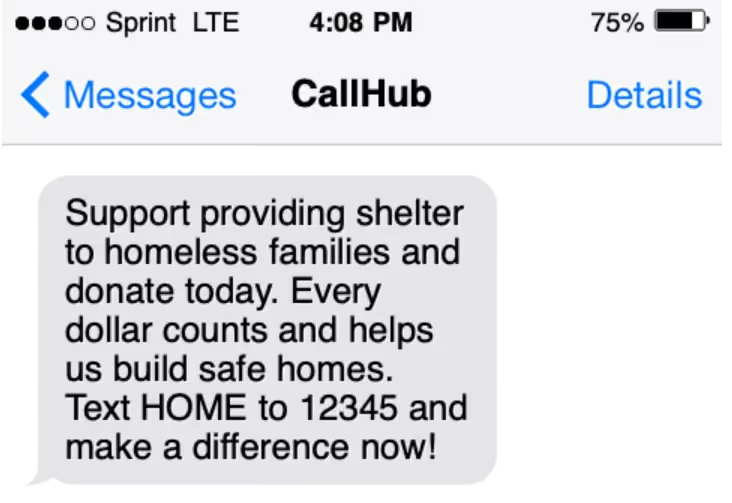
Urgency can be one of the strongest motivators for giving. When your donors know there’s a deadline or a goal within reach, they’re more likely to take action right away. Short, time-bound messages like these can help you make the most of that window of attention.
Hi [Name], we have 48 hours left to reach our goal. We’re still $3,000 short. Can you give $25 right now? [Link]
Only 6 hours remain! We need 50 more donors to unlock our challenge grant. Be one of them: [Link]
Deadline tonight at midnight. Your gift will be matched dollar for dollar, but only if you give before [time]. [Link]
[Name], we're 80% to our goal with just 12 hours left. Can you help us finish strong? [Link]
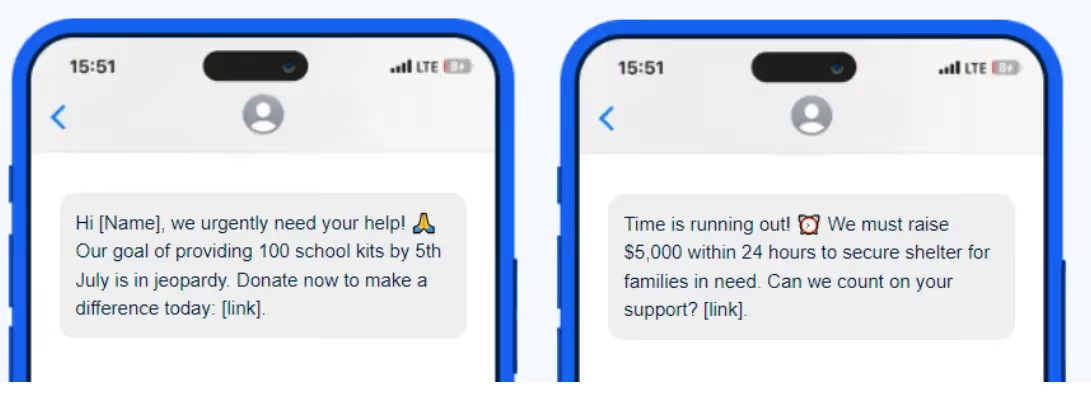
Events give you a chance to bring donors together, celebrate milestones, and raise additional support. A well-timed text can boost attendance and remind supporters why their presence, and their gifts, matter.
Hi [Name], join us for [event name] on [date]. Your participation helps raise funds for [cause or program]. Save your spot: [Link]
Only 20 seats left for [event name] this [day]. Every ticket supports [specific goal or program]. Register now before they’re gone: [Link]
[Name], [event name] happens tomorrow at [time]! Your attendance helps us reach our fundraising goal for [cause]. Here’s a key detail before you arrive: [Key detail]. See you there!
Last call for [event name]! Doors open in two hours. Join us and help make a difference for [cause]. RSVP now: [Link]
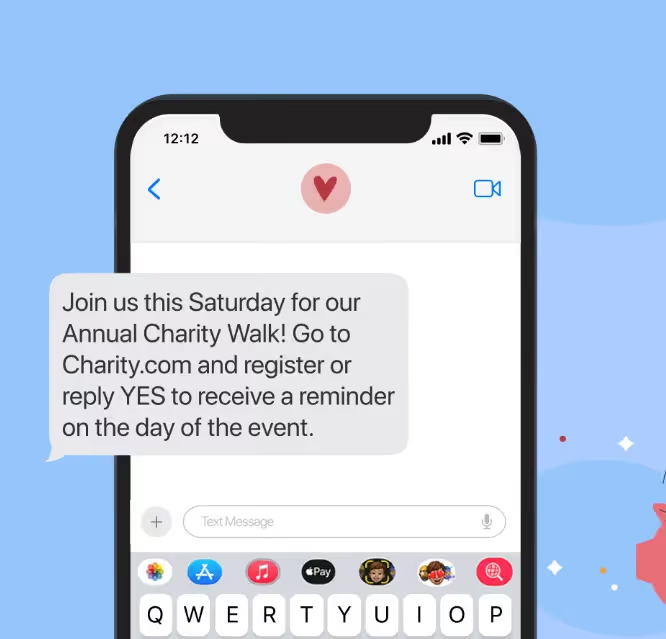
Few messages spark action faster than one that says, “Your gift counts twice.” Matching gift campaigns work because donors can immediately see the bigger impact of their support. A short, clear text that highlights the multiplier effect often drives quick responses.
Great news, [Name]! Every gift made today will be matched two to one. Your $50 turns into $150 for [cause or program]. Give now: [Link]
[Name], a generous supporter is matching all donations up to $10,000. This is your chance to double your impact for [specific cause]. Donate here: [Link]
Your employer might match your gift to [Organization]. Check your eligibility and make your donation go twice as far: [Link]
[Name], we still have $5,000 left in matching funds, but only until [time]. Give today and see your contribution doubled instantly: [Link]
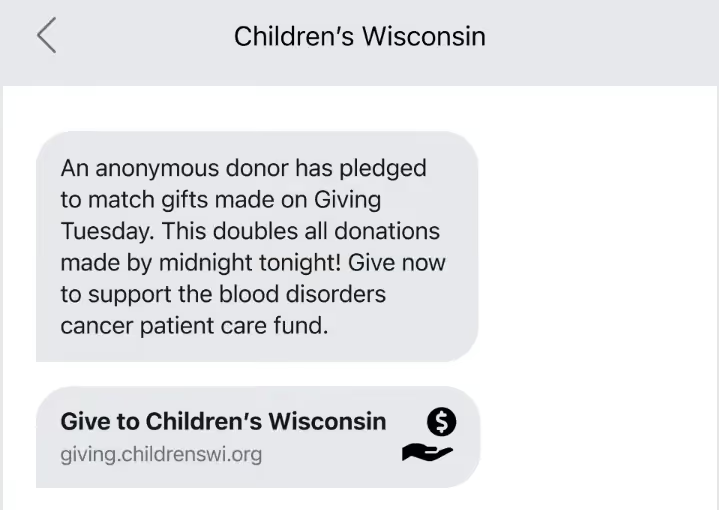
Giving Tuesday has become one of the biggest global movements in philanthropy. In 2024 alone, supporters contributed more than $3.6 billion, and text messaging played a huge part in that momentum. The immediacy of SMS helps organizations reach donors throughout the day, keeping the energy and generosity flowing.
Here are a few text ideas you can adapt for your next Giving Tuesday campaign.
It’s Giving Tuesday! Join [number] supporters who’ve already given today. Your gift of any amount makes a difference: [Link]
[Name], all Giving Tuesday donations are being matched. Your $25 becomes $50, and your $100 becomes $200. Give before midnight: [Link]
We’re halfway through Giving Tuesday and $8,000 short of our goal. Can you help us close the gap? [Link]
Only four hours left on Giving Tuesday! We need 75 more donors to reach our target. Be one of them: [Link]
[Name], thank you for considering a Giving Tuesday gift. Here’s what your donation supports: [specific outcome]. Give here: [Link]
Once the campaign ends, send a brief thank-you message the next day. A quick note of gratitude keeps the connection warm and helps donors feel part of the success they made possible.
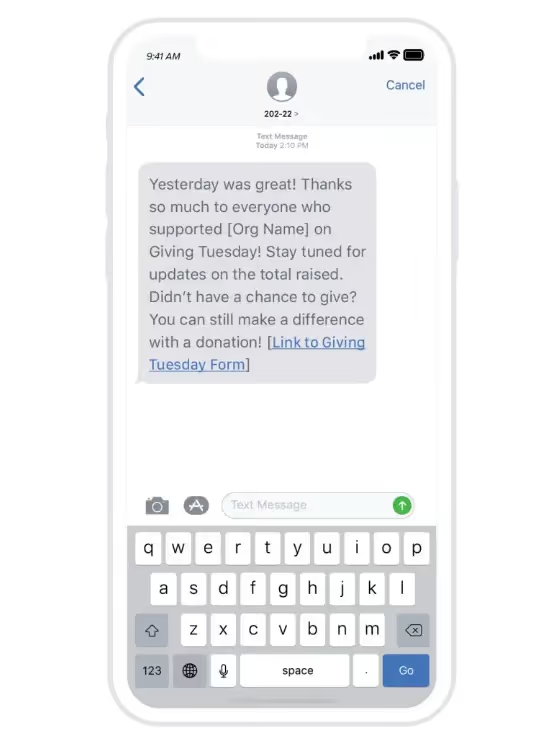
Your past donors are those who already believe in your mission. They just need a reminder of the difference they’ve made. Re-engagement texts work best when they sound personal, share a quick update, and show donors how their earlier support still creates impact.
Hi [Name], we haven't heard from you in a while, but we'd love to have you back. Here's what we've been up to: [Brief update]. Interested in getting involved again? [Link]
[Name], you gave to [campaign name] last year and it made a real difference. We're running a similar campaign now. Would you consider giving again? [Link]
We miss you, [Name]! Your last gift helped [specific outcome]. We're working on [new project] and would love your support: [Link]
[Name], your support in [year] helped us [achievement]. This year, we're trying to [new goal]. Will you help us again? [Link]
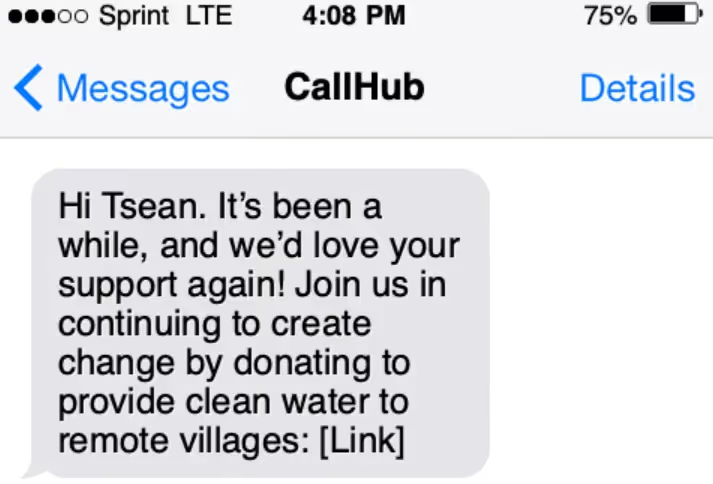
Gratitude matters. Donors who feel seen and appreciated are far more likely to stay connected and give again. Send one of these right after someone gives:
Thank you, [Name]! Your gift of [amount] just came through. You're making [specific impact]. We're grateful.
[Name], your donation means [specific outcome, e.g., '3 students will get scholarships']. Thank you for believing in our mission.
We got your gift of [amount], [Name]. Thank you! Here's your receipt: [Link]. Your support makes our work possible.
[Name], you just became donor #[number] in our campaign! Thank you for joining [number] others who are making this possible.
Your gift is already at work, [Name]. Thank you! Watch for updates on what we accomplish together.
Text messaging works best when it's part of an integrated strategy. Here's how advancement teams can automate their fundraising sms campaigns:
The result is a text messaging program that runs efficiently without eating up your team's time on manual tasks.
Text messaging can deliver results that other channels struggle to match, but only when you have the right tools and strategy in place.
Almabase helps advancement teams run text campaigns that convert, with built-in segmentation, personalization, and automated workflows that save time while raising more.
Request a demo to see how Almabase can power your next text messaging campaign.

Fundraising Text Message Examples
We've collected a whole bunch of fundraising text message templates for you to use for your upcoming giving days, events, and fundraisers.
Lorem ipsum dolor sit amet, consectetur adipiscing elit. Suspendisse varius enim in eros elementum tristique. Duis cursus, mi quis viverra ornare, eros dolor interdum nulla, ut commodo diam libero vitae erat. Aenean faucibus nibh et justo cursus id rutrum lorem imperdiet. Nunc ut sem vitae risus tristique posuere.

November 24, 2025
12 minutes
Text messaging has become an underrated channel for teams to connect with alumni and donors. With stacked mailboxes and email open rates proving a tricky problem, SMS provides a direct, personal alternative line to your community. But how do you use text messages strategically to maximize engagement and drive fundraising results?
In this blog, we’ll explain why text messaging works for donor engagement, offer best practices for using SMS in advancement and fundraising campaigns, and share actionable tips for integrating text into your advancement strategy.
Text messaging stands out for several reasons.
As alumni and donor management software evolve, features such as built-in compliance and text channel analytics are also making the channel easier to use than ever before.

Effective SMS fundraising goes far beyond sending a generic message blast. Advancement professionals should use text strategically to create meaningful engagement, inspire action, and foster ongoing relationships. Here’s how:
Every text you send should offer real value to the donor. Avoid sending generic updates or broadcasts that could be mistaken for spam. Segment your potential recipients and personalize your messages to deepen the relationship and provide value through your texting channel
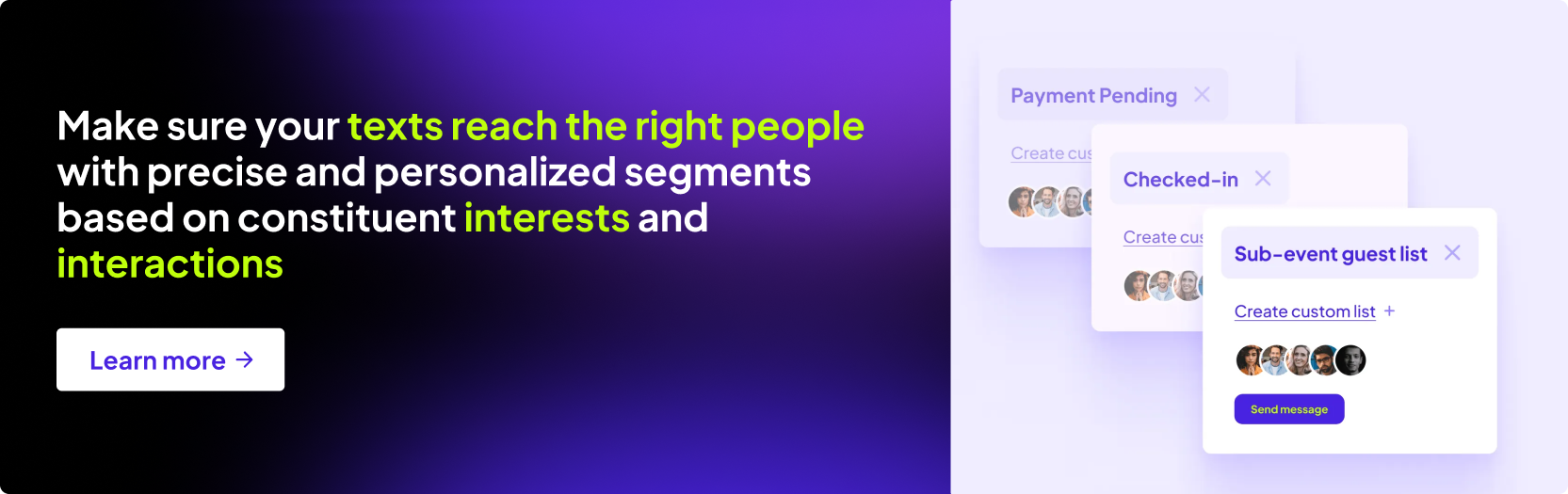
While it’s tempting to use texts only for quick updates, they can be powerful tools for fundraising appeals when used with care and purpose. Craft concise asks that are donor-focused, and always include a clear, simple way to act.
“Anna, we’re $1,000 away from our goal! Will you help us reach it? Donate here [shortened link]”
Share real-time updates about fundraising events, upcoming initiatives, or important milestones. Donors want to feel included and informed.
“Reminder! Tonight is our virtual gala at 7pm. Join us live here [link]. Your ticket helps local students thrive!”
Text messages act as the perfect channel for reminders or urgent calls to action that don’t warrant a full email. Overflow content, last-minute changes, or quick nudges can keep participation high. A good example would be countdown texts and goal updates.
Donors care about progress and outcomes as they prove they are making a real impact. Use text messaging to broadcast campaign milestones, share tally updates, or announce when fundraising targets are reached.
“We did it! With your help, we raised $50,000 for new library books. Thank you for your incredible support!”
Personal gratitude goes a long way. Automatic or manual thank you texts delivered within minutes of a donation build loyalty and trust.
Text messaging doesn’t have to be a one-way channel. Encourage engagement by inviting questions or feedback. Two-way texting can streamline event RSVPs, volunteer signups, and more. Do keep in mind that this will require implementing the appropriate workflows. However, it can make your text channels truly valuable
Segment your contact lists by donor type, giving history, or area of interest to tailor messaging.
Texting works best as part of a broader, thoughtful communication strategy, not as a novelty or “cool factor” add-on. Poorly thought-out texts can lead to opt-outs or disengagement.
For example, avoid sending reminders that are better suited to email or phone calls, or repeated requests.
Text messages are a high-impact tool for advancement and fundraising, but its effectiveness depends on thoughtful strategy, personalization, and robust integration. As it has always been, the future of donor engagement belongs to those who meet their audience where they are, on their terms, with messages that truly resonate— and texting is one step forward in that direction.
For advancement and fundraising professionals seeking to modernize their engagement, integrating robust text messaging is essential. Platforms like Almabase’s integrated SMS tool deliver:
Want to see how integrated text messaging can amplify your institution's fundraising and engagement efforts? Check out what we bring to the table by getting in touch with us! 🔽

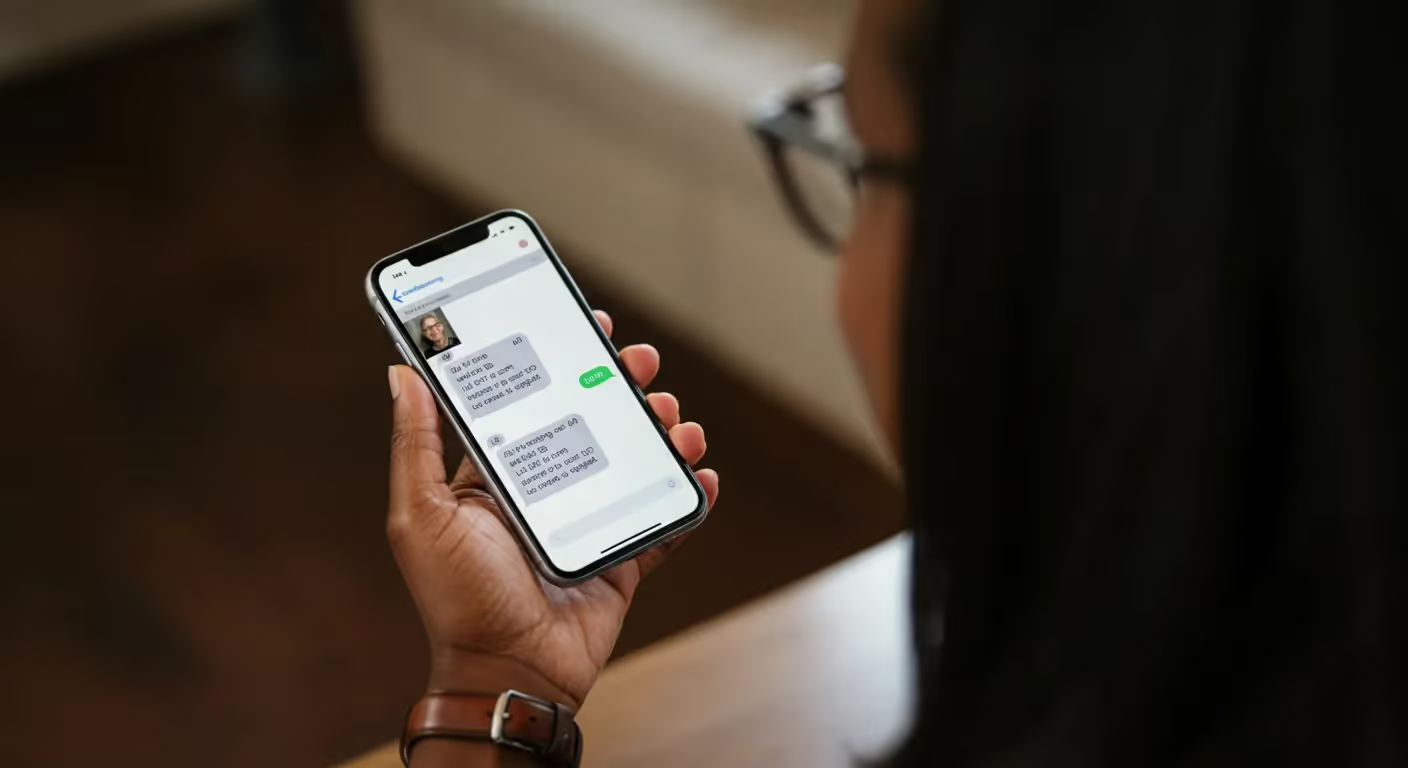
How to use text messaging for donor engagement & fundraising
Boost donor engagement and fundraising with text messaging. Learn strategies and best practices for advancement teams and nonprofits.
Lorem ipsum dolor sit amet, consectetur adipiscing elit. Suspendisse varius enim in eros elementum tristique. Duis cursus, mi quis viverra ornare, eros dolor interdum nulla, ut commodo diam libero vitae erat. Aenean faucibus nibh et justo cursus id rutrum lorem imperdiet. Nunc ut sem vitae risus tristique posuere.
You’ve got a giving campaign to run.
An event to promote.
A reminder to send.
And of course, the email isn’t going to write itself.
Until now.
We’re excited to introduce Emily AI, an intelligent assistant built right into your Almabase Email Center. Emily helps you create professional, context-aware emails using just a few prompts. From idea to first draft, the process takes seconds, not hours.
Just tell Emily what you want to say. She’ll take care of the rest.
Subject line, body, tone, even the inertia that usually holds things up.
Whether you’re inviting alumni to an event, thanking donors, or sending a save-the-date for your reunion, Emily AI helps you get the message out clearly and quickly.
Advancement teams today are juggling faster turnarounds, higher expectations for personalization, and less time to get it all done. The message still matters, but now it has to compete with everything else on your plate.
That’s where prompt-based tools like Emily AI come in.
They don’t replace your voice. They help you get the message out while it still matters.
Just type in a prompt like:
“Invite alumni to our 25th-year reunion in a warm, cheerful tone.”
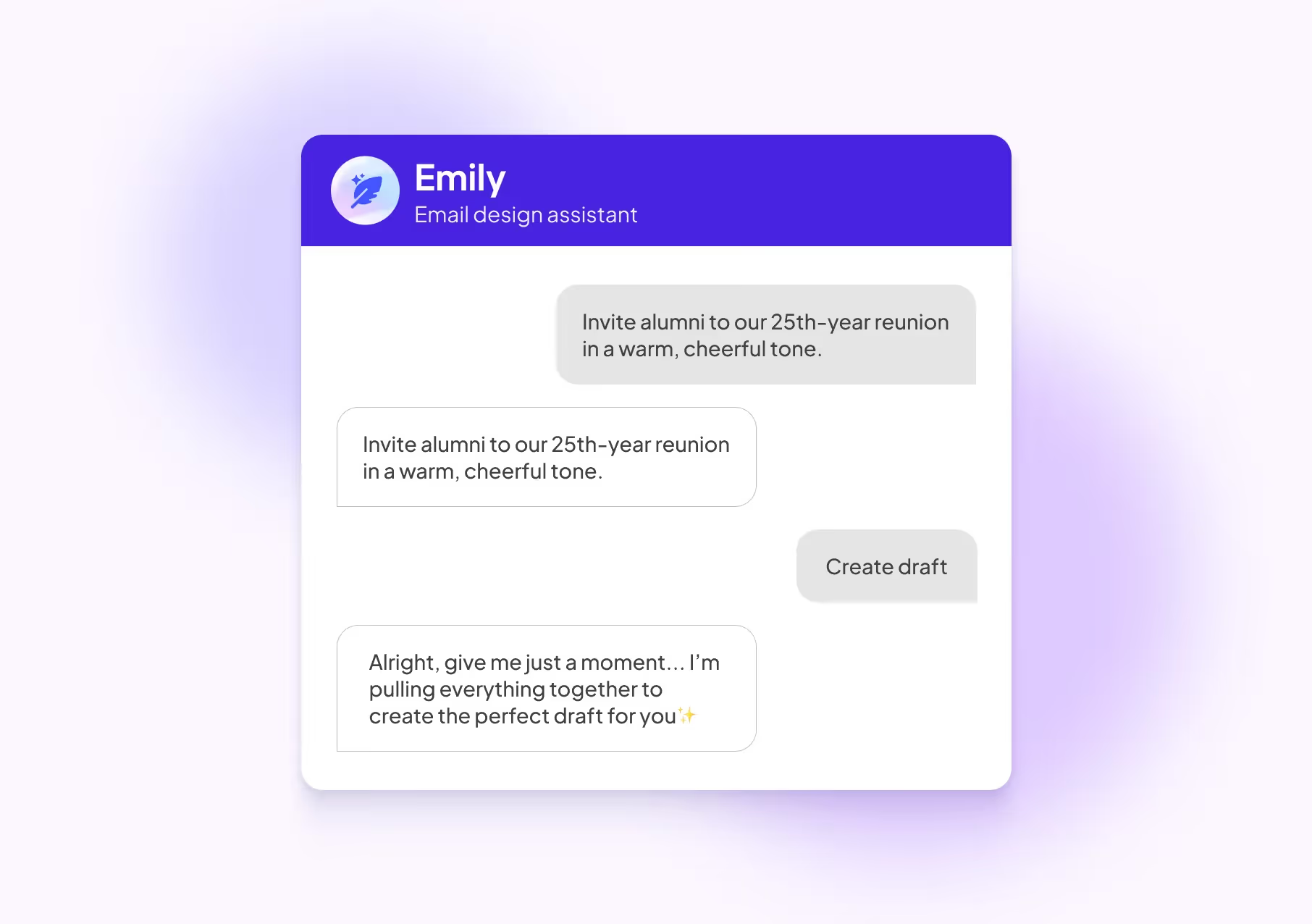
Emily instantly drafts a full email based on your prompt, no blank screen, no second-guessing.
You can:
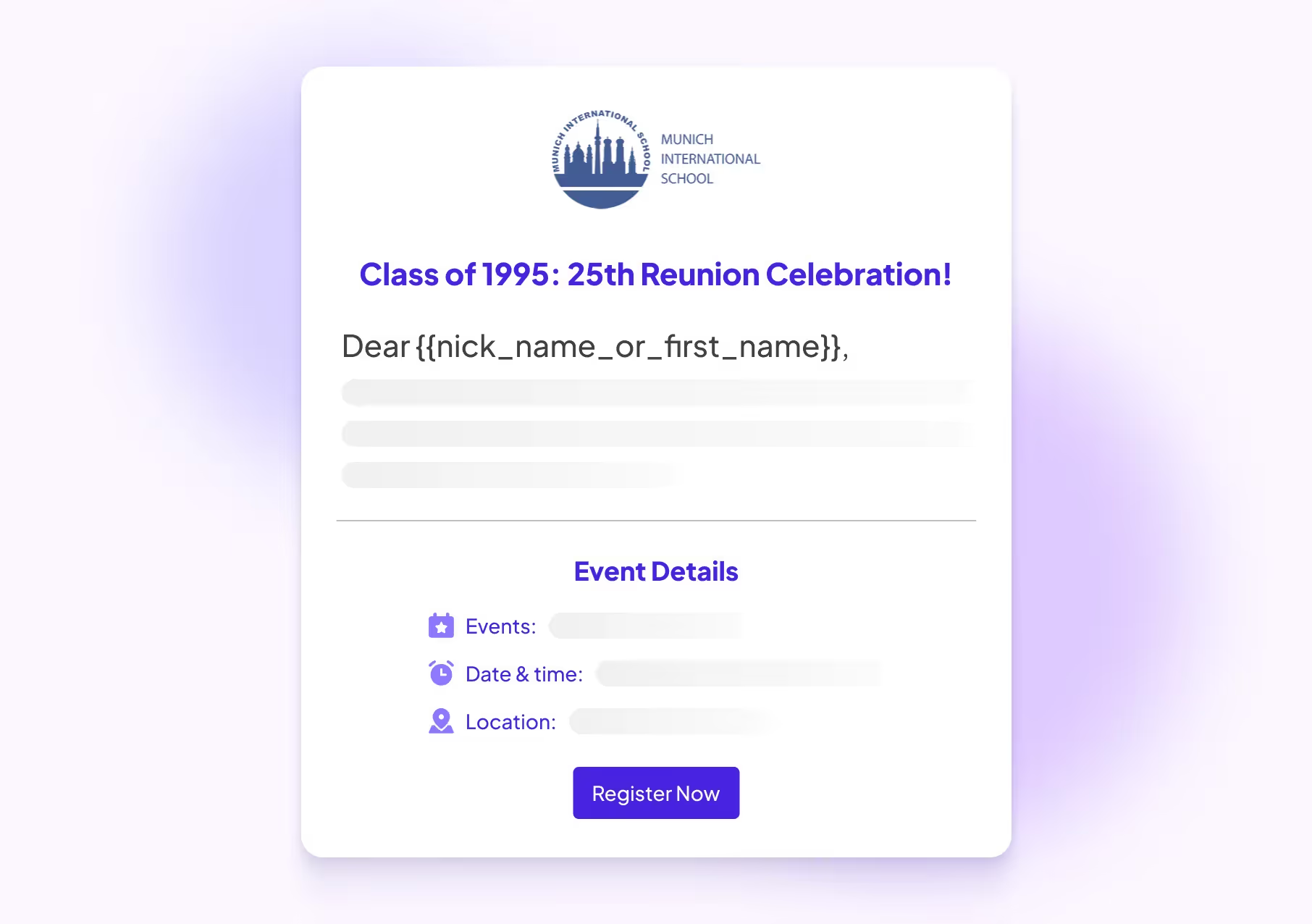
Emily lives right inside the Email Communication Center. No switching tabs. No extra tools. No friction.
Let’s be honest. Writing the email is often the one thing that gets pushed to the end of the day.
Not because it’s unimportant. But because it takes energy. The blank page. The pressure to sound just right.
And before you know it, that event reminder or donor follow-up is still sitting in drafts.
And yet, it’s one of the most important ways you drive attendance, engagement, and giving.
That’s where Emily AI helps.
Especially for lean advancement teams juggling multiple priorities, Emily AI is a quiet unlock for speed, quality, and consistency, and it offers more than convenience; it offers momentum.
Emily AI is only the start of what’s coming.
We’re building a set of AI-powered tools to help you do more, with less stress and more control. Think better messaging, faster execution, and more room to focus on building real alumni relationships.
Emily is live for all Almabase users.
➡️ Log in to Almabase
➡️ Head to the Email Center
➡️ Click “Let Emily help” and give her a prompt
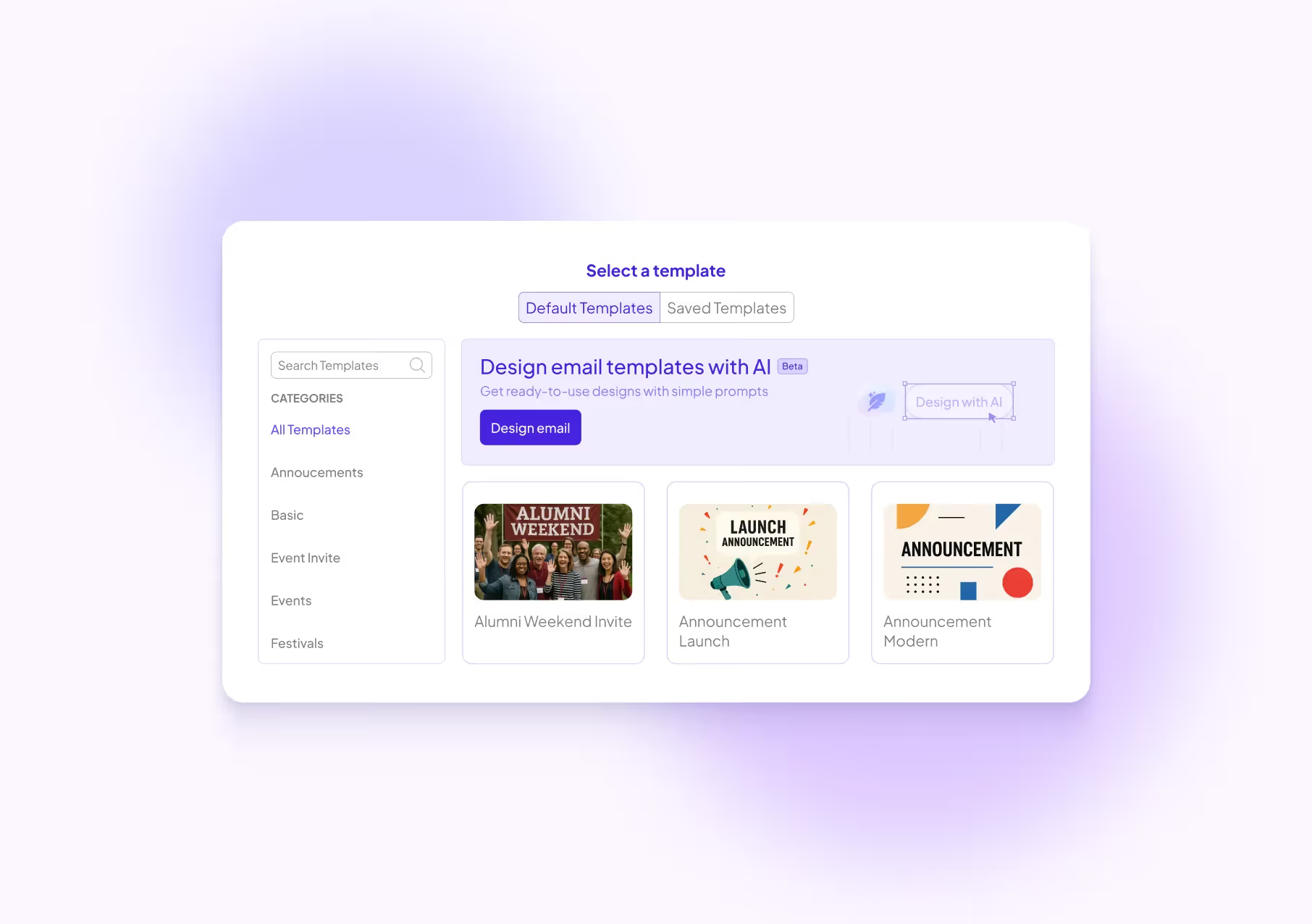
Let us know what she writes for you! We’re excited to see the creativity she helps unlock.

Fast, Smart, and Context-Aware Emails for Advancement Teams: Powered by Emily AI
Introducing Emily AI: create thoughtful, context-aware alumni and donor emails in seconds, right inside your Almabase workflow.
Lorem ipsum dolor sit amet, consectetur adipiscing elit. Suspendisse varius enim in eros elementum tristique. Duis cursus, mi quis viverra ornare, eros dolor interdum nulla, ut commodo diam libero vitae erat. Aenean faucibus nibh et justo cursus id rutrum lorem imperdiet. Nunc ut sem vitae risus tristique posuere.

.svg)

.avif)
.webp)