Practical resources to help alumni relations, fundraising, and advancement teams work smarter.

In today’s competitive fundraising environment, schools and nonprofits are constantly seeking ways to maximize revenue and deepen their relationships with donors. Luckily, matching gifts present a powerful opportunity not only to increase donations but also to foster long-term donor loyalty.
By engaging one-time donors through matching gift programs, institutions can transform them into lifelong supporters who remain committed to their cause year after year.
This article will explore the importance of matching gifts in donor retention, share strategies for leveraging them to build long-term relationships, and provide actionable tips for schools to engage their donors effectively throughout the giving lifecycle. Specifically, we’ll cover:
By turning one-time donors into repeat givers, schools can build a robust foundation of support that sustains their mission for years to come. Now, let’s dive into how matching gifts work and explore how they can be leveraged to boost engagement and retention among your donor base.
Before delving into strategies for using matching gifts, it's essential to understand exactly how they work. A matching gift program is a corporate giving initiative in which an employer agrees to match an employee's donation to a nonprofit organization. The match is typically made dollar-for-dollar, but can sometimes be at a lower or higher ratio.
For example, if a donor gives $100 to a school, and their employer offers a 1:1 match, the total gift to the school becomes $200. This process is a great way to encourage more giving, as it enables donors (including alumni!) to maximize their impact without increasing their own contributions.
For schools, matching gifts are an untapped resource that can significantly boost fundraising efforts. Many employers offer these programs, but donors often aren’t aware of the opportunity, and schools don’t always actively promote them. By effectively encouraging participation in matching gift programs, schools can increase the total value of donations, which has long-term benefits for both fundraising goals and donor retention.
In other words, matching gifts can serve as a powerful tool to not only increase funds but also to strengthen the relationship between a school and its supporters. These programs allow schools to expand their donor reach by motivating donors to give more, while also demonstrating to donors that the school is proactive in maximizing the impact of their contributions.
Matching gifts are an easy way to expand your donor base without recruiting new supporters. By promoting the opportunity for donors to maximize their gifts through matching, schools can encourage existing donors to contribute more and encourage potential donors to get involved in giving.
When donors know that their contribution will be doubled or even tripled, it creates an additional layer of satisfaction. This added value makes donors feel good about their contributions, and as a result, they’re more likely to support the school again in the future. Therefore, by encouraging matching gifts, schools can foster lasting donor relationships.
For many donors, the prospect of a company match is an appealing way to make their gift go further. By tapping into matching gifts, schools can increase revenue without asking donors for higher contributions. This makes matching an attractive strategy for schools that want to increase donations while respecting donor budgets.
While matching gifts can significantly boost donations in the short term, their true power lies in building long-term donor loyalty. By strategically engaging one-time donors and encouraging them to take full advantage of matching gift opportunities, schools can cultivate a repeat donor base that remains engaged year after year.
The key to converting one-time donors into lifelong supporters often lies in personalization. When schools reach out to donors about matching gifts, it’s important to make the communication feel personal. Send thank-you emails or follow-up messages that highlight how matching gifts have enhanced the impact of their donation. Make donors feel appreciated and valued for their generosity.
Transparency is crucial in building long-term relationships. Keep donors informed about how their matched gift was used, whether it's for scholarships, school programs, or facility improvements. By showing donors the tangible impact of their contributions (both the original and matched portion), you reinforce their connection to the school and encourage future support.
Once a donor has engaged in matching gifts once, it’s essential to keep them involved in the future. Send reminders about matching gift opportunities each year, especially during key fundraising periods such as Giving Tuesday or year-end campaigns. For the best results, ensure the process for submitting a match request is clear, simple, and as easy as possible for donors to complete.
To ensure matching gifts are used effectively, it’s a good idea to implement best practices that streamline the process and keep donors engaged. These strategies can make a significant difference in both immediate fundraising results and long-term donor retention. Here are a few of our recommendations:
Donors need to be made aware of matching gifts before, during, and after their donations. Ensure your messaging highlights matching gift opportunities across donation pages, thank-you emails, social media posts, school newsletters, and more. The more information you provide, the more likely donors are to take advantage of these programs.
To make it as easy as possible for donors to submit their matching gift requests, provide clear, step-by-step instructions. Partner with matching gift platforms, such as Double the Donation, to automate the process and provide a user-friendly interface for both donors and schools.
Once a donor has made a contribution, send a thank-you message that includes instructions for submitting their matching gift request. Follow up with reminders, especially as year-end deadlines approach. Offering assistance during this process can be an additional way to build trust and increase the chances of a donor returning.
Don’t limit matching gift appeals to just your major fundraising campaigns. Instead, integrate matching gift reminders into your regular communication efforts, whether that’s through email newsletters, donor thank-you letters, or social media posts. Regular engagement will keep matching gifts top of mind for donors.
Work with companies that already have matching gift programs in place to promote these opportunities within your community. For instance, if a local business is involved with your school, ask them to help spread the word about matching gifts among their employees. This partnership can lead to increased donations and stronger community ties.
Finally, to ensure matching gifts become a long-term part of your school’s fundraising strategy, you’ll need to track and manage these gifts efficiently. Here’s what we recommend:
It’s important to track how many donors ultimately get involved in matching gift programs and how much funding they generate for your school. Therefore, regularly review your matching gift data to identify trends and areas for improvement.
By analyzing the behavior of matching gift donors (such as how often they give and whether they return for future donations) you can refine your strategy to maximize engagement. Personalized communication, targeted outreach, and regular reminders can all help boost donor retention.
Matching gifts offer schools a powerful tool to turn one-time donors into lifelong supporters. By promoting matching gift programs, simplifying the donor experience, and engaging supporters year-round through matching gifts, schools like yours can maximize fundraising while fostering long-term donor loyalty.
Now is the time to incorporate matching gifts into your fundraising strategy. Start by promoting matching gifts more effectively, tracking participation, and following up with donors to ensure they take full advantage of these programs. By doing so, you’ll build a loyal donor base that helps support your school for years to come.

Matching Gifts: From One-Time Donors to Lifelong Supporters
Discover how matching gifts transform one-time donors into lifelong supporters. Learn strategies to maximize retention for schools and nonprofits alike.
Best practices
Your fundraising team just spent 40 hours planning a successful gala that raised $250,000. Now they'll spend another 40 hours manually entering guest lists into spreadsheets, reconciling payments across multiple systems, and sending individual thank-you emails.
This is the hidden cost of manual event workflows. While manual processes might seem like a cost-saving measure, they drain staff time, increase error rates, create HIPAA compliance risks, and pull your team away from what matters most: building donor relationships.
Hospital fundraising teams lose nearly five hours every day to these repetitive tasks. Almabase's fundraising event management software eliminates manual data entry, keeps Raiser's Edge NXT data in sync, and can save hundreds of staff hours each year.
Hospital fundraising teams rely on galas and events to fund critical programs, but manual processes drain staff time, increase the risk of errors, and make it harder to measure results accurately.
Here are just five ways your hospital foundation loses opportunities, revenue, and time by relying on outdated manual processes to manage your galas, golf tournaments and other fundraising events.
Manual workflows force staff to re-enter information across multiple systems — CRMs, payment systems, spreadsheets, and more. One analysis found that nonprofit staff spend up to 50 percent of their time on manual data entry. This kind of work is boring, wasteful and can lead to burnout.
Almabase’s TrueSync™ integration with Blackbaud Raiser’s Edge NXT and Blackbaud CRM reduces manual handling of sensitive records while maintaining clean, consistent data across systems.
A gala can generate thousands of data points, from attendee names and guest additions to dietary preferences and sponsorship tiers. That leaves too much room for error, since there are errors in about one percent of manual data entry keystrokes.
The result is delayed or missed donations and inconsistent communications—a major turnoff for donors. These mistakes often ripple downstream, leading to inaccurate reports and missed follow-ups that weaken donor trust.
Every hour spent on repetitive administrative work, like re-entering event registrations or sending one-off acknowledgments, detracts from opportunities to build meaningful donor relationships, plan strategic campaigns, and focus on high-impact activities that drive ROI for your organization.
Nearly 75% of nonprofits report persistent job vacancies tied to heavy workloads and manual processes. But one study found that turnover drops significantly when organizations shift away from the soul-sucking “busy work” of manual processes.
Many third-party vendors aren’t HIPAA-compliant or won’t sign BAAs—making them risky for fundraising for healthcare. Almabase’s HIPAA-compliant event registration platform is designed specifically for healthcare foundations, maintaining data security and compliance while integrating seamlessly with Raiser’s Edge NXT.
Trying to manage event registration, ticketing, and communications manually creates major inefficiencies.
Almabase’s event management software gives hospital foundations a single, HIPAA-compliant event registration software solution to handle every step from setup to stewardship.
For teams used to navigating disconnected tools, the results are immediate: faster event setup, fewer errors, and greater visibility into event ROI. Dashboards track participation, sponsorships, and giving in real time, helping staff quickly identify top prospects and follow up while engagement is fresh.
Key Benefits:
Almabase’s ticketing software for healthcare simplifies operations and keeps all event data connected to Raiser’s Edge, allowing fundraisers to spend more time on what matters—strengthening relationships and driving impact in healthcare fundraising.
Hospital foundations juggling multiple systems from spreadsheets to payment platforms and CRMs often leave staff buried in administrative work instead of engaging donors. Almabase eliminates that burden by creating a single, accurate source of truth so teams no longer need to chase down lists or reconcile records after every gala.
By automating event ticketing and maintaining HIPAA secure event registration, Almabase helps foundations run compliant, efficient, and mission-focused events that fuel sustainable fundraising for hospitals.
See how Almabase's fundraising event management software helps hospital foundations save hours, ensure compliance, and raise more funds.
Almabase replaces time-consuming manual workflows with automation that integrates every step of your event management process. Hospital foundations can set up event registration, ticketing, sponsorships, and communications in minutes—not weeks—through one platform that syncs directly with Raiser’s Edge NXT.
That means no more redundant data entry, disconnected spreadsheets, or manual imports. Event data, donor engagement, and payments all flow seamlessly in real time, ensuring accuracy and saving hours of administrative work.
Yes. Almabase is built with healthcare fundraising compliance in mind, offering SOC 2 Type II certification and Business Associate Agreement (BAA) support to meet HIPAA standards. The platform separates patient health information from donor engagement data, so hospital foundations can manage events, donor communications, and grateful patient programs securely and confidently. Compliance, data protection, and privacy are embedded into every workflow.
Through TrueSync, Almabase’s bi-directional Raiser’s Edge NXT integration ensures that all guest registrations, donations, and communications automatically sync with your CRM. This eliminates data duplication, reduces reporting errors, and gives fundraising teams real-time insights into donor engagement and event ROI. It also allows fundraisers to identify follow-up opportunities faster—translating event participation into sustained donor relationships.

Five Hidden Costs of Manual Event Workflows in Healthcare Fundraising
Stop losing hours to manual event work! Discover the Five Hidden Costs of manual gala operations, including HIPAA compliance risks and staff burnout. See how Almabase saves time for hospital fundraising teams.
Healthcare
Giving Days have become the Super Bowl of advancement. Teams spend months planning, alumni flood timelines with links and hashtags, and fundraising dashboards light up with activity. But once the campaign clock stops, engagement often fades. Donors vanish. Inboxes quiet down. The cycle resets.
What if Giving Day wasn’t an end but a beginning?
That question shaped a recent conversation hosted by Aaron Riley, VP of Sales at Almabase, joined by Mike Nagel, Chief Strategy and Growth Officer at Catalyst Campaign Partners, and Steve Sjoberg, Director of Foundation Marketing and Communication at the MSUM Foundation. Together they explored how advancement teams can turn Giving Day momentum into a year-round engagement strategy that builds relationships, strengthens retention, and drives sustainable fundraising results.
Fundraising totals across higher education continue to rise, yet fewer people are giving each year. In 2024, colleges in the US raised $61.5 billion, while donor participation declined by 7 percent.
“It’s not sustainable,” Mike said. “Every VP I talk to is thinking about the pipeline. You can’t grow revenue if your donor base keeps shrinking.”
Giving Days are great at attracting first-time and lapsed donors, but retention is the issue. Research shows that 34 percent of Giving Day gifts come from new or reactivated donors, yet only 20 percent make a second gift without continued engagement.
Institutions facing the same challenge can take inspiration from Boyd-Buchanan School’s story, which connected alumni engagement directly to fundraising growth.
At Minnesota State University Moorhead (MSUM), Steve Sjoberg and his team saw Giving Day participation spike, only to drop soon after.
Their solution was simple and strategic — extend the story.
“Giving Day should be the kickoff, not the closing ceremony,” Steve said. “We started asking what it would look like if this became the beginning of our engagement year.”
That mindset reframed MSUM’s communication strategy, building a cadence of connection throughout the year. It mirrors how RISD restructured its engagement journey by connecting alumni activity, fundraising, and communication into a unified experience.
Speed was MSUM’s first priority.
Before Almabase, it took nearly a month to process and thank all donors. With Almabase’s Alumni Engagement Platform, integrated with Blackbaud, the team reduced that to three days.
“Speed builds trust,” Steve said. “When donors hear from you within 24 hours, they remember how that gift felt.”
MSUM layered its stewardship program:
That one shift delivered a measurable impact.
“Just through personalized thank-you videos, we raised an additional $40,000,” Steve shared. “People responded because they felt seen.”
Mike added, “Three out of four first-time donors never renew. Quick and personal acknowledgment is the easiest fix.”
This approach aligns with how Samueli Academy automated alumni communication to maintain consistent connection and achieve a 97 percent engagement rate.
Data without insight is noise. The MSUM team shifted from simply counting donors to understanding who they were.
Mike explained, “Around 10 to 15 percent of your alumni have major-gift capacity. Giving Day is when they raise their hand. If you’re not analyzing that, you’re missing your next big donors.”
Using Almabase, MSUM tagged upgraded gifts, identified high-potential first-time donors, and synced this information with its CRM. Reports that once took weeks now update in real time.
“We moved from spreadsheets to instant visibility,” Steve said. “It freed our staff to focus on relationships, not reconciliation.”
This mirrors Concordia College’s strategy, which used data-driven segmentation to strengthen donor relationships and streamline advancement operations.
Every donor wants to be acknowledged, but the message needs to feel personal.
.jpg)
At MSUM, stewardship scales without losing authenticity:
Authenticity matters more than automation. “We handwrite names on whiteboards before filming videos,” Steve said. “That’s how they know it’s real.”
Mike compared it to the private sector: “If a retail brand can personalize an experience, advancement teams can personalize gratitude.”
Gann Academy’s example proves how small tweaks in personalization can lift open rates and engagement across the board.
Large campaigns attract visibility. Micro-campaigns sustain participation.
MSUM’s wrestling room renovation campaign invited alumni and fans to fund upgrades. In six weeks, it met its goal. “It wasn’t about the size of the gift,” Steve said. “It was about people feeling connected to something they love.”
Another small but powerful initiative expanded the campus Oceanarium, adding a teaching space for local schools. Both efforts gave alumni tangible proof of their impact.
A similar approach worked for DMBA, which funded its engagement platform through targeted micro-campaigns instead of large appeals.
MSUM replaced its traditional gala with Dragon Legacy Luncheons — smaller, college-based events that celebrate faculty, students, and alumni together.
“Legacy Luncheons let us lift up real stories,” Steve said. “People leave feeling valued, not entertained.”
Attendance grew, costs dropped, and alumni involvement deepened.
Antioch College saw similar success by focusing on community events that created real relationships instead of one-time gatherings.
Retaining young alumni begins before graduation.
MSUM’s Career Connections Office collects accurate contact data from seniors, offering small incentives like alumni gifts or pizza.
“A small reward today leads to stronger loyalty tomorrow,” Mike said. “If you capture contact info early, you never lose them.”
This early engagement mirrors Nicholls State University’s spotlight series, which kept young graduates connected through personal stories.
Institutions can also explore Almabase’s blog on how to engage alumni more effectively for actionable ideas to build meaningful early connections.
With Almabase, MSUM automated repetitive tasks like thank-you emails, donor segmentation, and event follow-ups. The team now spends more time creating experiences than managing workflows.
“Before, we reacted,” Steve said. “Now we plan ahead. The system gives us space to be creative.”
By aligning technology with human storytelling, MSUM built a sustainable rhythm of connection that continues long after Giving Day ends.
Learn more about how Almabase supports this workflow in the Alumni Engagement Platform overview.
Aaron Riley summarized the takeaway that tied everything together.
“Building systems matters more than building campaigns. When you create a rhythm of gratitude, storytelling, and follow-up, Giving Day becomes one part of a longer conversation.”
This mindset shifts advancement from transaction to transformation.
Since adopting this approach, MSUM has
The result isn’t only more funds but deeper community trust.
Giving Day may start as a 24-hour event, but its real value lies in what follows after the giving day event. The institutions that treat donors as partners, not participants, will build stronger communities and more sustainable pipelines.
To see how this strategy works in practice, watch the full conversation with Aaron, Mike, and Steve or explore how Almabase helps advancement teams sustain engagement throughout the year.
Watch the full webinar recording below:
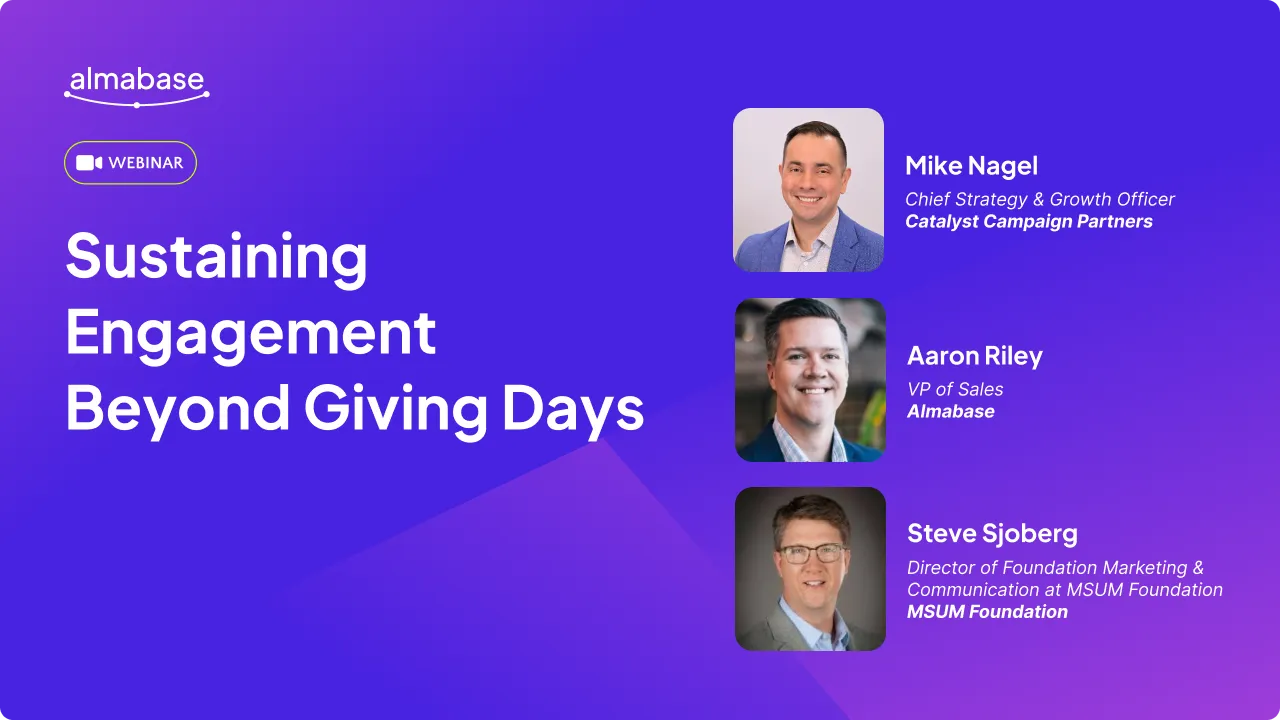
Sustaining Engagement Beyond Giving Day: How Institutions Are Building Long-Term Alumni Relationships
Discover how MSUM uses Almabase’s alumni engagement platform to turn Giving Day donors into lifelong supporters through personalization, automation, and smarter stewardship.
Live event recaps
The right way to fundraise means creating experiences that make giving feel natural, meaningful, and rewarding for the donors.
Universities and nonprofits spend countless hours building campaigns, yet too often the actual act of giving feels clunky. Donors drop off, admins lose time, and campaigns miss their potential.
With Almabase’s new spin on Payment Links, we’re changing that.
Not just with another feature, but with a smarter way to design giving experiences that encourage participation and generosity at scale.
%20(4).webp)
Until now, payment links have been a black box:
This meant lost opportunities for follow-ups, messy attribution, and a lot of wasted admin effort.
Research confirms why this is such a problem: nearly 60% of donors abandon online donation forms when the process feels long or confusing, and pre-filled amounts have been shown to increase average gift size by up to 20%.
Traditional donation forms work, but they put the burden on donors to find the right fund, enter the right amount, and complete multiple steps.
Payment Links flip this dynamic. Instead of asking donors to figure it out, admins can now:
%20(5).webp)
%20(1)%20(1).webp)
%20(3)%20(1).webp)
The result? A smoother, more personal giving journey.
Payment Links are part of a broader shift in fundraising: designing experiences that reduce friction, highlight the right opportunities, and make generosity the easy choice.
All of these, including Payment Links, are about the same thing: turning intent into impact, without extra steps.
Fundraising technology shouldn’t just digitize processes. It should optimize experiences for donors who want to give, and for admins who need to scale their efforts.
That’s what Payment Links are designed to do.
👉 Curious to see how this works in practice? Explore Almabase Giving and reimagine how your next campaign can feel effortless, personal, and powerful.
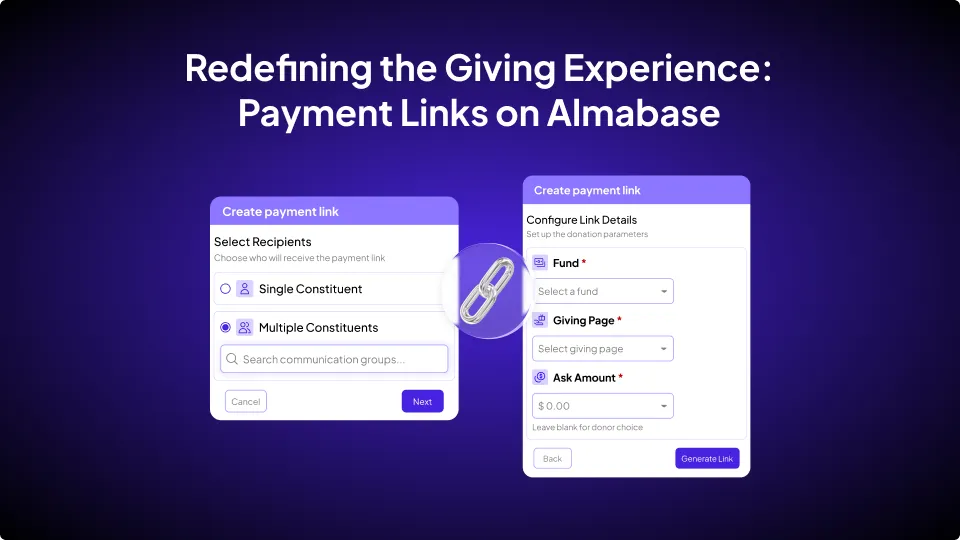
Redefining the Giving Experience: Payment Links on Almabase
The new Payment Links brought to you by Almabase turn giving into a seamless experience. Pre-filled funds, bulk distribution, and full tracking help teams design smarter fundraising workflows. Learn how it works in this blog.
Product
As the calendar heads toward the end of the year, advancement teams once again are heading into a notable fundraising season. Often called the season of giving, donors are often inclined to be motivated by holiday spirit, tax incentives, and a desire to make a difference before the year closes.
For higher education and K-12 institutions, a successful end-of-the-year giving campaign is a great chance to reinforce relationships, showcase impact, and build momentum for the year ahead. A well-executed campaign can significantly boost your annual fund, support new initiatives, and build momentum and trust that you can carry forward into 2026.
Why does end-of-the-year giving command so much attention? Nearly one-third (~30%) of all annual giving occurs in December, with a significant portion happening in the final few days of the year. This surge is driven by several key factors that your team should be aware of:
A successful campaign requires thoughtful planning and a deep understanding of your donor community. We’ve come up with 10 essential steps to guide your planning process for 2026.
Before you start building a committee and plan things out, it’s crucial to look back at your past year-end giving campaigns, gather your data, and ask key questions:
This simple review process will help you build on your successes and avoid repeating past mistakes, setting a solid foundation for your 2026 year-end campaign.
The most successful campaigns are planned months in advance. Nonprofits usually start planning their year-end campaigns by October, and you’ll definitely want your campaign to stand out from all the appeals that go out during the end of the year. We suggest having a solid idea on your campaign and for the first few emails or posts about events and causes tied to your campaign to be out by late September to mid-October if possible. Starting early reduces stress, allows for more creativity, and ensures every member of your team is aligned and prepared for a smooth execution.
Clear, measurable goals are the backbone of any successful campaign. Your goals should be ambitious yet achievable, and they should align with your institution's broader strategic priorities. The SMART framework is a popular starting point to define your objectives but your actual needs may vary:
Your goals will guide your strategy and messaging, providing a clear benchmark for success that you can communicate to your team, leadership, and donors.
Your campaign theme should be compelling and easy to understand. Your central message should clearly articulate the "why" behind your campaign.
Your theme and message should be consistent across all channels from your giving page and emails to your social media posts and direct mail pieces.
Your donor base is likely diverse, and segmenting your audience allows you to tailor your messaging for maximum impact. Some common donor segment examples are:
Personalized communication shows donors that you understand and value them as individuals, significantly increasing the likelihood of a positive response.
Donors nowadays expect a variety of ways to give. Offering multiple channels makes it convenient for them to contribute in the way they prefer. These may include:
A multi-channel approach ensures you reach the widest possible audience and remove any barriers to giving.
Your community is your greatest asset. Involving them in your campaign can amplify your message and build social proof.
When your community feels involved, they become co-owners of the campaign's success, allowing you to build incredible momentum.
Any friction in the giving process can lead to abandoned donations and impacts your campaign’s image.
Your work isn't done once a donation is made. Prompt and meaningful stewardship is crucial for donor retention.
Good stewardship makes donors feel valued and appreciated, turning a one-time gift into a long-term relationship.
Throughout your campaign, you will naturally collect a wealth of data. This data is gold for planning future initiatives.
This data-driven approach will enable you to continuously refine and improve your fundraising strategies year after year.
Planning and executing a multi-faceted end-of-the-year giving campaign can be complex, but you don't have to do it alone. Almabase is designed to empower educational institutions by streamlining every aspect of their fundraising efforts.
Our platform offers a comprehensive suite of tools that integrate seamlessly to enhance your campaign's efficiency and impact:
With Almabase, you can automate manual tasks, personalize your donor outreach, and gain a deeper understanding of your community, freeing up your team to focus on what matters most: building meaningful relationships and driving philanthropic support.
A successful end-of-the-year giving campaign has the power to transform your institution's fundraising results and set the stage for a prosperous new year. By planning early, setting clear goals, crafting a compelling message, and leveraging the right technology, you can create a campaign that not only meets but exceeds your financial targets.
More importantly, a thoughtful and strategic campaign strengthens the bond with your community, reminding them of the vital role they play in advancing your mission. As you prepare for 2026, use these steps as your guide to build a campaign that inspires generosity and celebrates the collective power of your community.

How to Plan a Winning End-of-Year Giving Campaign in 2026
Execute a winning end-of-the-year giving campaign in 2026. Our blog offers 10 steps to make the most of your year-end giving season.
Best practices

.svg)