Practical resources to help alumni relations, fundraising, and advancement teams work smarter.

Donor behavior shifts throughout the year, but the weeks leading into the holidays always bring a noticeable rise in generosity. It’s also the moment when many institutions start thinking about how Giving Tuesday matching donations can amplify that momentum and help reconnect with supporters who are ready to make a meaningful year-end contribution and gently encourage renewed engagement to turn one-time donors into long-term supporters.
This is also when the value of a matching donation becomes clearer to donors. GivingTuesday gives you a natural opening to talk about GivingTuesday matching funds, show how they work, and offer easy ways for supporters to submit a GivingTuesday donation match. With some early planning, budget reviews, message alignment, and timing, you can plan your GivingTuesday finances wisely and make the process feel organized rather than rushed.
Today, we’ll explore how to maximise matching donations by setting up a workflow that’s simple for both your team and your donors. You’ll learn how to surface matching opportunities earlier, communicate them more clearly, and remove small barriers that often stop donors from completing a match. With the right steps in place, you can double alumni impact and ensure that every match-eligible gift has a better chance of being completed on GivingTuesday.
GivingTuesday typically falls on the first Tuesday after Thanksgiving, marking the start of the year-end giving rush. This year, it falls on December 2, 2025. Over the years, participation has continued to grow globally, with more institutions using the day to highlight community impact, broaden donor engagement, and strengthen year-end fundraising efforts.
Corporate matching donations are programs where an employer matches the charitable gifts their employees make. The mechanics are simple- an employee donates, and the company contributes a second gift. In most cases, companies offer a 1:1 match, but many go further with 2:1 or even 3:1 programs, volunteer hour matches, or special giving-day matches for causes their workforce cares about. But despite how simple the process can be, it’s still one of the most overlooked opportunities in fundraising. Each year, an estimated $4–7 billion in matching gift funds goes unclaimed because many donors either don’t know they’re eligible or never complete the match request.
Educational institutions are especially well-positioned to benefit from these programs. Alumni networks span a wide range of industries, including many companies with strong matching-gift policies. Colleges and universities also tend to have clearer communication channels like email, advancement portals, reunions, and GivingTuesday campaigns, where they can regularly surface reminders about matching. Because alumni already feel a connection to their institution, they’re more likely to take the extra step of submitting a match when the process is explained clearly. All of this makes matching gifts a natural fit for education-based fundraising.
Here’s a step-by-step guide based on what we’ve seen work consistently well for institutions of all sizes-
Before anything else, map out how you want this year’s GivingTuesday matching-gift plan to run. Outline your core messages, identify which donor groups you’ll focus on, plan your pre-launch timeline, and decide where matching gifts will appear across your channels. A simple shared document helps everyone stay aligned and reduces last-minute stress.
A strong GivingTuesday plan always begins with clean, usable data. Update employer information, fix old records, and tag donors who have submitted matches in the past. Using a CRM like Raiser’s Edge NXT or an integrated platform like Almabase makes this much easier. These tools help you automate employment updates, segment donors based on match-friendly employers, and quickly build lists of supporters who are most likely to complete a match. When you’ve identified these groups in advance, your outreach becomes more focused and more effective.
In every successful GivingTuesday campaign I’ve worked on, the turning point has been a strong story. Donors respond when they can see a real person, a real moment, or a real outcome tied to their gift. Instead of trying to communicate multiple impact areas at once, choose one powerful story to carry the message.
This could be a student whose scholarship eased a financial burden, a family supported through an emergency fund, or a program that grew because donors stepped in at the right time. Keep the format simple: a short video filmed on a phone, a quote that feels honest, or a before-and-after snapshot that shows progress.
The goal is to help donors understand why their matched gift matters. When they can clearly imagine the difference their support makes and how matching gifts amplify that impact, they feel more connected to the cause and are more likely to take the extra step to complete a match request.
A well-defined goal gives your GivingTuesday plan structure and helps donors understand what they’re contributing to. Instead of announcing a broad target like “Help us raise more this year,” break it down into something achievable and measurable: a certain number of matched gifts, unlocking a board-sponsored match pool, or reaching a milestone within a specific time window.
You can also design smaller “momentum goals” throughout the day, such as unlocking a departmental match during a two-hour window or hitting 50 matched gifts before noon. These micro-milestones work incredibly well because they keep the energy steady instead of saving all excitement for the final hour.
As the day progresses, share updates through email, social media, and your campaign page. Even simple posts like “30 more matched gifts will unlock the next $5,000 in matching funds” help supporters feel like they’re part of something active and time-sensitive.
Donors are more likely to act when information is easy to find and easy to understand. A dedicated matching-gift section on your GivingTuesday page removes friction and keeps instructions consistent across channels.
This section should include:
You can also highlight examples from previous years, like “120 donors submitted match requests last year,” or “Top matching companies from our alumni community.”
When this page becomes the single source of truth, your team doesn’t have to answer the same questions repeatedly, and donors feel more confident engaging with the process.
From experience, some of the most successful campaigns come from institutions that treat their board, ambassadors, and volunteers as active partners instead of passive supporters.
Here’s how they can meaningfully support your matching-gift efforts:
Personal voices create credibility that institutional messaging alone can’t match. When donors see familiar names cheering on the campaign, engagement rises naturally, and match questions get answered faster because the information circulates more widely.
Social works best when updates feel real and in-the-moment. Institutions that maintain steady visibility tend to see higher engagement and more match participation. A few simple tactics go a long way:
These light-touch moments help donors feel connected and remind them to check their match eligibility throughout the day.
A smooth donation experience makes a big difference. Make sure your donation page is mobile-friendly, quick to load, and simple to complete. Add a small reminder like “See if your employer matches your gift” and, if possible, include a searchable employer field right on the page. When giving feels easy, match participation naturally increases.
A well-timed follow-up is one of the easiest ways to increase completed match requests, and automation makes this effortless. After someone gives, set up an automatic email that reminds them to check their employer’s matching-gift program and submit the required form. When platforms like Almabase sync donor and employment data from NXT, these reminders can be personalized so donors only receive the guidance that’s relevant to them.
This small automation helps capture match dollars that often get forgotten, and it saves your team the time they would otherwise spend sending reminders manually.
A prompt, sincere thank-you helps donors feel seen. Whether it’s a short email, a quick video, or a note from a student, appreciation that feels personal goes a long way. Keep communication clear and transparent so donors know how their gifts are being stewarded. Recognizing the impact of their gift and the potential match sets a positive tone for future engagement. When people feel valued and see the outcomes of their generosity, they stay engaged, trust your institution more deeply, and are far more likely to give again.
If you’re looking to simplify how your team tracks and manages matching gifts, the right tools make a noticeable difference. Integrations with platforms you already use can automate much of the work that would otherwise take hours.
When you connect Blackbaud with Almabase, donor identification and segmentation become much easier. Almabase can pull donor data directly from Blackbaud NXT, keep it up to date, and automatically group donors based on factors such as employment information, past giving, or potential match eligibility.
This means your team isn’t digging through spreadsheets or sending generic reminders. You can reach the right donors with clear, timely communication while letting the systems handle the heavy lifting in the background. A small investment in the right software often results in more completed matches and a much smoother experience for both staff and supporters.
A strong matching-gift strategy can make your GivingTuesday campaign more organized, more predictable, and easier for your team to manage. Institutions that plan well usually begin by getting their data in order, identifying where matches are most likely to come from, and making the steps clear for donors from the start. Keeping matching gifts visible throughout the campaign also helps maintain momentum and reduces confusion later.
What often gets overlooked is how much these campaigns teach you. GivingTuesday reveals patterns, who engages early, who responds to match prompts, where communication feels strong, and where your team might need better tools. Treating the campaign as a learning moment helps you shape a smarter, more donor-friendly approach for the future.
If you’re looking to make matching gifts easier to manage, give us a shout or book a demo with us and our team can help you figure out the best way to use Almabase for your goals.

How to Maximize Matching Donations for GivingTuesday
Matching gifts have become a staple of modern fundraising. Learn how you can maximize your gifts by integrating matching gifts into your GivingTuesday and Giving day campaigns
Best practices
Texting has quietly become one of the most effective ways to reach donors. In this blog, you’ll see real examples of fundraising texts, understand what makes them effective, see sample fundraising text message templates that work and learn simple ways to use them in your next campaign.
Text messages have an open rate of about 98%, while email averages only 20–28%. Even better, nine out of ten texts are read within three minutes of landing on someone’s phone.
SMS also drives faster action. The average response time for a text is 90 seconds, while emails take 90 minutes on average. For time-sensitive campaigns like Giving Tuesday, Fundraising Galas or end-of-year appeals, that speed matters.
SMS also outperforms email when it comes to conversions. Depending on the campaign, texts convert between 21–30%, while email responses stay closer to 2–3%. On Giving Tuesday, organizations that used texting saw 84% higher conversion rates than those that relied only on email.
For institutions using RE NXT or similar CRMs, text messaging can work alongside your existing donor segmentation. You can reach people based on giving history, event participation, or engagement level, through the channel they’re most likely to open.
💡Learn how to use text messaging for donor engagement and fundraising
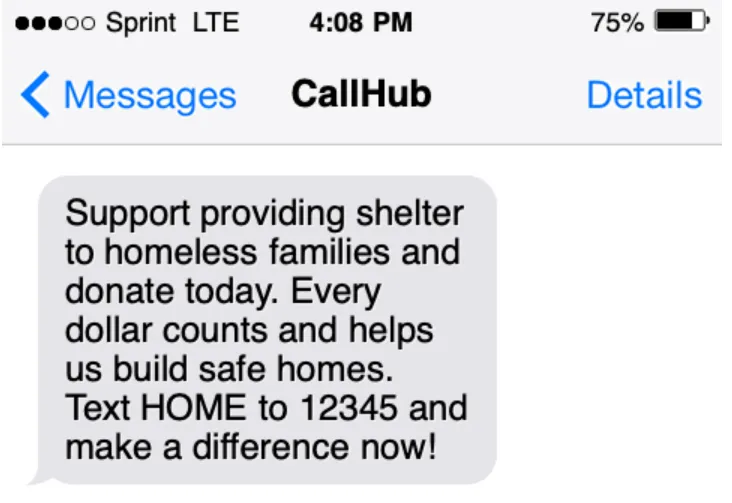
These examples work well for ongoing or all-year fundraising campaigns when you want to make a simple, heartfelt ask.
Hi [Name], it’s [Organization]. We’re $5,000 away from our goal for [specific program]. Can you chip in $25 today? [Link]
Hi [Name], your gift can make a real difference for [specific cause]. Every contribution helps us keep [impact statement, such as “meals on the table for families in need”]. Donate here: [Link]
Quick question, [Name]. Would you consider giving $50 to help [specific outcome]? Every bit of support brings us closer to our goal. [Link]
Hi [Name]. We’re reaching out to our most engaged supporters first. Can you make an early gift of [amount] to [campaign name]? [Link]
[Name], we have a shortfall in funding for [program]. Your gift of any amount today will help us close the gap. Give here: [Link]
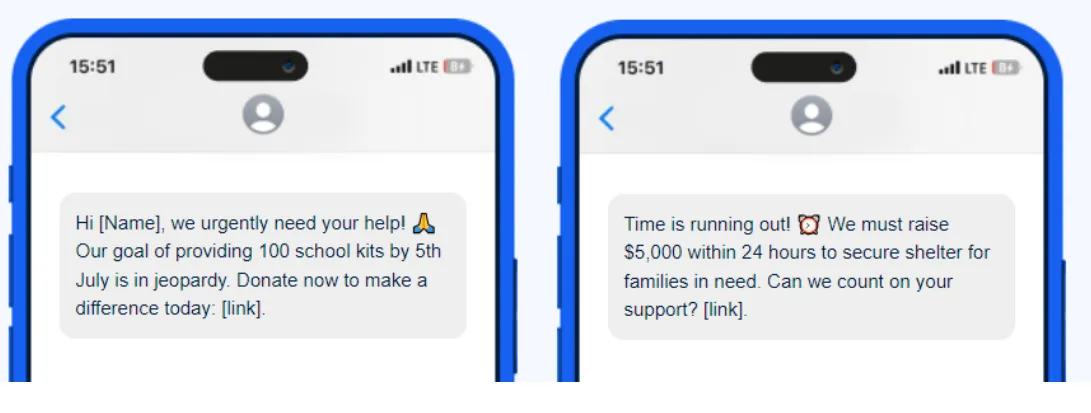
Urgency can be one of the strongest motivators for giving. When your donors know there’s a deadline or a goal within reach, they’re more likely to take action right away. Short, time-bound messages like these can help you make the most of that window of attention.
Hi [Name], we have 48 hours left to reach our goal. We’re still $3,000 short. Can you give $25 right now? [Link]
Only 6 hours remain! We need 50 more donors to unlock our challenge grant. Be one of them: [Link]
Deadline tonight at midnight. Your gift will be matched dollar for dollar, but only if you give before [time]. [Link]
[Name], we're 80% to our goal with just 12 hours left. Can you help us finish strong? [Link]
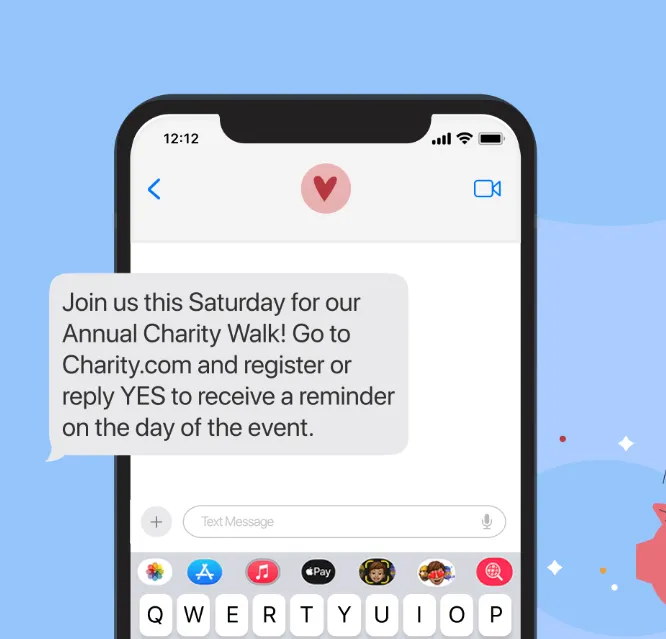
Events give you a chance to bring donors together, celebrate milestones, and raise additional support. A well-timed text can boost attendance and remind supporters why their presence, and their gifts, matter.
Hi [Name], join us for [event name] on [date]. Your participation helps raise funds for [cause or program]. Save your spot: [Link]
Only 20 seats left for [event name] this [day]. Every ticket supports [specific goal or program]. Register now before they’re gone: [Link]
[Name], [event name] happens tomorrow at [time]! Your attendance helps us reach our fundraising goal for [cause]. Here’s a key detail before you arrive: [Key detail]. See you there!
Last call for [event name]! Doors open in two hours. Join us and help make a difference for [cause]. RSVP now: [Link]
Few messages spark action faster than one that says, “Your gift counts twice.” Matching gift campaigns work because donors can immediately see the bigger impact of their support. A short, clear text that highlights the multiplier effect often drives quick responses.
Great news, [Name]! Every gift made today will be matched two to one. Your $50 turns into $150 for [cause or program]. Give now: [Link]
[Name], a generous supporter is matching all donations up to $10,000. This is your chance to double your impact for [specific cause]. Donate here: [Link]
Your employer might match your gift to [Organization]. Check your eligibility and make your donation go twice as far: [Link]
[Name], we still have $5,000 left in matching funds, but only until [time]. Give today and see your contribution doubled instantly: [Link]
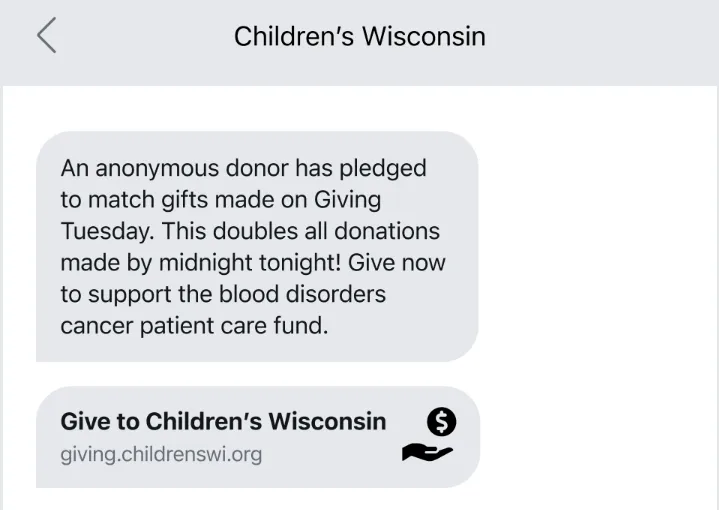
Giving Tuesday has become one of the biggest global movements in philanthropy. In 2024 alone, supporters contributed more than $3.6 billion, and text messaging played a huge part in that momentum. The immediacy of SMS helps organizations reach donors throughout the day, keeping the energy and generosity flowing.
Here are a few text ideas you can adapt for your next Giving Tuesday campaign.
It’s Giving Tuesday! Join [number] supporters who’ve already given today. Your gift of any amount makes a difference: [Link]
[Name], all Giving Tuesday donations are being matched. Your $25 becomes $50, and your $100 becomes $200. Give before midnight: [Link]
We’re halfway through Giving Tuesday and $8,000 short of our goal. Can you help us close the gap? [Link]
Only four hours left on Giving Tuesday! We need 75 more donors to reach our target. Be one of them: [Link]
[Name], thank you for considering a Giving Tuesday gift. Here’s what your donation supports: [specific outcome]. Give here: [Link]
Once the campaign ends, send a brief thank-you message the next day. A quick note of gratitude keeps the connection warm and helps donors feel part of the success they made possible.
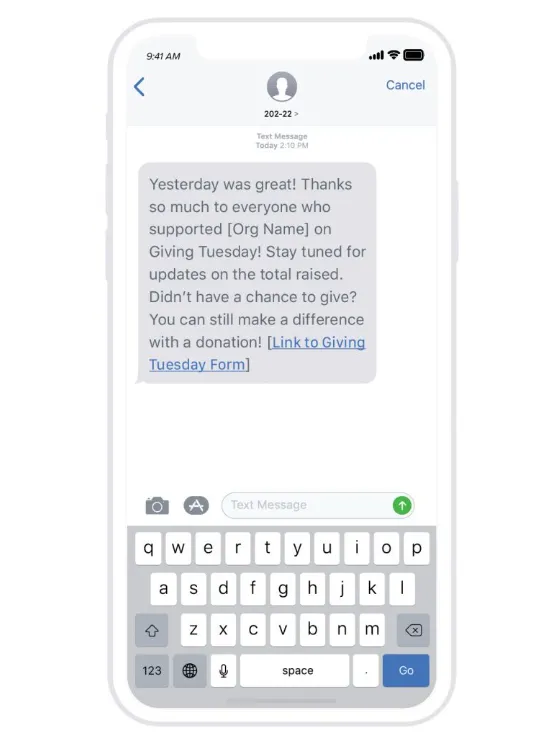
Your past donors are those who already believe in your mission. They just need a reminder of the difference they’ve made. Re-engagement texts work best when they sound personal, share a quick update, and show donors how their earlier support still creates impact.
Hi [Name], we haven't heard from you in a while, but we'd love to have you back. Here's what we've been up to: [Brief update]. Interested in getting involved again? [Link]
[Name], you gave to [campaign name] last year and it made a real difference. We're running a similar campaign now. Would you consider giving again? [Link]
We miss you, [Name]! Your last gift helped [specific outcome]. We're working on [new project] and would love your support: [Link]
[Name], your support in [year] helped us [achievement]. This year, we're trying to [new goal]. Will you help us again? [Link]
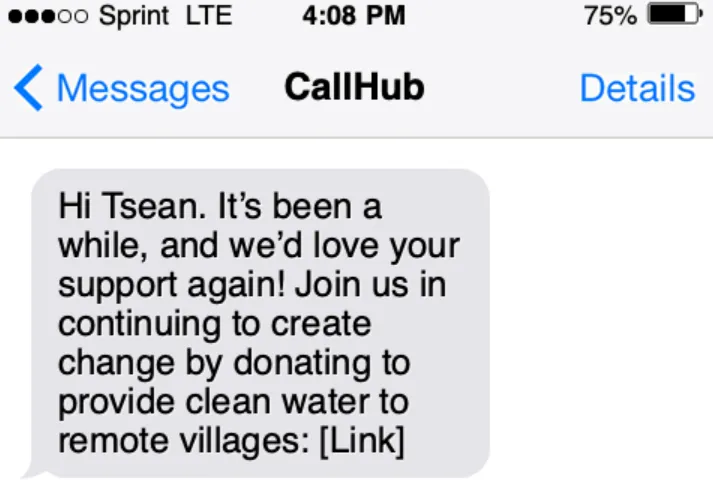
Gratitude matters. Donors who feel seen and appreciated are far more likely to stay connected and give again. Send one of these right after someone gives:
Thank you, [Name]! Your gift of [amount] just came through. You're making [specific impact]. We're grateful.
[Name], your donation means [specific outcome, e.g., '3 students will get scholarships']. Thank you for believing in our mission.
We got your gift of [amount], [Name]. Thank you! Here's your receipt: [Link]. Your support makes our work possible.
[Name], you just became donor #[number] in our campaign! Thank you for joining [number] others who are making this possible.
Your gift is already at work, [Name]. Thank you! Watch for updates on what we accomplish together.
Text messaging works best when it's part of an integrated strategy. Here's how advancement teams can automate their fundraising sms campaigns:
The result is a text messaging program that runs efficiently without eating up your team's time on manual tasks.
Text messaging can deliver results that other channels struggle to match, but only when you have the right tools and strategy in place.
Almabase helps advancement teams run text campaigns that convert, with built-in segmentation, personalization, and automated workflows that save time while raising more.
Request a demo to see how Almabase can power your next text messaging campaign.
Fundraising Text Message Examples
We've collected a whole bunch of fundraising text message templates for you to use for your upcoming giving days, events, and fundraisers.
Best practices
With the end of the calendar year approaching as well as the recent news regarding Anthology, this might be a good time for advancement teams to explore some of the best Encompass (or iModules) alternatives available today.
In this blog, we’ll do just that but also take a look at what a transition from Encompass to Almabase might look like for teams. Let’s get started.
Almabase is an all-in-one alumni engagement and fundraising software for educational institutions and nonprofits. It provides tools for building alumni communities, managing events, facilitating donations, and tracking engagement metrics.
Key differences include a strong focus on alumni engagement and digital fundraising automation compared to iModules, which has a broader suite for advancement offices. Almabase emphasizes personalized outreach, integrations, hassle-free events and giving. It also boasts comparatively easier set up and active support.
Givecampus is a fundraising platform focused on higher education, known for its social fundraising tools such as peer-to-peer giving, crowdfunding, and giving days.
Unlike iModules, Givecampus specializes primarily in modern fundraising strategies and donor engagement, offering robust social sharing features, video integrations, and campaign management dashboards. Givecampus works best for institutions primarily aiming to run engaging fundraising campaigns and leverage networks for peer-driven giving, including colleges, universities, and K-12 schools.
Hivebrite is an advanced community management platform supporting private networks for organizations, universities, and nonprofits. It enables networking, event management, content sharing, and job boards, all within a branded portal.
Compared to iModules, Hivebrite excels in building versatile online communities and streamlining member interactions. Where iModules centers on advancement and alumni relations, Hivebrite is more customizable and suitable for professional associations, universities with global alumni, and organizations needing diverse community features for members.
ToucanTech is a community and database software enabling schools, universities, and clubs to connect members, manage relationships, and drive fundraising and engagement. It combines CRM capabilities with community engagement tools.
Key differences from iModules include a heavy emphasis on unified data management, private portals, communications, and event features in a modern interface. ToucanTech stands out for integrated CRM and engagement tracking, whereas iModules has deeper legacy advancement functionalities.
Gravyty offers AI-powered engagement and fundraising tools for nonprofits and educational institutions, enabling personalized outreach and predictive analytics to increase donor participation.
Gravyty focuses on artificial intelligence to automate donor outreach, steward relationships, and prioritize fundraising tasks. Its proactive AI nudges and email management are not central features of iModules, which is more event and campaign-focused.
Blackbaud is perhaps one of the most well-known CRM systems for advancement teams in both institutional and nonprofit spaces. Their CRM services are centered largely around Raiser’s Edge NXT (also known as RE NXT) and Blackbaud CRM, both of which have become household names in the advancement industry.
Ellucian exclusively focuses on educational institutions through a variety of tools specialized for different teams and tasks. For advancement in particular, you have their CRM Advance which integrates natively with their student lifecycle and ERP-related products.
💡Ellucian has also successfully bid to acquire Anthology's Student Information Systems (SIS) and Enterprise Resource Planning (ERP) since the chapter 11 announcement.
When talking about CRMs, it’s pretty much impossible not to mention Salesforce. For educational institutions, you have the Salesforce Education Cloud while nonprofits may find the Salesforce Nonprofit Cloud more relevant.
Anna Twombley’s team at New England College were iModules users before they adopted Almabase. They were facing a few persistent challenges such as:
Essentially, a lot of staff time was being spent managing the tool itself, which is not sustainable for many advancement teams like theirs. Moving to Almabase on the other hand, allowed them to:
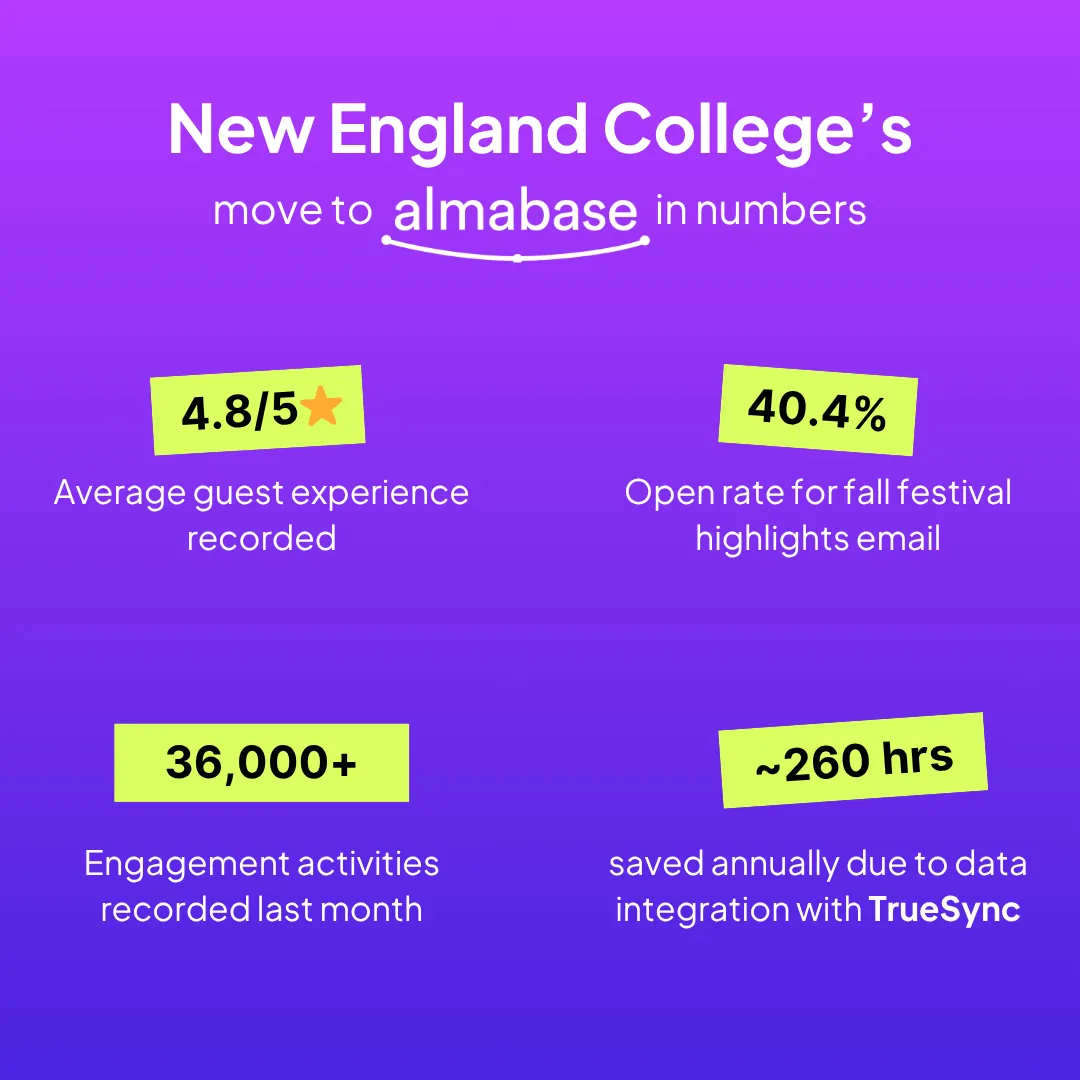
Their alumni also felt better connected to their alma mater and their fellow alumni with the addition of a cleaner, more accessible platform for both the directory and event-related pages such as giving days and fundraising forms.
You can check out the full recording of our conversation with Anna as well as an overview of Almabase through the link below 👇
▶️Inside New England College’s Future-Ready Advancement Strategy (Plus a Live Tour of Almabase)
At the end of the day, it is up to you and your team’s unique needs that will determine your platform of choice for 2026 and beyond. But we hope we’ve been able to give you a good starting point to find the right fit for you.
If you’d like to learn more about Almabase and how we help institutions and organizations for advancement needs, feel free to book a personalized demo call with us below! ⬇️
Almabase provides dedicated personnel for your onboarding and training as you or your team gets used to Almabase. We also provide readily available live chat, email, and on-call support in case you run into any hiccups.
Almabase also supports K-12 schools and healthcare foundations managing donor and alumni communities.
Almabase comes with its own set of reporting and analytics tools for giving, engagement, and donor pipeline data.

Best iModules Alternatives for Advancement & Alumni Teams (2026)
Looking for imodules (Encompass) alternatives available for advancement and alumni relations teams? We've picked out some of the popular options that you can consider.
Best practices
From annual galas to class reunions, there are numerous benefits to hosting events for alumni, parents, and other members of your school’s community. These fundraisers are mission-critical, generating the vital resources necessary to move your institution forward.
However, high engagement and an influx of fundraising dollars can easily overshadow a non-negotiable element of event planning: compliance.
Fundraising event compliance is a fundamental infrastructure that protects your school and strengthens donor trust. Not to mention, the consequences of failing to properly manage the legal and tax requirements of a fundraising event can be severe.
This guide details the core compliance pillars that your fundraising officers must prioritize for successful events.
Charitable solicitations registration is the foundational state-level requirement for nearly every nonprofit organization that solicits funds from the public. Registration is required in approximately 40 states, and organizations must register in every state where they conduct fundraising activities.
The registration process varies from state to state. For example, in Pennsylvania, educational organizations are exempt from registration if they meet specific criteria. Alaska, however, does not offer exemptions for educational institutions.
If your school’s state (or any state in which you’re fundraising) requires registration, the regulation likely applies to any solicitation activity targeting the state’s residents. According to Foundation Group, virtually all forms of revenue generation trigger a registration requirement. This can include:
While the rules for educational exemptions are inconsistent and often conditional, assuming an automatic exemption is a high-risk liability. Failure to secure and maintain registration—or proof of exemption—means the institution is soliciting illegally in that state.
The ramifications of non-compliance are serious. A state regulator can issue cease-and-desist orders, levy substantial fines and late fees, and, in extreme cases, demand the return of all funds raised illegally within their jurisdiction. For development officers charged with protecting alumni relationships and institutional reputation, the potential legal exposure and public scrutiny are not worth the administrative shortcut.
Tax-exempt status does not equate to tax immunity. Fundraising events are often subject to Unrelated Business Income Tax (UBIT) if they regularly generate revenue from activities that are not substantially related to the institution’s educational purpose.
Any tax-exempt organization that generates gross unrelated business income (UBI) of $1,000 or more during its fiscal year must file IRS Form 990-T. This form reports UBI to the IRS and indicates any tax due.
Educational institutions can determine whether a fundraising activity is subject to UBIT by considering:
Keep in mind that Form 990-T doesn’t take the place of an organization’s annual Form 990 filing—it supplements it. Failing to file both can result in severe penalties, such as having your 501(c)(3) status revoked.
It’s important to note that not all product sales are considered UBI. See the image below for examples of products your school can sell:
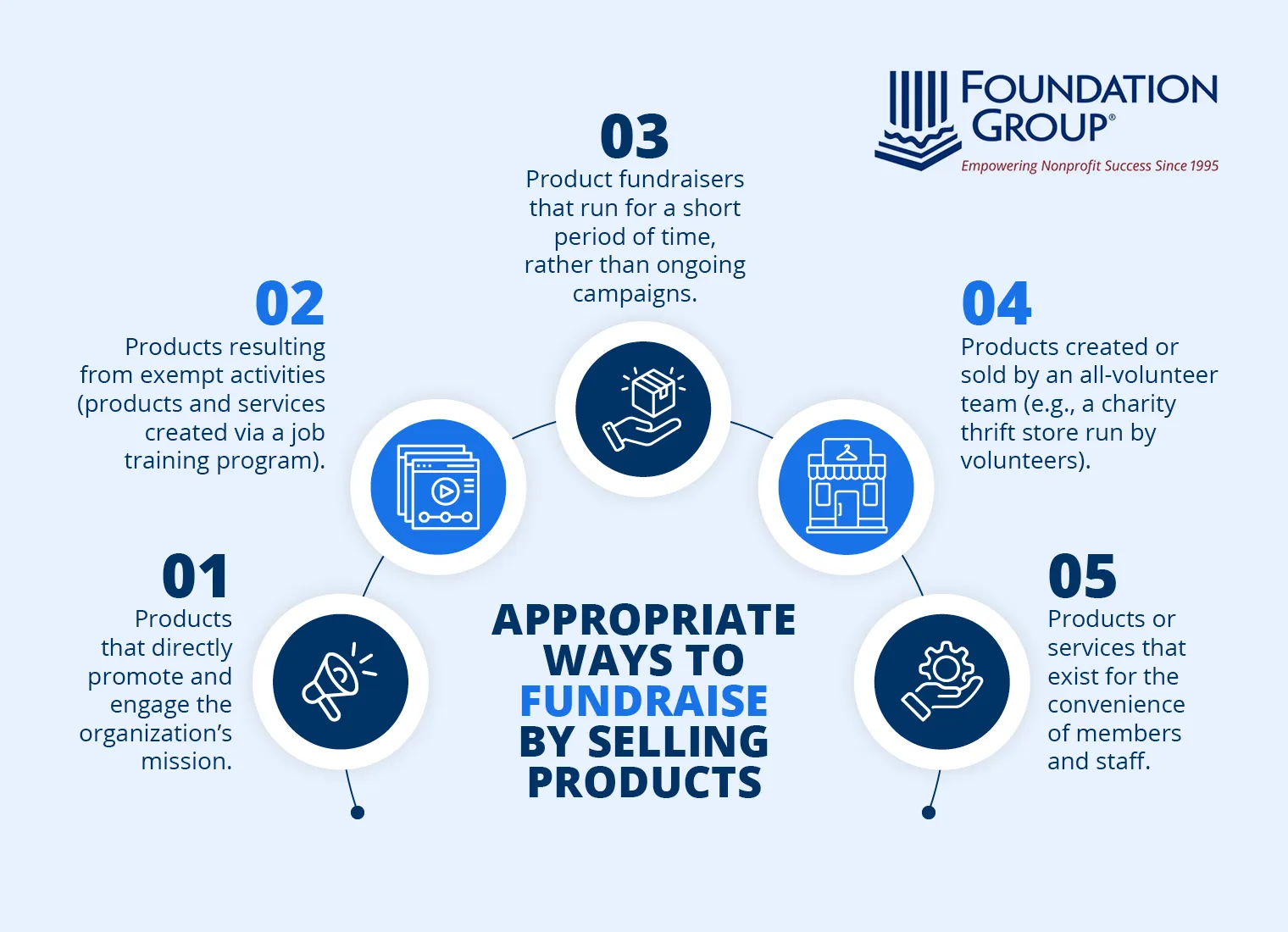
The best way to ensure your school adheres to tax regulations surrounding product sales is to prioritize detailed recordkeeping. Sales data, such as total revenue generated and fundraising expenses, is crucial in determining whether the income qualifies as UBI.
The final layer of event compliance involves managing local-level rules that directly affect the donor experience and the legality of the event itself. This includes securing the necessary permits for games and auctions, as well as properly calculating how much a donor can deduct from their taxes.
Beyond federal tax and state charitable solicitation laws, fundraising activities involving games of chance are regulated heavily at the state and local levels. Raffles, lotteries, poker tournaments, and even certain types of silent auctions may be considered illegal gambling unless the nonprofit has secured specific state licenses or local permits.
Many jurisdictions require educational organizations to obtain a separate permit for each game of chance, often with a strict cap on the prize value or the frequency of the game. Local authorities can shut down an event in progress for lack of proper permits, creating a highly damaging public relations crisis for the institution and exposing event organizers to personal liability.
Every fundraising event that provides something of tangible value to the donor—a gift card, a round of golf, a seat at a performance—is considered a quid pro quo transaction. Fundraisers are obligated to inform donors exactly what portion of their payment is a deductible contribution and what portion represents the Fair Market Value (FMV) of the goods or services received.
For example, if an auction ticket costs $100, but the event includes a dinner that typically sells for $25, then only the $75 excess contribution is tax-deductible. Careful bookkeeping for nonprofits is critical for accurately calculating FMV and reporting it to donors.
The IRS requires organizations to provide a written acknowledgment for any contribution of $250 or more that includes the following information:
Incorrectly stating the FMV or neglecting to provide proper receipts places the burden of proof on the donor in an IRS audit. This can directly damage the relationship and trust your fundraising team has worked so hard to build, ultimately sacrificing your chances of retaining donors for future fundraisers.
Effective fundraising is built on a foundation of operational excellence, and compliance is the most essential element of that operation. With the right strategy and expertise, your school can achieve successful fundraising and capacity building.
Many organizations benefit from the expertise of compliance experts who specialize in the nonprofit regulatory environment. These professionals handle the painstaking administrative and legal requirements of compliance, allowing development officers to focus entirely on their mission.

Fundraising Event Compliance: Permits, Taxes, and More
Fundraising event compliance is an often-overlooked yet essential aspect of raising money for your school. Learn the essential compliance requirements here.
Events
Every hospital fundraising event is an opportunity to turn attendees into donors. When your post-event stewardship is fast, personal, and data-driven, you’re more likely to turn one-time guests into loyal supporters.
The difference between a successful gala and a transformational one lies in your ability to turn the energy and passion of the live event into meaningful, ongoing donor support, using the right healthcare fundraising strategy and technology to make it happen efficiently and securely.
Almabase simplifies hospital foundation donor cultivation with automation tools that make every follow-up faster and more personal.
Our event management platform automatically syncs attendee data directly to Raiser’s Edge NXT, allowing you to personalize communication at scale. Built-in email, text, and video tools let your team send targeted thank-yous, impact updates, and future invitations without manual data entry or list sorting.
See how Almabase helps hospital foundations automate event follow-up for fundraising and strengthen donor relationships after every event.
For more than a decade, Almabase has helped hundreds of nonprofit organizations plan successful events and turn them into long-term donor relationships.

These are five of the most effective steps we’ve identified to turn event attendees into loyal donors.
Almabase’s Raiser's Edge integration for hospital foundations ensures all data flows accurately and securely.
Registration details, ticket purchases, donations, and check-ins flow directly into donor profiles—no spreadsheets required. And automatic tagging of attendees by type (sponsor, bidder, volunteer, or first-time guest), makes it easy to segment your list and send more personalized follow-up communications.
Send a thank-you email to all attendees the same day as the event. Call or send handwritten notes to top supporters within two days.
Personalized, automated donor follow-up ensures your hospital foundation stays top-of-mind after every event. Almabase’s AI Email Builder makes it easy to personalize messages by participation type, such as table sponsor, auction bidder, or volunteer, and cuts creation time from 20 minutes to less than one.
1 Week Later: Segment by engagement level and tailor your donor outreach accordingly.
By tracking attendee behavior in real time (donated $0 vs. $100+, purchased add-ons, checked in), Almabase automatically triggers personalized, behavior-based outreach.
Our multi-channel automation keeps your message consistent across email, SMS, and print. Outreach remains timely, relevant, and aligned to each supporter’s engagement level.
2 Weeks Post-Event: Send a concise “Event Impact” email that demonstrates what their participation accomplished. Share event photos, total funds raised, and a powerful patient story to highlight impact: “Your support helped raise $250,000 to expand the neonatal ICU.”
Use storytelling to build emotional connections and trust—two essentials in healthcare fundraising success.
Add a next-step call-to-action. For example:
Almabase’s partnership with Storyraise simplifies this kind of impactful outreach. By enabling digital donor reports with visuals and video, we help hospital foundations create interactive updates that show donors their impact and deepen donor engagement over time.
4 Weeks Post-Event: Send a short survey to capture feedback and insights you can use to personalize future outreach. Then, transition attendees into your ongoing donor communications so they continue receiving impact stories and invitations year-round
Almabase automates this process through our healthcare donor management software, built to link event and donor data in real time. With TrueSync for Raiser’s Edge NXT, every interaction—whether a gift, registration, or memorial campaign—is instantly reflected across systems, eliminating manual updates and ensuring staff always have a current view of each supporter’s activity.
Using Almabase’s Grateful Community Engagement tools, families and patients can easily create memorial or gratitude campaigns to honor loved ones, invite others to give, and keep supporters emotionally connected to your mission throughout the year
These HIPAA-secure features empower healthcare foundations to strengthen long-term relationships, unify event and donor data, and build a sustainable culture of gratitude across every touchpoint.
Hospital foundations need secure, compliant technology that simplifies post-event stewardship. Almabase is fully HIPAA-ready and SOC 2 Type II certified. Almabase’s Raiser’s Edge integration helps hospital foundations maintain real-time data accuracy and compliance.
By connecting every registration, check-in, and gift directly to Raiser’s Edge NXT, Almabase helps hospital foundations convert fundraising event attendees into donors, ensuring every event fuels long-term engagement and sustainable growth through automated donor follow-up and smart segmentation.
Hospital foundations can convert event attendees into donors by using automated post-event stewardship tools like Almabase to send personalized thank-yous, share impact stories, and sync engagement data directly to Raiser’s Edge NXT for targeted donor cultivation.
Almabase’s healthcare donor management software includes AI-powered email tools, TrueSync integration with Raiser’s Edge, and automated workflows that streamline donor communication, saving staff time and improving engagement accuracy.
Post-event stewardship and donor engagement keeps the momentum going after galas or auctions, turning one-time guests into repeat supporters. Consistent follow-up strengthens relationships and improves long-term donor retention.
We automate data syncing, tagging, and segmentation through Almabase’s Raiser’s Edge integration for hospital foundations, helping teams track donor journeys and manage cultivation workflows efficiently.

How Hospital Foundations Can Turn Fundraising Event Attendees into Donors
Learn how your hospital foundation can turn event attendees into donors and loyal supporters through well-planned stewardship and follow-ups.
Healthcare

.svg)