Here are 10 practices you definitely want to keep in mind to build and nurture your donor relationships.
Hari Govind
Published:
June 16, 2026
Updated:
June 17, 2026

Donors are the champions of your mission, your cause. The connection you have with them ultimately decides your ability to impact people and communities. So having a solid strategy for donor relationship management becomes a key part of ensuring your institution or nonprofit’s success.
In this blog, we’ll explore donor lifecycles, the best outreach and communication practices, helpful tools, and guide you in creating the best relationship management strategy for your organization.
Nonprofits focus on two things primarily to increase funds. Acquiring new donors, and retaining existing ones for continued contributions. Donor relationship management is the set of practices that are used to improve and maintain both.
This includes, but is not limited to campaigning, stewardship, and milestone recognitions, which will be expanded upon in the later sections. Ultimately, it boils down to fostering a positive culture and making donors feel like they’re making a difference.
It’s quite easy (and tempting) to go all-in on acquiring as many donors as possible. While this might lead to great gains in the short-term, building a reliable, sustainable pipeline of donations takes much more.
If you’re aiming for lasting impact and stability, deepening your relationships with your donor base is the way to go. A few important reasons to do this:
1. Improved Donor Retention: It’s a well established fact that retaining donors is a lot more cost-effective than acquiring new ones. Having solid engagement and stewardship plans gives you a much-needed edge in fundraising. Donor retention in the US sits at around 20%, with organizations often underutilizing recurring programs. Use it to your advantage.
2. Increased Donor Lifetime Value: The more loyal your donors are, the more they are likely to contribute. Retained donors have a higher likelihood of increasing their donation amounts, contributing to annual campaigns, and donating to emergency causes in a pinch. They end up feeding your cause a lot more throughout their lifetime.
Overall, organizations with great relationship management practices perform better in fundraising, and have higher DLVs.
3. Greater Advocacy and Support: New donors introduced through friends, family, or word-of-mouth in general tend to stick around. Engaged donors don’t just contribute more long-term, but also bring in new faces and spread word of your nonprofit’s impact and cause.
4. Success Beyond Numbers: Building trust and engaging donors in meaningful ways often is a great way of not only bringing in reliable, recurring revenue, but also creating a sense of community. Your mission is only as strong as the people supporting it. A satisfied donor base contributes in other non-financial ways too, like volunteering.
While coming up with a strategy for building relationships with donors, follow these practices to cover all bases efficiently.
A donor profile holds all the relevant information about your current and prospective donors. They live in your institution’s database or CRM, and have to be updated regularly. Treat them as live documents giving you the relevant, up-to-date data.
Donor profiles are used extensively for almost every step of the way in fundraising. Targeted outreach, reviewing campaign performance, and so much more require accurate donor data.
What do you include in a donor profile? There are some necessary fields that are useful for many fundraising activities. Some important ones are:
Different types of donors need different outreach strategies and messaging. You don’t want veteran donors looking at an introductory email with blank faces. Or scare away first time/casual donors with too much information.
Segmenting your donors based on their financial capability, giving history, volunteering interests, and associations with particular causes lets you execute targeted campaigns that have far more effective conversion rates.
Having segmented lists of donors helps greatly here. You can’t expect someone to be moved by your cause if the messaging sounds like generic marketing slop. While it’s impossible to personalize every single message, you can tweak outreach group-wise. Ask for small contributions from first timers, introduce recurring programs to existing donors.
With the right data and outreach tools, you can even personalize based on local events and non-philanthropic interests.
We probably know this all too well, but if there’s one thing that kills confidence, it’s getting ghosted. Timely recognition is non-negotiable unless you want donors feeling like they’re shooting money into a void.
Immediate thank-you messages acknowledge donors’ valuable time and contribution, and builds trust. Use multiple channels to thank your donors. Apart from one-off emails, social media can be used for collective recognition.
Knowing how exactly your contribution is being utilized is a great way of gaining trust and deepening your relationship with a nonprofit or a mission. Regularly update donors on ongoing initiatives, communities being helped, total money raised for causes, and overall impact.
Take this a step further by sharing video snippets, pictures, and other visual media to make them truly feel like they’re working together with you and are a part of your organization. Engaged donors are more likely to continue contributions long-term.
While emails get the job done, inboxes are more often than not flooded with unimportant emails and your messages can be lost among them. To increase interaction, plan an outreach strategy across multiple channels.
Aside from personalized email sequences, create a social media schedule to reach donors organically. Another underrated channel is text messaging – it feels a lot less formal and increases authenticity.
Your outreach plan should contain steps for initial campaign introduction, building up anticipation in the days leading up to it, live updates during the campaign, and nurture sequences post-event/campaign. Share relevant news and ask for donations every now and then, but don’t overdo it.
With the volume of donors and donations, it can sometimes be hard to track follow-ups manually, leading to gaps in communication. Having a dedicated platform for automating follow-ups makes sure that messages aren’t lost among the confusion.
Regular, timely emails constantly expose your nonprofit to potential donors. Consistent reminders and nudges are necessary as most people operate with tight and busy schedules.
Increasing your donations over time isn’t just about launching effective campaigns or reaching the most donors. It’s also about identifying the most engaged participants, seeing what drove the engagement, and replicating it for different donor groups.
Using a digital engagement platform, track metrics that give you an idea of donor engagement. This can include response rates across different channels (fundraising appeals, feedback requests, social media engagement), number of event/volunteer sign-ups, donor retention rate, and online engagement metrics such as email open rate, click-through rates, donation form abandonment rate, and website traffic sources.
As emphasized earlier, your donor profiles are live documents that contain accurate, updated information at all times. Inaccuracies in donor data can lead to wrong segmentations, incorrect campaign enrollments, and mismatched donation data, all of which affect fundraising performance in subsequent campaigns significantly.
While it’s possible to manually update records, it can be very time consuming and leave your head spinning. Using workflows to auto-update fields and contributions is a lot more efficient and accurate.
Some essential metrics allow you to measure your progress and to see how good your donor management strategy really is. These are different from donor engagement metrics; evaluating fundraising performance can give you a good indication of how much donors are willing to contribute to your cause, which groups have the most capability, what segments are strong targets, and where your teams can improve.
Here’s a few of them in no particular order:
Donor lifecycle is the journey that unaware, potential donors make that ends in some form of contribution to your cause. There are various stages in the cycle, each requiring its own set of initiatives and strategies.
Understanding the donor lifecycle step-by-step can help you identify potential gaps in your donor management process, and gives you insight into the donor’s perspective leading to better outreach and retention methods.
Here are the 5 major steps that nonprofits take to manage donors:
This is the start of it all, when your nonprofit tries to identify prospective new donors and engage with them. To do this, you utilize paid ads, emails, and social media to reach low to mid-level donors.
They might also land in your website through referrals, word-of-mouth, or stumbling across some of your mass-communication material.
For acquiring major donors though, a more personalized approach is required. This usually means researching affluent donors who might be connected to your cause or willing to contribute to it and contacting them through their preferred channel of communication (calls, emails, etc).
In this stage, nonprofits start building their relationships with potential donors. For casual donors, this means introducing your nonprofit’s mission, the goals, initiatives and the like. The key here is to build trust; answering queries and showcasing impact are important.
Cultivating major donors isn’t as straightforward. Aim for long-term relationship building by meeting them one-on-one, developing consistent communication threads, and offering engagement opportunities that will expose them directly to your nonprofit’s work, like volunteering and attending events.
Again, keep in mind that major donor cultivation can take a long time. Constantly research, personalize, and meet. Fundraising performance depends on your charisma too, no pressure.
Once you’ve introduced your nonprofit and its causes, donors will evaluate if it’s worth contributing to. You will be asking donors to contribute for the first time, and this is easy with smaller gifts. After all, $10 isn’t exactly life changing for either party. The intent here is to get them to make a contribution, how much doesn’t really matter at this stage.
To turn interest into action, make your forms easy to fill (only the necessary details), and make it easy to contribute. Payment should be frictionless, and they should have multiple choices when it comes to payment modes.
Soliciting major donors might require a lot more presentation, involvement and relationship-building beforehand.
It’s very important to express gratitude for contributions, and make donors feel recognized. This can range from a simple thank-you email to major personalized gifts and plaques.
One good pointer to keep in mind is to match the scale of their contribution. For example, for small donations, a simple email might suffice. For major gifts, recognition should involve exclusive event invites, awards, etc.
After receiving donations, have nurture programs in place to ensure constant communication, awareness, and deeper relationships over time. Highlight new initiatives, invite for volunteering, host events, and provide impact updates regularly.
Your stewardship efforts directly tie into donor retention. Aside from that, there are a couple of things you can do to avoid driving them away.
Predicting churn proactively is a good way to boost donor retention. This can be achieved by thorough analysis of data, following up with lapsed donors to get feedback, and creating lists. Another thing you can do is alternating donation requests with other appeals to prevent fatigue.
What does upgrading your donors look like? It just simply means increasing their contributions; converting a one-time donor to a recurring donor, or a casual donor to a major donor are all upgrades. Keep tracking donor engagement and gifting data to determine the right time to ask for more.
We’ve laid out the best practices to cultivate long-term relationships with donors and build a pipeline of steady, reliable contributions over extended periods of time. There are a few minor tweaks which, though optional, can help you identify gaps quicker, save time, and just have an easy time of maintaining the hygiene of the overall process.
Taking a step back and experiencing your organization through a donor’s perspective can be massively helpful in seeing if your process is actually smooth and easy, and finding out where friction creeps in. What’s optimal for your team isn’t necessarily optimal for the average donor.
Often, prospective major donors are hidden in plain sight. By checking wealth data against donor profiles, you might be able to fish out members who are already aligned to your cause and have the ability to contribute a lot more.
Stewardship is a vital part of donor outreach management. Automating the generic follow-ups (immediate thank-you messages or gift acknowledgements) gives you more time to focus on personalized updates and asks.
To actually execute the best practices in donor relationship management, having the right tools is a must. The bare essentials include a nonprofit CRM to build and manage donor profiles, a digital engagement platform for donor outreach management, and an event management tool to coordinate volunteering, award ceremonies, and other interactions with donors.
Just like in real life, donors give subtle hints through the material they choose to interact with. Tracking non-financial activity like content downloads, visits to a particular program page, video views, and email click-through rates gives your team much needed signals on the donor’s affinities to various activities and causes.
The right donor management software can save your team a lot of time and frustration. The wrong one can turn even simple tasks like updating records or sending follow-ups into a headache.
Before evaluating platforms, think about your team's day-to-day work. A tool might have lots of advanced features, but if it has a tacky UI and a steep learning curve, your staff may end up avoiding it altogether. The best donor management software is the one your team will actually use consistently.
Below are a bunch of priorities to keep in mind while you’re on the lookout.
Segmentation is one of the foundations of effective fundraising. Your software should make it easy to group donors based on giving history, donation size, engagement levels, volunteer activity, interests, and other relevant criteria.
The easier it is to create and update donor segments, the easier it becomes to run targeted campaigns and personalized outreach.
Look for platforms that can track donation trends, campaign performance, donor retention, engagement levels, and other fundraising metrics.
Good reporting helps your team identify which donor groups are performing well, which campaigns are driving results, and where improvements need to be made.
Manually handling acknowledgements, follow-ups, reminders, and record updates can quickly become overwhelming as your donor base grows.
A strong donor management platform should automate repetitive tasks such as thank-you emails, recurring donation reminders, event follow-ups, and data updates. This allows your team to spend more time building relationships and less time managing spreadsheets.
Donor information often ends up scattered across spreadsheets, email inboxes, event platforms, and fundraising tools. This stands in the way of creating complete donor profiles like we outlined earlier.
Choose a platform that serves as a central source of truth for donor records, engagement history, campaign interactions, and contributions.
Fundraising teams rarely use a single platform. Your donor management software should integrate with donation forms, email marketing tools, event management platforms, and payment processors, or, better yet, have all that functionality built in.
It's also worth thinking long-term. A platform that works for 500 donors should still work when you're managing 5,000.
Ultimately, the goal isn't to find the software with the longest feature list. It's to find a platform that helps your team maintain accurate donor data, automate routine work, execute targeted outreach, and build stronger relationships as things scale without breaking anything.
Almabase brings fundraising and engagement data together in one place, helping teams understand how donors interact with the institution over time. With a connected view of donor activity, it's easier to identify engaged supporters, track interests, and build more meaningful outreach strategies.
The platform also helps teams segment donors based on giving history, engagement levels, event participation, etc. This makes personalized communication easy, allowing you to send more relevant appeals, updates, and stewardship messages to different donor groups, and with the workflow automation capabilities, automate general tasks and follow-ups.
If you’d like to see how Almabase can help you build and nurture your relationships with your donors, feel free to book a free personalized demo and we’d love to discuss how we can help!
Table of Contents
Subscribe
See how modern advancement teams bring alumni engagement and fundraising together.
Successful school auctions require significant planning, thoughtful execution, and effective follow-through. Since they can be so involved, how do you measure their ROI? Of course, you’ll track your fundraising goals, but another underused metric can help supercharge your efforts: donor relationships.
School auctions help you increase both the quality and quantity of your donor relationships to facilitate future support, improve donor loyalty, and build sustainable engagement habits.
.jpeg)
Think about how you foster these relationships before, during, and following your auction. To help you get started, we’ve listed our top recommendations for making the most of your school auction. Let’s jump in!
To tailor your outreach approach, research potential attendees in advance to determine who you should prioritize inviting and engaging with. Reference your data and be sure to invite previous attendees with:
Pay special attention to your most recent audience data that dates back about two years. Using this data, you can identify your high-impact donors and tailor your outreach and auction format to engage them. For example, you might recognize their impact from the previous year and ask them if they have any auction items they would like to see at this upcoming auction.
While researching individuals to invite to your auction, note their business affiliations. These connections will help you uncover valuable insights into other opportunities for potential guests to contribute to your school.
Here are a few opportunities business affiliations can present:
Reference these business affiliations when preparing a live auction. For instance, you might create a seating chart with two (friendly) business competitors side by side to increase healthy competition.
Leading up to your school auction, lay the groundwork for building lasting donor relationships that engage your community. Doing this will open the door to opportunities for long-term connections. To increase anticipation before your auction, consider:
According to SchoolAuction.net, pre-auction event planning and promotion can define your auction’s success as promotion is the first step in inviting donors into a productive relationship. In other words, effective event promotion will widen your reach which can positively impact your donor acquisition efforts.
For best results, stick to posting on channels that your alumni and other potential guests are already active on. For instance, many schools have active Facebook groups you can leverage to get the word out about your upcoming auction.
During the auction, have your team mix and mingle with guests freely. That means you should avoid spending time supervising check-in, check-out, and other bidding procedures. To streamline auction logistics, use comprehensive auction software.
Use software that offers the following features to streamline your event:
These features are essential for providing an unforgettable guest experience. You might consider partnering with an auction provider whose software is also format flexible, so you can easily transition in-person auctions to hybrid or online formats. Built-in gamification features like countdowns and outbid notifications are also useful tools for enhancing the bidding experience and spurring friendly competition.
Your work is not over after the auction! Engage your auction guests and communicate that your school is willing to go the extra mile even after securing support. To make your guests feel valued, follow these best practices:
.png)
Your recognition and gratitude efforts will vary according to the donor. For instance, you might mention major sponsors in your newsletter updates, call them personally on the phone to express gratitude, or plan an appreciation event to celebrate their generosity.
By considering which donors to invite, how you’ll invite them, and how you’ll engage them, you can set the stage for long-term relationships. Use tools like prospect research and auction software to plan and execute your auction. That way, you can expand your network and streamline your event. To your fundraising success!

5 Tips for Building Donor Relationships at School Auctions
Are you ready to improve your school’s auction fundraising potential and build lasting donor relationships? Read this short guide for top recommended tips!
Lorem ipsum dolor sit amet, consectetur adipiscing elit. Suspendisse varius enim in eros elementum tristique. Duis cursus, mi quis viverra ornare, eros dolor interdum nulla, ut commodo diam libero vitae erat. Aenean faucibus nibh et justo cursus id rutrum lorem imperdiet. Nunc ut sem vitae risus tristique posuere.

July 13, 2023
12 minutes
Giving Days have become the Super Bowl of advancement. Teams spend months planning, alumni flood timelines with links and hashtags, and fundraising dashboards light up with activity. But once the campaign clock stops, engagement often fades. Donors vanish. Inboxes quiet down. The cycle resets.
What if Giving Day wasn’t an end but a beginning?
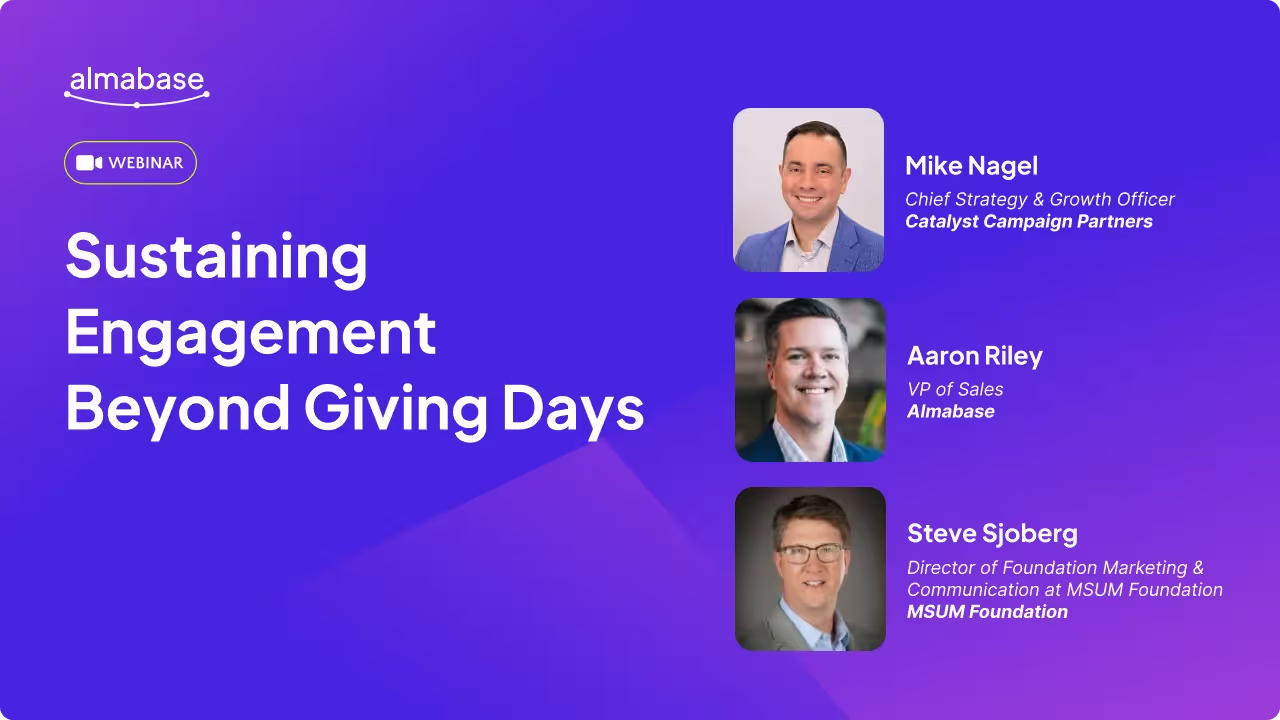
That question shaped a recent conversation hosted by Aaron Riley, VP of Sales at Almabase, joined by Mike Nagel, Chief Strategy and Growth Officer at Catalyst Campaign Partners, and Steve Sjoberg, Director of Foundation Marketing and Communication at the MSUM Foundation. Together they explored how advancement teams can turn Giving Day momentum into a year-round engagement strategy that builds relationships, strengthens retention, and drives sustainable fundraising results.
Fundraising totals across higher education continue to rise, yet fewer people are giving each year. In 2024, colleges in the US raised $61.5 billion, while donor participation declined by 7 percent.
“It’s not sustainable,” Mike said. “Every VP I talk to is thinking about the pipeline. You can’t grow revenue if your donor base keeps shrinking.”
Giving Days are great at attracting first-time and lapsed donors, but retention is the issue. Research shows that 34 percent of Giving Day gifts come from new or reactivated donors, yet only 20 percent make a second gift without continued engagement.
Institutions facing the same challenge can take inspiration from Boyd-Buchanan School’s story, which connected alumni engagement directly to fundraising growth.
At Minnesota State University Moorhead (MSUM), Steve Sjoberg and his team saw Giving Day participation spike, only to drop soon after.
Their solution was simple and strategic — extend the story.
“Giving Day should be the kickoff, not the closing ceremony,” Steve said. “We started asking what it would look like if this became the beginning of our engagement year.”
That mindset reframed MSUM’s communication strategy, building a cadence of connection throughout the year. It mirrors how RISD restructured its engagement journey by connecting alumni activity, fundraising, and communication into a unified experience.
Speed was MSUM’s first priority.
Before Almabase, it took nearly a month to process and thank all donors. With Almabase’s Alumni Engagement Platform, integrated with Blackbaud, the team reduced that to three days.
“Speed builds trust,” Steve said. “When donors hear from you within 24 hours, they remember how that gift felt.”
MSUM layered its stewardship program:
That one shift delivered a measurable impact.
“Just through personalized thank-you videos, we raised an additional $40,000,” Steve shared. “People responded because they felt seen.”
Mike added, “Three out of four first-time donors never renew. Quick and personal acknowledgment is the easiest fix.”
This approach aligns with how Samueli Academy automated alumni communication to maintain consistent connection and achieve a 97 percent engagement rate.
Data without insight is noise. The MSUM team shifted from simply counting donors to understanding who they were.
Mike explained, “Around 10 to 15 percent of your alumni have major-gift capacity. Giving Day is when they raise their hand. If you’re not analyzing that, you’re missing your next big donors.”
Using Almabase, MSUM tagged upgraded gifts, identified high-potential first-time donors, and synced this information with its CRM. Reports that once took weeks now update in real time.
“We moved from spreadsheets to instant visibility,” Steve said. “It freed our staff to focus on relationships, not reconciliation.”
This mirrors Concordia College’s strategy, which used data-driven segmentation to strengthen donor relationships and streamline advancement operations.
Every donor wants to be acknowledged, but the message needs to feel personal.
.jpg)
At MSUM, stewardship scales without losing authenticity:
Authenticity matters more than automation. “We handwrite names on whiteboards before filming videos,” Steve said. “That’s how they know it’s real.”
Mike compared it to the private sector: “If a retail brand can personalize an experience, advancement teams can personalize gratitude.”
Gann Academy’s example proves how small tweaks in personalization can lift open rates and engagement across the board.
Large campaigns attract visibility. Micro-campaigns sustain participation.
MSUM’s wrestling room renovation campaign invited alumni and fans to fund upgrades. In six weeks, it met its goal. “It wasn’t about the size of the gift,” Steve said. “It was about people feeling connected to something they love.”
Another small but powerful initiative expanded the campus Oceanarium, adding a teaching space for local schools. Both efforts gave alumni tangible proof of their impact.
A similar approach worked for DMBA, which funded its engagement platform through targeted micro-campaigns instead of large appeals.
MSUM replaced its traditional gala with Dragon Legacy Luncheons — smaller, college-based events that celebrate faculty, students, and alumni together.
“Legacy Luncheons let us lift up real stories,” Steve said. “People leave feeling valued, not entertained.”
Attendance grew, costs dropped, and alumni involvement deepened.
Antioch College saw similar success by focusing on community events that created real relationships instead of one-time gatherings.
Retaining young alumni begins before graduation.
MSUM’s Career Connections Office collects accurate contact data from seniors, offering small incentives like alumni gifts or pizza.
“A small reward today leads to stronger loyalty tomorrow,” Mike said. “If you capture contact info early, you never lose them.”
This early engagement mirrors Nicholls State University’s spotlight series, which kept young graduates connected through personal stories.
Institutions can also explore Almabase’s blog on how to engage alumni more effectively for actionable ideas to build meaningful early connections.
With Almabase, MSUM automated repetitive tasks like thank-you emails, donor segmentation, and event follow-ups. The team now spends more time creating experiences than managing workflows.
“Before, we reacted,” Steve said. “Now we plan ahead. The system gives us space to be creative.”
By aligning technology with human storytelling, MSUM built a sustainable rhythm of connection that continues long after Giving Day ends.
Learn more about how Almabase supports this workflow in the Alumni Engagement Platform overview.
Aaron Riley summarized the takeaway that tied everything together.
“Building systems matters more than building campaigns. When you create a rhythm of gratitude, storytelling, and follow-up, Giving Day becomes one part of a longer conversation.”
This mindset shifts advancement from transaction to transformation.
Since adopting this approach, MSUM has
The result isn’t only more funds but deeper community trust.
Giving Day may start as a 24-hour event, but its real value lies in what follows after the giving day event. The institutions that treat donors as partners, not participants, will build stronger communities and more sustainable pipelines.
To see how this strategy works in practice, watch the full conversation with Aaron, Mike, and Steve or explore how Almabase helps advancement teams sustain engagement throughout the year.
Watch the full webinar recording below:
Sustaining Engagement Beyond Giving Day: How Institutions Are Building Long-Term Alumni Relationships
Discover how MSUM uses Almabase’s alumni engagement platform to turn Giving Day donors into lifelong supporters through personalization, automation, and smarter stewardship.
Lorem ipsum dolor sit amet, consectetur adipiscing elit. Suspendisse varius enim in eros elementum tristique. Duis cursus, mi quis viverra ornare, eros dolor interdum nulla, ut commodo diam libero vitae erat. Aenean faucibus nibh et justo cursus id rutrum lorem imperdiet. Nunc ut sem vitae risus tristique posuere.
As a fundraising professional, you understand the importance of building relationships with your valuable donors. They’re the ones who provide the funding that make it possible to provide new opportunities for students and alumni. Therefore, building relationships with them secures support both now and in the future for these fundraising programs to continue taking place.

Considering the disruptions that everyone experienced (and continues experiencing) during the COVID-19 pandemic and how the industry has evolved since then, your relationships with many donors might appear to be volatile or different. When everyone changed up their strategies to incorporate the latest trends in engagement, some strategic aspects undoubtedly fell through the cracks.
We recommend taking your approach back to the basics of engagement and donor relationships this coming year. Revisit some tried-and-true ideas that have been proven time and time again to bolster relationships with your supporters. After all, these are the strategies that are most often forgotten when we embrace new methods and change up our approach to relationships.
The tips we’re covering in this article are ones that you may have seen before. However, they’re immensely important to maintain throughout the hubbub and chaos of the year. Without further ado, let’s dive deeper into these important and timeless strategies to help take your donor relationships to the next level.

For students, alumni, and donors, it’s painfully obvious when you send out emails or other communications that do not employ segmentation or other personalization strategies. Everything from a “To whom it may concern” introduction to the lack of personal details in the message makes it clear that you sent the same message to everyone on your email list.
Generic, impersonalized outreach is the easiest to ignore and causes the downfall of many marketing programs. See how institutions such as Gann Academy increased alumni email open rates by personalizing their email campaigns.
When it comes to your donors, you should include the same personalization strategies for outreach.
The easiest way to start making the most of personalization is to use the same approach as Gann Academy: start with your email campaigns. Use the information in your donor database to fill in some gaps and to show your supporters that the message you’re sending is customized just for them. You can do this by:
- Using the donor’s preferred name in the introduction.
- Including details about the supporters’ engagement history.
- Approaching specific segments of donors with targeted messages.
- Sending messages relevant to the interests of the donor.
When you have access to an effective donor database, a lot of this information can be automated to save you time and energy in sending these highly targeted messages. This effective donor database buyer’s guide explains that automation features, when used correctly, can make personalization more effective and efficient.
Your database can be used to auto-populate details into message templates and ensure you reach the right audience segments in your communications to enhance donor engagement.

Building relationships is impossible if it’s a one-sided effort. Your institution needs to not only work to communicate and show your donors that you care, you need to invite them to engage back with you by providing ample opportunities.
Since COVID-19, engaging opportunities look a little different than they have in the past. To create engaging opportunities amidst of a pandemic, many institutions had to adhere to social distancing guidelines by coming up with new virtual event ideas.
We’ve come up with a list of our favorite virtual fundraising ideas that any educational institution, nonprofit, or other organization can make use of. While you can find the full list here, we’ll highlight some of the options below:
- Online Gala - This is a great opportunity to encourage your major donors to get dressed up and network with one another using virtual conferencing software.
- TED Talk Events - Encourage your donors while enforcing your emphasis on education by providing TED Talk-style events to spread knowledge about certain topics.
- Online Classes - Provide online class opportunities for donors as well as students. These may not be full-fledged courses, but mini opportunities to sharpen skills.
- Annual Giving Days - Giving days encourage a great number of people (especially alumni) to give on a very specific day, similar to #GivingTuesday.
- Matching Gift Drives - This is a great way to encourage more donations and maximize impact. Promote corporate giving opportunities and remind supporters to check their eligibility for matched gifts.
When your donors get involved with all of the opportunities you offer, they strengthen their ties to your institution. This makes it all the more likely that they’ll continue supporting you in your upcoming fundraising events.

A phone call is an often overlooked relationship-building strategy because it can be somewhat time-consuming. However, it’s a valuable tool and makes a huge difference, especially when it comes to new donors.
For instance, consider the new donor cultivation timeline below. It shows that a thank-you call within 48 hours of a donation can dramatically improve your donor retention rates. Plus, it’s the first step to begin a strong relationship with your donors. This is because you establish a personal connection with the donor while showing your appreciation for their contribution.

Phone calls are a great way to start a relationship with donors on the right foot. However, don’t forget to employ the strategy with your seasoned donors as well! Call them to maintain regular contact and to express your gratitude for their continued support in your fundraising initiatives.

You’ll notice that on the cultivation timeline from the previous section that the step after a “thank you phone call” is sending a “signed thank you letter.” While email is likely your primary method of communication with the donors, the power of a physical letter of appreciation should not be underestimated, especially when it’s hand-written.
Handwritten notes are a classic way to show your donors that you will truly take the time out of your day for them. They want to feel like a priority for your organization, which is what a hand-written note should communicate.
When you write these notes, there are specific elements that you should make sure to include, such as:
- The preferred name of the donor. Just like in email communications, you should make sure to refer to the specific donor as you hand-write letters (be sure to double-check your spelling, too!)
- The activity they participated in. If your donor has just contributed funds, be sure to thank them for the specified amount. If they attended an event, thank them for their involvement and participation.
- The president’s signature. Letters are generally better received when they come from the top office of your institution. Therefore, you should make sure the president of your institution’s signature is on each and every one of them.
Just like phone calls, hand-written letters tend to be important strategies as you cultivate relationships with your new donors. However, don’t forget about the strategy for your veteran donors!
Be sure both phone calls and hand-written letters are a part of both your cultivation and stewardship strategies to strengthen donor relations.
.avif)
Don’t we all love stories? Your donors want to hear your inspiring story. They want to hear the reason behind all the great work that you do and the support that you provide to your community. Sharing these stories with your donors is a great way to show them what it is that their contributions support.
One of the current trends in the higher education space is the use of images to communicate these types of narratives. This trend is important to keep in mind because there are so many different platforms on which you’ll be telling stories. For instance, consider the following examples:
- Email - Whether it’s an email to a certain segment of your audience or a regular newsletter sent to many, include an image of an individual who attended your institution along with their story. This adds a face to the name and a personal touch to show the impact of donations.
- Social media - Platforms like Instagram and Facebook are made for visual storytelling. Be sure to use an image that tugs at the heartstrings to gain the attention of your audience, then caption it with details about the story itself. If it’s a longer story, be sure to provide a link to where donors can read the rest of it.
- Blog posts - Blogs are the perfect way to write long stories about individuals or about the progress of your institution. Showing images, faces, and specific names makes them even more powerful.
They say a picture is worth a thousand words. And it’s true! Be sure to leverage both text and image when you tell the story of your institution’s successes.

In the last section, we mentioned briefly that stories are a method of showing impact. Communicating impact is critical for donor engagement and continued support down the line. Think about it. If you give to an organization, you’re not contributing money for the sake of spending it. That would be silly! Rather, you’re donating to help accomplish a mission.
Communicating the progress of this mission and the impact of specific donations is a great way to give your donors the warm and fuzzy feeling in the pit of their stomachs that was probably what drove them to contribute in the first place. You’re reinforcing the positive aspect of donating.
Check out this nonprofit annual report guide that conveys the story of The Johnsons and how their impact was communicated to all contributors in an end-of-year report.

Notice some key aspects of this example:
- It shows a picture of The Johnsons
- The text uses a statistic showing the impact their contributions made
- The text is framed to put all of the emphasis on the Johnsons rather than on the efforts of the organization
These aspects are some of the most important things to remember when you communicate the impact of specific donors. Generally, on annual reports such as this, it’s your major donors that you’ll highlight. However, you can still use these strategies in emails, letters, phone calls, and other methods of communication to show any supporter that they’ve made a difference.
Building donor relationships is an incredibly important part of the fundraising strategy at your institution. Therefore, even as you explore all of the new and exciting ways to communicate and engage with them, don’t forget about the basics. Form a strong foundation for your donor relationships by using these tried-and-true strategies. Then, continue to cultivate and build these relationships to watch your fundraising soar!


Co-Founder and current Chief Relationship Officer at Bloomerang
He has served this sector for 33 years and is considered the most well-known senior statesman whose advice is sought constantly.
Prior to Bloomerang, he was the CEO and Co-Founder of eTapestry for 11 years, which at the time was the leading SaaS technology company serving the charity sector. Jay and his team grew the company to more than 10,000 nonprofit clients, charting a decade of record growth.
He is a graduate of Butler University with a B.S. in Business Administration. Over the years, he has given more than 2,500 speeches around the world for the charity sector and is often the voice of new technology for fundraisers.

6 Ways to Take Your Donor Relationships to the Next Level
Donor relationships are necessary to maximize fundraising and support retention rates. Check out these six expert tips to take relationship-building further.
Lorem ipsum dolor sit amet, consectetur adipiscing elit. Suspendisse varius enim in eros elementum tristique. Duis cursus, mi quis viverra ornare, eros dolor interdum nulla, ut commodo diam libero vitae erat. Aenean faucibus nibh et justo cursus id rutrum lorem imperdiet. Nunc ut sem vitae risus tristique posuere.

.svg)

.avif)
.webp)