Medical fundraising presents a unique set of challenges. Explore how the right software can help your team manage medical donors and expand your revenue base.
Almabase
Updated:
October 13, 2026
.jpg)
Medical fundraising has an entirely different set of requirements than traditional nonprofit or association fundraising. This is because medical organizations have to navigate a heavily regulated landscape that includes privacy compliance laws and HIPAA standards, which sometimes limit traditional fundraising opportunities, all while maintaining a deeply empathetic approach to potential donors.
Robust software helps your healthcare organization build reliable fundraising pipelines while still prioritizing the patient experience. This article explores essential features that development teams should prioritize when evaluating healthcare-focused donor management platforms.
Medical facilities typically rely on a complex ecosystem of patient management, billing, and communication tools. Your donor management platform should be an extension of your existing healthcare constituent relationship management (CRM) system to reduce the cognitive load of switching between platforms and increase the visibility of potential donors' data.
Your donor management system should:
Make sure your donor management database is completely separate from your electronic health records (EHR). To maintain HIPAA compliance, your team cannot include any protected health information (PHI) in their donation requests or solicitation efforts. The easiest method to maintain regulatory compliance while navigating a donation is to isolate your donor system from sensitive information.
Wondering what HIPAA compliance looks like for you? Check out our HIPAA Compliance Checklist for Healthcare Organizations.
Frontline clinicians naturally build deep, trusting relationships with patients and their families. They can also become a primary source of referrals, connecting patients with your fundraising and development team.
Grateful patient programs are unique to the healthcare sector and one of your most valuable fundraising opportunities. BWF defines grateful patient programs as a healthcare fundraising and engagement system that allows past patients and their families to financially support or honor the medical staff and facilities that provided their care.
If a patient or family initiates a conversation about giving back, train your physicians to provide the contact details of your institution’s development and fundraising office. Physicians can also directly refer a patient’s name and contact information to your development office, but they should not participate in solicitation conversations or log donation data themselves in order to maintain ethical guidelines set by the American Medical Association.
You can also use patient follow-up procedures and patient satisfaction surveys to identify individuals who might be interested in contributing financially to your organization. Track the responses and feedback you receive in your CRM. Ensure that any surveys used for this purpose include the legally required HIPAA opt-out language for fundraising communications.

Track your positive survey responses and grateful patient referrals in your donor database to maintain a record of patients and families who have had positive experiences with your care. Your grateful patient database provides a ready list of individuals who may be interested in contributing to your organization through fundraising campaigns.
Segment your grateful patients based on the programs they’ve vocally expressed interest in supporting, and send event invitations and funding appeals on a semi-regular basis. When constructing your grateful patient appeals, it’s important to remove any sensitive health information from your requests and to cease contact if the patient requests. Individuals who have had their lives impacted by your care should be able to give on their own terms.
Healthcare practices often run diverse fundraising initiatives simultaneously, from cause-specific initiatives, such as cancer awareness fundraisers, to giving days to community-driven health awareness events. Your fundraising efforts should reflect opportunities to support this array of causes. Likewise, your software system should be able to manage a wide variety of campaigns and donors simultaneously.
Make sure your system can:
Your chosen platform should prioritize your donors’ user experience and easy data management for your team. Walk through the donation process yourself to ensure your donors can give to your cause conveniently. If you experience slow load times or a confusing experience, your donors likely do, too.
AI and automated technologies can help your team analyze donor data efficiently and identify the strongest prospective supporters within your existing network. You can use AI to:
While AI can be a useful tool in healthcare fundraising, it’s best to use it with caution. Promptly’s guide to AI in healthcare explores how to use AI effectively while creating a strong AI data governance policy.
Always make sure that the AI cannot share any of your data with outside servers, and double-check its outputs to reduce your chance of hallucinations.
Avoid including PHI in your AI data inputs to maintain compliance with HIPAA standards.
Acquiring the right technology is only the first step in establishing a strong donor base for your healthcare organization. Consistent stewardship, driven by accurate data and respectful communication, ensures that one-time grateful patients evolve into dedicated, lifelong champions of your mission.
After acquiring new donors, use your donor management system to create an outreach cadence that keeps your supporters up-to-date on new research initiatives, treatment options, programs, and the impact of their donations. This way, they know their contributions are seen and felt by everyone in your organization.
Subscribe
See how modern advancement teams bring alumni engagement and fundraising together.
Plan faster. Execute better
Explore free templates designed for alumni and fundraising teams.
.png)

.avif)
Almabase
Your fundraising team just spent 40 hours planning a successful gala that raised $250,000. Now they'll spend another 40 hours manually entering guest lists into spreadsheets, reconciling payments across multiple systems, and sending individual thank-you emails.
This is the hidden cost of manual event workflows. While manual processes might seem like a cost-saving measure, they drain staff time, increase error rates, create HIPAA compliance risks, and pull your team away from what matters most: building donor relationships.
Hospital fundraising teams lose nearly five hours every day to these repetitive tasks. Almabase's fundraising event management software eliminates manual data entry, keeps Raiser's Edge NXT data in sync, and can save hundreds of staff hours each year.
Hospital fundraising teams rely on galas and events to fund critical programs, but manual processes drain staff time, increase the risk of errors, and make it harder to measure results accurately.
Here are just five ways your hospital foundation loses opportunities, revenue, and time by relying on outdated manual processes to manage your galas, golf tournaments and other fundraising events.
Manual workflows force staff to re-enter information across multiple systems — CRMs, payment systems, spreadsheets, and more. One analysis found that nonprofit staff spend up to 50 percent of their time on manual data entry. This kind of work is boring, wasteful and can lead to burnout.
Almabase’s TrueSync™ integration with Blackbaud Raiser’s Edge NXT and Blackbaud CRM reduces manual handling of sensitive records while maintaining clean, consistent data across systems.
A gala can generate thousands of data points, from attendee names and guest additions to dietary preferences and sponsorship tiers. That leaves too much room for error, since there are errors in about one percent of manual data entry keystrokes.
The result is delayed or missed donations and inconsistent communications—a major turnoff for donors. These mistakes often ripple downstream, leading to inaccurate reports and missed follow-ups that weaken donor trust.
Every hour spent on repetitive administrative work, like re-entering event registrations or sending one-off acknowledgments, detracts from opportunities to build meaningful donor relationships, plan strategic campaigns, and focus on high-impact activities that drive ROI for your organization.
Nearly 75% of nonprofits report persistent job vacancies tied to heavy workloads and manual processes. But one study found that turnover drops significantly when organizations shift away from the soul-sucking “busy work” of manual processes.
Many third-party vendors aren’t HIPAA-compliant or won’t sign BAAs—making them risky for fundraising for healthcare. Almabase’s HIPAA-compliant event registration platform is designed specifically for healthcare foundations, maintaining data security and compliance while integrating seamlessly with Raiser’s Edge NXT.
Trying to manage event registration, ticketing, and communications manually creates major inefficiencies.
Almabase’s event management software gives hospital foundations a single, HIPAA-compliant event registration software solution to handle every step from setup to stewardship.
For teams used to navigating disconnected tools, the results are immediate: faster event setup, fewer errors, and greater visibility into event ROI. Dashboards track participation, sponsorships, and giving in real time, helping staff quickly identify top prospects and follow up while engagement is fresh.
Key Benefits:
Almabase’s ticketing software for healthcare simplifies operations and keeps all event data connected to Raiser’s Edge, allowing fundraisers to spend more time on what matters—strengthening relationships and driving impact in healthcare fundraising.
Hospital foundations juggling multiple systems from spreadsheets to payment platforms and CRMs often leave staff buried in administrative work instead of engaging donors. Almabase eliminates that burden by creating a single, accurate source of truth so teams no longer need to chase down lists or reconcile records after every gala.
By automating event ticketing and maintaining HIPAA secure event registration, Almabase helps foundations run compliant, efficient, and mission-focused events that fuel sustainable fundraising for hospitals.
See how Almabase's fundraising event management software helps hospital foundations save hours, ensure compliance, and raise more funds.

Almabase replaces time-consuming manual workflows with automation that integrates every step of your event management process. Hospital foundations can set up event registration, ticketing, sponsorships, and communications in minutes—not weeks—through one platform that syncs directly with Raiser’s Edge NXT.
That means no more redundant data entry, disconnected spreadsheets, or manual imports. Event data, donor engagement, and payments all flow seamlessly in real time, ensuring accuracy and saving hours of administrative work.
Yes. Almabase is built with healthcare fundraising compliance in mind, offering SOC 2 Type II certification and Business Associate Agreement (BAA) support to meet HIPAA standards. The platform separates patient health information from donor engagement data, so hospital foundations can manage events, donor communications, and grateful patient programs securely and confidently. Compliance, data protection, and privacy are embedded into every workflow.
Through TrueSync, Almabase’s bi-directional Raiser’s Edge NXT integration ensures that all guest registrations, donations, and communications automatically sync with your CRM. This eliminates data duplication, reduces reporting errors, and gives fundraising teams real-time insights into donor engagement and event ROI. It also allows fundraisers to identify follow-up opportunities faster—translating event participation into sustained donor relationships.

Five Hidden Costs of Manual Event Workflows in Healthcare Fundraising
Lorem ipsum dolor sit amet, consectetur adipiscing elit. Suspendisse varius enim in eros elementum tristique. Duis cursus, mi quis viverra ornare, eros dolor interdum nulla, ut commodo diam libero vitae erat. Aenean faucibus nibh et justo cursus id rutrum lorem imperdiet. Nunc ut sem vitae risus tristique posuere.

Wendy Johnson
November 6, 2025
12 minutes
People trust healthcare organizations with some of their most sensitive information. For hospital and healthcare foundations, too, this information is extremely valuable since it could bring a patient to a diagnosis, treatment, provider, or healthcare experience. As it moves across teams, systems, and individuals, protecting this information becomes a crucial, shared responsibility for all involved organizations.
This makes HIPAA compliance indispensable for fundraising and advancement teams, particularly when patient information touches donor records, grateful patient programs, communications, or third-party technology. A good HIPAA compliance program covers much more than keeping information behind a secure login. In fact, the most important part is for organizations to understand what information they handle, who can access it, how it moves between systems, and what happens if something goes wrong.
This HIPAA compliance checklist covers the main areas healthcare organizations should review, like identifying protected health information (PHI),managing vendors, and documenting compliance efforts.
The Health Insurance Portability and Accountability Act of 1996, or HIPAA, established federal requirements around the privacy and security of certain health information.
The HIPAA Rules include requirements covering the privacy and security of protected health information, along with requirements for responding to breaches and protecting individuals' rights.
For organizations handling health information, these parts of HIPAA are particularly relevant:
HIPAA applies to covered entities and business associates.
Covered entities include healthcare providers, health plans, and healthcare clearinghouses that meet HIPAA's definitions. A business associate is generally an organization or individual that performs certain functions or services for a covered entity that involve creating, receiving, maintaining, or transmitting PHI.
If an organization does not meet the definition of a covered entity or business associate, HIPAA may not apply to it.
Being affiliated with a hospital does not automatically make a foundation a covered entity under HIPAA. What’s relevant is looking at what information the foundation handles and what role it plays in relation to the covered entity.
For example, a foundation may work with information connected to grateful patient programs or receive information from a hospital that contains PHI. In those situations, the foundation and hospital need to understand their respective responsibilities and how this information should be handled.
The same principle applies when a foundation brings in an outside technology provider. If the provider functions as a business associate, HIPAA requires an appropriate written arrangement covering how PHI will be handled and safeguarded. It’s not a standard answer across the board for every organization and differs each time in relation to the data, partnerships, vendors and other factors involved. So it becomes important to have an understanding of what will make your organization compliant even under changing circumstances.
HIPAA compliance addresses everything, including the data you collect, the systems your team uses and even the vendors you work with.
The following checklist will help you review the major areas of your compliance program. Before we get into it in detail, here’s the checklist at a glance:
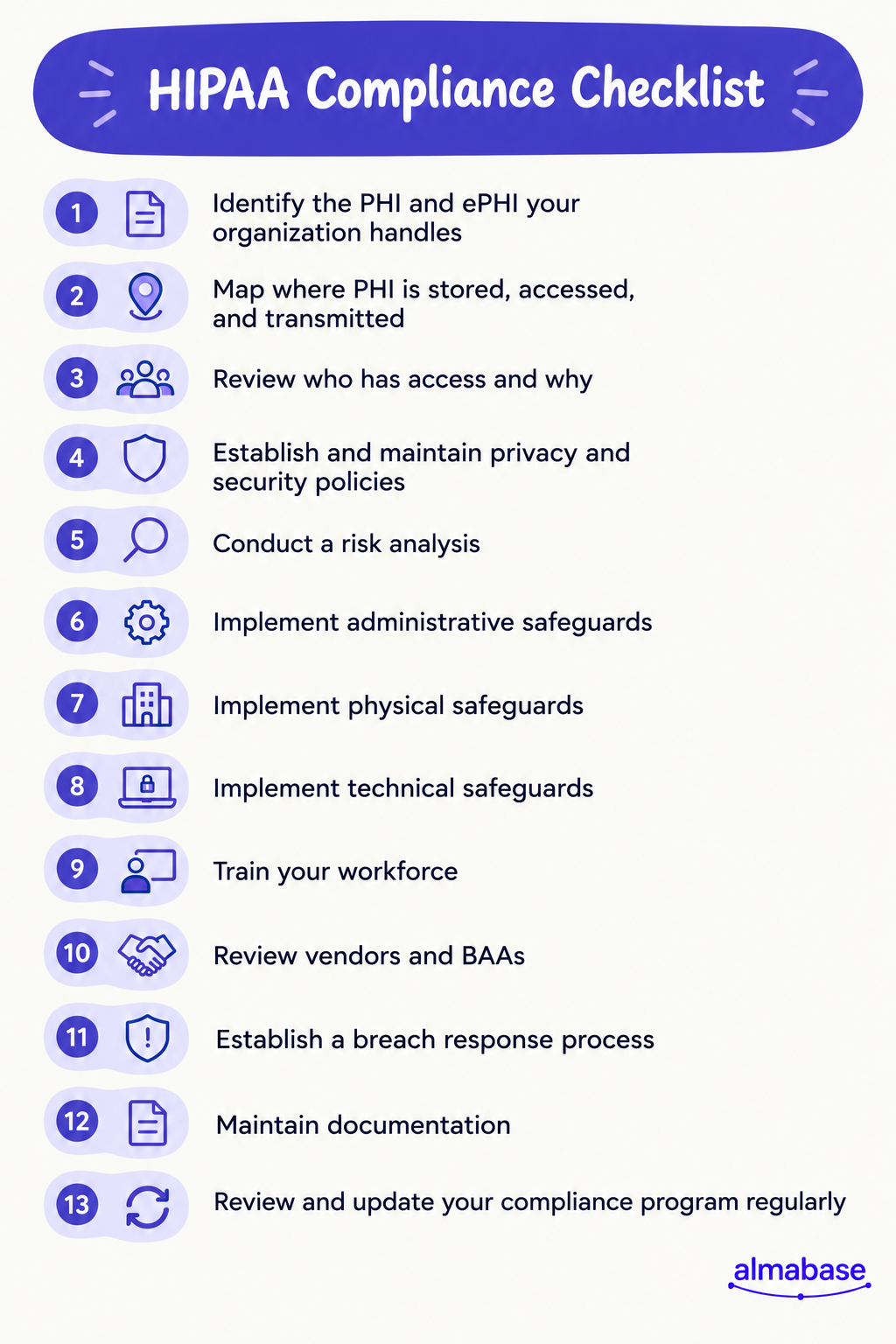
This is the most fundamental step to get right before you can approach protecting the data: you need to know where it is and how your organization uses it. The best way to look for it would be to break this down into granular steps.
Ideally, this should include:
For a healthcare foundation, this could mean looking closely at how information moves between the hospital, advancement team, CRM, fundraising platform, communication tools, and other systems.
Once you’re certain where the PHI is stored, and how it enters and leaves your systems, look at who can access it and deliberate on the access. Of course, trust plays a huge part in this process, and you probably trust your team to be responsible with handling this data.
However, access should be tied to a person's responsibilities. Someone working on donor communications may not need the same access as a member of a grateful patient team, for example. Consider access from this perspective.
Review whether your organization:
Regular access reviews can also help catch permissions that made sense when they were created but no longer make sense today.
A HIPAA policy sitting in an internal folder or understood by only a few employees will only be so effective. Employees need to understand what the policies mean for the work they do every day.
Your organization should establish policies and procedures covering areas such as:
Training should also reflect people's responsibilities. A fundraising officer, IT administrator, and volunteer who encounter health information in different ways may need different guidance. Consider conducting specific workshops and training to address these role-based differences.
The HIPAA Security Rule organizes safeguards into three categories: administrative, physical, and technical.
Here's what to review in each area.
Administrative safeguards focus on the policies, processes, and people responsible for protecting ePHI.
You must include:
HHS credits risk analysis as a foundational step in identifying and implementing appropriate safeguards. It also notes that organizations should take their own environment and circumstances into account rather than relying on a single compliance blueprint.
Physical safeguards protect the facilities, workstations, and devices where ePHI can be accessed.
Review whether your organization:
Technical safeguards focus on the technology used to protect ePHI.
Depending on your environment and setup, this means:
The exact safeguards an organization needs will depend on its systems, risks, and environment. This is one reason the risk analysis should come before deciding which controls to implement.
Your organization can have strong internal controls and still introduce risk through a third-party vendor.
To minimize this risk, identify every vendor that creates, receives, maintains, or transmits PHI on your behalf. Then determine what information each vendor handles and what protections are in place.
Check that you:
A BAA establishes permitted uses and disclosures of PHI and requires the business associate to implement appropriate safeguards. HHS also requires business associates to address certain obligations with their subcontractors.
This detail is particularly relevant when evaluating fundraising and engagement technology. A CRM, event platform, communication tool, or other system may interact with information that falls within your organization's HIPAA obligations, so its data practices should be part of your vendor review.
A compliance program is not complete without a plan for incidents. Your organization should have a clear process for identifying, reporting, investigating, and responding to potential breaches.
Make sure you can:
Under the HIPAA Breach Notification Rule, covered entities and business associates have notification obligations following a breach of unsecured PHI.
Having these procedures in place before an incident occurs gives your team a defined process to follow if the need arises.
A part of HIPAA compliance also means having evidence on hand of the work your organization has done.
Document the following:
It’s best to set up a regular cadence for reviewing these materials. Any new development, such as a new vendor, system, fundraising workflow, or a change in how information is shared introduces new risks that were not part of the previous assessment. Regular cadences will help make compliance part of your organization's rhythm and ensure you stay on top of these changes.
Healthcare fundraising teams work with a wide range of information across donor engagement, events, giving, communications, and grateful patient programs. The technology used for these processes needs to support the organization's privacy and security requirements.
Almabase is designed to help healthcare foundations manage these fundraising workflows with security and HIPAA considerations built into the platform.
Almabase provides controls designed to help healthcare organizations manage access to sensitive information, including permissions and audit trails. The platform also supports a Business Associate Agreement for organizations that require one.
Healthcare foundations can use Almabase to manage donor engagement, giving, events, communications, and other advancement workflows in one connected environment.
Almabase integrates with Raiser’s Edge NXT and other CRMs to help reduce manual data movement between platforms and keep donor and engagement information synchronized. Reducing unnecessary movement of information makes day-to-day data management easier to control.
HIPAA compliance is an ongoing process. As your organization adds new technology, works with new vendors, or changes how teams handle information, your compliance measures must adapt to remain airtight.
This means keeping an eye on how patient and donor information moves through fundraising workflows and making sure the right people, systems, and safeguards are in place.
Use this checklist as a starting point for reviewing your current practices, identifying gaps, and deciding where your team may need to take a closer look. Regular risk assessments, policy reviews, employee training, and vendor reviews can help keep your HIPAA program aligned with the way your organization actually works.
Looking for a fundraising platform built with healthcare organizations in mind?
See how Almabase supports healthcare fundraising →
HIPAA applies to covered entities and business associates. Covered entities include qualifying healthcare providers, health plans, and healthcare clearinghouses. Business associates provide certain services to covered entities that involve PHI.
PHI is individually identifiable health information that is created, received, maintained, or transmitted by a covered entity or business associate and is subject to HIPAA's protections.
The Privacy Rule establishes standards for how covered entities may use and disclose PHI and gives individuals certain rights regarding their health information.
The Security Rule establishes requirements for protecting electronic protected health information through administrative, physical, and technical safeguards.
The Breach Notification Rule establishes requirements for notifying affected individuals, HHS, and, in certain cases the media following a breach of unsecured PHI.
The Enforcement Rule establishes procedures for investigations, hearings, penalties, and enforcement of the HIPAA Rules.
The 2013 Omnibus Rule implemented changes to the HIPAA Privacy, Security, Enforcement, and Breach Notification Rules under the HITECH Act and strengthened requirements for business associates and their subcontractors.
The HIPAA requirements that apply to an organization depend on its role and circumstances. Organizations should first determine whether they are a covered entity or business associate and then identify the specific requirements that apply to their activities.
.jpg)
HIPAA Compliance Checklist for Healthcare Organizations
Lorem ipsum dolor sit amet, consectetur adipiscing elit. Suspendisse varius enim in eros elementum tristique. Duis cursus, mi quis viverra ornare, eros dolor interdum nulla, ut commodo diam libero vitae erat. Aenean faucibus nibh et justo cursus id rutrum lorem imperdiet. Nunc ut sem vitae risus tristique posuere.

Anwesha Kiran
September 30, 2026
12 minutes
Over the past few months, we've been talking to healthcare foundations across the country. From large health systems to community hospitals, each serving different communities and fundraising goals.
While every organization was different, one thing stood out—healthcare fundraising is built on relationships. Relationships with grateful patients, family members, donors, sponsors, volunteers and members who care deeply about improving healthcare in the communities they call home. And yet, many fundraising teams are being asked to manage those relationships across systems that were never really designed for the way healthcare foundations work.
As we spoke with foundation teams, we heard the same frustrations again and again and again.
"We have great donor data in our CRM, but events, registrations, sponsorships, and campaigns are happening somewhere else.”
“We’re chasing sponsor logos, guest lists, and event details over email”
“Event data didn't flow automatically into Raiser's Edge NXT, so the team spent weeks cleaning it up after every event.”
Underneath each of these challenges was the same issue: relationships were getting fragmented across systems.
The result wasn't just duplicate work or manual data entry. It meant less visibility into supporter engagement, more time spent connecting data across systems, and fewer opportunities to focus on the relationships that drive fundraising forward. But there was another challenge we heard repeatedly. Most fundraising platforms weren't built with healthcare foundations in mind. Teams supporting grateful patient fundraising were constantly navigating HIPAA requirements, ensuring donor information was handled correctly, preparing for audits, and worrying that a single mistake could expose sensitive patient information.
Healthcare foundations don't struggle with mission. They struggle with technology that wasn't built for healthcare.
When fundraising teams are juggling disconnected systems and constantly thinking about compliance, they have less time to do what matters most: building relationships with grateful patients, donors, sponsors, and their communities.
That's what got our attention. And that's why we're excited to share what we've been building.
Built around four integrated products, Events, Giving, Beacon (Donor Communications & Marketing), and TrueSync, Almabase helps healthcare foundations manage the entire fundraising journey while keeping every interaction connected to Blackbaud's Raiser's Edge NXT.
Fundraising works better when every relationship stays connected.
Whether someone attends a gala, sponsors an event, gives online, participates in a peer-to-peer campaign, or responds to an email, every interaction contributes to a richer understanding of that supporter.
Almabase brings those interactions together into one connected experience, giving fundraising teams a complete view of every donor relationship instead of scattered pieces spread across different systems.
And because Almabase is powered by TrueSync, every registration, sponsorship, donation, attendance record, and engagement activity flows seamlessly into Raiser's Edge NXT. Constituent records stay complete and up to date without manual imports or duplicate work.
Healthcare fundraising comes with unique privacy and compliance responsibilities, especially when engaging grateful patients. That's why Almabase is designed to support the privacy and compliance expectations healthcare foundations operate under, helping teams confidently engage supporters while protecting sensitive information.
Put simply, we're not building another database. We're building on top of the one healthcare foundations already trust.
Now, if you're thinking,
"Wasn't Almabase the company that worked with advancement teams on alumni engagement and fundraising?" 🤔
Fair question. After all, we literally have "alma" in our name.
Eleven years ago, our founders watched classmates leave college because they couldn't afford tuition. Together with alumni, they raised scholarships that helped more than 150 students complete their education. That experience became Almabase. Over the next decade, hundreds of colleges, universities, and independent schools trusted us to help strengthen alumni relationships, build engaged communities, and raise more support for their missions.
As we grew, we realized the challenges we were solving weren't unique to education. Different missions, but the same fundamentals: building meaningful relationships, inspiring support, and advancing a mission that matters. Alumni became patients. Advancement teams became healthcare foundation teams. But the work, and the people behind it, felt remarkably familiar.
Fundraising has always been about understanding supporters, creating meaningful experiences, and building relationships that last far beyond a single campaign or event. That's what Almabase has always been built for. So when we started working closely with healthcare foundations, it didn't feel like a pivot. It felt like a natural extension of the mission that brought us here.
That's why we're thrilled to officially launch Almabase for Healthcare Fundraising! ✨
And the product wasn't built behind closed doors, either.
We built it alongside healthcare foundations that challenged our assumptions, shared their workflows, and helped shape what the platform looks like today.
Take Essentia Health. Their foundation supports a 500-mile footprint across Minnesota, North Dakota, and Wisconsin, covering 15 hospitals with a team of just 16 people.
Working closely with teams like theirs helped us design workflows that reflect how healthcare fundraising actually happens, from sponsorship management and gala planning to donor engagement and CRM integration.
As Wade Jones, Director of Foundation Operations at Essentia Health, shared:
"One of the reasons we chose Almabase was so that we could more seamlessly get our constituents and event attendees into our database so that we could engage with them and build a relationship with them."
Healthcare fundraising doesn't happen in isolated systems. Neither should your technology.
With Almabase, healthcare foundations can:
Together, Events, Giving, Beacon, and TrueSync give healthcare foundations a connected fundraising platform designed for the way they work, helping teams spend less time managing disconnected systems and more time building relationships that advance their mission.
We're incredibly grateful to organizations like Essentia Health who trusted us early, challenged our thinking, and helped shape what Almabase for Healthcare has become.
And we're far from done.
We'll continue listening, learning, and building alongside our customers, just as we have throughout our journey in education. Healthcare Fundraising is an exciting new chapter for Almabase. But our mission hasn't changed. We're still building technology that helps mission-driven organizations strengthen relationships, better understand their supporters, and raise more for the communities they serve.
And to our friends in higher education, this doesn't change a thing for you.
Everything we learn building for healthcare foundations will continue to strengthen the products you already use every day. Education was the beginning. Healthcare is the next chapter, and we're excited to see where the journey leads from here.
Want to learn more? Explore Almabase for Healthcare Fundraising.
Almabase is now serving healthcare foundations ✨
Lorem ipsum dolor sit amet, consectetur adipiscing elit. Suspendisse varius enim in eros elementum tristique. Duis cursus, mi quis viverra ornare, eros dolor interdum nulla, ut commodo diam libero vitae erat. Aenean faucibus nibh et justo cursus id rutrum lorem imperdiet. Nunc ut sem vitae risus tristique posuere.
Almabase
August 4, 2026
12 minutes
%201.svg)
%201.svg)
%204.svg)




.svg)