Managing targeted campaigns, giving days, and CRM syncs with Blackbaud NetCommunity? See where BBNC creates friction and how Almabase simplifies it.

Anwesha Kiran
Published:
July 21, 2026
Updated:

Blackbaud NetCommunity (BBNC) has been the default choice for institutions on Blackbaud Raiser's Edge for a long time now. It still handles the basics well enough; things like a simple donation form, a straightforward event RSVP, or an email blast to contacts off of an existing list.
But advancement work has grown more complex, and there are tasks modern teams need done that BBNC hasn’t been able to keep up with, simply because it wasn’t built for these tasks.
In this blog, we’ll walk you through some of these tasks that users have come to realize that BBNC cannot handle well, and how Almabase closes that gap.
This is a well-documented pain point that BBNC users face when scaling their events: email lists have to originate from a Raiser's Edge (RE) query. If you have a list of addresses that didn't come from RE, there's no way to feed it in directly. These could be lists procured from an event partner or from around a campus, but it cannot be used to send email blasts unless recreated as a query within RE first.
The email builder itself offers limited design flexibility without a modern interface, so anything beyond a simple layout takes real effort to construct. Even then, there’s no way to know for sure that these emails would look the same in the recipients’ inbox.
Another related limitation is that unsubscribes work at a single level: a constituent who wants out of event emails but wants to keep getting annual fund appeals has no way to say so. They either get everything or nothing.
BBNC's analytics cover opens, bounces, and opt-outs, which is fine for knowing what happened to an email. It doesn't tell you what the constituent did next. There's no link-level click attribution and no behavioral data, like page visits or email-to-gift conversion paths, flowing back into the CRM.
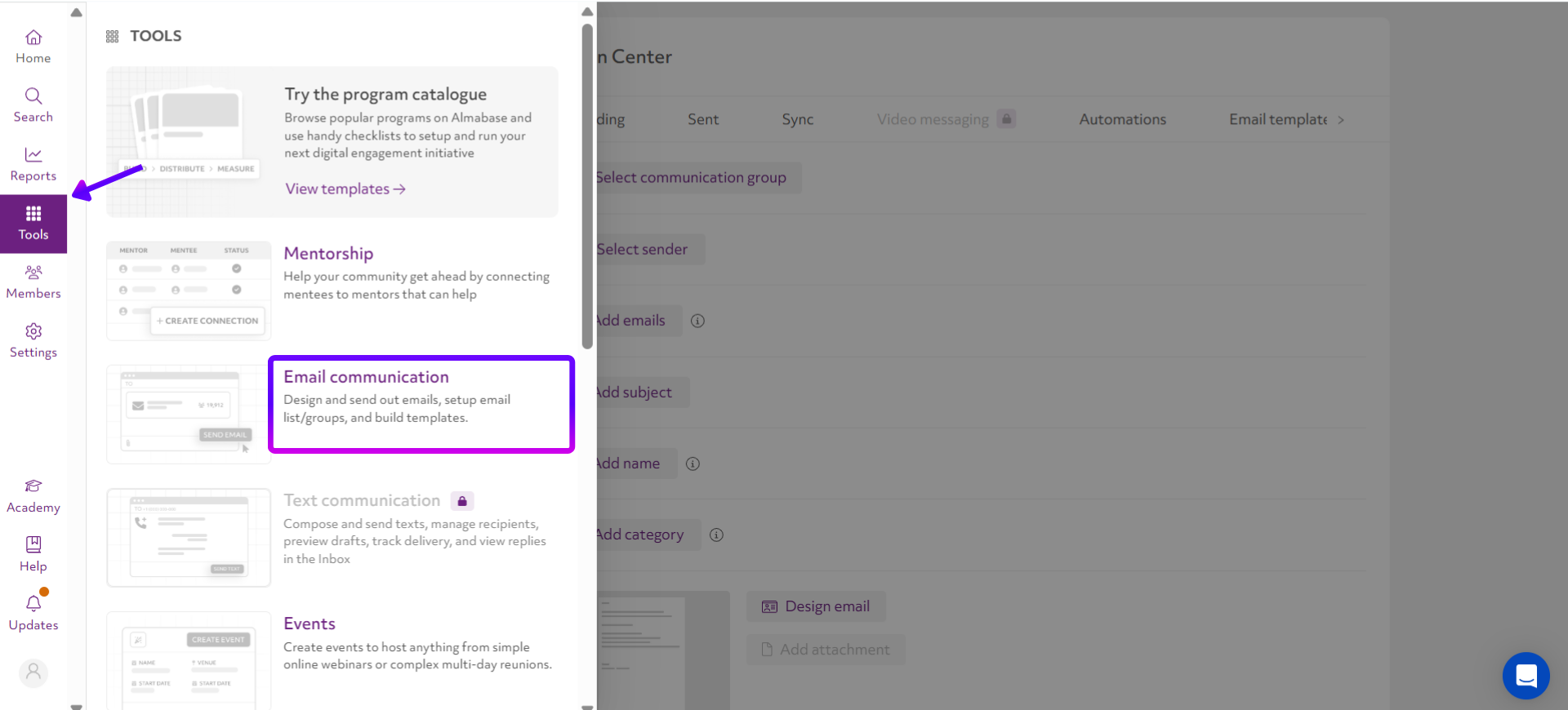
Almabase's drag-and-drop email builder works from any list, whether that means uploading a spreadsheet or building a segment directly inside the platform.
Email layouts also render consistently on mobile, and unsubscribes are handled through category-level preference centers, so a constituent can opt out of one kind of communication while staying on others.
Because Almabase's engagement data flows back to the constituent's RE NXT tile through TrueSync, your team can see which emails someone opened, which links they clicked, and which giving pages they visited before they gave, all without pulling a separate report.
BBNC works just fine for a simple, single-fund "give now" page. It really starts to struggle when institutions begin to get more ambitious with their scale: campaign hubs, fund-level thermometers, leaderboards, time-based matching challenges, or a mobile checkout handled cleanly with only a few clicks. Institutions running multi-event giving days or homecoming weekends with sub-events where more is required from the platform find that BBNC doesn't have the building blocks for it.
The workaround is obviously to layer on a different tool to handle the campaign mechanics BBNC can't. That solves the giving day experience but reintroduces the exact data problem BBNC's RE sync was supposed to prevent. Gift data now lives in the third-party tool and Raiser's Edge, and neither talks to the other automatically. For complex events, this could mean up to a week of manual data reconciliation for your team.
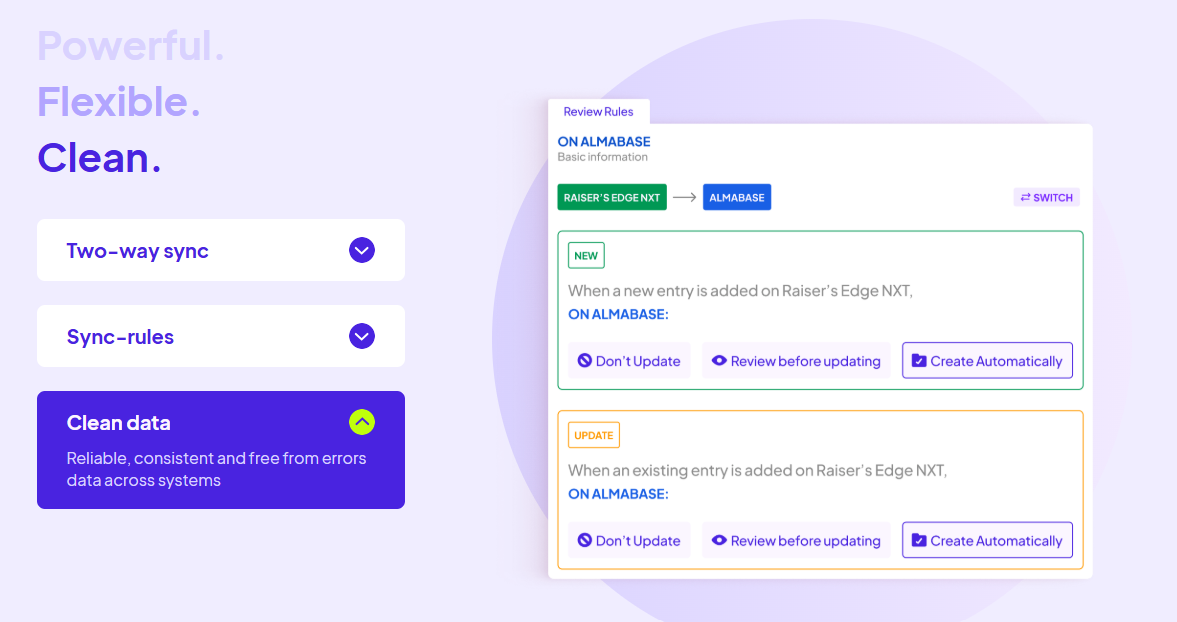
Almabase solves this problem by building this natively. Branded campaign hubs support fund-level goals with rollups, live leaderboards, and matching challenge banners, all with mobile-first checkout that doesn't ask donors to navigate multiple screens.
Every transaction captured during the rush of a giving day flows into RE NXT in real time through TrueSync, so there's no separate reconciliation step because there's no separate system generating a second set of records to begin with!
Faster reconciliation isn't just about efficiency. With Almabase, MSUM reduced Giving Day reconciliation from four weeks to four days, giving the advancement team time to launch a stewardship campaign that generated an additional $40,000 in follow-on gifts.
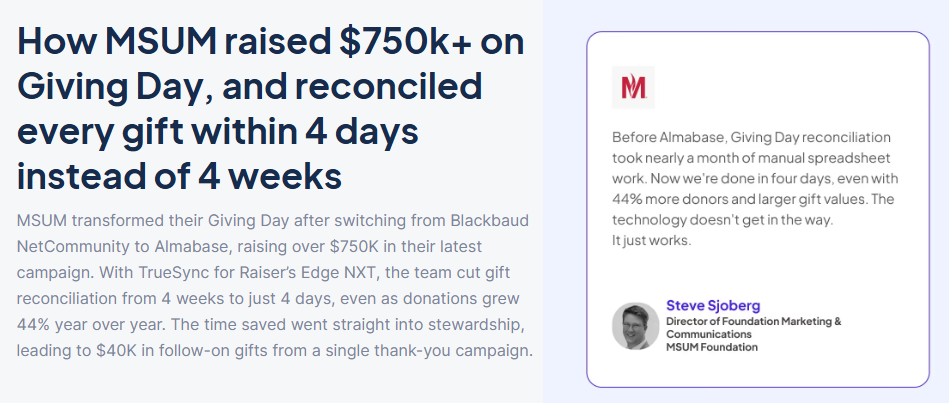
Read the full case study here.
BBNC's own connection to Raiser's Edge handles transactional data reasonably well. Gifts link to the right funds, registrations flow into the correct event records, and email lists continue pulling from your existing queries. For teams using BBNC largely as-is, the native connection does what it's meant to do.
Where it falls short is context. BBNC's RE integration records that a gift happened, but not what led up to it. There's no lead scoring, no engagement history on the constituent record, and no way for a gift officer to see that a prospect opened three campaign emails and visited the Giving Day page four times before finally making a gift.
Those kinds of signals are the ones that help teams decide who to reach out to and when, and unfortunately, these never make it into Raiser's Edge. Instead, advancement teams are left relying on campaign-level reports and educated guesses, even though RE NXT is already where they're doing most of their work.
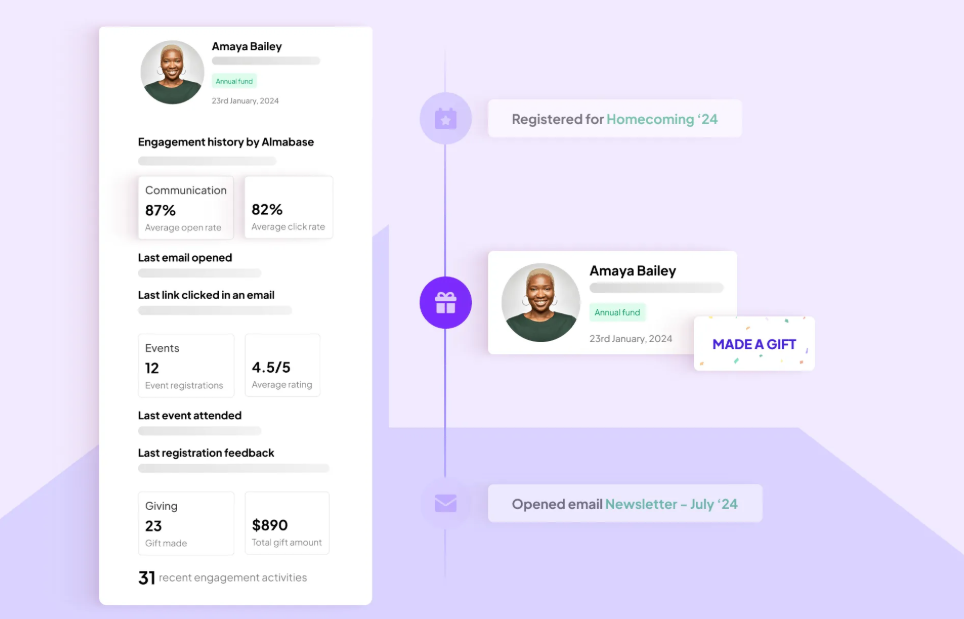
Almabase's TrueSync integration fills in those missing pieces by surfacing engagement data directly on the RE NXT constituent record at no additional charge. Gift officers can see which emails someone opened, which links they clicked, where they've been engaging, and where their gifts are directed, all without leaving the CRM. Instead of a record that simply logs transactions, they get a much clearer picture of how someone has engaged over time.
BBNC's event registration works well for straightforward events, but it starts to show its limits as complexity increases. It doesn't support sub-event management, ticket-level fund designation, guest forms for collecting meal preferences or accessibility needs, QR code check-in, or conditional registration based on class year or affiliation. A multi-day reunion weekend or a Homecoming with parallel events across departments is basically more than what BBNC was built to handle.
At that point, once again, institutions turn to third-party tools. The trade-off is that the same event often has to be built twice: once in BBNC to maintain the connection with Raiser's Edge, and again in a third-party platform to deliver the registration experience attendees need. That creates another data silo, doubles administrative work, and makes it harder to keep track of who's attending what.
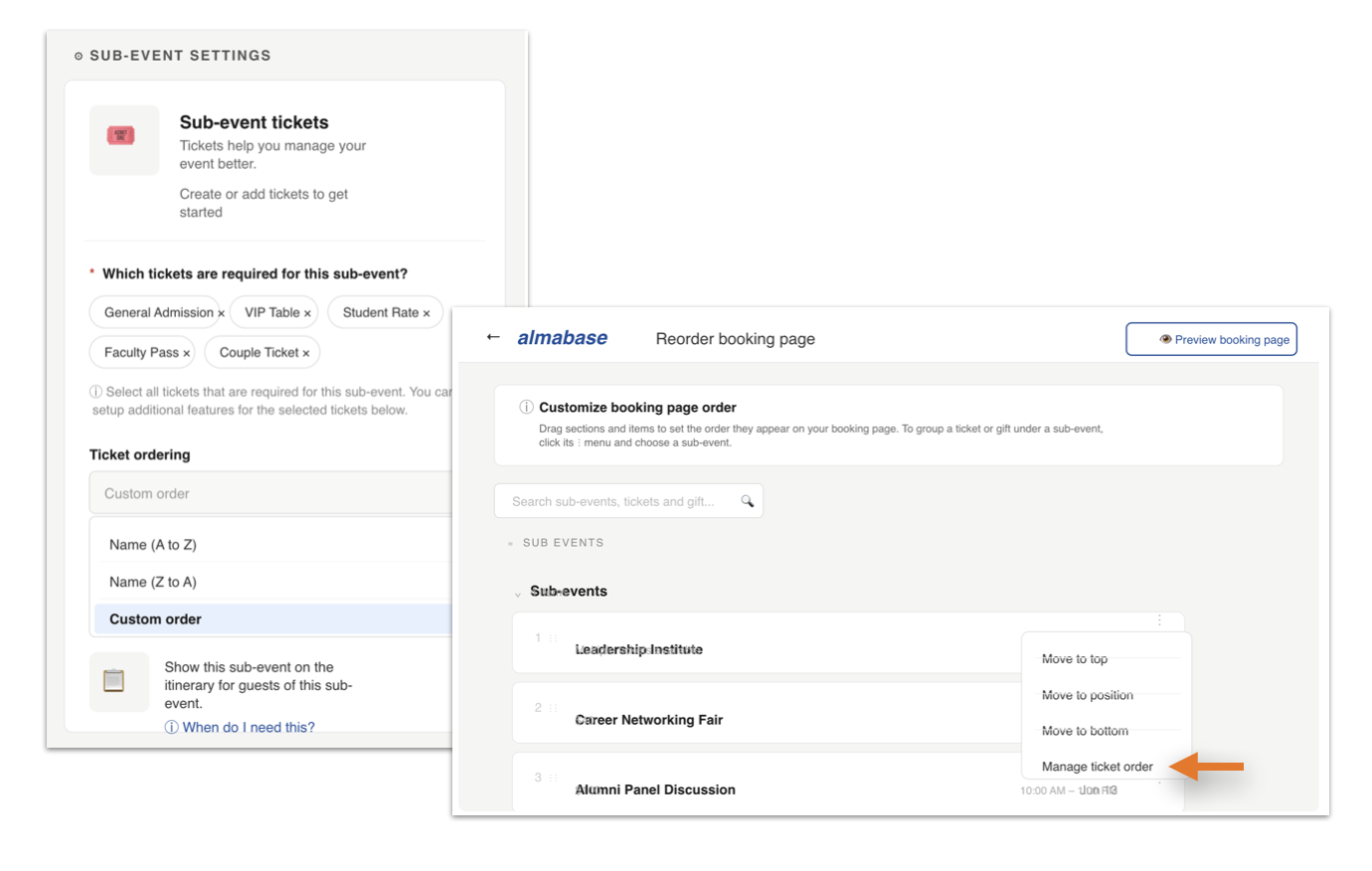
Almabase handles those more complex events within a single registration flow. A 15-event Homecoming weekend can live under one event instead of a dozen separate registration pages. Staff can check in attendees with QR codes, register walk-ins, and accept on-site payments from a mobile device.
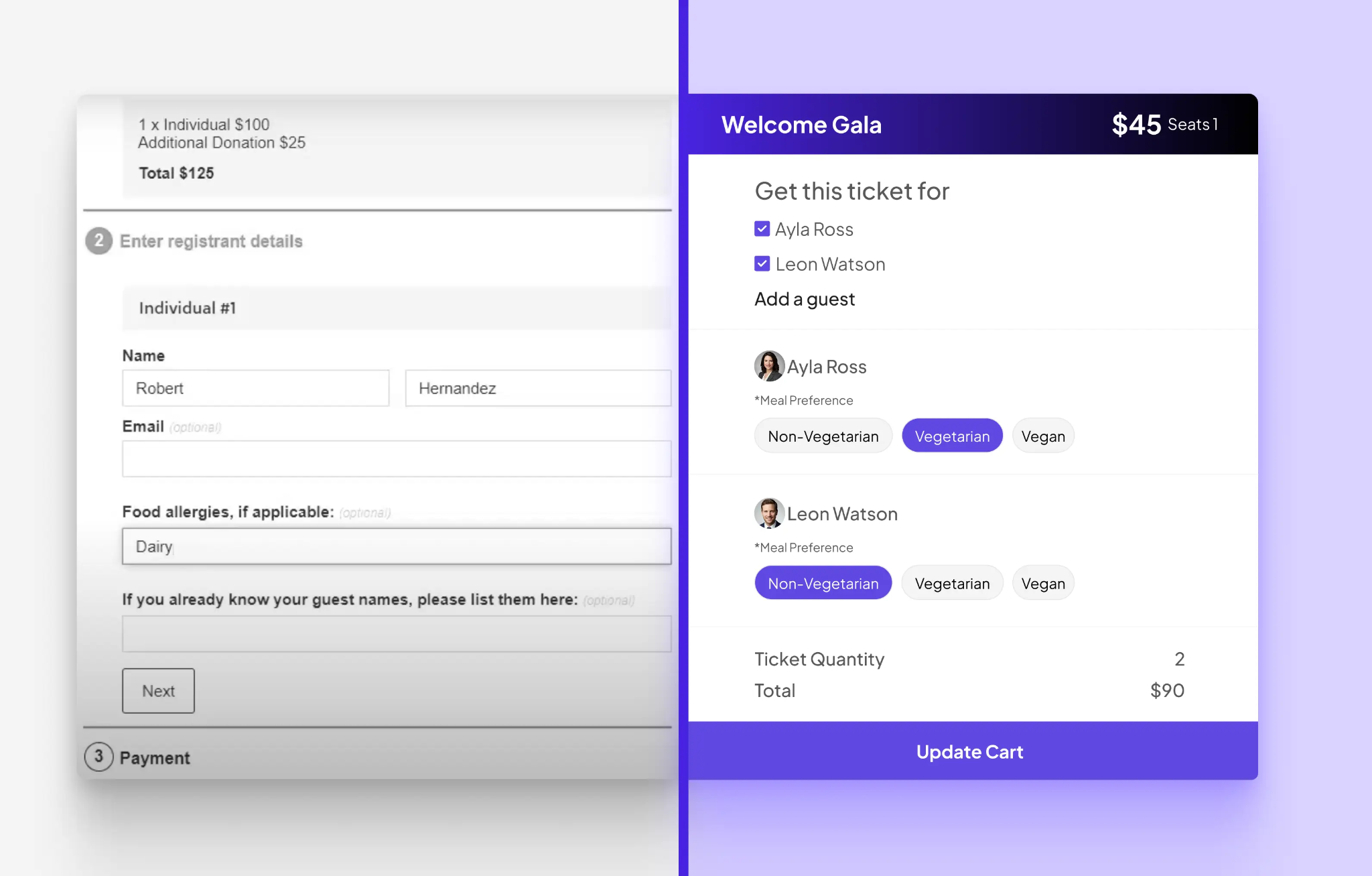
Through conditional questions, the form adapts in real time based on who is registering and how they respond. Alumni, parents, volunteers, or specific class years can each see a different set of questions, while nested follow-up fields appear only when they're relevant.
Attendees can register themselves and manage one or more guests, choose sub-events, select meal or accessibility preferences, and complete everything in a single, mobile-friendly checkout experience.
BBNC's page editor gets the job done for basic pages, but customization is limited. Anything beyond a simple layout: adding a promotional video banner, updating the color scheme, creating a modern grid, or building a more polished landing page requires code-level changes. In 2026, maybe it is not the most reasonable to have to depend on a developer to make minor changes to your donation pages.
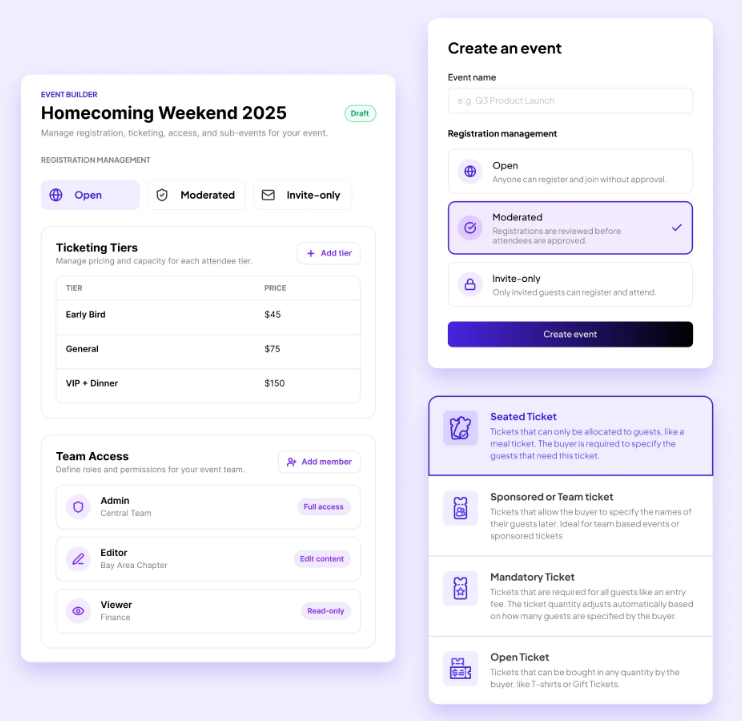
Almabase gives advancement teams a no-code way to build branded, mobile-responsive pages themselves. Event pages, giving forms, and campaign microsites can all be created, launched, and updated without writing code. Teams can embed donation asks directly into the registration journey, delegate event management with role-based permissions, and make last-minute updates without waiting on IT or a developer. This flexibility can be especially valuable in the weeks leading up to a launch, when messaging, visuals, and calls to action might need to change in real time as you make adjustments to your campaign strategy.
Check out our blog that compares Almabase with BBNC for a deeper look at how these two platforms stack against each other.
No platform does everything perfectly, and it's worth calling out the areas where BBNC still has an advantage.
BBNC can surface information stored in RE NXT's relationship tables, such as spouses, children, congregation membership, and other family or affiliation records directly on a constituent's profile. Almabase doesn't currently sync those relationship records from RE NXT, although anniversary dates are supported.
For institutions that rely heavily on family or congregational relationships as part of stewardship, that's an important consideration to discuss during the evaluation process.
In practice, many teams continue to treat RE NXT as the source of truth for that information, with gift officers referring to those records when relationship context is needed.
RE NXT supports a wide range of address types, all of which BBNC can surface. Almabase currently supports two: Home and Office. During onboarding, one RE NXT address type is mapped to each, which is sufficient for most institutions' day-to-day communication and stewardship.
The main consideration is for schools that maintain several distinct address types, such as seasonal residences, business addresses, or separate international mailing addresses. Those institutions may need to decide which addresses should remain primary and which can be consolidated.
RE NXT lets institutions manage email consent for each individual email address. That means a constituent can choose to receive communications at a personal email while opting out of a work address, or vice versa.
Almabase takes a simpler approach by managing consent at the constituent level. If someone opts out, the preference applies across all of the email addresses associated with their record. For most institutions, this wouldn’t make a huge difference. But if your team regularly works with constituents who maintain separate personal, professional, or other email addresses, it's a distinction worth understanding before implementation.
Some BBNC institutions maintain different subdomains for different audiences; for example, ‘alumni.school.edu’ and ‘parents.school.edu’, each with its own branding, navigation, and experience. Almabase brings those audiences together under a single subdomain.
This distinction, of course, can still be retained with Almabase: different audiences can be served through dedicated landing pages, conditional content, and tailored navigation within the same site. But if your current setup depends on entirely separate subdomains, it's something to account for when planning your migration.
Migrations from BBNC generally follow the same path as any move to a new advancement platform. Our blog on migrating from BBNC covers the process in more detail, but the short version is this: most implementations take anywhere from three weeks to two months, depending on the amount of data cleanup, testing, and staff training involved.
Almabase starts reducing that work before implementation even begins. A free 30-minute integration audit with a solutions engineer reviews your current data structure, naming conventions, integrations, and migration goals so potential issues are identified upfront instead of during go-live.
From there, TrueSync configures the two-way sync between Almabase and RE NXT while preserving your existing field mappings and naming conventions. Your team also decides how data should flow, whether updates from Almabase sync automatically into RE NXT or require review before they're committed to the CRM.
Cornell College manages a community of 15,000 to 17,000 alumni with a lean advancement team. Before moving to Almabase, staff were piecing together BBNC and other tools, and spending valuable time managing disconnected systems instead of building relationships with alumni.
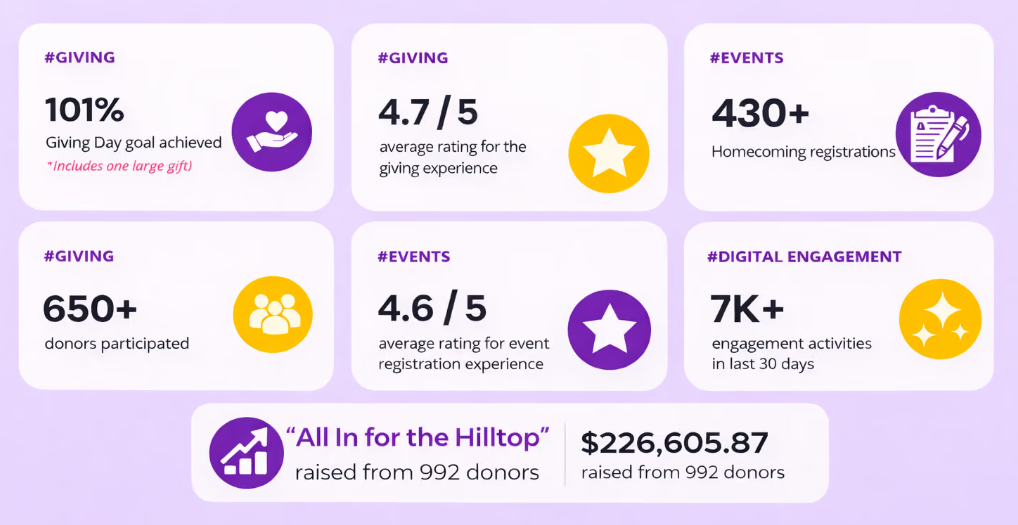
With giving, events, email, forms, and community engagement all in one platform, registrations flowed smoothly, alumni could update their own records, and the team spent less time on administration.
The results followed: 1,008 donors on Giving Day, a 4.7/5 participant rating, more than 430 Homecoming attendees, and over $226,000 raised from 992 donors during the "All In for the Hilltop" campaign.
Here’s the full scoop on Cornell College for more on how that shift played out.
None of the limitations above are deal-breakers on their own. Exporting a CSV takes only a few minutes. Building an event in two systems isn't impossible. Even manually reconciling registrations after a campaign can become part of the routine for an event or two.
But dealing with all of these together and operating with workarounds that cost in manual hours is not what your team should have to experience.
A few things to think about:
For some institutions, the existing setup might still be the right fit. But if the workarounds are starting to consume more time than the work itself, it's a good signal that it's worth evaluating what's changed.
As budget planning comes around, ask your team the right questions: "What does this platform cost?", but also, "How much time are we spending working around it?".
If your team is constantly exporting data, reconciling spreadsheets, or jumping between tools for events, email, giving, and community engagement, those hours add up. The question is whether the operational savings from keeping everything in one place outweigh the cost of continuing with a stack of disconnected tools.
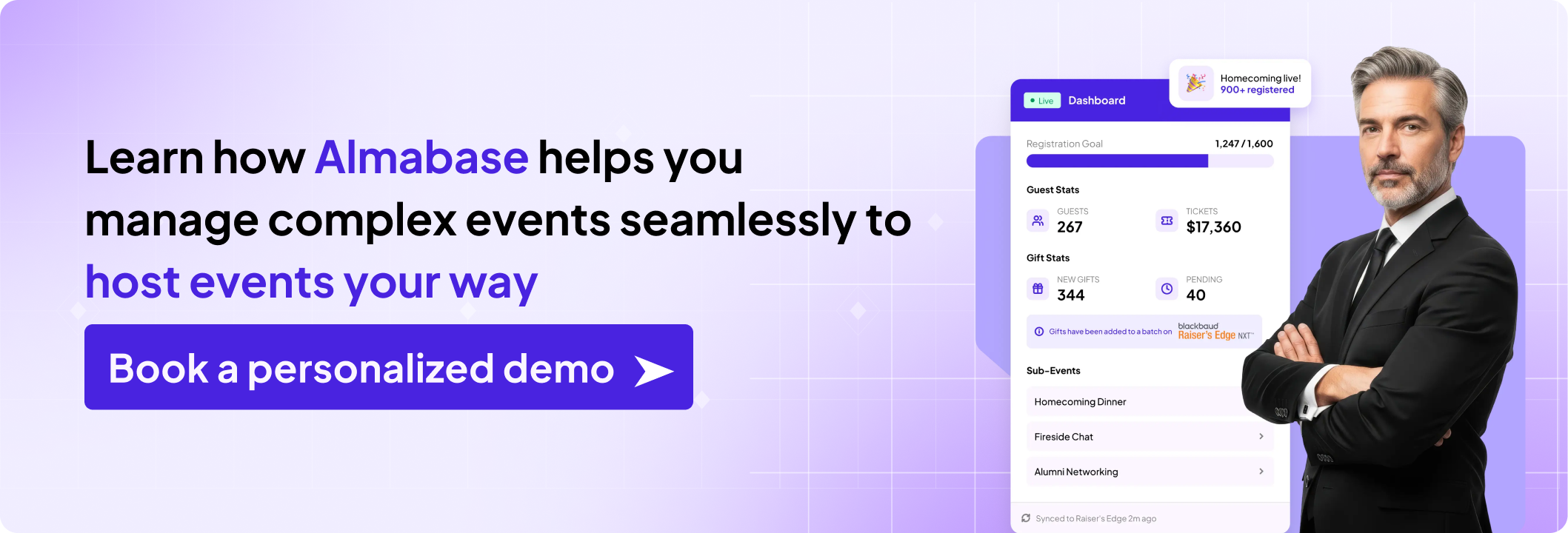
Ready to see how you could run your events without the workarounds? Request a demo today.
Subscribe
See how modern advancement teams bring alumni engagement and fundraising together.
Plan faster. Execute better
Explore free templates designed for alumni and fundraising teams.
.png)

.avif)
Anwesha Kiran
It’s never an easy decision to switch to a new platform and if you’ve been a frequent user of Blackbaud NetCommunity (BBNC) for a while, you might have a fair amount of questions about moving elsewhere.
In case you’re on the lookout for BBNC alternatives, we’ve rounded up 5 potential replacements for you and your team to consider. Our choices are based on a variety of factors which we’ll be getting into first.
While evaluating alternatives, you might feel like most platforms have similar feature lists with a few differences here and there. But the way those features are organized and how they work together can reveal the best fit for your team.
Here's what to evaluate:
For most BBNC users, Raiser's Edge NXT is already at the center of donor management. The rest of your advancement tools must work seamlessly alongside it and help your team stay coordinated.
That means having giving, events, email, and community engagement data flow into your CRM automatically and in real time. When a donor makes a gift, your team should be able to see it right away in RE NXT.
Most advancement teams likely do not have a dedicated tech person. The people using these tools should find it easy to navigate (and this shouldn’t only be the most tech-savvy member in your team!).
This means your team should be able to create event pages, build audience segments, send emails, and manage campaigns with confidence, because doing all this on the platform feels intuitive to them. Some platforms pay close attention to the user experience and take special care to make it easier for them to work on.
Just as important is the experience for alumni. The more alumni can do for themselves, the easier it is for your team to keep data current and engagement high. Features like profile updates, event registration, class note submissions, and communication preferences give alumni greater control while helping you maintain accurate records.
The platform you choose today should still work for you down the line as your alumni community grows and fundraising efforts expand in scale and complexity. Whether you're managing 5,000 alumni or 50,000, the experience should remain consistent.
This is particularly important for colleges and universities planning for long-term growth. The best platforms scale alongside your institution, making it easy to increase capacity and expand programs without disrupting day-to-day operations. As your needs evolve, your team can stay focused on engaging alumni and advancing institutional goals rather than managing technology transitions.
If you've spent years juggling multiple systems, you've probably accepted a certain amount of friction as part of the job. This could look like pulling different places or reports that take longer than they should. As a result, your team spends more time making sense of information between platforms instead of building relationships with alumni and donors.
So moving platforms becomes an opportunity to look for a platform that does the work your old platform was doing, but does it better, and preferably, in one place.
On paper, many advancement teams have everything they need: tools for fundraising, events, email, and alumni engagement. But if those systems don’t work together smoothly, your team could find itself in a bit of a fix, managing tools when they could be managing experiences for attendees and donors. It's rarely a major problem on any given day, but the time and effort add up over the course of recurring issues across events.
In fact, we saw something similar firsthand at Almabase: Cornell College moved from managing alumni engagement across BBNC and multiple tools to one integrated platform, and the shift eliminated the constant back-and-forth that was taking up their team's time.
Before we get into the deep-dive, here is a quick look at the platforms we’ve listed for you:
Almabase was built with advancement teams in mind. Instead of juggling separate tools for giving, events, email, and alumni engagement, teams can manage everything in one place. It also integrates closely with Raiser's Edge NXT, helping data flow naturally between systems and giving staff a more complete view of alumni activity.
Best for: Institutions on BBNC struggling with complexity, looking to simplify their tech stack by bringing key advancement activities together on a single platform. It is a great fit for colleges and universities of all sizes.
Key Strengths:
Almabase in action:
Cornell College manages a community of 15,000-17,000 alumni with a remarkably lean advancement team. Before Almabase, staff were piecing together BBNC and other tools, spending valuable time managing disconnected systems and manual processes.
After moving giving, events, email, forms, and community engagement into Almabase, event registrations flowed in smoothly and alumni could update their own information. With an alumni community that cares about staying connected, the college was able to elevate their Giving Day experience with leaderboards, campaign pages, and real-time participation tracking.
After the switch, Cornell exceeded its Giving Day goal, reaching 1,008 donors and earning a 4.7/5 participant rating. Homecoming attracted more than 430 attendees, and their "All In for the Hilltop" campaign raised over $226,000 from 992 donors.
Watch the team from Cornell College share their experience here.
.avif)
What it's not great at: Almabase does not include prospect research or wealth screening tools. If major gifts research is a priority, you'd need to layer in a separate platform.
Pricing: Custom pricing based on institution size and needs.
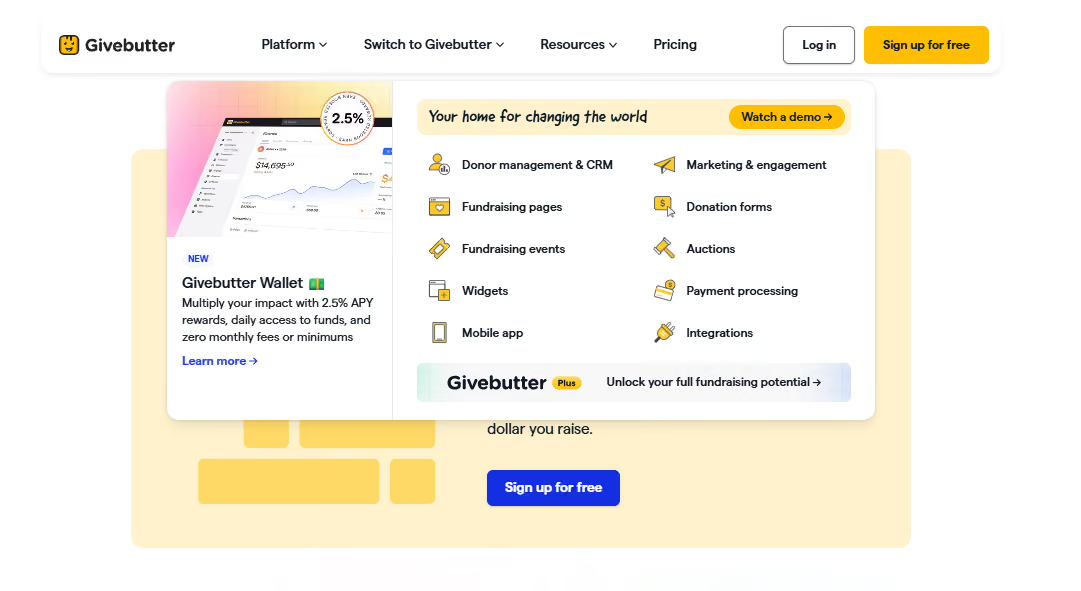
GiveButter is an all-in-one fundraising platform designed to help nonprofits raise funds, engage donors, and manage donor relationships through customizable donation forms, embedded donation widgets, and various payment options. The platform is known for its transparent pricing model, operating on a "tip-or-optional-fee" basis, meaning nonprofits receive 100% of their donations with no hidden fees.
Best for: Organizations looking to launch peer-to-peer campaigns without a subscription commitment, schools running crowdfunding initiatives on a low budget, and nonprofits seeking easy-to-navigate platforms for both staff and donors.
Best for: Organizations looking to launch peer-to-peer campaigns without a subscription commitment, schools running crowdfunding initiatives on a low budget, and nonprofits seeking easy-to-navigate platforms for both staff and donors.
Key Strengths:
What it's not great at: GiveButter primarily caters to nonprofits and may not be as experienced with educational institution's needs, especially volunteer management and alumni engagement like platforms built specifically for higher education. If you’re looking for advanced alumni networking, community engagement, or multi-day event management at institutional scale, you'll likely need to supplement GiveButter with other tools.
Pricing: The platform’s core features are available at zero platform fee when optional donor tips are enabled. If you turn off tips, a flat 3% platform fee applies.
Givebutter Plus, which is their paid tier, starts at $29/month and provides advanced automation and analytics.
Hivebrite started as a community platform and has evolved into a comprehensive alumni engagement hub. If your priority is building a place where alumni actively engage with each other (not just receive messages from the institution), Hivebrite delivers that experience.
Best for: It's a great pick when your goal is fostering actual peer-to-peer connections: discussion spaces, networking, job boards, and mentoring. It works well for schools with large, geographically dispersed alumni networks that want to position the platform as a living community.
Key Strengths:
What it's not great at: While Hivebrite features direct, bidirectional integrations with major CRMs like Blackbaud Raiser's Edge NXT and Salesforce to prevent manual data syncing, its transactional giving modules are still not at the center of operations. If your team requires advanced fundraising toolsets like gamified giving day leaderboards or major gift prospect tracking, you will likely need separate, dedicated tools alongside it.
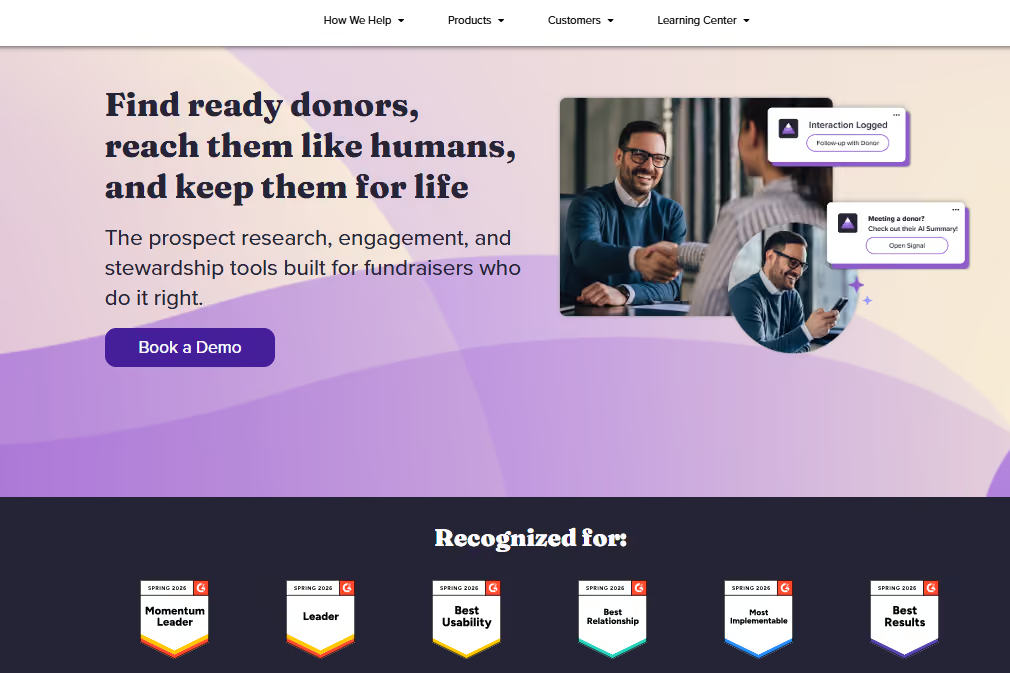
EverTrue brings prospect research and wealth screening directly into the platform. It's built for institutions focused on major gifts and looking to connect engagement data with donor intelligence. It really stands out with helping teams identify which alumni are most likely to give and when. This is fundamentally different from the other platforms in that it's more specialized than all-in-one.
Best for: Institutions with a dedicated major gifts program and the capacity to leverage wealth screening and engagement data together. Works best for universities managing alumni records where prospect identification directly feeds major gifts strategy.
Key Strengths:
What it's not great at: It’s not a full platform replacement. You still manage separate systems for events, email marketing, and community. Best used alongside other tools, not instead of them.
Pricing: EverTrue offers custom pricing based on institutional requirements.

360Alumni is an all-in-one platform similar to Almabase, but leans more into networking and community as the centerpiece. It's built for schools that want to give alumni a branded, customizable space to connect and engage while also managing fundraising and events. The platform launched in 2013 with a specific mission: help institutions deliver value through their alumni network, not just extract giving.
Best for: Institutions wanting a modern, integrated alternative with strong community and engagement features. It works well for colleges prioritizing alumni network building alongside fundraising, particularly schools at earlier stages of alumni relations sophistication.
Key Strengths:
What it's not great at: CRM integration maturity is less established than some other platforms on this list. The community-first approach can mean fundraising and advancement workflows feel secondary. Smaller user base means fewer case studies and peer reference institutions compared to more established platforms.
Pricing: EverTrue offers custom pricing for institutions based on alumni count and feature requirements.
Setting expectations around things like how data migration will work, what resources your team will need, and what “success” looks like in the first few months will help you and your team down the line.
Before you commit, it helps to get clear on a few key areas:
Get answers to these before you sign anything:
1. Data migration: Think about all the logistical parts:
2. Timeline: What's a realistic implementation schedule? If a vendor suggests a short implementation window, like a week, for a full migration, it might be time to invoke some healthy skepticism. Most implementations take 3 weeks to two months when you factor in data cleanup, staff training, and testing.
3. Training and onboarding: What does the platform’s ongoing support look like after go-live? Will you get a dedicated implementation manager, or are you on your own, and does that work for you?
4. CRM integration: Work out the specifics: will it be real-time or batch sync? How often do you sync? What happens if something breaks, who takes the responsibility to troubleshoot?
5. Costs: Consider implementation, ongoing licensing, and any integration fees you might not have anticipated. Ask for a three-year cost projection, not just the first-year number.
6. Contingency: What happens if you need to run both systems in parallel? Can the vendor accommodate that, or are there any additional costs there?
Your current platform isn't disappearing tomorrow. You have time to approach this strategically.
Running parallel systems briefly costs less than rushing the transition and spending months fixing mistakes. Early vendor conversations will tell you a lot about their implementation approach and about gaps in your own readiness. Budget time for staff training alongside platform setup. Even the best platform in the world won't work out if your team doesn't know their way around it.
Choosing the best alternative to BBNC is a chance to make day-to-day work easier for your team and create a smoother experience for alumni and donors. We've seen institutions get the most value when they reduce the number of disconnected tools staff have to manage. Cornell College achieved this by bringing critical functions together in one connected ecosystem.
That same pattern shows up in other institutions that have modernized their BBNC setup: cleaner workflows, less manual work, and a better experience for the people interacting with the institution.
If you'd like to explore more, these stories are a good place to start:
Whatever platform you choose, the goal is the same: give your team fewer systems to wrestle with and more time to focus on alumni, donors, and the work that matters most.
If you're exploring alternatives to BBNC and want to see what a more connected advancement experience could look like, request a demo and we'd be happy to walk you through it.
.avif)
Top 5 Blackbaud NetCommunity Alternatives
Lorem ipsum dolor sit amet, consectetur adipiscing elit. Suspendisse varius enim in eros elementum tristique. Duis cursus, mi quis viverra ornare, eros dolor interdum nulla, ut commodo diam libero vitae erat. Aenean faucibus nibh et justo cursus id rutrum lorem imperdiet. Nunc ut sem vitae risus tristique posuere.
Anwesha Kiran
June 11, 2026
12 minutes
Alumni events have evolved throughout the decades and have taken many forms to become the powerful touchpoints that strengthen engagement, loyalty, and fundraising that we know them for today.
Their importance has only grown for advancement teams looking to fundraise and engage alumni. For example, the University of Delaware partnered with Blackbaud to refine its event-driven outreach and reported a 43% increase in fundraising dollars. It’s a reminder of how events stay at the heart of alumni experiences and drive both engagement and fundraising simultaneously.
Today, we’re going back to the basics and looking at why events continue to be at the heart of advancement teams and what they bring to the table today.
Advancement professionals generally consider events as the most effective activity to engage alumni. In-person gatherings in particular offer the irreplaceable value of face-to-face connections, while hybrid formats make it possible for alumni across the globe to join in. Together, these formats keep communities active and connected in ways that emails or newsletters alone can’t achieve.
A well-planned alumni event often becomes the spark that triggers mentorship drives, giving, and the gradual growth of your constituent community. They serve as anchors in the alumni journey, offering memorable moments that fuel long-term engagement and creating touchpoints that keep alumni coming back.
Here are 10 key benefits of alumni events in 2026, each showing how the right strategy can turn a simple gathering into a lasting impact for your institution and community.
The true mark of an alumni program is when events evolve from being occasional highlights to becoming part of the institution’s culture. Alumni who attend one event and have a positive experience are more likely to show up for the next, to mentor a student, to make a gift, and to stay connected in between. Over time, these small touchpoints compound into lifelong support, and mutual support is crucial for building communities.
Events have become cultural community touchstones that are both natural and enduring, creating a culture that grows stronger with every gathering. This is why alumni events today are both a great opportunity as well as an important responsibility.
When alumni attend a reunion, regional mixer, or even a casual alumni picnic, they’re showing they still feel connected to the institution. That act of participation often becomes the first step toward giving back. Engaged alumni are naturally more likely to become donors.
By creating an inspiring and positive atmosphere, you can motivate alumni to give back. Whether it’s through a direct fundraising appeal during the event or as a follow-up, a well-executed gathering often leads to a significant increase in contributions.
Events are a natural setting for pairing seasoned professionals with recent graduates or current students. The conversations between professionals and current students or recent graduates can often lead to internships, referrals, or ongoing mentorships that wouldn’t happen through online platforms alone.
For students and young alumni, meeting someone who once sat in their classroom but is now established in their field is motivating. For senior alumni, offering advice strengthens their pride in the institution and renews their connection to the community. Both sides walk away with value.
Enthusiastic and successful alumni are your best ambassadors. When prospective students and their families see a thriving alumni network, it serves as powerful social proof of the institution's value. Alumni can share their positive experiences and career successes, making a compelling case for why your institution is an excellent choice.
Every successful alumni event is a public relations opportunity. Positive social media mentions, photos, and testimonials from attendees amplify your institution's brand and showcase a vibrant, active community. This positive exposure can attract prospective students, impress stakeholders, and solidify your institution's reputation as a place that cares for its community long after graduation.
For many alumni, professional networking is a primary reason to attend events. By connecting individuals from various industries and career stages, you provide a valuable resource for career development and mentorship. Facilitating these connections not only benefits your alumni but also positions your institution as a hub for professional growth, enhancing its reputation.
Activities and features such as flash mentoring, corporate matching gifts, and networking-specific events and online communities are great ideas to make both prospects and professionals feel appreciated.
Every institution has a segment of alumni who have lost touch. Your institution can attempt to re-engage these segments. A compelling milestone, tailored reunion, or a unique themed gathering, can be the perfect excuse to re-establish contact. By offering an experience they don't want to miss, you can bring lapsed members back into the fold and remind them of their connection to the institution.
An alumni event is the perfect stage to unveil new campus developments, academic programs, or research breakthroughs. Bringing alumni back to campus allows them to see the tangible results of their past and future support. This transparency builds trust and excitement, making them more likely to stay involved and contribute to future projects.
Events offer a direct line to your alumni. Informal conversations and structured feedback sessions can provide honest insights into what your alumni want and need from your institution. This information is gold for refining your engagement strategies, academic programs, and communication efforts, ensuring they remain relevant and impactful..
While alumni increasingly prefer smaller affinity-based events and reunions, there is great value in fostering engagement between different generations through your events. While this mostly comes through major events such as family weekends and homecomings apart from the obvious mentorship-related events, you can tailor events to mingle specific segments to promote a sense of community among different generations.
These multi-generational connections ensure that alumni don’t just stay tied to their classmates, but to the broader community itself.
The alumni events that stand out today are the ones that feel intentional. It’s not about how big the guest list is, but how well the event reflects the needs of your community. A small, personalized dinner can often create more impact than a large formal gala. Adding hybrid access for those who live abroad, collecting fresh alumni data at check-in, and following up with clear impact reports are simple shifts that transform events from “one-off memories” into long-term engagement drivers.
We’ve prepared a simple checklist that covers the basics you should look out for when planning your next event. Have a look:
Set the Purpose
Pick the Right Time & Place
Budget with intention
Design the Experience
Spread the Word
Welcome with Warmth
Keep Energy Flowing
Support Behind the Scenes
Capture the Magic
Share, Listen & Learn
Reflect & Refine
Hopefully, this blog helped you revisit and re-appreciate the wonderful cornerstone of advancement and alumni relations which is the alumni events. Even the most experienced teams sometimes need to take a step back and look at the rudimentary reasons why these events happen in the first place to help them approach their next event with fresh ideas, which is what this blog was meant to do.
That being said, if you’re looking for a partner to help you and your institution/organization set up your next alumni event and make it a big success, feel free to start a conversation or request a personalized demo with us and we’d love to get in touch!
A successful alumni event has clear goals, provides tangible value to attendees (like networking or learning opportunities), is well-organized, and is effectively promoted to the right audience. Post-event follow-up is also crucial for maintaining momentum.
Measure ROI by tracking metrics tied to your event goals. These can include attendance numbers, a survey of attendee satisfaction, the number of new volunteers or mentors, and the amount of donations raised. Tracking website traffic to alumni pages or social media engagement around the event can also provide valuable data.
Popular ideas include traditional homecomings and reunions, professional networking nights, industry-specific panels, family-friendly picnics, virtual workshops or webinars, and exclusive gatherings for major donors. The best idea will depend on your specific alumni base and institutional goals.

10 Key Benefits of Alumni Events in 2026
Lorem ipsum dolor sit amet, consectetur adipiscing elit. Suspendisse varius enim in eros elementum tristique. Duis cursus, mi quis viverra ornare, eros dolor interdum nulla, ut commodo diam libero vitae erat. Aenean faucibus nibh et justo cursus id rutrum lorem imperdiet. Nunc ut sem vitae risus tristique posuere.

Sharada Koti
September 18, 2025
12 minutes
If you've been running events on Blackbaud NetCommunity (BBNC), chances are you've felt the strain for a while now. Whether it's the platform's age, limited functionality, or the growing manual processes, you might be coming to the conclusion that BBNC is no longer keeping up with the demands of modern advancement.
We’ve already covered the top 5 BBNC alternatives and how Almabase stacks up against it. In this blog, we’ll talk about how to approach migrating to a new platform, and what to expect in the weeks and months after making the switch.
The reason teams are looking for BBNC alternatives is because advancement itself has evolved. As advancement strategies grow more flexible, personalized, and data-driven, many teams are finding themselves stretching BBNC beyond what it was designed to do.
Modern advancement platforms are built to handle the complex needs that have become standard for advancement teams today.
Here’s a quick comparison of the top 5 alternative BBNC platforms:
For a more detailed look at how these platforms compare to BBNC, check out our blog on Top 5 Blackbaud NetCommunity alternatives.
Choosing a platform is an important first step, but it's only part of the journey. Once you've identified the right fit, understanding the migration process itself becomes just as important.
A good way to approach planning would be to sit down with your team and set expectations on what ‘success’ looks like.
Most BBNC migrations take several weeks to a few months, depending on database size, data quality, and implementation complexity. As much as it is about the data transfer itself, preparation and testing could also take up quite a bit of time, depending on your requirements.
Key stages include:
A realistic timeline allows room for cleanup, validation, and adoption. If a migration plan seems unusually fast, it's worth understanding what has been left out.
A successful migration is always a team effort. Advancement leaders and directors may define goals, timelines, and success criteria, while database managers oversee data cleanup and validation. IT teams review security and integration requirements with your vendor, and front-line users identify critical workflows and day-to-day processes that need to be preserved.
Involving the right stakeholders early helps surface dependencies, customizations, and workarounds that might otherwise be overlooked.
A common challenge is balancing speed with continuity. Leadership may want to move quickly, while staff are focused on preserving workflows and institutional knowledge built up over time. Think about this as an opportunity to identify what remains essential and what can be simplified.
Before moving data, identify what's actively used, what's valuable for historical reporting, and what's no longer relevant. You can bucket it into three categories:
Being selective reduces migration complexity and improves data quality. Moving thousands of outdated or unused records creates additional cleanup work without adding meaningful value.
As with any platform, it is likely that your team’s processes developed around BBNC's features and limitations. Before migrating, figure out which of those processes are essential and which exist because the platform required them.
Look at the last year of advancement activity:
For each workflow, ask two questions:
If a critical workflow depends on spreadsheets, manual reconciliation, or staff workarounds, it's better to identify that before migration than after the go-live day.
Data problems have a way of sneaking up after go-live when your team begins using the system day to day.
This could look like:
To avoid this, set up a system for validation that can go beyond a quick spot check. Pull a random subset and verify complete constituent records, including phone numbers, class years, giving history, event participation, and custom attributes. Have your database manager reconcile export and import counts as part of validation. If 15,000 alumni records were exported and only 14,800 appear in the new system, identify what happened to the remaining 200 before go-live.
At Minnesota State University, Moorhead, the team used Almabase to simplify Giving Day management and support year-round engagement efforts.

A single training session will probably not be enough. Different teams use the platform in different ways, and each group needs training that reflects its day-to-day responsibilities.
A well-considered training plan could include:
Without role-specific training, you risk your team falling back on manual processes simply because they don't know a better option exists. In some cases, institutions discover weeks after launch that staff are still completing tasks manually that the new platform could have automated from day one, at which point they’re not realizing the full potential of the switch made.
Running BBNC and your new platform side by side for a period gives your team a chance to test real workflows before fully committing to the switch.
That might mean running a giving campaign on the new platform while monitoring gift data as it syncs to Raiser's Edge NXT, or sending communications through the new system and comparing results against historical performance.
The goal is that by the time you retire BBNC, you should know how the new platform handles fundraising, events, communications, and data syncs in practice.
Custom fields and custom workflows often create surprises during migration.
A field such as "Giving Capacity” or "Affinity Group" may not exist in the same format in the new platform. Some fields can be imported directly and others may need to be remapped. In some cases, the new platform handles the same information through a completely different structure.
Before signing with a vendor, review the custom fields your team actually uses and ask how each one will be handled. If a field contains years of historical data, confirm what will happen to that data after migration.
The same applies to custom workflows. A process built around BBNC may need to be recreated, modified, or replaced entirely.
Migration support varies widely between vendors. Some handle data migration as part of implementation while others might expect your team to support with managing exports, imports, and validation.
Before signing, ask:
You should also understand how the vendor handles unexpected issues. If data cleanup takes longer than planned or additional migration work is required, will you bear that cost?
Ask vendors how they verify data before and after migration. Consider questions such as:
You want a process that includes testing, review, and approval before the final migration.
Find out who will be working on your migration and what that will look like, and also think about staff training and post-launch documentation.
These questions matter because implementation teams are structured differently. Some vendors assign dedicated resources for the duration of the project. Others route requests through a shared support team, and you will need a plan in place for each scenario.
This is where you ask your vendor about what support looks like during the first few weeks after launch.
Your team will be learning new workflows, finding edge cases, and asking questions they couldn't have anticipated during training. Make sure you know what help is available when that happens.
Your team will notice workflow changes immediately. Different platforms are organized differently, and familiar processes may take time to relearn.
For example, event creation, registration management, and communications may be handled within a single workflow rather than across multiple tools. Email campaigns may no longer require exporting lists and moving data between platforms.
Expect a learning curve during the first few weeks as staff build familiarity with new workflows.
Reporting is one of the first areas where teams need additional training.
Reports that existed in BBNC may not exist in the same format, and information may be accessed through dashboards, filters, or event records instead.
With a modern platform, these dashboards would likely be much more intuitive, but there will still be a learning curve. Staff should spend time learning where they can access key metrics and how to build the reports they use regularly.
With this switch, you might be moving from a process that relies on exports and imports to one where data flows automatically between systems.
Email engagement, event participation, and giving activity may sync directly to the CRM rather than requiring manual updates. These changes do simplify day-to-day operations, but they also change established processes and responsibilities.
As your team is making its way through the learning curve, there will be wins that you can celebrate to build their confidence!
One of the first benefits teams notice is how much less time they might spend pulling data.
Audience segments that once required exports, spreadsheets, and manual filtering can be created directly within the platform. Common questions about donors, event attendees, and engagement history can be answered in minutes instead of hours.
Profile updates, event registrations, and form submissions tend to work much better on mobile devices.
That convenience benefits both alumni and advancement teams. Alumni are more likely to complete registrations, update their information, and submit content when the process takes only a few minutes from their phone.
Many routine tasks can be automated once and reused across campaigns and events.
Thank-you emails, event reminders, registration confirmations, and other common communications can be triggered automatically based on attendee or donor activity. Duplicate detection, data updates, and CRM syncs can run in the background as well.
Even if your team is up and running within a few weeks, you’ll likely see the full value in a bit longer. A more realistic timeline would look something like:
The biggest improvements show themselves gradually, as your team gets used to the new platform and uses it in different settings.
Training should reflect how people actually use the platform.
Also plan for follow-up training after launch. The most relevant questions will arise once your team starts working with the new platform.
Identify a couple of members in your team who will become platform experts inside your organization.
They don't need to master everything right from the get-go, but they should be involved throughout implementation, training, and testing. Over time, they become the first point of contact for questions and reduce reliance on vendor support.
Clearly lay out who owns what:
Clear ownership helps issues get resolved faster and prevents support requests from bouncing between teams.
If you're specifically evaluating Almabase as your BBNC alternative, here's how smoothly the transition works (even if we say so ourselves!).
Before any data is moved, Almabase validates your setup within 30 minutes with a solutions engineer. This is an expectations vs. reality check on your data structure, naming conventions, and requirements and it prevents surprises.
TrueSync handles two-way, real-time sync between Almabase and Raiser's Edge NXT. Your field mappings stay intact and even your naming conventions are preserved. Almabase ensures nothing is lost in translation.
More importantly, you get to control the sync. If new data from Almabase should auto-push to NXT, you set that rule. If you want to review changes before they touch NXT, you can.
Both BBNC and Almabase run simultaneously until you've validated with a live event. BBNC and Almabase can run side by side while you test real campaigns, events, and data syncs. Your team gets to see how the platform performs with live activity before making the switch.
At Rhode Island School of Design (RISD), the advancement team moved from a combination of BBNC and GiveCampus to Almabase and reduced the time spent managing data across multiple platforms.
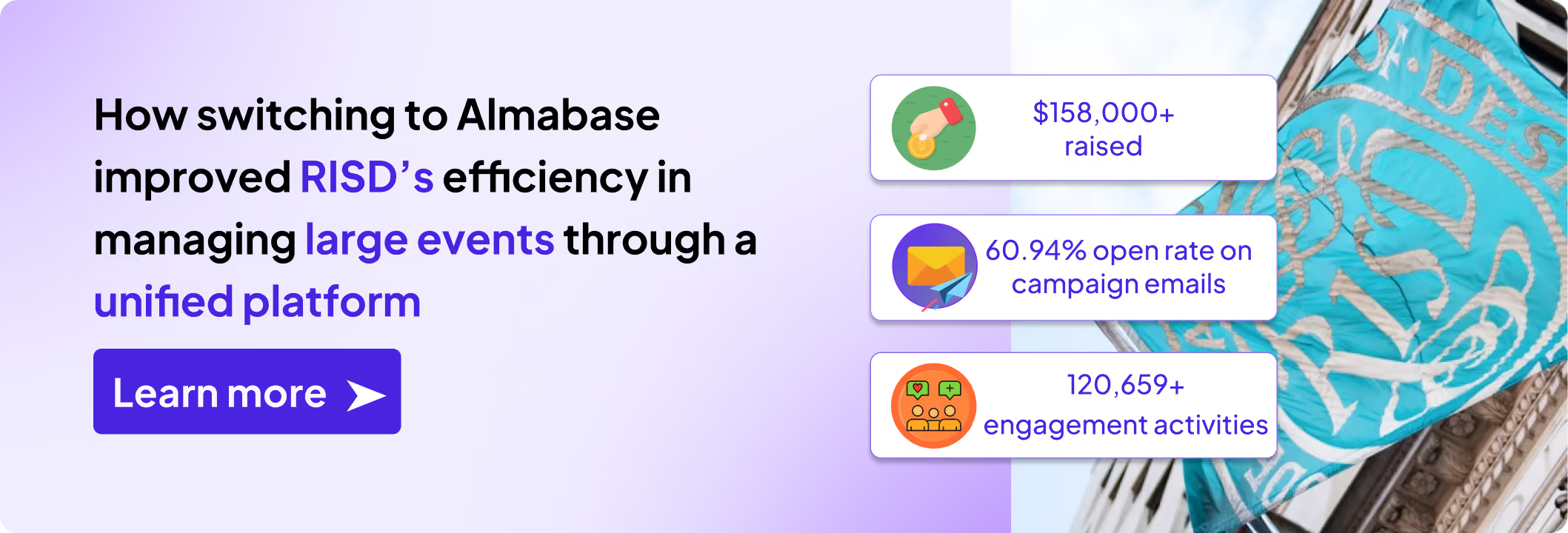
The biggest change most teams feel is the removal of manual work that had become part of everyday operations. Fewer exports, fewer reconciliation tasks, and fewer systems to manage means more time spent on fundraising, events, and alumni engagement.
The planning around the migration is almost as important as the platform you switch to. You want something your team will actually use, something that doesn't force you to rebuild everything from scratch or hunt down missing records.
If you want to see how different platforms stack up, here's a breakdown of top 5 BBNC alternatives.
Or if you're curious how Almabase handles this kind of migration specifically, request a demo to see how an integrated approach works for your team.

Moving on from Blackbaud NetCommunity: Alternatives, Migration, and What to Expect Next
Lorem ipsum dolor sit amet, consectetur adipiscing elit. Suspendisse varius enim in eros elementum tristique. Duis cursus, mi quis viverra ornare, eros dolor interdum nulla, ut commodo diam libero vitae erat. Aenean faucibus nibh et justo cursus id rutrum lorem imperdiet. Nunc ut sem vitae risus tristique posuere.
Anwesha Kiran
June 22, 2026
12 minutes
%201.svg)
%201.svg)
%204.svg)



.svg)