Promoting your fundraiser right is crucial as you want to make sure your potential donors are alerted and also motivated to give. Check out these fundraiser promotion ideas.

Sharada Koti
Published:
May 15, 2026
Updated:
May 15, 2026

For schools, universities, and nonprofits, organizing a fundraising event is a perfect opportunity to build connections and make an impact. However, there is another challenge before the progress bars start going up and that’s getting the word out.
Figuring out how to promote a fundraiser seems easy at first but overlooking crucial steps or messing something up can be the difference between a potential donor noticing your giving day or not, or even if they do, they might not feel as connected if your fundraiser’s first impression isn’t great.
In this blog, we will walk through how teams approach marketing a fundraiser across channels, what to focus on, how to keep it manageable, and how to turn visibility into actual donations.
Most campaigns you run will fall into a few familiar buckets. The way you promote each one changes slightly, but the goal of getting the people to walk through the door, notice, care, and act remains the same. Here’s how it usually plays out in practice.
You’ll see this across Giving Days, annual funds, scholarship appeals, emergency campaigns, crowdfunding, or even smaller department-level pushes. Everything centers around a campaign page, and most of your effort goes into driving people there.
Events give you a defined window to work with, but they need attention on both sides of that window. This includes galas, auctions, walkathons, runs, school fairs, reunions, homecoming, networking events, or even virtual sessions like webinars.
In institutions, you’re working within existing communities. You’ll see campaigns like annual funds, parent giving, student-led fundraisers, athletics drives, giving Days, reunion giving, or class-year challenges. Each one taps into a slightly different group.
These campaigns usually depend on participation as much as they do on donations. That could be recurring giving drives, peer-to-peer campaigns, emergency appeals, volunteer-led efforts, or partnerships with sponsors and local groups.
Monthly giving, memberships, sponsorships, and corporate programs stay active year-round. They don’t rely on one big push, so consistent visibility becomes the focus.
Emails hold an advantage over other channels in that they can come off as more authentic with your audience. Emails are not decided by algorithms and don’t need to follow trends. If you want to drive action, consider using emails to promote your fundraiser.
Most organizations already use email heavily, but it usually lands in one of two buckets: routine updates, or messages shaped to actually drive engagement. The ideas below might just help you move your email promotion to the latter bucket.
A broad mission statement will not be able to carry the weight that a single lived experience can. One of the best ways to make a fundraising email land is to narrow the lens: focus on one person or one visible change that donations made possible.
Instead of processing statistics or organizational language, people connect emotionally and start imagining a real outcome. As a result, your ask stops feeling too broad and becomes clear.
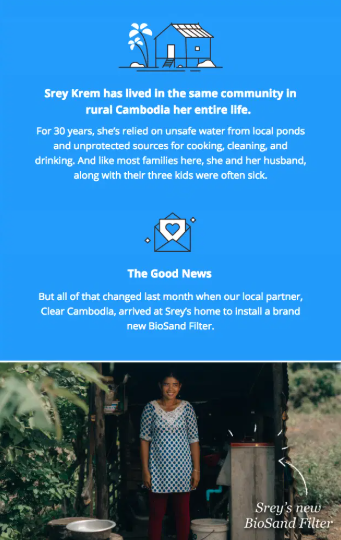
A strong example comes from charity: water’s email “A New Way of Life for Srey”. Rather than opening with urgency or fundraising targets, the email walks readers through one woman’s daily reality and how access to clean water changed it. When the ask follows such an impactful story, giving to the cause feels like a no-brainer.
Why this works: Regular donors have seen every version of “support our mission.” Impactful storytelling cuts through with specificity and emotion as the advantage. A single story gives people something concrete to hold onto, and that makes the impact feel both believable and personal.
Here’s an opportunity to use emails to do more than just persuade givers: remove uncertainty and confusion.
Once people are interested in participating, scattered information could still lead to drop offs. If you’ve faced this, the problem might not be visibility. Donors might be finding the process lengthy: one detail lives on the event page, another in a previous email, another in a PDF attachment nobody can find later. Supporters don’t consciously decide not to engage, they just decide to figure it out later. Chances are, by that time, the giving window is over.
This is where you can employ a well-structured logistical email.

An example of this comes from Mount Calvary Christian School’s fundraising auction campaign. The giving page led supporters to the email which had everything they needed to give, in one go: auction wish lists, sponsorship details, featured items, participation options, and next steps. Instead of pushing readers toward a single action, it gave them enough clarity to choose how they wanted to engage.
Donors need clear direction to participate in your cause, and this email gave them exactly that.
Why this works: Use complete emails to eliminate confusion and build momentum for your campaign. When supporters don’t have to search for information or second-guess what comes next, participation is easy and decisions are made much quicker.
One of the smartest ways to grow a fundraising campaign is to use your ambassador’s and supporters’ voices to amplify your cause.
The challenge here is that most people are willing to help spread the word, but very few have the time or resources to draft messages from scratch, resize graphics, or figure out what to say. Even highly engaged supporters tend to delay sharing when it feels like extra work.
This is where ‘ready-to-use’ email resources will come to your rescue.

For its Giving Day campaign, University of North Alabama created a resource hub with pre-written email templates that could be shared before their Founder’s Giving Day to spread word and on the day of, to share live progress. Instead of a more abstract, high-effort ask like “help promote the campaign,” they gave them a toolkit that made participation almost frictionless.
A huge advantage here is also that the campaign’s voice stays consistent even as more people start sharing it. You widen reach without diluting the message.
Ambassadors become visible contributors to the campaign’s momentum and sharing feels like joining something already in motion.
Why this works: Ready-made resources remove hesitation, keep messaging cohesive, and make it far more likely that people will actually share your cause with their own networks. It also makes them feel considered, which goes a long way in ensuring support, year-on-year.
No matter what kind of fundraising email you’re sending, a few small tweaks can have an outsized impact on engagement.
If you’re seeking immediate visibility, social media is the best bet to promote your fundraiser. People see your campaign and they also get to see see other people engaging with it in real time. That visibility creates a sense of urgency, especially during fundraising events where energy and community matter as much as the ask itself.
But the campaigns that perform best on social media rarely feel overly designed. They feel human and socially alive. The ideas below help you bring that authenticity into your promotion plan.
One of the easiest ways to make fundraising content more compelling on social media is to loosen institutional control a little.
Supporters are very used to the same formats, with polished graphics, campaign slogans, and branded messaging. And these best fit on your official giving page. On social media, lead with voices that feel immediate and personal. That’s why student takeovers, ambassador posts, and behind-the-scenes perspectives consistently outperform highly produced promotional content.

National English Honor Society (NEHS) used social media takeovers, where students shared their own experiences, perspectives, bits of the planning effort and their involvement, directly with followers. The organization was letting students speak for themselves.
That changes the tone of the campaign instantly. The content feels less like planned outreach and instead starts to feel spontaneous and authentic.
It also creates a kind of peer validation that cannot be manufactured, and these consistently perform better with younger supporters.
Why this works: social media runs on perceived authenticity. Real voices cut through polished feeds because they feel socially credible. Prospective donors, families, alumni, and community members are seeing a lot more than what programme matters: they are seeing who it matters to and why, and everyone involved in making it possible. Think of it like bringing the delight of bloopers and behind-the-scenes of a beloved movie to your supporters.
One reason live content works so well during fundraising campaigns is that it is essentially live proof. Updates are immediate. Wins are communal. Small moments that would normally stay invisible suddenly become part of the event itself.

The Community Foundation of Louisville leaned into this during its giving day campaign by using Facebook Live throughout the day. The team went live at least once every hour, sharing rallies, nonprofit interviews, campaign updates, and “power hour” competitions tied to fundraising milestones. Donors could watch organizations react to milestones, see communities rally around specific causes, and feel the pace of the day accelerating. The campaign ultimately raised more than $4 million.
Why this works: Visible momentum lowers hesitation. When supporters can see energy building around a campaign in real time, participation becomes socially reinforced and the dollars raised, a community win.
The strongest fundraising campaigns on social media feel less like the outcome of carefully planned content calendars and more like the result of spontaneity. Here are a few practices that could help you sustain that authenticity:
Text messaging changes the fundraising equation because it bridges the gap between intent and action. It works differently because a message arrives in a space people already check, and the response only needs a few seconds. In contrast, other channels ask supporters to pause what they’re doing: open a new tab, revisit the campaign later, check their inbox, remember to come back.
This immediacy is what makes SMS so effective for fundraising events, time-sensitive campaigns, and last-mile engagement. But it also means there’s very little room for wasted language.
One of the best ways you can use SMS for fundraising is reducing the number of decisions a donor has to make before contributing.
The more steps people encounter, the more likely it is for momentum to disappear somewhere along the way. Text-to-give campaigns work because they make this process instantaneous.
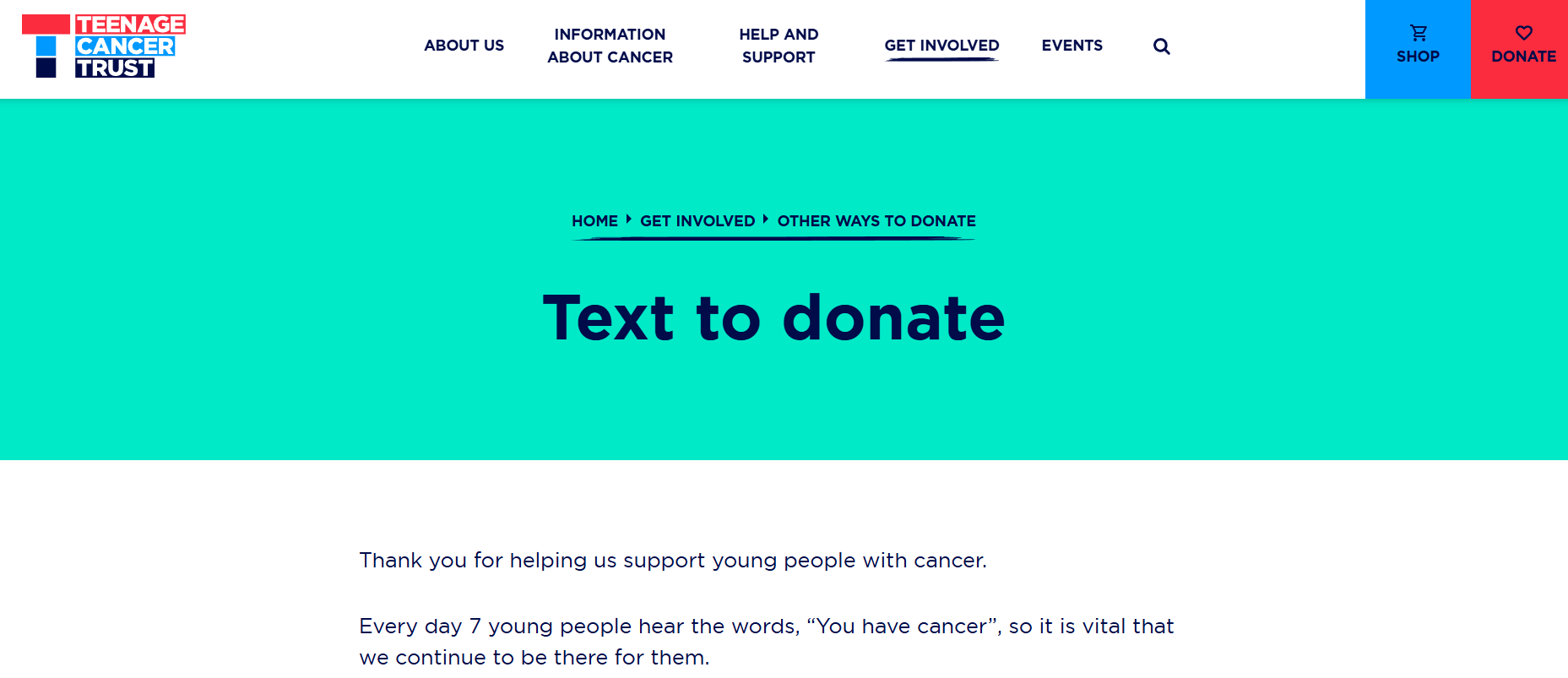
A good example is Teenage Cancer Trust’s text-to-donate campaigns, where supporters could contribute simply by texting a keyword. The interaction is familiar because it repurposes an action people already perform.
Why this works: Every additional step creates another opportunity for hesitation. You can remove that barrier by turning giving into a behaviour that already exists. Text-to-give succeeds because of this underrated advantage. Adding text message as a channel to your campaign also researches segments of your audience who aren’t present elsewhere.
SMS messaging, just like other channels, is not a one-size-fits-all tool.
Some messages are designed to create urgency. Others inspire emotional connection. Yet another simply reminds highly engaged supporters that it’s time to act. The effectiveness usually comes down to timing and audience readiness. A good approach is to treat SMS like a running conversation that changes as the campaign progresses:
The strategy shift here is that SMS is used to pace and guide donor attention over the course of a campaign.
Why this works: People respond differently depending on where they are emotionally and contextually. Let your message reflect the moment instead of repeating the same appeal every time.
Because SMS is such a direct channel, small execution details tend to have an outsized impact on response rates and supporter experience.
Physical media reaches people in those rare moments away from their screens. It also has one big advantage over digital channels: someone might scroll past a fundraising post once and forget it an hour later, but physical materials stay in the same space for days or weeks, building familiarity through repetition.
Physical promotion also makes a campaign feel more present in the real world. When people keep seeing posters or handouts across shared spaces, the fundraiser starts to feel more immersive.
One reason physical promotion gets delayed is the assumption that every campaign asset has to be designed from scratch. But if you’re able to find materials that already work and can be adapted quickly to fit their event, you can reach supporters that much better.

That’s what makes resources like Save the Children’s downloadable fundraising materials so useful. Their comprehensive collection of posters, banners, bunting, forms, totalisers and booklet templates give organizers a professionally structured starting point that can be customized with event details, school branding, or campaign messaging.
You can edit these downloadable resources and plan your campaign around those. Promotion starts earlier. And consistency across posters, handouts, and signage becomes much easier to maintain.
Why this works: professionally designed templates remove one of the biggest hidden bottlenecks in fundraising promotion: getting materials created in the first place. The easier assets are to customize and deploy, the more likely they are to be used effectively.
Design barriers are real constraints that fundraising teams face. Many don’t have an in-house designer available to design flyers to hand out to prospects for promotion. But if non-designers can still create usable flyers confidently, your campaign’s promotion and presence will be stronger.

That’s Canva’s library of fundraising templates becomes extremely usable. They’re thoughtful, structured, and have a visual hierarchy that guides attention toward a single next step, whether that’s a QR code, a donation prompt, or an event detail.
For teams without dedicated designers, this means you’re not choosing between “good design” and “getting it done.” You can produce materials that are both usable in real-world environments and fast enough to deploy while the campaign is active.
And another powerful change to your promotion strategy is that design stops being a decorative layer and becomes part of the conversion pathway.
Why flyers work: In physical environments, attention is brief and competitive. Lowering the effort required to create good promotional materials dramatically increases the likelihood that campaigns will consistently use them. Teams stop postponing promotional work because it no longer feels intimidating, with good quality resources at their disposal. Finally, good looking flyers are simply more likely to get taken seriously by supporters.
The most effective print materials succeed because they grab attention and make action feel obvious at a glance. A few small design and distribution choices can make a noticeable difference.
In-person fundraising works for a very fundamental reason: people remember experiences.
An event creates a shared memory, and yet no two attendees walk away with the exact same experience. People remember who they spoke to, what they participated in, and how the moment felt. That emotional residue often translates into stronger long-term giving behavior, even when attendance is relatively small.
One of the biggest constraints in school and community fundraising events is staff capacity. Teachers, coordinators, and volunteers often want to participate, but don’t have time to build an event structure from scratch.
That’s where plug-and-play toolkits make a real difference.

For example, Alex’s Lemonade Stand Foundation’s “Change Childhood Cancer” coin drive toolkit gives schools everything they need upfront: instructions, parent communication templates, and simple step-by-step guidance for running a classroom campaign.
Schools and teachers are being handed a complete, usable system that they can implement as is or tweak as they see fit. When setup effort drops close to zero, more classrooms opt in, even in already busy school environments.
In fact, putting together a toolkit is simpler than it sounds:
Why this works: The fewer decisions an organizer has to make, the more likely they are to run the event at all. Convenience directly increases participation.
In-person events work best when they feel tailored to the people attending them, instead of just broadly “for supporters.”
That’s why segmented programming outperforms one-size-fits-all activities, especially in school environments where age groups have very different engagement styles.
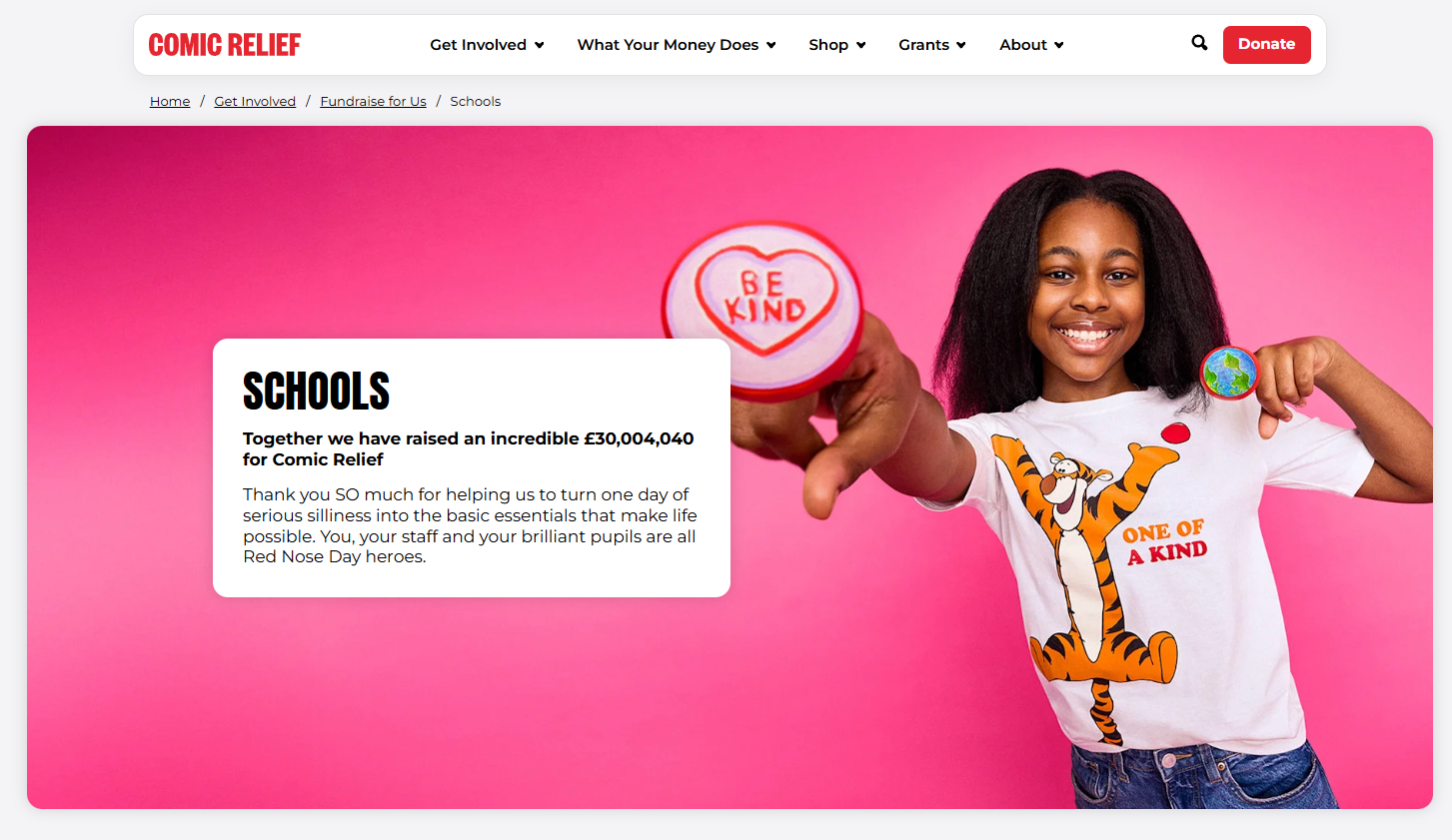
Comic Relief’s school fundraising approach in the UK understands this. Their materials structure participation by age group: Early Years, Primary, and Secondary, each with activity ideas suited to how those students naturally engage, from dress-up days to talent-based challenges.
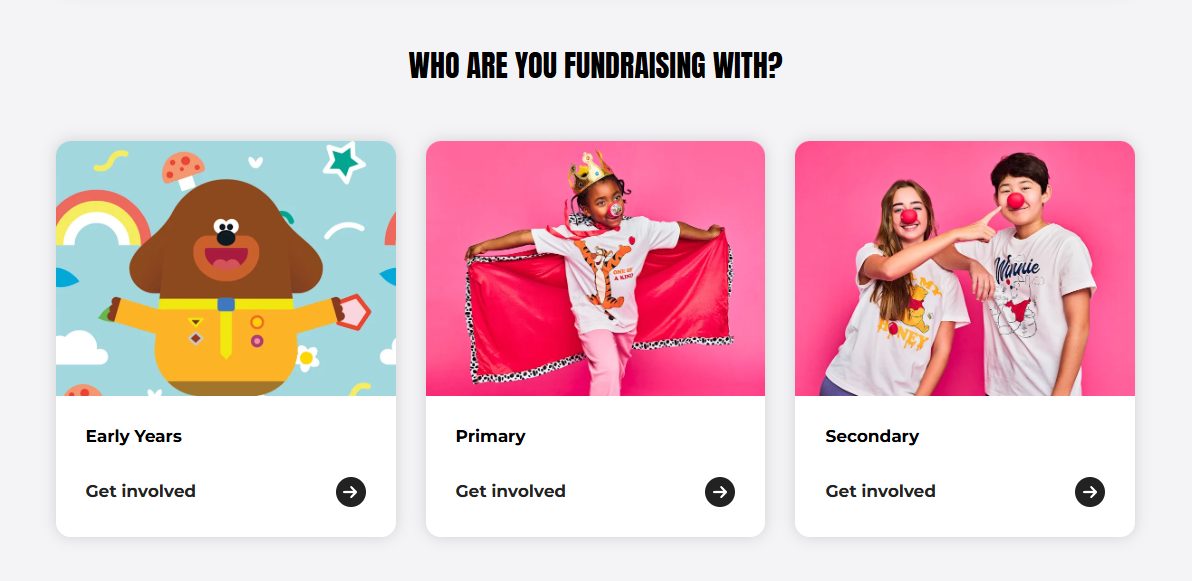
The underlying idea is simple: relevance drives participation. When an activity feels designed for a specific group, it doesn’t feel like an imposition, rather, it feels like something meant for them.
Why this works: People participate more when the experience matches their identity and context. Meet your participants where they are.
The most effective events succeed through consistent coordination across all phases, not just execution on the day itself.
Today, your team’s fundraiser promotion efforts happen through either a dedicated platform or a network of specialized tools. Almabase excels at integrating your promotion efforts into your larger engagement and fundraising strategy on many levels. Here’s how:
Almabase aims to bridge the gap between engagement and giving by providing specialized features built to complement each other. Take for example, the alumni directories and communities that make segmentation and personalized outreach much easier. This in turn makes post-event communications and donor follow-ups much more streamlined and interconnected.
Dynamic filters provide detailed insight into donors' interests, careers, and engagement history to personalize fundraising appeals. Past donation data can also be used to identify major gift donors and intensify retention and upgrade efforts.
Almabase acts as a one-stop shop for all things outreach especially for email/SMS campaigns through personalized outreach, segmented lists, or post-event communications.
Campaigns can be promoted across both texts and emails to drive real-time engagement, and advanced audience segments can be built to raise more from untapped donor opportunities. Beyond one-off fundraisers, it also empowers year-round campaigns and recurring giving as Almabase’s focuses on empowering your engagement and giving strategy beyond just short-term fundraising goals.
Almabase’s powerful sync with CRMs such as RE NXT (through TrueSync) means that when someone clicks a donation link and gives, that data flows back into the CRM automatically with no manual record updates or channel tracking required.
Text messages boast a 98% open rate and get responses much faster than email, making them perfect for urgent appeals like Giving Tuesday. Almabase pulls in donor data so teams can reference past gifts, event attendance, or volunteer history in their texts for highly personalized outreach.
Almabase is also easy to use with it’s no-code approach to building giving pages, checkout pages, leaderboards, and much more. For important giving days and events, customers get priority support on multiple channels.
Promoting a fundraiser today is a complicated process. Beyond just getting the word out, you and your team need to find the right platform, have the right strategy, and reach out to potential donors at the right time with the right message, and of course, execute the right ideas in the best way possible.
We have a few resources to ease the planning process:
And if you are looking for a partner to help you find success in your fundraising efforts, feel free to book a demo call personalized to you and your team’s needs! 👇
Table of Contents
Subscribe
See how modern advancement teams bring alumni engagement and fundraising together.
Plan faster. Execute better
Explore free templates designed for alumni and fundraising teams.
I fall right between Gen Z and Millennials, a Zillennial, if you want to get specific.
I'm not starting my day with matcha every morning, but I appreciate the vibe. Memes are definitely a love language, but so is a well-organized Excel sheet.
Writing this piece felt oddly personal. Because I am both generations at once.
So when the data on alumni giving from younger graduates landed in front of me, I didn't just analyze it. I recognized myself in it.
Here's what the numbers actually say, and what university fundraising teams need to hear.
The short answer to why Millennials and Gen Z aren't giving to their alma mater: they are giving. Just not to you.
And before you take that personally, it's worth understanding why.
The 2026 National Alumni Survey, gathered from over 82,000 alumni voices across 31 colleges and universities, makes the picture clear:
That's a signal right there.

When Millennials and Gen Z give, they give to causes that feel immediate, personal, and visible.
Here's what that looks like in practice:

The pattern is clear: younger alumni gravitate toward giving that feels direct. They want to see a face, a story, a specific person whose life changed because of their contribution. Broad, abstract institutional appeals simply don't compete with that.
This isn't a generational quirk. It's a logical response to how younger alumni experience the world and institutions.
Let's break it down:
1. They need to see visible impact.Younger alumni don't give out of tradition or obligation. They give when they can connect their contribution to a real, tangible outcome, like a scholarship that put a first-generation student through graduation or an emergency fund that kept someone from dropping out. When the impact is invisible, so is the motivation to give.
💡For example, the University of North Carolina School of the Arts moved from a “one day, one fund” model to offering over 40 donor-choice funds during Giving Day. [Read More]
2. They prefer immediacy over schedules.Nearly one in three younger alumni give on an "as needed" basis, responding when a cause needs support right now. Only 17% give on a regular schedule, compared to 38% of older alumni. Annual fund cycles and fiscal year deadlines don't map to how this generation thinks about generosity.
3. Institutional trust isn't automatic.Older giving models assumed loyalty. Younger alumni don't start from a place of institutional trust. They extend it based on evidence, transparency, and whether they feel genuinely seen. According to the 2026 National Alumni Survey, 40% of alumni feel disconnected from their institution, and nearly half feel ill-informed about what it's doing. That's not a foundation for giving.
🔥In our recent webinar with Dr Amanda Shoemaker, we unpack what drives young alumni to give. [Watch here]
4. They expect frictionless, digital-first giving.43% of younger alumni give via digital wallets like Apple Pay or Venmo, compared to just 14% of older graduates. If your giving process has friction, you've already lost them.
Here's what you need to know: most advancement teams are still running playbooks written for a different generation of donors.
Annual fund appeals, broad unrestricted messaging, and campaigns built around institutional pride may work for older alumni but they land flat with younger ones. Generic outreach doesn't answer the question younger alumni are silently asking:
"What does this have to do with me, and what will actually change because of my gift?"
Impact storytelling is often delayed, buried in newsletters, or framed around the institution rather than the people it serves. That's the opposite of what works.
The good news is that the data doesn't just diagnose the problem. It points clearly toward what moves younger alumni.
1. Lead with cause-based campaigns.Replace broad annual fund appeals with specific, values-driven opportunities like student emergency funds, mental health services, first-generation initiatives, and campus food pantries. These are the areas where younger alumni see themselves and their values reflected.
Here's what the data shows about which funding areas resonate most by age group:

The gap on mental health services, first-gen initiatives, and emergency funds is especially telling. These are causes younger alumni care about deeply, often from personal experience, and they are chronically underpromoted in most alumni giving campaigns.
2. Tell real stories about real people.The shift toward GoFundMe-style giving is a signal, not a trend to dismiss. Younger alumni want to know who they are helping. Put a name, a face, and a specific situation at the center of your ask. The institution is the vehicle. The person is the story.
💡Alumni Association of the School of Medicine of Loma Linda University saw success by tying campaigns to real outcomes and beneficiaries, helping donors understand not just what they’re giving to, but who they’re helping. [Learn more]
3. Make online giving frictionless.Offer digital wallet options and mobile-first experiences that simplify online giving. Create time-bound, shareable campaigns like Giving Days that feel communal and immediate. Younger alumni are more likely to give in the moment than on a schedule, so meet them where they are.
4. Acknowledge debt without making it awkward.Student loan debt is a real factor for younger alumni, particularly alumni of color and women. But here's what the survey found: 77% of those burdened by debt still give to other organizations. The barrier isn't financial capacity. It's relevance and trust. Acknowledge competing financial pressures in your messaging without pressure or apology, and focus the ask on collective impact rather than individual sacrifice.
💡Is Your Higher Ed Website Meeting Gen Z’s Expectations? Audit your higher ed website with this self-assessment.
The 2026 National Alumni Survey puts it plainly: younger alumni haven't disengaged from generosity. They're selective about where it goes, and they're directing it toward causes and organizations that earn their trust, show their impact, and respect their agency.
Higher education hasn't lost their goodwill. It just hasn't earned their giving yet.
The gap is closeable. But it closes through relevance, transparency, and real human connection.
👉 Curious about what motivates alumni giving across institutions? Explore the full 2026 National Alumni Survey findings to see how your institution compares.

Why Millennials and Gen Z Aren't Giving to Their Alma Mater (And What Actually Works)
Why Millennials and Gen Z aren’t giving to their alma mater and what actually works. Insights from the 2026 National Alumni Survey on how younger alumni give differently.
Alumni Engagement
Middle school fundraising comes with it’s own set of challenges. You have kids and parents with lots of energy and passion, but you might not always have the budget or staff to consistently host the ideal fundraiser you’ve been thinking about.
Sometimes a fresh set of inspiring ideas can help you find the perfect fundraiser that fits your team’s capabilities while meeting students, parents, and other constituents where they are.
In this blog, we’re walking through middle school fundraising ideas that work in real school settings. These are practical, easy to run, and designed to keep participation steady so your efforts lead to meaningful results.
Middle school fundraising ideas are structured activities that help schools raise money for events and classroom needs. Common options include bake sales, color runs, penny wars, educational challenges, and community-based campaigns.
These fundraising events help middle schools bridge the gap between available budgets and the actual cost of running well-rounded student programs. It allows schools to fund initiatives that go beyond core academics, improve learning environments, and support activities that would otherwise not be possible.
Fundraising also helps schools sustain programs over time instead of relying on one-time allocations. This makes it a critical part of how schools plan and deliver consistent student experiences.
Fundraising brings both financial and engagement-related benefits when planned thoughtfully.
Across the education sector, fundraising continues to play a central role in supporting institutions. In fact, CASE Voluntary Support of Education reports that US institutions received over $61.5 billion in voluntary support in FY24, which shows how essential fundraising has become in maintaining programs beyond core budgets.
The best middle school fundraising ideas are the ones that are easy to run and keep students involved throughout the campaign. In this section, we focus on ideas that work well in real school environments, where time and budget often shape what is possible.
These fundraising ideas for middle school work well when you need something practical that does not require a large budget or complex setup. The focus here is on ideas that are easy to launch, simple to manage, and still capable of bringing strong participation when executed thoughtfully.
Bake sales remain one of the most reliable school fundraising ideas because they are easy to organize and familiar to families. What makes the difference is how you structure participation. Instead of only relying on donations, you can assign themes, organize class-wise contributions, or pair the sale with an event to increase footfall.

A good example comes from St James School, where students organized a bake sale to support charity. They managed contributions, set up sales during school hours, and created a simple but well-coordinated event. The result was a successful fundraiser that raised £122, showing how even small-scale efforts can deliver meaningful outcomes when executed well.
This idea works especially well in middle school settings because it adds a playful element that students enjoy. Students donate for the chance to place temporary tattoos on teachers during a designated time. It creates anticipation and encourages participation without requiring much setup.

At Greenbrier Middle School, the “Tattoo the Teacher” fundraiser turned into a highly engaging event. Students contributed enthusiastically to take part, and the activity created a lively atmosphere across the school. The success of the fundraiser came from how simple the idea was to execute while still making students feel directly involved.
Recycling, cleaning, or waste collection drives combine fundraising with a sense of purpose. Schools can collect items such as old electronics, cables, or recyclable materials and partner with organizations that offer returns for collected items. This approach works well when you want to involve students in a cause while raising funds.

The Stevenson Middle School ran a e-waste recycling drive just this year. The school provided clear guidelines on which items were acceptable and which were not, making it easier for participants. The campaign not only raised funds but also built awareness around sustainability, showing how educational fundraising ideas can create both financial and learning outcomes.
Penny Wars introduce a competitive element that keeps participation consistent over several days. Each grade contributes coins to earn points while adding other denominations to competing grades to reduce their scores. The format is simple, yet it keeps students engaged because of the ongoing competition.

At Narragansett Middle School, a penny wars campaign was organized as a grade-level competition. Regular updates and visible tracking helped maintain excitement. The structure encouraged steady participation and showed how a low-cost fundraiser can stay active over time when competition is built into the format.
A fun run or jog-a-thon is a strong option when you want a low-cost fundraiser with high participation potential. Students collect pledges based on laps completed or distance covered. The event itself becomes a shared activity, which helps maintain energy and involvement.

Golden Hill Elementary’s Eagle Fun Run is a good example of how this can work. The school structured the event around student participation and community support. By focusing on pledges and clear goals, they created a fundraiser that was easy to manage and capable of generating strong contributions through collective effort.
These middle school fundraiser ideas work best when participation is driven by experience. Students stay involved when the activity itself feels exciting and social, rather than something they have to do. The goal here is to create moments that bring energy into the school while still supporting your fundraising efforts.
A staff talent show shifts the spotlight to teachers and staff, which creates a different kind of excitement for students. Participation increases because students are curious to see familiar faces perform in a new setting.

South Portland Middle School hosted a staff talent show to raise funds for grade-level field trips. Staff members performed for students, and the event drew strong attention across the school. This approach works well because it builds community involvement while keeping the setup manageable.
Sports-based fundraisers work well because they tap into existing student interests. A structured tournament allows students to participate actively while also attracting spectators who contribute through entry fees or small ticketed access.

Anderson Middle School organizes a basketball tournament every year to support a charity of their community’s choosing. This year, they raised $15,000 for Camp Casey, a nonprofit organization. This format works well for schools that want to combine physical activity with community involvement.
A color run is one of the more engaging fundraising ideas for schools because it combines physical activity with a visually exciting experience. Students raise pledges and take part in a run where colored powder is used at different checkpoints, turning the event into something memorable.

Buford Middle School set a fundraising goal of $75,000 for its Color Run event, positioning it as a key event to support student and teacher initiatives. The success of this approach comes from how the event itself becomes the main attraction, which helps drive both participation and contributions.
Interactive game-style events can bring families into the fundraising process without requiring a physical setup. Schools can host quiz nights or game show formats where families join, participate, and contribute through entry fees or donations.

Chelsea School ran a virtual Family Feud-style event as part of its community programming. Families joined remotely, participated in live games, and contributed as part of the experience. This approach worked well because it extended participation beyond students and made fundraising feel like a shared activity at home.
A move-a-thon builds participation around physical activity while allowing flexibility in how students take part. Instead of limiting the event to one format, schools can include multiple activities and let students choose how they want to participate.
The Southeast Seattle Schools Fundraising Alliance organized a large-scale move-a-thon that involved around 6,700 students across multiple schools. Students participated in activities such as yoga, capoeira, and neighborhood cleanups. This approach helped increase participation because students could engage in ways that suited their interests, while still contributing toward a shared fundraising goal.
Educational fundraising ideas work best when the activity itself adds value to students. Instead of treating fundraising as a separate task, these ideas build it into learning. This makes participation more consistent because students are working toward both academic and fundraising goals at the same time.
A read-a-thon encourages students to build reading habits while raising funds through pledges tied to time spent reading. Schools can set collective goals and track progress publicly to keep momentum strong throughout the campaign.

The STEM K–8 PTA organized a Read-A-Thon scheduled from April 1 to 24 with a target of 110,000 minutes. Students went beyond that goal and reached over 206,000 minutes of reading. The campaign also raised $20,854 to support PTA programs. This shows how combining a clear goal with visible progress can drive both participation and results.
A math-a-thon focuses on problem-solving instead of reading, making it a good fit for schools that want to promote analytical skills. Students complete structured problem sets and collect sponsorships based on participation or performance.

Damascus Middle School ran a Math-A-Thon where students worked through math “funbooks” and earned support through sponsorships. The format made the activity feel structured yet approachable, which helped maintain participation while aligning the fundraiser with classroom learning.
These fundraising ideas for schools focus on small, ongoing contributions rather than one-time events. The goal is to connect everyday activities with classroom support so fundraising becomes part of the broader school ecosystem.
Many middle schools often introduce a rewards-based system for the school year where local shopping contributes directly to funding teacher resources. This approach works well because it reduces the need for repeated campaigns and instead builds a steady flow of support tied to community participation.
Seasonal fundraising ideas for middle school work because they align with moments students already look forward to. When a fundraiser is tied to a holiday or time of year, participation feels more natural. The theme creates built-in interest, which reduces the effort needed to promote the event.
Halloween-themed events are effective because students already expect something fun around that time. Schools can build activities such as costume contests, themed games, or small group experiences and charge for entry.

Rye Neck Middle School hosted a “Spooktacular” event with themed activities designed for students. The event sold over 190 tickets, showing how a well-timed seasonal fundraiser can drive strong participation when the experience feels unique and relevant.
Holiday fundraising ideas work well because families are already spending during this period. Schools can offer services such as gift wrapping or partner with vendors to sell seasonal products, making it easy for families to contribute while completing their own holiday purchases.
Boyce Middle School partnered with Charleston Wrap and Chestnut Hill Candle Company for their winter fundraising campaign. The initiative supported sixth-grade trips and allowed families to contribute through everyday holiday purchases. This approach works because it fits into existing seasonal behavior rather than asking for additional effort.
Fall festivals bring together students, families, and the wider community through a mix of activities and attractions. These events usually combine ticketed entry with paid activity stations, which helps create multiple ways to contribute.

Challenge School hosts an annual “Harvest Howl” fall festival that includes attractions such as interactive games, performances, and themed activities. The school also offers early ticket pricing to encourage advance participation. This structure helps generate revenue early while building anticipation for the event.
Some fundraising ideas for middle school are designed to generate higher returns by combining participation with stronger intent to give. These work best when there is a clear purpose, structured execution, and multiple ways for the school community to contribute.
Cause-based fundraisers connect contributions to a specific purpose. When students and families understand what they are supporting, participation tends to feel more meaningful, which often leads to higher contributions

Enumclaw Middle School organized a fundraiser to support the Sudan Relief Fund. The school brought the community together around a shared cause and structured the event to encourage participation through awareness and involvement. This approach works because it gives fundraising a clear direction and helps participants see the impact of their contributions.
Instead of relying on a single event, schools can run a series of activities under one campaign. Each activity may be simple on its own, but together they create multiple opportunities for participation and contributions.
Cramerton Middle School, along with the wider Gaston County district, ran a multi-event campaign that included daily activities such as slushie sales, themed dress-up days, and teacher challenges. This combined approach helped the district raise nearly $132,000, making it their highest total. The success came from creating consistent touchpoints where students could participate in small ways throughout the week.
A direct donation model removes the need for product sales and focuses entirely on contributions. This works well when schools want a simpler structure that is easier to manage and track.

Creekside Middle School adopted a one-time donation approach with a goal of $50,000. By focusing on direct giving instead of physical sales, the school streamlined the process and made it easier for families to contribute. This approach works best when communication is clear and the purpose of the fundraiser is well defined.
A Fund-A-Dream model combines a traditional silent auction with a focused fundraising goal. Instead of raising money for general use, the campaign highlights a specific project that the school wants to complete.

Saints Academy used this approach by linking their auction to a specific, tangible "dream" project, which helped create urgency and stronger participation. When contributors understand exactly what their donations support, they are more likely to give at higher levels. This model works well for schools looking to fund larger initiatives with clear outcomes.
A CASE study suggests that charitable support for education continues to show long-term resilience, even during periods of economic uncertainty, which makes well-structured fundraising efforts more reliable over time.
Also read → 15 proven school fundraising ideas for 2026
In order to run successful middle school fundraisers, the primary focus should be on how clearly the idea is planned before it begins. When the structure is simple and roles are defined early, teams spend less time managing issues and more time driving participation.
Every fundraiser needs a clear starting point. Without a defined goal, it becomes difficult to guide participation or measure success.
Start by identifying what the fundraiser is supporting. This could be a student program, a trip, or classroom improvements. Then set a specific target that reflects that need.
Visible and easy to follow fundraising goals are a must if you want participation to stay consistent.
Strong participation depends on how involved students and parents feel throughout the fundraiser. Clear communication and simple ways to contribute make a noticeable difference.
Students should feel like active participants rather than just contributors. Giving them small roles can help maintain interest.
For parents, clarity matters more than frequency.
Clear and relevant communication also improves response. McKinsey suggests that personalized outreach can significantly increase engagement, which means messages that feel specific to the audience are more likely to drive participation.
The platform you use plays a key role in how smoothly the fundraiser runs. Without the right setup, teams often spend time managing payments, updating records, and sending reminders manually.
A good fundraising platform helps by:
Crowdfunding platforms like Almabase are designed to support this kind of workflow. Schools can set up structured giving pages, manage campaigns, and track donations as they happen. Since it works alongside existing systems, it also helps keep records aligned without additional effort.
Choosing the right platform allows your team to focus on participation and engagement, which is where most fundraising outcomes are shaped.
Also read → 10 Best fundraising software platforms for schools in 2026
Even the best middle school fundraising event ideas need the right execution to deliver results. Small changes in how you promote, structure, and run your campaign can make a noticeable difference in participation and outcomes.
Here are a few practical ways to improve how your fundraiser performs:
A fundraiser needs visibility throughout its duration, not just at the start. Students and parents often miss the first announcement, so regular reminders help keep participation steady.
Use channels your school already relies on. Share updates through school newsletters, send short email reminders, and post progress updates on social media. When people see the fundraiser more than once, they are more likely to act.
Users have also found that fundraisers perform better when messaging stays consistent across all communication channels. Repeating the same core message instead of changing it frequently helps families recognize the campaign and understand what action is expected.
A defined timeline gives structure to your school fundraising campaign. When there is no clear end date, participation tends to slow down.
Set a start and end date before launching the fundraiser. Share these dates clearly with students and parents. You can also introduce small milestones within the campaign to keep attention focused and encourage timely participation.
Students respond well to shared goals. Adding a team element can help maintain energy during the fundraiser.
You can organize participation by class or grade level. Track progress and share updates regularly so students can see where they stand. When students feel part of a group effort, they are more likely to stay involved.
Recognition helps sustain participation without adding unnecessary complexity. Students are more motivated when their efforts are acknowledged.
This does not always require large prizes. Simple rewards such as certificates, announcements, or small privileges can be effective. The key is to make the recognition visible so others are encouraged to participate as well.
When these elements come together, fundraising becomes easier to manage and more consistent in its results.
Also read → Quarterly fundraising playbook for schools you’ll need in 2026
Managing a fundraiser becomes easier when your tools support execution instead of adding extra steps.
Almabase provides a crowdfunding platform that helps schools run structured fundraising campaigns in one place. Teams can set up giving pages, monitor donations as they come in, and manage the campaign without switching between tools.
This approach helps in a few key ways:
At Boyd Buchanan School, this structured approach helped connect engagement with fundraising results. The school surpassed its giving goal by 201%, had 60% of alumni sign up on the platform, and saw a 5X increase in engaged users within five months of onboarding. Almabase also helped the team use leaderboards, donor segmentation, goal thermometers, and Raiser’s Edge sync to manage the campaign more effectively.
The right middle school fundraising ideas make a clear difference in how a campaign performs. When the idea fits your school and is easy to run, participation stays steady and the effort feels manageable for everyone involved.
This guide shows that effective fundraisers do not need to be complicated. What matters is clear planning, consistent communication, and ideas that students and families are willing to support. Even simple fundraisers can deliver strong results when they are executed well.
Almabase helps bring structure to the process. It allows your team to manage campaigns, track donations, and stay organized without relying on multiple tools. Book a free demo to find out how this can work for your school's next fundraising event.

The most effective middle school fundraising ideas are those that are easy to manage and keep students involved. Examples include bake sales, fun runs, read-a-thons, and themed events. These work well because they combine participation with clear goals, which helps maintain steady contributions.
Quick fundraising ideas for middle schools usually involve simple setups and immediate participation. Options like spirit days, snack sales, or direct donation drives work well because they do not require long planning cycles and can generate funds within a short time.
The most successful fundraising ideas keep participation steady and are easy to run. Fun runs, read-a-thons, themed events, and multi-day campaigns work well because they keep students engaged over time and families have more chances to contribute, which leads to stronger overall results.
Participation improves when students feel involved and understand the purpose of the fundraiser. Clear communication, visible progress tracking, and small incentives can help maintain interest. Group-based activities such as class competitions also encourage more consistent involvement.
Online platforms help schools manage fundraising more efficiently. They allow teams to track donations, communicate with donors, and run campaigns without manual coordination. This becomes especially useful for larger or longer campaigns where organization and visibility are important.

20 Best Middle School Fundraising Ideas for 2026
Looking for middle school fundraising ideas? Find low-cost, fun, and high-impact ideas with tips to increase participation and results.
Fundraising
A donor rarely spends time deciding whether to give to a cause they care about. Most of it happens quickly, often in a single glance.
Short donation messages are built for exactly that moment. They help you communicate the ask clearly without slowing the decision down.
This also shows up in how donors prefer to be reached. Bandwidth's State of Messaging report states 13.1% of people prefer SMS for communication about causes and organizations they care about. That makes short, well-timed messages even more important in fundraising outreach.
In this guide, we’ll share short donation message examples you can use across text, email, and social channels to drive action. We’ll also show you how to create messages that feel natural and perform consistently across campaigns.
Short donation messages work best in moments where donors are already deciding whether to act. This could be right after they read about your campaign, see a peer share it, or receive a reminder during a live fundraiser. At that point, they don’t need more information, just a clear next step. A short message provides the next step without adding extra details.
Here are the situations and channels where short donation messages consistently drive the strongest results:
SMS is built for immediacy. In fact, text messages still see open rates above 98%, making them one of the fastest ways to capture attention. Short, actionable messages work best here because they align with how people use their phones. A clear instruction, like clicking a link or replying with a keyword, removes friction and increases conversion rates, especially during giving days or live campaigns, where timing directly impacts participation.
On platforms like Instagram, Facebook, and X, users scroll quickly and engage selectively. Short donation messages work because they capture attention without demanding too much time. When paired with strong visuals or videos, a concise line can drive shares, comments, and clicks. This is especially useful for peer-to-peer fundraising, where messages need to be easy to repost and amplify across networks.
While email allows for longer content, shorter messages tend to perform better in both subject lines and key sections of the email body. Donors often scan emails rather than read them fully, especially on mobile devices. A direct call to action placed early in the email increases the likelihood of engagement. Even in longer emails, the most effective parts are usually the short and clearly written donation prompts.
Time-sensitive campaigns are where short messages have the strongest impact. They create urgency without overwhelming the reader, helping them make quick decisions and take immediate action. Whether it’s the final hours of a giving day or a crisis response campaign, a short message often drives faster conversions than a detailed appeal.
Short donation messages work best when they feel natural to the channel and the moment. The structure usually stays simple: a quick context, a clear ask, and an easy next step. What changes is the tone, depending on who you’re speaking to and where the message appears.
Below are ready-to-use examples tailored for different campaign types and platforms.
These messages are meant for broad outreach where you’re engaging a wide audience without much context. They work well across email, SMS, and website banners where clarity matters most.
Hi [Name], we’re close to our goal for [campaign]. A quick gift today can help us get there. [Link]
Hi [Name], your support keeps [program] running. If you’ve been thinking about giving, now’s a great time. [Link]
Hi [Name], we’re reaching out to a small group before we go broader. Would value your support if you’re open to it. [Link]
These focus on impact, helping donors quickly understand what their contribution supports. They’re especially effective on donation pages and email campaigns.
Hi [Name], your gift today goes directly toward [specific outcome, e.g., funding 3 research grants]. You can be part of that here. [Link]
Hi [Name], we’ve made progress on [initiative], but there’s still a portion left to fund. Sharing the link if you’d like to help.
Hi [Name], donors this week have helped us reach [milestone]. Your support today keeps that progress going. [Link]
School campaigns benefit from messages that connect directly to students and community outcomes. These are commonly used in alumni outreach and annual fund campaigns.
Help students access better learning opportunities this year. Support here: [Link]
Hi [Name], your graduating class is supporting [program]. Adding your name would help push it further. [Link]
Your support keeps programs like [sports/labs/scholarships] going. Give here: [Link]
Peer-to-peer messages should feel personal and conversational. These work best on messaging apps and direct outreach.
Hey [Name], I just supported [cause]. Thought I’d share in case you want to join in: [Link]
A few of us are contributing to [campaign]. Passing this along if you’d like to take a look: [Link]
Hey [Name], I came across this initiative, and it’s doing meaningful work. Sharing in case you want to check it out.
These messages are ideal for seasonal or gift-based campaigns where the focus is on meaning and impact rather than urgency.
A small gift today can support [cause] in a meaningful way. Contribute here: [Link]
Looking for a more intentional way to give this year? Consider supporting [initiative]: [Link]
Your contribution today helps create lasting impact for [community]. Give here: [Link]
SMS messages need to be clear and immediate, with one simple action. These are best used for time-sensitive campaigns.
Hi [Name], we’re close to our target for today. Can you help us get there? [Link]
Only a few hours left to support [campaign]. Be part of it here: [Link]
Hi [Name], we’re 8 donors away from hitting today’s target. You can help us cross it here. [Link]
On social platforms, messages need to be quick to read and easy to engage with. Pair these with visuals or campaign updates.
Support [cause] today and help us reach our goal: [Link]
Join others supporting [campaign]. Every contribution makes a difference: [Link]
Be part of this effort to support [community]. Contribute here: [Link]
Email allows slightly more context, but the ask should remain clear and upfront. These work well as part of campaign sequences.
Hi [Name], we’re nearing our goal for [campaign]. Your support can help us finish strong: [Link]
This is a quick note to invite you to support [initiative]. You can contribute here: [Link]
As we wrap up this campaign, we’re reaching out to a few more supporters. Join us here: [Link]
These highlight the added impact of giving at the right time. They are most effective during giving days or milestone campaigns.
Your contribution today will be matched. Double your impact here: [Link]
A matching grant is active for [campaign]. Make your gift go further: [Link]
Every dollar given today is being matched. Take part here: [Link]
When tied to events, the message should connect participation with impact. These are useful before, during, and after events.
Support [event name] and help us reach our fundraising goal: [Link]
As we prepare for [event], your contribution helps make it possible. Give here: [Link]
Be part of [event] by supporting the cause behind it. Donate here: [Link]
Across all these examples, the principle stays consistent: keep the message focused on one idea and guide the reader toward a single next step.
Short donation messages work because they remove friction. But what actually makes them effective is how clearly they connect with the donor and guide them toward action.
Across all successful donation campaigns, two elements consistently stand out: personalization and a strong call to action. Personalization makes the message feel relevant, and a strong call to action makes it easy to respond. When both come together, even a short message can drive meaningful engagement.
Personalization is what turns a generic message into something that feels intentional. Even small details like using the donor’s name, referencing their past support, or acknowledging their connection to the cause add context without adding length.
In practice, personalization can be as simple as:
The goal is to make the message more relevant. When donors feel the message is meant for them, engagement naturally improves.
A short message only works if the next step is clear. This is where the call to action plays a critical role. A strong CTA tells the donor exactly what to do and removes any ambiguity. Without it, even a well-written message can fall flat.
The CTA should be direct, short, action-oriented, easy to follow, and especially tailored for mobile devices where most messages are read. Effective calls to action usually:
For example, “Support the campaign” is more effective than a vague closing line, and “Help us reach our goal today” creates a clearer sense of timing.
The key is simplicity. When donors don’t have to think about what to do next, they’re far more likely to act.
Once you’ve seen what effective short donation messages look like, the next step is building your own.
The key is to treat donation messaging as a repeatable process. When you combine the right tools with a few practical best practices, it becomes much easier to create messages that perform well across channels.
As campaigns grow, manually sending and managing messages becomes inefficient. This is where platforms like Almabase help streamline the process by combining messaging, fundraising, and CRM data in one place.
With Almabase’s crowdfunding platform and multi-channel bundle, teams can automate outreach while still keeping messages personal and relevant. In practice, this allows you to:
This approach reduces manual work while making every message feel more targeted. Instead of sending one generic message to everyone, you can deliver the right message to the right group at the right time.
Not every campaign needs the same tone or structure. A message that works for a year-end appeal may not work for a last-minute push on giving day.
The most effective messages align closely with the campaign objective. That means adjusting both the tone and the call to action based on what you’re trying to achieve. For example:
The closer your message aligns with the campaign context, the easier it becomes for donors to understand why they should act now.
Even small changes in your words can make a noticeable difference in results. That’s why testing should be a regular part of your messaging strategy.
Instead of relying on assumptions, use simple A/B testing to compare different versions of your messages. This helps you identify what resonates most with your audience. You can test variations such as:
Over time, these insights help you build a stronger messaging playbook. What starts as experimentation becomes a set of proven approaches you can reuse across campaigns.
A well-crafted donation message can drive action, but what happens next shapes the relationship that follows.
It’s easy to focus on getting the message right before the donation. But what you say after someone gives often has a bigger impact on whether they stay connected.
Short follow-up messages work best here because they feel timely and genuine. A quick thank-you, sent soon after the donation, reassures the donor that their contribution was received and valued. It also keeps them connected to the impact they’ve made.
The goal is simple: acknowledge the gift, reinforce the impact, and keep the door open for future engagement.
Thank-you message examples
These messages are ideal for immediate follow-ups via SMS or email confirmations. They should be warm, direct, and specific where possible.
Follow-up and engagement messages
After the initial thank-you, it’s important to keep donors informed without overwhelming them. These messages help maintain connection and build trust over time.
Consistent follow-up builds familiarity and trust. When donors feel informed and appreciated, they’re far more likely to stay engaged and support future campaigns.
Most donation messages don’t fail because of the cause but because the message doesn’t land fast enough.
Short donation messages work because they respect how people engage. When your message is clear, relevant, and easy to act on, you remove the biggest barrier to giving. When you combine personalization, a clear call to action, and the right channel, even a few lines can drive meaningful results.
As you start crafting your own messages, think about this. Are you making it easy for someone to understand the impact? Are you guiding them toward a single, clear action? And are you reaching them in the moment they’re most likely to respond?
Use the examples and best practices in this guide as a starting point. Test what works for your audience, refine your approach, and build a messaging style that feels consistent across campaigns.
If you’re looking to scale this without adding manual effort, platforms like Almabase can help you bring everything together. From personalized outreach to automated campaigns and real-time tracking, it makes it easier to deliver the right message at the right time.
Want to see how this works in practice? Request a demo now.

A short donation message is a concise fundraising appeal designed to quickly communicate the purpose of a campaign and prompt immediate action. It is commonly used in SMS, email, and social media, where attention spans are limited, and clarity is critical to getting a response.
The ideal length of a donation message depends on the channel. For SMS, it should stay within 160 characters to ensure readability. For email or social media, messages can extend up to 250–300 characters while still remaining clear, focused, and easy to act on.
An effective donation message clearly communicates the purpose of the campaign, highlights the impact of giving, and includes a strong call to action. It should feel relevant to the audience and guide them toward a single, simple next step without overwhelming them with too much information.
Short donation messages can improve response rates because they are easier to read and process quickly. When donors don’t have to spend time understanding the message, they are more likely to act immediately, especially in time-sensitive campaigns or mobile-first communication channels.
Short donation messages are versatile and can be used across multiple channels, including SMS campaigns, email subject lines, social media posts, peer-to-peer outreach, and urgent fundraising appeals. They are especially effective in situations where quick decisions and immediate responses are important.
Personalizing a donation message involves tailoring it to the recipient using details such as their name, past contributions, or connection to the cause. This makes the message feel more relevant and intentional, which can increase engagement and improve the likelihood of a response.

25+ Short Donation Message Examples For Engaging Donors
Find short donation message examples for real campaigns. Use practical templates to create clear, actionable messages across channels.
Fundraising