Why Millennials and Gen Z aren’t giving to their alma mater and what actually works. Insights from the 2026 National Alumni Survey on how younger alumni give differently.

Sushmitha
Published:
May 11, 2026

Discover AI Summary
I fall right between Gen Z and Millennials, a Zillennial, if you want to get specific.
I'm not starting my day with matcha every morning, but I appreciate the vibe. Memes are definitely a love language, but so is a well-organized Excel sheet.
Writing this piece felt oddly personal. Because I am both generations at once.
So when the data on alumni giving from younger graduates landed in front of me, I didn't just analyze it. I recognized myself in it.
Here's what the numbers actually say, and what university fundraising teams need to hear.
The short answer to why Millennials and Gen Z aren't giving to their alma mater: they are giving. Just not to you.
And before you take that personally, it's worth understanding why.
The 2026 National Alumni Survey, gathered from over 82,000 alumni voices across 31 colleges and universities, makes the picture clear:
That's a signal right there.
.png)
When Millennials and Gen Z give, they give to causes that feel immediate, personal, and visible.
Here's what that looks like in practice:

The pattern is clear: younger alumni gravitate toward giving that feels direct. They want to see a face, a story, a specific person whose life changed because of their contribution. Broad, abstract institutional appeals simply don't compete with that.
This isn't a generational quirk. It's a logical response to how younger alumni experience the world and institutions.
Let's break it down:
1. They need to see visible impact.
Younger alumni don't give out of tradition or obligation. They give when they can connect their contribution to a real, tangible outcome, like a scholarship that put a first-generation student through graduation or an emergency fund that kept someone from dropping out. When the impact is invisible, so is the motivation to give.
💡For example, the University of North Carolina School of the Arts moved from a “one day, one fund” model to offering over 40 donor-choice funds during Giving Day. [Read More]
2. They prefer immediacy over schedules.
Nearly one in three younger alumni give on an "as needed" basis, responding when a cause needs support right now. Only 17% give on a regular schedule, compared to 38% of older alumni. Annual fund cycles and fiscal year deadlines don't map to how this generation thinks about generosity.
3. Institutional trust isn't automatic.
Older giving models assumed loyalty. Younger alumni don't start from a place of institutional trust. They extend it based on evidence, transparency, and whether they feel genuinely seen. According to the 2026 National Alumni Survey, 40% of alumni feel disconnected from their institution, and nearly half feel ill-informed about what it's doing. That's not a foundation for giving.
In our recent webinar with Dr Amanda Shoemaker, we unpack what drives young alumni to give. [Watch here]
4. They expect frictionless, digital-first giving.
43% of younger alumni give via digital wallets like Apple Pay or Venmo, compared to just 14% of older graduates. If your giving process has friction, you've already lost them.
Here's what you need to know: most advancement teams are still running playbooks written for a different generation of donors.
Annual fund appeals, broad unrestricted messaging, and campaigns built around institutional pride may work for older alumni but they land flat with younger ones. Generic outreach doesn't answer the question younger alumni are silently asking:
"What does this have to do with me, and what will actually change because of my gift?"
Impact storytelling is often delayed, buried in newsletters, or framed around the institution rather than the people it serves. That's the opposite of what works.
The good news is that the data doesn't just diagnose the problem. It points clearly toward what moves younger alumni.
1. Lead with cause-based campaigns.
Replace broad annual fund appeals with specific, values-driven opportunities like student emergency funds, mental health services, first-generation initiatives, and campus food pantries. These are the areas where younger alumni see themselves and their values reflected.
Here's what the data shows about which funding areas resonate most by age group:
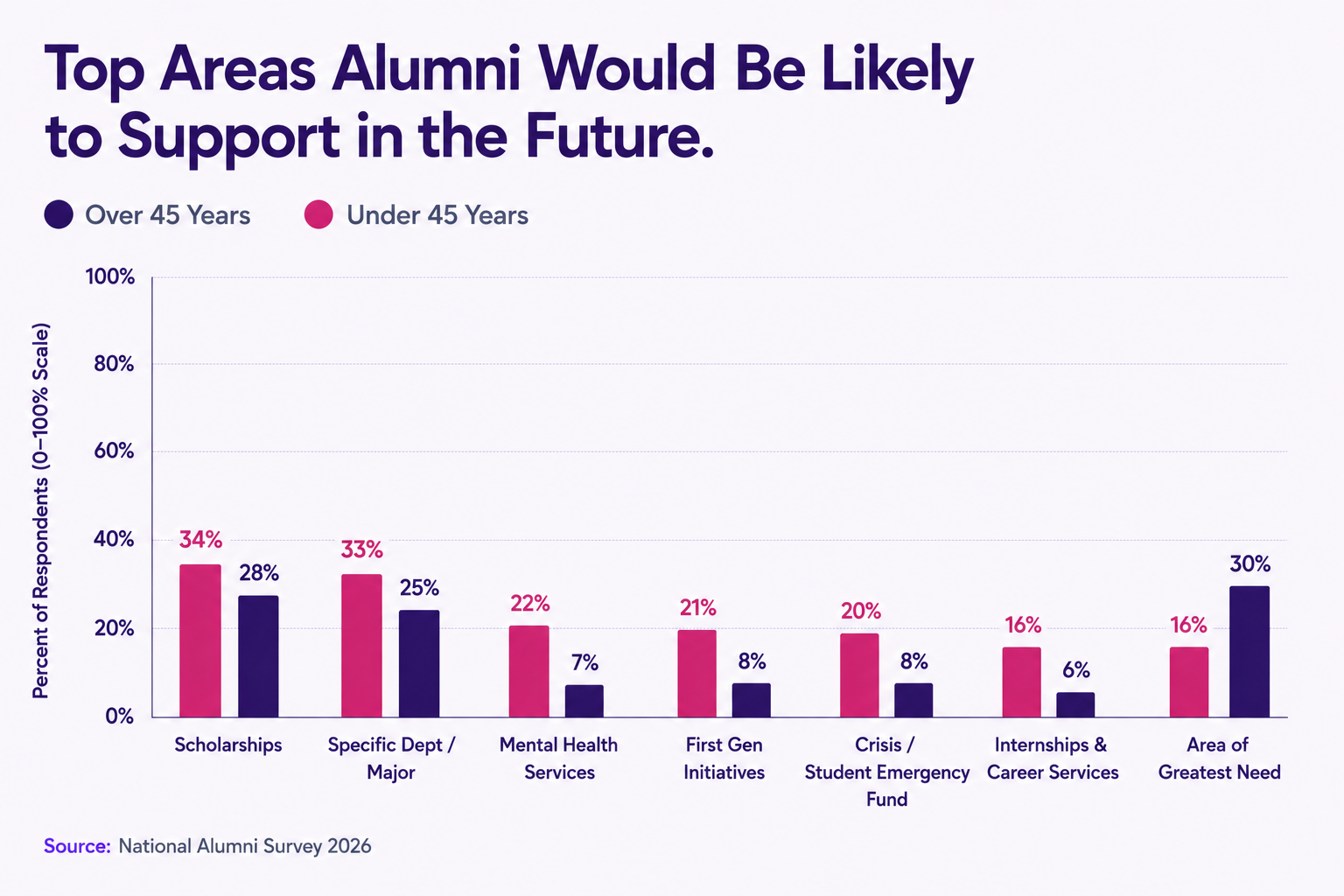
The gap on mental health services, first-gen initiatives, and emergency funds is especially telling. These are causes younger alumni care about deeply, often from personal experience, and they are chronically underpromoted in most alumni giving campaigns.
2. Tell real stories about real people.
The shift toward GoFundMe-style giving is a signal, not a trend to dismiss. Younger alumni want to know who they are helping. Put a name, a face, and a specific situation at the center of your ask. The institution is the vehicle. The person is the story.
💡Alumni Association of the School of Medicine of Loma Linda University saw success by tying campaigns to real outcomes and beneficiaries, helping donors understand not just what they’re giving to, but who they’re helping. [Learn more]
3. Make online giving frictionless.
Offer digital wallet options and mobile-first experiences that simplify online giving. Create time-bound, shareable campaigns like Giving Days that feel communal and immediate. Younger alumni are more likely to give in the moment than on a schedule, so meet them where they are.
4. Acknowledge debt without making it awkward.
Student loan debt is a real factor for younger alumni, particularly alumni of color and women. But here's what the survey found: 77% of those burdened by debt still give to other organizations. The barrier isn't financial capacity. It's relevance and trust. Acknowledge competing financial pressures in your messaging without pressure or apology, and focus the ask on collective impact rather than individual sacrifice.
💡Is Your Higher Ed Website Meeting Gen Z’s Expectations? Audit your higher ed website with this self-assessment.
The 2026 National Alumni Survey puts it plainly: younger alumni haven't disengaged from generosity. They're selective about where it goes, and they're directing it toward causes and organizations that earn their trust, show their impact, and respect their agency.
Higher education hasn't lost their goodwill. It just hasn't earned their giving yet.
The gap is closeable. But it closes through relevance, transparency, and real human connection.
👉 Curious about what motivates alumni giving across institutions? Explore the full 2026 National Alumni Survey findings to see how your institution compares.
Table of Contents
Subscribe
See how modern advancement teams bring alumni engagement and fundraising together.
Young alumni engagement has long been one of advancement’s most persistent challenges. Low event attendance. Limited giving. Minimal volunteer participation.
But what if the problem isn’t that young alumni don’t care?
In a recent webinar, Shweta Mathew sat down with Dr Amanda Shoemaker, Director of Advancement Operations at the University of Illinois’ College of ACES, to unpack exactly that. Drawing from Amanda’s doctoral research, the session moved beyond assumptions and into something more useful: real insights from young alumni themselves.
.png)
Across institutions, one pattern holds true:
Young alumni (graduates from the last decade) consistently engage less in events, volunteering, and giving, despite a wide range of opportunities available.
But this isn’t a story of complete disengagement. They’re still opening emails, following on social media, and staying loosely connected.
Which leads to the real question: Why does engagement drop off when it comes to deeper involvement?

Through in-depth interviews with recent graduates, Amanda identified three recurring themes that explain this gap.
Young alumni, along with attending something, want to see themselves involved in it. They’re asking questions that matter to them, such as, “Will I feel comfortable?” “Will I connect with someone?" etc.
In fact, one alum shared she avoided events where she’d be “the youngest person in the room by 20 years". That says it all.
Takeaway:
Engagement starts with peer connection.
Many young alumni want to get involved but don’t know how to. They aren’t aware of the opportunities that exist, or how to participate, or even what they will get out of it.
And when it comes to giving, misconceptions run deep:
At the core is one simple question:
“What’s in it for me?”
Takeaway:
Clarity and value communication matter more than volume of outreach.
Early adulthood is chaotic, where everyone gets busy paying off loans, building careers or saving up for big life milestones.
Even when intent exists, engagement often depends on whether it’s convenient, timely or easy to act on.
As Amanda put it, engagement needs to “fall into place".
Takeaway:
It’s less about willingness and more about whether opportunities “fit” into already busy lives.

One of the most surprising findings?
Many young alumni are open to giving. Even small amounts.
What stops them is perception because they end up assuming that small gifts don’t matter, or their impact won’t be visible, or they postpone their giving for “later in life”.
But consistent, small contributions are exactly what build long-term philanthropic habits.
A $5 gift today is more powerful than a $500 gift ten years later if it builds consistency.
The good news: solving this doesn’t require massive overhauls.
Small, intentional shifts can make a big difference.
The most engaged alumni?
Those who were engaged as students.
Build habits early around student-alumni programs mentorship opportunities, and exposure to advancement work.
Reframing the narrative around small, consistent contributions can help young alumni see that participation matters more than the amount.
Ultimately, the biggest shift is in perspective. Instead of asking why young alumni aren’t showing up, institutions might need to ask whether they are making engagement clear, relevant, and worthwhile. Because the reality is, young alumni aren’t disengaged; they’re just waiting for experiences that truly fit their lives.
If you’re interested in exploring Amanda’s research in detail, check out her full dissertation.
We also host Lunch & Learn sessions, smaller, personalized conversations where we dive into your institution’s specific challenges and opportunities around alumni engagement.
And if you’d like to see these insights come to life, watch the full webinar recording here.
Why Young Alumni Engagement Feels Difficult and What We Can Do About It
Why engaging young alumni often feels like an uphill task—and, in this webinar recap with Amanda Shoemaker, we unpack the small, strategic shifts institutions can make to turn it around.
Lorem ipsum dolor sit amet, consectetur adipiscing elit. Suspendisse varius enim in eros elementum tristique. Duis cursus, mi quis viverra ornare, eros dolor interdum nulla, ut commodo diam libero vitae erat. Aenean faucibus nibh et justo cursus id rutrum lorem imperdiet. Nunc ut sem vitae risus tristique posuere.

April 23, 2026
12 minutes
Gen Z is the generation born between 1997 and 2012. As current high school students, college students, and young alumni, Gen Z is the prime audience for your university’s digital content. But is your higher education website meeting their needs effectively?
The top college websites are user-friendly, accessible, mobile-compatible, and unique. They offer the authenticity that students and young alumni need to feel strongly connected to their alma mater. If your website isn’t clearing that bar, it could be time for a Gen Z-focused reset.
A Gen Z-friendly website is especially important as more Gen Z members become young alumni. Gen Z's philanthropic engagement has increased by 22% since 2021, making your young alumni a key audience for your university's fundraising efforts.
Below, we’ve created a self-assessment tool with questions to help you determine whether your website is meeting the needs of your Gen Z audience, organized by key website features. Use these guiding questions and tips to help you determine your website’s current state and growth path.
Morning Consult’s Most Trusted Universities report found that, among the four generations surveyed (including Millennials, Gen Z, and Baby Boomers), Gen Z is the least likely to trust higher education institutions. As your digital home, your higher education website is among your strongest tools for building trust with Gen Z students and alumni.
Gen Z craves social proof in the form of unfiltered reality rather than curated experiences. Your website should appeal to that preference by:
These content strategies ensure your digital presence reflects and prioritizes student voices.
Young alumni donors want to see the immediate, tangible impact their contributions will have before deciding to give or engage with your alumni giving program. To meet Gen Z's demand for authenticity, impact stories should focus on individual stories rather than general institutional updates.
For example, avoid generic, nebulous fundraising requests like “Please give to our annual fund.” Instead, send an email asking young alumni to “Help first-generation student Sarah fund essential cancer research to complete her senior thesis.” The second option pulls potential Gen Z donors directly into the story of a real student on your campus who needs help.
Your higher education website must be fully mobile-optimized, as a Harmony Healthcare IT survey found that Gen Z spends an average of 6 hours and 27 minutes on their phones every day.
A seamless, mobile-optimized giving experience is an essential step toward making alumni giving more convenient and less intimidating for Gen Z.
Your website should look good on any device, whether visitors are using a laptop, an Android device, or an iPhone. Keep these elements in mind when optimizing your website for mobile devices:
Your institution can further enhance engagement by creating mobile-friendly online forums or Facebook groups to foster a sense of community among young alumni.
Digital wallets such as Apple Pay, Google Pay, and PayPal are now the third most popular way donors give to nonprofits, surpassing traditional methods like checks.
If your donation checkout process requires entering a 16-digit credit card number and a billing address, Gen Z members won’t take the time to complete their transactions. Integrate one-touch payment options via digital wallets to reduce friction and increase young alumni giving.
An EAB survey found that nearly half of high school students now use AI tools such as ChatGPT and Gemini during their college search, a sharp increase from 26 percent in spring 2025. If your website is invisible to AI search tools, it’s invisible to potential applicants.
GEO is the term for optimizing a website to appear in generative AI search engines for specific queries. Users tend to interact with AI-powered search tools much more conversationally than with traditional search platforms, because they can ask multi-part questions and receive personalized answers.
To ensure your website appears for highly-targeted searches, Kanopi Studios’ guide to AI for higher education recommends providing “specific information on your website that highlights your unique credentials and offerings.”
For example, if your coastal university wants to increase traffic from potential applicants looking for schools by the beach, you could include keywords such as “universities with the best ocean views” and “colleges 30 minutes from the beach” on your student life page.
The National Alumni Survey discovered that only 14% of alumni believe their institution has a good understanding of their current career or life stage. Increase alumni engagement and retention by creating secure portals where they can log in and see personalized gated content, such as a custom alumni or student dashboard that displays relevant information, deadlines, and upcoming events.
Potential and current students, as well as young alumni, want to feel included in your university’s community. They want real-time, transparent information to help them navigate your application process, student life, or the post-grad experience.
Higher education website design and development isn’t just about how your website looks. Gen Z wants to find answers and information about the questions and causes they care most about, such as:
Don’t make website visitors hunt for this information. Use your main navigation menu to share links to essential resources, including your campus security details, environmental sustainability reports, and DEI policies.
The National Alumni Survey found that the vast majority of alumni (86 percent) are very satisfied or satisfied with their student experience, but just 50 percent feel very satisfied or satisfied with their alumni experience. This stark contrast highlights a critical gap that higher education websites can easily address by improving event discoverability.
Though considered a digital-native generation, Gen Z alumni actually crave community. They rank networking opportunities, career support, and sporting events as the three most valuable services offered by their alma mater, demonstrating a clear desire for engagement. By spotlighting relevant event opportunities, your website can help them find their alumni niche.
Make it easy for Gen Z website visitors to find opportunities to connect, such as fundraising events, sporting events, networking meetups, and giving days, on your online calendar. Ensure your calendar offers all the need-to-know information for each event, including how to register, date, time, location, and any associated costs. Additionally, to fully support their desire for community and career development, offer clear information about local alumni groups to join, virtual career prep panels and webinars, and mentorship opportunities with current students.
So, how did you do? If you answered yes most of the time, congratulations; your website is probably in pretty good shape for engaging Gen Z. If you had a few more nos than you’d like, don’t panic. Start by addressing your site’s infrastructure, ensuring it's mobile-friendly and optimized for AI search. Then, build on your approach by layering in the personalization, community-building, and authenticity that Gen Z is looking for. As a result, you’ll be able to build a website that engages your core audience and helps them feel at home with your university.

Is Your Higher Ed Website Meeting Gen Z’s Expectations?
Audit your higher ed website with this self-assessment. Get tips for digital fundraising, mobile UX, and AI discoverability to engage Gen Z students and alumni.
Lorem ipsum dolor sit amet, consectetur adipiscing elit. Suspendisse varius enim in eros elementum tristique. Duis cursus, mi quis viverra ornare, eros dolor interdum nulla, ut commodo diam libero vitae erat. Aenean faucibus nibh et justo cursus id rutrum lorem imperdiet. Nunc ut sem vitae risus tristique posuere.

April 23, 2026
12 minutes
Engaging alumni has been a critical part of your alumni programming but, the bigger question here is - how many of these initiatives are truly accessible to every single one of your alums?
Traditional alumni engagement initiatives include organizing local mixers, career networking events, and workshops on campus but 2020 has put an end to all of these in-person activities. While these initiatives will continue to be an integral part of your alumni program in the longer run, the one downside that has become evident in these past few months is that they’re not accessible to everyone.
If your programming involves quarterly class reunions on campus or Friday night happy hours at a nearby club, alumni who live far away are most likely to miss out. Also, some of your busier alumni might not have enough time to come to your in-person event and some may not see enough value in providing their services as a mentor. Various factors such as location, time, and the right value are crucial in defining how accessible your alumni programming is.
As advancement teams increasingly need to think out of the box in order to penetrate wider segments of alumni, institutions have found the perfect way to make their alumni programming more accessible to everyone - On-Demand Alumni Programs. On-demand alumni programs are services that any alum can access from anywhere, ideally anytime they want.

As 2020 throws one curveball after another, here’s a closer look at how your peers are fighting these challenges by implementing on-demand alumni programs.
Events have and will always be at the forefront of your alumni programming. However, the pandemic has completely transformed the way alumni events are now being hosted. An increasing number of institutions are choosing to include virtual events in their alumni programming owing to strict social distancing measures in place.
Virtual events allow more flexibility and that’s also a major reason behind this format seeing a huge traction over the last few months. As your alumni mostly stay confined to their homes, time and location are no longer a constraint when it comes to participation. Moreover, events like social mixers and happy hours hosted virtually are also helping institutions provide their alumni with some much-needed respite in the face of rising anxiety and stress due to isolation.
Career support networks offer incredible opportunities for alumni and students to interact with one another, increasing the chances of students landing job offers, internships, and finding the right mentors. For your alumni community, a career support network acts as a great source for professional networking opportunities and helps alumni make valuable connections to further accelerate their careers.
With unemployment an ever-looming problem on the horizon for students and alumni alike, career support networks have become even more relevant in 2020. As alumni and students count on their peers and alma mater respectively to navigate the tough job market, career support networks should be a mainstay feature to your alumni programming in 2020.
While traditional job fairs or in-person networking sessions are currently on hold due to the pandemic, institutions have switched to the virtual format to host these events.
Alumni business directories are a great way to empower businesses owned by your community members. These directories are perfect for showcasing your solidarity with budding entrepreneurs in your community and help uplift their efforts by leveraging the power of your alumni network. Not only do these networks help promote local alumni businesses, they’re also super helpful in building avenues for collaboration between alumni business owners.
According to data from Yelp, a platform used widely by local businesses to advertise their services in the US, nearly 66,000 businesses have folded since March 1. Researchers at Harvard believe that the rates of business closures across various markets are likely to be even higher. (Information source: The New York Times)
If the above data is to be believed, investing in an online alumni business directory for your alumni may no longer be an option but a necessity in 2020.
If your institution believes in providing value to alumni and foster lasting relationships, you have to find ways beyond the traditional. Continued learning programs are a great way to ensure that your alumni stay actively engaged with you long after they’ve left campus.
While you may already have monthly guest lecture programs or seminars where your notable alumni come to campus and share their experiences with invited community members, just imagine the impact of doing all of this virtually. If you share the same resources in an educational webinar, podcast, or video format and live-stream it, or just publish it on your alumni website, your alumni community will be able to access all this information anytime they want, at their own convenience. More importantly, they can always come back to these resources and even re-share them with their own networks, helping you tap into a wider network of alumni.
The best way to identify what learning resources your alumni find valuable is by asking them. You could start by conducting a short survey to gauge their interest in different topics ranging from professional to personal development.
Take inspiration from Fielding Graduate University’s Alumni Association that did a phenomenal job of providing on-demand learning resources to their alumni community in the form of webinars, virtual workshops, and learning guides amidst COVID-19. Head over to Fielding Graduate University’s alumni website to learn more.
From increasing meaningful engagement to facilitating professional development for your alumni and students, a mentoring program is a great addition to your alumni programming. While some of you might already have this in place, how much of this is truly accessible for every single one of your constituents?
Do you have a mentoring program where your alumni have to visit your campus to talk to students or answer their questions, even if it is for a couple of days in a year? What if this process could be completely moved online adding more flexibility? Digitizing your mentoring program means increased flexibility for both alumni and students as they get to avail the benefits of this program right from their homes at their own convenience.
Now that your alumni program is accessible and easy to engage for all your alumni, let’s look at some of the things you can do with it.
Alumni programs readily lend themselves to alumni engagement strategies. Your emails, newsletters, social media posts, and online communities all combine to keep your alumni engaged while providing a sense of community. What sets an accessible alumni program apart is its ability to provide personalized, two-way communication channels that make alumni feel valued and, therefore, willing to support.
💡Check out how Almabase empowers your alumni relations efforts
Alumni who are actively part of your program are more likely to have a personal connection and sense of loyalty. Nurturing these sentiments is a huge part of any institution’s fundraising strategy. An accessible alumni program should also help you nurture first-time donors and turn them into loyal supporters.
💡 Check out how we helped Boyd-Buchanan School turn alumni engagement into fundraising success.
Alumni programs provide a pool of well-nurtured contacts and probable volunteers for upcoming events such as your homecoming and reunions, among others. These programs become increasingly important for hosting affinity reunions or special events meant for a specific segment of alumni.
Your alumni should be able to easily see opportunities to help your next wave of graduates, either by providing mentorships or sharing career opportunities. A well-functioning and accessible alumni program reinforces a sense of lifetime partnership between your institution and your alumni to motivate both alumni and current students to get involved.
Alumni are not only stakeholders and supporters but can also be organic partners in shaping your educational programs. Your alumni program could either invite feedback or have a formal structure through, say, an **alumni advisory board** for specific departments or courses. Thesis assistance, curriculum enrichment, and extracurricular assistance are some other avenues through which your alumni program can become a valuable pool of educational partners.
An accessible and well-run alumni program naturally develops into a long-term partnership with a body of loyal supporters and advisors who share a common educational and philanthropic goal with you.
Today, there are a lot of tools and platforms out there that will help you build that partnership and nurture it. If you’re looking for a platform that integrates with your CRM, springboards your engagement, and streamlines your fundraising goals, why not give Almabase a try? 👇

5 ways to make your alumni program more accessible to all your alumni
Looking to make your alumni programming more accessible? Here are 5 ways to make alumni programs accessible in schools, colleges, and universities in the US
Lorem ipsum dolor sit amet, consectetur adipiscing elit. Suspendisse varius enim in eros elementum tristique. Duis cursus, mi quis viverra ornare, eros dolor interdum nulla, ut commodo diam libero vitae erat. Aenean faucibus nibh et justo cursus id rutrum lorem imperdiet. Nunc ut sem vitae risus tristique posuere.

.svg)

.avif)
.webp)