Whether it is to attract admissions, donations, or simply to raise your institution's brand, university marketing plays a big role in your institution's engagement strategy.
Prajnya Yelamali
Updated:
July 8, 2026

Your university’s marketing strategies shape whether donors feel connected to you. They also determine whether a prospective student finds your institution when they start searching, or finds a competitor instead. Done well, they benefit both enrollment numbers and campaign totals. Because guess what? Advancement and admissions teams now compete for the same audience's attention, trust, and money, whether they've coordinated around that fact or not.
In this blog, we’ll go over the best marketing strategies for your university whether you're trying to improve brand awareness, grow donor participation, or get more out of your digital marketing efforts.
University marketing is the set of strategies used to attract new students, retain and engage alumni, and build relationships with donors and community stakeholders. It spans paid advertising, content, events, email, social media, and direct outreach.
Several forces are shaping how universities approach marketing right now. One of the main factors is in how students and donors find and evaluate universities is changing. A school's digital presence, its website, search ranking, social media, and reputation on review platforms all influence decisions and are questions frequently asked on AI tools.
Over 80% of students now use AI tools to research programs. They ask questions about costs, outcomes, and campus life. A university website that doesn't answer those questions effectively to help AI-assisted searches or feed Answer Engine Optimization gets skipped.
Generation Alpha in particular, who entered high school in fall 2024, grew up watching short-form videos and expect two-way conversations. They want to know what a degree leads to in more specific terms. In this case, personalized and outcome-focused communication works well with them.
For advancement teams, the same principle applies. Alumni and donors expect to feel like the institution knows who they are. When communications feel mass-produced, engagement drops, and donor participation follows.
Advancement raised money. Marketing recruited students. For a long time, those were separate jobs with separate teams. But that separation is not so clear cut in 2026.
American colleges and universities received $61.5 billion in voluntary contributions in FY24, according to the CASE VSE report. That number grows at institutions that stay visible and credible all year round, and not just between campaigns.
Here's where the connection between marketing and fundraising becomes inevitable:
Advancement, alumni relations, admissions, and communications share more goals than most universities acknowledge. When those teams coordinate around a shared consistent message, their work compounds. When they don't, they often compete for the same audience's attention with conflicting messages.
These strategies focus on how advancement and alumni relations teams can use marketing to drive donor participation and deeper engagement.
Sending the same appeal to a recent graduate, parents, and a major donor is a missed opportunity for all 3. Effective segmentation divides audiences by graduation year, geographic location, interest area, giving history, and engagement level. Start with what's already in your CRM, even basic segmentation will get you good results.
Personalization today goes far beyond using someone's first name. It means referencing their class year, their program, or the cause they previously supported. Personalized email campaigns consistently outperform generic ones on click-through rates and on conversion to gifts.
Short-form video on TikTok and Instagram Reels generates the highest engagement rates among prospective students, who will be your future donors. It’s also an effective way to invite current students to be influencers or advocates for your campaign. On the other hand, longer-form impact videos work well for alumni and donor audiences. For example, showing how a scholarship changed a student's trajectory or how funding to a particular department helped keep an important program alive. Both formats outperform text-only content for emotional response and sharing.
Alumni give more when asked by people they know. Peer-to-peer campaigns, where engaged alumni solicit gifts from classmates and community members, have consistently raised more per campaign than institution-led appeals. They also extend reach into networks the advancement office can't access.
The less scripted and more user-generated your content is (while keeping the core message intact), the better. All audience segments are starting to prefer more organic content over polished scripts. Alumni sharing their own stories reinforces the value of an institution's network for current donors and giving-day prospects.
A giving day is a marketing campaign with a deadline. The urgency mechanics that make it work are the countdown timers, matching gift challenges, leaderboards, and other gamification elements on the fundraising page. They are the same tools any timed marketing campaign uses to drive action.
Thomas Aquinas College used this approach to achieve a 45% alumni donor participation rate, raising $142K+ from more than 650 donors.
New donors and alumni nowadays often use ChatGPT, Claude, and Google's AI Overview to research institutions and causes before they give. They ask questions like "what has [university] done with donations?". Answer Engine Optimization for AI-powered search tools is now as important as traditional SEO. So, if your institution's impact content, donor stories, and program outcomes aren't structured to answer those questions clearly, you won't appear in AI-generated responses. This means writing content that leads with specific answers: how gifts were used, what changed, and what outcomes were achieved.
Mentorship platforms, alumni directories, job boards, and affinity group networks give alumni reasons to stay connected all year round and not just during fundraising campaigns. Engaged alumni are significantly more likely to donate than those with no ongoing relationship to the institution.
Illinois Tech generated 123,000+ engagement activities in a single month after rebuilding its digital engagement strategy with Almabase.
Blog posts, impact reports, case studies, and research-backed thought leadership serve multiple purposes: they improve SEO, build institutional credibility, and give advancement teams shareable material for donor outreach. Content that addresses what prospective new donors actually care about will work wonders over generic promotional material (for example: student outcomes, program impact, institutional stewardship content over generic giving day numbers)
Which email led to which gift? Which event attendance correlated with a subsequent donation? What content on which platform led to the most amount of engagement? Advancement teams that track attribution across touchpoints can plan and allocate marketing budgets toward what works, and stop spending on what doesn't.
Most alumni and prospective donors open emails, visit giving pages, and register for events on their phones. Giving pages and event registration forms that aren't mobile-optimized see higher abandonment rates. Test the entire donor journey on a phone before every campaign launch.
Digital-only or mail-only campaigns never consistently outperform integrated approaches. A direct mail followed by a personalized email, or a social ad retargeting someone who visited your giving page but didn't donate, will outperform either channel working on its own. The next section covers the data.
According to the M+R Benchmarks 2026 report, direct mail revenue grew 9%, online giving revenue grew 15%, and email revenue grew 16% in 2025. Digital is growing faster, but direct mail is holding its own.
According to the same report, the average direct mail gift was $120. For every dollar raised online, nonprofits in the study raised $0.66 through direct mail. That's a channel that still drives real money and not one in decline, especially with donors who already know your institution.
But digital channels do bring different strengths to the table: lower costs, wider and more accurate targeting, real-time data, and the ability to reach alumni whose mailing addresses have long since changed.
The truth is, the right mix depends on your audience, budget, and your data quality. Older alumni tend to respond better to direct mail. Younger alumni and recent graduates engage more through digital. That's not a reason to run two separate campaigns. You can let channel selection be driven by the audience segment rather than what’s been the norm.
Generic goals like "Increase alumni engagement" are too broad to act on. Create clear and practical goals such as "Increase donor participation rate among alumni who graduated between 2015 and 2022 by 10% before our March giving day" which is actionable.
Here are some common goals you can include:
Different audiences need different messages, channels, and timing. Know who you're talking to before you decide what to say or where to say it. Typical higher ed audiences usually include:
Most universities lead with what they're proud of. Rankings, facilities, research output. But for some that might already be common knowledge and in any case, that's not always what your audience is there for.
A prospective student is curious about the costs involved, the campus life, and whether the degree will open doors for them. A donor wants to know if their last gift made a difference and if this one will too.
Build the message around what your audience is asking, not based on internal priorities or what your institution wants to say.
Channel selection should always follow your audience and your goal, not over team familiarity. Ask yourself,
A giving day campaign has vastly different channel needs than a graduate program recruitment campaign, and marketing is heavily dependent on choosing and making the most out of the right channels for each objective.
Based on what we’ve already discussed above, you'll need a combination of:
A smart team builds a measurement before launch. Set up A/B tests where volume permits and track which channels, subject lines, and messages are actually driving the outcomes important to you, not just opens and clicks, but registrations, gifts, and engagement activities.
Use your analytics tools during and after each campaign to review and carry the findings forward.
Your marketing strategy will continue to improve through several iterations. For longer campaigns, a team that collects data and iterates on the go tends to see better results.
Here are some common pitfalls that you or your team may want to avoid while marketing your university.
A 23-year-old recent graduate and a 60-year-old major donor share almost nothing as an audience. Generic communications that try to speak to everyone end up reaching no one. Basic segmentation by graduation year and giving history alone will improve your campaign performance.
A lot of advancement teams pour everything into a giving day and then go quiet for months. Donors who give once and hear nothing back are less likely to give again. A newsletter, an alumni spotlight, an event invitation, or impact stories - low-pressure touchpoints between campaigns keep the relationship warm.
High follower counts and strong open rates feel good. But they don't always translate to gifts. Track what actually matters: donor participation rates, year-over-year retention, cost per gift, and lifetime donor value. Track the entire journey, from first impression, to gift, to retention.
Donors want to know their gift made an impact. Show them, specifically: "Our endowment grew by X%" tells a donor little to nothing. "Here's a student whose scholarship changed what was possible for her" tells donors their impact.
A slow-loading giving page, a confusing registration process, or a broken confirmation email does more damage than a weak campaign. Donors who hit friction don't often come back. Walk through your own giving journey multiple times and fix on the go.
Some teams default to direct mail because that's what they've always done. Others go fully digital because it's cheaper. Both channels work. The best results come from using them together and letting your audience segment guide you.
Give current students, recent alumni, and active donors moments and opportunities worth sharing, since organic awareness grows when people with a genuine connection to your institution talk about it publicly. Build on that momentum through consistent content marketing across every channel and paid social advertising in your target markets.
Neither of them win out categorically. Both channels work and the right balance changes from one institution to another. Most modern approaches use them together, as in a direct mail piece followed by a personalized email to the same person lets each touchpoint build on the last and reinforces your message.
For undergraduate programs, Instagram and TikTok see the highest engagement. RNL's 2025 research found that social media mattered most for 56% of students when they first started thinking about college, and students tend to follow college accounts for organic student life content, application information, and major-specific content. For graduate and professional programs, LinkedIn usually performs better. You’ll want to pick two or three that match your audience and invest in them.
Define what ROI means for each campaign first, because it changes with the goal. A giving day might be measured by total revenue raised, cost per gift, or donor participation rate, while admissions might look at applications per dollar spent or yield improvement. Track the full funnel rather than the single channel that drove traffic, asking which touchpoints in what sequence led to the outcome you wanted. UTM parameters reveal which email, ad, or post someone clicked, CRM attribution reporting shows which touchpoints led to a gift, and A/B testing tells you which subject lines, messages, and formats perform best.
Subscribe
See how modern advancement teams bring alumni engagement and fundraising together.
Plan faster. Execute better
Explore free templates designed for alumni and fundraising teams.
.png)

.avif)
Prajnya Yelamali
There’s something powerful about watching a community come together online- whether it’s to celebrate a milestone, support a cause, or share a moment that matters. These everyday digital interactions hold incredible potential when it comes to fundraising. Whether you're a K-12 school, a college alumni office, or a student club trying to hit your annual goals, social media fundraising can turn your campaign from "meh" to major. With the right mix of creativity, timing, and platform strategy, you can tap into your community, build buzz, and raise way more than you expected.
In this blog, we’ll unpack what social media fundraising is, why it matters, and how educational institutions can use it to boost engagement and giving. You’ll find helpful tips, creative social media fundraising ideas, real examples, and ways to promote a fundraiser on social media that truly connect with your audience.
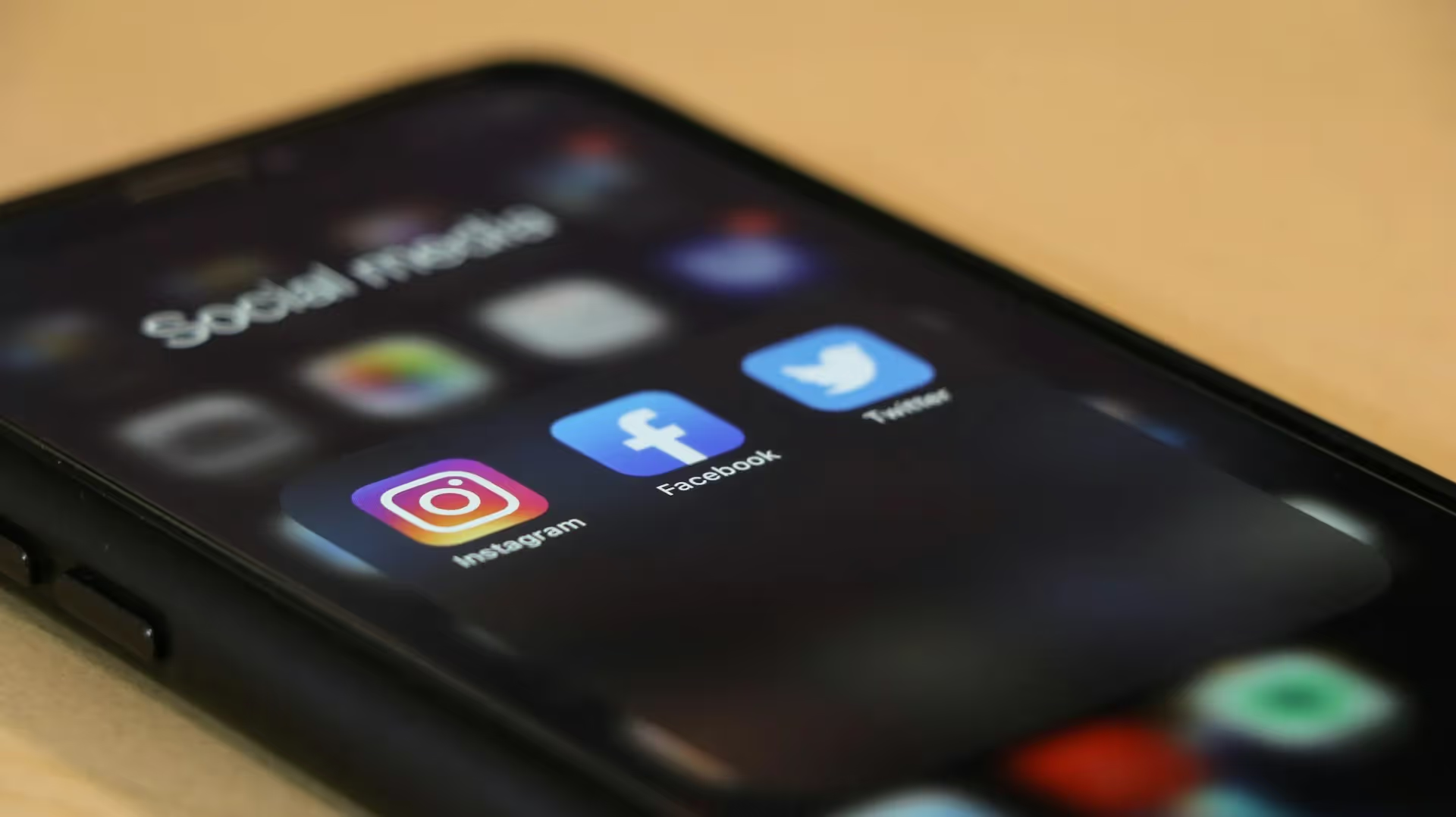
Social media fundraising is the practice of using social networking platforms like Facebook, Instagram, LinkedIn, and X to raise funds for a cause, campaign, or institution. But it’s not just about dropping a donation link and hoping for the best. It’s about building awareness, showing people why your cause matters, sharing real stories, giving your community simple ways to get involved and and encouraging them to take action, all in real-time.
Social media fundraising has been around for over a decade, slowly gaining traction as platforms like Facebook and Twitter introduced donation tools and nonprofits began experimenting with online giving. Back then, it was mostly big organizations leading the charge, with schools and colleges dipping their toes in the water, trying to see if social media fundraising was something they truly needed to make waves.
Then 2020 changed everything. With events canceled and face-to-face meetings off the table, and virtual gatherings taking the center stage, institutions had to get creative and fast. Social media became the easiest and most effective way to stay connected with their communities. Campaigns went digital, giving days went live, and suddenly, fundraising on social media wasn’t just an extra; it was essential.
For schools and colleges, this shift opened up new possibilities. Social media bridged the gap between past and present students, parents, faculty, and alumni. It made it easier to reach alumni, parents, and students where they already were, and in a way that felt more personal. It turned annual giving days into digital celebrations and everyday posts into opportunities for support. Ever since the pandemic, social media fundraising has been helping institutions to stay visible, relevant, and donor-ready—all at once.
Today, social media and fundraising go hand in hand, making it easier than ever to engage supporters where they already are. It has revolutionized how we approach fundraising, offering tools that amplify outreach, build connections, and tap into networks in ways that were once out of reach. Let’s dive into the key reasons why social media is a game-changer for fundraising and how you can make the most of it-
Social media allows you to instantly connect with a global audience, from alumni and current students to parents and beyond, breaking down geographical barriers and reaching more people than ever before.
When your community shares and promotes your campaign, it creates a ripple effect. Friends and family see it, trust it, and are more likely to donate, making your campaign stronger through organic, peer-driven support.
Unlike traditional fundraising methods that limit you to a small circle, social media opens the door to a global audience. Each platform brings its own vibe, strengths, and type of community—and that’s exactly what makes it exciting. The key is to use each platform to do what it does best.
Not sure how to promote a fundraiser on social media without being all over the place? Here's a simple breakdown to help you plan, post, and follow up like a pro, without burning out your team.
Now that we've unpacked what social media fundraising is and how to build the right framework around it, let's take a look at these 10 fresh and creative social media fundraising ideas that can be used by schools and universities-
Encourage alumni and supporters to participate in a challenge hosted by the school or university. It’s all about tapping into school spirit and encouraging participation through friendly competition and community pride. A great example? The University of New Hampshire’s annual "(603) Challenge." With over 11,800 donors in 2025, it raised more than $3.6 million. The campaign used strategic donor challenges, matching gifts, and a robust social media presence to energize alumni, students, and parents alike.

Yes, crowdfunding has been around for a while, but when paired with the right social media strategy, it can still pack a punch. Set up a sleek GoFundMe or GiveCampus page, and drive traffic through Instagram reels, student-led TikTok videos, and short alumni testimonial clips on LinkedIn. When donors see a live progress bar and real-time peer activity, it creates that perfect blend of FOMO and feel-good energy that leads to a successful campaign.
Turn your students and faculty into featured artists for a cause. Set up an online gallery where followers can preview and bid on artwork, all linked to your school’s social channels. Instagram carousels showcasing the artists, behind-the-scenes reels of their process, and countdown stories leading up to the final auction create a buzz that makes people want to tune in (and bid big).
Forget the auditorium—go global with a livestreamed talent show. Students, alumni, or even faculty submit audition clips, the community votes on who makes the final cut via polls on Instagram and Twitter, and the final event is hosted live on YouTube or Facebook. Viewers can donate while they watch, with real-time donation trackers and pop-ups thanking donors on screen. The more engaging the show, the more viral it gets—and the more funds you raise.
Launch a social-first storytelling campaign where individual students or groups are highlighted weekly on Instagram and LinkedIn. Show their projects, their journeys, their dreams—and how donor support fuels them. Purdue University mastered this with its "Purdue Day of Giving," allowing donors to choose exactly where their gift goes, connecting names to impact in a deeply personal way.

Bring the black-tie magic to people’s living rooms. Host a virtual gala on Zoom or YouTube Live with emcees, entertainment, student performances, and live auction items. But don’t stop there—build excitement on social media for weeks leading up: teaser videos, theme reveals, Instagram stories with polls to choose menu or music, and LinkedIn shoutouts to donors or sponsors. On event day, make your hashtags trend and watch donations roll in with every applause emoji.
The bake sale gets a digital glow-up. Students, parents, and alumni bake from home and post mouthwatering pics using a unique hashtag like #BakesForBooks or #SweetSupport. Orders and payments are managed online, and limited-edition treats or campus-themed goodies create urgency. Use Instagram and Facebook to drive this one: Reels of the baking process, Stories showing “behind the oven” moments, and shoutouts for every donor. It's cozy, shareable, and community-driven.
Let a student, alum, or a club take the reins of your official social channels for a day. They share their behind-the-scenes, their memories, and what makes your institution special. Not only is it authentic, but it also breaks the algorithmic monotony with fresh voices. NEHS uses this method beautifully with its chapters, and it sparks serious engagement. Pair this with donation swipe-up links, countdown stickers, and pinned stories that stay long after the day ends.

This one’s got legacy written all over it. Donors get to submit selfies, memes, letters, or inside jokes into a digital time capsule that’ll be opened 5 or 10 years down the road. Access is donor-exclusive, and the buildup is part of the charm. Use nostalgic music reels, design retro digital postcards, and let student ambassadors post teaser entries.
Take a cue from the stock market, but make it campus-coded. Create a mock "Meme Market" featuring inside-joke tokens like “Coffee Line Coin” or “Finals Panic Token.” Donors pick which memes to back with their money. The more a meme gets shared or voted up, the higher its "value." Sponsors match donations to top-performing memes. Track it all in Instagram Stories with stock-style charts, Friday recaps, and student commentary.
Now that you’ve had some ideas to spark your next social media fundraising campaign, here are a few best practices to help you fine-tune your approach and boost your results. These tips are all about working smarter with content, platforms, and outreach—because even great ideas need the right delivery.
Every platform has its own vibe, and what clicks on one might fall flat on another. To get the most out of your outreach, think about where your audience hangs out and what kind of content feels native to that space.
It’s all about aesthetics and energy. Use high-quality visuals, Reels, and Stories to share short, engaging content. Countdown stickers and donation link buttons can drive urgency and action. Showcase student life, behind-the-scenes moments, and quick thank-you shoutouts.
Perfect for alumni and parents who love staying connected with their alma mater. Host Facebook Live events with faculty or student panels, launch Facebook Fundraisers tied to specific campaigns, and share nostalgic throwbacks or impact updates.
This one’s best for tapping into the professional pride of your graduates. Share stories of scholarship recipients, research breakthroughs, and student and alumni success stories that show the long-term impact of giving. Keep it polished, purpose-driven, and authentic.
You need more than pretty pictures; you need content that makes people feel something, then do something. Mixing it up keeps your audience curious and engaged.
Data doesn’t lie. Even small tweaks to your posts can make a measurable difference, especially if you're experimenting with how you present the same message.
Reviving the spirit of the Ice Bucket Challenge, the University of South Carolina’s MIND Club launched the #SpeakYourMIND campaign in 2025 to support mental health awareness with a goal of $500. Through short-form videos on TikTok and Instagram, students and supporters amplified the cause, driving both visibility and donations. The campaign went viral, drawing celebrity endorsements and far exceeding expectations by raising $250,000+ until now.
In 2023, the University of the Pacific's "Pacific Gives" campaign brought together alumni, staff, faculty, parents, and friends in a 24-hour online fundraising effort. The campaign successfully raised over $1.7 million, with 75% of the gifts being $100 or less, highlighting the power of collective small donations.
During Giving Tuesday 2024, Penn State University leveraged social media platforms to share real-time updates, success stories, and donor acknowledgments. This strategy enhanced community engagement and encouraged widespread participation in the fundraising efforts. It achieved a record-breaking fundraising milestone of more than 9,700 donors contributing 11,986 gifts and collectively raising over $1.7 million for various university programs and initiatives.
It’s important to have an engagement tool that integrates smoothly with social media platforms and your CRM—so all your donor data stays organized and actionable. The right digital tools help you streamline operations, personalize experiences, and drive results regardless of which platform you use. Having integrations with industry experts like Almabase+ RE NXT can be powerful. They allow campaign tracking, smart donor segmentation, and the creation of personalized giving links, enabling advancement teams to monitor performance, adapt in real-time, and make each interaction more meaningful.
Take Boyd-Buchanan School for example; they saw a remarkable turnaround after adopting such a setup. Before using Almabase, their team had to manually log every donation into Raiser's Edge NXT. With Almabase’s tailored sync rules for RE NXT, their gift data now flows directly and accurately into the CRM, allowing them to focus more on strategy and engagement. Within just five months, they surpassed 200% of their Giving Day goal and reconnected meaningfully with their alumni.
With a plethora of specialized tools and proven strategies available today, advancement teams have the opportunity to take their social media fundraising to the next level. If you’re looking for a partner to help your digital engagement and fundraising efforts, do give us at Almabase a shout and we’d love to chat!
Social Media Fundraising: Ideas, Examples, and Tips to Promote Your Next Campaign
Lorem ipsum dolor sit amet, consectetur adipiscing elit. Suspendisse varius enim in eros elementum tristique. Duis cursus, mi quis viverra ornare, eros dolor interdum nulla, ut commodo diam libero vitae erat. Aenean faucibus nibh et justo cursus id rutrum lorem imperdiet. Nunc ut sem vitae risus tristique posuere.

Sharada Koti
May 22, 2025
12 minutes
If you’re involved in fundraising efforts for your school, chances are you’ve already been hearing a lot about Giving Days. With this year’s #GivingTuesday i.e. December 3rd fast approaching, it’s likely you won’t stop hearing about it any time soon.
.avif)
Giving Day was first introduced in 2012 and has since helped institutions around the world boost their fundraising efforts tremendously. A well-planned Giving Day can entirely transform your fundraising approach by helping you acquire new donors, enrich the giving experience, and instill a culture of giving in your constituents.
However, the success of a Giving Day depends not only on planning but equally on its promotion. While there are many ways to promote Giving Days, in this blog post, we’re looking at the 8 most effective ones that have helped our customers achieve Giving Day success.

One of the best means for influencing donors is by carefully selecting a cause that they relate to and would most likely contribute towards. Making donors believe in your cause is pivotal to your fundraising efforts. Here’s how Archbishop Riordan High School targeted its alumni by asking them to contribute towards campus improvements.
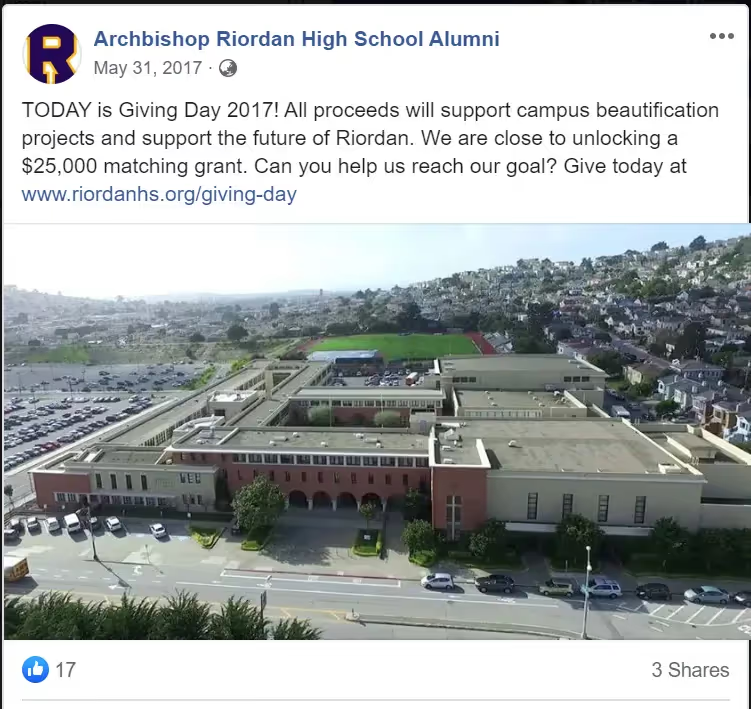
If you’re on social media, you obviously know how hashtags can boost your marketing efforts. While #GivingTuesday is a generic hashtag that almost everyone follows during the Giving season, creating a unique hashtag, relevant to your cause is highly recommended. Using your own unique hashtag makes it easier for your community to share your posts on their network, and for you to effectively monitor and further promote your social message. Calvert Hall College High School made great use of a unique hashtag. Check the full post here.
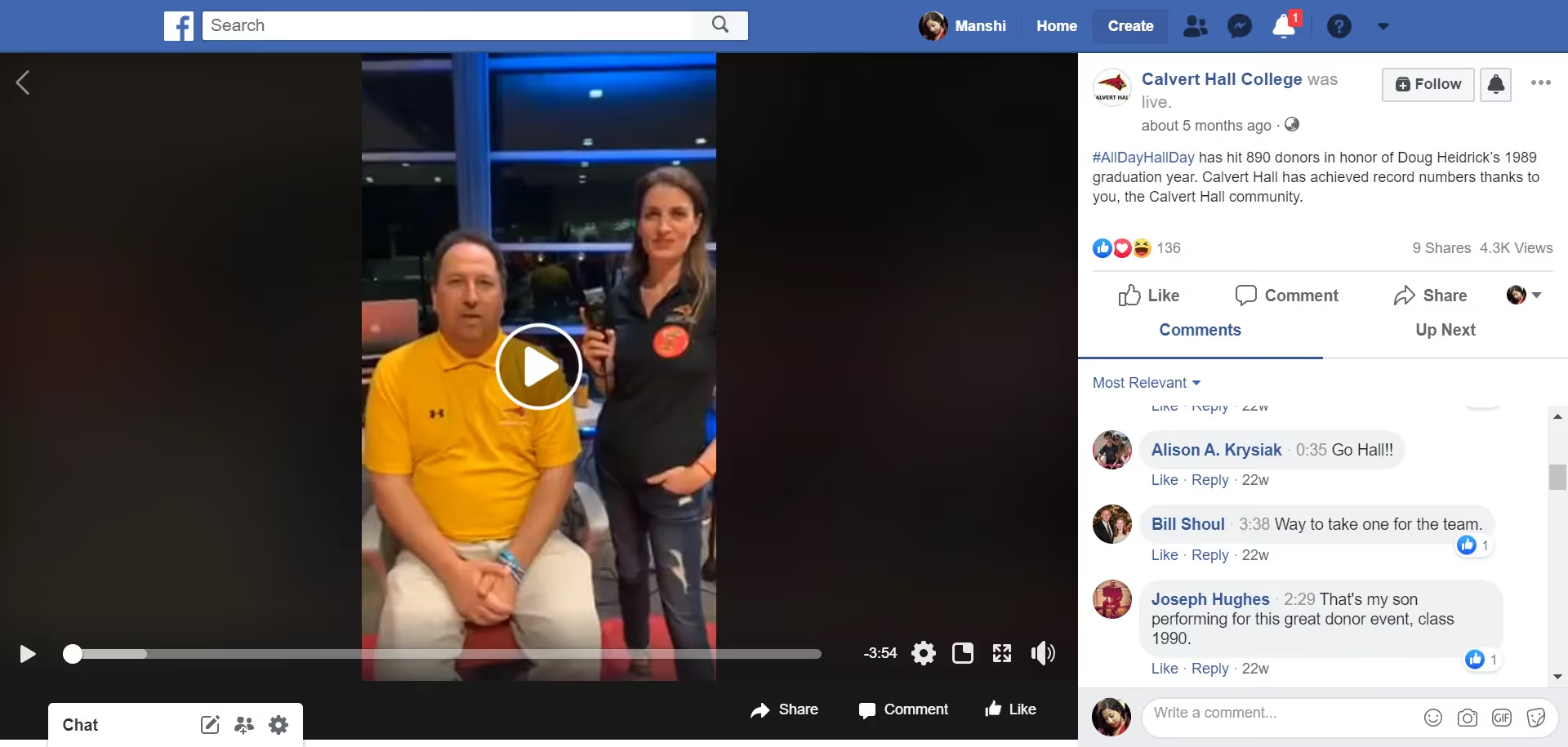
You might have seen a lot of people use countdown posts as a part of their social media marketing plan. They have proven to be highly effective as they help serve as constant reminders for the upcoming event and also arouse curiosity.
Here’s how Scranton Preparatory School got this right.
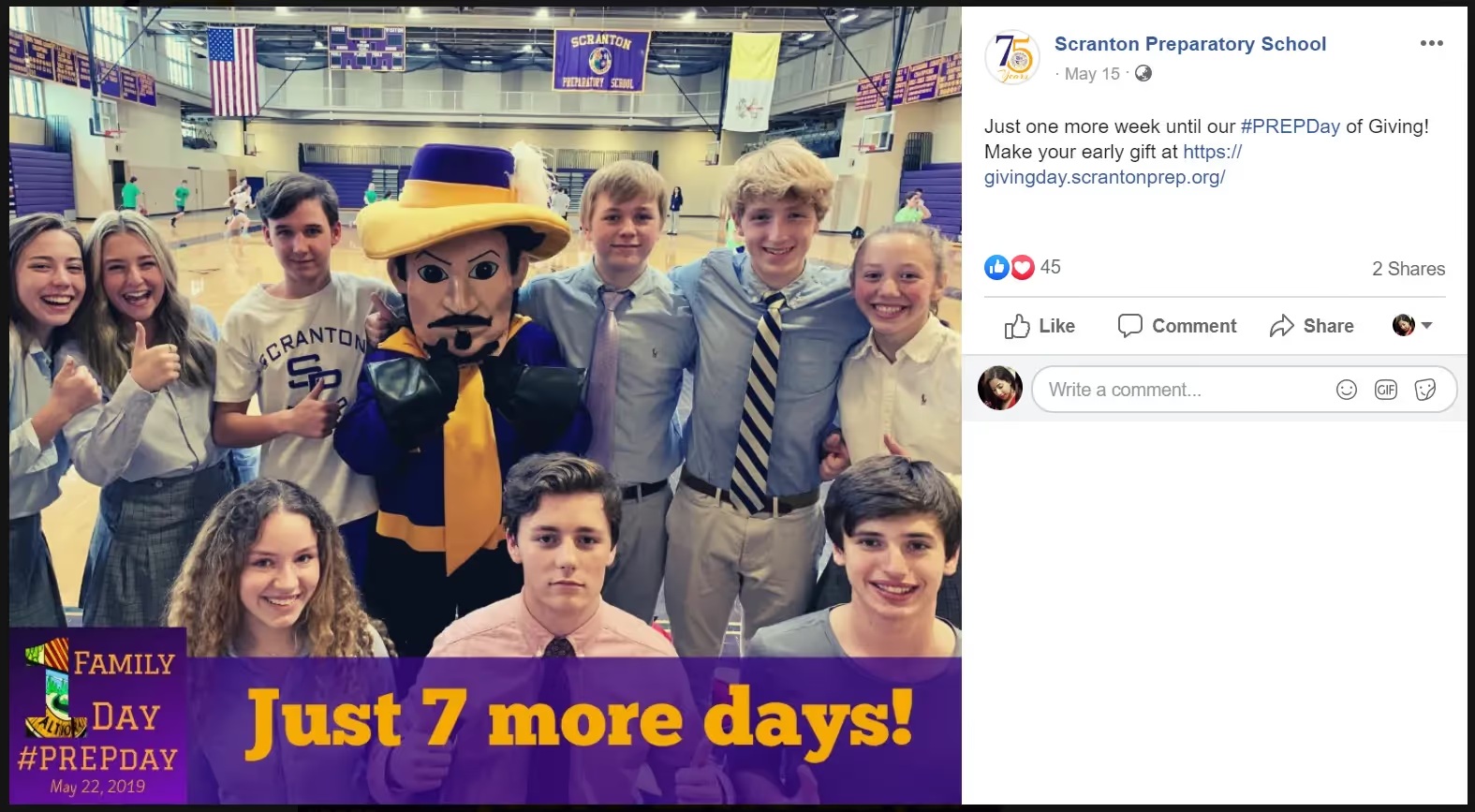
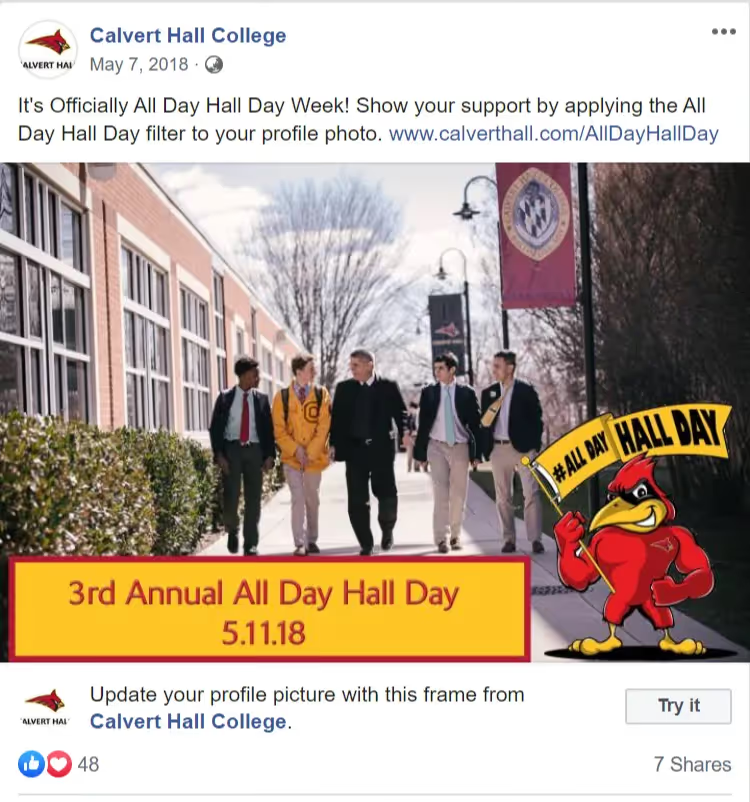
A great way to capture the attention of donors is to create opportunities that influence them to actively engage. Unlike fundraising campaigns that are run over a period of time, Giving Days provide an opportunity for your constituents to donate to your cause within a 24-hour time frame. Other than the sense of urgency already being created, any low-effort activities on your part can help channel your donors toward making a contribution.
For the college’s 3rd Annual All Day Hall Day campaign, Calvert Hall College High School asked its followers on Facebook to show support by applying the All Day Hall Day filter to their profile pictures. Calvert Hall’s followers loved this approach and many took to applying the filter to their profile picture and pledging support to the Giving Day campaign. Here’s how Calvert Hall creatively provided an opportunity for its Facebook followers to actively engage & support the upcoming Giving campaign.
As of 2022, videos are undoubtedly the most powerful marketing tool.
People gaze five times longer at video than at static posts on Facebook & 71% of people have increased their online video viewing in 2018 alone.
As users on social media increasingly prefer the video format, it is a good practice to incorporate more videos in your Giving Day marketing strategy. Here are some ways in which schools have leveraged videos on their social media:
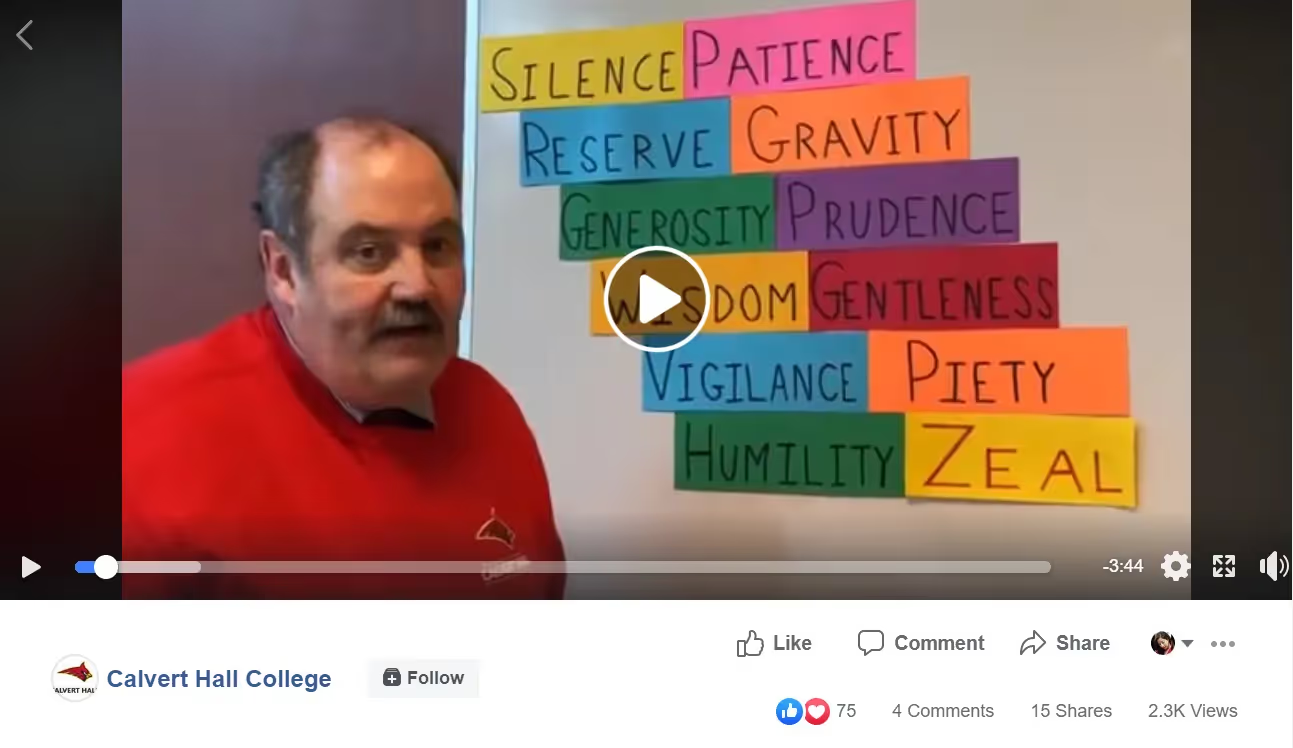
Creating a video that boasts of your school’s legacy is a great way of showing donors why their contributions matter. In this video, Calvert Hall College High School’s CAO/Director of Advancement, Joe Baker talks about all that Calvert Hall stands for and passionately urges donors to contribute to keep the tradition of the school intact. View the post here.
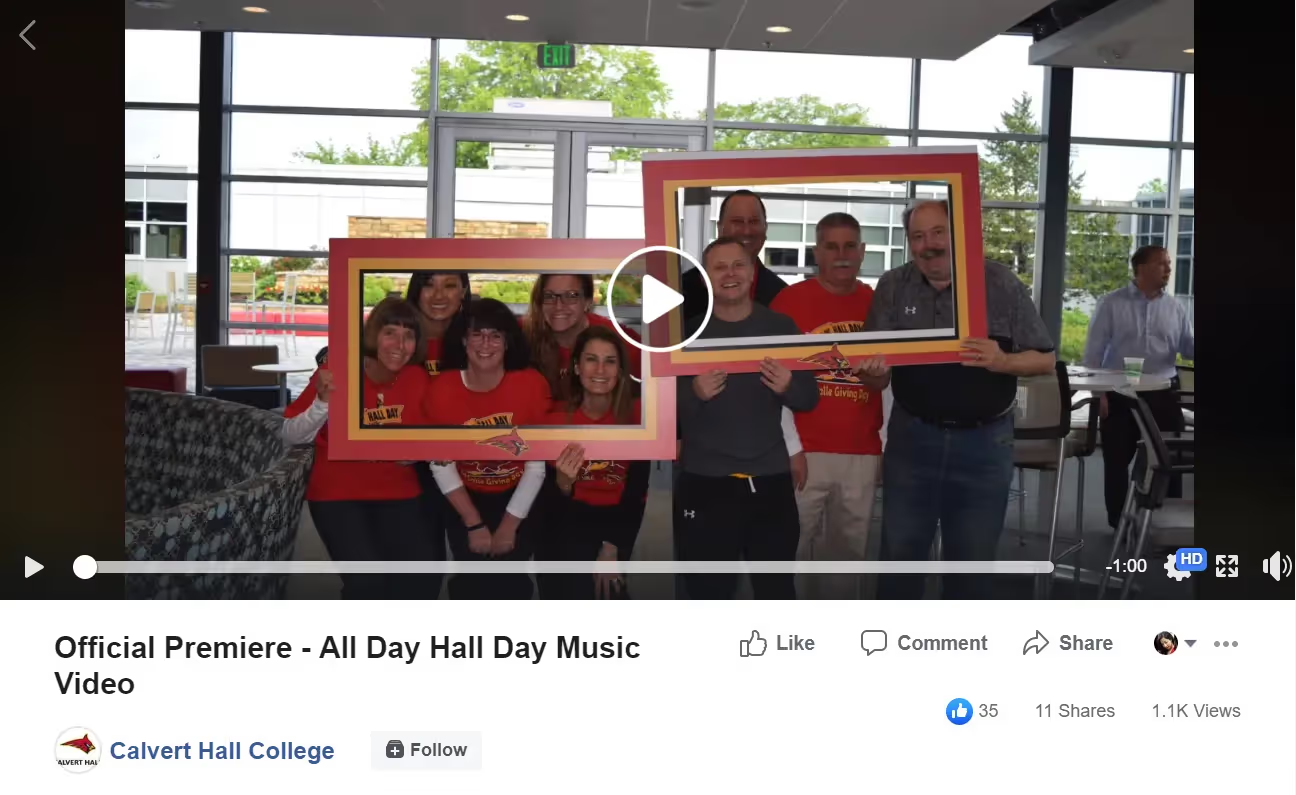
If you’re worried that a professional video might be too expensive or time-consuming, a simple slideshow video is the next best thing! Including pictures of students and faculty members clicked on-campus in the video can be a great way to influence participation from donors. Calvert Hall created an amazing music slideshow video for its 3rd All Day Hall Day giving campaign.
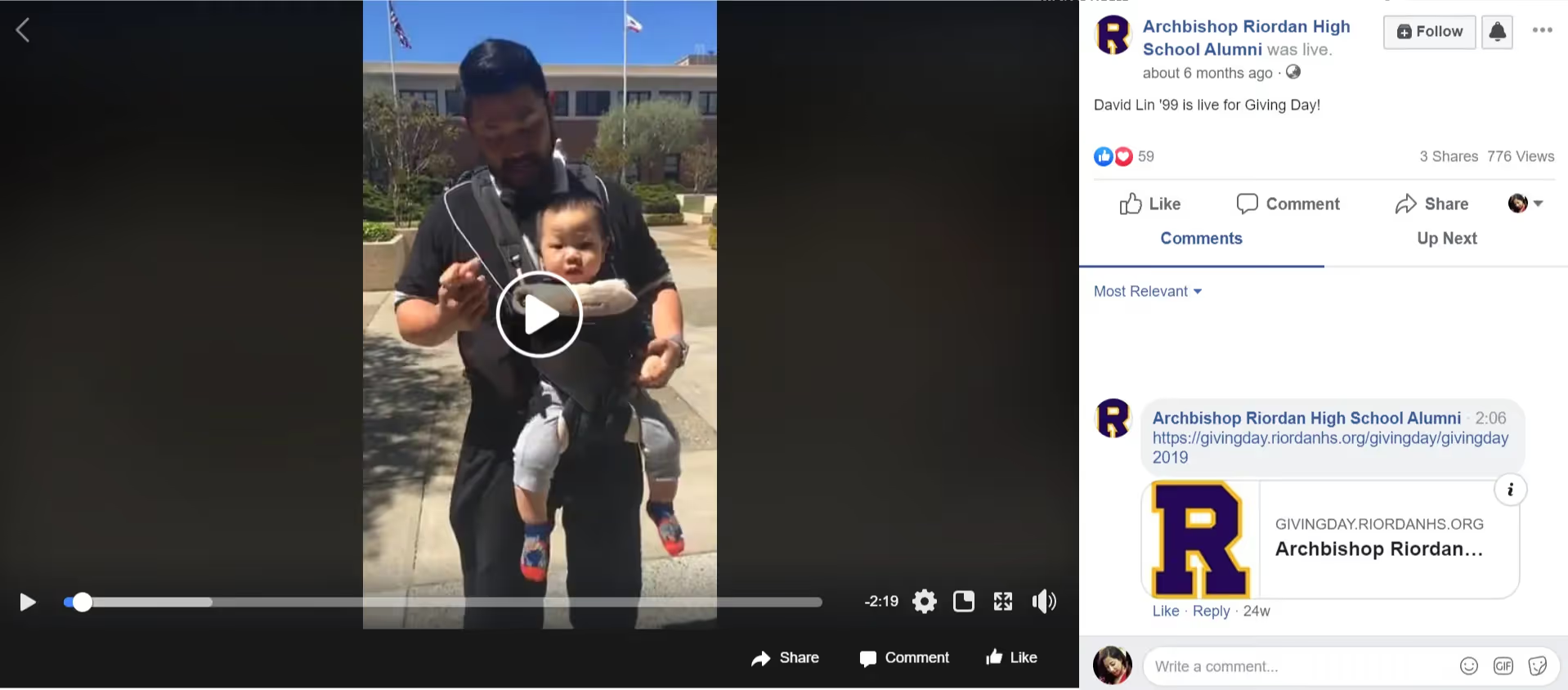
Going live on the day of the event is one of the most commonly employed methods to promote Giving Days. This helps donors view real-time progress and get an inside picture of the events and activities planned during the day.
According to SproutSocial, Facebook users spend 3X more time watching a live video than a pre-recorded one.
Here’s David Lin, Director of Boarding at Archbishop Riordan High School going live on the school’s campus, during 2019’s Giving Day campaign. View the post here.
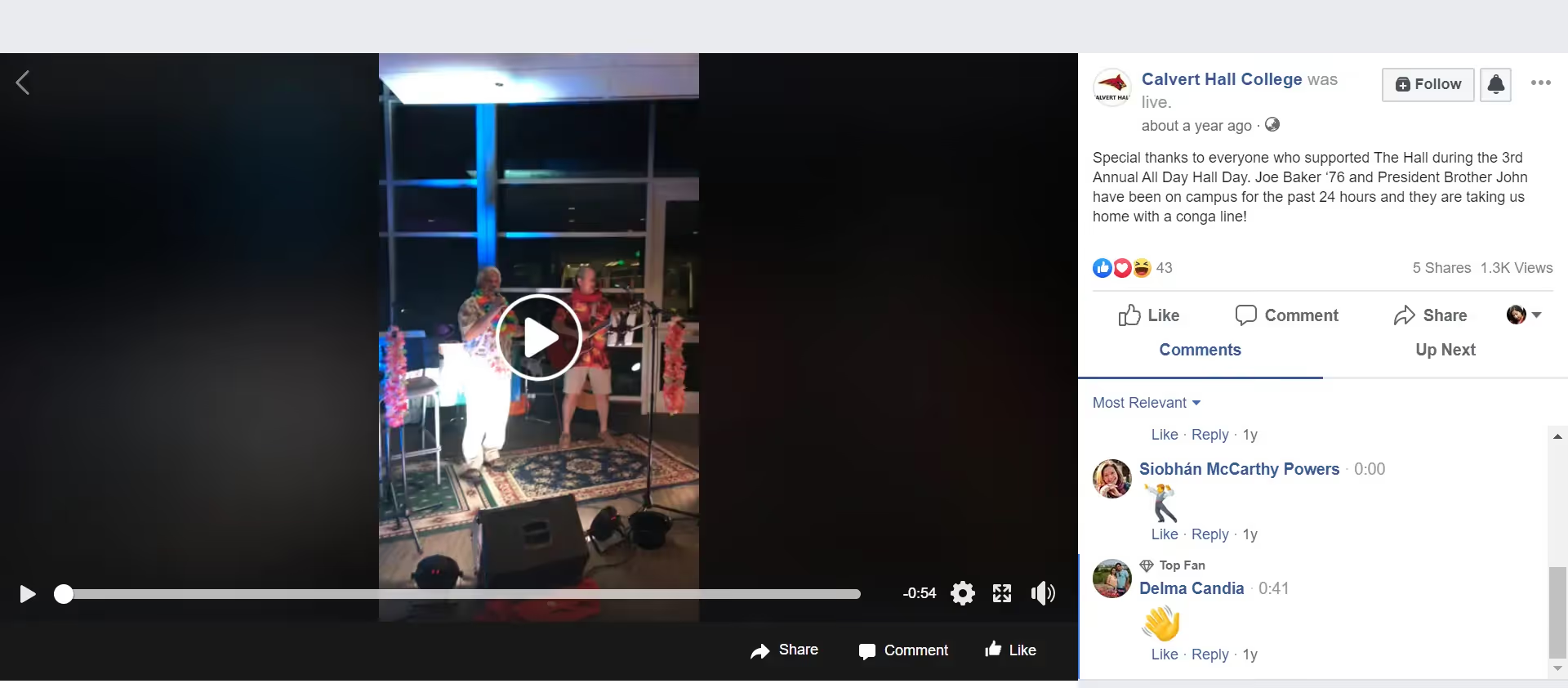
When it comes to sharing updates about your giving day via videos, go beyond the usual formula of simply announcing these updates. Check out how Calvert Hall College High School created an awesome video, sharing updates from its 2018 All Day Hall Giving Day campaign.

The team responsible for running your giving campaign definitely deserves a special shout-out for their endless dedication and hard work. There’s no better way to do this than showcasing their efforts for donors to see. This creates a sense of gratitude and acts as a strong incentive for people to do their part by contributing towards a noble cause. Here again, Calvert Hall wins our hearts by creating a beautiful video dedicated to its passionate team members.
Email marketing continues to play a crucial role in the success of Giving Days for most schools.
Here’s a look at how email marketing has been leveraged by schools to boost Giving Day donations:
While schools start planning their Giving Days much ahead, why don’t a lot of them recognize the need to market their campaign in advance? From the initial announcement informing potential donors about the campaign right down to the thank-you email to all participants, every email must be well-timed and carefully crafted. At the same time, be careful not to overdo it by sending too many emails. Take a cue from Scranton Preparatory School’s immaculate planning for the school’s Giving Day 2022 campaign.
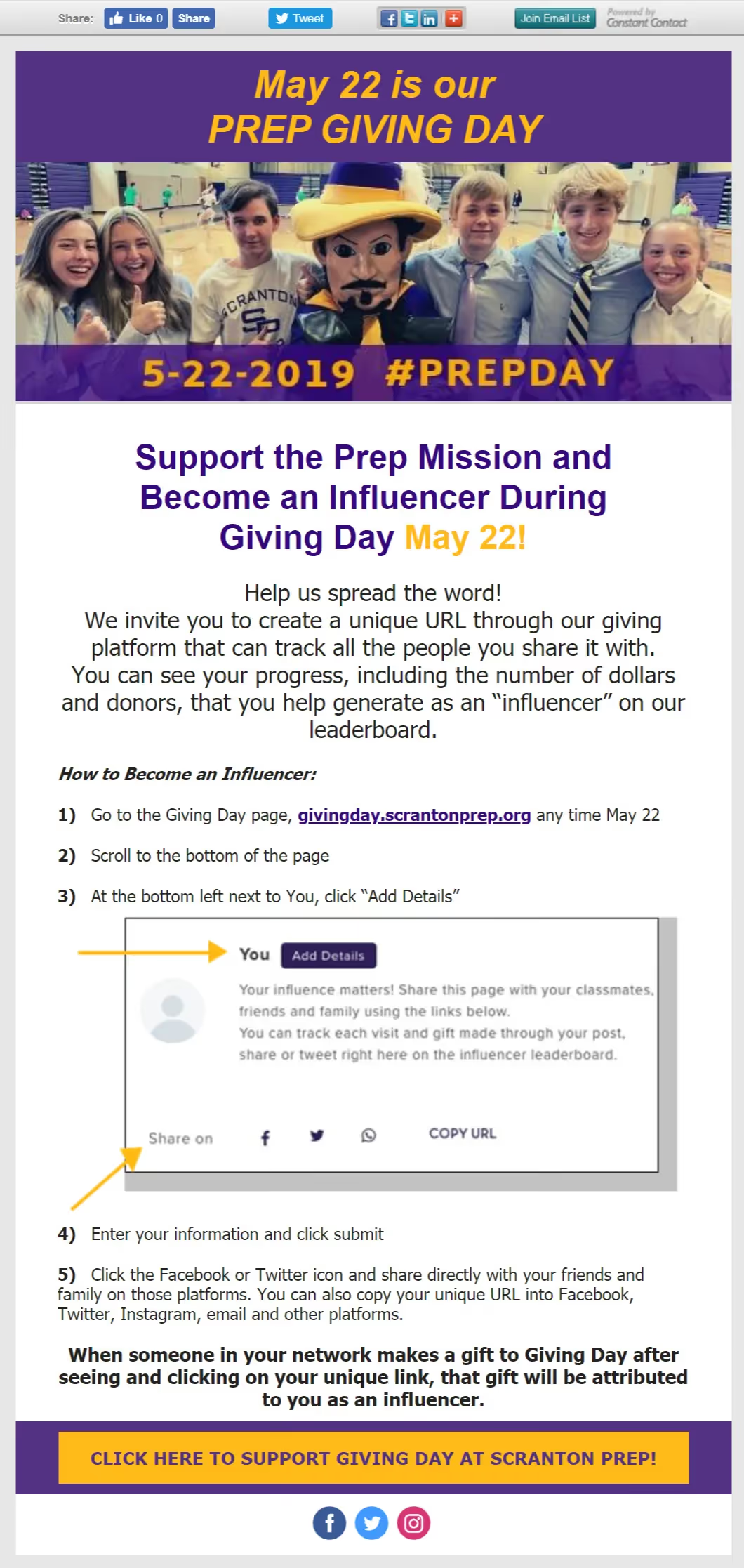
In addition to generating awareness about the upcoming Giving Day via emails, another way of capturing donors is by informing them of incentives. By providing exclusive benefits to select donors, the chances of securing early bird donations significantly increase.
Your approach to marketing a Giving Day can vary greatly depending on who you’re reaching out to. Long-time donors, for instance, are the most loyal of your followers and therefore, it is best to personalize your approach while asking for their contribution. Here’s how Scranton Preparatory School created a customized email invite for its Class of ‘79, asking for their support during the school’s Giving Day 2019 campaign.
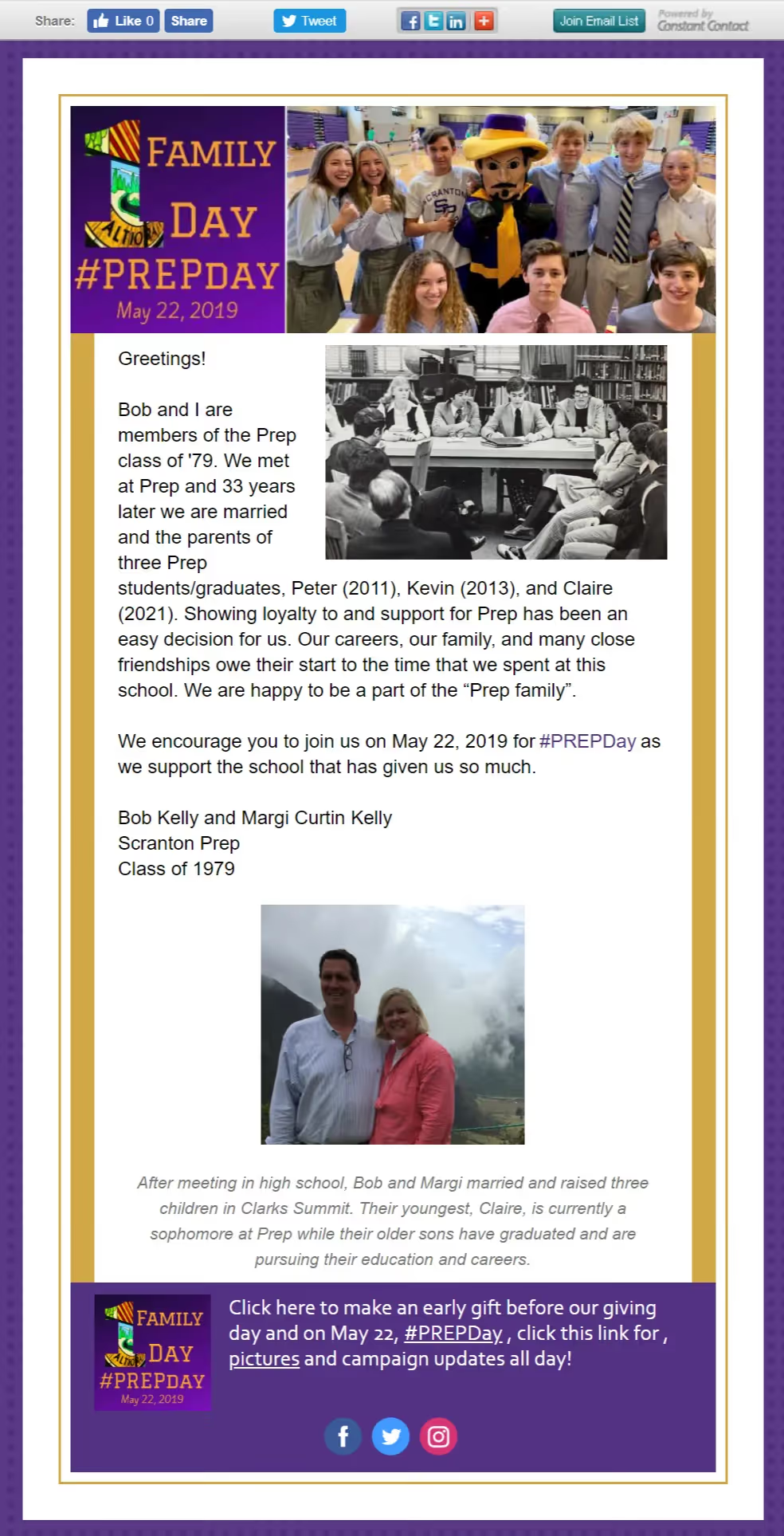
Peer-to-peer fundraising has proven to be highly effective for most schools. Emails or referrals from peers help create a personalized touch and act as a strong incentive for fellow alumni to contribute.

8 Proven Ideas for Promoting Giving Days
Lorem ipsum dolor sit amet, consectetur adipiscing elit. Suspendisse varius enim in eros elementum tristique. Duis cursus, mi quis viverra ornare, eros dolor interdum nulla, ut commodo diam libero vitae erat. Aenean faucibus nibh et justo cursus id rutrum lorem imperdiet. Nunc ut sem vitae risus tristique posuere.
For schools, universities, and nonprofits, organizing a fundraising event is a perfect opportunity to build connections and make an impact. However, there is another challenge before the progress bars start going up and that’s getting the word out.
Figuring out how to promote a fundraiser seems easy at first but overlooking crucial steps or messing something up can be the difference between a potential donor noticing your giving day or not, or even if they do, they might not feel as connected if your fundraiser’s first impression isn’t great.
In this blog, we will walk through how teams approach marketing a fundraiser across channels, what to focus on, how to keep it manageable, and how to turn visibility into actual donations.
Most campaigns you run will fall into a few familiar buckets. The way you promote each one changes slightly, but the goal of getting the people to walk through the door, notice, care, and act remains the same. Here’s how it usually plays out in practice.
You’ll see this across Giving Days, annual funds, scholarship appeals, emergency campaigns, crowdfunding, or even smaller department-level pushes. Everything centers around a campaign page, and most of your effort goes into driving people there.
Events give you a defined window to work with, but they need attention on both sides of that window. This includes galas, auctions, walkathons, runs, school fairs, reunions, homecoming, networking events, or even virtual sessions like webinars.
In institutions, you’re working within existing communities. You’ll see campaigns like annual funds, parent giving, student-led fundraisers, athletics drives, giving Days, reunion giving, or class-year challenges. Each one taps into a slightly different group.
These campaigns usually depend on participation as much as they do on donations. That could be recurring giving drives, peer-to-peer campaigns, emergency appeals, volunteer-led efforts, or partnerships with sponsors and local groups.
Monthly giving, memberships, sponsorships, and corporate programs stay active year-round. They don’t rely on one big push, so consistent visibility becomes the focus.
Emails hold an advantage over other channels in that they can come off as more authentic with your audience. Emails are not decided by algorithms and don’t need to follow trends. If you want to drive action, consider using emails to promote your fundraiser.
Most organizations already use email heavily, but it usually lands in one of two buckets: routine updates, or messages shaped to actually drive engagement. The ideas below might just help you move your email promotion to the latter bucket.
A broad mission statement will not be able to carry the weight that a single lived experience can. One of the best ways to make a fundraising email land is to narrow the lens: focus on one person or one visible change that donations made possible.
Instead of processing statistics or organizational language, people connect emotionally and start imagining a real outcome. As a result, your ask stops feeling too broad and becomes clear.
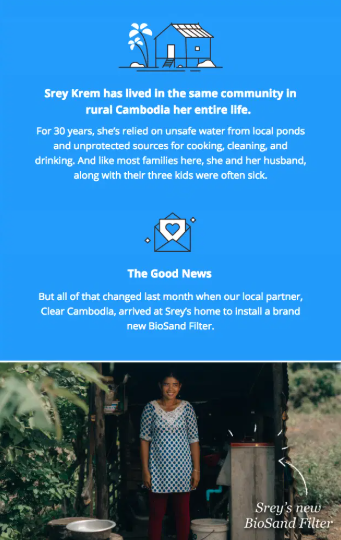
A strong example comes from charity: water’s email “A New Way of Life for Srey”. Rather than opening with urgency or fundraising targets, the email walks readers through one woman’s daily reality and how access to clean water changed it. When the ask follows such an impactful story, giving to the cause feels like a no-brainer.
Why this works: Regular donors have seen every version of “support our mission.” Impactful storytelling cuts through with specificity and emotion as the advantage. A single story gives people something concrete to hold onto, and that makes the impact feel both believable and personal.
Here’s an opportunity to use emails to do more than just persuade givers: remove uncertainty and confusion.
Once people are interested in participating, scattered information could still lead to drop offs. If you’ve faced this, the problem might not be visibility. Donors might be finding the process lengthy: one detail lives on the event page, another in a previous email, another in a PDF attachment nobody can find later. Supporters don’t consciously decide not to engage, they just decide to figure it out later. Chances are, by that time, the giving window is over.
This is where you can employ a well-structured logistical email.

An example of this comes from Mount Calvary Christian School’s fundraising auction campaign. The giving page led supporters to the email which had everything they needed to give, in one go: auction wish lists, sponsorship details, featured items, participation options, and next steps. Instead of pushing readers toward a single action, it gave them enough clarity to choose how they wanted to engage.
Donors need clear direction to participate in your cause, and this email gave them exactly that.
Why this works: Use complete emails to eliminate confusion and build momentum for your campaign. When supporters don’t have to search for information or second-guess what comes next, participation is easy and decisions are made much quicker.
One of the smartest ways to grow a fundraising campaign is to use your ambassador’s and supporters’ voices to amplify your cause.
The challenge here is that most people are willing to help spread the word, but very few have the time or resources to draft messages from scratch, resize graphics, or figure out what to say. Even highly engaged supporters tend to delay sharing when it feels like extra work.
This is where ‘ready-to-use’ email resources will come to your rescue.

For its Giving Day campaign, University of North Alabama created a resource hub with pre-written email templates that could be shared before their Founder’s Giving Day to spread word and on the day of, to share live progress. Instead of a more abstract, high-effort ask like “help promote the campaign,” they gave them a toolkit that made participation almost frictionless.
A huge advantage here is also that the campaign’s voice stays consistent even as more people start sharing it. You widen reach without diluting the message.
Ambassadors become visible contributors to the campaign’s momentum and sharing feels like joining something already in motion.
Why this works: Ready-made resources remove hesitation, keep messaging cohesive, and make it far more likely that people will actually share your cause with their own networks. It also makes them feel considered, which goes a long way in ensuring support, year-on-year.
No matter what kind of fundraising email you’re sending, a few small tweaks can have an outsized impact on engagement.
If you’re seeking immediate visibility, social media is the best bet to promote your fundraiser. People see your campaign and they also get to see see other people engaging with it in real time. That visibility creates a sense of urgency, especially during fundraising events where energy and community matter as much as the ask itself.
But the campaigns that perform best on social media rarely feel overly designed. They feel human and socially alive. The ideas below help you bring that authenticity into your promotion plan.
One of the easiest ways to make fundraising content more compelling on social media is to loosen institutional control a little.
Supporters are very used to the same formats, with polished graphics, campaign slogans, and branded messaging. And these best fit on your official giving page. On social media, lead with voices that feel immediate and personal. That’s why student takeovers, ambassador posts, and behind-the-scenes perspectives consistently outperform highly produced promotional content.

National English Honor Society (NEHS) used social media takeovers, where students shared their own experiences, perspectives, bits of the planning effort and their involvement, directly with followers. The organization was letting students speak for themselves.
That changes the tone of the campaign instantly. The content feels less like planned outreach and instead starts to feel spontaneous and authentic.
It also creates a kind of peer validation that cannot be manufactured, and these consistently perform better with younger supporters.
Why this works: social media runs on perceived authenticity. Real voices cut through polished feeds because they feel socially credible. Prospective donors, families, alumni, and community members are seeing a lot more than what programme matters: they are seeing who it matters to and why, and everyone involved in making it possible. Think of it like bringing the delight of bloopers and behind-the-scenes of a beloved movie to your supporters.
One reason live content works so well during fundraising campaigns is that it is essentially live proof. Updates are immediate. Wins are communal. Small moments that would normally stay invisible suddenly become part of the event itself.

The Community Foundation of Louisville leaned into this during its giving day campaign by using Facebook Live throughout the day. The team went live at least once every hour, sharing rallies, nonprofit interviews, campaign updates, and “power hour” competitions tied to fundraising milestones. Donors could watch organizations react to milestones, see communities rally around specific causes, and feel the pace of the day accelerating. The campaign ultimately raised more than $4 million.
Why this works: Visible momentum lowers hesitation. When supporters can see energy building around a campaign in real time, participation becomes socially reinforced and the dollars raised, a community win.
The strongest fundraising campaigns on social media feel less like the outcome of carefully planned content calendars and more like the result of spontaneity. Here are a few practices that could help you sustain that authenticity:
Text messaging changes the fundraising equation because it bridges the gap between intent and action. It works differently because a message arrives in a space people already check, and the response only needs a few seconds. In contrast, other channels ask supporters to pause what they’re doing: open a new tab, revisit the campaign later, check their inbox, remember to come back.
This immediacy is what makes SMS so effective for fundraising events, time-sensitive campaigns, and last-mile engagement. But it also means there’s very little room for wasted language.
One of the best ways you can use SMS for fundraising is reducing the number of decisions a donor has to make before contributing.
The more steps people encounter, the more likely it is for momentum to disappear somewhere along the way. Text-to-give campaigns work because they make this process instantaneous.
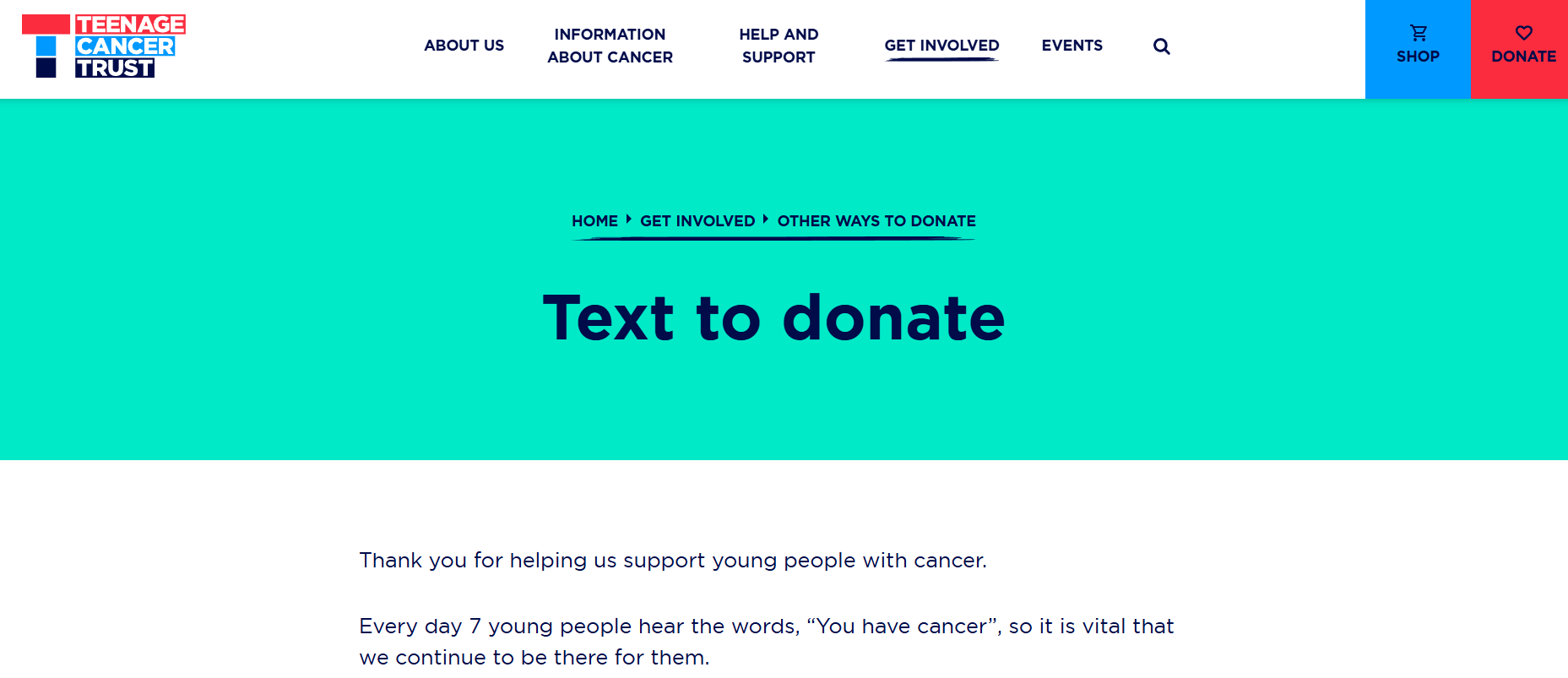
A good example is Teenage Cancer Trust’s text-to-donate campaigns, where supporters could contribute simply by texting a keyword. The interaction is familiar because it repurposes an action people already perform.
Why this works: Every additional step creates another opportunity for hesitation. You can remove that barrier by turning giving into a behaviour that already exists. Text-to-give succeeds because of this underrated advantage. Adding text message as a channel to your campaign also researches segments of your audience who aren’t present elsewhere.
SMS messaging, just like other channels, is not a one-size-fits-all tool.
Some messages are designed to create urgency. Others inspire emotional connection. Yet another simply reminds highly engaged supporters that it’s time to act. The effectiveness usually comes down to timing and audience readiness. A good approach is to treat SMS like a running conversation that changes as the campaign progresses:
The strategy shift here is that SMS is used to pace and guide donor attention over the course of a campaign.
Why this works: People respond differently depending on where they are emotionally and contextually. Let your message reflect the moment instead of repeating the same appeal every time.
Because SMS is such a direct channel, small execution details tend to have an outsized impact on response rates and supporter experience.
Physical media reaches people in those rare moments away from their screens. It also has one big advantage over digital channels: someone might scroll past a fundraising post once and forget it an hour later, but physical materials stay in the same space for days or weeks, building familiarity through repetition.
Physical promotion also makes a campaign feel more present in the real world. When people keep seeing posters or handouts across shared spaces, the fundraiser starts to feel more immersive.
One reason physical promotion gets delayed is the assumption that every campaign asset has to be designed from scratch. But if you’re able to find materials that already work and can be adapted quickly to fit their event, you can reach supporters that much better.

That’s what makes resources like Save the Children’s downloadable fundraising materials so useful. Their comprehensive collection of posters, banners, bunting, forms, totalisers and booklet templates give organizers a professionally structured starting point that can be customized with event details, school branding, or campaign messaging.
You can edit these downloadable resources and plan your campaign around those. Promotion starts earlier. And consistency across posters, handouts, and signage becomes much easier to maintain.
Why this works: professionally designed templates remove one of the biggest hidden bottlenecks in fundraising promotion: getting materials created in the first place. The easier assets are to customize and deploy, the more likely they are to be used effectively.
Design barriers are real constraints that fundraising teams face. Many don’t have an in-house designer available to design flyers to hand out to prospects for promotion. But if non-designers can still create usable flyers confidently, your campaign’s promotion and presence will be stronger.

That’s Canva’s library of fundraising templates becomes extremely usable. They’re thoughtful, structured, and have a visual hierarchy that guides attention toward a single next step, whether that’s a QR code, a donation prompt, or an event detail.
For teams without dedicated designers, this means you’re not choosing between “good design” and “getting it done.” You can produce materials that are both usable in real-world environments and fast enough to deploy while the campaign is active.
And another powerful change to your promotion strategy is that design stops being a decorative layer and becomes part of the conversion pathway.
Why flyers work: In physical environments, attention is brief and competitive. Lowering the effort required to create good promotional materials dramatically increases the likelihood that campaigns will consistently use them. Teams stop postponing promotional work because it no longer feels intimidating, with good quality resources at their disposal. Finally, good looking flyers are simply more likely to get taken seriously by supporters.
The most effective print materials succeed because they grab attention and make action feel obvious at a glance. A few small design and distribution choices can make a noticeable difference.
In-person fundraising works for a very fundamental reason: people remember experiences.
An event creates a shared memory, and yet no two attendees walk away with the exact same experience. People remember who they spoke to, what they participated in, and how the moment felt. That emotional residue often translates into stronger long-term giving behavior, even when attendance is relatively small.
One of the biggest constraints in school and community fundraising events is staff capacity. Teachers, coordinators, and volunteers often want to participate, but don’t have time to build an event structure from scratch.
That’s where plug-and-play toolkits make a real difference.

For example, Alex’s Lemonade Stand Foundation’s “Change Childhood Cancer” coin drive toolkit gives schools everything they need upfront: instructions, parent communication templates, and simple step-by-step guidance for running a classroom campaign.
Schools and teachers are being handed a complete, usable system that they can implement as is or tweak as they see fit. When setup effort drops close to zero, more classrooms opt in, even in already busy school environments.
In fact, putting together a toolkit is simpler than it sounds:
Why this works: The fewer decisions an organizer has to make, the more likely they are to run the event at all. Convenience directly increases participation.
In-person events work best when they feel tailored to the people attending them, instead of just broadly “for supporters.”
That’s why segmented programming outperforms one-size-fits-all activities, especially in school environments where age groups have very different engagement styles.
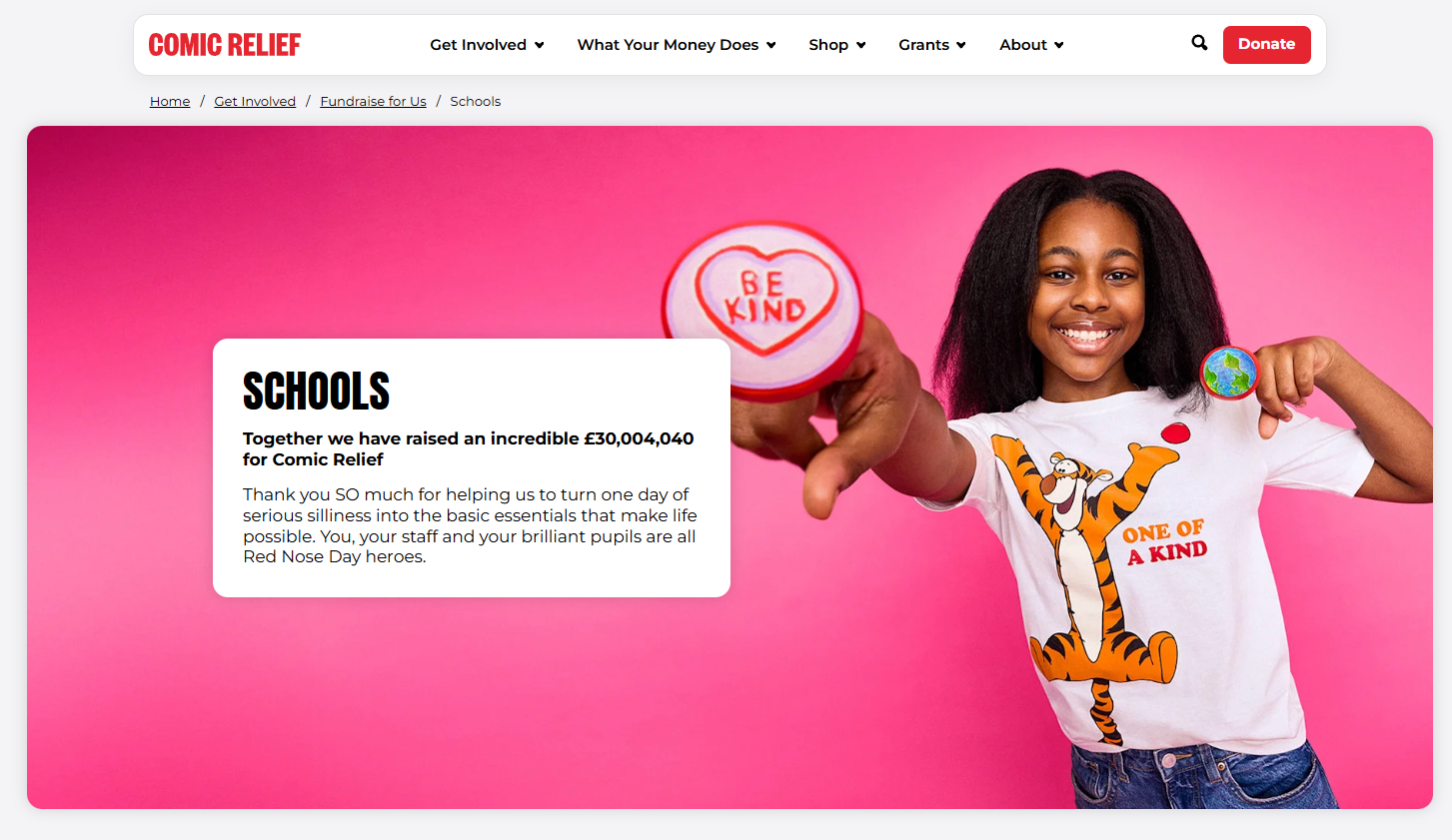
Comic Relief’s school fundraising approach in the UK understands this. Their materials structure participation by age group: Early Years, Primary, and Secondary, each with activity ideas suited to how those students naturally engage, from dress-up days to talent-based challenges.
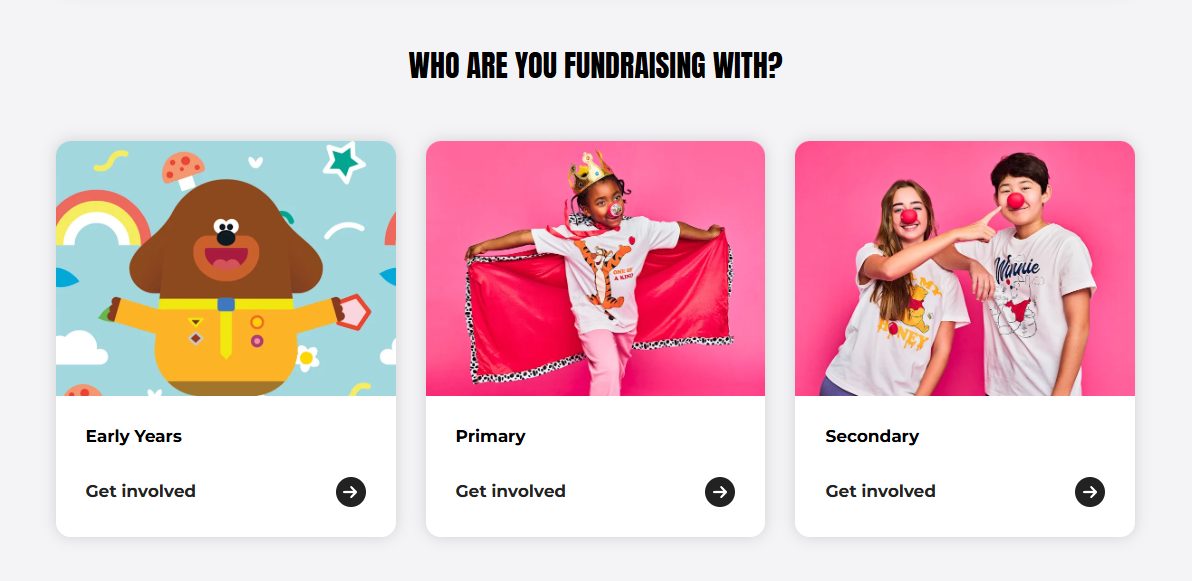
The underlying idea is simple: relevance drives participation. When an activity feels designed for a specific group, it doesn’t feel like an imposition, rather, it feels like something meant for them.
Why this works: People participate more when the experience matches their identity and context. Meet your participants where they are.
The most effective events succeed through consistent coordination across all phases, not just execution on the day itself.
Today, your team’s fundraiser promotion efforts happen through either a dedicated platform or a network of specialized tools. Almabase excels at integrating your promotion efforts into your larger engagement and fundraising strategy on many levels. Here’s how:
Almabase aims to bridge the gap between engagement and giving by providing specialized features built to complement each other. Take for example, the alumni directories and communities that make segmentation and personalized outreach much easier. This in turn makes post-event communications and donor follow-ups much more streamlined and interconnected.
Dynamic filters provide detailed insight into donors' interests, careers, and engagement history to personalize fundraising appeals. Past donation data can also be used to identify major gift donors and intensify retention and upgrade efforts.
Almabase acts as a one-stop shop for all things outreach especially for email/SMS campaigns through personalized outreach, segmented lists, or post-event communications.
Campaigns can be promoted across both texts and emails to drive real-time engagement, and advanced audience segments can be built to raise more from untapped donor opportunities. Beyond one-off fundraisers, it also empowers year-round campaigns and recurring giving as Almabase’s focuses on empowering your engagement and giving strategy beyond just short-term fundraising goals.
Almabase’s powerful sync with CRMs such as RE NXT (through TrueSync) means that when someone clicks a donation link and gives, that data flows back into the CRM automatically with no manual record updates or channel tracking required.
Text messages boast a 98% open rate and get responses much faster than email, making them perfect for urgent appeals like Giving Tuesday. Almabase pulls in donor data so teams can reference past gifts, event attendance, or volunteer history in their texts for highly personalized outreach.
Almabase is also easy to use with it’s no-code approach to building giving pages, checkout pages, leaderboards, and much more. For important giving days and events, customers get priority support on multiple channels.
Promoting a fundraiser today is a complicated process. Beyond just getting the word out, you and your team need to find the right platform, have the right strategy, and reach out to potential donors at the right time with the right message, and of course, execute the right ideas in the best way possible.
We have a few resources to ease the planning process:
And if you are looking for a partner to help you find success in your fundraising efforts, feel free to book a demo call personalized to you and your team’s needs! 👇

Fundraiser Promotion Ideas for Institutions and Nonprofits
Lorem ipsum dolor sit amet, consectetur adipiscing elit. Suspendisse varius enim in eros elementum tristique. Duis cursus, mi quis viverra ornare, eros dolor interdum nulla, ut commodo diam libero vitae erat. Aenean faucibus nibh et justo cursus id rutrum lorem imperdiet. Nunc ut sem vitae risus tristique posuere.
Sharada Koti
May 15, 2026
12 minutes
%201.svg)
%201.svg)
%204.svg)


.svg)