Explore the most popular year-round alumni engagement initiatives and learn how higher education institutions can build sustainable alumni engagement strategies that foster lasting connections beyond major events.

Prajnya Yelamali
Published:
October 26, 2026
Updated:
Summary
• Popular initiatives: Volunteer opportunities, career networking, alumni storytelling, and affinity groups.
• Sustainability challenges: Limited staff capacity and the effort required to maintain programs like mentorship.
• What works: Repeatable programs, automation, alumni-led communities, and multiple opportunities for continued engagement.
• Real-world examples: Institutions using digital communities and automated communications to strengthen alumni relationships and drive long-term participation.
More advancement teams are finding ways to stay connected with alumni beyond homecoming and reunions. A mentorship program or a new regional chapter can give alumni a reason to stay involved between the big events, and there's really no shortage of good ideas to try next.
The harder part is finding the capacity to run them all. In our research report, The State of Year-Round Alumni Engagement (2026), limited staff capacity was the most cited barrier to year-round engagement, named by 69% of the 103 advancement professionals we surveyed. A third of them also work in teams of five people or fewer, so adding program after program isn't realistic for most.
The good news is that you don't need dozens of new programs to engage alumni throughout the year. You can just start by assessing which initiatives are actually worth your team's time and effort.
In this blog, we'll look at the most popular year-round initiatives from the report and which ones are easiest to sustain. We'll also go through which programs keep alumni coming back and what the ones that last have in common, along with a few examples from the field.
We asked respondents which initiatives they run to keep alumni engaged outside of their big annual events. The three most common answers were:
Beyond the top three, the report shows a wide variety of programs. Instead of listing them one after the other, in this blog we will group them by what they offer alumni.
These programs, while giving alumni a way to contribute their time and experience, also line up with what alumni say they want. The 2026 National Alumni Survey found that when it comes to volunteering, 55% of alumni are interested in sharing career insights. Traditional roles rank lower, with attending alumni events at 33% and serving on leadership committees at 28%.
These are the programs that help alumni find each other and open doors professionally. A directory or job board also keeps working in the background once it's set up, since alumni can use it whenever they need it.
These programs bring alumni together around something they have in common. That might be where they live or what stage of life they're in.
This group keeps alumni informed and gives them a voice. Interestingly, polls and online forums are among the least common initiatives in the survey, even though they tend to ask very little of alumni.
Looking at the full picture, institutions are moving towards giving alumni multiple segmented ways to get involved, instead of relying on one uniform ask.
When we asked which initiatives had been most successful for sustained engagement, volunteer opportunities came out on top at 34%, followed by affinity groups and regional communities at 27% each. The common thread is connection, as these programs bring alumni together around a shared identity or purpose.
But the report also found that this is what makes them demanding. The initiatives that create the deepest engagement need the most ongoing coordination and staff attention. Mentorship is a good example: When we asked what's hardest to keep alive, mentorship came up more than any other answer. It demands significant staff time and one-on-one attention, and alumni who sign up don't always follow through.
There are three ways to look at how sustainable a program is.
A high-lift program needs a lot of hands-on work every cycle. For a mentorship program, someone has to match mentors and mentees and send reminders. They also have to handle drop-offs and prepare for the next cohort.
A low-lift program asks very little of your team or your alumni. East Stroudsburg University Foundation found early traction through simple, low-effort ways to get alumni involved. A recurring social media prompt called "Morning Warriors" asks alumni to share a quick update about their day. It gives them an easy way to interact with the university without registering for an event or receiving an incentive.
A one-time moment has to be rebuilt from scratch every time, while a recurring program builds on itself.
💡 Punahou School in Honolulu turned several one-off moments into standing programs: A once-a-year "gift season" push became an always-on gift guide directory. Ad hoc carnival volunteering became a formal system that captures contacts for ongoing outreach.
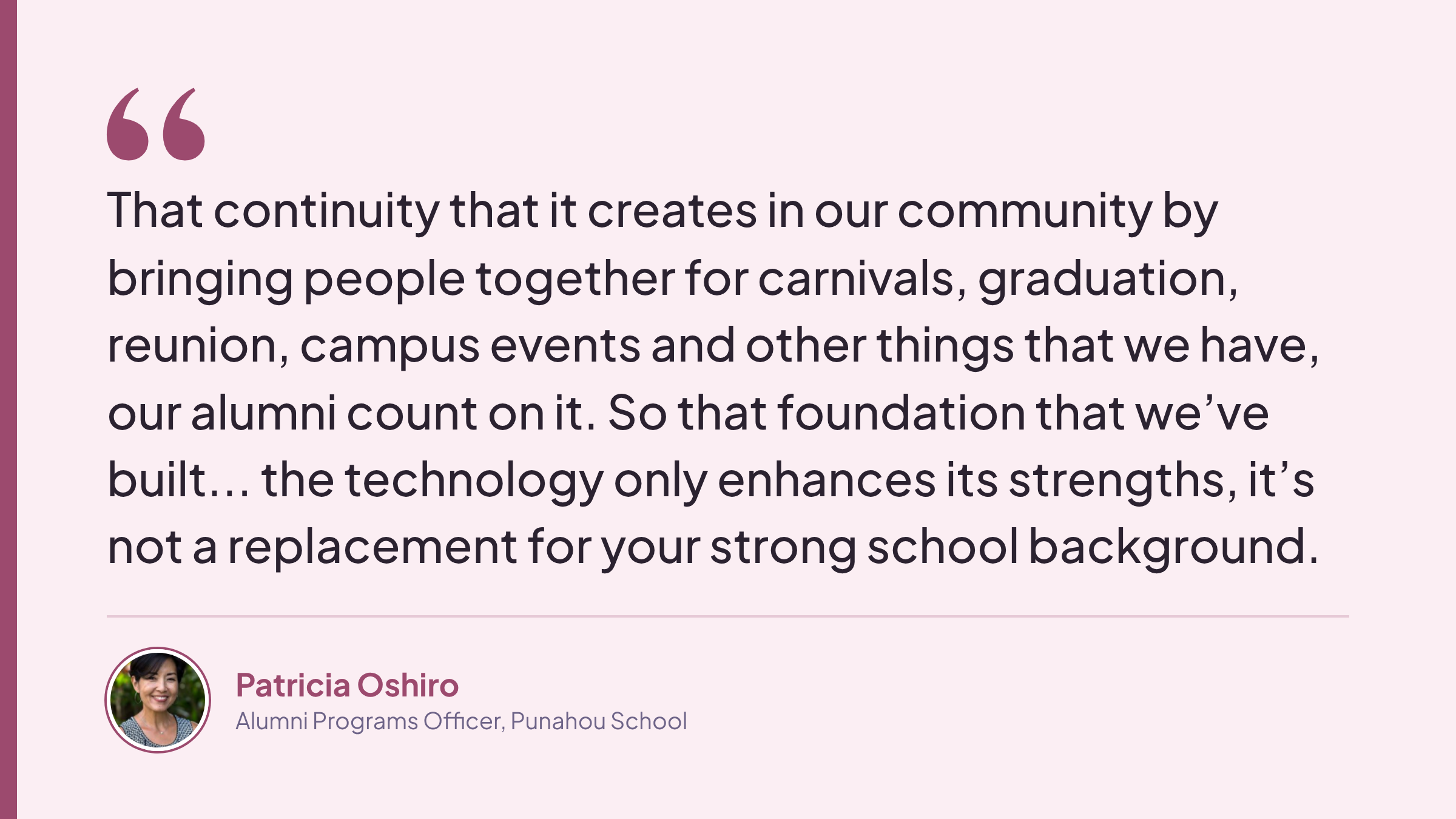
The gift guide is one of several self-serve programs Punahou has built for its global network of over 30,000 alumni. Alumni business owners submit their details once, and their business appears in the directory and in personalized email digests. Alumni who used to contact the school for career help can now use a self-serve job board, which has recorded more than 2,000 interactions. Alumni also keep the school’s regional chapters alive by posting announcements and connecting with peers. Today, Punahou averages more than 7,000 engaged alumni every month.
Some programs only move when your team is actively involved, while others run with alumni initiative.
💡At Illinois Tech, a mapping tool showed alumni who lived nearby or were traveling to the same place, so one alumni association president used it to organize a dinner with a dozen alumni in Greece, entirely on his own. Similar self-organized meetups have since taken place in other cities, without any event appearing on the university's calendar.
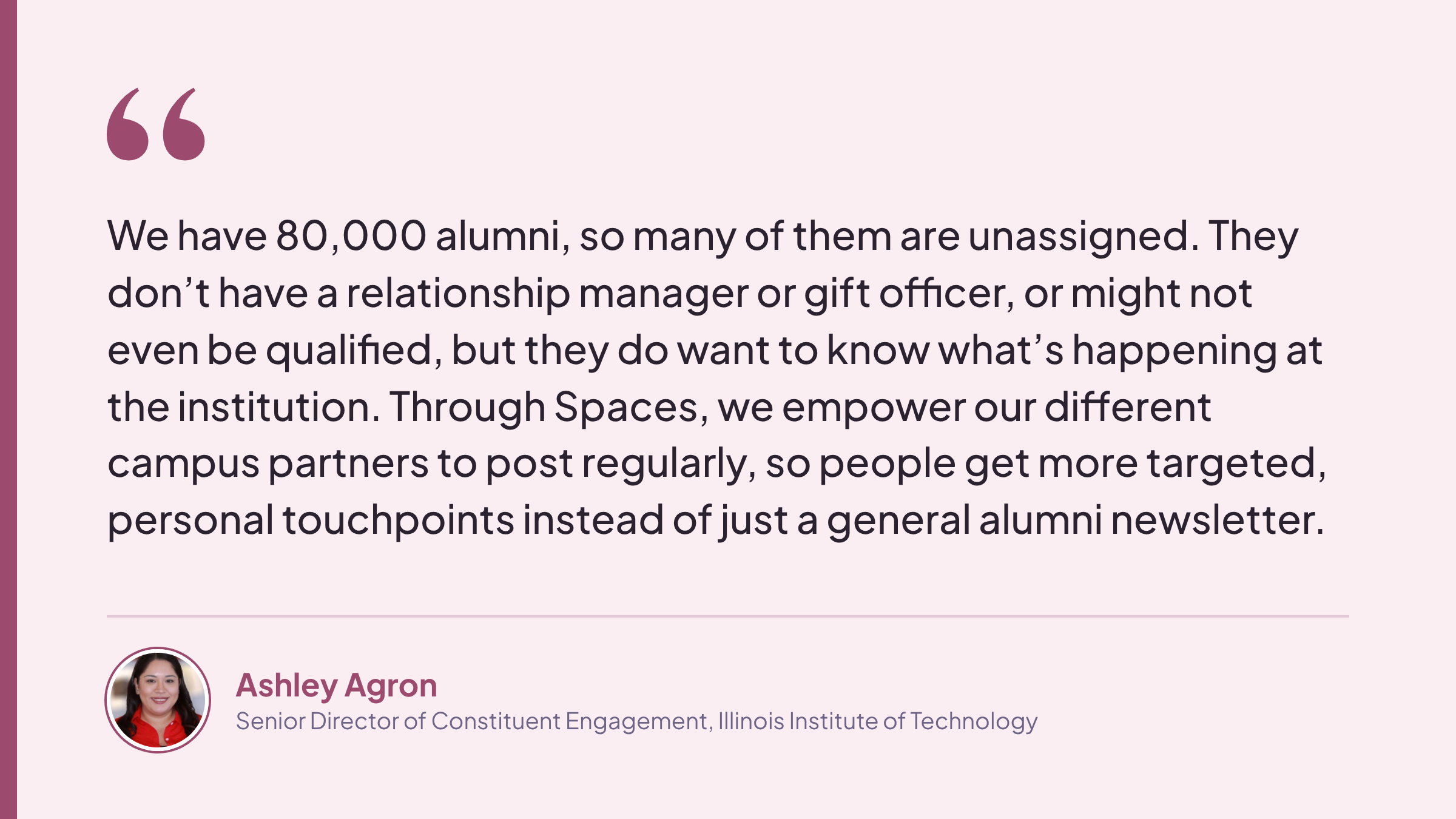
Illinois Tech needed a way to stay connected at scale. Instead of routing everyone through the same channel, the university built affinity-based online communities organized around things like athletics and regional chapters, so campus partners can post directly to the groups people care about. According to the Illinois Tech case study, the university recorded more than 123,000 engagement activities in a single month and has over 2,600 alumni subscribers to its digital spaces.
If you want to find where your own programs sit, the report suggests picking one high-impact program and mapping every step involved in delivering it. Then highlight the tasks that take up the most staff time and look for places where:
Programs that are popular and busy needn't necessarily be the ones that last. A couple of helpful things to keep in mind when you look at your own portfolio:
Career networking is run by nearly half of the teams we surveyed (48%), and mentorship programs are run by 36%. Yet neither made it to the top of the list for sustained engagement, and mentorship was named as the hardest program to keep alive. Volunteer opportunities are the exception, they were both the most common initiative and the one rated most successful.
The lesson here is to judge a program by what it keeps producing over time, rather than by how many institutions offer it.
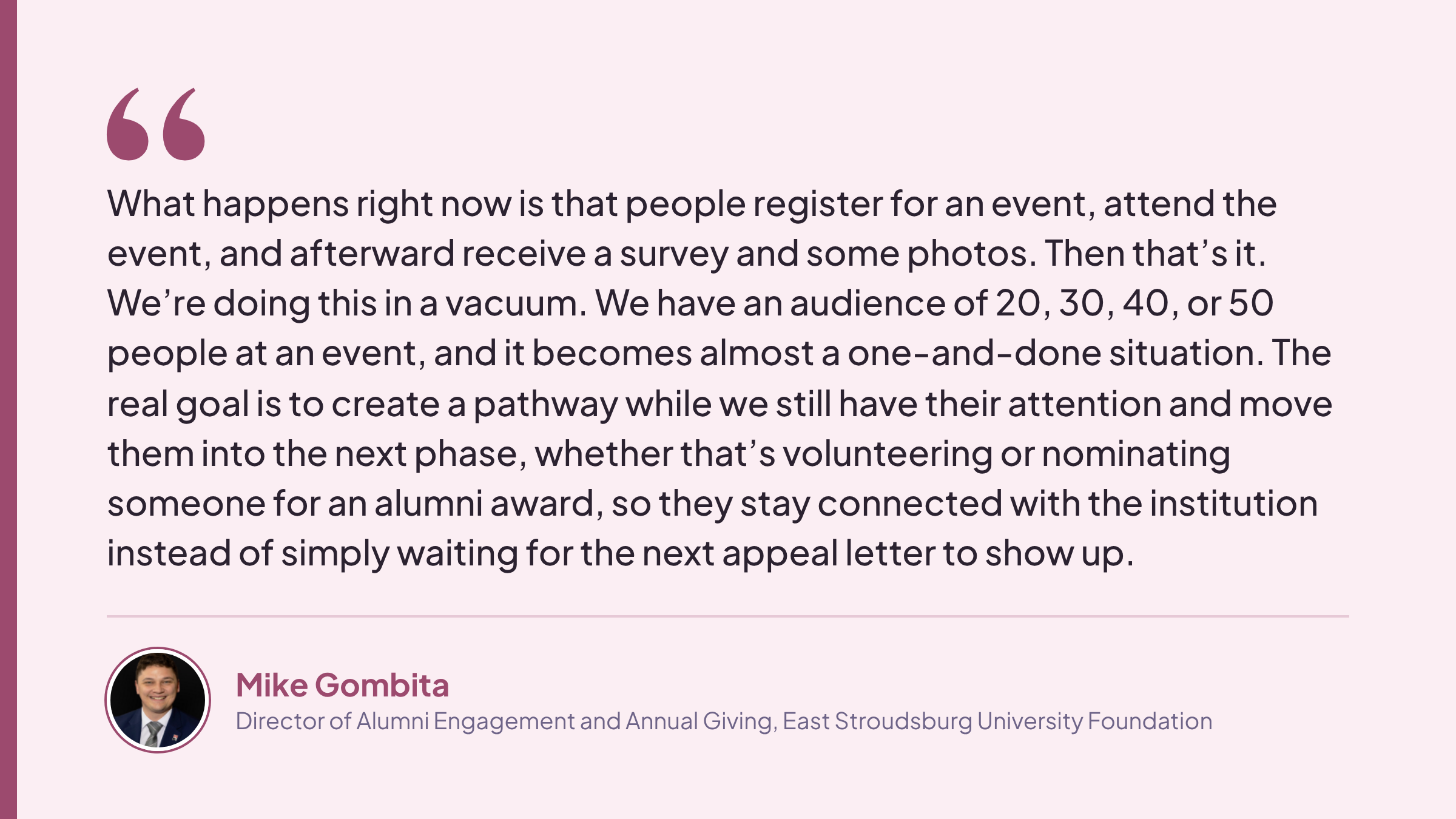
Mike Gombita, Director of Alumni Engagement and Annual Giving at East Stroudsburg University Foundation, described a pattern many teams will recognize: People register for an event and attend it, and afterwards, they receive a survey and some photos. And "Then that's it," he says.
He described the real goal as creating a pathway while the institution still has an alum's attention, so they can move into the next phase of involvement. That might be volunteering or nominating someone for an alumni award.
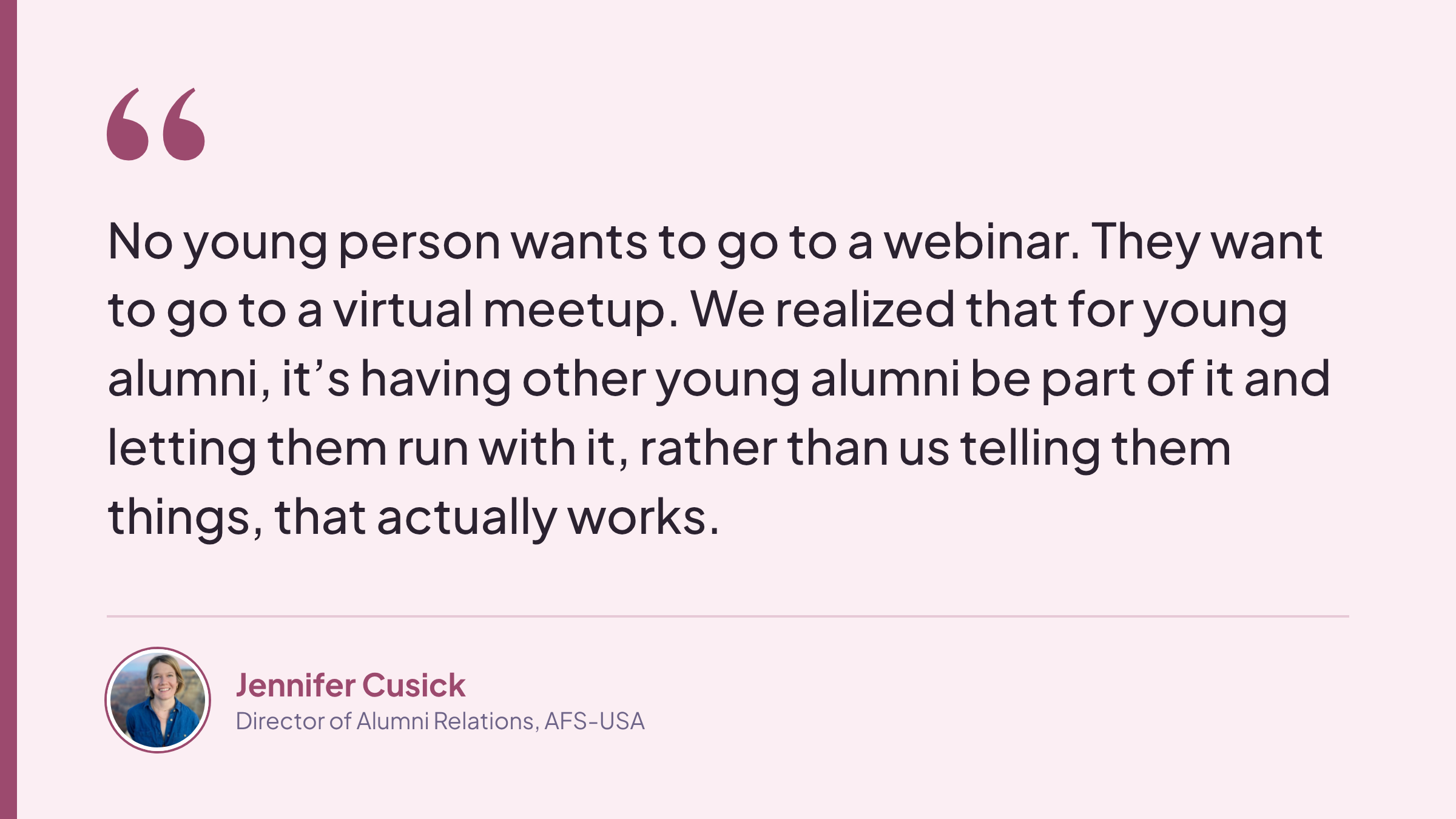
💡AFS-USA had no dedicated alumni department until Jennifer Cusick stepped into the role less than a year ago. After prioritizing basic data cleanup and a CRM migration the team built two simple tracks. One follows the calendar through a quarterly newsletter. The other follows each alum's life stage through automated birthday emails, plus a digital badge and certificate sent shortly after alumni return from their program. That badge worked better than almost anything the team had tried. They also turned their "Welcome Home Webinar," which used to be a staff-led presentation followed by a list of asks, into a peer-led virtual meetup run by alumni just a year or two older. As Jennifer, their Director of Alumni Relations, put it, "No young person wants to go to a webinar."
The strongest programs give alumni a natural next step. The report maps out what this can look like:
Each interaction is one step in a longer journey, and this is also where volunteering shows its value. According to the 2026 National Alumni Survey, recent volunteers are 3 times more likely to have given to their alma mater last year than those who have never volunteered. They are also 3.5 times more likely to give again the following year.
💡Castilleja School, an independent girls' school founded in 1907, has around 4,000 alumnae worldwide. Through Casti Connect, a network built on Almabase, alumnae update their own profiles and share their expertise and willingness to mentor. A monthly digital digest and a quarterly eNews point them to digital spaces with around 20 posts a month, where they can register for events or connect with peers. The results show how one program can feed another. In 2025, 57 alumnae returned to campus as speakers, Career Day went from 4 alumnae speakers out of 20 to more than 15, and 46% of contactable alumnae have reviewed and added to their profiles.
Across the survey data and the stories institutions shared with us, the programs that last have a few things in common:
We'll go deeper into how to build each of these into your programs in our next blog.
💡 Merchant Taylors' School runs alumni relations as a one-person shop. Lisa Connor, Head of Development and Alumni Relations, used to spend a lot of her time setting up campaigns and updating the database by hand. After the school switched to Almabase, she was able to put several programs on autopilot. The alumni directory lets alumni network on their own, and automated emails through the mentorship program nudge mentees to take the next step or share feedback. Weekly digests update automatically, and email communications are scheduled well in advance. Since the school started offering alumni more ways to get involved, average annual donations have tripled, it now has more than 70 active mentors, and 90% of alumni have engaged with the school at least once.
The most popular programs may not automatically be the right ones for your team. So, before you add something new, ask whether it can run on a steady rhythm and whether it gives alumni a reason to come back.
Start with what you already have, look at which programs bring alumni back and which ones rely too heavily on staff time. The goal is a smaller set of programs that keep working for your alumni in the long run.
For more insights on how institutions are approaching year-round engagement, including which programs teams find hardest to sustain and seven stories from the field, explore the full State of Year-Round Alumni Engagement (2026) report.
Subscribe
See how modern advancement teams bring alumni engagement and fundraising together.
Plan faster. Execute better
Explore free templates designed for alumni and fundraising teams.

Prajnya Yelamali
For years, advancement teams have been trying to answer the same question:
Why are alumni participation rates declining even when alumni still seem to care deeply about their college experience?
The 2026 National Alumni Survey, built on responses from 82,000+ alumni, offers a pretty clear answer:
This isn’t a “people care less” problem. It’s a relationship problem.
Alumni haven’t stopped valuing education, giving or wanting community or purpose.
What’s changed is how they expect institutions to show up in their lives.
A lot of traditional advancement strategy was built for a different era, one where institutional loyalty was almost automatic. You graduated, stayed connected, attended reunions, and eventually became a donor.
That path is much less linear now.
Today’s alumni are asking harder questions:
And honestly, those are fair questions.
The survey surfaced a few patterns that feel especially important right now. Not just as “trends,” but as signals of how alumni expectations are evolving.
This was one of the most interesting tensions in the survey.
Many alumni still see their degrees as incredibly valuable. They’re grateful for the opportunities, friendships, and career outcomes that came from their education. But that appreciation doesn’t automatically translate into an ongoing relationship with the institution itself. And if we’re being honest, a lot of alumni engagement still assumes it does.
For many alumni, graduation quietly became the end of the relationship, except for the occasional fundraising email or event invitation. There’s very little in-between. For example, there’s no consistent sense of community and no feeling that the institution understands what life looks like for them now.
That gap matters more than institutions sometimes realise because people rarely give to institutions they feel disconnected from, even if they once loved their college experience.
What the data shows: According to the 2026 National Alumni Survey, 40% of alumni feel disconnected from their institution, and nearly half feel ill-informed about what it's doing. This isn't minor dissatisfaction — it's a structural gap that shows up directly in engagement and giving rates.
💡 Concordia College built a relationship-first digital strategy specifically to close this gap. Rather than defaulting to campaign-driven outreach, their approach centred on helping alumni feel connected to the institution's ongoing story, not just its fundraising calendar. The result was a community that stayed engaged between asks, not just during them. (Read the Concordia case study →)
One thing advancement teams often interpret as “declining generosity” is actually a shift in where generosity is going.
Alumni are donating to mutual aid funds, local nonprofits, climate initiatives, scholarships, community organizations, and causes they interact with regularly.
In other words, the willingness to give is still there, but institutions are no longer competing only with peer universities. They’re competing with every organization that communicates impact clearly and makes people feel emotionally invested.
That’s a very different landscape than the one advancement teams operated in even 10 years ago. And it also explains why vague institutional appeals don’t land the way they used to.
For example, "Support the annual fund” feels abstract.
Change: “Help first-generation students access emergency grants during finals week” feels real.
What the data shows: The 2026 National Alumni Survey makes this stark: only 13% of Millennial and Gen Z alumni gave to higher education in the past year, compared to 32% of older alumni. Meanwhile, 37% gave to individuals through GoFundMe-style campaigns, 34% gave to civil rights and social justice causes, and higher education ranked 11th on their list of giving priorities. They aren't ungenerous — they're directing generosity toward causes where impact feels direct and personal.
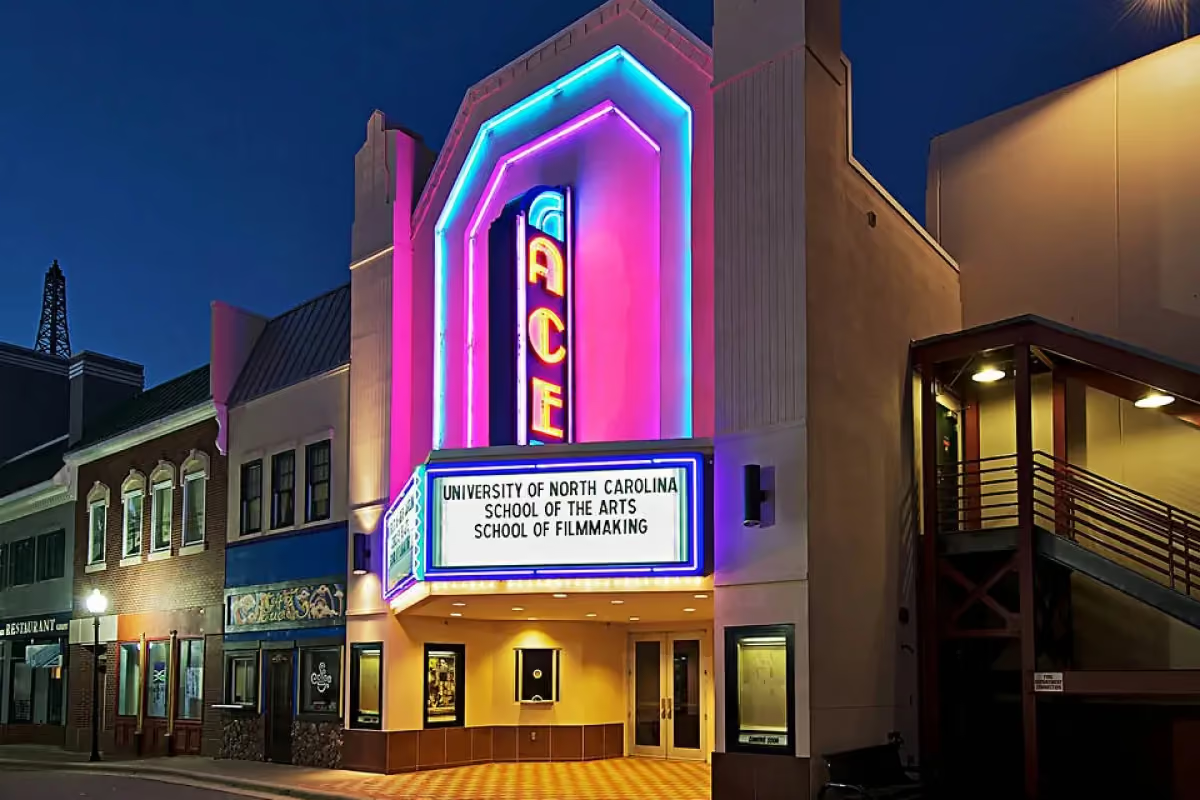
💡 The University of North Carolina School of the Arts ditched the "one fund fits all" model and expanded their Giving Day to 40+ donor-choice funds — letting alumni direct gifts toward causes they actually cared about. Participation and giving both climbed. When alumni can see themselves in the cause, they show up.
For a long time, alumni engagement relied heavily on nostalgia. Such as campus memories, school pride, and traditions. And those things still matter, but they’re rarely enough on their own anymore. Especially for younger alumni.
People stay engaged when they feel connected to something ongoing, not just reminded of the past.
One thing that kept coming up in conversations with advancement professionals this year was that engagement seems to grow when alumni feel like participants, not audiences.
That could mean mentorship, career communities, regional meetups and volunteer opportunities. Digital spaces where alumni can genuinely interact with each other.
The strongest engagement strategies today should feel more like community-building.
💡 Illinois Tech invested in a digital-first strategy — directories, job boards, mentorship, and affinity groups — giving alumni ongoing reasons to show up year-round. The result: 123,000+ engagement activities in a single month. That's a living, active community.(Read the Illinois Tech case study →)
A lot of advancement strategy is still optimized for alumni behavior that no longer exists.
Younger alumni don’t automatically respond to long email appeals, formal institutional messaging, or generic engagement asks. And honestly, that doesn’t mean they’re disengaged. It usually means the experience feels impersonal or outdated.
Younger alumni are used to personalization everywhere else in their lives, from media platforms to shopping experiences to online communities. So when every alumni email feels identical, it creates distance immediately.
They also expect more flexibility in how they engage. Not everyone wants to attend a formal event. Some people want short virtual interactions or mentorship opportunities. Some want to volunteer skills instead of donating money, and some simply want to stay informed without constant asks. The idea that there’s one “correct” alumni journey is starting to break down.
What the data shows: 43% of younger alumni give via digital wallets like Apple Pay or Venmo, compared to just 14% of older graduates. Nearly one in three younger alumni give on an "as-needed" basis — responding when a cause needs support right now — while only 17% give on a regular schedule (vs. 38% of older alumni). Annual fund cycles and fiscal year deadlines simply don't map to how this generation thinks about generosity.
💡 Calvert Hall optimized their Giving Day for mobile and added digital wallet options — and saw donations increase 2x over three years. As Joe Baker, Director of Advancement, put it: partnering with Almabase made their annual giving day more successful than ever before. (Read the Calvert Hall case study →)

A quiet theme running through the survey was this: Many alumni don’t feel confident their contribution actually matters.
Not because they distrust institutions entirely, but because impact often feels vague or invisible. And recognition isn’t just about donor walls or public acknowledgements anymore. It’s about feeling seen or remembered or the feeling like participation matters at every level.
A lot of alumni communication still unintentionally feels transactional: “We need support", “Here’s our campaign.”, “Please donate before the deadline.”
But trust is built in the moments between campaigns. Through transparency, consistency, and storytelling. And showing alumni the outcomes of engagement.
💡 Loma Linda University School of Medicine Alumni Association tied every campaign to real outcomes and real beneficiaries — so donors could see exactly who their gift helped. The result: over $1 million in gifts, driven by genuine confidence that their contribution would matter. (Read the Loma Linda case study →)
This isn’t new, but the expectation is much stronger now. General fundraising appeals used to work because institutional trust was higher by default.
Today, alumni want clarity. They want tangible outcomes. They want to understand the direct connection between contribution and impact. And clearly, this shift is healthy.
The institutions doing this well are getting extremely specific:
Specificity creates emotional connection because people can actually picture the impact.
What the data shows: In the 2026 National Alumni Survey, alumni consistently cite specificity as a deciding factor in whether they give. Vague asks like "Support the annual fund" land differently from "Help first-generation students access emergency grants during finals week." The latter creates emotional connection because people can actually picture the impact.
💡 Boyd Buchanan built clear, specific giving opportunities tied to outcomes alumni could understand and rally behind. Combined with leaderboards, donor segmentation, and goal thermometers, they surpassed their giving goal by 201%, brought 60% of alumni onto the platform, and saw a 5x increase in engaged users within five months. (Read the Boyd Buchanan case study →)
Debt absolutely shapes how younger alumni think about giving. But the survey suggests something important: Debt alone doesn’t fully explain disengagement.
Many alumni with financial pressure still choose to engage in other ways when they feel connected to the institution. Meanwhile, some financially stable alumni remain disengaged because the relationship itself feels weak. That distinction matters. Because it shifts the conversation away from "Young alumni can’t give.” Toward: “Have we created enough value in the relationship for them to want to engage at all?”
Those are very different questions.
What the data shows: 77% of alumni burdened by student debt still give to other organizations. The barrier isn't financial capacity — it's relevance and trust. This reframes the entire conversation. The question isn't "Can young alumni give?" It's "Have we created enough value in the relationship for them to want to engage at all?"
💡 The Almabase blog on younger alumni giving makes a practical recommendation that gets at this directly: acknowledge debt without making it awkward. Frame giving as collective action rather than individual sacrifice. Show alumni what the group can achieve together, and recognize every contributor regardless of gift size, as part of something larger. Institutions that make small gifts feel meaningful see stronger participation among younger alumni, even those carrying debt. (Read the blog here →)
This stood out as one of the most practical takeaways from the survey. A lot of institutions still treat giving as the primary indicator of alumni engagement. But many alumni are far more willing to give time before money.
They’ll mentor students, speak at events, offer internships, join panels, and help build regional communities. And in many cases, those experiences become the foundation for long-term donor relationships later.
The mistake is treating volunteering as secondary instead of seeing it as relationship-building. Because often, it’s the first meaningful interaction alumni have had with the institution in years.
💡 Merchant Taylors' built their advancement strategy around non-financial engagement first — volunteer and mentorship pathways that connected alumni to the institution and its students. Giving followed naturally, as a product of the relationship rather than a response to a campaign. (Read the Merchant Taylors' case study →)
A personalized subject line isn’t the same thing as meaningful relevance.
Real relevance looks like:
The institutions doing this well don’t just “segment audiences"; they build experiences around alumni needs and interests. And alumni can feel the difference.
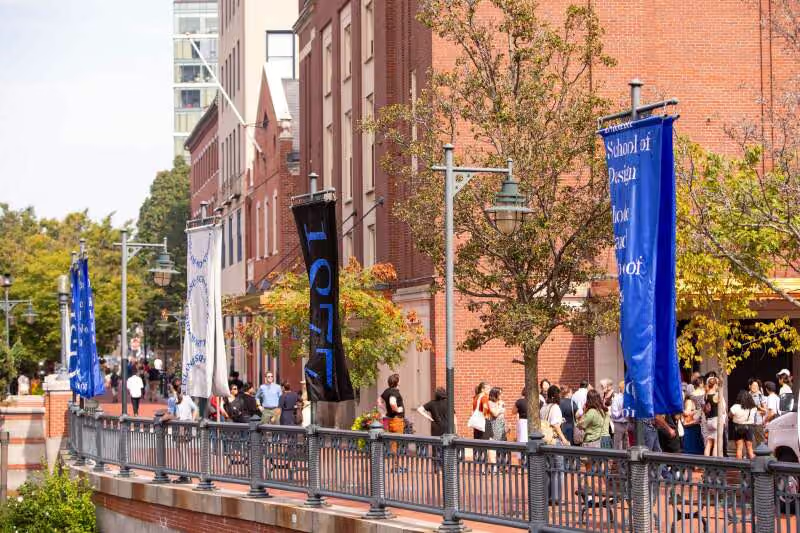
💡 Rhode Island School of Design (RISD) shifted from broadcast messaging to relevance-based digital engagement using interest data and engagement history to match alumni with the right opportunities at the right time. The result: alumni stopped feeling like they were on a mailing list and started feeling like part of a community. (Read the RISD engagement story →)
If there’s one thing the survey makes clear, it’s this:
Advancement is more about relationship quality.
Alumni are still open to engagement, to giving, and still looking for connection and purpose. But expectations have changed. People want authenticity, relevance, transparency and community. And they want institutions to earn attention the same way every other organization now has to. That can feel uncomfortable for advancement teams because it requires moving away from long-standing assumptions. But it’s also a huge opportunity.
Because institutions that adapt early have the chance to build stronger, more resilient alumni relationships than before. These relationships are built on actual value.
The full report explores:
Whether you're making the case internally for a strategy shift or looking for specific benchmarks to anchor your next planning cycle, the full report gives you what you need.

2026 National Alumni Survey: 9 Trends Reshaping Alumni Giving & Engagement
Lorem ipsum dolor sit amet, consectetur adipiscing elit. Suspendisse varius enim in eros elementum tristique. Duis cursus, mi quis viverra ornare, eros dolor interdum nulla, ut commodo diam libero vitae erat. Aenean faucibus nibh et justo cursus id rutrum lorem imperdiet. Nunc ut sem vitae risus tristique posuere.

Sanna Bara
May 26, 2026
12 minutes
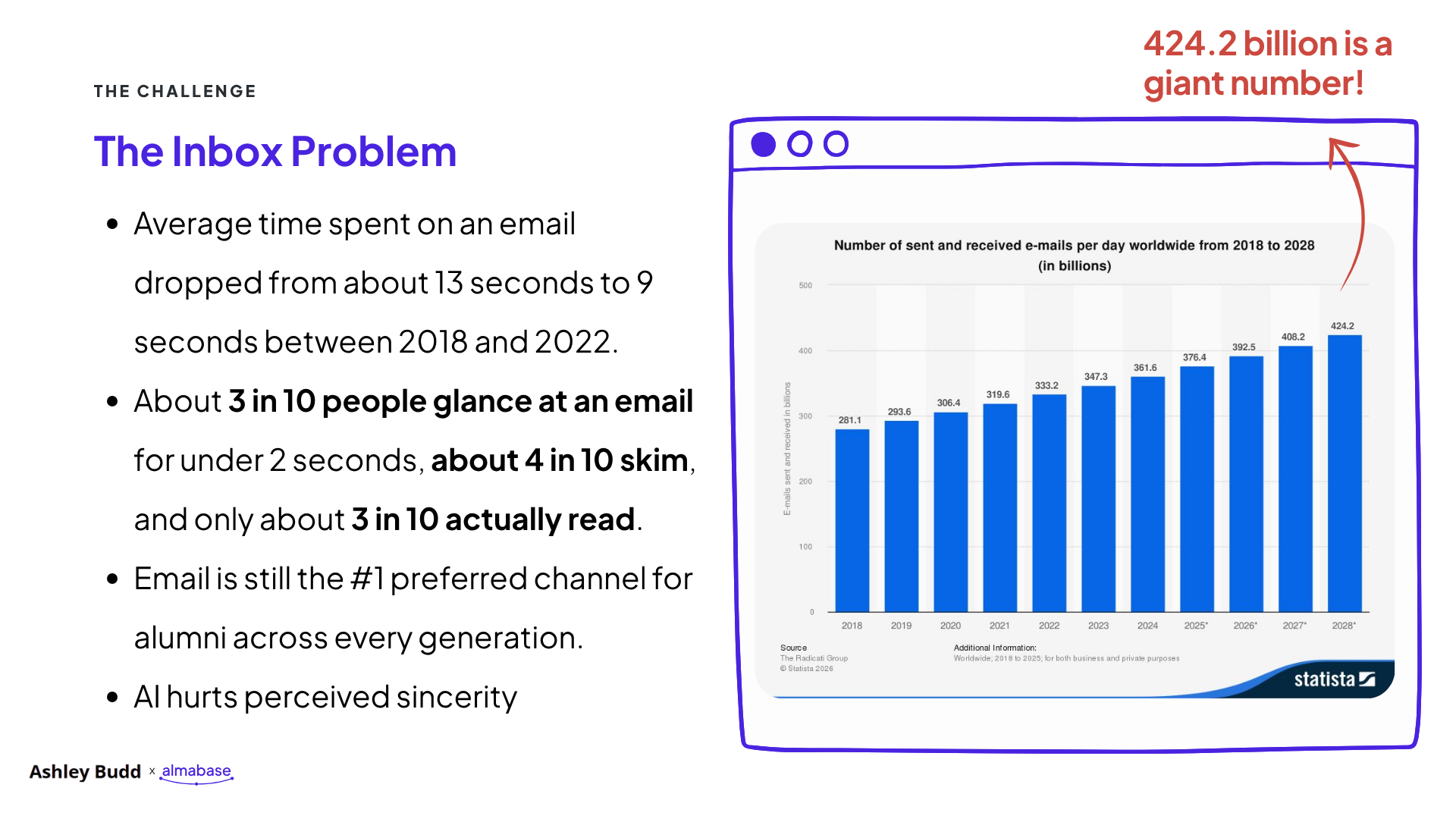
Over 400 billion emails get sent every single day! That’s a huge number, and maybe not too surprising when you look at your very own inbox and see 2,359 unread emails.
Yet, email remains one of the most effective ways to communicate with alumni.
So, how do we make our emails stand out?
To answer this, we caught up with Ashley Budd, nonprofit consultant, former Senior Marketing Director at Cornell University, and co-author of Mailed It! She has spent years working on alumni communications and has plenty of lessons to share.
In our recent webinar, How to Write Emails Alumni Actually Want to Open (Even in the Age of AI), Ashley walked us through what makes people open emails, read them, and take action.
Here are seven practical lessons from the session that you can try in your next alumni email.
Think about how you read your emails. Do you read every word? Or do you scan the subject lines, glance at a few messages, and open the ones that catch your attention?
Your alumni do the same.
During the webinar, Ashley shared research showing that the average time people spent reading an email dropped from around 13 seconds in 2018 to 9 seconds in 2022. About 3 in 10 people glance at an email for less than two seconds, while around 4 in 10 skim it.
That leaves you with very little time to get your message across.
Ashley's advice is simple: write for the two-second glance.
Try this: Open your next alumni email and look at it for two seconds. Then look away. Can you tell what the email is about and what the reader should do?
If you can't, it's time to simplify.
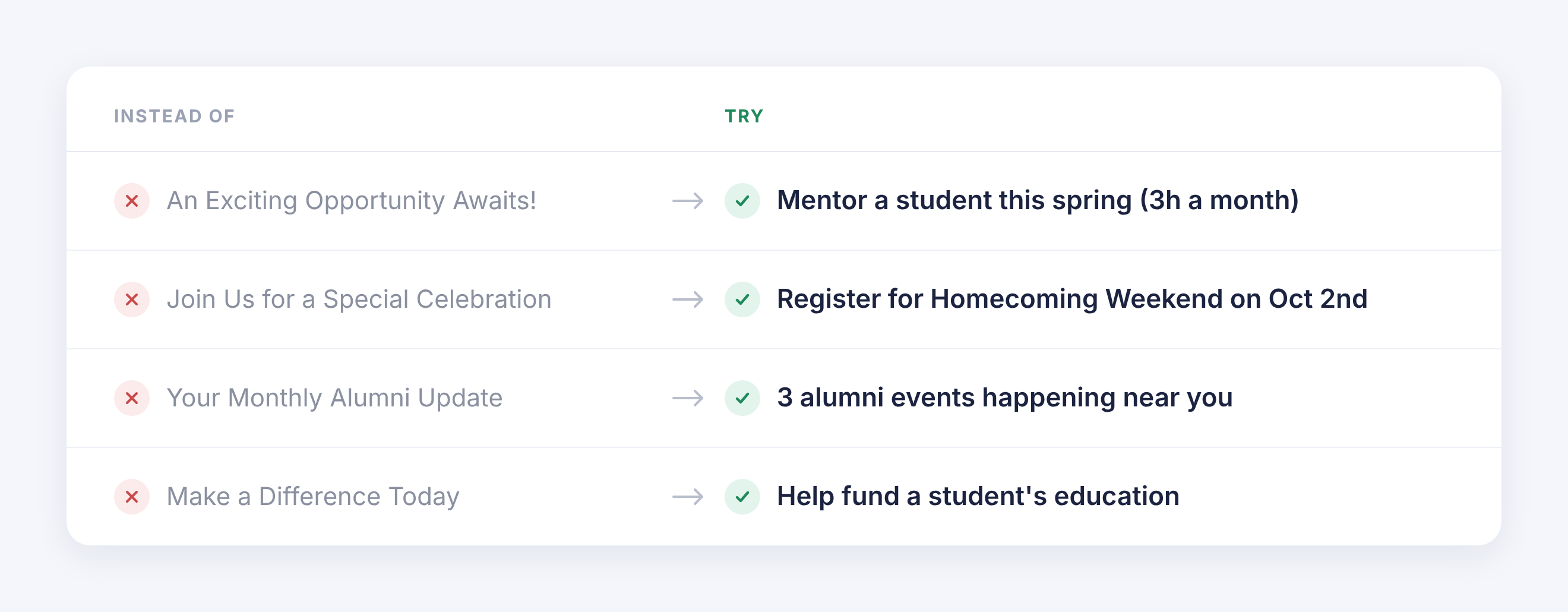
We spend a lot of time trying to write clever subject lines. But when people have hundreds of emails to get through, they want to know what each email is about.
During the webinar, we shared this example.
Option A: Alumni Newsletter | October 2026 | Issue 14 Option B: Homecoming photos and 3 alumni events near you
Which one would you open?
Option B gives readers a better idea of what they'll find inside. But there's a catch. If your alumni newsletter has built a strong reputation and people recognize its name, leading with the newsletter's name might work better. It all comes down to relevance. Think about what your audience recognizes, what they care about, and what would make them want to open your email.
Ashley recommends keeping subject lines to around six to nine words. Use simple language and give readers enough information to decide whether the email is worth opening.
Your sender name matters too. People check who sent an email before deciding whether to open it. Use a name your alumni will recognize, whether that's your institution, an alumni association, or a familiar staff member.
Try this: Before sending your next email, write three subject lines. Ask a colleague to pick the one that tells them the most about the email. Use that feedback to improve your final version.
Imagine you're hosting an alumni networking event in Boston. You send an invitation to every alumnus in your database, including people who live thousands of miles away. Some might be interested, but most won't be able to attend. This is where audience segmentation helps.
Ashley suggested grouping alumni into three broad categories based on their engagement.
Off-the-grid alumni: People you have trouble reaching. Their contact details may be outdated, or they haven't interacted with your communications in a long time.
Wallflowers: People who occasionally open your emails but rarely attend events, volunteer, or donate.
Engaged alumni: People who regularly open emails, click links, attend events, volunteer, or give.
Each group needs a different approach. Your engaged alumni may be happy to hear from you more often. Wallflowers may respond better to fewer emails with a clear reason to get involved. Off-the-grid alumni may need help reconnecting with your institution.
Start with the information you already have.
You can also ask alumni what they'd like to hear about. A short survey or a simple choice within an email can help you understand their interests. You don't need to build dozens of segments on day one. Start with two or three groups and see how the response changes.
If your team uses Beacon, Almabase’s fundraising marketing platform, you can segment alumni by giving history, location, and class year, then use dynamic content to tailor each email to the group receiving it. If you use Raiser’s Edge NXT, you can also use your existing segments directly, without exporting or uploading data.
Try this: Pick an upcoming event or campaign. Instead of sending the same email to everyone, create two versions for different groups of alumni. Change the opening, the details, and the call to action to suit each audience.
Then compare the results.
A common mistake in advancement emails is spending too much time talking about the institution. The email starts with the department, explains the program's history, and eventually gets to the reason for writing. By then, the reader may have moved on.
During the webinar, Ashley showed an example of a Giving Day email.
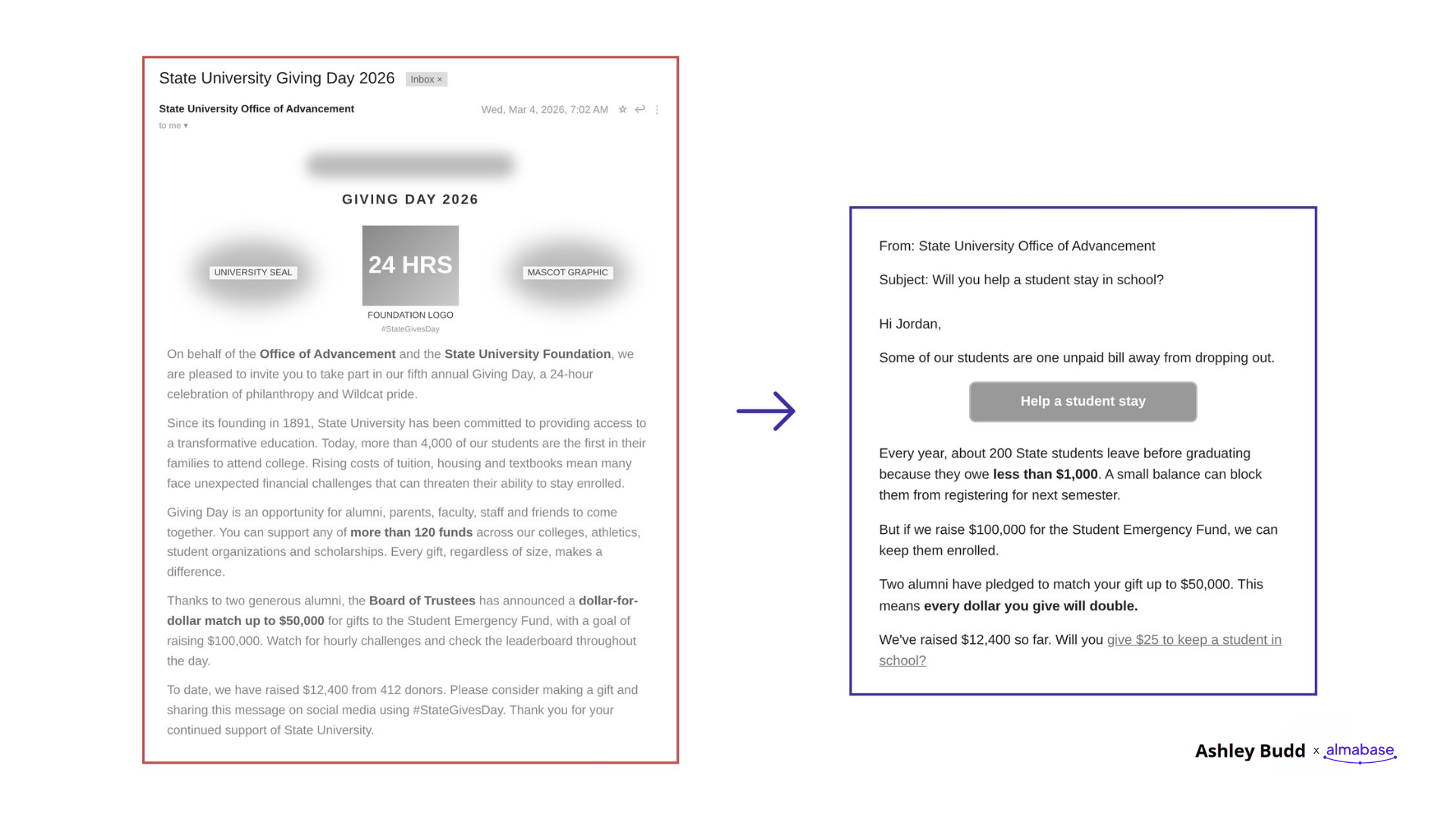
The original version included background about the foundation and its campaign. The revised version opened with a clear message:
Subject line: Will you help a student stay in school?
Opening line: Some of our students are one unpaid bill away from dropping out.
Call to action: Help a student stay.
The revised email quickly explains why the campaign matters and how the reader can help. This approach works for alumni events, mentoring programs, volunteer opportunities, and fundraising appeals.
Before writing your next email, ask yourself:
Use your answers to write the opening. For example, if you're promoting a mentoring program, you could write:"Help a student take the next step in their career. Share your experience as a mentor this spring."
This gives alumni a clear reason to get involved. You can add more information about the program further down the email.
Try this: Look at the first two sentences of your next email. Do they explain why the message matters to the reader? If they mainly talk about your department or institution, rewrite them.
Once someone opens your email, the next job is to help them understand what to do. Ashley shared five elements that can make emails easier to read and act on.
Ashley recommends writing at around a sixth- to ninth-grade reading level. This helps people understand your message quickly, especially when they're scanning it on their phones.
For example:
Instead of: "We invite you to participate in an opportunity to facilitate meaningful professional development for students."
Try: "Help a student prepare for their future career."
Read your email aloud. If a sentence sounds too formal or takes a second read to understand, rewrite it. Ashley suggested Hemingway Editor to check the reading level of your writing and highlights sentences that are hard to read.
Every email should have a clear purpose. Are you asking alumni to register for an event, make a gift, or sign up as a mentor? Choose one main action and make it easy to find. You can include other links when necessary, but make sure the primary action stands out.
Links such as "Click here" and "Learn more" don't tell readers much. Ashley recommends using a verb followed by an explanation of what happens next.
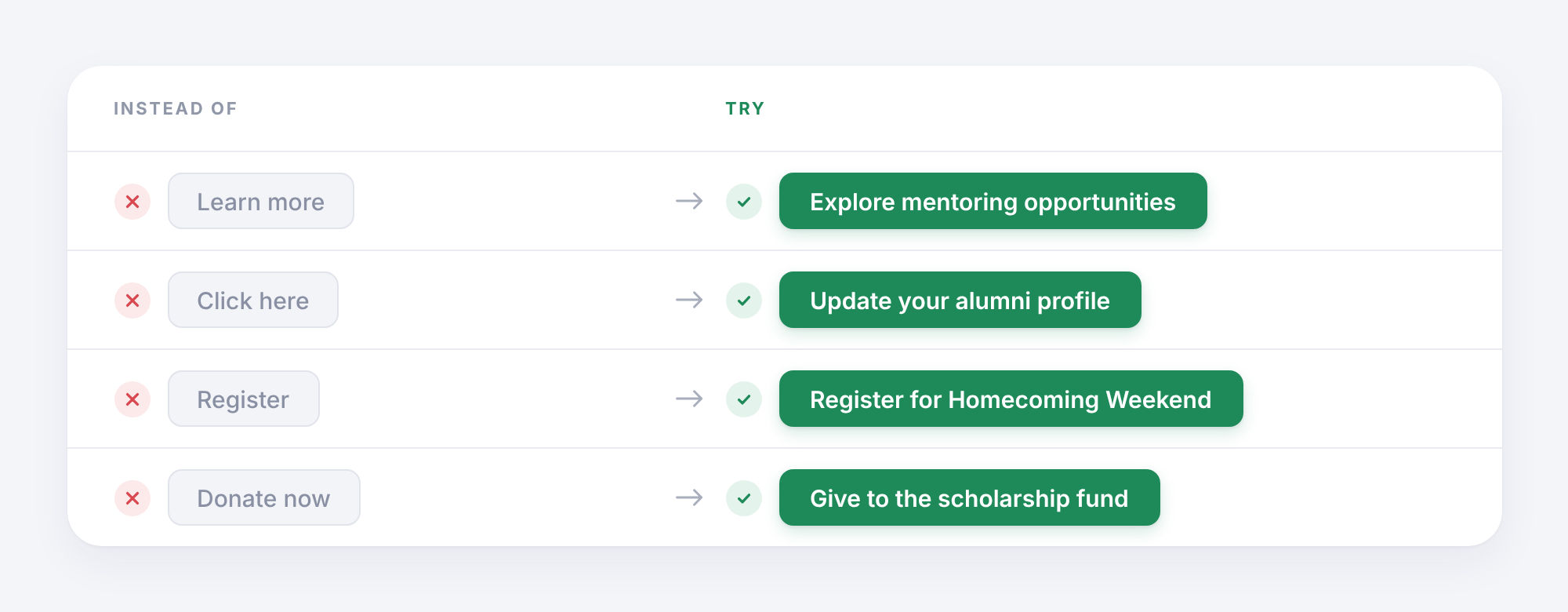
Clear link text helps readers understand where they'll go before they click.
Many emails place the call-to-action button at the very bottom, after several paragraphs of background information.
Ashley recommends placing the primary button near the top, after the opening message. People who are ready to act can do so immediately. Others can keep reading for more information.
Images can make an email look good, but people may skip over them while scanning. If your event date, location, or registration deadline appears only inside a graphic, readers could miss it. Include these details in the email text too.
Try this: Take your next email and check three things: Can readers understand the main message quickly? Can they find the primary button? Does the button explain what happens when they click?
Small changes here can make your emails much easier to use.
AI tools can help advancement teams write emails faster. They can suggest subject lines, create first drafts, and adapt messages for different audiences. During the webinar, we discussed several useful ways to bring AI into the writing process.
These tasks can save time, especially when your team has several campaigns running at once.
However, every draft still needs a human review.
AI can get names, dates, and facts wrong. It can also produce generic language that sounds nothing like your institution. In fundraising communications, these mistakes can affect the trust you've built with alumni and donors.
"Help me write an email for our alumni relations team.
Goal: [What do we want readers to do?]
Audience: [Who are we writing to? Include their graduation year, location, interests, or past engagement if relevant.]
Key details: [Add the verified information, dates, links, and other facts.]
Write a short email that:
Do not invent facts, names, statistics, or stories. Flag anything that needs checking. Give me three subject-line options and one email draft."
Once AI gives you a draft, read it carefully. Check the facts, add details from your own knowledge, and edit the language until it sounds like your team.
You don't need to spend hours reviewing every email. A short checklist can help you catch common problems before they reach your alumni.
Ashley reviewed several real advancement emails during the webinar, including a Homecoming invitation, an alumni networking invitation, and an alumni newsletter. Her feedback focused on making the message easier to follow, bringing key information forward, and helping readers find the next step.
Here's a checklist you can use with your team.
You can also ask a colleague to read the email for two seconds and explain what they understood. If they can't identify the main message, you have a clear place to start editing.
Writing better alumni emails starts with a few simple habits.
Make your subject lines clearer. Use the first sentence well. Send relevant messages to the right groups. Keep your language simple and make the next step obvious.
For your next campaign, choose one email and try three changes:
Then look at how your alumni respond.
Over time, these small changes can help your team build emails that people find useful and want to engage with.
This article is based on our webinar with Ashley Budd, How to Write Emails Alumni Actually Want to Open (Even in the Age of AI).
Watch here:
You can find Ashley's newsletter and more of her work at ashleybudd.com.
For more on creating relevant alumni communications, explore Almabase's fundraising marketing platform.

How to write emails that your alumni actually want to read (even in the age of AI)
Lorem ipsum dolor sit amet, consectetur adipiscing elit. Suspendisse varius enim in eros elementum tristique. Duis cursus, mi quis viverra ornare, eros dolor interdum nulla, ut commodo diam libero vitae erat. Aenean faucibus nibh et justo cursus id rutrum lorem imperdiet. Nunc ut sem vitae risus tristique posuere.

Sushmitha
October 21, 2026
12 minutes
Alumni engagement is not just a buzzword—it’s a critical component of an institution’s long-term success. It involves cultivating meaningful, lasting connections between graduates and their alma mater, relationships that provide mutual value.
In fact, 87% of alumni professionals acknowledge the need to improve member engagement, underscoring the demand for approaches that go beyond traditional methods. And in a world where digital communication is so crucial, implementing alumni engagement best practices means having a solid alumni engagement strategy backed by thoughtful planning and the right technology to bring it to life.
This guide takes you through ten proven strategies to refresh your approach and build stronger, more sustainable bonds with your alumni community.
Alumni engagement refers to all the ways in which graduates stay connected to their alma mater after they’ve moved on—whether it’s by attending reunions, mentoring students, offering their professional expertise, or even making a donation. The Council for Advancement and Support of Education (CASE) defines alumni engagement as any activity that alumni find valuable, that helps build long-term, mutually beneficial relationships, and that encourages loyalty, support, and a stronger institutional image.
And the benefits go well beyond fundraising. When alumni are actively engaged, they become powerful allies for the institution. They:
A great real-world example comes from Franklin College, which built a comprehensive scoring system to track alumni interaction across multiple channels. Using tools like Power BI and automation, they created a live dashboard that gave them a clear view of engagement metrics. This helped them pinpoint their most involved alumni and personalize their outreach—an excellent model of how a data-driven alumni engagement plan can deliver impressive results.
Another success story comes from the California College of the Arts’ MBA in Design Strategy (DMBA) program. With limited resources, the team launched a crowdfunding initiative using Almabase. In just 21 days, they raised $4,534—not only covering their platform costs but also jumpstarting a dynamic online alumni community. It’s a perfect example of creative and strategic alumni engagement that brings people together and makes a lasting impact.
Here are ten strategies for boosting alumni engagement this year, with insights into how Almabase can help institutions implement these approaches effectively.
Tailored outreach is essential for meaningful engagement. Generic mass emails and one-size-fits-all communications no longer resonate with today's alumni, who expect personalized experiences in all their digital interactions.
According to Campaign Monitor, segmented email campaigns can result in a 760% increase in revenue compared to non-segmented campaigns. Additionally, emails with personalized subject lines are 26% more likely to be opened.
Almabase enables institutions to automate personalized communications at scale by analyzing alumni data and creating dynamic content based on individual preferences, career paths, and past engagement history.
Many institutions struggle with scattered data across multiple systems, making it difficult to gain a holistic view of alumni engagement.
Tracking alumni behavior—such as event attendance, volunteer participation, or donation patterns—provides insights that can optimize engagement strategies. Today, a well-maintained CRM combined with an effective tool can allow your institution to automate and personalize alumni communications at scale, track engagement through synced dashboards, and continuously enrich alumni data to keep relationships strong.
Almabase's engagement reporting consolidates touchpoints like email interactions, event registrations, and volunteer hours into actionable data. Institutions can categorize activities into experiential, philanthropic, voluntary, or communication-based touchpoints to better understand alumni interests and patterns of engagement.
Events that address specific career stages or interests typically see significantly higher attendance than general alumni gatherings.
Creating events tailored to specific alumni segments—such as virtual networking sessions for young professionals, industry-specific panels, or exclusive reunions—can drive higher participation rates.
An event management suite allows institutions to manage complex events easily, providing attendees with a seamless experience from registration to check-ins and payments. This comprehensive approach enables advancement teams to focus on creating meaningful experiences rather than managing logistics.
Connecting alumni with current students through structured mentorship programs fosters meaningful relationships while enhancing career opportunities for students. These programs also provide alumni with a tangible way to give back beyond financial contributions.
Many alumni engagement tools today support mentorship initiatives by offering tools that facilitate easy sign-ups, mentor-mentee matching based on career paths or interests, and tracking participation metrics. These tools usually include guided checklists and templates to assist institutions in setting up mentorship programs effectively. It also enables automated feedback loops, allowing for regular check-ins and the collection of feedback to improve the program over time.
Giving Empowering engaged alumni to act as ambassadors can significantly amplify outreach efforts. Ambassadors can lead initiatives such as fundraising campaigns, host regional meetups, or serve as points of contact for fellow alumni in their geographic area.
Many engagement tools can be used for ambassador programs to recruit, train, and support these volunteer leaders effectively. The platform offers resources like communication templates, marketing toolkits, and real-time tracking metrics to help ambassadors promote campaigns and events successfully.
Segmenting alumni into interest groups based on graduation year, academic program, career field, or geographic location ensures that communication remains relevant.
Beyond newsletters, creating dedicated content hubs where alumni can access resources related to their interests—whether it's career development, continuing education, or industry insights—provides value and keeps them connected to their alma mater between your events and campaigns.
Check out how institutions can use segmentation and automation to send personalized newsletters to different alumni groups, increasing both open rates and engagement here.
Recognition is a powerful motivator for continued engagement. It tells your alumni base that you value their time and contribution, and that you want to keep having them around. Digital badges, alumni spotlights, and public acknowledgment of volunteer contributions or professional achievements can significantly boost participation rates.
💡Almabase allows you to build alumni spotlights to recognize and celebrate alumni achievements.
Creating spaces for alumni with shared interests, identities, or experiences builds stronger connections to the institution. Whether based on student organizations, cultural backgrounds, or professional fields, these communities foster a sense of belonging that enhances overall engagement.
With tools such as Almabase's community-building tools, institutions can create dedicated spaces for affinity groups to connect, share resources, and organize their own events, driving deeper engagement through peer-to-peer relationships.
Institutions often struggle to maintain updated contact information for all graduates. As alumni change jobs, relocate, or adopt new email addresses, they can become disconnected from their alma mater despite a willingness to stay involved.
💡Almabase’s alumni directory addresses this challenge by enabling alumni to update their own profiles through user-friendly portals. Additionally, the platform simplifies the data enrichment process by allowing alumni to pull updated information from their Facebook and LinkedIn profiles. This data is presented in a neat dashboard for all your alumni outreach needs.
Fundraising is a key aspect of alumni engagement, but its success depends on offering diverse giving options that resonate with alumni interests and capacities.
Institutions that provide multiple channels for giving—such as annual funds, crowdfunding campaigns for specific projects, and peer-to-peer fundraising—often see higher participation rates across all metrics.
💡If you’re looking for an effective and easy-to-set-up giving platform, do check us out!
Alumni engagement is a long-term commitment to nurturing meaningful connections that benefit both the institution and its graduates. With the right approach, these relationships can evolve into powerful partnerships that support everything from mentorship and advocacy to fundraising and brand building.

10 Strategies to Boost Alumni Engagement in 2026
Lorem ipsum dolor sit amet, consectetur adipiscing elit. Suspendisse varius enim in eros elementum tristique. Duis cursus, mi quis viverra ornare, eros dolor interdum nulla, ut commodo diam libero vitae erat. Aenean faucibus nibh et justo cursus id rutrum lorem imperdiet. Nunc ut sem vitae risus tristique posuere.

Anwesha Kiran
April 22, 2025
12 minutes