Discover essential strategies for building donor trust online. Learn how your nonprofit can improve site security, keep content fresh, and solidify authority.

Ira Horowitz
Updated:
October 6, 2026

Before making a gift, many donors will do their homework by visiting your website, scrolling through your social media, and searching your organization’s name to see what comes up. Along the way, they’re watching for red flags like slow-loading pages, a cluttered or spammy layout, or an events page that hasn’t changed in three years.
And they’re doing this with good reason. Online scams are more convincing than ever, and AI-generated content has made it harder to tell what’s real. As a result, users are increasingly approaching unfamiliar websites with a dose of skepticism. This means that non-profits and higher ed institutions cannot assume trust and credibility, and it has to be built with donors.
Building donor trust online comes down to a handful of practical habits that can also support strong donor relationships in the long term. In this article, we will walk you through three ways to show donors your organization is secure, active, and credible.
Even if donors connect with your mission, they need to know their credit card and personal information are safe. If your site feels risky, even the most moving story won’t get them to click “Donate.”
Start with these basics:
Privacy expectations are shifting as technology changes, too. Many donors now want to know how organizations handle their information, including whether AI tools are involved. It’s worth reading up on how advancement teams are approaching AI and donor trust so your data practices keep pace.
Picture this: a prospective donor lands on your homepage and sees “meals served in 2021” as your highlighted metric. Then they go to your Facebook page and see that your most recent post is from last year. This could send confusing messages about if your organization is still active or not.
Fresh content signals that your organization is still at work pursuing its mission. Here are some tips to help keep your content fresh and engaging:
The same principle applies to your outreach. Short, timely donation messages that mention current campaigns and recent wins show donors their support is part of something happening now.
Regular nonprofit website maintenance makes all of this easier. When you set a schedule for reviewing content, checking links, and refreshing stats, your site will never have the chance to look abandoned.
When prospective donors want to learn more about your school or the issues your nonprofit tackles, they search. If they can’t find you, or worse, if they find inaccurate information about you, they won’t see you as an authority on the subject.
Search is also changing fast. Tools like Google’s AI Overviews and Perplexity now summarize answers right in search results, and many people ask their questions directly to large language models (LLMs) like ChatGPT, Claude, and Gemini. That means organizations need to optimize for traditional search engines to make sure AI tools cite them as the trusted source.
Luckily, many best practices support both traditional search engines and AI tools. To help your content show up where your donors and advocates are looking, try the following:
While AI search is growing, traditional search still drives a significant portion of website traffic. Strong search engine optimization remains the foundation of both. It works best when it’s tied to your overall fundraising strategy, ensuring every optimized page leads visitors to clear calls to action and a straightforward path to donate..
Building donor trust online isn’t a one-time project. It’s an ongoing commitment to keeping your website secure, current, and easy to find. When donors feel confident in your organization, they’re more likely to give and keep giving. That confidence is at the heart of any long-term donor retention strategy.
Small updates add up, and donors notice. Start off by opening your website in an incognito window and look at it the way a potential first-time donor would. Is the copyright in your footer from 2022? Does the browser bar say “Not Secure?” Pick one or two quick fixes and tackle them this week. Donor trust grows through these small moments. Keep your website secure, current, and easy to navigate, and you give donors more reasons to feel confident supporting your organization.
Subscribe
See how modern advancement teams bring alumni engagement and fundraising together.
Plan faster. Execute better
Explore free templates designed for alumni and fundraising teams.
.png)

.avif)
Ira Horowitz
Donors are the champions of your mission, your cause. The connection you have with them ultimately decides your ability to impact people and communities. So having a solid strategy for donor relationship management becomes a key part of ensuring your institution or nonprofit’s success.
In this blog, we’ll explore donor lifecycles, the best outreach and communication practices, helpful tools, and guide you in creating the best relationship management strategy for your organization.
Nonprofits focus on two things primarily to increase funds. Acquiring new donors, and retaining existing ones for continued contributions. Donor relationship management is the set of practices that are used to improve and maintain both.
This includes, but is not limited to campaigning, stewardship, and milestone recognitions, which will be expanded upon in the later sections. Ultimately, it boils down to fostering a positive culture and making donors feel like they’re making a difference.
It’s quite easy (and tempting) to go all-in on acquiring as many donors as possible. While this might lead to great gains in the short-term, building a reliable, sustainable pipeline of donations takes much more.
If you’re aiming for lasting impact and stability, deepening your relationships with your donor base is the way to go. A few important reasons to do this:
1. Improved Donor Retention: It’s a well established fact that retaining donors is a lot more cost-effective than acquiring new ones. Having solid engagement and stewardship plans gives you a much-needed edge in fundraising. Donor retention in the US sits at around 20%, with organizations often underutilizing recurring programs. Use it to your advantage.
2. Increased Donor Lifetime Value: The more loyal your donors are, the more they are likely to contribute. Retained donors have a higher likelihood of increasing their donation amounts, contributing to annual campaigns, and donating to emergency causes in a pinch. They end up feeding your cause a lot more throughout their lifetime.
Overall, organizations with great relationship management practices perform better in fundraising, and have higher DLVs.
3. Greater Advocacy and Support: New donors introduced through friends, family, or word-of-mouth in general tend to stick around. Engaged donors don’t just contribute more long-term, but also bring in new faces and spread word of your nonprofit’s impact and cause.
4. Success Beyond Numbers: Building trust and engaging donors in meaningful ways often is a great way of not only bringing in reliable, recurring revenue, but also creating a sense of community. Your mission is only as strong as the people supporting it. A satisfied donor base contributes in other non-financial ways too, like volunteering.
While coming up with a strategy for building relationships with donors, follow these practices to cover all bases efficiently.
A donor profile holds all the relevant information about your current and prospective donors. They live in your institution’s database or CRM, and have to be updated regularly. Treat them as live documents giving you the relevant, up-to-date data.
Donor profiles are used extensively for almost every step of the way in fundraising. Targeted outreach, reviewing campaign performance, and so much more require accurate donor data.
What do you include in a donor profile? There are some necessary fields that are useful for many fundraising activities. Some important ones are:
Different types of donors need different outreach strategies and messaging. You don’t want veteran donors looking at an introductory email with blank faces. Or scare away first time/casual donors with too much information.
Segmenting your donors based on their financial capability, giving history, volunteering interests, and associations with particular causes lets you execute targeted campaigns that have far more effective conversion rates.
Having segmented lists of donors helps greatly here. You can’t expect someone to be moved by your cause if the messaging sounds like generic marketing slop. While it’s impossible to personalize every single message, you can tweak outreach group-wise. Ask for small contributions from first timers, introduce recurring programs to existing donors.
With the right data and outreach tools, you can even personalize based on local events and non-philanthropic interests.
We probably know this all too well, but if there’s one thing that kills confidence, it’s getting ghosted. Timely recognition is non-negotiable unless you want donors feeling like they’re shooting money into a void.
Immediate thank-you messages acknowledge donors’ valuable time and contribution, and builds trust. Use multiple channels to thank your donors. Apart from one-off emails, social media can be used for collective recognition.
Knowing how exactly your contribution is being utilized is a great way of gaining trust and deepening your relationship with a nonprofit or a mission. Regularly update donors on ongoing initiatives, communities being helped, total money raised for causes, and overall impact.
Take this a step further by sharing video snippets, pictures, and other visual media to make them truly feel like they’re working together with you and are a part of your organization. Engaged donors are more likely to continue contributions long-term.
While emails get the job done, inboxes are more often than not flooded with unimportant emails and your messages can be lost among them. To increase interaction, plan an outreach strategy across multiple channels.
Aside from personalized email sequences, create a social media schedule to reach donors organically. Another underrated channel is text messaging – it feels a lot less formal and increases authenticity.
Your outreach plan should contain steps for initial campaign introduction, building up anticipation in the days leading up to it, live updates during the campaign, and nurture sequences post-event/campaign. Share relevant news and ask for donations every now and then, but don’t overdo it.
With the volume of donors and donations, it can sometimes be hard to track follow-ups manually, leading to gaps in communication. Having a dedicated platform for automating follow-ups makes sure that messages aren’t lost among the confusion.
Regular, timely emails constantly expose your nonprofit to potential donors. Consistent reminders and nudges are necessary as most people operate with tight and busy schedules.
Increasing your donations over time isn’t just about launching effective campaigns or reaching the most donors. It’s also about identifying the most engaged participants, seeing what drove the engagement, and replicating it for different donor groups.
Using a digital engagement platform, track metrics that give you an idea of donor engagement. This can include response rates across different channels (fundraising appeals, feedback requests, social media engagement), number of event/volunteer sign-ups, donor retention rate, and online engagement metrics such as email open rate, click-through rates, donation form abandonment rate, and website traffic sources.
As emphasized earlier, your donor profiles are live documents that contain accurate, updated information at all times. Inaccuracies in donor data can lead to wrong segmentations, incorrect campaign enrollments, and mismatched donation data, all of which affect fundraising performance in subsequent campaigns significantly.
While it’s possible to manually update records, it can be very time consuming and leave your head spinning. Using workflows to auto-update fields and contributions is a lot more efficient and accurate.
Some essential metrics allow you to measure your progress and to see how good your donor management strategy really is. These are different from donor engagement metrics; evaluating fundraising performance can give you a good indication of how much donors are willing to contribute to your cause, which groups have the most capability, what segments are strong targets, and where your teams can improve.
Here’s a few of them in no particular order:
Donor lifecycle is the journey that unaware, potential donors make that ends in some form of contribution to your cause. There are various stages in the cycle, each requiring its own set of initiatives and strategies.
Understanding the donor lifecycle step-by-step can help you identify potential gaps in your donor management process, and gives you insight into the donor’s perspective leading to better outreach and retention methods.
Here are the 5 major steps that nonprofits take to manage donors:
This is the start of it all, when your nonprofit tries to identify prospective new donors and engage with them. To do this, you utilize paid ads, emails, and social media to reach low to mid-level donors.
They might also land in your website through referrals, word-of-mouth, or stumbling across some of your mass-communication material.
For acquiring major donors though, a more personalized approach is required. This usually means researching affluent donors who might be connected to your cause or willing to contribute to it and contacting them through their preferred channel of communication (calls, emails, etc).
In this stage, nonprofits start building their relationships with potential donors. For casual donors, this means introducing your nonprofit’s mission, the goals, initiatives and the like. The key here is to build trust; answering queries and showcasing impact are important.
Cultivating major donors isn’t as straightforward. Aim for long-term relationship building by meeting them one-on-one, developing consistent communication threads, and offering engagement opportunities that will expose them directly to your nonprofit’s work, like volunteering and attending events.
Again, keep in mind that major donor cultivation can take a long time. Constantly research, personalize, and meet. Fundraising performance depends on your charisma too, no pressure.
Once you’ve introduced your nonprofit and its causes, donors will evaluate if it’s worth contributing to. You will be asking donors to contribute for the first time, and this is easy with smaller gifts. After all, $10 isn’t exactly life changing for either party. The intent here is to get them to make a contribution, how much doesn’t really matter at this stage.
To turn interest into action, make your forms easy to fill (only the necessary details), and make it easy to contribute. Payment should be frictionless, and they should have multiple choices when it comes to payment modes.
Soliciting major donors might require a lot more presentation, involvement and relationship-building beforehand.
It’s very important to express gratitude for contributions, and make donors feel recognized. This can range from a simple thank-you email to major personalized gifts and plaques.
One good pointer to keep in mind is to match the scale of their contribution. For example, for small donations, a simple email might suffice. For major gifts, recognition should involve exclusive event invites, awards, etc.
After receiving donations, have nurture programs in place to ensure constant communication, awareness, and deeper relationships over time. Highlight new initiatives, invite for volunteering, host events, and provide impact updates regularly.
Your stewardship efforts directly tie into donor retention. Aside from that, there are a couple of things you can do to avoid driving them away.
Predicting churn proactively is a good way to boost donor retention. This can be achieved by thorough analysis of data, following up with lapsed donors to get feedback, and creating lists. Another thing you can do is alternating donation requests with other appeals to prevent fatigue.
What does upgrading your donors look like? It just simply means increasing their contributions; converting a one-time donor to a recurring donor, or a casual donor to a major donor are all upgrades. Keep tracking donor engagement and gifting data to determine the right time to ask for more.
We’ve laid out the best practices to cultivate long-term relationships with donors and build a pipeline of steady, reliable contributions over extended periods of time. There are a few minor tweaks which, though optional, can help you identify gaps quicker, save time, and just have an easy time of maintaining the hygiene of the overall process.
Taking a step back and experiencing your organization through a donor’s perspective can be massively helpful in seeing if your process is actually smooth and easy, and finding out where friction creeps in. What’s optimal for your team isn’t necessarily optimal for the average donor.
Often, prospective major donors are hidden in plain sight. By checking wealth data against donor profiles, you might be able to fish out members who are already aligned to your cause and have the ability to contribute a lot more.
Stewardship is a vital part of donor outreach management. Automating the generic follow-ups (immediate thank-you messages or gift acknowledgements) gives you more time to focus on personalized updates and asks.
To actually execute the best practices in donor relationship management, having the right tools is a must. The bare essentials include a nonprofit CRM to build and manage donor profiles, a digital engagement platform for donor outreach management, and an event management tool to coordinate volunteering, award ceremonies, and other interactions with donors.
Just like in real life, donors give subtle hints through the material they choose to interact with. Tracking non-financial activity like content downloads, visits to a particular program page, video views, and email click-through rates gives your team much needed signals on the donor’s affinities to various activities and causes.
The right donor management software can save your team a lot of time and frustration. The wrong one can turn even simple tasks like updating records or sending follow-ups into a headache.
Before evaluating platforms, think about your team's day-to-day work. A tool might have lots of advanced features, but if it has a tacky UI and a steep learning curve, your staff may end up avoiding it altogether. The best donor management software is the one your team will actually use consistently.
Below are a bunch of priorities to keep in mind while you’re on the lookout.
Segmentation is one of the foundations of effective fundraising. Your software should make it easy to group donors based on giving history, donation size, engagement levels, volunteer activity, interests, and other relevant criteria.
The easier it is to create and update donor segments, the easier it becomes to run targeted campaigns and personalized outreach.
Look for platforms that can track donation trends, campaign performance, donor retention, engagement levels, and other fundraising metrics.
Good reporting helps your team identify which donor groups are performing well, which campaigns are driving results, and where improvements need to be made.
Manually handling acknowledgements, follow-ups, reminders, and record updates can quickly become overwhelming as your donor base grows.
A strong donor management platform should automate repetitive tasks such as thank-you emails, recurring donation reminders, event follow-ups, and data updates. This allows your team to spend more time building relationships and less time managing spreadsheets.
Donor information often ends up scattered across spreadsheets, email inboxes, event platforms, and fundraising tools. This stands in the way of creating complete donor profiles like we outlined earlier.
Choose a platform that serves as a central source of truth for donor records, engagement history, campaign interactions, and contributions.
Fundraising teams rarely use a single platform. Your donor management software should integrate with donation forms, email marketing tools, event management platforms, and payment processors, or, better yet, have all that functionality built in.
It's also worth thinking long-term. A platform that works for 500 donors should still work when you're managing 5,000.
Ultimately, the goal isn't to find the software with the longest feature list. It's to find a platform that helps your team maintain accurate donor data, automate routine work, execute targeted outreach, and build stronger relationships as things scale without breaking anything.
Almabase brings fundraising and engagement data together in one place, helping teams understand how donors interact with the institution over time. With a connected view of donor activity, it's easier to identify engaged supporters, track interests, and build more meaningful outreach strategies.
The platform also helps teams segment donors based on giving history, engagement levels, event participation, etc. This makes personalized communication easy, allowing you to send more relevant appeals, updates, and stewardship messages to different donor groups, and with the workflow automation capabilities, automate general tasks and follow-ups.
If you’d like to see how Almabase can help you build and nurture your relationships with your donors, feel free to book a free personalized demo and we’d love to discuss how we can help!

10 Donor Relationship Management Best Practices
Lorem ipsum dolor sit amet, consectetur adipiscing elit. Suspendisse varius enim in eros elementum tristique. Duis cursus, mi quis viverra ornare, eros dolor interdum nulla, ut commodo diam libero vitae erat. Aenean faucibus nibh et justo cursus id rutrum lorem imperdiet. Nunc ut sem vitae risus tristique posuere.

Hari Govind
June 16, 2026
12 minutes
The year 2020 served as a warning that anyone can be the victim of a data breach. More than 120 non-profit organisations learnt that their data was at risk after a breach in Blackbaud's platforms by a ransomware attack. Millions of donors, customers, and staffers were affected, and the incident became the most impacting data breach of 2020.
The ransomware fiasco necessitates reiterating the principal duty of educational institutions to secure the data of their trusting constituents.
Advancement leaders are custodians of data of thousands of alumni and donors, and securing their data must be their highest priority. A lapse in security can have a damaging effect on advancement, as years of relationship-building can be undone by one moment of vulnerability. It is, therefore, the responsibility of institutions to reaffirm their seriousness towards security by adapting secure systems to solidify their constituent's trust in them.

Today, passwords are also a threat to our security. Traditional password authentication is susceptible to threats such as data breaches and phishing. According to a report conducted in 2020, 63% changed their passwords due to a security breach.
In addition to external risks, our heedless habits with managing and sharing passwords increase their risk of exposure.
Our habits with passwords coupled with the looming risk of attacks prove that passwords are no longer a safe way of authentication.
.avif)
At Almabase, we have taken proactive measures to secure the data of its customers and their constituents.
We have integrated with Auth0 to upgrade our login mechanism to become completely password-less. By replacing passwords with single-use codes, this mechanism immunes itself from threats.
This partnership with Auth0 moreover aims to improve the experience of members. Single-use codes will help even the most infrequent users log in without the need to remember their passwords. The platform now also supports SSO (Single-sign-on) via Facebook, Linkedin, and Google, in addition to allowing members to log in using any of the multiple emails listed on their records.
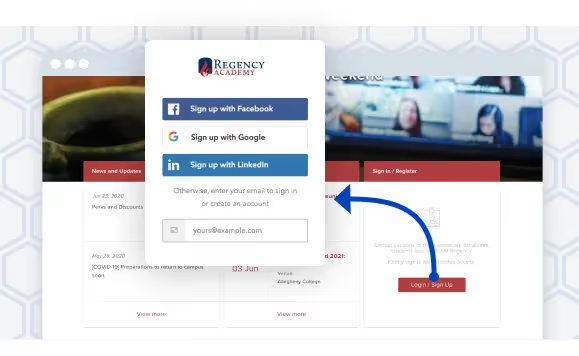
On top of improving the login experience and making it robust, the platform now also supports moderation of access to content and resources to segments of users based on criteria admins set.
With these upgrades, millions of alumni across hundreds of institutions will access their data securely online. We hope that institutions take data security seriously across all their systems, allowing for this relationship to build on greater trust.

How Securing Alumni Data Is Pivotal To Building Trust
Lorem ipsum dolor sit amet, consectetur adipiscing elit. Suspendisse varius enim in eros elementum tristique. Duis cursus, mi quis viverra ornare, eros dolor interdum nulla, ut commodo diam libero vitae erat. Aenean faucibus nibh et justo cursus id rutrum lorem imperdiet. Nunc ut sem vitae risus tristique posuere.
Successful school auctions require significant planning, thoughtful execution, and effective follow-through. Since they can be so involved, how do you measure their ROI? Of course, you’ll track your fundraising goals, but another underused metric can help supercharge your efforts: donor relationships.
School auctions help you increase both the quality and quantity of your donor relationships to facilitate future support, improve donor loyalty, and build sustainable engagement habits.
.jpeg)
Think about how you foster these relationships before, during, and following your auction. To help you get started, we’ve listed our top recommendations for making the most of your school auction. Let’s jump in!
To tailor your outreach approach, research potential attendees in advance to determine who you should prioritize inviting and engaging with. Reference your data and be sure to invite previous attendees with:
Pay special attention to your most recent audience data that dates back about two years. Using this data, you can identify your high-impact donors and tailor your outreach and auction format to engage them. For example, you might recognize their impact from the previous year and ask them if they have any auction items they would like to see at this upcoming auction.
While researching individuals to invite to your auction, note their business affiliations. These connections will help you uncover valuable insights into other opportunities for potential guests to contribute to your school.
Here are a few opportunities business affiliations can present:
Reference these business affiliations when preparing a live auction. For instance, you might create a seating chart with two (friendly) business competitors side by side to increase healthy competition.
Leading up to your school auction, lay the groundwork for building lasting donor relationships that engage your community. Doing this will open the door to opportunities for long-term connections. To increase anticipation before your auction, consider:
According to SchoolAuction.net, pre-auction event planning and promotion can define your auction’s success as promotion is the first step in inviting donors into a productive relationship. In other words, effective event promotion will widen your reach which can positively impact your donor acquisition efforts.
For best results, stick to posting on channels that your alumni and other potential guests are already active on. For instance, many schools have active Facebook groups you can leverage to get the word out about your upcoming auction.
During the auction, have your team mix and mingle with guests freely. That means you should avoid spending time supervising check-in, check-out, and other bidding procedures. To streamline auction logistics, use comprehensive auction software.
Use software that offers the following features to streamline your event:
These features are essential for providing an unforgettable guest experience. You might consider partnering with an auction provider whose software is also format flexible, so you can easily transition in-person auctions to hybrid or online formats. Built-in gamification features like countdowns and outbid notifications are also useful tools for enhancing the bidding experience and spurring friendly competition.
Your work is not over after the auction! Engage your auction guests and communicate that your school is willing to go the extra mile even after securing support. To make your guests feel valued, follow these best practices:
.png)
Your recognition and gratitude efforts will vary according to the donor. For instance, you might mention major sponsors in your newsletter updates, call them personally on the phone to express gratitude, or plan an appreciation event to celebrate their generosity.
By considering which donors to invite, how you’ll invite them, and how you’ll engage them, you can set the stage for long-term relationships. Use tools like prospect research and auction software to plan and execute your auction. That way, you can expand your network and streamline your event. To your fundraising success!

5 Tips for Building Donor Relationships at School Auctions
Lorem ipsum dolor sit amet, consectetur adipiscing elit. Suspendisse varius enim in eros elementum tristique. Duis cursus, mi quis viverra ornare, eros dolor interdum nulla, ut commodo diam libero vitae erat. Aenean faucibus nibh et justo cursus id rutrum lorem imperdiet. Nunc ut sem vitae risus tristique posuere.

Roger Devine
July 13, 2023
12 minutes
%201.svg)
%201.svg)
%204.svg)



.svg)