While the homecoming season is not over yet, 2024 has proven that educational institutions have learned a lot from previous years to enhance alumni relations.
Published:
October 24, 2024
Updated:

While the homecoming season is not over, 2024 has proven that educational institutions have learned much from previous years.
In this blog, we’d like to explore some interesting trends and strategies that we observed and what other institutions can learn from them. Let’s get started:
Author's Note: We chose these examples purely based on what we found interesting and no promotions, rewards, or affiliations were involved in the creation of this blog.
Many institutions continue to see the value of hybrid events to connect with a broader alumni base as it provide a mix of in-person and virtual experiences. By allowing alumni to participate regardless of their location, it reinforces the sense of community.
University of Maryland Global Campus (UMGC) and their Spirit Week featured global events, both virtual and physical, allowing alumni from different countries to join the celebrations. Participants engaged in creative challenges throughout the week via social media, using hashtags and even attending events in the Metaverse to feel more connected to their alma mater.

Illinois State University incorporated a hybrid approach with its "Town and Gown Hybrid 5K Run," combining a physical race and virtual participation to encourage broader alumni involvement. Virtual participants could run in their own location, submit their race times online, and even receive race shirts by mail. To foster engagement, participants were encouraged to share their experience on social media using the hashtag “#RedbirdHomecoming”.

It’s exciting to see that adding hybrid options to homecoming events is gaining popularity, with broadcasting key events like parades via live streams becoming a standard practice. This is a welcome development as it allows alumni to experience the vibrancy of campus life even from afar.
While post-event surveys are a valuable tool, simply sending out a form may not always entice alumni to participate. To improve engagement and gather richer feedback, institutions can enhance the way they collect and share insights. This year, we have noticed some of these insights being put into action:
St. John’s College had not hosted a homecoming event since 2019. As they planned to resume in 2024, they not only invited feedback but also announced the changes early in the year. Seemingly small steps like these can go a long way in fostering alumni trust and confidence.

Bowdoin College took an introspective approach by including a feedback link within a narrative recap of their Homecoming 2024. Alumni were encouraged to reflect on their experiences while reading a vibrant recap and visual gallery of the events, giving them value and encouragement to provide feedback for their next iteration. You can check it out here.

Recognizing outstanding alumni, supporters, and community members during homecoming can strengthen their connection to the institution while inspiring current students and fellow alumni. In addition to the typical alumni hall of fame, we’ve seen awards pop up to recognize younger alumni, active volunteers, and career spotlight awards.
Morehead State University (MSU) continued to host its annual Homecoming Awards to celebrate distinguished alumni who have made significant contributions. What we love about their approach is that they celebrate a diverse array of appreciations that cover various segments of their alumni at a banquet in addition to their hall of fame. You can find their list of award recipients here.
Another great way to appreciate alumni careers while engaging them is to use homecoming as an opportunity for them to give back. Some of the institutions that have taken this idea forward are:
These are just some examples of taking the homecoming spirit forward as a way to bridge the gap between present and future alumni.
Over the past few decades, Homecoming has proven to be one of the best opportunities to engage alumni while having some room to innovate and be creative. This year, several institutions continued to embrace creative events that provided unique experiences for all attendees.
Millerverse University hosted the Skully Shoppes, an event that promoted local artisans and student businesses. This initiative supported entrepreneurship by allowing alumni to connect with current students through shared interests and local culture.

Hesston College featured an art auction and exhibition showcasing art pieces made from local wood collected on campus. This creative twist encouraged alumni and community members to engage with the institution’s commitment to sustainability and artistic expression, making it a meaningful experience for attendees.
Kennesaw State University hosted a variety of esports tournaments as part of their homecoming celebrations, tapping into the growing interest in gaming and technology. This event not only attracted current students but also engaged alumni who share a passion for esports, fostering a lively atmosphere that appealed to diverse interests.

While there are many more exciting homecoming events to come, what we’ve seen so far this year has been very positive. Institutions seem to be easing into the pure net-positive additions such as adding live-streaming options to parades, and diversifying award categories to appreciate different alumni segments. What we love to see is that the unwavering sense of community-building and appreciation continues to be at the heart of all homecoming initiatives, both old and new.
We hope that some of our observations will have given you some insight into the homecoming season so far this year, as well as provided some inspiration for your continued advancement and alumni relations efforts.
Subscribe
See how modern advancement teams bring alumni engagement and fundraising together.
Plan faster. Execute better
Explore free templates designed for alumni and fundraising teams.
.png)

.avif)
Homecoming or Alumni Weekend days are one of the most significant events in an institution's calendar. These are opportunities to create memories and meaningfully engage with alumni across age groups, gather up-to-date data, as well as build lasting relations, hoping they’ll come back later for another milestone event.
As an advancement professional, we understand that you’re constantly looking for ways to improve engagement, retention, and fundraising drive.
Here's how some colleges leverage their creativity to make the most out of their homecomings and alumni weekends/reunions.
The Robert Wesleyan College Homecoming is a weeklong extravaganza of all things fun.
They have an exciting array of events planned for alumni and students alike, from live music performances and soccer games to reunions and awards ceremonies.
They also have panel discussions on navigating your next career change for middle-aged alumni, brunch and campus tours for older alumni celebrating their 50th reunion, and giant lawn games and an inflatable obstacle course for the younger ones. Truly alumni-centric!
But don't take our word for it—just look at all these events.
Everyone knows a party is all the more fun when you’re around someone you know. Similarly, the most effective way to get more alumni to attend your event is to ensure you know who else is attending.
Greenwich Academy leveraged this and displayed who else is attending the event by class years. This created FOMO for those who couldn’t attend and encouraged more alumni to show up!
.avif)
.gif)
Yes, that was our reaction to seeing the Homecoming schedule of the College of Idaho.
When all of us were on a break from the real world, cooped up at home in 2020, the College of Idaho hosted a friends-themed Homecoming - “The one where everyone stays home.” They were on point, from the color schemes to the events and messaging!
.avif)
Institutions often struggle to build and maintain a consistent relationship with their alumni. In an interesting response to this problem, NCSSM encourages alumni to volunteer as class representatives. These reps serve as ambassadors, help bridge the communication gap between the alumni office and alumni, and encourage their peers to participate.
You can see how they did it, here.
Homecoming is an exciting event for students, alumni, and parents alike. Homecoming 2020 at the University of The Ozarks struck the perfect balance of events for all its constituents through an amalgamation of three major events that are celebrated at the University - Alumni Weekend, Family Weekend, and Homecoming.

Trinity University’s Alumni Weekend is a three-day spectacle full of activities that host anywhere between 1000-1500 alumni across all age groups. They host their signature event -Block Party Reunions by allocating dedicated space for various class years.
Another cherished occasion when alumni and faculty members can meet is the ‘Fiesta with Faculty’. Alumni can meet former and current faculty members over a drink and enjoy a wonderful afternoon together. They also invite notable alumni writers and artists to participate.
Also popular is Alumni College. Without the grades and tests, it's exactly like going back to school. Who says learning needs to stop at college?
Here’s where you can find their schedule.
We’ve all heard of experts. But have you heard of Axe-perts? The folks at Misericordia University certainly have!
They have been throwing the best tailgates for years, and it has only gotten better this time. Their Homecoming is a mix of fun activities like Axe-throwing, caricature drawing, balloon art, and DJ music that'll keep everyone entertained for hours. They also honor alumni who've done extremely well academically and athletically.

The Alumni Relations team at Murray State, in collaboration with the Campus Activities Board and Racer Athletics, crafted a week-long hybrid homecoming - Healthy at Home(coming).
It included virtual 5k runs, reunions, campus visits, and more. The week's activities had the Racer spirit screaming from every corner. Healthy competition between the students and alumni made their e-sports tournament a huge hit!
.avif)
Despite being stuck at home during the pandemic, Evergreen State College ensured its alumni and students had meaningful experiences, through their virtual alumni weekend -Return to Evergreen 2020.
It featured four carefully curated programs (breakout sessions) that bring together alumni and faculty leaders to tackle social challenges through the lens of racial justice and equity. Issues such as wealth inequality, immigration, racism, climate change, and gun violence were integral parts of the talks.
Want more such ideas for your homecoming? You can watch our latest LinkedIn Live with Ryan Finnelly (Trinity University) and Mike Gombita (Misericordia University) where we spoke about the factors behind a successful Homecoming event.
.avif)
9 Homecoming Ideas You Can Steal
Lorem ipsum dolor sit amet, consectetur adipiscing elit. Suspendisse varius enim in eros elementum tristique. Duis cursus, mi quis viverra ornare, eros dolor interdum nulla, ut commodo diam libero vitae erat. Aenean faucibus nibh et justo cursus id rutrum lorem imperdiet. Nunc ut sem vitae risus tristique posuere.
Homecomings are usually a great opportunity for educational institutions to raise funds. With many alumni returning and campus spirits high, we’re sure that most institutions are already deep into their preparations already.
While auctions, themed events, merchandise sales, and event ticketing are all pretty much part of every institution’s homecoming inventory today, we’d like to introduce you to some of the less popular but upcoming ways that can help you get the most out of your fundraising efforts this homecoming season.
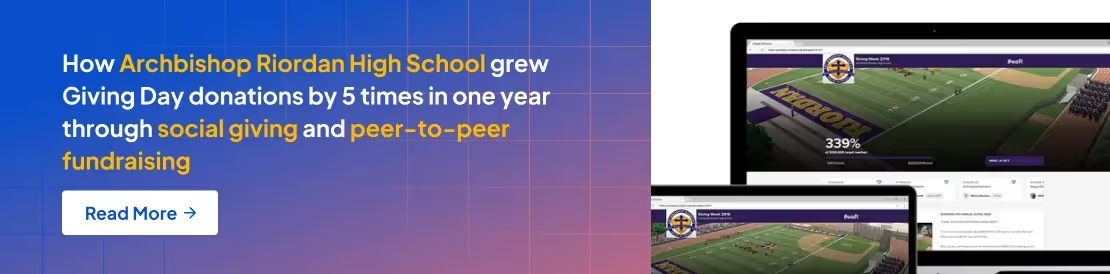
Take advantage of the community spirit of homecoming with a P2P fundraiser. These fundraisers allow your supporters to create their own pages where they can reach out to their network of friends, family, and colleagues. This is a great way to promote trust and get your active supporters more involved in your fundraising. Check out our blog earlier this year to learn more about P2P fundraising and how to use it effectively.
Over the past few years, matching gifts have emerged as a great way to maximize donations. Segment your potential donors that have matching gift opportunities and personalize your strategy accordingly. They are also a great way to celebrate the career success of your alumni.
While there is no substitute for physical presence, enhancing your events with virtual or hybrid capabilities will go a long way in drawing in interest and donations from alumni who cannot attend your homecoming events in person. For example, you can live-stream your homecoming parade through a platform that allows online donations. Be sure to make your virtual attendees feel included. They might just be tempted to make the trip next time!

Organizing a Giving Day during your homecoming is not a new thing. However, alumni today want to see more value out of their contributions. You can make your Giving Days more intriguing by matching donations, highlighting donors and recipients, or offering exclusive benefits such as tickets or merchandise to donors.
If your institution has a giving society, homecoming is a great opportunity to give back to their generosity by providing exclusive benefits such as discounts, free access, or extra tickets to share. If you don’t have one, homecoming is still a great opportunity to build one, as it provides a good opportunity to find out your most engaged and generous donors. The goal with giving societies and homecoming is to foster a sense of value and gratitude towards your most active benefactors (or to begin that path).
With so many people involved, your homecoming events are a great opportunity to announce or promote your new initiatives, such as mentorships, career partnerships with businesses, scholarship funds, or a crowdfunding campaign. While not a direct fundraising strategy, they are a great opportunity to inspire your alumni and help them visualize the value of their contributions, ultimately inspiring loyalty and support.
Even beyond your fundraising efforts, your homecoming 2024 is an invaluable step in your alumni relations efforts. By having the right infrastructure in place, you can collect valuable insights, user touchpoints, and feedback to make your next homecoming even better.
With that, we hope we’ve given you plenty to think about as you prepare for an exciting homecoming season. If you are done with or in the middle of one, we hope we have inspired some additional innovation through our suggestions.


Maximizing your Homecoming 2024 Fundraisers: Strategies You Might Have Missed
Lorem ipsum dolor sit amet, consectetur adipiscing elit. Suspendisse varius enim in eros elementum tristique. Duis cursus, mi quis viverra ornare, eros dolor interdum nulla, ut commodo diam libero vitae erat. Aenean faucibus nibh et justo cursus id rutrum lorem imperdiet. Nunc ut sem vitae risus tristique posuere.
If you work in higher-education, you’re probably ramping up for Giving Tuesday, but if your organization is not already doing that, you better get started. If you’ve never heard of this day that’s filled with philanthropic spirit, no worries! Giving Tuesday, a day devoted to charitable giving, marks the beginning of the year-end giving season. It falls on the Tuesday directly after Thanksgiving and is one of the most highly-anticipated days of giving across the world.
This day alone brings in millions of dollars for higher education institutions, so it’s important to leverage it in your fundraising strategy. Specifically, the higher ed market stands to gain substantial sums of money from alumni and other major givers on this day.
This year, Giving Tuesday is in December, but it’s never too early to start prepping! To ensure your institution or organization reaches its maximum Giving Tuesday potential, do the following:
1. Create a reasonable timeline
2. Set aspirational goals
3. Communicate before, during, and after
4. Enable multiple donation platforms
5. Inquire about matching gifts
6. Rely on volunteer fundraisers
If you need a refresher on why the giving season is so important, visit this end-of-year fundraising guide.
Ready to have the best giving season ever? Let’s get started!
As with any fundraising endeavor, your institution can’t wait until the last minute to plan. Otherwise, you’ll wind up with a chaotic mess that doesn’t come anywhere close to its potential.
While it may just be one day of the year, it’s the most important day of the year for fundraising. So treat it as such. Crafting your Giving Tuesday plan requires a lot of careful planning and communication.
Specifically, you’ll need to engage two main groups of people before the big day: your employees and your supporters (both current and potential). Before you can even conduct outreach, your team needs to be on the same page. That means fully planning your campaign by doing the following:
- Setting goals and timelines. Remember, this day kicks off end-of-year giving. Span your timeline over the course of giving season, with the biggest goals set on Giving Tuesday. Read on to learn about the types of goals you should set.
- Planning your outreach strategy. Before contacting any prospects, you should plan your strategy. This means planning your posts, emails, and so on and determining what they’ll say. For posts after Giving Tuesday, plan outlines for different types of end results. For instance, you should outline separate posts for meeting your goals, not quite reaching your goals, and exceeding your goals.
When you plan ahead and consider multiple campaign outcomes, you set your institution up for fundraising success!
Your Giving Tuesday ideas (get inspiration here!) might be more creative than any other campaign you’ve ever created, but creativity means nothing without communicated goals. You need to make sure that your entire team is on the same page so that everyone is working towards the same overarching goal.
There are a number of goals you can set. For instance, your institution may set the following goals:
1. Financial goals
2. Total number of donors
3. Number of recurring donors
4. Number of new donors
5. Percentage of participating alumni
While these goals can be measured via metrics, there are others that don’t rely on numbers. While you should implement measurable goals, consider making qualitative objectives, too. For instance, maybe you want to provide donors with opportunities to actively engage with you. Perhaps you want to simply spread the word about your higher education organization. Regardless of the goals you choose, they should be aspirational but still attainable. That way, you don’t sell yourself short, but you don’t create goals that are impossible to reach, either.
As you’ve learned, before even launching your campaign, you should communicate the goals and explain the fundraising strategies to your team. Once the campaign is fully planned, your employees will need to conduct outreach to both current and potential supporters. Outreach should continue throughout the entire campaign. Throughout your campaign, keep both your staff and supporters updated on the progress. That way, they know when they need to step up their efforts to reach your goals.
Remember, whatever goals you choose, your employees need to be on the same page. That means continuous communication. Otherwise, neither your employees nor your donors will have a solid understanding of what they’re trying to achieve. Then, once your campaign wraps up, thank your donors personally via email, so they feel valued. Additionally, use social media to announce the end totals in relation to your goal.
Your campaign isn’t over until you announce your end totals. Since the giving season continues over the course of the next several months, you shouldn’t wrap up quite yet. Instead, you should post an update once Giving Tuesday ends and say where your organization stands in relation to its total goal for the rest of the giving season.
Planning, communication, and aspirational goals mean nothing if your donors don’t have a way to give! To ensure that your college or university receives the most funds possible on Giving Tuesday, you’ll need to enable multiple donation platforms. You likely already have the basics set up, like an online donation page or direct mail giving. However, if you don’t enable other ways to give, you won’t make as much revenue as you possibly can.
To start, look at the types of donations you allow. In other words, don’t just allow credit and debit card donations. Allow cash donations, check donations, donor-advised fund gifts, foundation giving, and so on. Also, for those who have the affinity to give but not the capacity, provide volunteer opportunities for events. By encouraging the philanthropic spirit, you let them know their efforts are recognized. Then, if they ever acquire the funds to donate, they’ll be more likely to give! Text-to-give is also on the rise. Get creative with your ways to give. Don’t limit your donors! Multiple donation platforms shouldn’t exist only on Giving Tuesday. Rather, you should enable several platforms year-round to accommodate all donors. That way, you boost your fundraising potential!
If you’re not already aware, corporate philanthropy has changed the fundraising game for all players in the nonprofit world. When an employee of a company with a matching gift program donates, the employer then matches that donation, so long as the donation meets the company’s criteria. In other words, eligible contributions might be doubled, or maybe even tripled depending on the program guidelines! Some major companies will even match the donations that your volunteers raise from their friends and family on your behalf! It’s all about locating those opportunities, so you don’t miss out on any revenue opportunities.
A good way to start the conversation about matching gifts is to create a dedicated matching gift page on your website. You can also add information about corporate giving on your Ways to Give page. From here, start devoting time to making matching gift appeals, such as direct mail, emails, social media posts, and so on. When valuable supporters learn their donations can be multiplied without reaching back into their own pockets, they’ll likely take an extra five minutes to fill out the necessary forms. As a higher education institution with a substantial donor base, you are undoubtedly missing out on major revenue opportunities. However, if you leverage dedicated software, you can pinpoint all of your matching gift opportunities.
Remember, Giving Tuesday produces substantial amounts of revenue for colleges and universities, so if you can multiply your donations through matching gifts, do it.
Just like corporate philanthropy, peer-to-peer fundraising is on the rise, too! Giving Tuesday is the perfect opportunity to reach out to your supporters to raise money on your behalf. Since your institution likely has more donors than the average organization, you stand to gain major revenue from volunteer fundraising.
If you’re unfamiliar with peer-to-peer fundraising, here’s how they typically work:
1. Your fundraising team sets goals and timelines like any other campaign
2. You choose a peer-to-peer fundraising platform
3. Your team recruits and trains your volunteers
4. Participants create personalized pages where they’ll fundraise for you
5. Volunteers share their pages and encourage friends and family to donate
Volunteer fundraising ensures that you’re reaching the widest possible audience. Instead of only reaching your current supporters, you’ll reach supporters’ friends and family, too! To kick off your peer-to-peer research, check out these six proven peer-to-peer fundraising strategies that bring success.
Plus, you can incentivize participants to raise more with gamification tools. Gamification can mean anything from leaderboards to badges to fundraising thermometers. Leaderboards show your participants those who have earned the most, and badges show up on participants’ profiles when they reach certain milestones. On the other hand, fundraising thermometers show overall financial progress toward your goal. There are several peer-to-peer fundraising platforms and tools on the market. Choose the ones that best align with your institution and its goals. That way, you enable your volunteer fundraisers to do the best campaigning possible!
The whole point of Giving Tuesday is to boost funds, but your institution can experience a number of other benefits, such as new donor acquisition and alumni engagement. The point is, the giving season represents a major opportunity for every organization in the nonprofit sector, including major schools. Remember, fully plan your campaign, set aspirational goals, and communicate effectively throughout the entire giving season. You should have multiple ways of giving, look for matching gift opportunities, and rely on your volunteers year-round. However, these strategies are especially important on Giving Tuesday. As always, remember to thank your supporters. Now, get out there, and plan for your institution’s best giving season ever!

Adam Weinger is the President of Double the Donation, the leading provider of matching gift tools to nonprofit organizations and educational institutions. Adam created Double the Donation in order to help nonprofits increase their annual revenue through corporate matching gift and volunteer grant programs.
.avif)
Prepping for Giving Tuesday: How to Get Ready for the Most Philanthropic Day of the Year
Lorem ipsum dolor sit amet, consectetur adipiscing elit. Suspendisse varius enim in eros elementum tristique. Duis cursus, mi quis viverra ornare, eros dolor interdum nulla, ut commodo diam libero vitae erat. Aenean faucibus nibh et justo cursus id rutrum lorem imperdiet. Nunc ut sem vitae risus tristique posuere.
%201.svg)
%201.svg)
%204.svg)




.svg)