Asking for donations to your annual fund can feel repetitive, but your appeal letters shouldn’t be. Learn how to develop better annual fund appeals here.
.jpg)
Alyssa Jefferies
Published:
September 3, 2026
Updated:

Modern donors expect deeply relevant, personalized communications, especially when it’s alumni hearing from their alma mater. Generic messages won’t cut it, but it can also be difficult to make your appeals stand out when you’re making the same ask every year. To develop annual fund appeal letters that drive revenue and deepen relationships, you need a strategic approach.
Annual fund appeals succeed when they have refined messaging, emotional resonance, and enough variation to win donors’ support outside of flashier, major campaigns. In this post, we’ll explore a few key ways to elevate your university’s next ask.
Donors give to people, not institutions, making personal narratives one of the most effective fundraising and marketing strategies you can use. By shifting the focus from university-wide achievements to the tangible success of individual students, you foster a direct emotional connection with your audience and demonstrate the real, lasting impact of their donations.
Instead of relying on generic asks for annual fund appeal letters, incorporate the stories of individual students and the scholarships and programs that empower them to thrive. For instance, you might share how a first-generation nursing student used a grant to complete their clinical rotations, or include a quote from a scholarship recipient about how attending your university made their dreams a reality.
No matter how you incorporate storytelling into your appeals, Meyer Partners recommends using the three R's of storytelling to make them as impactful and ethical as possible:
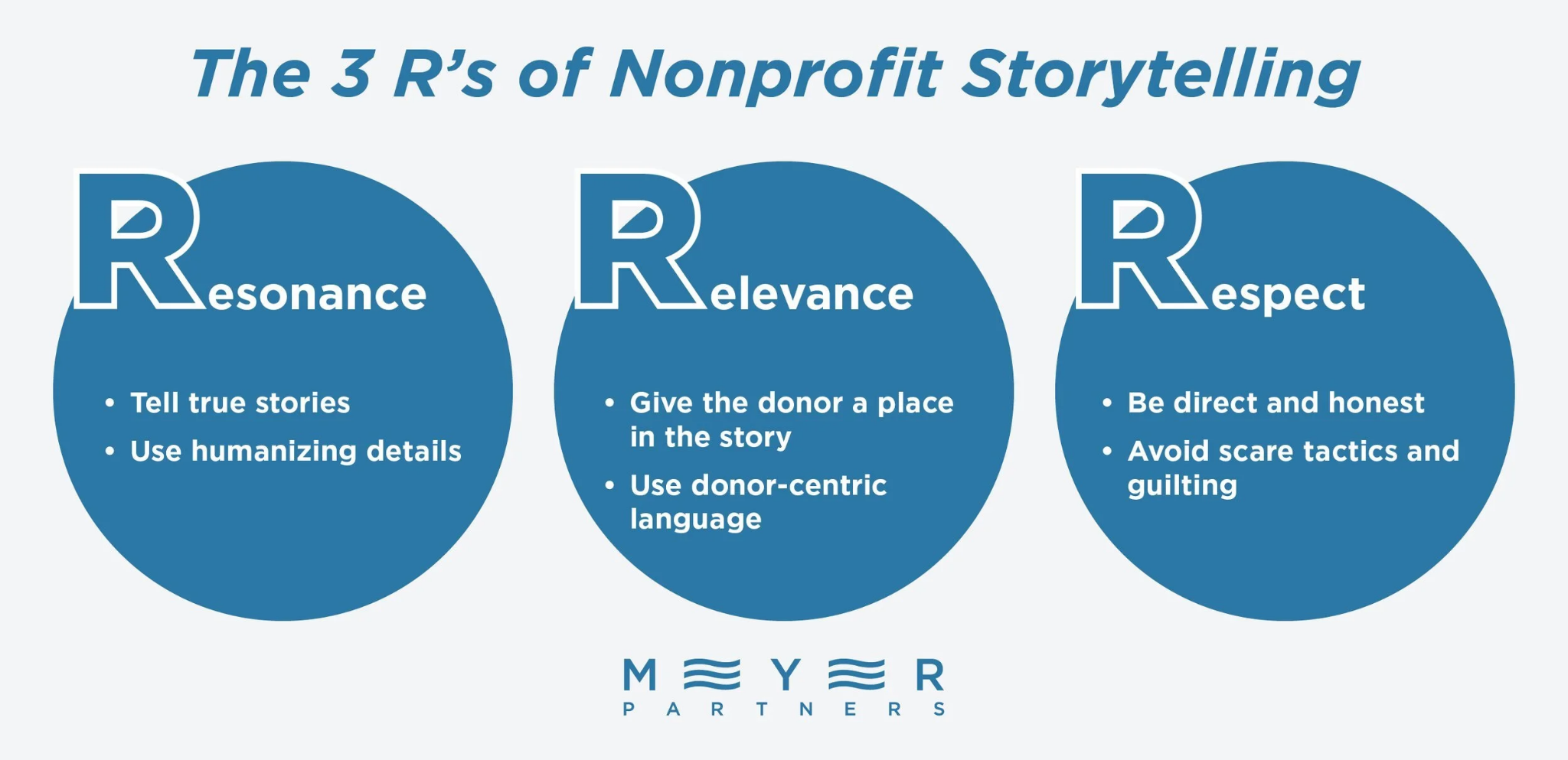
Incorporate these stories into multiple elements of your annual fund campaign to ensure maximum visibility and consistency. For example, you might include quotes from a student in your direct mail appeals, then post a selfie video of the same student telling their story on social media.
To maximize revenue and increase average gift sizes, ask for more than standard, one-time cash gifts in your annual appeal letters. Offer additional giving options that provide greater flexibility and can increase donors’ long-term impact. These opportunities are often more compelling, especially for young alumni looking for accessible options and for high-capacity donors looking to make the most of their donations.
Specifically, use your annual appeals to highlight opportunities like:
The easiest way to make supporters’ donations go further is to double them. Typically, donors can double the impact of their gifts at no extra cost in one of two ways:
Either way, donation matching is a powerful motivator, especially during year-end giving season. Feature matching gifts prominently in your annual fund appeals, explaining how to participate and why these donations are so impactful.
Imagine you’re a recent graduate just starting your career and trying to pay off student loans. You wouldn’t want to donate $1,000 to the university you left last year, but it might be feasible to give $20 a month. In this case, you’re much more likely to respond to an appeal that highlights recurring giving.
Recurring gifts offer a more manageable opportunity to support your university while deepening donor relationships. In your annual fund appeal letters, include the option to give monthly and provide several accessible donation tiers.
Plant the seed for long-term support by introducing planned giving and bequest options in your annual appeals, too. These avenues empower alumni to leave a lasting mark on your institution without requiring an immediate, large-scale donation.
Even if most donors aren’t ready to commit to a legacy gift right now, just including information about planned giving in your appeal can get them thinking about it. Include links in emails and QR codes in direct mail letters so supporters can easily learn more on your university’s website or request a meeting with your major gifts officer. Note each donor who shows interest in the program so you can cultivate the relationship over time.
The best fundraising strategies reflect the unique relationship each supporter has with your university. Highly personalized appeals show each donor that you value them as an individual and respect their unique contributions.
Use your donor and alumni data to tailor your asks as much as possible. Go beyond addressing recipients by their preferred names—reference their specific past involvement, giving history, and personal connections to the university. Acknowledging that an alumnus was on the debate team or that a donor consistently supports the engineering department validates their identity and gives them clear, specific reasons to give again.
Segment your donor lists in several ways to maximize relevancy, and regularly audit your donor database to ensure all contact information and engagement records are accurate before sending appeals.
If you aren’t sure how to best segment your audience, hone in on the highest-value potential donors, or match supporters with the right requests, consider professional donor analytics services. Experienced fundraising consultants who specialize in data analysis can help you optimize your strategy for this year’s annual fund appeal and well into the future.
An effective annual fund approach relies on deep personalization, authentic narratives, and a variety of flexible giving options tailored to your audience. Upgrading the underlying strategy of your communications with these tips will help you build stronger relationships with alumni and secure the financial future of your core programs.
Subscribe
See how modern advancement teams bring alumni engagement and fundraising together.
Plan faster. Execute better
Explore free templates designed for alumni and fundraising teams.
.png)

.avif)
Alyssa Jefferies
You may notice that throughout this article, we use the term “investor” when referring to “donors.” This is because Convergent believes in reframing charitable institutions as valuable community assets worthy of investment. By positioning donors as investors, we focus on sustainable funding rather than one-time gifts.
Your educational institution is a pillar of your community. However, you may undermine its stability by approaching your alumni annual fund with a transactional mindset, focusing solely on raising funds rather than on developing relationships with supporters. As a result, you may exhaust your investors and create volatile cash flows in your nonprofit’s financial accounts.
For this reason, it is necessary to shift away from a transactional relationship (in which giving is driven by the expectation of receiving something in return, such as a tax write-off) and toward a sustainable partnership, which is rooted in shared values and strategic alignment.
This guide provides actionable steps to realign your alumni annual fund giving with long-term, mission-critical outcomes. When you treat alumni as true financial partners, you can secure robust, predictable funding that sustains your institution for decades to come.
Different investors have their own reasons for giving, so analyzing giving behavior is an important step to tailoring your investment-driven approach. For example, the Lilly Family School of Philanthropy reported that younger generations tend to support causes tied to social impact and advocacy, so if you want people in this demographic to give more, you have to highlight your mission and the impact you’ve had in your community in your outreach materials.
No two investors are alike. To understand why your supporters choose to contribute, try the following strategies:
Incorporate these insights into your nonprofit’s constituent relationship management system (CRM), so your team can segment your audiences accurately. By the time the alumni annual fundraising comes around, you can deploy tailored messaging, thereby drastically improving conversion rates.
Establish your institution’s value by demonstrating strict alignment between your mission, fundraising objectives, and the outcomes delivered to the community. For example, if your organization is planning a STEM initiative for first-generation students, you can frame it like this:
When sharing the impact report with your investors, spotlight a specific narrative (e.g., a student who benefited directly from the funds), then pair that with hard numbers (e.g., “we’ve helped 100 students achieve their dreams like [Student X]”). By incorporating data in the narrative, you’re showing investors that their contributions fund tangible results.
Realigning your alumni annual fund with strategic outcomes can be challenging because there are several moving parts to consider. For this reason, Convergent recommends conducting a development audit, which provides a clear, objective assessment of your current fundraising efforts and a strategic roadmap to improve them. The result is that everyone in your team is aligned with your goals, and you can build a stronger case for investment.
Shifting from a traditional donation mindset to an investment value proposition fundamentally changes the dynamic between your institution and your alumni. When you operate with a donation mindset, you inherently position the educational institution as a charity in need of a handout. Additionally, a donation mindset relies heavily on emotional appeals and transactional exchanges (e.g., giving a t-shirt or a tax write-off in exchange for money), which ultimately exhaust supporters.
When you reframe your outreach and treat alumni as long-term investors and stakeholders, you unlock distinct benefits that secure sustainable funding, such as:
To complete your shift from a transactional to an investment-driven mindset, you’ll need to audit your current communication templates and eliminate passive phrasing. For example, refer to gifts and donations as “partnerships” instead. So, rather than saying “Your gifts are needed to help maintain our current programs,” you can say, “Your partnership with our organization has helped expand our scholarship endowment and directly funds our new STEM initiative.” This subtle linguistic shift empowers alumni, making them feel like co-architects of the institution's future.
In addition to launching capital campaigns, your organization should integrate workplace giving into your alumni annual fund strategy. This is because corporate philanthropy programs, such as matching gifts and volunteer grants, significantly amplify the ROI of each contribution.
That said, not many people know about workplace giving initiatives; in fact, studies show that nearly 80% of donors are unaware of whether their company offers a matching gift program. Because of this, you must educate your investors about these programs by:
By leveraging corporate philanthropy programs, you’re shifting the giving narrative away from individual charitable donations toward larger-scale, sustainable institutional investments. In other words, you’re ensuring no money is left on the table, while maximizing the impact of your existing investor base.
As an educational institution, you’re an indispensable community asset, and your funding strategies must reflect this vital role. Transitioning from transactional appeals to a sustainable, investment-focused model ensures that you maintain long-term partnerships with alumni investors. By prioritizing data-driven stewardship and clear ROI, your future fundraising efforts will build a resilient foundation for generations to come.

Transforming Your Alumni Annual Fund for Sustainability
Lorem ipsum dolor sit amet, consectetur adipiscing elit. Suspendisse varius enim in eros elementum tristique. Duis cursus, mi quis viverra ornare, eros dolor interdum nulla, ut commodo diam libero vitae erat. Aenean faucibus nibh et justo cursus id rutrum lorem imperdiet. Nunc ut sem vitae risus tristique posuere.

Brian Abernathy
July 10, 2026
12 minutes
Picture this: You’re the director of fundraising and development at a well-known higher education institution. You’ve recently had a ton of money coming in to support your larger-scale initiatives. A private grant-giving foundation is providing your team with the money required to open a high-tech computer lab, and a major donor is funding the building of a new wing at the school.
But what about your other day-to-day operations? You need funds to keep your institution above water, continue paying staff salaries, and invest in behind-the-scenes technology that allows your university to continue running smoothly. Oftentimes, major gifts and grant funding don’t cover those needs.
And that’s where your annual fundraising strategy comes in! In this guide, we’ll explore four powerful tips for boosting this particular type of fundraising. As you begin planning your upcoming campaign, be sure to:
.png)
All sorts of mission-driven organizations rely on annual fundraising to help manage their in-between needs—and when it comes to university and other education-based institutions, your alumni are likely to be your biggest supporters!
Are you ready to uncover how you can position your school for the greatest annual fundraising success going into 2022? Let’s get started.
Fundraising organizations have learned a lot about effective fundraising strategies (and the way that they’re always changing) from the highs and lows of 2021. And before that, 2020. Going in 2022, reviewing efforts and results from previous years can give you a head start toward success.
To get started, take a look at where your fundraising flourished in the past year, as well as where you see room for improvement. If you notice that your efforts in the corporate giving arena could use some extra work, for example, consider prioritizing corporate fundraising in the upcoming year.
Here are some other key performance indicators (or KPIs) you might look at:
As you craft your newest annual fundraising strategy, make sure to prioritize the avenues that have historically been your most profitable while also giving extra care to channels that may be lagging behind.
A significant element of successful fundraising involves setting fundraising goals beforehand. Otherwise, how will you determine “success” in the first place?
You’ll want to choose lofty objectives that inspire donors and fundraisers alike while ensuring you don’t aim too high that it can seem unrealistic or like a “lost cause.” To find the perfect medium between the two, the best and most effective goals often follow the SMART framework.
As you craft your upcoming objectives, make sure they are:
Here’s an example of a SMART goal for an upcoming campaign - “To collect $10,000,000 in individual contributions to fund university operations by 12/31/2022.”
To contrast, a poorly crafted goal might look like this - “To raise a lot of money in the next few months.”
The former sample is much clearer and will ultimately result in greater success, while the latter is subjective and vague. When your annual fundraising objectives incorporate each element listed above, you can ensure your team is positioned for success.
The more fundraising strategies and tools develop, the more comprehensive your campaigns are expected to be. As a result, organizations are encouraged to integrate multiple channels to spread the word about their annual fundraising efforts far and wide.
The particular avenues you choose to leverage for your annual campaign can vary depending on your donors’ preferences and your team’s strong points. However, they will likely incorporate a combination of the following:
Several years ago, you may have been able to reach your goals solely through phone and in-person solicitation efforts. Now, it’s essential that you take a multichannel approach—both to meet donors where they already are and to stand out from other organizations seeking your audiences’ attention.
Did you know that more than 26 million people work for companies with corporate matching gift programs? It’s likely that many of these individuals are your alumni, donors, and other key supporters.
Before you can expect a solid flow of corporate matches coming in, however, you’ll need to enact specific matching gift marketing strategies to raise awareness of this powerful opportunity. Because although 26+ million individuals are eligible for company matches, more than 78% of this group is completely unaware.
To incorporate corporate matching gifts into your annual fundraising strategy, consider these best practices:
For you, matching gifts mean that your school has the potential to collect two donations for the cost of soliciting one. And for your donors, they get to know their contributions went twice as far.
You can’t do the big things (like your overall mission impact) without being able to fund the little things as well. An effective annual fundraising strategy allows your team to collect the dollars you need to bankroll every part of your school’s operations—from the most glamorous of tasks to the most mundane.
Luckily, integrating these best practices into your strategy will allow you to raise more funding for your institution and better situate your team for ongoing success. Good luck!

4 Tips for Your Annual Fundraising Strategy
Lorem ipsum dolor sit amet, consectetur adipiscing elit. Suspendisse varius enim in eros elementum tristique. Duis cursus, mi quis viverra ornare, eros dolor interdum nulla, ut commodo diam libero vitae erat. Aenean faucibus nibh et justo cursus id rutrum lorem imperdiet. Nunc ut sem vitae risus tristique posuere.

Adam Weinger
December 30, 2021
12 minutes
Donation request letters remain one of the most effective ways for schools, colleges, and universities to raise funds and strengthen community bonds. Whether sent by email or printed and mailed, these letters go beyond simply asking for money, they tell a story, create an emotional connection, and make donors feel part of something meaningful.
For institutions and organizations looking to boost their fundraising efforts, pairing the right words, tone, and structure with a clear purpose can transform a simple note into a powerful appeal.. Today, we’re helping you craft these letters and providing ready-to-use donation request letter templates alongside best practices to help you craft appeals that truly resonate.
It’s tempting to think that today, email and social media are all you need. But the data tells a different story. Institutions are still seeing significantly higher engagement from direct-mail appeals compared to digital-only outreach.
48% of donors say email is their preferred channel for receiving updates and appeals, while 21% still prefer direct mail. This shows that a hybrid approach, combining both digital and physical touchpoints, helps maximize reach and impact.
Each of these templates is designed for a specific use case, audience, and channel. You can copy them directly or customize them for your institution.
A fundraising letter that supports tuition assistance, classroom materials, and extracurricular programs, sent through email or print.
Subject: Together, We Can Help Every Student Thrive
Dear [First Name],
Every child deserves the chance to learn, dream, and succeed. This year, our classrooms are buzzing with curiosity, but some students are struggling to access the resources they need.
With your support, we can provide essential materials, fund extracurricular programs, and ensure no student is left behind. A gift of $50 can supply an entire class with art supplies for a semester.
Will you join us in making this possible?
[Donate Now]
Thank you for being part of our school community. Your generosity changes lives every day.
With gratitude,
[Your Name]
[Your Title]
A template for annual fund drives, Giving Tuesday, or Reunion Giving, shared by email or as a mail-merged PDF.
Subject: Your Legacy at [School Name] Continues
Dear [First Name],
Every time a student walks across the graduation stage, your legacy grows. As an alum, you know how life-changing an education at [School Name] can be.
This year, our Annual Fund supports scholarships, research opportunities, and campus programs that define the [School Name] experience. Your contribution, no matter the size, makes that possible.
Will you help the next generation of students thrive by making a gift today?
[Give to the Annual Fund]
Thank you for keeping the spirit of [College/University/Association Name] alive.
Warm regards,
[Your Name]
[Your Title]
A short, urgent appeal crafted for global giving days, delivered via email.
Subject: Join Thousands Changing Lives This Giving Tuesday
Dear [First Name],
Today, we join millions worldwide for Giving Tuesday—a celebration of generosity and community. Our goal is to raise $[Goal Amount] in just 24 hours to support [specific program/cause].
Every gift, no matter the size, will help us reach our target and create real change. Your $25 today could fund [specific, tangible impact] for a student in need.
Please don’t wait—this opportunity to make an immediate difference ends at midnight.
[Give Now]
Thank you for standing with us and with the community we serve.
With gratitude,
[Your Name]
[Your Title]
💌Each email click during Giving Tuesday 2024 was worth an average of $39 in donations—proving that every subject line, call-to-action, and send time matters. Perhaps that's why 33% of donors say email is the channel that most inspires them to give.
Here’s a version suited for monthly giving programs, sent by email or as a print follow-up.
Subject: Make an Impact Every Month
Dear [First Name],
Every month, your generosity can bring steady, lasting change. By joining our monthly giving program, you can provide steady, reliable support for [cause/program].
Just $15 a month can [specific impact], and over a year, your generosity will [larger outcome].
Become a monthly supporter today and watch your impact grow all year long.
[Join Monthly Giving]
Gratefully,
[Your Name]
[Your Title]
A request focused on post-donation matching, sent through email or mailed as a postcard.
Subject: Double Your Recent Gift at No Extra Cost
Dear [First Name],
Thank you for your generous gift of $[Gift Amount] to [Organization Name]. Did you know your donation may be eligible for a match from your employer?
Many companies match charitable contributions, effectively doubling your impact. To check if your gift qualifies, visit [Matching Gift Portal Link] and follow the quick steps.
Thank you for helping us do even more with your generosity.
Sincerely,
[Your Name]
[Your Title]
A formal print letter for scholarships, facility upgrades, or endowment campaigns.
Dear [First Name],
We are embarking on one of the most ambitious projects in our history, the [Campaign Name]. This initiative will [describe vision: build a new library, endow scholarships, expand labs].
We invite you to be part of this legacy. Your gift will not only transform our campus but also shape the futures of generations to come.
Please consider a contribution to the [Campaign Name with link]. Together, we can make this vision a reality.
With deepest appreciation,
[Your Name]
[Your Title]
A stewardship message for post-campaign follow-up, shared through email or print.
Subject: Look What We Achieved Together!
Dear [First Name],
Thanks to your generosity, our [Campaign Name] has raised $[Total Raised], surpassing our goal! Your gift helped make [specific result] possible.
[Insert photo of completed project or impact in action]
While this chapter is complete, our work continues. We’d love for you to stay connected as we take the next steps toward [future initiative].
Thank you for believing in our mission. It would not be possible without supporters like you.
Warmly,
[Your Name]
[Your Title]
A stewardship and donor retention note, best suited for email or handwritten delivery.
Subject: Your Gift Made an Immediate Difference
Dear [First Name],
Thank you for your recent gift of $[Gift Amount] to [Organization Name]. Because of you, we were able to [specific impact, e.g., “provide 200 meals to students in need”].
Your generosity inspires us and the community we serve. We are honored to have you as part of our donor family.
We’ll keep you updated on the difference you’re making, but for now, please know how much you are appreciated.
With heartfelt thanks,
[Your Name]
[Your Title]
Whether you’re writing to a long-time supporter or a first-time donor, your letter should check these boxes:
This level of personalization shows donors that you’ve taken the time to understand who they are, which builds trust and strengthens your appeal.
Avoid abstract language like "supports our programs." Instead, paint a picture of the specific change their generosity will create in the world.
The easier you make it, the more likely they are to follow through in the moment when they're most motivated.
Remember, personalization and segmentation can yield massive improvements. Segmented emails have demonstrated the potential to drive 30% more open rates and 50% more click-throughs than unsegmented campaigns, making audience segmentation a critical success factor for educational institutions.
Here’s how we're helping advancement teams connect technology to their storytelling:
More than asking for money, donation request letters help keep relationships strong. In a world full of emails and notifications, a letter can stand out because it feels personal and genuine.
With the right timing and smart segmentation, these letters do more than raise funds. They remind alumni and supporters why they matter, spark pride in your community, and strengthen the connection between your school and its graduates.


Donation Request Letter Best Practices + Templates
Lorem ipsum dolor sit amet, consectetur adipiscing elit. Suspendisse varius enim in eros elementum tristique. Duis cursus, mi quis viverra ornare, eros dolor interdum nulla, ut commodo diam libero vitae erat. Aenean faucibus nibh et justo cursus id rutrum lorem imperdiet. Nunc ut sem vitae risus tristique posuere.

Anwesha Kiran
August 19, 2025
12 minutes
%201.svg)
%201.svg)
%204.svg)




.svg)