Alumni events get more complicated as they grow. Here's how Almabase keeps every stage running smoothly.

Anwesha Kiran
Published:
July 24, 2026
Updated:
.jpg)
As alumni events grow, so do the headcount and the complexity in executing them.
A Homecoming weekend, for example, has so many things to plan for and keep track of: registrations, sub-events, guest management, communications, fundraising, check-in, CRM updates, reporting, all happening simultaneously. This is a whole different ballgame than just a bigger pool of attendees.
Every successful event, whether it's a regional chapter gathering or a multi-day Homecoming celebration, moves through the same five stages:
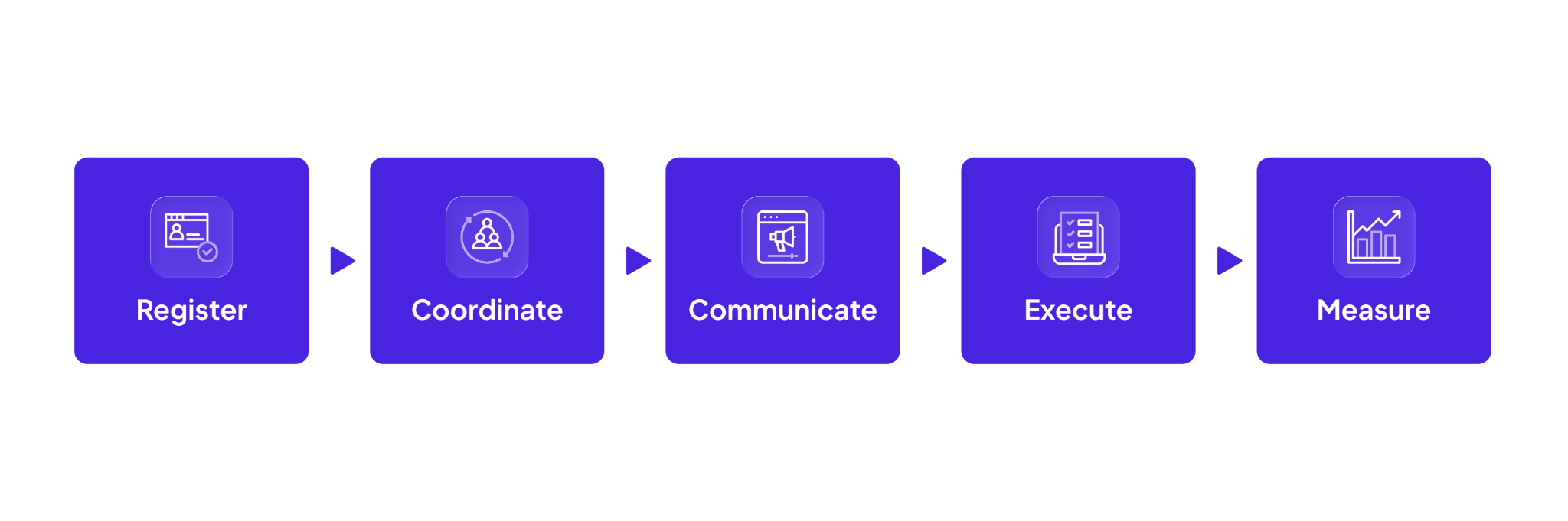
A Homecoming weekend or a Giving Day means these same five things, but now alongside multiple sub-events running in parallel, attendees taking completely different paths through the weekend, tighter timelines to pull it all together, and more data flowing between more systems than any one person can track by hand.
These learnings are gained over time and Almabase is built around them to support the entire event lifecycle, from the first registration to the insights that shape the next event.

Getting alumni to register sounds straightforward, but the complexity could already start building at this stage.
Attendees RSVP and bring guests, or sign up for a single session before opting into several others, which may carry different pricing tiers. Sometimes, they even change their minds midway through.
The organizers’ goal is to accommodate these compounding decisions seamlessly. A good registration experience makes all of these as effortless as possible, for attendees and for the team behind the scenes.
Regardless of when you start planning, your event page should be something your team can build themselves. It is very likely that you’ll need to make last-minute adjustments to keep up with changes to your strategy.
Almabase lets you build fully branded event pages with no code, reuse templates across events, and publish quickly while keeping everything aligned with your institution's visual identity.
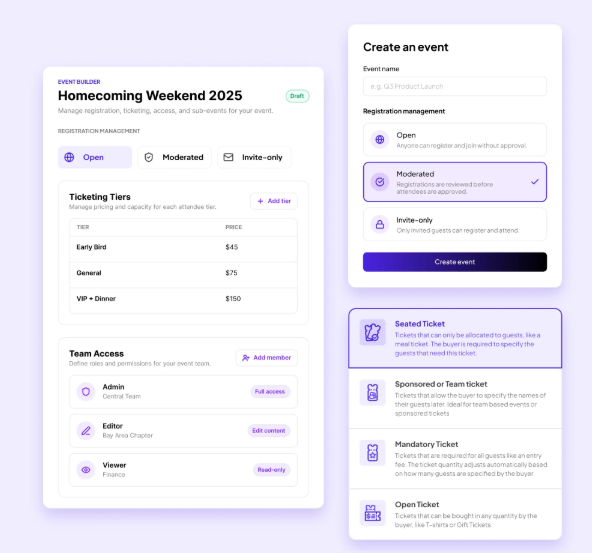
The result is faster launches and one less external dependency when timelines tighten close to event day.
Think about a typical alumni weekend or events scattered throughout spirit week. On the guests’ end, someone signs up for the Friday evening reception, skips the Saturday morning campus tour, buys tickets for the gala, and brings two guests to the football tailgate.
Behind the scenes, every one of those activities has its own capacity, schedule, pricing, and attendee list. If your systems don’t keep up at this point,tracking individual attendee schedules and ticket details becomes overwhelming. Information will slip through the cracks.
With Almabase, you can organize all of those experiences under one parent event, while giving each sub-event its own registration flow, ticketing, capacity limits, and logistics. Alumni still enjoy one seamless registration journey, while your team manages everything from a single backend instead of juggling multiple event pages and spreadsheets.
Cornell College runs its entire alumni program with 15,000+ alumni on a lean team, and it shows in what they've been able to pull off with one connected system: 1,008 donors on Giving Day, a 4.7/5 participant rating, and 430+ Homecoming attendees, all without adding headcount.
Read the full blog here.
Reunions are designed around reconnecting with classmates, old roommates, mentors, partners, and sometimes introducing children to the campus that's featured in so many family stories. The point is, these are not solo events, and the registration should reflect that.
Instead of asking every guest to complete a separate registration, Almabase allows alumni to register together. Families, spouses, classmates, and other guests need not separate out in the registration process, making for a smoother experience while helping your team keep relationships and headcounts organised.
You don’t want a reunion volunteer to see the same questions as a first-time attendee, and someone attending only the gala shouldn't have to scroll through options for every campus tour.
This is solved by the conditional questions that can be used in forms built with Almabase.
Based on an attendee's answers and preferences, you can choose to surface different questions, sessions, ticket options, or pricing automatically. The form adapts as people move through it, keeping the experience simple while ensuring your team still captures the information it needs.
While it is a small detail, saving your attendees unnecessary information overload definitely adds to their experience.
A tale as old as time, and perhaps the most unsurprising: a delayed flight means swapping the morning session for the afternoon one, or someone remembers (well after registrations have closed) that they wanted to bring their spouse along.
While it’s great to accommodate these changes, there’s no way to account for the manual overhead these create.
Instead of asking staff to rebuild registrations every time someone's plans shift, Almabase allows attendees to update registrations, cancel or switch sessions, or manage guests themselves. The time your team would’ve spent fixing records is now free to go into preparing for the event.
Once registrations start flowing in, your team then needs to focus on organizing an increasingly complex event without creating too much operational overhead.
Moments that get your attendees the most excited, such as when they walk in through the campus they once called home, catching up with old friends, watching current students with pride or recounting their campus experiences to their kids, are moments of pure connection.
Fundraising, when built into the event, must come as part of this experience, but not interrupt it. It takes a bit of careful planning to get this just right.
With Almabase, you can choose to build fundraising moments throughout the event journey: during registration, through dedicated giving pages, at check-in, or on-site through mobile giving. Whether someone wants to make a one-time gift, set up recurring giving, or add a donation alongside their ticket purchase, it all happens within the same experience.
Part of running a great event is watching popular sessions get sign ups beyond anticipation.
Without a structured way to manage this demand, your team might find itself needing to maintain manual waitlists, replying to individual emails, or trying to remember who expressed interest first. And when a spot opens up because someone cancels, the scramble unfolds: pulling sign-up data from multiple lists, checking who cancelled, who expressed interest and can be slotted in instead - it’s a lot.
Almabase's sub-event waitlists are built to handle that process for you. When a session reaches capacity, attendees can join a waitlist instead of being turned away. If a spot becomes available, whether through a cancellation or increased capacity, they're automatically (or manually, if you prefer) offered that spot with a time-bound registration link. If they don't respond in time, the offer moves to the next person in line.
For events where some attendees deserve priority, like reunion committee members, sponsors, or VIP guests, you can switch to manual mode, reorder the queue, and choose exactly who receives the next available spot.
It’s one of those details that you think you can manage, but it's exactly the kind of thing that saves event teams hours of back-and-forth while ensuring every available seat has the best chance of being filled.
The event begins much before event day for your team, but in many ways, for your attendees as well. Invitations and save-the-dates are followed by a period of planning: booking accommodation, transportation, taking time off work or family, or bringing someone along.
The communication should spark the decision to come and honor this commitment shown by your attendees. The reminder nudges them to finally register, while the confirmation reassures them they've signed up for the right sessions. The follow-up keeps the conversation going once the event is over. All of these parts come together to make sure the attendees feel like they’re wanted and welcome at the events, and more than just names off of a guest list.
Good communication matches the right receiver with the right message. As simple as it sounds, it can get really complicated in practice as you try and figure out ways to get different messages across to different segments of your audience.
Almabase lets you build audiences using the alumni data you already have. You can decide to segment them by class year, reunion cohort, geography, volunteer involvement, previous event attendance, or giving history.

Instead of blasting your entire database with one generic invitation, you can tailor outreach to the communities you're trying to bring together and no one gets blasted with one generic invitation. A little more thought for some really promising results.
Every event has almost the same email and communication cycle: the save-the-dates, the invitation, a couple of reminders and follow-ups, parking and general event information the day before (sometimes on the day of), and finally a ‘thank you’ once everything is over.
Writing, scheduling, and sending them one by one could take up a lot of time, time that leaner teams especially, could be spending on other, less-repetitive tasks.
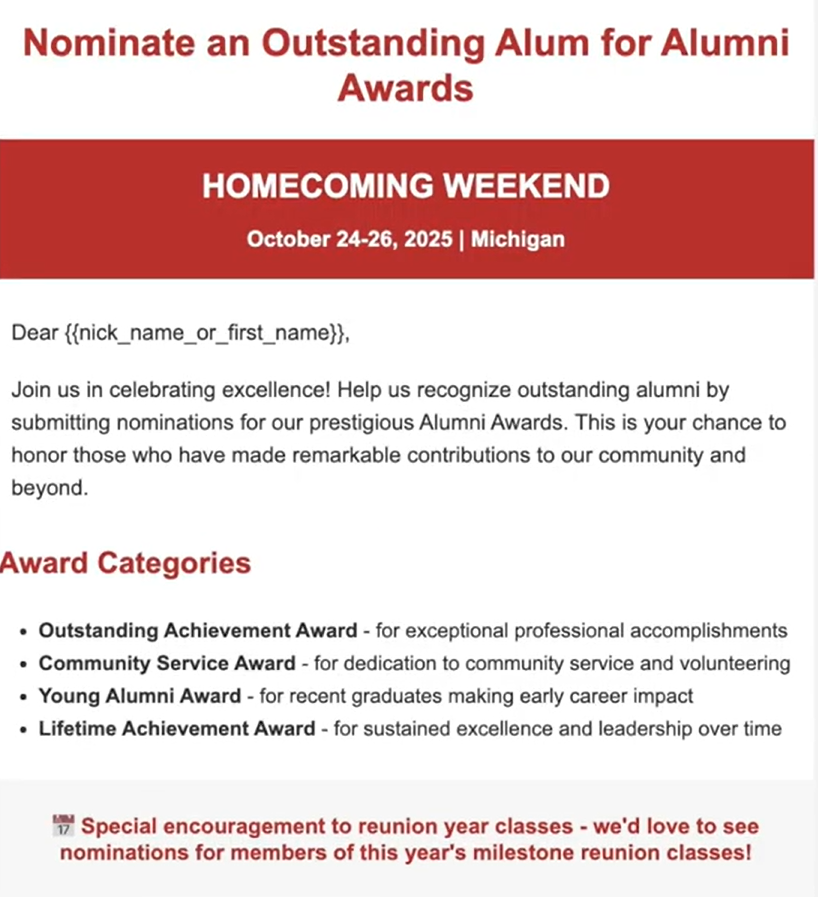
Almabase treats email communication as a workflow. With its Emily AI integration, your team can generate a context-aware first draft right inside Almabase's Email Center using a simple prompt like "Invite alumni to our 25th reunion in a warm, conversational tone".It can even pull details from your event page, like the event name, date, location, and registration link, so you're not starting from scratch every time. Once you have a draft, you can refine it, regenerate it, or send it through your usual workflow without ever leaving the platform.
From there the invite automation lets you build an entire invitation sequence upfront, complete with follow-up reminders that are sent only to alumni who haven't yet registered. As people respond, the workflow automatically adapts, so your team isn't manually tracking who still needs a nudge.
And because every email is sent from a sender identity you configure for your institution, the experience feels consistent and familiar to alumni from the very first invitation to the final thank-you. This goes far when your goal is to scale communication without losing the voice that resonates with your audience.
The days immediately after an event are when alumni feel most connected to your institution. The experience is fresh: reliving conversations, sharing photos, reconnecting with classmates, and thinking about when they'll come back next.
That's the perfect moment to keep the momentum going.
Send attendees a thank-you and earnestly ask for feedback while attendees care enough to write back. Share event photos. Reach out with event highlights for those who couldn’t make it. Invite those interested to volunteer at the next planning committee. If fundraising is part of your strategy, follow up with an ask while the emotional connection is still strong.
Almabase makes those conversations easier by letting you tailor follow-up based on what went on: who attended, who didn't, who volunteered, who donated, and who might just need another reason to reconnect.
We believe that the end of an event is a place to show gratitude and leave the door open for conversations about the next one.
Registrations have closed, reminder emails have gone out, and volunteers are at their stations, and everyone's hoping the weather holds up. Months of planning come down to a few hours or a weekend.
Ironically, the mark of a well-run event is when nobody notices the operations behind it.
Attendees notice whether they got through the door without a hitch.
Someone forgot to bring their confirmation email, or a spouse is tagging along but isn't sure whose name the registration is under. These last-minute oddities aren’t unusual, so Almabase equips you with exactly what you need to handle this.
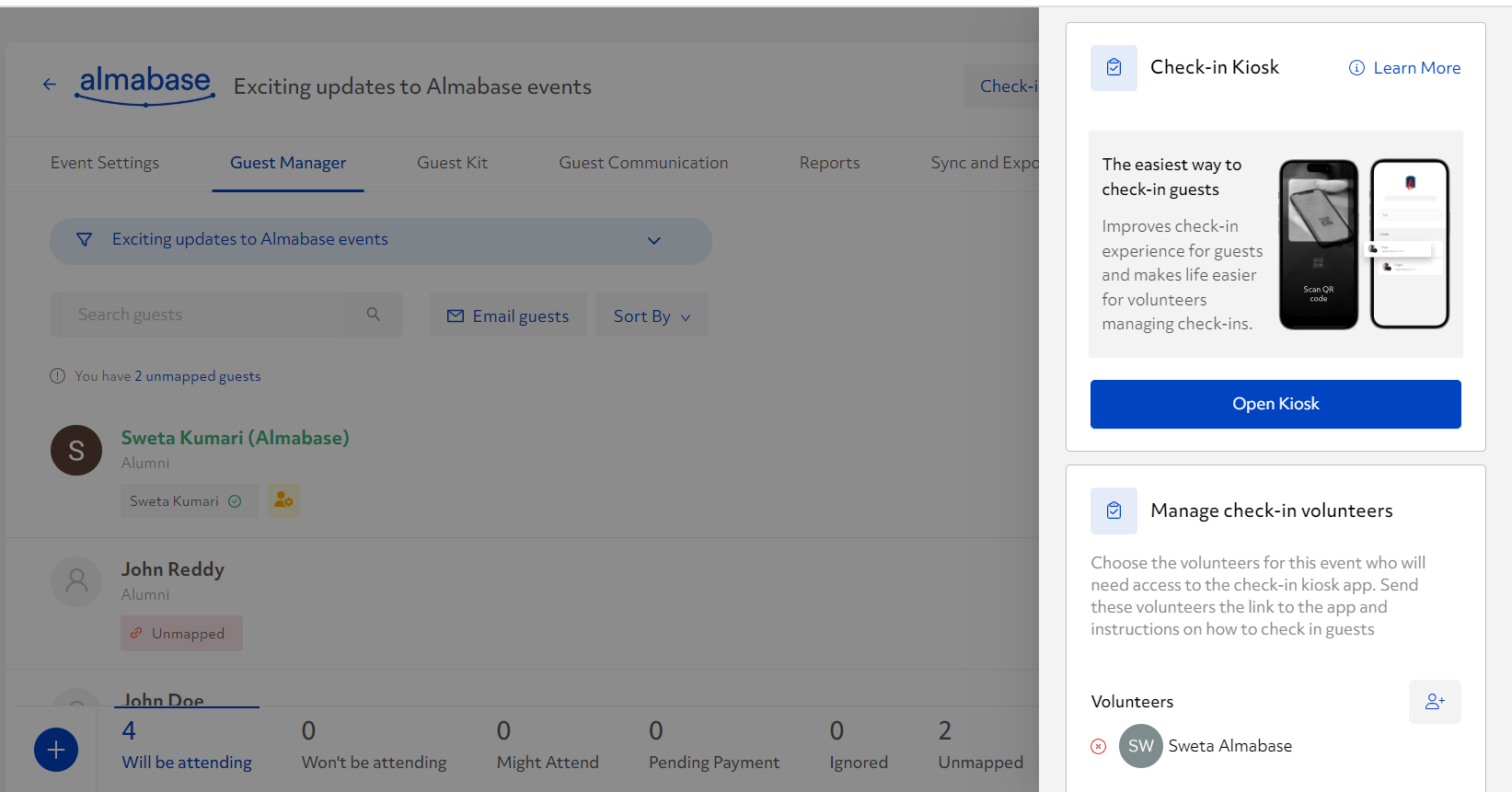
With the QR check-in option, volunteers can scan an attendee's QR code or search for them by name. If someone isn't registered, they can be added on the spot. And because you can assign check-in access to volunteers without giving them full admin permissions, it's easy to run multiple check-in desks without everyone working from the same laptop.
From the attendee's perspective, it's a smooth welcome. From your team's perspective, every check-in is automatically recorded, so you know who actually attended without spending half a day reconciling attendance lists.
Knowing the total headcount of your event is useful, but data that tells you what your attendance means looks like you knowing who showed up for the campus tour, how many stayed for the reunion lunch, and what percentage of your attendees were at the donor reception. This kind of data goes into informing decisions for the next edition of your event.
With Almabase, every sub-event has its own check-in flow. Attendees can scan the QR code from their confirmation email or be checked in by a volunteer, and participation is captured in real time for each individual session. That means you know who attended the event and which experiences they chose to be part of.
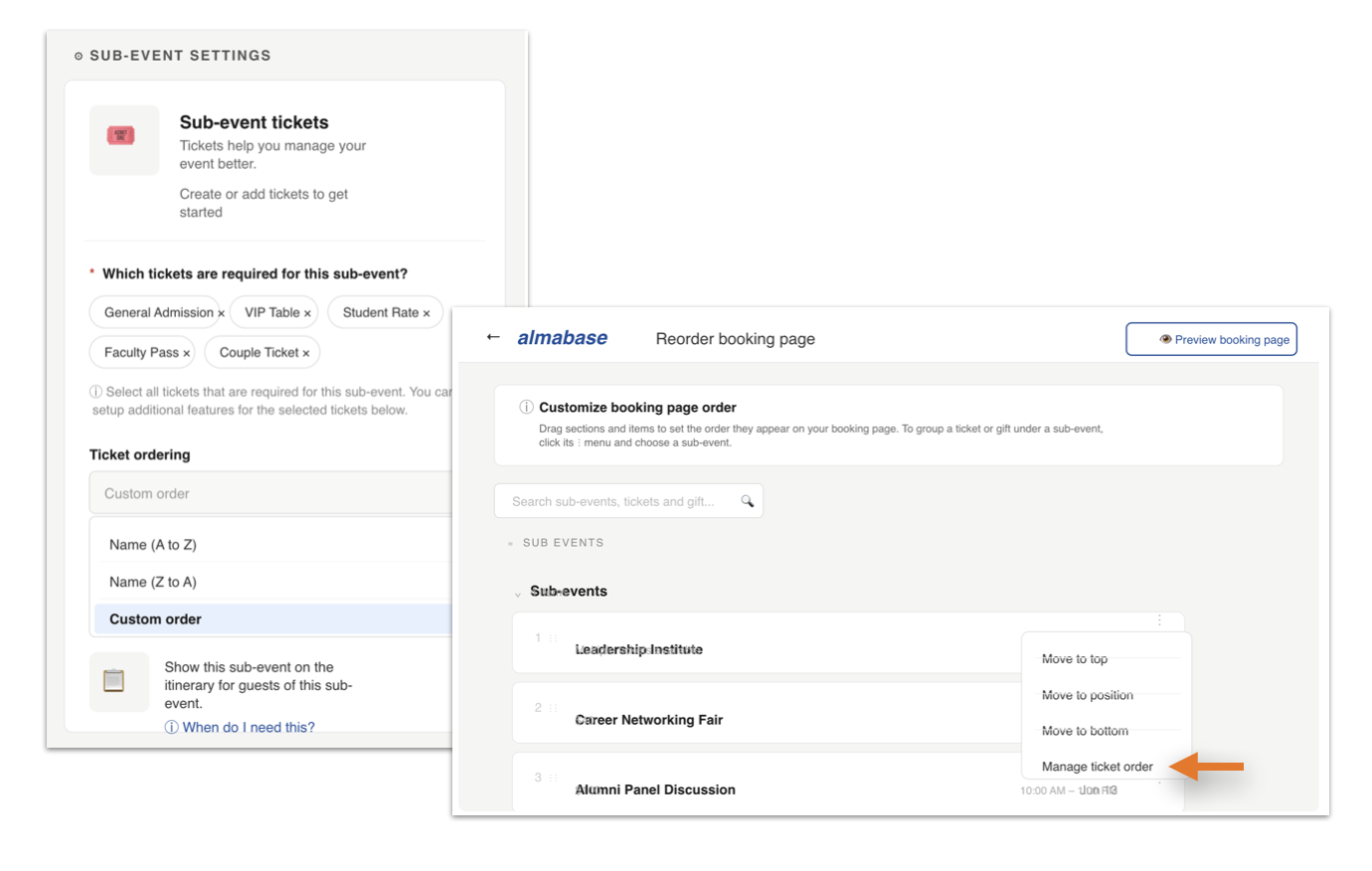
Behind the scenes, that attendance data is synced with your CRM, giving your team a complete picture of engagement.
One enduring change since the pandemic years has been the blending of in-person and virtual programmes throughout event experiences, allowing organizers to reach alumni who will not be able to make it in person.
Almabase understands the importance of providing a uniform experience across these formats. It supports in-person, virtual, hybrid, and multi-day events through the same registration, communication, and reporting framework, giving both attendees and event teams a familiar experience regardless of the format.
Now that the event is over, it’s time to unearth the wealth of insights provided by the data captured throughout all the previous stages.
Answering the ‘How did it go’ question depends on accurately reading the insights from this data. As your team embarks on this last project, your platform should be able to keep up by capturing this information for them.
With Almabase's TrueSync with Raiser's Edge NXT, constituent profiles, event registrations, guest information, gifts, ticketing, and sub-event participation stay synchronized between both systems. You decide how data should move, with flexible sync rules that let you automatically update records where it makes sense or review changes before they're pushed to your CRM.
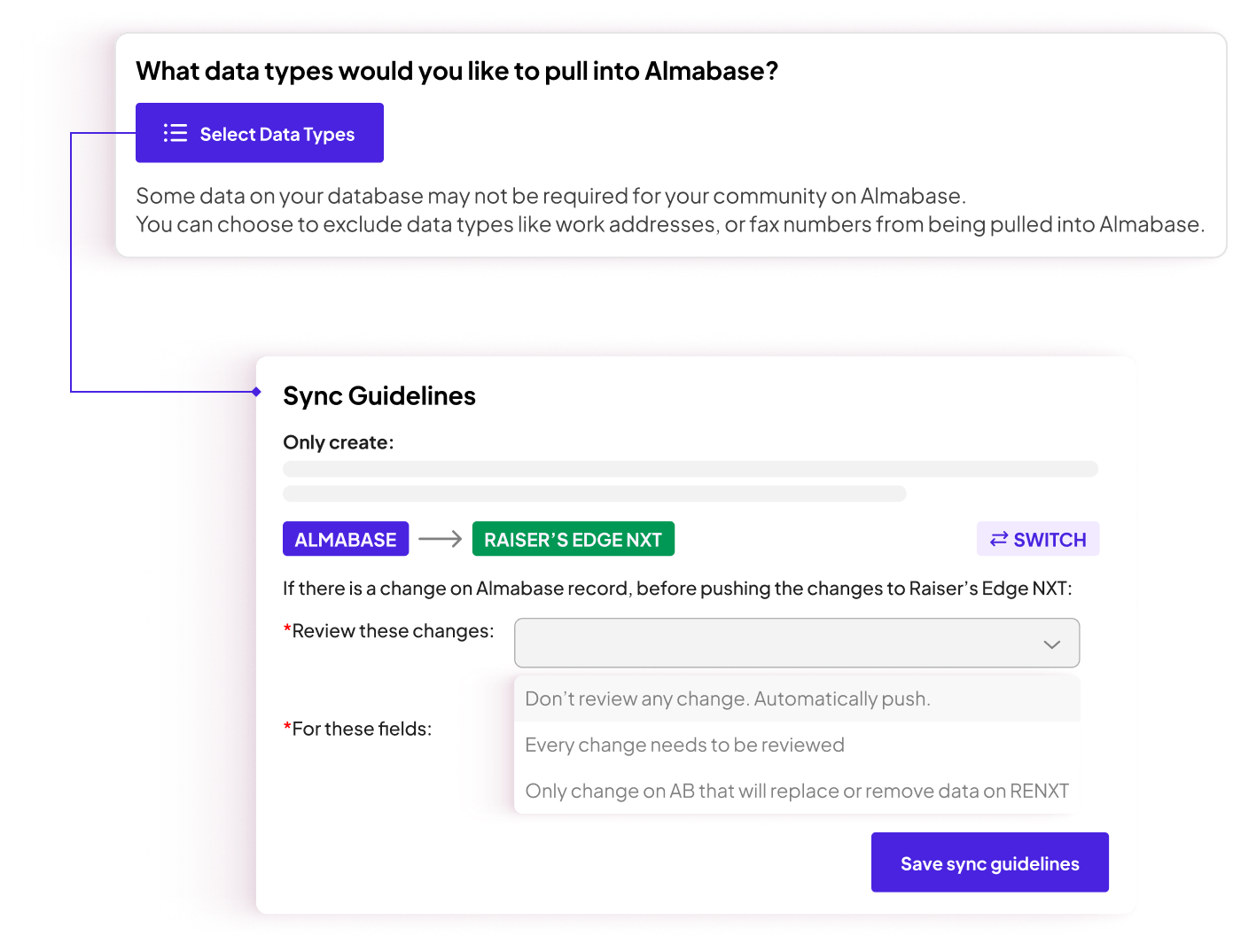
As a result, your team is always working with current, clean data: less time spent maintaining records and more time acting on the insights contained in them.
For MSUM, synced data turned into time they got back: Giving Day reconciliation dropped from four weeks to four days, freeing the team up to launch a stewardship campaign that brought in an additional $40,000 in follow-on gifts. Read more about it here.
Once the event wraps, everyone looks for different metrics for value: the alumni office wants attendance, the alumni relations officer wants to know which reunion class had the highest turnout and leadership wants information on the ROI for the event.
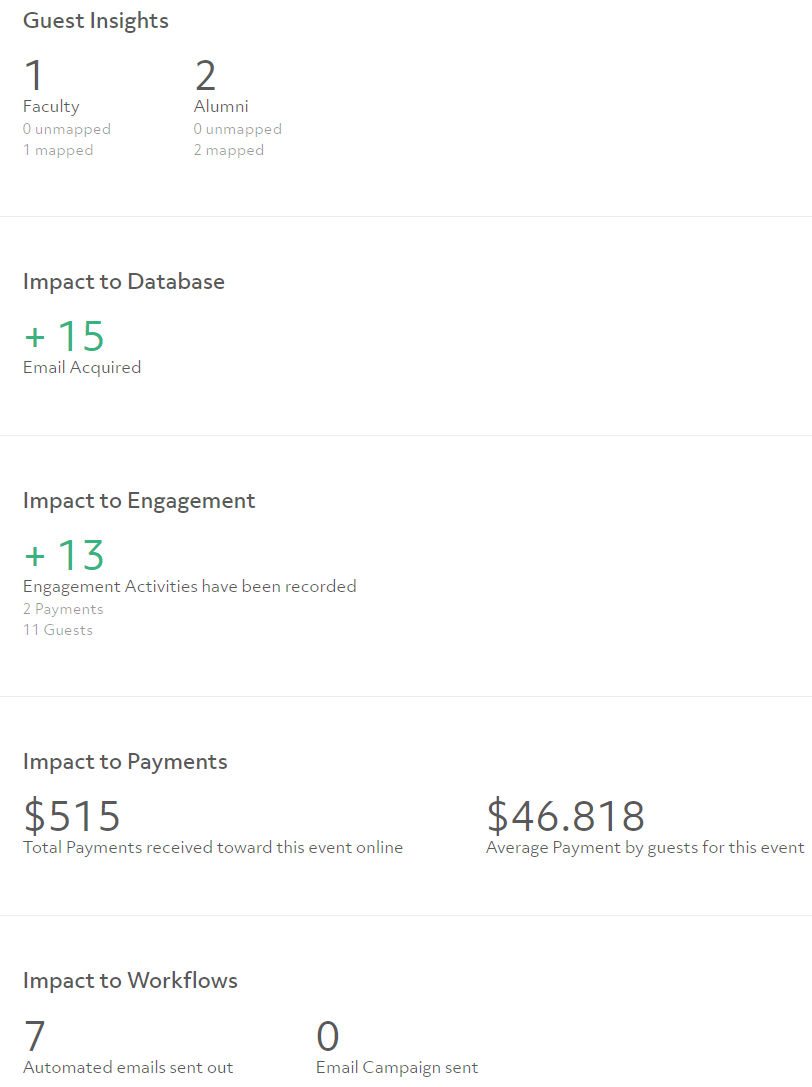
With Almabase, this information is easily accessed and you just have to put it together. Your team gets reports for registrations, attendees, guests, ticket sales, revenue, registration sources, and sub-events without having to export data from three different places first. All of this in a matter of a few clicks.
And because guest data, attendance, and registrations all stay connected via CRM sync, you're working from one version of the truth. Essentially, the data is as reliable as it gets.
Discussing all the stages so far, one thing becomes very clear: if the journey ends at ‘Measure’, you start from scratch with every new event.
Maybe regional events are outperforming expectations while a long-running format has started to plateau. Those patterns only become visible when your event history stays connected. The reports you've built, the attendance you've tracked, the registrations you've captured, and the gifts you've recorded all have another, more important job to do. They're meant to inform the next event.
That's why we'd add one more stage to the framework:

While Measure tells you what happened, Post-event Insights help you decide what to do differently.
Of course, this only works if your event data is complete and trustworthy. When registrations, check-ins, guest records, and gifts flow back into your CRM automatically, you're looking at one complete picture of how the event unfolded and using it to make smarter decisions about the next one.
In other words, you’re feeding the loop instead of closing it.
Every event should leave your team a little smarter than it was before. Over time, Almabase helps build that institutional knowledge, making it easier to compare events year over year, understand what drives engagement, and make decisions based on evidence instead of instinct.
It’s a bit of a misconception that a bigger headcount is what drives up the difficulty when it comes to scaling events. Issues start showing up because with multiple events, the complexity rises, demanding the right systems handle it. With Almabase, teams can handle this complexity while continuing to spend time on curating and creating experiences instead of wrestling with technology.
Scalable ▶️ repeatable ▶️ bigger and better, year on year.
Curious to see what that looks like for your institution? Request a demo with us now! 🤗

Yes. A reunion weekend, Homecoming, or Giving Day can run as one parent event with several sub-events underneath it, each with its own registration flow, capacity, and pricing. Your team manages it all from a single backend instead of juggling separate event pages.
Yes. In-person, virtual, hybrid, and multi-day events all run through the same registration, communication, and reporting framework, so attendees and staff get a consistent experience no matter the format.
Yes. Through TrueSync with Raiser's Edge NXT, registrations, guest information, gifts, and sub-event participation stay synced automatically, so your team is always working from current, clean data.
Almabase is suitable for teams of all sizes. The platform scales to the complexity of the event, keeping registration, coordination, communication, and reporting manageable across an entire calendar of events.
Subscribe
See how modern advancement teams bring alumni engagement and fundraising together.
Plan faster. Execute better
Explore free templates designed for alumni and fundraising teams.
.png)

Anwesha Kiran
Alumni are more online today than ever before, and it’s important for your team to meet them where they are. While in-person events should remain the key focus, there are a variety of virtual alumni event ideas that remove the logistics and cost associated with traditional events that you should definitely consider for your event calendar.
With around 52% of event professionals claiming to have just as much attendance in online events, they’re clearly a great tool for community building.
On the flip side, it’s harder to emulate in-person alumni engagement activities in terms of meaningful connections and immersion. Alumni events require incentive to not be ‘just another virtual engagement event’.
Today, we explore 10 virtual alumni event ideas that focus on meaningful engagement and nurturing relationships, along with tips and best practices.
For both offline and virtual events, attendance is crucial. But by itself, it doesn’t give insights into the outcomes achieved or the relationships formed. Most institutions want an active alumni network that engages with them constantly. For any event to be successful, there are 3 important goals to be achieved:
Planning virtual engagement events effectively requires a great event management platform that lets you handle things end-to-end, from outreach to follow-up campaigns and everything in between. To realize the goals outlined earlier, keep the following pointers in mind while designing a virtual event:
Virtual engagement events come with their own set of unique challenges. Most of these are centred around fatigue, lack of engagement, and availability. The major ones that need to be addressed are:
Here are 10 high-engagement virtual alumni event ideas.
At any given time, various alumni are scaling their careers or building businesses. A big perk of being part of an alumni community are the opportunities to learn from industry leaders and entrepreneurs, especially for the ones early in their careers.
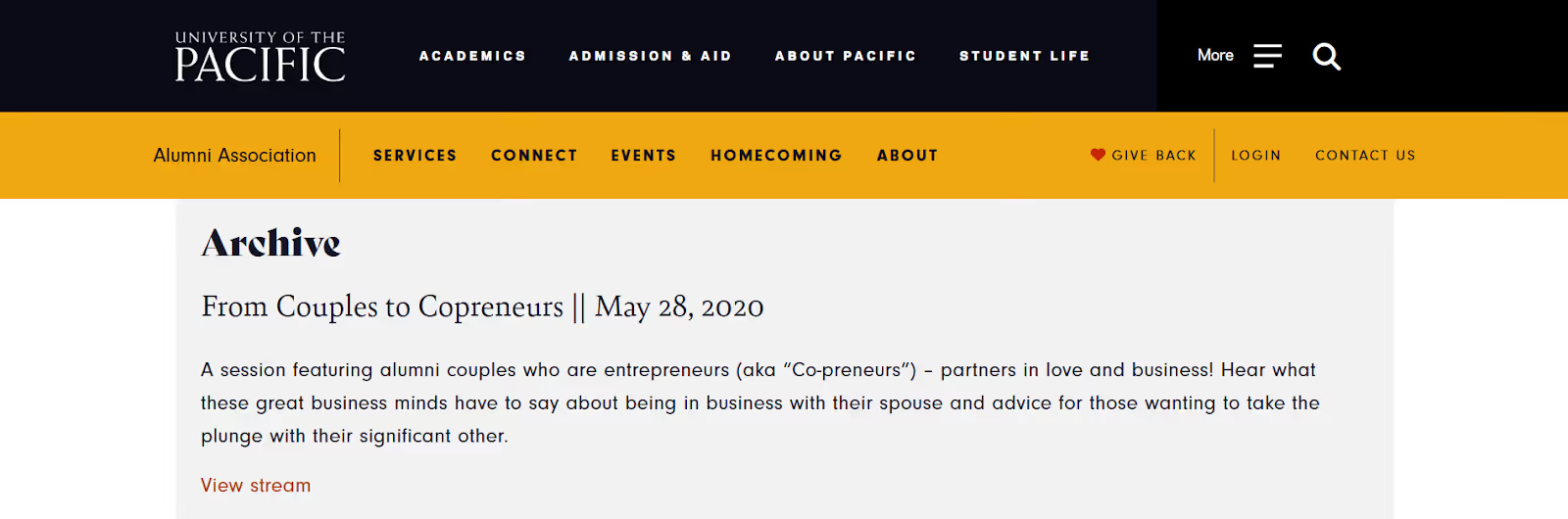
You can cover a variety of industries and niches, increasing inclusivity and participation.
Pointers and tips:
Engagement suggestion: Tie the event into another program. For example, assign the speaker as a mentor to interested alumni, or create a poll for gauging interest on further sessions.
For a lot of alumni, college events and competitions, especially sporting ones, were an integral part of campus life and tradition. University teams draw forth a sense of pride, competitiveness, and belonging even after graduation, as is evident from events like March Madness every year.
They lean into nostalgia, and attract alumni of all ages.
Pointers and tips:
Engagement suggestion: Have a virtual breakout session post-match with current and previous members of the team to drive conversations.
Nothing beats a good old fashioned happy hour for candid conversations and forming connections. Alumni can bring each other up to date on their lives, and old friends can reminisce on their university days. It’s usually hard for alumni spread across the world to meet each other informally, and a virtual happy hour makes it easier.
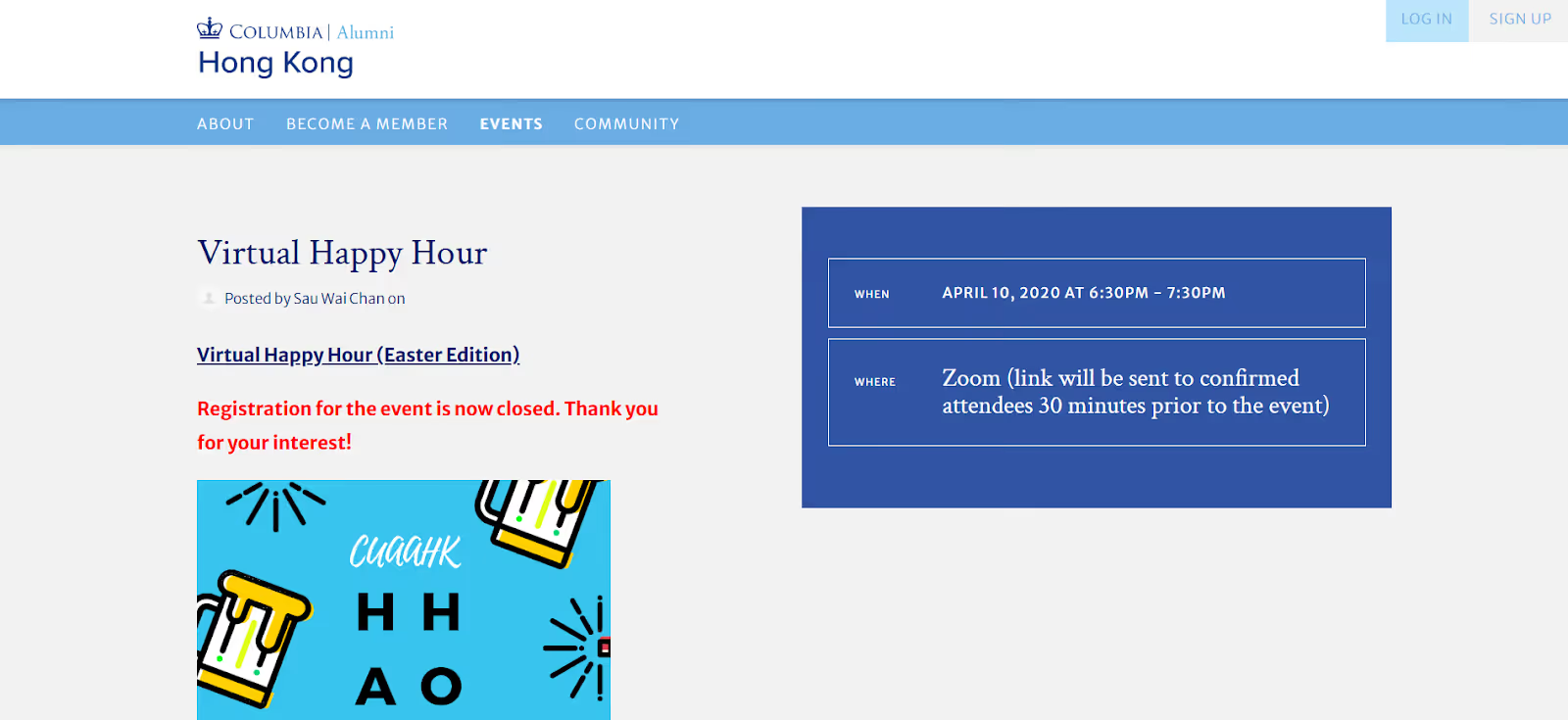
It can also be a way to highlight new initiatives and changes in your institution in a casual setting.
Pointers and tips:
Engagement suggestion: Incorporate a fun, low-stakes party game to make it engaging, something like ‘never have I ever’ is great for breaking ice.
Networking is a powerful tool for a lot of alumni, and offline, it is a very straightforward process. However, alumni are spread across various industries, roles, and geographies, making it difficult for them to network frequently.
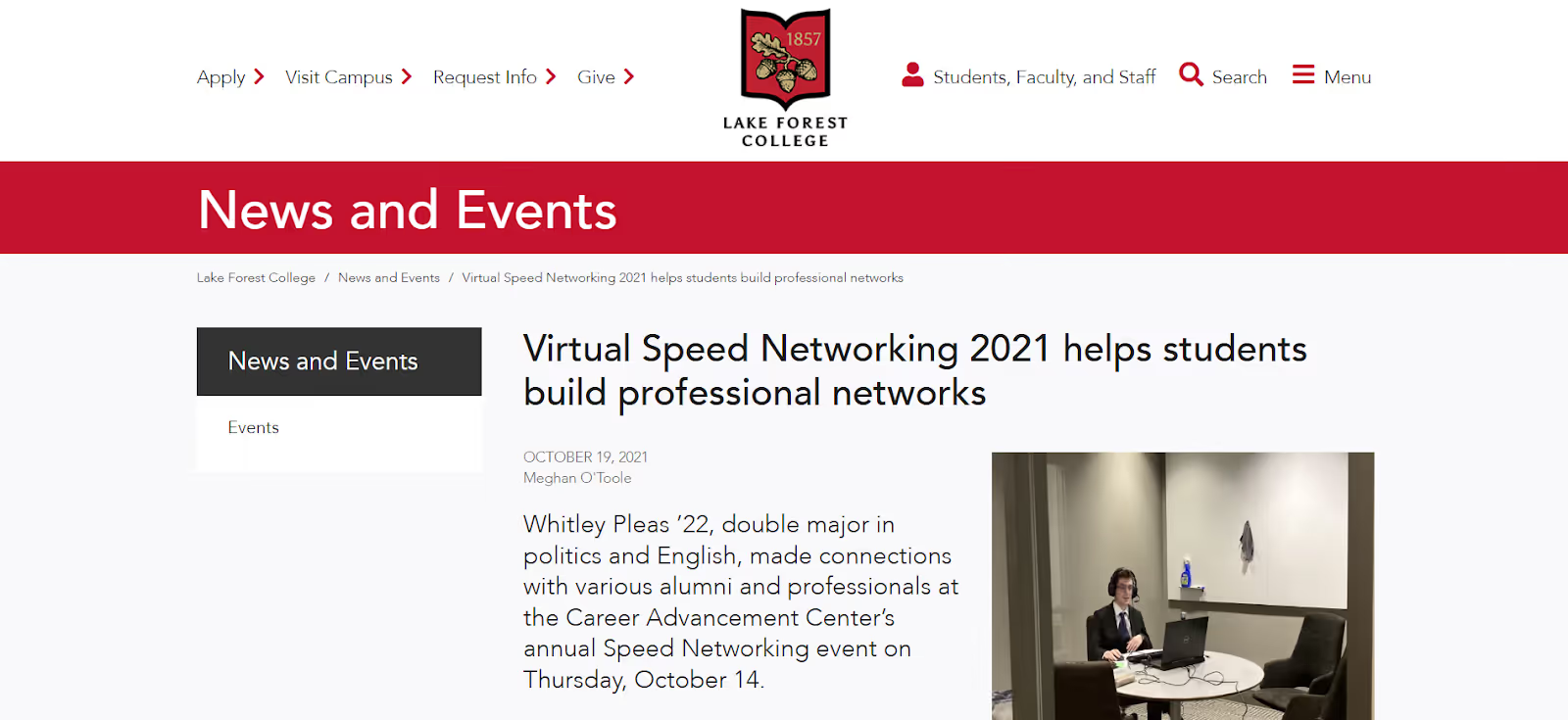
By pairing up early-career alumni with experienced professionals in a particular field, virtual speed networking sessions facilitate knowledge transfer and expose alumni to multiple mentors in a short time period.
Pointers and tips:
Engagement suggestion: Provide a fun, random fact about each person at the start of every rotation (their most ridiculous collection, a niche hobby) to reduce friction and keep things light-hearted.
For a number of topics like career strategy, job-seeking, business challenges, industry trends, current affairs - group discussions are an excellent way to gain new perspectives, engineer solutions, and stay up to date with the best practices.
Virtual roundtables with compact groups drive impactful discussions, while still being casual and engaging.
Pointers and tips:
Engagement suggestion: Create live polls throughout the session based on what’s being debated. They provide direction and it’s interesting to learn people’s opinions on matters.
Running any of these events? Almabase helps you manage invites, track engagement, and automate follow-ups so your team spends less time on logistics and more time building relationships.
Book a Free Demo | Explore the Platform
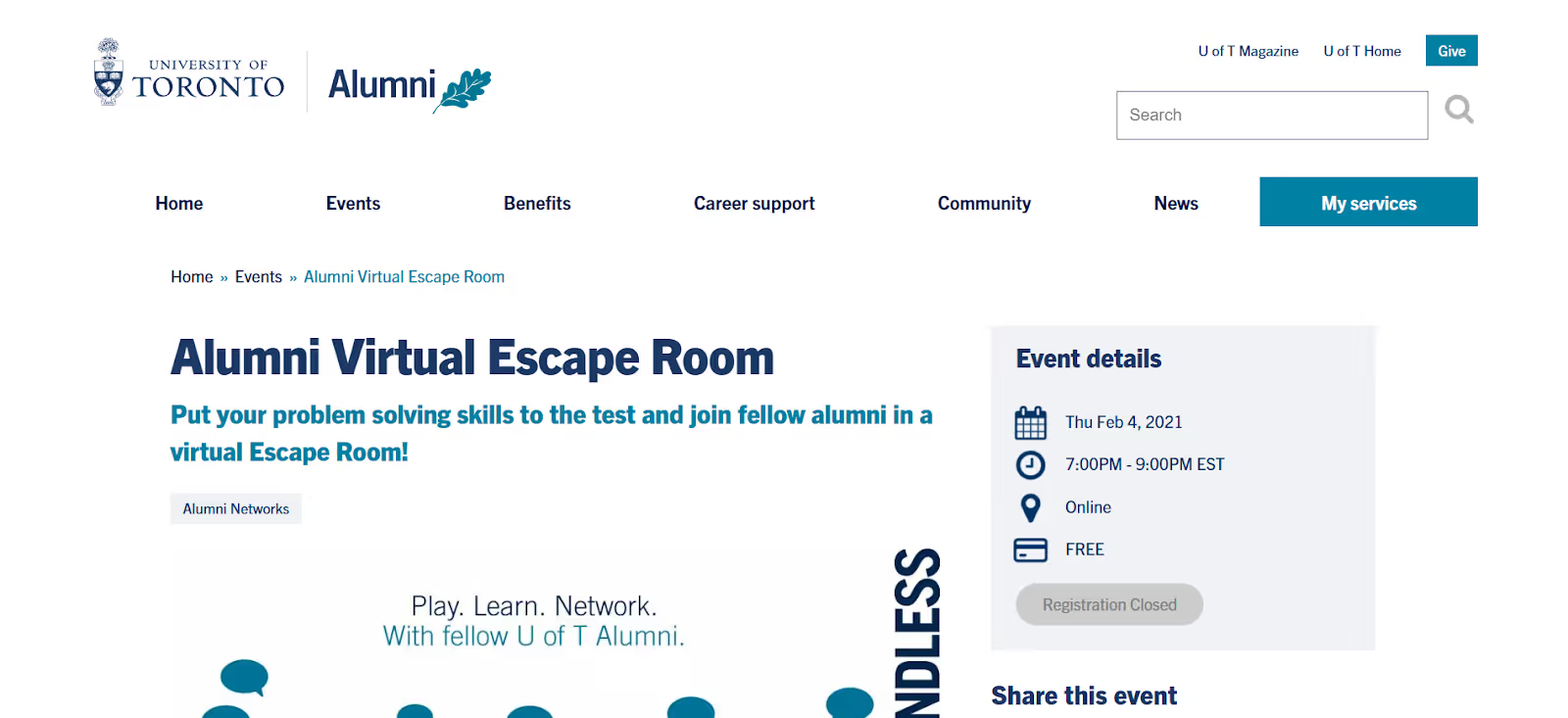
For alumni who may not naturally gravitate toward structured networking events, this format offers a fun way to interact and collaborate with others. It is especially effective for younger alumni and recent graduates.
Pointers and tips:
Engagement suggestion: Include one puzzle related to university trivia or traditions. It sparks nostalgia and gets alumni reminiscing together.
Trivia nights are simple to execute and highly engaging when done well. They appeal to alumni across generations and are particularly effective for building camaraderie among larger groups.
Trivia themes centered around campus history, pop culture, industry trends, or regional topics can keep things interesting and encourage participation.
Pointers and tips:
Engagement suggestion: Include a lightning round where alumni submit questions about their time on campus. It turns the audience into participants and adds a personal touch.
Skill workshops provide clear professional value and are particularly appealing to alumni focused on career growth or transitions. Sessions can cover a wide range of topics such as leadership, entrepreneurship, emerging technologies, financial planning, or personal branding.
Alumni who have developed expertise in these areas can serve as facilitators, strengthening peer learning within the community.
Pointers and tips:
Engagement suggestion: Ask attendees to submit one real challenge they are currently facing related to the skill being taught, and have the facilitator address a few of them live.
Reunions are a staple of alumni engagement and are often centered around nostalgia and reconnecting with old friends. While traditional reunions are usually held on campus, virtual versions allow alumni from around the world to participate without the need for travel.
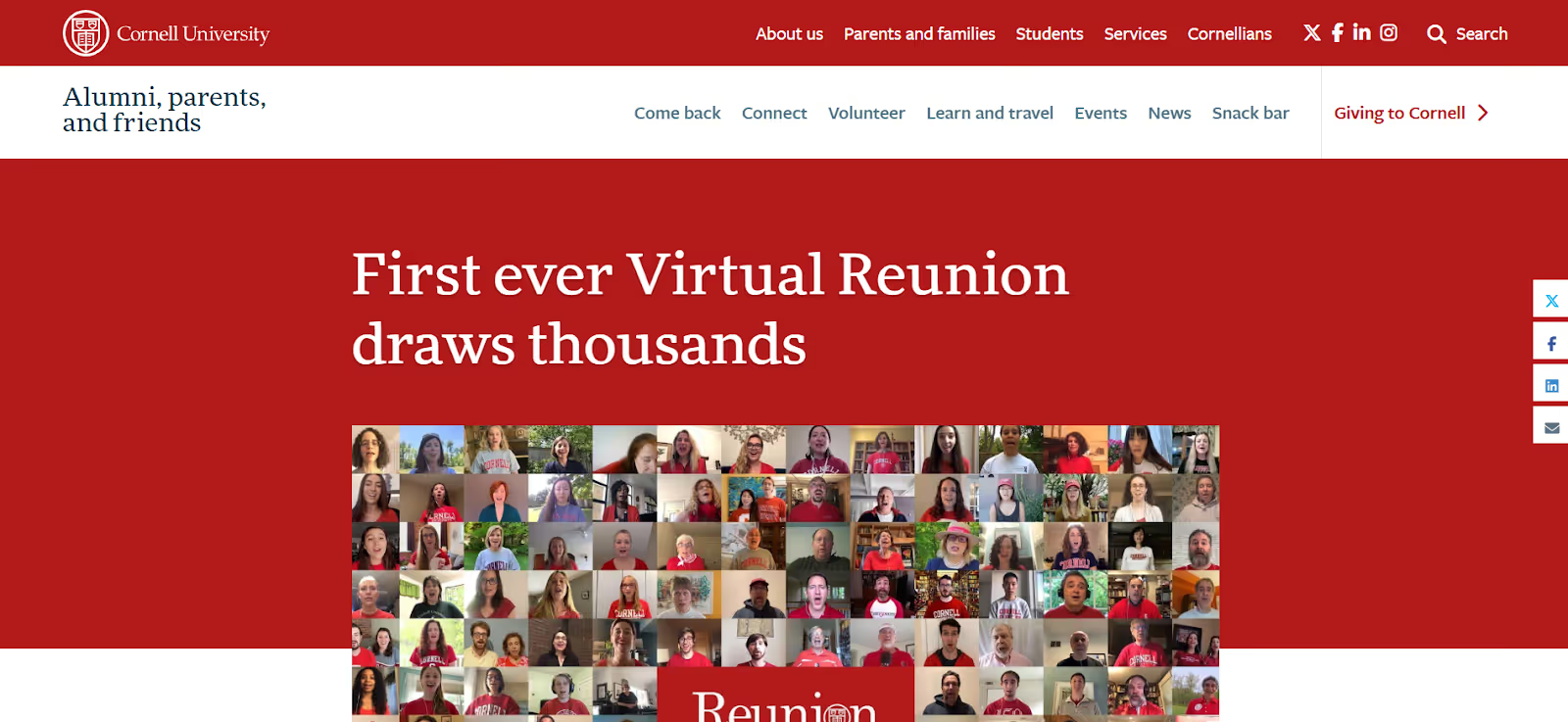
This format works well for milestone batches celebrating five, ten, or twenty years since graduation.
Pointers and tips:
Engagement suggestion: Ask attendees to bring an old photo or memory from their time at university and briefly share the story behind it.
Career-focused discussions remain one of the most valuable formats for alumni engagement. Panels featuring alumni from different industries or career stages provide insights into evolving job markets, emerging opportunities, and professional challenges.

These events are particularly useful for students and early-career alumni seeking guidance.
Pointers and tips:
Engagement suggestion: Ask panelists to share one unconventional career decision they made and how it shaped their journey. It often leads to unique perspectives and interesting discussions.
These virtual alumni event ideas can help institutions foster meaningful connections even when alumni are spread across the world.
Check out how Misericordia University transitioned to a virtual homecoming amidst the pandemic here.
As with any event, attendance still remains the biggest challenge while conducting virtual engagement events. You could plan the perfect event, come up with innovative ideas for alumni engagement, but its success is dependent on pre-event marketing and getting alumni to show up.
Generic emails and a couple of social media posts just don’t cut it anymore. For your event to stand out, you need a multi-channel approach that highlights the event’s value, or the chance to network productively.
Using an event management software to segment alumni based on data helps you design a targeted outreach strategy, and integration with advancement CRMs like Blackbaud's RE NXT streamlines the process. Here’s a quick walkthrough for setting up a killer outreach campaign:
Tracking event metrics go a long way in identifying what worked and what didn’t. Engagement data is very helpful to determine successful formats, group sizes, and scheduling. Since not all data is useful, track intentionally so data doesn’t end up becoming noise. Focus on metrics alumni leaders care about:
What exactly do you need to run virtual events smoothly? A database of alumni along with their details and interests (alumni directory), an event management software, and tools for outreach and email campaigns (that can pull lists and data from the CRM).
Almabase’s event management module integrates with your CRM, and has all the features necessary for end-to-end event management – bringing together outreach, logistics, and data into one holistic platform.
Here’s how Almabase helps you run virtual engagement events:
Your next virtual alumni event could be your most engaging one yet.
Interested in exploring how Almabase can enhance your alumni engagement activities? Book a free demo with Almabase here.


10 Virtual Alumni Event Ideas to Drive Engagement (2026)
Lorem ipsum dolor sit amet, consectetur adipiscing elit. Suspendisse varius enim in eros elementum tristique. Duis cursus, mi quis viverra ornare, eros dolor interdum nulla, ut commodo diam libero vitae erat. Aenean faucibus nibh et justo cursus id rutrum lorem imperdiet. Nunc ut sem vitae risus tristique posuere.

Hari Govind
March 24, 2026
12 minutes
Homecoming is one of the most anticipated events of the school year for both students and alumni. Picking the perfect high school homecoming theme means balancing what attendees are excited about with what your school can realistically pull off on budget. The goal is simple: create an experience people will remember.
Planning your theme early makes that much easier. It gives you more time to organize everything smoothly and avoid last-minute surprises. To help you get started, we’ve put together 20+ high school homecoming themes ranging from classic and elegant to trendy, easy to pull off and unique.
Classic themes are a mainstay for homecoming week. They’re visually rich, they age well, and alumni can connect with them just as easily as current students, which makes them a smart pick if you want homecoming to feel like a true community event.
A night sky theme is one of the most enduring homecoming themes, and it's easy to see why. Dark blue drapes and shimmering lights can transform almost any gym or hall into something that feels magical without requiring a massive budget.
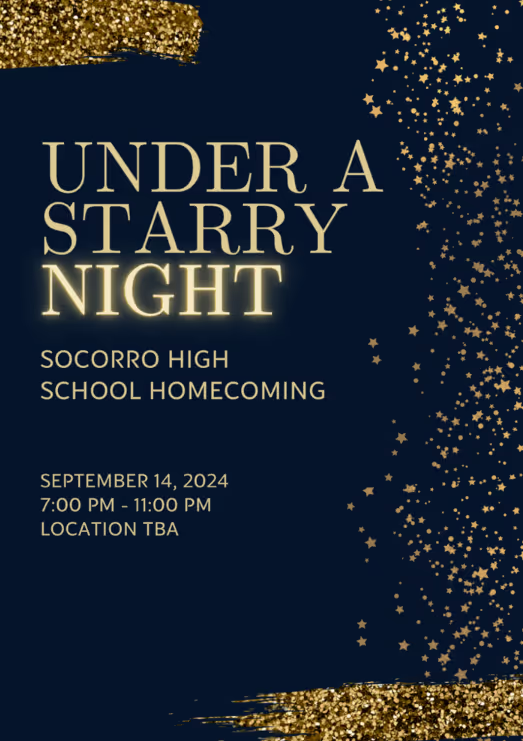
Both Lincoln High School in Nebraska and Socorro High School in Texas ran 'Starry Night' themed homecomings in 2024, leaning into deep blue and silver palettes, complete with photo booths. The theme works across different school sizes and budgets, which is a big part of why the theme is here to stay.
Why it stands out: It's romantic, timeless and photographs well, which makes it a win. Done well, it is a very shareable theme for social media, which boosts engagement with your events.
Decor ideas:
A Hollywood theme holds the potential to give every attendee their A-list moment. It’s high-energy, glamorous, and everyone knows what to wear and how to act when there's a red carpet involved.
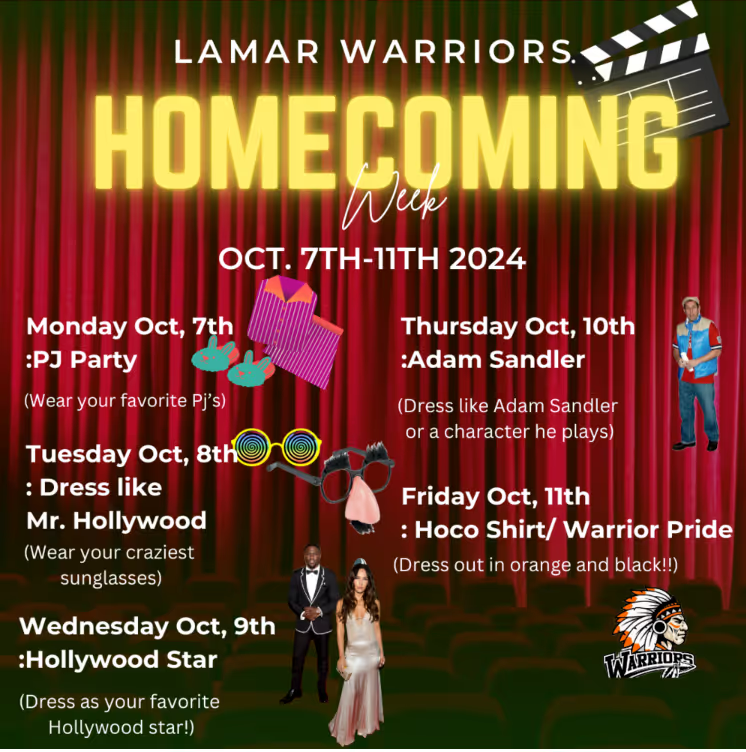
Lamar High School made Hollywood the centerpiece of their 2024 homecoming, building spirit week dress-up days around students channeling their favorite stars. The theme gave every student a chance to feel like a million dollars!
Why it stands out: It's flexible enough to work for spirit week (dress as your favorite celebrity one day, arrive at the dance like you're walking into the Oscars the next), which keeps things exciting and new even while being on-theme.
Decor ideas:
“Enchanted forest” is a theme that can transform a school gym into something that feels straight out of a storybook. Decorations can be as simple or elaborate as your budget allows, and the theme still comes across clearly. You could go for fairy tale elements, a more natural woodland look, or something in between, tailored to your school’s style.

Herndon High School in Virginia took this theme for their 2025 homecoming, incorporating nature-inspired floats in the parade and floral decor throughout the week, proving that the concept carries through spirit week activities as well as the dance itself!
Why it stands out: It feels immersive because of the fantasy element and also lends itself beautifully to photography.
Decor ideas:
A masquerade theme introduces an air of mystery to a regular homecoming week. Masks are an accessory to look forward to, and the Venetian inspiration lends to striking decor in almost any venue.

Fremont Christian School in California ran a masquerade-themed homecoming dance in 2024, leaning into the mystery and elegance of the format.
Why it stands out: It's inherently formal and visually unique. Even those who don't go all-out on their outfit can look the part with just the right mask. It also doubles well as a semi-formal or formal event.
Decor ideas:
Retro themes have been making a comeback, something reflecting on student culture right now as well. Driven by the wave of nostalgia running through fashion and social media, these ideas tap directly into that energy, making them some of the best themes to get excited about.
A decade-hopping retro theme is an energetic format for homecoming week. You can draw inspiration from the decades related to past generations of students, incorporating music, fashion, and popular trends from each era.
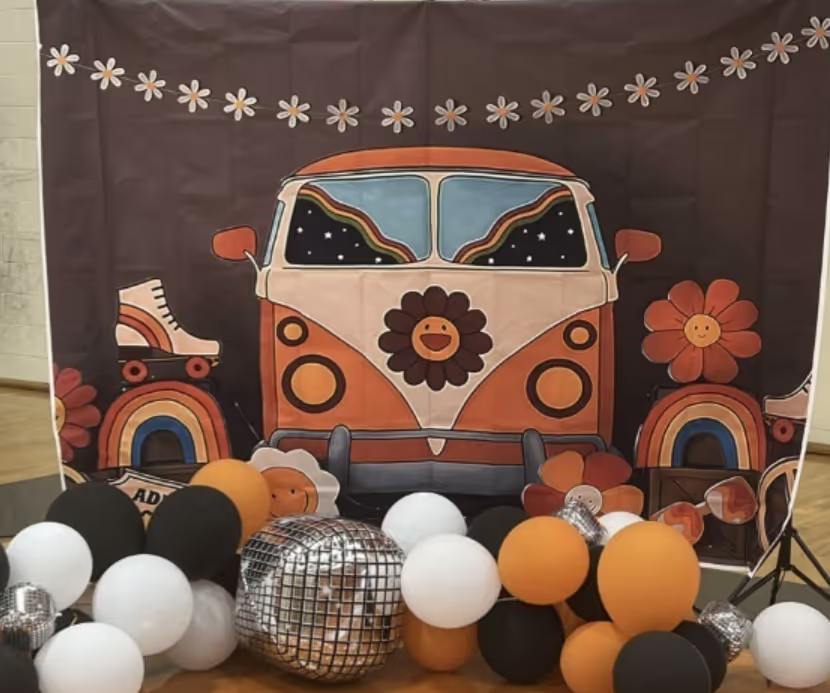
Artesia High School in New Mexico themed their entire 2024 homecoming week around "Groovin' into HoCo," running decade-dedicated dress-up days from the '60s through the '00s, complete with an enchilada supper, bonfire, parade, and assembly.
Why it stands out: It's extremely flexible. Every student can find a decade they connect with, whether it's flower-power '60s, disco '70s, or MTV '80s.. And because most of the "costume" is just clothing, there's almost no financial barrier or prior planning, increasing participation.
Decor ideas:
Leather jackets, sock hops, and drive-in vibes: the 1950s and 60s are full of ideas that can easily be incorporated into a homecoming theme. The looks are fun, accessible, and lend themselves naturally to a full week of themed activities.
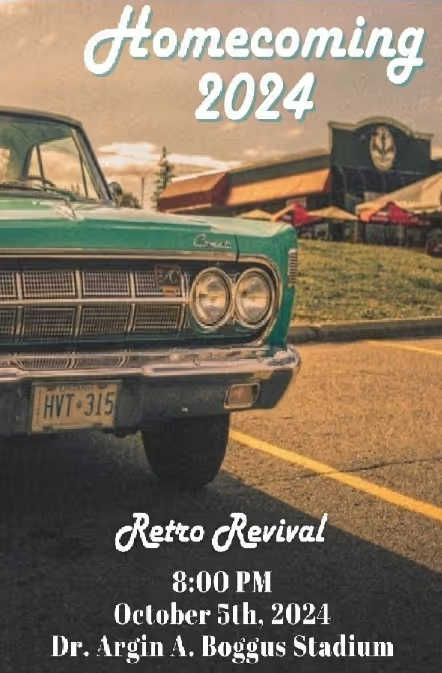
Tavares High School in Florida ran a 'Retro Revival' homecoming in 2024, planning their spirit week around decade-specific themes. The day-by-day format kept students engaged all week, with a retro aesthetic tying everything together.
Why it stands out: It tends to have high dress-up participation because the looks are fun and easy to create. The costume options are wide enough for everyone to find something they're comfortable wearing.
Decor ideas:
The early-2000s nostalgia wave isn't slowing down any time soon! From butterfly clips to shiny tech-inspired accessories, Y2K is having a full cultural moment and high school students are very much along for the ride. There's also a fun generational connection when teachers, parents and alumni join in, having lived through these moments themselves.
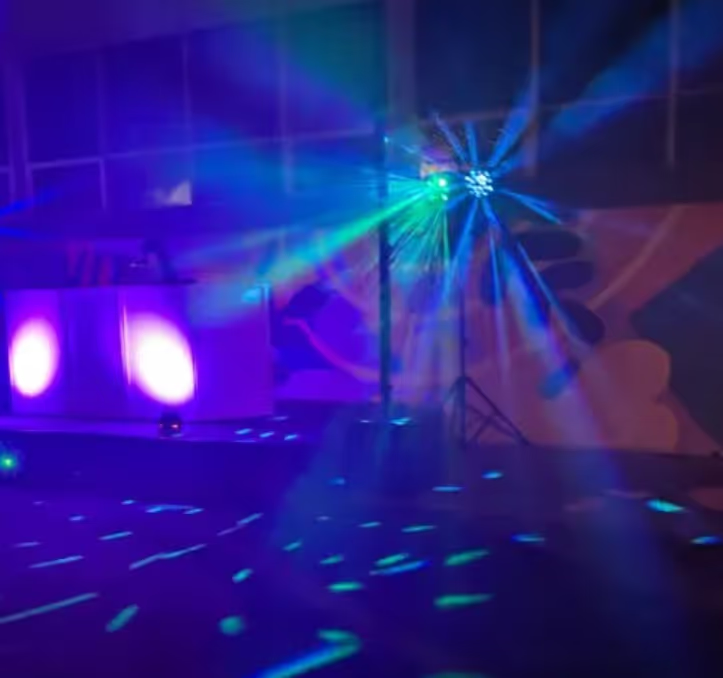
Sunset High School in Portland ran a Y2K homecoming in 2024.
Why it stands out: It reflects what's trending on social media and in fashion right now, which means attendees can simply pick items from their wardrobe and create their costumes.
Decor ideas:
A neon or glow theme turns any venue into a high-energy, visually electric experience. UV black lights do most of the heavy lifting, which makes this a surprisingly easy theme to execute well.
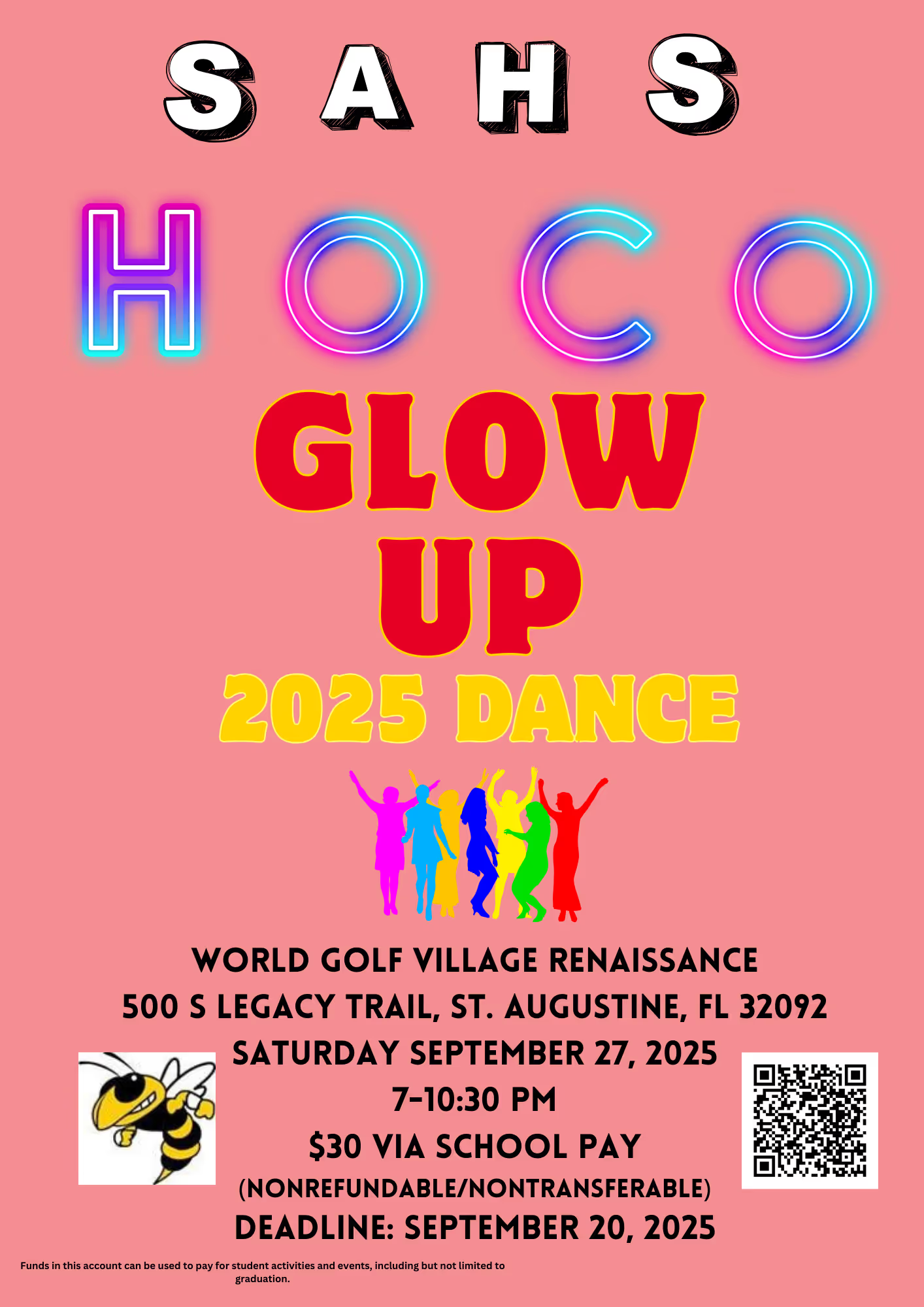
St. Augustine High School in Florida made their 2025 homecoming theme 'Neon Glow Up!', hosting the dance at a local hotel to add an upscale feel to the vibrant concept. Taking the theme off school grounds gave it an elevated atmosphere.
Why it stands out: Neon and glow accessories are easy to find, so attendees at every budget level can fully participate. The visual impact in photos is also huge, which drives social sharing and school spirit.
Decor ideas:
The best homecoming themes don't need to be expensive ones. These ideas require no elaborate venue transformations and those attending can put their look together from things they already own.
A western theme works because it builds the week around something attendees can dress for without spending a dime. Flannel, boots, denim, and cowboy hats are already in most wardrobes.
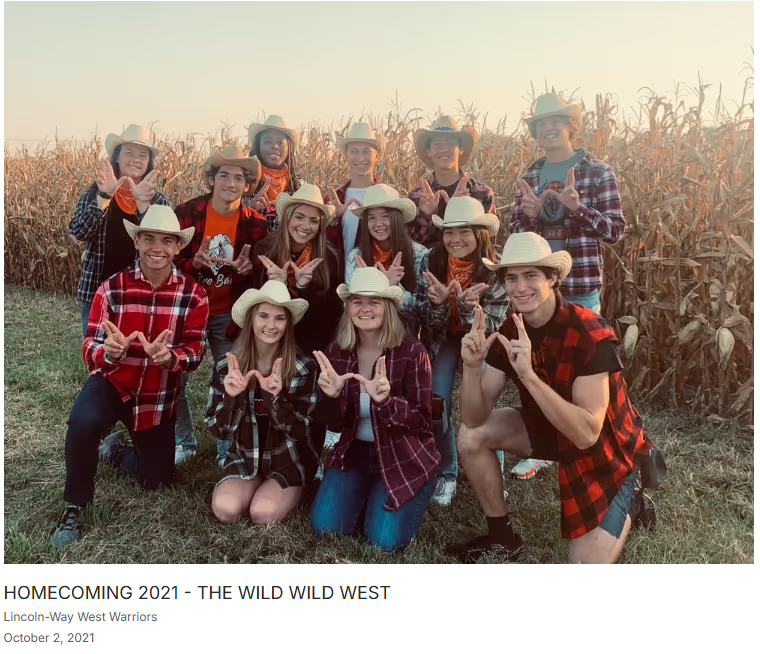
Lincoln-Way West High School in Illinois ran a "Wild Wild West" homecoming week, with flannel day, class color day, and a western-themed spirit day leading into a Friday night game. The dance itself was held off-campus at a local commons, with food trucks adding to the casual, community feel of the event.
Why it stands out: When those attending don't need to buy anything to create looks around the theme and participate, attendance goes up across the board.
Decor ideas:
A music festival theme is flexible enough to run all week across different genres: country, hip-hop, pop, throwback, while keeping a concept that ties everything together. It is essentially a theme with the spirit week inspiration built-in.
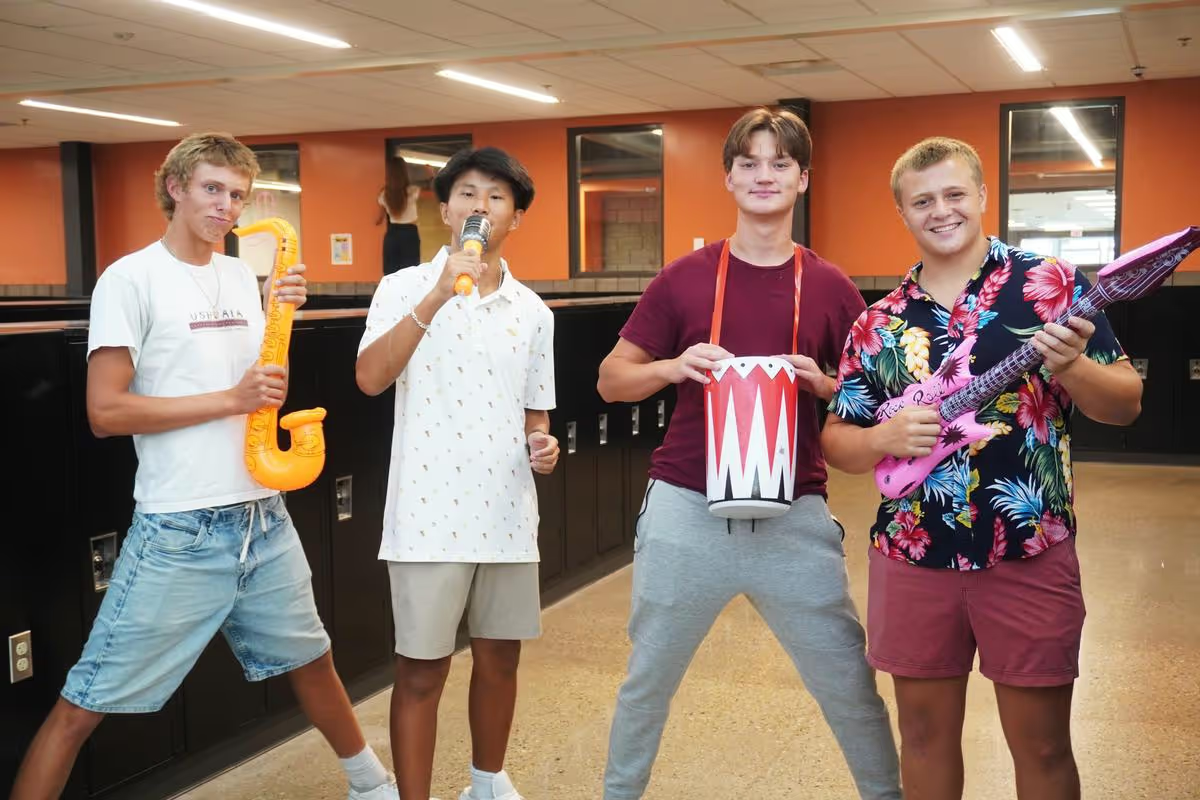
Thornapple Kellogg High School in Michigan made their 2024 homecoming theme 'TK Palooza', with each spirit day dedicated to a different music genre: Country Day, Hip Hop Day, Pop Music Day, and Throwback '60s Day. The school-wide rollout extended the theme across all grade levels, making it a community-wide event pulled off with a low budget.
Why it stands out: Every student has a musical genre they love, which means every student can find a day they're excited to dress for. It keeps the week feeling fresh, without needing expensive venue transformations.
Decor ideas:
The denim-and-diamonds concept is a smart budget theme because it pairs something everyone owns (denim) with glamorous accessories. It’s elevated but at the same time accessible.

Why it stands out: Attendees can wear their own jeans and elevate the look with jewellery or sparkly accessories. There is no formal wear required, in fact, the contrast between casual and glam is the whole point.
Decor ideas:
This theme is the one to pick for schools that want an accessible, fun dress code that still photographs well and feels like a proper event. It's a great pick if your student body is mixed on how formal they want things to be.
Sometimes the simplest idea is the best one. A school colors night strips the theme back to its most essential element: pride in your own school.
Why it stands out: Participation is essentially guaranteed. Every student owns something in their school colors, which means no one is left out for financial reasons. It also doubles as a lead-in to the Friday night game, keeping energy high all week.
Decor ideas:
Homecoming already falls in autumn, so leaning into the season is an easy creative decision. A rustic fall theme ties the event to the season and delivers a warm, inviting atmosphere that works with almost any venue.
Why it stands out: The dress code is accessible: flannel shirts, boots, denim, and cozy layers are things folks already own. There’s no shopping required, which means higher participation across income levels. The aesthetic also scales naturally: it looks just as good in a school gym as it does in a rented hall, which keeps anticipation high.
Decor ideas:
Some schools want their homecoming dance to feel distinctly formal: a step up from the usual school social. These themes are designed to set that tone from the moment guests walk in the door.
A galaxy-inspired formal theme takes the classic 'stars' concept and gives it a more sophisticated, high-design treatment. The vision: a ballroom that looks like the inside of a planetarium.
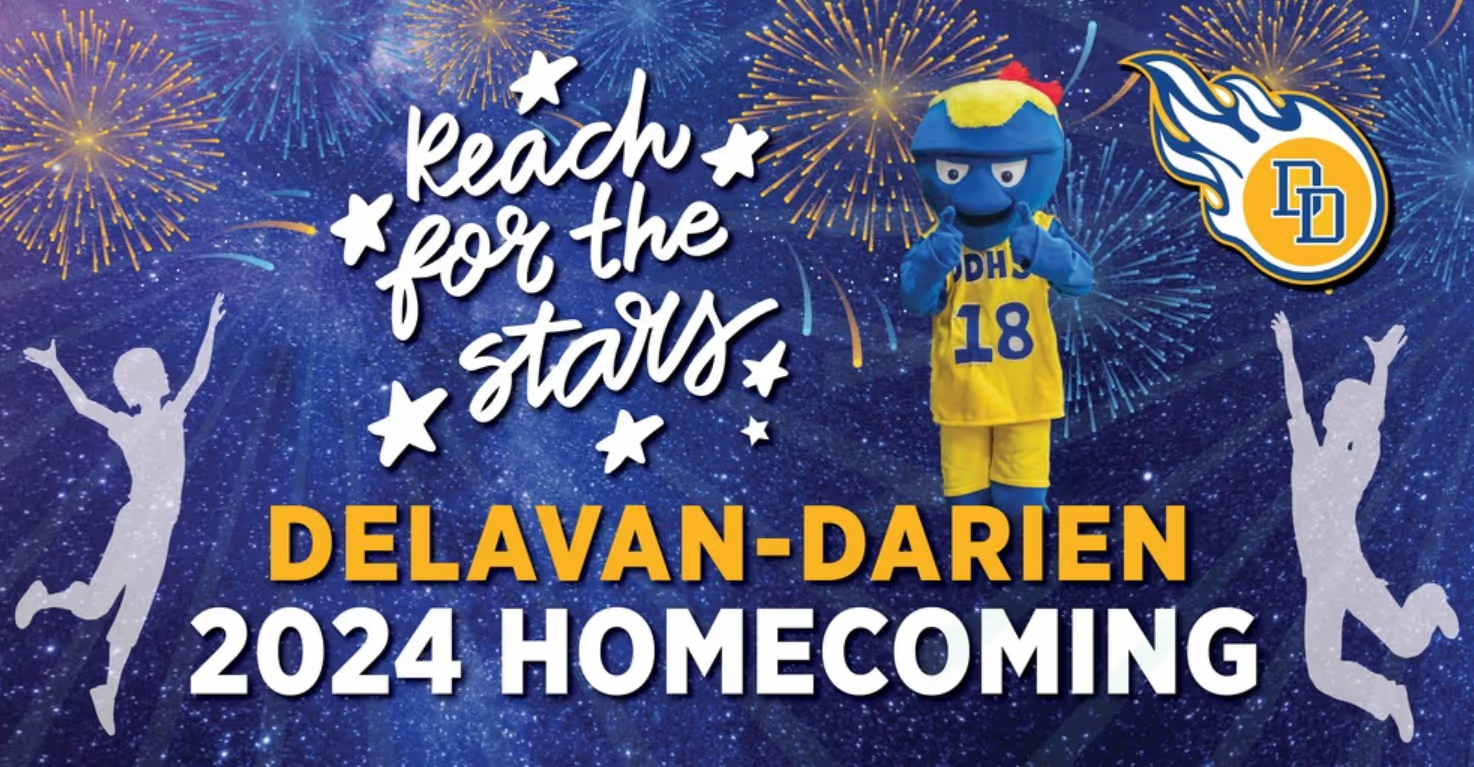
Delavan-Darien High School in Wisconsin chose 'Reach for the Stars' for their 2024 homecoming, turning their gym into a galaxy-inspired ballroom. The focus was on creating an atmosphere that felt special and formal and a genuine upgrade from the standard decorated gym.
Why it stands out: It clearly differentiates the formal dance from the casual spirit week activity days. Attendees immediately understand this is the 'elevated' event of the week. The visual effect, done well, is genuinely breathtaking.
Decor ideas:
A black and gold color scheme is one of the most reliably elegant choices for a formal school event. It's sophisticated, visually cohesive, and gives the room an immediately prestigious feel.

Trinity Academy in North Carolina runs an annual Black and Gold Gala that has become a school tradition, celebrated for the sense of occasion it creates and its role in bringing the community together. It isn't technically a homecoming event, but the combination of a strict dress code, a formal venue, and a consistent visual identity makes it work, and any school can apply that same idea to homecoming.
Why it stands out: The dress code requirement creates a visually unified room that looks stunning in photos. The formal nature raises the perceived status of the event, which motivates those attending to show up in elegant garb..
Decor ideas:
Only a few themes can make a school gym feel genuinely luxurious, and Champagne Dreams is one of them. Built around a palette of whites, creams, gold, and shimmer, the entire aesthetic signals "special occasion".
Why it stands out: It holds a lot of potential for a transformative set up. It's the kind of night guests talk about for years because it gives them an elevated experience within the school itself.
Decor ideas:
A sophisticated take on the celestial theme, Moonlight and Marble evokes a Grecian feel with cool whites, soft greys, gold accents, and a venue that feels like a high-end art gallery crossed with a ballroom.
Why it stands out: The theme is visually striking without being loud. The color palette white, ivory, grey, and gold, is elegant and photographs really well..
Decor ideas:
Where Moonlight and Marble is cool and architectural, Celestial Elegance is warmer, more whimsical. It mixes soft lighting, hanging stars, and glowing centerpieces to create grandeur that feels special but is easy to achieve with simple decorations.
Why it stands out: It treads the line between formal and magical. Attendees feel like they're attending something truly special and memorable. The palette also allows for a wide range of dress options, from classic black tie to rich jewel tones.
Decor ideas:
If your school is ready to move beyond the standard theme ideas, here are some out-of-the-box ideas that get people talking.
Basing your homecoming theme on a specific film or show is one of the most effective ways to generate real buzz from the moment it's announced. You get to harness the emotional connection that students already have to the source material. The best picks are ones that have a strong visual world with vivid color and a recognizable aesthetic.

RHCS, California chose Rio as their 2024 homecoming theme, building an entire spirit week around the film's world. Each day had its own twist drawn from the movie, like twin days inspired by characters Blu and Jewel, and surfers vs. tourists, or animal print day. The theme was planned months in advance specifically to deliver a "wow factor,".
Why it stands out: A specific, well-chosen idea gives the planning committee a complete creative brief from day one: the color palette, the soundtrack, the decor style, and the dress code all flow naturally from the source. Planners and attendees don't need to interpret a vague concept, they just need to channel their connection with the story.
Decor ideas:
An Around the World theme is a great way to give each class a unique experience within the same theme. Each class claims a different country or region, then competes through hallway decorations, float design, and dress-up days. This means the creative energy runs school-wide for the entire week.
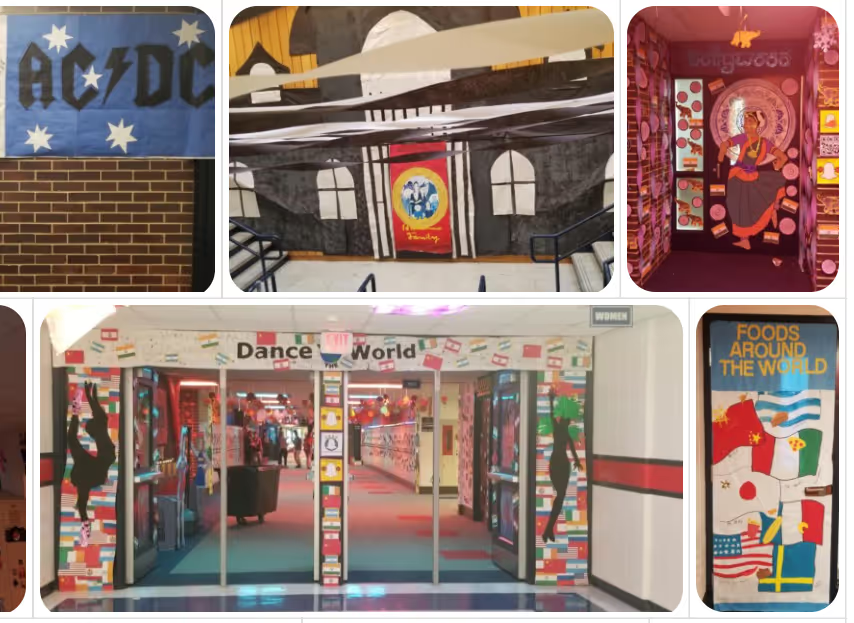
Conant High School in Illinois used "Around the World" as their homecoming theme and had student decorate different hallways, each representing a different global destination. The result was a school-wide installation that turned the building itself into an event.
Why it stands out: It naturally distributes participation and encourages creativity since each grade has to think differently about their assigned region. It's also one of the most inclusive homecoming themes available. Every cultural background has a place in it.
Decor ideas:
A Candyland theme is immediately fun and community-facing. It's vivid, playful, and translates beautifully to parade floats and family-friendly events. It's also a great way to involve younger students and the broader community beyond high school.

Westminster High School in Colorado went all-in on 'Candyland' for their 2024 homecoming parade, with bright color schemes and giant candy-themed float designs. The community event aspect worked particularly well; the theme is welcoming for all ages, which brings more families out to the parade and builds school spirit.
Why it stands out: It’s a fun theme that works well for homecoming parades and encourages community interaction with the floats. Giant candy-themed props and bright primary colors have a huge visual impact, increasing participation and excitement.
Decor ideas:
An enchanting theme with castles, magic, and the feeling that anything could happen, this is the perfect one to pick for an unforgettable night. It's immersive, visually rich, and gives attendees full permission to go all-out with their looks.
Why it stands out: It moves beyond the typical school dance atmosphere and creates a sense of occasion. Those who might not otherwise dress up find it easier to commit. The theme invites imagination and they can put their own spin on it..
Decor ideas:
This is a step up from the standard music festival concept: instead of a single-room dance, the school is divided into "zones," each with a different genre, playlist, and visual aesthetic. Students move between zones throughout the night, making homecoming feel more like a live experience than a standard dance.
Why it stands out: It keeps attendees moving and engaged all night rather than clustering in one corner. It also naturally accommodates different tastes: one who loves country music and one who lives for hip-hop, both have somewhere to feel at home.
Decor ideas:
Just choosing a good theme isn’t enough; it has to fit your school. Here’s how to choose one that works.
Trends shift quickly, so last year’s idea might already feel outdated. Ask your student council or run a quick poll. Participants are more likely to show up and take part if they have a say in the events.
Some themes are flexible, others need specific setups. A Celestial Elegance theme needs height and space for hanging decor. An Enchanted Forest needs room to build things out. A Neon Glow Party only works if you can control lighting. Take a walk through your venue and be honest about what you can pull off.
Pick something your team can actually execute. A Western Week or Music Festival is simple and easy to set up. A Masquerade Ball or Galaxy Ballroom takes more planning and resources. If you’re stretched thin, go simpler and do it well.
The theme should help guide everything else. Music, outfits, photo spots, even small activities should all connect. A groovy retro night, for example, makes it easy to choose mirror balls for decor, vintage looks for dress code, and backdrops and photo booths in bold, warm colors and patterns. When it all lines up, the event just feels more cohesive and better.
The more effort or money it takes to participate, the more people will sit it out. Choose a theme that’s easy to show up for. The goal is simple: everyone should feel like they can be part of it.
Once you’ve picked the theme, you arrive at your real challenge: making it come to life across an entire week of events. Here are some planning moves that will aid you in delivering a memorable experience:
Have a single page with all the details: schedule, dress-up days, tickets, and updates. When information is scattered, people miss things and you end up answering the same questions over and over.
Skip paper lists and manual tracking if you can. Use one system so you know your numbers ahead of time and avoid last-minute confusion.
People rarely act on the first message. Send a reminder when you announce, another a week out, one a couple of days before, and one on the day. It makes a big difference in turnout.
You’re talking to students, parents, and sometimes alumni. Send each group what they need so no one gets overwhelmed or misses something important.
Don’t let it end when the night is over. Share photos, post a quick recap, and thank the people who helped. It keeps the energy going and makes next year easier to build.
Managing a multi-event Homecoming week and everything around it can get messy. Registrations, communication, tracking attendance, and follow-ups all take time, and small gaps can turn into bigger issues.
That’s where having a system like Almabase’s event solution helps by bringing everything into one place so your team isn’t juggling tools or chasing information. This is done through a few core functions
Instead of spreading details across emails, social posts, and flyers, you can set up a single event page in Almabase. This includes sub-events with customized access and admin features so that students, parents, and alumni know exactly where to go for schedules, registration links, and updates. This keeps everyone informed and cuts down confusion from scattered information.
Almabase lets you handle RSVPs and ticketing in one place without manual tracking. You can see your numbers in real time, which makes planning everything else a lot more straightforward. This gives you clarity early, so you can plan with fewer last-minute surprises.
You can send reminders, updates, and follow-ups directly through Almabase. It helps make sure people don’t miss key details and saves your team from answering the same questions repeatedly. This improves turnout and reduces last-minute back-and-forth.
With everything in one system, you can track who registered, who attended, and how different groups engaged. That visibility makes it easier to plan future events and improve each year. This helps you make better decisions instead of guessing what worked.
Almabase also helps you follow up after homecoming, whether that’s sharing photos, sending a recap, or staying in touch with alumni and families. It turns a one-night event into something that builds longer-term engagement, so people keep coming back.
Planning your next school event? See how Almabase can help you manage registrations, communication, and community engagement more smoothly. Request a demo to get started.

20+ Inspiring High School Homecoming Theme Ideas (2026)
Lorem ipsum dolor sit amet, consectetur adipiscing elit. Suspendisse varius enim in eros elementum tristique. Duis cursus, mi quis viverra ornare, eros dolor interdum nulla, ut commodo diam libero vitae erat. Aenean faucibus nibh et justo cursus id rutrum lorem imperdiet. Nunc ut sem vitae risus tristique posuere.
Anwesha Kiran
April 10, 2026
12 minutes
Planning an alumni event is a tall order. Be it a reunion, a donor gala, or a campus program, the journey is complex, and your team is expected to deliver experiences that feel seamless for attendees and meaningful for your institution.
The challenge here is that most advancement teams are stuck juggling disconnected systems that aren’t built particularly for schools and universities. While there are plenty of event management software options available on the market that might reduce your burden, the right platform will ensure that every detail runs like clockwork and delivers measurable impact.
In this guide, we’ll show you how modern event management software can help your advancement teams gain the clarity and confidence to choose the right platform that makes planning easier and outcomes clearer.
Higher education leaders are making technology a top priority. In the 2025 CCS Philanthropy Pulse survey, more than 70% of institutions identified technology adoption as a key focus for the year ahead, reflecting the push to strengthen fundraising operations and engagement systems. This shift is driven by the growth of alumni and fundraising events, the rise of hybrid formats that bring global audiences together, and increasing pressure from leadership to demonstrate ROI with clear, data‑driven reporting.
At the same time, common pain points remain stubbornly familiar. Manual list exports, disconnected CRM data, and separate systems for email, ticketing, and giving leave staff juggling fragmented workflows. On-site check‑ins often feel chaotic, post‑event reporting is delayed or missing, and leadership lacks visibility into how events contribute to long‑term donor engagement. In 2026, event management software matters more than ever because it addresses these challenges head‑on, integrating CRM workflows, simplifying check‑ins, and delivering the reporting advancement leaders now demand.
When you look closely, not every event management software is built with institutional needs in mind. Some tools focus on running events; others support everything that happens around and after them. Before getting into comparisons or questions, it helps to understand the core features that tend to matter most for institutions managing alumni, advancement, and engagement at scale:
Your attendees’ first impression is shaped by how easy it is to register. A platform that offers automated registration, flexible ticketing, and QR code check‑in saves staff time and reduces bottlenecks at the door.
Look for mobile‑friendly sign‑ups, customizable forms, and real‑time attendance tracking so you know exactly who’s in the room without chasing spreadsheets.
Clean data is non‑negotiable for advancement teams. Native integrations with systems like Raiser’s Edge NXT or BBCRM ensure every registration, gift, and interaction flows directly into your database without duplicate records.
Prioritize platforms that sync automatically, prevent errors, and give you confidence that your event data strengthens long‑term alumni and donor strategy.
One of the biggest frustrations for alumni and donor teams is juggling multiple tools just to send event updates. The right platform should let you manage confirmations, reminders, and segmented outreach in one place, so you’re not copying lists back and forth between systems. Personalization is where communication really pays off; alumni should get invites to reunions they care about, donors should see recognition that feels genuine, and students should receive messaging tailored to their involvement.
Look for software that integrates directly with your CRM, makes it easy to segment audiences, and tracks engagement so you know which messages resonate and which need adjustin
Events are often where giving happens, and the right software makes it effortless. Built‑in donation options during registration or live events encourage spontaneous contributions, while sponsorship and auction features help you manage commitments and maximize revenue.
Look for platforms that make giving frictionless and follow‑up automatic, so you capture every opportunity without extra manual work.
Large events come with moving parts: seating charts, table assignments, and multi‑day schedules. Software that supports seating and table management helps you place donors thoughtfully, while sub‑event support keeps conferences or reunions organized under one umbrella. These tools reduce manual coordination and give your team more control over the attendee experience.
Data tells the story of your event’s success. Real‑time attendance reporting gives you visibility into who showed up, while post‑event summaries help you demonstrate impact to leadership. Compliance features like SOC 2 certification and ADA accessibility considerations ensure your institution meets standards and delivers inclusive experiences without extra stress.
Events are about connection, and interactive features make attendees feel part of the experience. Tools like live polls, Q&A, gamification, or hybrid event support extend your reach and keep participants engaged.
Look for platforms that make these features easy to set up and integrate, so your team can focus on building relationships instead of troubleshooting tech.
Advancement teams are expected to do more with less, and AI is becoming the tool that makes it possible. A platform with built‑in AI can automate repetitive tasks like reminders and follow‑ups, clean up attendee lists, and even predict which events are most likely to drive donor conversions.
Look for systems that use AI to personalize alumni communication, surface engagement patterns you might otherwise miss, and deliver smarter reporting that connects attendance directly to fundraising outcomes. Instead of adding more manual work, AI frees staff to focus on relationships while giving leadership the clarity they need.
Events aren’t just about logistics; they’re also about managing dollars and cents. Having built‑in tools to track expenses against sponsorships and ticket sales gives you a clear view of ROI without juggling spreadsheets. This makes it easier to justify budgets to leadership and plan smarter for the next event.
Events don’t happen in a vacuum. Integrations with student portals, finance systems, or learning management tools reduce silos and keep everything connected. For advancement teams, this means smoother coordination across departments and fewer headaches when pulling reports or reconciling data.
When you’re sitting down with a vendor or demoing a platform, asking the right questions will help you cut through the sales pitch and see if the software truly fits your institution’s needs. Here are the ones worth asking:
Once you’ve asked the right questions, the next step is weighing the answers. Choosing the right software is about finding a tool that fits your institution’s goals, budget, and the way your team actually works. Here’s how to approach the decision:
The right event management software should feel like an extension of your team, reducing manual work, strengthening alumni and donor records, and scaling with your institution’s ambitions. If it feels like “just another system to manage,” keep looking.
Choosing the right software is only half the story; the other half is how quickly and smoothly it becomes part of your institution’s day‑to‑day. Here’s what a typical rollout looks like, and what you should expect along the way:
You’ve asked the right questions, weighed practical tips, and seen what a rollout might look like. The final step is exploring which platforms can actually deliver on those expectations. We’ve put together a detailed roundup of the best event management software for K‑12 and higher ed.
To give you a quick snapshot, here are five options schools and universities often consider:
After exploring the broader software options, it’s clear that advancement teams need something different. They need a platform that aids in strengthening alumni relationships, stewarding donors, and connecting participation to long‑term outcomes. This is where Almabase comes in. Designed with educational institutions in mind, it helps you move beyond one‑off event management and into a connected approach where every gathering contributes to engagement and fundraising goals.
Here’s how Almabase supports schools and universities in practice:
While the decisions often look straightforward, hidden costs, weak integrations, and poor rollout planning can derail even the best‑intentioned purchase. Here are some quick pointers to keep in mind before you make the final choice-
Best practices
Pricing realities
Common pitfalls to avoid
Making the right choice will and should depend on knowing what matters most to your team, understanding how events fit into your larger advancement strategy, and choosing a tool that makes those connections easier to handle.
If you’re ready to see what that looks like in practice, we’d love to continue the conversation. Schedule a demo and let’s talk about how your next reunion, gala, or giving day can become part of a connected engagement journey.

Event Management Software for schools and universities. A Complete Buyer's Guide (2026)
Lorem ipsum dolor sit amet, consectetur adipiscing elit. Suspendisse varius enim in eros elementum tristique. Duis cursus, mi quis viverra ornare, eros dolor interdum nulla, ut commodo diam libero vitae erat. Aenean faucibus nibh et justo cursus id rutrum lorem imperdiet. Nunc ut sem vitae risus tristique posuere.

Sharada Koti
February 25, 2026
12 minutes
%201.svg)
%201.svg)
%204.svg)



.svg)